San Francisco Association of REALTORS®, Bay Area Real Estate Information Services, Inc., and bridgeMLS Reach …

“This agreement provides real estate professionals with the ability to use mobile apps to access MLS listings from the San Francisco Bay Area’s East Bay, North Bay, and the City of San Francisco,” says DaVina Lara, CEO of bridgeMLS. “The number of listings now available to participants and subscribers from all participating MLSs has increased by the thousands.”  

The apps that will handle the MLS data from the three organizations are: mytheo.com, mypropertyoffice.com, RealScout, Cloud CMA, Cloud Streams, Cloud MLX, and a new public portal, reBayArea.com.

“With this enhancement of the existing data share agreements, members will have the same ease of access to neighboring market listing data through their preferred business tools, as they have enjoyed for the last 10 years through their MLS systems,” says K.B. (Karen) Walter, president and CEO of BAREIS MLS. “We look forward to expanding this benefit to additional products as the program develops.”

“The markets of BAREIS, bridgeMLS, and SFAR MLS are deeply intertwined. Our members deserve access to all of the data they need, in all of the apps they use,” says Walt Baczkowski, CEO of San Francisco Association of REALTORS®.

About the San Francisco Association of REALTORS®
The San Francisco Association of REALTORS® is part of a network of local and state associations of REALTORS®, all of which are affiliated with, and chartered by the National Association of REALTORS®. SFAR provides services to REALTORS® doing business in San Francisco and the Northern Peninsula. The Association operates the SFAR multiple listing service in addition to providing services for members, including: publications, education programs, and legislative representation. For more information, visit http://my.sfrealtors.com/.

About Bay Area Real Estate Information Services, Inc.
BAREIS MLS® is the broker-owned multiple listing service serving real estate professionals throughout the beautiful Marin, Sonoma, Napa, Solano, and Mendocino counties in Northern California. Since 1997, BAREIS MLS® has provided members with personalized service and support, accurate and extensive listing data, broad listing distribution, and powerful technology tools. BAREIS MLS members enjoy access to property data throughout California and across the nation, ensuring BAREIS’ members remain their clients’ trusted advisor for the North Bay and beyond. For more information, visit: http://bareis.com.

About bridgeMLS
bridgeMLS, formerly East Bay Regional Data, Inc., is a leading MLS source providing real estate professionals with a centralized online source for real estate data in the San Francisco Bay Area, including the South Bay, and throughout Northern California. Using innovative technology, brokers and agents have access to 10-plus MLSs, covering more than 80 percent of California. bridgeMLS is owned by the Oakland|Berkeley Association of REALTORS®, and provides MLS services to the Delta Association of REALTORS®.

For more information, visit: http://www.bridgemls.com.


To view the original version on PR Newswire, visit:http://www.prnewswire.com/news-releases/san-francisco-association-of-realtors-bay-area-real-estate-information-services-inc-and-bridgemls-reach-agreement-to-share-real-estate-listing-data-300459585.html

SOURCE San Francisco Association of REALTORS®; Bay Area Real Estate Information Services, Inc.; bridgeMLS

Related Links

http://my.sfrealtors.com
http://bareis.com
http://www.bridgemls.com

Article source: http://www.prnewswire.com/news-releases/san-francisco-association-of-realtors-bay-area-real-estate-information-services-inc-and-bridgemls-reach-agreement-to-share-real-estate-listing-data-300459585.html

Posted in SF Bay Area News | Tagged | Leave a comment

Luxury high-rise boom makes downtown San Jose a millennial magnet

SAN JOSE — Mike Kim walks out onto the seventh-floor patio of Centerra, a swanky, 21-story apartment complex, taking in the bird’s-eye view of downtown’s rapidly changing skyline.

It’s clear from up here that downtown San Jose is ascendant, with activity in all directions: cranes swinging, bulldozers digging. Silicon Valley’s technology companies have created more jobs in recent years, fueling new residential and mixed-use construction. Now, as developers build more high-rise housing with luxury amenities — the most downtown has ever seen — they expect the well-heeled residents moving in will lure more restaurants and coveted retailers.

“It’s happening,” says Kim, chief investment officer for Simeon Properties, which opened Centerra in 2016. “The housing production is happening. The services are starting to come, and if we can sustain it, we can become an 18-hour city,” he says, meaning that downtown’s sidewalks might one day stop rolling up at 6 p.m. “I don’t want to predict, but we can get there — eventually.”

Then he mentions the downside of the current building boom: Construction and labor costs are increasing, financing has tightened, rents have plateaued. Downtown San Jose’s luxury housing generally gets built in response to new jobs. But while Silicon Valley’s job market has enjoyed a strong recovery from the recession, the area’s job growth has been up and down these last few months.

“The party can’t go on forever,” Kim observes with a shrug.

But right now, the party is on.

Transit-rich, adjacent to freeways and with parks, museums and theaters already in place, the approximately 250-square-block downtown core — with rents lower than San Francisco and more or less on par with Oakland — appears poised to become a new urban destination for millennials and the tech crowd.

Five projects have lately broken ground and — to use the parlance of developers — are now “going vertical,” bringing about 1,300 apartments and condos to the neighborhood. Beyond that, as many as 20 projects with about 6,000 units are in the pipeline, recently approved or under review by City Hall.

Just how many of the planned projects will move forward remains to be seen, as developers are constantly reassessing the marketplace. Still, all this activity potentially dwarfs the previous wave of downtown high-rise development, which came right before the crash of 2008 and brought just over 900 units to the neighborhood. Prior to that, new downtown housing projects had been low-rise, mid-rise — and sporadic, though there have been waves of office tower development going back decades.

As the cityscape changes yet again, the Centerra patio perch looks down on a wide swath of the new San Jose.

Straight ahead is San Pedro Square Market and its trendy eateries, ground zero for downtown’s growing population of millennials. Over to the left, the twin Silvery Towers — recently taken over by a Chinese development firm known as Full Power Properties — is on the rise and will house 643 condominiums. Going up to the right of the market is the Modera, with 204 apartments, and farther to the right of that is the dreary old Greyhound bus terminal, awaiting demolition and replacement by a 781-unit luxury high-rise.

Four luxury complexes with more than 1,100 units opened in the last year, and occupancy rates are high — approaching 95 percent at Centerra, where most tenants are in their mid-20s to early 40s and work in tech. They pay between $2,500 and $3,780 monthly for apartments that come with hotel-style amenities including a full gym, heated swimming pool, and “barbecue zone.”

“We wanted a feel where it was young, hip kind of people in a fun, young area where we could walk to things,” says Tamara Sam, 38, a marketing strategist and Centerra resident since March, when she and her fiancé left Toronto for new careers in Silicon Valley. After looking at 25 apartments up and down the Peninsula and South Bay, the couple settled on downtown San Jose: “We’re walking to restaurants, we’re walking to bars, and a big deal for me is being close to transit,” says Sam, who walks to Caltrain at nearby Diridon Station.

The neighborhood hasn’t entirely shed its stigma as a place that’s both grubby and dull, though. Sam says downtown still lacks quality retail, a decent choice of movies – the Camera 12 cinema recently shuttered – and, basically, Toronto’s buzz.

“It seems this is a more transient city, where people come in for the Sharks game and then go away,” Sam says. “And where are the outdoor hangouts? Where’s the people tossing Frisbees and having picnics in the park? Is that not a thing here?”

Just a few blocks from Centerra, St. James Park is a hangout for homeless people, and stretches of Santa Clara Street are marked by boarded-up storefronts. But those buildings soon enough will get scooped up by developers, predicts Prashant Vanka, 28, a real estate agent and house flipper who lives at Centerra: “I just see a ton of growth coming — the potential for it,” he says.

A mixed-use project planned near Diridon Station includes 1 million square feet of office space, retail and 325 apartments. High-end Blue Bottle Coffee – a magnet for hipsters — plans to open an outlet at the corner of First and Santa Clara streets.

All in all, downtown is seeing “interest from commercial developers in a way that it hasn’t in the past,” says Laura Tolkoff, San Jose policy director for SPUR, the San Francisco Bay Area Planning and Urban Research Association.

Blage Zelalich, downtown manager in the San Jose Office of Economic Development, notes that downtown has been through previous boom-and-bust cycles. It remains “episodic in terms of having the vibrancy and the energy — the hustle and bustle of what you think the center of a city with a million people is like. We still have a relatively small office workforce,” she says, “just 35,000 to 45,000 workers.”

By contrast, downtown Oakland has about 85,000 jobs, while downtown San Francisco has around 350,000, according to SPUR.

San Jose City Hall offers periodic incentives to developers, including tax reductions, to encourage residential construction. Even so, only about 10,000 people live in the downtown core, or about 22,000 when the boundaries of downtown are broadened to include San Jose State University and the area around Diridon Station. It’s anyone’s guess as to when there will be enough feet in the street to create a big-city vibe.

Yet downtown is steadily “heading toward more and more density,” says Paul Zeger, partner with Polaris Pacific, the San Francisco-based real estate sales and marketing firm. With the next wave of residential construction, he predicts, “the critical mass will be stabilized in San Jose’s urban core to the point that this is a place where people want to be.”

A missing element in the discussion is affordable housing. Not much has been built or planned, even though downtown is home to a sizable population of university students. Lenders and developers say that’s because high-end housing generates the investment returns required to take on the years-long process of planning and building projects that typically cost more than $100 million.

A “fairly long runway” is required for such projects, says Ken Tersini, principal of KT Urban, a major downtown developer. And with construction costs rising, he adds, “returns are still really nebulous, and it’s keeping a lot of activity on the sideline right now.”

There’s “nobody in the real estate business that thinks this cycle will last forever,” cautions Drew Hudacek, chief investment officer for the Sares Regis Group, which built The Pierce, a luxury mid-rise complex with 230 units that opened in the SoFA district this year. He suggests that downtown is best thought of as “a living organism” that has its ups and downs “and is doing great right now.”

Remember, he says, “Every new building is a step toward more vibrancy.”

Article source: http://www.mercurynews.com/2017/05/18/luxury-high-rise-boom-makes-downtown-san-jose-a-millennial-magnet/

Posted in SF Bay Area News | Tagged | Leave a comment

Zephyr Real Estate Expands into San Mateo County

SAN FRANCISCO, May 22, 2017 (GLOBE NEWSWIRE) — Zephyr Real Estate, San Francisco’s largest independent real estate firm, is widening its horizon once again. This time Zephyr is moving southward to Burlingame in San Mateo County. With an increasing number of clients in that area, the new business center in Burlingame is optimally located to best serve them and Zephyr’s agents who specialize in that segment of the Bay Area.

Photos accompanying this announcement are available at:
http://www.globenewswire.com/NewsRoom/AttachmentNg/4cc2d67a-9b19-4cf2-9a42-9a9c3366774d 
http://www.globenewswire.com/NewsRoom/AttachmentNg/4afd70a8-6ea5-4668-846c-6d84b044dd31 
http://www.globenewswire.com/NewsRoom/AttachmentNg/9db96a9d-b299-46e6-985e-eab95f2726b4

San Mateo County is situated between San Francisco to the north and Silicon Valley to the south. From Daly City to Año Nuevo State Park, San Mateo County is home to several villages, tony suburbs, towns and major cities with a variety of lifestyles, architecture and cultures. Tech companies Google, Facebook and Oracle, and biotech giant Genentech are located here.

Burlingame, the home of Zephyr’s new business center, is also known as the City of Trees and is a progressive “think green” city. In an effort to reduce carbon emissions, water consumption and energy usage, Burlingame has created everything from bicycle transportation plans to major recycling events. The Burlingame Trolley provides free local shopping transportation, and BART, Cal-Train and buses are great methods of transport to neighboring employment centers. The Burlingame location is in the Broadway business district, which is very walkable, has ample parking and hosts several locally owned restaurants, coffee shops and boutiques.

“Zephyr will be one of the top brokerage choices for sellers and buyers here as a result of their excellent reputation, being tech driven, and researching the latest marketing options,” stated Cheryl Bower, a Zephyr agent who is based out of both the West Portal and Burlingame locations to best serve her clients in San Francisco and the Peninsula. “Zephyr focuses on delivering superior support and a positive experience to agents and their clients.”

Zephyr’s new Burlingame location offers added convenience to its growing client base in communities such as San Mateo, Redwood City, Brisbane, San Bruno and Daly City as well as the highly-desirable coastal locales like Pacifica and Half Moon Bay. Zephyr agents were responsible for nearly $230 million in sales volume on the Peninsula over the past two years, prior to Zephyr even having a physical office space.

“Our clients have been steadily expanding into the Peninsula, and many of our agents live here and are experts in these communities,” commented Kevin Koerner. “The decision to open an office in Burlingame was a logical response to this growth.”

Koerner, who managers Zephyr’s West Portal office, will also manage the new business center, located at 1126 Broadway, Suite 8, Burlingame. He has been in the real estate business for over 15 years and is active in several real estate associations, including San Francisco, San Mateo and Silicon Valley. For more information about the new office, he may be reached at 415.426.3293 or kevinkoerner@zephyrsf.com.

Just two short years ago, Zephyr opened a brand new office in Marin County to accommodate the rapidly growing base of clients and agents who lived and worked north of San Francisco. That office, located in Greenbrae, is one of Marin County’s fastest-growing offices.

About Zephyr Real Estate
Founded in 1978, Zephyr Real Estate is San Francisco’s largest independent real estate firm with nearly $2.3 billion in gross sales and a current roster of more than 300 full-time agents. Zephyr’s highly-visited website has earned two web design awards, including the prestigious Interactive Media Award. Zephyr Real Estate is a member of the international relocation network, Leading Real Estate Companies of the World; the luxury real estate network, Who’s Who in Luxury Real Estate; global luxury affiliate, Mayfair International; and local luxury marketing association, the Luxury Marketing Council of San Francisco. Zephyr has six offices in San Francisco, a Marin County office in Greenbrae, a San Mateo County business center in Burlingame, and two brokerage affiliates in Sonoma County, all strategically positioned to serve a large customer base throughout the San Francisco Bay Area. For more information, visit www.ZephyrRE.com.


Article source: https://globenewswire.com/news-release/2017/05/22/994795/0/en/Zephyr-Real-Estate-Expands-into-San-Mateo-County.html

Posted in SF Bay Area News | Tagged | Leave a comment

The problem with YIMBY


90e15 facebook The problem with YIMBY90e15 twitter The problem with YIMBY90e15 google plus The problem with YIMBY90e15 mail The problem with YIMBY90e15 facebook The problem with YIMBY90e15 twitter The problem with YIMBY90e15 google plus The problem with YIMBY90e15 mail The problem with YIMBY

Last week, Truthout published our article, “YIMBYs: The ‘Alt-Right’ Darlings of the Real Estate Industry,” which investigated the Bay Area’s growing Yes-in-my-backyard (YIMBY) pro-development movement.

We exposed the ways that YIMBY activists have co-opted social justice movements against gentrification toward a capitalist, pro-gentrification agenda. YIMBYism’s long standing affiliation with right-wing free-market, or neoclassical/neoliberal, economics is precisely what our article illuminated. Rather than a scrappy group of young, liberal-minded “housing activists,” their politics are rooted in racist and anti-poor conservative neoliberal ideologies first inaugurated by Ronald Reagan. Further, they collaborate with the real estate industry to rebrand these racist and conservative policies as hip and edgy — this is the “alt-right’s” method of spreading right-wing politics beyond its old white men in suits image.

An article by columnist Seung Lee on May 15, took special issue with our framing of the YIMBY movement.

He suggests we “did not read” the “research” sent to us. This is a false accusation that could be remedied if Lee and others read the sentences following the quoted line, where we say such studies have been challenged again and again as empirical truth.

For example, YIMBYs cite a host of conservative economists, planners and sociologists as the basis for empirical validation of pro-development policies’ efficacy. Of note is work by prominent “new urbanist” scholar Ed Glaeser, whom has received funding from the conservative Manhattan Institute think tank. Glaeser, as well as fellow “market urbanist” Richard Florida, has been challenged extensively by scholars but is branded as commonsense in urban planning.

A recently published book, “Zoned Out! Race, Displacement, and City Planning in New York City,” for example, demonstrates that YIMBY policies — such as zoning liberalization — actually furthers racial and economic inequality. Countless other scholars offer research supporting our claims, including David Harvey, Neil Smith, Rachel Brahinsky, Jamie Peck, Peter Marcuse, Lisa K. Bates, Alex Schafran, Richard Walker and Sharon Zukin. This body of scholarship is strikingly absent from YIMBY’s materials; however, Lee takes no issue with that.

Lee’s second accusation is that YIMBYs are not a part of the “alt-right.” It is evident that YIMBY policies are aligned with conservative right-wing libertarianism. To be clear, YIMBYs are copying Donald Trump’s pro-business “trickle down” policies on economic urban development. Indeed, real estate development is how the Trump family developed their fortune. Milton Friedman could not be more proud.

In the aftermath of our article’s publication, we have been the subjects of a mass doxing campaign — a common tact used by the alt-right against leftists. Our personal information has been shared widely over the internet, and our employers and publishers harassed, presumably to have us fired. If YIMBYs are so sure they are not right-wing conservatives, their actions hardly prove otherwise.

The third point Lee makes is also one missed by other neoliberal pundits like Randy Shaw. Lee repeats a YIMBY talking point about how anti-gentrification activists are anti-immigrant and conservative for not endorsing the gentrification of working-class communities of color, like the Mission. Indeed, Lee goes as far as to label us “borderline xenophobic.”

What Lee obscures is the fact that it was the racism from white SF BARF ringleader Sonja Trauss, who first argued Latinx Mission anti-gentrification activists were “like Trump” in a November board of supervisors meeting. In that same meeting, then-supervisor David Campos expressed his own outrage at the YIMBYs’ blatantly racist tactic of consistently labeling actual immigrant communities as “anti-immigrant.”

If YIMBYs truly want to house people, why are they not lobbying for the houseless and others to be housed, first? Where are they when our communities are getting evicted? The answer is obvious.

Lee’s column is a part of a larger YIMBY strategy to divert attention away from those most impacted and to argue that tech employees are benevolent citizens bringing riches and not negatively impacting The City.

The mass outrage over our article is another distraction to the real crisis at hand: working-class, queer and trans, Latinx, black and indigenous communities being evicted to the outer reaches of the Bay Area.

Instead of the pro-displacement politics of YIMBYism, we should center and follow radical housing justice groups led by those most impacted like the national Right to the City Alliance and the Movement for Black Lives. These groups offer visions and policy platforms that clearly demonstrate that ending inequality, transforming our society and fighting for our right to The City requires going beyond neoliberal capitalism — and YIMBYism.

Toshio Meronek and Andrew Szeto are journalists reporting on gentrification, displacement and the tech political economy in the Bay Area.

Click here or scroll down to comment


<!– Place your ad here
Loading… (function(){ var D=new Date(),d=document,b=’body’,ce=’createElement’,ac=’appendChild’,st=’style’,ds=’display’,n=’none’,gi=’getElementById’; var i=d[ce](‘iframe’);i[st][ds]=n;d[gi](“MarketGidScriptRootC52455″)[ac](i);try{var iw=i.contentWindow.document;iw.open();iw.writeln(“”);iw.close();var c=iw[b];} catch(e){var iw=d;var c=d[gi](“MarketGidScriptRootC52455″);}var dv=iw[ce](‘div’);dv.id=”MG_ID”;dv[st][ds]=n;dv.innerHTML=52455;c[ac](dv); var s=iw[ce](‘script’);s.async=’async’;s.defer=’defer’;s.charset=’utf-8′;s.src=”//jsc.mgid.com/s/f/sfexaminer.com.52455.js?t=”+D.getYear()+D.getMonth()+D.getDate()+D.getHours();c[ac](s);})();
–>


Article source: http://www.sfexaminer.com/the-problem-with-yimby/

Posted in SF Bay Area News | Tagged | Leave a comment

Bay Area home sales and prices heat up in March

Bay Area home sales and prices heat up in March


April 27, 2017
Updated: April 27, 2017 3:12pm

  • 4a781 920x920 Bay Area home sales and prices heat up in March

Caption

Close


‘);
}

If March is, as some real estate agents say, a bellwether for the spring and summer home-buying season, then it could be a hot one in the Bay Area.

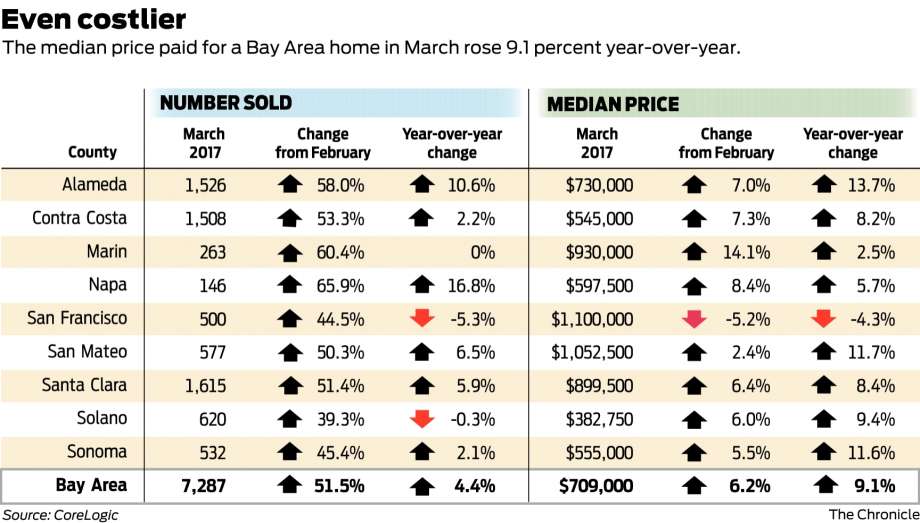
The median price paid for all new and existing homes and condos sold in March was $709,000, up 6.2 percent from February and up 9.1 percent from March of last year, according to CoreLogic. The year-over-year increase was the highest for any month since January 2016.


Home sales typically pick up between February and March, as real estate’s busy season gets under way, but this year’s increase was bigger than usual. A total of 7,287 transactions closed in March, up 51.5 percent from February and up 4.4 percent year over year. On average since 1988, March sales rise only 40 percent between February and March. Last month’s sales, however, were still almost 15 percent below the long-run average for the month of March, CoreLogic said.

ec649 920x1240 Bay Area home sales and prices heat up in March

“It was a fairly strong start to the spring-summer home-buying season,” said Andrew LePage, a CoreLogic research analyst.

‘);
}

One caveat, though, is the weather.

The relentless rain might have depressed activity during the winter. Year-over-year sales were down almost 10 percent in December, flat in January and down 2.4 percent in February. Sales that might have taken place during the winter could have been pushed into March, LePage said.

Jim Tierney, a principal at Net Equity Real Estate in San Mateo, said he had several clients postpone putting their homes on the market because they couldn’t do landscaping or painting. With the rain tapering off, “we are seeing it pick up a little in the last couple weeks,” he said.

Sales and prices were up month over month and year over year in almost every Bay Area county. One exception was San Francisco, where the median price was down 5.2 percent since February and down 4.3 percent since March of last year. Sales were also down about 5 percent year over year, but up 44.5 percent from February.

More by Kathleen Pender

San Francisco’s numbers have been volatile because of a building boomlet, mainly of luxury condos. Developers generally begin selling units long before construction is completed, but sales are not recorded until the building is ready for occupancy and buyers close escrow. So sales often close in clumps.

In San Francisco, only 68 new homes and condos closed last month, compared to 107 in March of last year. And their median price dropped to $939,000 from $1.15 million last year. Resale condo sales and prices also declined year over year, though by much smaller percentages.

But if you look only at single-family homes in San Francisco, sales were up 7.4 percent year over year and prices were up 4.7 percent, LePage said.

Despite the March rebound, the Bay Area is still plagued by a shortage of homes for sale.

“In all of San Mateo County, there were less than 500 listings (including some commercial properties) at one point,” Tierney said. “Our inventory has just been really low. It has built up a little, yesterday it was up to 640-some-odd listings. It’s a relatively small number and demand has not backed off.”

Dominique Stevens, a mortgage broker at Mayfair Mortgage Advisers in San Rafael, said she is seeing more people move out of the Bay Area but keep their house here as a rental: “They are getting $4,000, $5,000, $6,000 a month for modest homes. That helps them with retirement income.” She is also seeing grown children who inherit homes, instead of selling them, renting them out “and getting really healthy rental income.”

This is happening mainly in Marin, the Peninsula and San Francisco. In the East Bay, it’s more common for people who move out to sell their homes. “There is a frenzy of sales in Fruitvale and Jingletown,” she said. “That whole area (of Oakland) is really going to be reinvented in the next five or 10 years. When you drive in an area that was downtrodden and you start to see yoga studios, you know something is up.”

Kathleen Pender is a San Francisco Chronicle columnist. Email: kpender@sfchronicle.com Twitter: @kathpender

Article source: http://www.sfchronicle.com/business/networth/article/Bay-Area-home-sales-and-prices-heat-up-in-March-11104611.php

Posted in SF Bay Area News | Tagged | Leave a comment