San Francisco Goes From First to Worst in U.S. Home-Price Gauge

San Francisco, which in recent years had the biggest home-price gain in the U.S., was the country’s weakest market in the first quarter, with values falling for the first time since 2011.

Single-family home prices in the region that includes San Francisco and San Mateo counties dropped 2.5 percent from a year earlier, the worst performance among the 100 largest U.S. metropolitan areas, according to an index released Wednesday by the Federal Housing Finance Agency. Grand Rapids, Michigan, a relatively affordable area where prices jumped 13.7 percent, had the biggest gain.

San Francisco is cooling after a booming technology industry, with its big salaries, fueled soaring values in recent years and made real estate unaffordable for most buyers in the market. Home prices rose 10 percent in last year’s first quarter and 15 percent in the first part of 2015, when its gains led the nation, FHFA data show. The area’s median home price in the first quarter was $1.1 million, making it the most expensive of the 100 largest metros, according to real estate website Trulia.

“We’re seeing signs that the housing market is slowing down,” Ralph McLaughlin, chief economist for Trulia, a unit of Zillow Group Inc., said in a telephone interview. “Homebuyers in the Bay Area have just been stymied by affordability fatigue.”

1bb35 60x 1 San Francisco Goes From First to Worst in U.S. Home Price Gauge

The FHFA index may leave out a large portion of buyers in the region. It only measures purchases financed with conforming loans, which in the San Francisco Bay area are capped at $636,150, well below the median price of more than $1 million.

“Those homeowners who would qualify for conforming loans are the ones that have seen the biggest drops in inventory and the biggest increases in prices over the past five or six years,” McLaughlin said. “It’s no surprise that if there is any cohort impacted by a very frustrating home market, it’s going to be those buyers.”

CoreLogic Data

CoreLogic Inc. also released data Wednesday showing a decline in values. In April, the median price for all home sales in San Francisco County was $1.3 million, down 4 percent from a year earlier. The number of transactions fell 12 percent, according to the data provider, which doesn’t limit its research to homes bought with conforming loans.

Patrick Carlisle, an analyst at San Francisco market tracker Paragon Real Estate Group, said the first quarter isn’t a good gauge because relatively few homes are sold during the early part of the year. Carlisle said he sees a flattening on the higher end of the market, not on the lower end where inventory remains tight.

“San Francisco led the whole country in its recovery,” Carlisle said. “It’s not surprising that the market that blasted off first and rose the most is now the one that is cooling first.”

    Article source: https://www.bloomberg.com/news/articles/2017-05-24/san-francisco-goes-from-first-to-worst-in-u-s-home-price-gauge

Posted in SF Bay Area News | Tagged | Leave a comment

Bay Area home prices hit record as sales drop – SFGate

http://www.sfgate.com/business/networth/article/Bay-Area-home-prices-hit-a-new-record-as-sales-11170993.php


Updated 9:27 pm, Wednesday, May 24, 2017

  • a00b5 920x920 Bay Area home prices hit record as sales drop   SFGate

Caption

Close


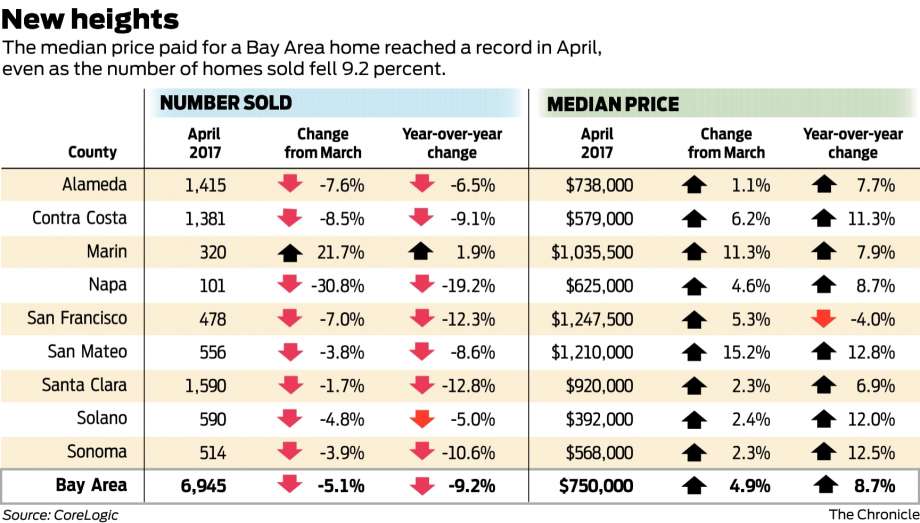
The median price paid for a Bay Area home last month surged to a record — $750,000 — as the inventory of homes for sale continued to fall far short of demand, according to a report released Wednesday by the research firm CoreLogic.

The median price paid for new and existing single-family homes and condos in the nine-county region was up 4.9 percent from a revised $715,000 in March, and up 8.7 percent year over year, the report said. Prices typically rise from March to April, but only by 2.6 percent on average.

Adjusted for inflation, however, last month’s median price remained about 7 percent below its June 2006 peak.

That’s little solace to Bay Area house hunters. “The competition is very fierce,” said Luke Vernagallo, 28, who is looking for a home in the East Bay for $500,000 to $600,000. He and his wife own a one-bedroom home in Hayward but would like to upsize and start a family. “We had been looking haphazardly for the last couple years, hoping the market would take a downturn,” but that never happened. So now they are looking more seriously.

KTVU’s Frank Mallicoat reports that the Bay Area housing market is not slowing down, thanks to a new generation of home buyers


Media: KTVU


“We offered on one home, above asking, but were beaten out by a substantial amount,” Vernagallo said. “We have determined a fair amount of time, it’s not even worth it to submit an offer because we know it will go for (an amount) extraordinarily higher than the listing price.” So now they are targeting homes that need more work than they originally anticipated. “We are looking for a diamond in the rough,” he said. “Maybe we will win the lottery” and get one.

In San Francisco, the median price last month was $1,247,500. For that amount, you might be able to pick up something like 221 Steiner St., a two-bedroom, one-bathroom Hayes Valley condo. The condo, listed at $1,249,000, has 1,525 square feet of “gracious living space,” according to its ad, and monthly homeowners association fees of $500.

Sales typically rise from March to April, as the weather improves and families get ready to move over the summer. But last month they declined on both a month-to-month and year-over-year basis. A total of 6,943 new and existing homes and condos sold in April, down 5.1 percent from March and 9.2 percent from April 2016.

“I just sold a home, the buyers were tired of getting outbid and went way overboard,” said Murline Monat, an agent with Paragon Realty Group in Danville. The Castro Valley home was listed at $695,000, and the seller accepted an offer that was “well over $800,000,” she said.

That kind of overbidding is not unusual in Oakland or Berkeley, where homes often sell for $50,000, $250,000 or $500,000 over asking, she said. The Castro Valley deal has not closed, and Monat believes the appraisal will come in at least $25,000 below the accepted offer price. Because the buyers had released their appraisal contingency to sweeten the deal, they will have to increase their down payment by the difference between the appraised price and the offer price, Monat said.
13cab 920x1240 Bay Area home prices hit record as sales drop   SFGate

The median home price rose in every Bay Area county last month except San Francisco, where it fell 4 percent year-over-year but rose 5.3 percent from March. The year-over-year drop was largely due to a drop in condo prices; the single-family median rose.

Real estate agents blame the current situation largely on a persistent lack of inventory, which has plagued the region since around 2013.

The California Association of Realtors reported this week that the median amount of time it would take to sell all Bay Area homes on the market at the current sales rate was 2.4 months in April, down from 2.6 months the previous April and about half the historical average of 5.1 months, said Jordan Levine, the association’s senior economist.

The median time it took to get an offer accepted on a Bay Area home was just 20.1 days last month, down from 20.4 days a year ago and about half the long-term average of 36.8 days.

Annie Shen, 30, started looking for a place in November, thinking she might score a bargain during real estate’s slow season. Priced out of her preferred neighborhood (North Oakland-Berkeley), she made an offer on a townhome in Emeryville around Thanksgiving, but it went for more than $100,000 over asking.

So last week, she put a 3 percent deposit down on a two-bedroom, 2.5-bathroom unit under construction in West Oakland in the Station House development. Buying new “is a little bit easier. The ($725,000) list price is what they are going to sell at,” she said. “But it’s still a gamble. They are not going to be done with it until late this year or next year. They can’t promise the exact square footage” or what features and finishes will be available.

And there’s no telling where mortgage rates will be when she closes.

Although it’s acute in the Bay Area, inventory is tight nationwide. The number of homes on the market per 10,000 households hit an all-time low of 15.5 in April, said Trulia Chief Economist Ralph McLaughlin. He attributed the nationwide shortage to several factors.

“First and foremost is demographics,” he said. “Many of those who own homes in the U.S. are older, and older households, aging households, tend to move less.” During the recession, he added, “many homes foreclosed upon were bought up by investors and turned into rental units.”

And many homes still have not reached their pre-recession peak. “Owners of those homes are waiting for home values to surpass that peak,” before selling. Even if the owners owe less than their home is worth and could pay off the mortgage if they sold, “they say I’m not going to sell for less than what it was worth 10 years ago,” McLaughlin said.

Finally, in some markets, rising income inequality has helped widen the price gap between starter, move-up and luxury homes. “As the price points spread out, it gets harder for owners to trade up,” McLaughlin said. Instead of moving up, “they will stay put and renovate.”

Although more new homes are being built, construction nationwide is still about 65 percent of the 50-year average relative to the size of the population. More construction would help, but it can’t solve the problem considering that new homes typically account for only one out of 10 homes on the market.

On the plus side, if you can call it that, 40 percent of Americans age 18 to 34 (excluding college students) are still living with parents or relatives, the highest percentage since around 1940. “We see from surveys they very much want to be homeowners, but their current financial circumstances are preventing them from living on their own or buying,” McLaughlin said.

“They are the largest potential cohort of homeowners in the U.S.,” McLaughlin said. “God forbid that they all decide to move out at once. There would be a huge rush of demand without a lot of supply and prices would spike.”

As dire as it seems, affordability in the Bay Area has been worse. Currently, only 25 percent of households can afford the median-price home, according to the Realtors association. But in the summer of 2007, only 10 percent of Bay Area households could afford the median-price home. Even though prices have risen sharply since then, so have incomes, and mortgage rates have come down, Levine said.

Kathleen Pender is a San Francisco Chronicle columnist. Email: kpender@sfchronicle.com Twitter: @kathpender

Article source: http://www.sfgate.com/business/networth/article/Bay-Area-home-prices-hit-a-new-record-as-sales-11170993.php

Posted in SF Bay Area News | Tagged | Leave a comment

Reali expands its online real-estate service to the entire Bay Area …


bcc49 2017 05 24 1516 Reali expands its online real estate service to the entire Bay Area ...

Reali wants to change how people buy and sell their homes and now it has $5 million more to work on it, thanks to a Series A led by Signia Venture Partners. The company also today announced that it is expanding beyond to the entire San Francisco Bay area, including the cities of San Francisco, Oakland and San Jose, and that its app is now available on Android, too.

The service aims to take the hassle out of real estate transactions for both buyers and sellers and also promises buyers a full refund of the standard buyer’s agent commission. Instead of this commission, Reali charges a flat fee of just under $5,000. The seller’s commission is also reduced to 4 percent. Given the markets Reali is active in, those percentages can add up quickly (though in some states, including Oregon, Kansas and Tennessee, these kind of rebates are actually illegal thanks to the tireless work of the local real estate lobbies).

It’s able to do this thanks to a focus on tech (like installing smart locks and Bluetooth beacons for self-guided visits in homes so that a potential buyer can tour it without an agent having to drive out to the house).

As Reali co-founder and CEO Amit Haller told me, the company plans to use the new funding to invest in its technology platform, enhance its operational footprint and expand its market reach.

  1. 1x1 Reali expands its online real estate service to the entire Bay Area ...

    SearchResults

  2. 1x1 Reali expands its online real estate service to the entire Bay Area ...

    BuyersJourney

  3. 1x1 Reali expands its online real estate service to the entire Bay Area ...

    Listing2

“With our expansion to the entire San Francisco Bay Area, we want to demonstrate the excitement, adoption and trust that we’ve experienced on the Peninsula and strengthen our leadership position in this very competitive market,” Haller said. “Once we’ve accomplished that successfully here in the Bay Area, we plan to expand into other major California markets, as well as selected regions out of state.”

Haller doesn’t seem to be all that worried about competing services like Redfin. “Many of the other online brokerages haven’t changed the fundamentals of the business,” he said. “They are still heavily based on the use of traditional real estate agents, and most of their technology has to do with lead generation and discovery platforms. Unlike other online brokerages, Reali has invested in and created an end-to-end transaction and collaboration platform.”

He also argued that his company’s business model means it can provide better customer service and still give them all the advantages of working with licensed real estate brokers.

Article source: https://techcrunch.com/2017/05/25/reali-expands-it-online-real-estate-service-to-the-entire-bay-area-raises-5m-series-a-round/

Posted in SF Bay Area News | Tagged | Leave a comment

Reali expands its online real-estate service to the entire Bay Area, raises $5M Series A round


7700e 2017 05 24 1516 Reali expands its online real estate service to the entire Bay Area, raises $5M Series A round

Reali wants to change how people buy and sell their homes and now it has $5 million more to work on it, thanks to a Series A led by Signia Venture Partners. The company also today announced that it is expanding beyond to the entire San Francisco Bay area, including the cities of San Francisco, Oakland and San Jose, and that its app is now available on Android, too.

The service aims to take the hassle out of real estate transactions for both buyers and sellers and also promises buyers a full refund of the standard buyer’s agent commission. Instead of this commission, Reali charges a flat fee of just under $5,000. The seller’s commission is also reduced to 4 percent. Given the markets Reali is active in, those percentages can add up quickly (though in some states, including Oregon, Kansas and Tennessee, these kind of rebates are actually illegal thanks to the tireless work of the local real estate lobbies).

It’s able to do this thanks to a focus on tech (like installing smart locks and Bluetooth beacons for self-guided visits in homes so that a potential buyer can tour it without an agent having to drive out to the house).

As Reali co-founder and CEO Amit Haller told me, the company plans to use the new funding to invest in its technology platform, enhance its operational footprint and expand its market reach.

  1. 1x1 Reali expands its online real estate service to the entire Bay Area, raises $5M Series A round

    SearchResults

  2. 1x1 Reali expands its online real estate service to the entire Bay Area, raises $5M Series A round

    BuyersJourney

  3. 1x1 Reali expands its online real estate service to the entire Bay Area, raises $5M Series A round

    Listing2

“With our expansion to the entire San Francisco Bay Area, we want to demonstrate the excitement, adoption and trust that we’ve experienced on the Peninsula and strengthen our leadership position in this very competitive market,” Haller said. “Once we’ve accomplished that successfully here in the Bay Area, we plan to expand into other major California markets, as well as selected regions out of state.”

Haller doesn’t seem to be all that worried about competing services like Redfin. “Many of the other online brokerages haven’t changed the fundamentals of the business,” he said. “They are still heavily based on the use of traditional real estate agents, and most of their technology has to do with lead generation and discovery platforms. Unlike other online brokerages, Reali has invested in and created an end-to-end transaction and collaboration platform.”

He also argued that his company’s business model means it can provide better customer service and still give them all the advantages of working with licensed real estate brokers.

Article source: https://techcrunch.com/2017/05/25/reali-expands-it-online-real-estate-service-to-the-entire-bay-area-raises-5m-series-a-round/

Posted in SF Bay Area News | Tagged | Leave a comment

Bay Area home prices hit record as sales drop

http://www.sfgate.com/business/networth/article/Bay-Area-home-prices-hit-a-new-record-as-sales-11170993.php



Updated 5:50 pm, Wednesday, May 24, 2017

  • 0d97a 920x920 Bay Area home prices hit record as sales drop

Caption

Close


The median price paid for a Bay Area home last month surged to a record — $750,000 — as the inventory of homes for sale continued to fall far short of demand, according to a report released Wednesday by the research firm Corelogic.

The median price paid for new and existing single-family homes and condos in the nine-county region was up 4.9 percent from a revised $715,000 in March, and up 8.7 percent year over year, the report said. Prices typically rise between March and April, but only by 2.6 percent on average.

Adjusted for inflation, however, last month’s median price remained about 7 percent below its June 2006 peak.

In San Francisco, the median was $1,247,500. For that price, you might be able to pick up something like 221 Steiner St., a two-bedroom, one-bathroom Hayes Valley condo. The condo, which is listed at $1,249,000, has 1,525 square feet of “gracious living space,” according to its ad, and monthly homeowners association fees of $500.

KTVU’s Frank Mallicoat reports that the Bay Area housing market is not slowing down, thanks to a new generation of home buyers


Media: KTVU


Sales also typically rise between March and April, as the weather improves and families get ready to move over the summer. But last month they declined on both a month-to-month and year-over-year basis. A total of 6,943 new and existing homes and condos sold in April, down 5.1 percent from March and 9.2 percent from April 2016.

“I just sold a home, the buyers were tired of getting outbid and went way overboard,” said Murline Monat, an agent with Paragon Realty Group in Danville. The Castro Valley home was listed at $695,000, and the seller accepted an offer that was “well over $800,000,” she said.

That kind of overbidding is not unusual in Oakland or Berkeley, where homes often sell for $50,000, $250,000 or $500,000 over asking, she said. The Castro Valley deal has not closed, and Monat believes the appraisal will come in at least $25,000 below the accepted offer price. Because the buyers had released their appraisal contingency to sweeten the deal, they will have to increase their down payment by the difference between the appraised price and the offer price, Monat said.

The median home price rose in every Bay Area county last month except San Francisco, where it fell 4 percent on a year-over-year basis but rose 5.3 percent from March. (CoreLogic had to estimate San Francisco sales for the last week of April.)

Real estate agents blame the current situation largely on a persistent lack of inventory, which has plagued the region since around 2013.

7e27e 920x1240 Bay Area home prices hit record as sales drop

The California Association of Realtors reported this week that the median amount of time it would take to sell all Bay Area homes on the market at the current sales rate was 2.4 months in April, down from 2.6 months the previous April and about half the historical average of 5.1 months. The statewide “unsold inventory index” was 3.3 months in April and 4.2 months nationwide, said Jordan Levine, the association’s senior economist.

The median time it took to get an offer accepted on a Bay Area home was just 20.1 days last month, down from 20.4 days a year ago and about half the long-term average of 36.8.

Although it’s acute in the Bay Area, a lack of inventory is a problem nationwide.

“Homebuyers have been stymied by low inventory over the past few years, and the trend continued in April. The number of homes on the market fell yet again last month, dropping another 8.7 percent from last year. This home buying season has not brought the relief they so desperately need,” Trulia Chief Economist Ralph McLaughlin said in a report Wednesday.

He noted that the number of homes on the market per 10,000 households hit an all-time low of 15.5 in April. McLaughlin attributed the nationwide shortage to several factors.

“First and foremost is demographics,” he said. “Many of those who own homes in the U.S. are older, and older households, aging households, tend to move less.”

During the recession, he added, “many homes foreclosed upon were bought up by investors and turned into rental units.”

Also, there are still many homes that have not reached their pre-recession peak. “Owners of those homes are waiting for home values to surpass that peak,” before putting them on the market. Even if the owners owe less than their home is worth and could pay off the mortgage if they sold, “they say I’m not going to sell for less than what it was worth 10 years ago,” McLaughlin said.

Finally, in some markets, rising income inequality has helped widen the price gap between starter, move-up and luxury homes. “As the price points spread out, it gets harder for owners to trade up,” McLaughlin said. Instead of moving up, “they will stay put and renovate.”

Although more new homes are being built, construction nationwide is still about 65 percent of the 50-year average relative to the size of the population. More construction would help, but it can’t solve the problem considering that new homes typically account for only one out of 10 homes on the market.

On the plus side, if you can call it that, 40 percent of Americans age 18 to 34 (excluding college students) are still living with parents or relatives, the highest percentage since around 1940. “We see from surveys they very much want to be homeowners, but their current financial circumstances are preventing them from living on their own or buying,” McLaughlin said.

“They are the largest potential cohort of homeowners in the U.S.,” McLaughlin said. “God forbid that they all decide to move out at once. There would be a huge rush of demand without a lot of supply and prices would spike.”

As dire as it seems, affordability in the Bay Area has been worse. Currently, only 25 percent of households can afford the median-price home, according to the Realtors association. This number — which takes into account median incomes and prevailing mortgage rates — is 32 percent statewide and 57 percent nationwide.

But in the summer of 2007, only 10 percent of Bay Area households could afford the median priced home. Even though prices have risen sharply since then, so have incomes, and mortgage rates have come down, the Realtors association’s Levine said.

Kathleen Pender is a San Francisco Chronicle columnist. Email: kpender@sfchronicle.com Twitter: @kathpender

Article source: http://www.sfgate.com/business/networth/article/Bay-Area-home-prices-hit-a-new-record-as-sales-11170993.php

Posted in SF Bay Area News | Tagged | Leave a comment