Finding starter homes a tall order in the Bay Area – San Francisco …

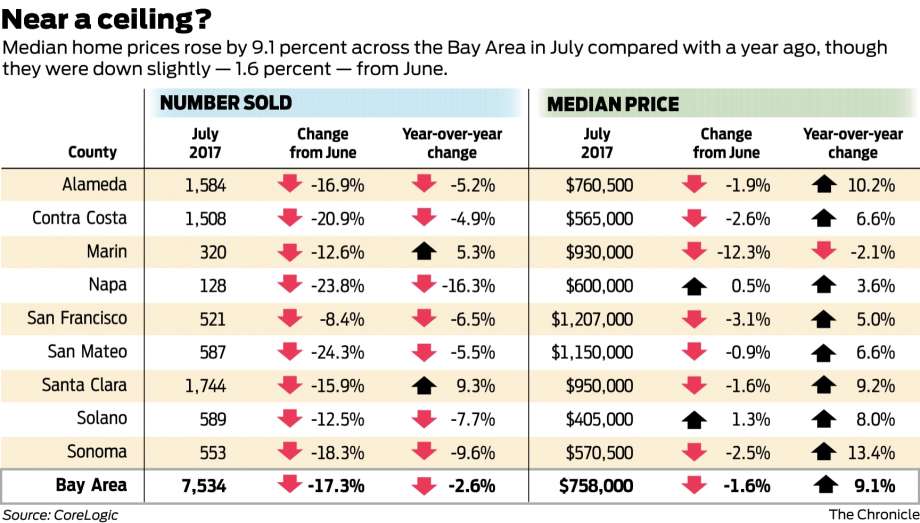
Sales typically fall from June to July as house hunters and real estate agents head off on vacation, but the average drop-off since 1988 has been only 6 percent. The number of homes sold last month was the lowest for a July since 2011. CoreLogic attributed the sharp slowdown to “a tight inventory and waning affordability.”


Meanwhile, the median price paid for a home in the nine-county region last month was $758,000, down 1.6 percent from a record $770,500 in June, but up 9.1 percent year over year. The report includes new and existing single-family dwellings and condos.

More from Kathleen Pender

Vacations also cause prices to dip from June to July; the long-run average is a 0.2 percent decline. For buyers, the slightly larger-than-average price decline last month will provide little solace.

Only 21 percent of households in the Bay Area could afford a median-priced home in the second quarter, according to the California Association of Realtors’ affordability index. That’s down from 25 percent in the first quarter. The index estimates the percentage of households that have the minimum income needed to buy an existing, median-priced single-family home with a 20 percent down payment at prevailing mortgage rates. It does not include condos, which tend to be cheaper than single-family homes.

By the association’s reckoning, a Bay Area buyer would need $179,390 in annual income to buy the median-priced home.

Home prices are soaring because the region’s supply of new housing is not keeping up with demand, which is fueled largely by job growth, especially in high-paying technology jobs.

However, even at tech companies, most employees are not making enough to buy a median-priced home, Katie Ferrick, director of community affairs at LinkedIn, said at a housing conference in San Francisco last week sponsored by the Center for California Real Estate and Bay Area Council. At LinkedIn, the “vast majority” of workers are not making $179,000, she said.

The state’s least-affordable county is San Francisco, where only 12 percent of households could afford the median-priced home in the second quarter. But it has been worse. In 2005, when incomes were lower and mortgage rates higher, the index was 8 to 9 percent. Its recent high was 29 percent in early 2012.

Finding an entry-level home in the city is getting nearly impossible, according to a study out this week by the San Francisco Association of Realtors.

Last month, there were only 140 homes and condos in the city listed at less than $758,000, it said. In July 2014, there were 367 homes listed below $758,000. Over those three years, the average household income for a family of four in San Francisco rose 15.7 percent, but the median home and condo price rose 25 percent.
bc724 920x1240 Finding starter homes a tall order in the Bay Area   San Francisco ...

“The most competitive price point is the single-family home under $1.5 million,” said Drew Wilkerson, an agent with Vanguard Properties. Last week, he filmed an episode of the HGTV show “House Hunters” with a couple searching in that price range in San Francisco.

His clients had written three previous offers before buying a three-bedroom, 1.5-bath place in Merced Heights for $1,090,000. The couple, who have two young children, both work full-time, but not in tech. Like many first-time buyers, they got help with the down payment from parents, Wilkerson said.

One of the homes they visited was 415 Amazon Ave. in the Excelsior district. The home has two bedrooms, two baths and 1,155 square feet. It’s listed at $899,000. Traffic at two open houses last weekend “was absolutely constant,” said listing agent James Belisle, also with Vanguard. On Sunday, “there were 10 people waiting to get in at 2 o’clock.”

Most of the housing — both rental and for sale — being built in the Bay Area is either below-market rate or high end. People who earn too much to qualify for the former and too little to afford the latter are often forced into “mega commuting” or “driving till you qualify,” Carol Galante, faculty director at UC Berkeley’s Terner Center for Housing Innovation, said at last week’s conference.

A package of bills aimed at easing the state’s housing shortage could come up for a vote in Sacramento this week. But none is aimed at what Galante calls the “missing middle.”

One would create a new recording fee on certain real estate documents to fund low-income and affordable housing. One would ask voters to approve $4 billion in bonds, mainly for low-income rental housing but also for the state’s veteran home loan program, which could help middle-income vets, Galante said.

The third “basically requires that localities streamline their development-approvals process for communities that aren’t meeting their regional needs formula,” Galante said in an interview. This could open the door for some middle-income housing, but it applies to a very limited range of projects.

Galante said middle-income buyers and renters don’t have the same type of advocacy groups that champion low-income housing.

Of course, any new housing — high or low end, for sale or rent — eventually will relieve pressure on middle-income buyers.

Galante and other speakers at the conference said the state should do more to overcome the barriers to development erected at the local level, such as utility and impact fees.

Because Proposition 13 limits property tax increases, local governments put much of the cost of providing services on developers, which discourages new housing. The state also should consider creating incentives for housing by redistributing sales and property taxes and transportation dollars for communities that are meeting their goals, she said.

Kathleen Pender is a San Francisco Chronicle columnist. Email: kpender@sfchronicle.com Twitter: @kathpender

Article source: http://www.sfchronicle.com/business/networth/article/Finding-starter-homes-a-tall-order-in-the-Bay-Area-12162525.php
Posted in SF Bay Area News | Tagged | Leave a comment

Bay Area gala season’s power players

That’s the idea behind “Reflections,” the theme of the Rodin by Moonlight benefit at Cantor Arts Center at Stanford on Sept. 23. The museum, with the largest collection of works by Auguste Rodin outside of Paris, is marking the 100th anniversary of his death by renovating the indoor galleries displaying his work. The collection has been winnowed and regrouped to make his story clearer for visitors, and the result, “Rodin: The Shock of the Modern Body,” will look at his innovations in presenting emotion, psychological states and sensuality in nude sculpture.


How to innovate? That’s the kind of food for thought Silicon Valley enjoys. But mental escapes are part of the creative process, too.

“The museum was a place of refuge,” said startup executive Komal Shah, a dinner committee member, remembering her first visit to the Cantor 26 years ago as an engineering student at Stanford. “It was always a place to uplift and transport you to a different place.”

That has only intensified with the opening in 2014 of the Anderson Collection next door, a second stop (after the Cantor) on the personal tour she gives art world friends of the campus’ vibrant art scene. “It has added a gravitas,” she said, “with a stunning collection of post-World War II art.”

Philanthropist Michele Kirsch, wife of entrepreneur Steve Kirsch (Infoseek, Propel, Abaca), also on the dinner committee (for the seventh time in 14 years and who has chaired it in the past), sits on six other boards and took the bar exam this summer, a feat of time-management worthy of deeper reflection.

The committee meets regularly; members are expected to leverage personal connections in acquiring sponsors and party favors (like the Laduree macarons real estate agent Charlene Cogan flew in from New York one year) and to better the biennial event’s record $500,000 (net) raised in 2015, which goes to educational programs.

The dinner in the sculpture garden for 420 guests (paying $1,500 and up per person to attend) features food by Paula LeDuc, with a guest celebrity chef (chef Staffan Terje of Perbacco this year) and dancing under the stars. The decor is being overseen by New York-based Colin Cowie Lifestyle. There is no satin-glove strong-arming of moneyed guests with raffles or silent and live auctions. “It really is the signature event for the Peninsula,” Kirsch said.

For the San Francisco Opera’s 95th season, Courtney Labe and Maryam Muduroglu will co-chair the Opera Ball at the Imperial Palace on Sept. 8. The performance of “Turandot,” Giacomo Puccini’s opera set in China and depicting a prince’s quest for love, is the springboard for decor at a dinner by McCalls Catering for 750 patrons and benefactors ($1,750 per person and up) styled by events man Riccardo Benavides of Ideas. (The younger Bravo! professionals group has its own dinner.) The evening benefits community and educational programs of the Opera Guild and the Opera that reach 60,000 students in Northern California a year.

On Sept. 14, the San Francisco Symphony opens its season with a gala chaired by Priscilla Geeslin and four dinners (including a Patrons Dinner, $1,750 and up per person) catered by McCalls, a performance by the Symphony with cellist Yo-Yo Ma and an after-party. Proceeds go to programs including Adventures in Music for San Francisco public elementary schools, now in its 30th year, and the San Francisco Symphony Youth Orchestra, now in its 35th year.

And that’s how these parties — evenings of glamour, to be sure — provide more than glitter: by touching other peoples’ lives in both abstract and concrete ways.

Cathyyn Down, a San Francisco Symphony violinist, reflected on her time in the youth symphony, which she joined in its inaugural year. In the 1980s, as a 16-year-old, it was a sanctuary and a place to have fun again — she’d played from age 2 through 12 and quit, weary of the discipline required to excel. Without it, “I’d either be in economics or …” she said, her voice trailing off. “I don’t know if I would’ve been able to find that continued drive without youth orchestra. I had a strong one inside of me, but the orchestra was such a propeller that I just had to do it.”

Carolyne Zinko is a San Francisco Chronicle staff writer. Email: czinko@sfchronicle.com

Notable fall galas

Sept. 8: San Francisco Opera’s “Opera Ball 2017 at the Imperial Palace,” War Memorial Opera House, 301 Van Ness Ave.; www.sfopera.com.

Sept. 14: San Francisco Symphony Opening Night Gala with cellist Yo-Yo Ma, “Bernstein at 100,” Davies Symphony Hall, 201 Van Ness Ave.; www.sfsymphony.org.

Sept. 23: Iris B. Gerald Cantor Center for the Arts “Rodin by Moonlight,” 328 Lomita Dr., Stanford; https://museum.stanford.edu.

Article source: http://www.sfchronicle.com/style/article/Bay-Area-gala-season-s-power-players-12165513.php

Posted in SF Bay Area News | Tagged | Leave a comment

Finding starter homes a tall order in the Bay Area

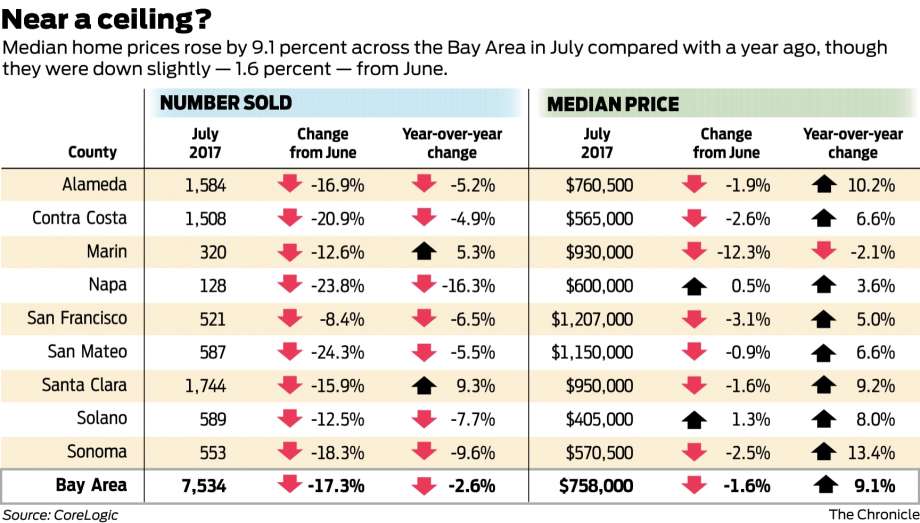
Sales typically fall from June to July as house hunters and real estate agents head off on vacation, but the average drop-off since 1988 has been only 6 percent. The number of homes sold last month was the lowest for a July since 2011. CoreLogic attributed the sharp slowdown to “a tight inventory and waning affordability.”


Meanwhile, the median price paid for a home in the nine-county region last month was $758,000, down 1.6 percent from a record $770,500 in June, but up 9.1 percent year over year. The report includes new and existing single-family dwellings and condos.

More from Kathleen Pender

Vacations also cause prices to dip from June to July; the long-run average is a 0.2 percent decline. For buyers, the slightly larger-than-average price decline last month will provide little solace.

Only 21 percent of households in the Bay Area could afford a median-priced home in the second quarter, according to the California Association of Realtors’ affordability index. That’s down from 25 percent in the first quarter. The index estimates the percentage of households that have the minimum income needed to buy an existing, median-priced single-family home with a 20 percent down payment at prevailing mortgage rates. It does not include condos, which tend to be cheaper than single-family homes.

By the association’s reckoning, a Bay Area buyer would need $179,390 in annual income to buy the median-priced home.

Home prices are soaring because the region’s supply of new housing is not keeping up with demand, which is fueled largely by job growth, especially in high-paying technology jobs.

However, even at tech companies, most employees are not making enough to buy a median-priced home, Katie Ferrick, director of community affairs at LinkedIn, said at a housing conference in San Francisco last week sponsored by the Center for California Real Estate and Bay Area Council. At LinkedIn, the “vast majority” of workers are not making $179,000, she said.

The state’s least-affordable county is San Francisco, where only 12 percent of households could afford the median-priced home in the second quarter. But it has been worse. In 2005, when incomes were lower and mortgage rates higher, the index was 8 to 9 percent. Its recent high was 29 percent in early 2012.

Finding an entry-level home in the city is getting nearly impossible, according to a study out this week by the San Francisco Association of Realtors.

Last month, there were only 140 homes and condos in the city listed at less than $758,000, it said. In July 2014, there were 367 homes listed below $758,000. Over those three years, the average household income for a family of four in San Francisco rose 15.7 percent, but the median home and condo price rose 25 percent.

96ff1 920x1240 Finding starter homes a tall order in the Bay Area

“The most competitive price point is the single-family home under $1.5 million,” said Drew Wilkerson, an agent with Vanguard Properties. Last week, he filmed an episode of the HGTV show “House Hunters” with a couple searching in that price range in San Francisco.

His clients had written three previous offers before buying a three-bedroom, 1.5-bath place in Merced Heights for $1,090,000. The couple, who have two young children, both work full-time, but not in tech. Like many first-time buyers, they got help with the down payment from parents, Wilkerson said.

One of the homes they visited was 415 Amazon Ave. in the Excelsior district. The home has two bedrooms, two baths and 1,155 square feet. It’s listed at $899,000. Traffic at two open houses last weekend “was absolutely constant,” said listing agent James Belisle, also with Vanguard. On Sunday, “there were 10 people waiting to get in at 2 o’clock.”

Most of the housing — both rental and for sale — being built in the Bay Area is either below-market rate or high end. People who earn too much to qualify for the former and too little to afford the latter are often forced into “mega commuting” or “driving till you qualify,” Carol Galante, faculty director at UC Berkeley’s Terner Center for Housing Innovation, said at last week’s conference.

A package of bills aimed at easing the state’s housing shortage could come up for a vote in Sacramento this week. But none is aimed at what Galante calls the “missing middle.”

One would create a new recording fee on certain real estate documents to fund low-income and affordable housing. One would ask voters to approve $4 billion in bonds, mainly for low-income rental housing but also for the state’s veteran home loan program, which could help middle-income vets, Galante said.

The third “basically requires that localities streamline their development-approvals process for communities that aren’t meeting their regional needs formula,” Galante said in an interview. This could open the door for some middle-income housing, but it applies to a very limited range of projects.

Galante said middle-income buyers and renters don’t have the same type of advocacy groups that champion low-income housing.

Of course, any new housing — high or low end, for sale or rent — eventually will relieve pressure on middle-income buyers.

Galante and other speakers at the conference said the state should do more to overcome the barriers to development erected at the local level, such as utility and impact fees.

Because Proposition 13 limits property tax increases, local governments put much of the cost of providing services on developers, which discourages new housing. The state also should consider creating incentives for housing by redistributing sales and property taxes and transportation dollars for communities that are meeting their goals, she said.

Kathleen Pender is a San Francisco Chronicle columnist. Email: kpender@sfchronicle.com Twitter: @kathpender

Article source: http://www.sfchronicle.com/business/networth/article/Finding-starter-homes-a-tall-order-in-the-Bay-Area-12162525.php

Posted in SF Bay Area News | Tagged | Leave a comment

Only in the Bay Area: Real estate for progressives at UC Berkeley

UC Berkeley is launching a new graduate program that puts a politically progressive stamp on real estate development.

It’s not just about the money.

The Masters in Real Estate Development + Design (MRED+D) will teach emerging real estate developers to merge finance with cutting-edge design principles in order “to build sustainable, equitable and prosperous cities,” according to an announcement from the College of Environmental Design, where the program will be based.

The announcement cites challenges in “our rapidly urbanizing world,” including climate change and social inequality. A new wave of developers must “understand the power of design and have a deep knowledge not only of the mechanics of real estate, but also how development can bring positive benefits to society and the environment.”

Creating a new wave of socially minded developers is a lofty goal in a region where spiraling housing costs already are driving out service workers and the middle class. The program — the first of its kind in the UC system — will be led by faculty director Chris Calott, who holds the Lalanne Chair in Real Estate, Architecture and Urbanism, and practice director Carol Galante, the I. Donald Terner Distinguished Professor in Affordable Housing and Urban Policy.

A former assistant secretary of the U.S. Department of Housing and Urban Development, Galante is also faculty director of Cal Berkeley’s Terner Center for Housing Innovation. Speaking at a housing forum in San Francisco last week, she warned that the region’s middle class is being “hollowed out” by housing prices.

The announcement of MRED+D, an 11-month interdisciplinary degree program, notes that the Bay Area “is a vibrant nexus of technology, innovation, business leadership, and progressive real estate development firms — an ecology in which” the program “is embedded.”

Students will study with experts in real estate development, housing and credit markets, land use and environmental law, infill development, conventional and prefab construction, urban transportation, sustainable design, green infrastructure and more.

“Developing well-designed, sustainable communities in urban areas requires vision, creativity and a skill set to navigate today’s real estate development complexities,” said Cynthia Parker, president and CEO of Bridge Housing, a nonprofit developer of affordable housing. One of the experts who will mentor students, she added, “This program will provide those tools for future leaders in the industry.”

Article source: http://www.mercurynews.com/2017/08/29/only-in-the-bay-area-real-estate-for-progressives-at-cal-berkeley/

Posted in SF Bay Area News | Tagged | Leave a comment

Only in the Bay Area: Real estate for progressives at Cal Berkeley

4cda2 GGB Only in the Bay Area: Real estate for progressives at Cal Berkeley

UC Berkeley is launching a new graduate program that puts a politically progressive stamp on real estate development.

It’s not just about the money.

The Masters in Real Estate Development + Design (MRED+D) will teach emerging real estate developers to merge finance with cutting-edge design principles in order “to build sustainable, equitable and prosperous cities,” according to an announcement from the College of Environmental Design, where the program will be based.

The announcement continues: “As our rapidly urbanizing world faces major challenges — from climate change to social inequality — creating a need for professionals who understand the power of design and have a deep knowledge not only of the mechanics of real estate, but also how development can bring positive benefits to society and the environment, is paramount to the future.”

Those words — though arriving a little late in the game — need to be heard in a region where the spiraling cost of real estate is driving out service workers and the middle class. The program — the first of its kind in the UC system — will be led by faculty director Chris Calott, Lalanne Chair in Real Estate, Architecture and Urbanism, and practice director Carol Galante, the I. Donald Terner Distinguished Professor in Affordable Housing and Urban Policy.

A former assistant secretary of the U.S. Department of Housing and Urban Development, Galante is also faculty director of Cal Berkeley’s Terner Center for Housing Innovation. Speaking at a housing forum in San Francisco last week, she warned that the region’s middle class is being “hollowed out” by housing prices.

The announcement of MRED+D, an 11-month interdisciplinary degree program, notes that the Bay Area “is a vibrant nexus of technology, innovation, business leadership, and progressive real estate development firms — an ecology in which” the program “is embedded.”

Students will study with experts in real estate development practice across product types, housing and credit markets, land use and environmental law, infill development, conventional and prefab construction, urban transportation, sustainable design, green infrastructure and more.

“Developing well-designed, sustainable communities in urban areas requires vision, creativity and a skill set to navigate today’s real estate development complexities,” said Cynthia Parker, president and CEO of Bridge Housing, the nonprofit developer of affordable housing. One of the experts who will mentor students, she added, “This program will provide those tools for future leaders in the industry.”

Photo: The Golden Gate Bridge. (Karl Mondon/Bay Area News Group)

Tags: , , , , , , ,

Article source: http://www.siliconbeat.com/2017/08/29/bay-area-real-estate-progressives-cal-berkeley/

Posted in SF Bay Area News | Tagged | Leave a comment