‘Homes for human beings’: Millennial-driven anti-NIMBY movement is winning with a simple message

California’s unprecedented housing crisis has ushered a new power player onto the scene with a supply-and-demand message so succinct it could fit on a T-shirt: Build more homes.

Meet the YIMBYs, a network of pro-development, tech-funded, ‘Yes-In-My-Backyard’ organizations cropping up throughout the Bay Area and beyond to counter the sentiment against building more homes in existing neighborhoods. Led by millennials, who have been frozen out of the housing market and slammed by California’s skyrocketing rents, the movement has distilled a collection of wonky policies into an urgent problem with a ready solution.

“Where is my generation going to live?” Laura Clark, executive director of YIMBY Action, asked the San Francisco planning commission earlier this year. “Where are my kids going to live? My entire generation is stunted by the chronic housing shortage that has been brought on by people who can’t stand to have apartment buildings in their neighborhoods. And that is an outrage.”

California has built so few homes over the past four decades that it needs as many as 100,000 more per year in its high-cost metro areas — nearly double what it typically constructs — just to keep prices from rising faster than the national average, according to the Legislative Analyst’s Office.

Groups such as YIMBY Action, East Bay for Everyone, Palo Alto Forward, and Catalyze SV are using time-tested organizing tactics to chip away at the shortage. The new movement has helped like-minded candidates run for office, such as 31-year-old Adrian Fine, elected last year to the Palo Alto City Council.

“I graduated with 400 kids from Gunn High School,” said the Palo Alto native, “and there’s like two of us left. That’s not normal.”

The movement now has two lobbyists in Sacramento, where a YIMBY-sponsored bill to make it harder for cities to deny housing projects was just signed into law. The young activists also have unsettled the entrenched local politics of housing and land use, making it acceptable — even politically necessary — to favor more development in the Bay Area, said Sen. Scott Wiener, a former San Francisco supervisor who was first elected to the Legislature last year.

ad86a sjm l yimby 1109 006 Homes for human beings: Millennial driven anti NIMBY movement is winning with a simple message
Guests at YIMBY Action’s fundraising gala mingle on Nov. 2, 2017, in San Francisco. (Dai Sugano/Bay Area News Group) 

“You have changed everything,” Wiener told the crowd at the coalition’s gala in San Francisco last week, holding a homemade avocado trophy, a millennial meme, that honored him as Housing Legislator of the Year. “The politics have been turned on its head — in a good way.”

YIMBYs are united by a central idea: A shortage of homes — not an influx of new tech workers and other young people moving to the booming Bay Area — is the main culprit for the pain caused by runaway housing costs, including the displacement of longtime working-class residents.

“There’s people moving here every day,” said Sonja Trauss, a 35-year-old San Francisco transplant from Philadelphia who is at the forefront of the 3-year-old movement and running for supervisor. “I saw it, I was one of them.” But, she said, the message she heard was: “You are ruining San Francisco. You are ruining the Bay Area. Go home.”

Perhaps the most common criticism of the movement comes from those who say it does little for the low-income tenants most severely affected by widening income inequality in the Bay Area.

“They’re definitely not advocates for lower income people, even though the way they speak about it, you could be fooled into thinking that they are,” said Merika Reagan, an activist with Housing Now!, a statewide coalition of affordable housing advocates. She said she was forced to leave her hometown of San Francisco because of the soaring rents — and now is struggling to stay in her increasingly costly East Oakland rental house.

California is actually having two related housing crises, said Miriam Zuk, a researcher who directs UC Berkeley’s Center for Community Innovation. The first continues to hammer the poor and working-class, she said, while the second is squeezing moderate- and upper-income residents like those at the core of the YIMBY movement.

The Bay Area does need to build more, Zuk said. But, she said, “There’s no reason to think that everybody’s going to be better off if we just build a lot more housing. There’s no reason to believe that if we just let the market do its thing and let development happen, the housing problems for low-income housing would be solved.”

Leaders of San Francisco’s YIMBY movement counter that they are pushing policies that make it easier for developers to build subsidized, affordable housing — not just market-rate homes. And without more building, they argue, rents will continue to soar.

ad86a sjm l yimby 1109 011 Homes for human beings: Millennial driven anti NIMBY movement is winning with a simple message
Portrait: Sonja Trauss is a leader of the Bay Area’s YIMBY (Yes In My Backyard) movement, which blames the housing crisis on the shortage of homes and promotes development in existing neighborhoods. (Dai Sugano/Bay Area News Group) 

“We just flat out ran out of housing,” said Trauss. “There’s not enough to go around, and as with any kind of shortage if there’s not enough to go around, rich people get what’s there.”

The YIMBY Party, whose groups include East Bay for Everyone, YIMBY Action and a legal nonprofit known as CaRLA, has raised more than $1 million over three years, supported primarily by Yelp CEO Jeremy Stoppelman and other large employers whose workers can’t afford to live near their jobs, according to Trauss. It also collects monthly dues from hundreds of members, she said, and receives some funding from developers.

“As a large employer myself, I’m like, ‘This is a disaster,’” Stoppelman said in an interview outside the group’s recent fundraiser. “I want to grow my business here in San Francisco. We love that we have our headquarters here — it’s where we started — but as rents ever escalate, it’s a real burden.”

Catalyze SV, a YIMBY group that started meeting a year ago in a South Bay living room, is trying to make city planning in San Jose and Santa Clara more user-friendly so that discussions of new development include a broader cross-section of residents and aren’t as confrontational, said co-founder Alex Shoor.

The legal advocacy nonprofit that Trauss co-founded — the California Renters Legal Advocacy and Education Fund — has sharper elbows. It has taken Berkeley, Lafayette and now Sausalito to court for alleged violations of the state’s 35-year-old “anti-NIMBY (Not In My Backyard)” housing law, the Housing Accountability Act, which requires cities to approve building permits that meet existing zoning rules.

Last week, it filed a lawsuit against Sausalito over a proposed single-family home that the city denied. Just one home will be built if they win, but “lawsuits have educational value,” said Ryan Patterson, the young lawyer representing the YIMBYs.

The lawsuit was announced to applause last week at a fundraising gala YIMBY Action held at San Francisco’s historic Verdi nightclub. The event was a victory lap, an appeal to supporters, and a comedy roast.

Among the attendees was Todd David, the political director for Wiener’s state Senate campaign who now directs the nonprofit San Francisco Housing Action Coalition.

“Being in the right place at the right time with the right message is either luck or genius,” he said. “I’ve been in politics long enough to recognize they have something going on, and we are going to fully throw in with them.”


All about YIMBY

What does YIMBY mean?: Yes In My Backyard. It is a pro-development movement that grew in response to the housing crisis.

What does it do? Its leaders and volunteers lobby, testify at public hearings and sue to get more housing built in existing neighborhoods.

Who is behind it? The San Francisco-based YIMBY Party has raised more than $1 million over the past three years, said one of its leaders, Sonja Trauss. Yelp CEO Jeremy Stoppelman is the biggest benefactor, she said, donating roughly a quarter of that total. Hospitals and other big employers have also supported the efforts, as have some developers and real-estate investors. The coalition collects monthly dues from hundreds of members.

ad86a sjm l yimby 1109 90 Homes for human beings: Millennial driven anti NIMBY movement is winning with a simple message

Article source: http://www.mercurynews.com/2017/11/12/homes-for-human-beings-millennial-driven-anti-nimby-movement-is-winning-with-a-simple-message/


Posted in SF Bay Area News | Tagged | Leave a comment

California Group Remaking Tough City, One Park at a Time

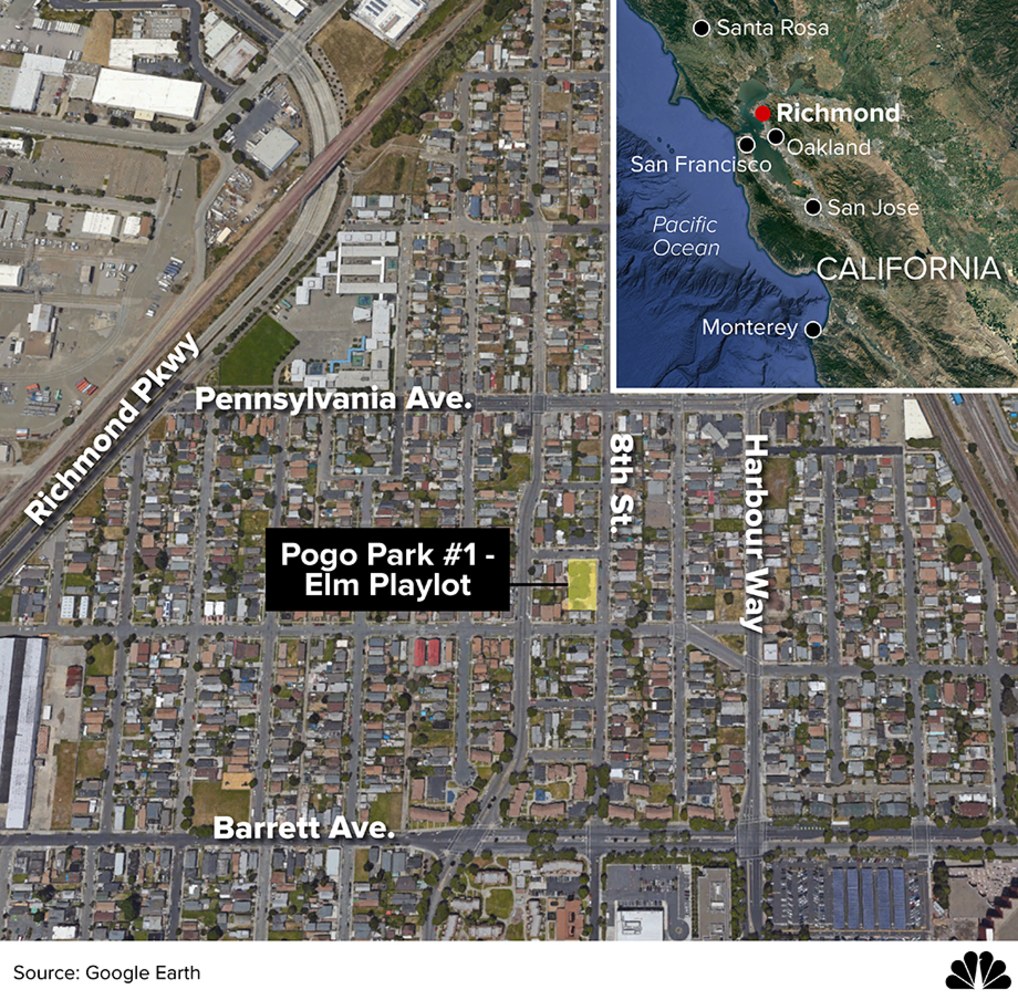
RICHMOND, Calif. — A decade ago, not much playing went on at the Elm Play Lot, unless you counted the pitbulls ripping at the raggedy children’s swings, or the unemployed men tossing wine bottles on the barren asphalt.

The playground was broken, like too many things in the Iron Triangle, one of the poorest neighborhoods in the heart of one of the poorest cities in the San Francisco Bay Area. About a third of the residents lived below the poverty line and the city’s murder rate topped the region — two times higher than in Oakland.

Ten years later, a park that epitomized urban despair is unrecognizable. Grass has sprouted, along with a garden, play structures, barbecues, a zip-line and even a small creek. Children dip their toes in the burbling water, if they aren’t too distracted by classes in art, chess, gardening and much more.

These programs, driven by a non-profit called Pogo Park, could be a model for urban innovation, experts say. They let residents, rather than bureaucrats, decide what they need. Kids who once feared leaving their homes said the park has created an oasis for fun and friendship, where they can play and put aside the cares of a sometimes troubling world.

95a7d 171107 pogo park jhc 1645 4313fae91bffc7840b37e2a6419007e1.nbcnews fp 360 360 California Group Remaking Tough City, One Park at a Time


95a7d 171107 pogo park jhc 1645 4313fae91bffc7840b37e2a6419007e1.nbcnews ux 600 480 California Group Remaking Tough City, One Park at a Time

“They have activities all the time, a Halloween party and games,” said Markel Anderson, 17, who began coming to the park when he was 12. He said adult volunteers lent him a kind ear when he was having problems and he now works a few hours a week with younger kids. “Knowing I can be a role model,” Anderson said, “it makes me feel warm.”

The Christian Science Monitor this year dubbed the transformed Elm Play Lot “one of America’s most innovative public places.” An Australian scholar who promotes urban development and social responsibility for the United Nations called it “one of the most incredible examples of social entrepreneurship I have ever seen.” And an acclaimed Berkeley urban planner cited Pogo Park as “maybe the best example of true community ownership and hands-on engagement” that he has encountered.

Related: ChangeMakers: Fighting for Social Justice on Her ‘City Bloc’

The metamorphosis in Richmond already includes a second community green space, Harbour-8 Park. Plans have been laid to connect the two parks with an urban safe zone, dubbed the “Yellow Brick Road.” And, as of last week, Pogo Park announced it would create a start-up business out of making good parks.

Workers who have remade the two Richmond locales now will build playground equipment for other parks and private clients under the banner Pogo Park Products. The effort will be jump-started by a $1 million million grant from Chevron. (The petroleum giant has brought jobs, along with toxic air pollution, to Richmond for more than a century. Its refinery is the city’s largest employer.)

The startup will train and employ community residents at three craft shops in the city, constructing the kind of quirky, hand-made play structures, benches, fences and barbecues that have become signatures of the two Richmond parks. The jobs and skills training will be welcome, as will proceeds from the venture, which will be folded back into more parks programs.

The Chevron grant will add to millions of other dollars that the non-profit has attracted to rebuild the two parks and begin planning the new yellow pathway that will connect the parks with schools, churches, community centers and other havens.

Related: Agnes Gund Donates $100 Million From Lichtenstein Sale to Start Social Justice Fund

The government and foundations have been less interested in paying the ongoing costs of classes and other programs — ranging from free haircuts, to afternoon Zumba sessions to a petting zoo —that have changed the Richmond parks from dead zones into ebullient gathering spots.

95a7d 171110 richmond california ad760b2e694e605eadc2ccd8c452f8b0.nbcnews fp 360 360 California Group Remaking Tough City, One Park at a Time


90716 171110 richmond california ad760b2e694e605eadc2ccd8c452f8b0.nbcnews ux 320 320 California Group Remaking Tough City, One Park at a Time

“The construction provided the bones, but the programs are the spirit and life of the thing,” said Toody Maher, the founder and executive director of Pogo Parks.

Maher hopes that Pogo Products, and other entrepreneurial programs to come, will one day provide as much as one-third of the non-profit’s budget. “We don’t just want to put our hand out,” Maher says. “We want to earn our own.”

Maher, 57, was raised in the Los Angeles suburbs. As a tomboy who spoke with a severe stutter, she knew from a young age what it felt like to be ostracized. She found her place, in part, in a park, where she was the only girl on her Little League team.

After attending the University of California, Berkeley, where she starred on the volleyball team, she built a few small businesses, then switched to the non-profit sector. Moving to Richmond, she immediately spotted a disconnect: The city’s parks were largely empty, while children — living with the stress of poverty and crime — clearly needed an outlet.

In a neighborhood that is nearly 90 percent black and Latino, Maher stands out. She is white and 6 feet tall and given to wearing a broad-brim straw hat atop hair in pig-tails, jeans and a tie-died shirt: an Amish hippie, come to the ‘hood. And Richmond hasn’t had the best experiences with other newcomers with big ideas.

Thirty years earlier, dozens of locals had been shepherded away from the city by a smooth-talking evangelist, the Rev. Jim Jones. But rather than a utopia on earth, Jones brought the Bay Area’s dispossessed to a woebegone jungle encampment that became known as Jonestown, Guyana, where hundreds would die in a mass murder-suicide. In her early years, some people were not shy about asking Maher, “Are you another Jim Jones?”

But this newcomer seemed remarkably unfocused on herself. And she persisted.

Related: Bigger Than Basketball: How the NBA is Supporting Social Justice

“Regardless of race, creed, color, sexual orientation or whatever, Toody is real with everyone,” said N. Bruce Williams, an administrator at a foster care agency, who helps Pogo Park with personnel issues. “It’s not about ego. This is where she has found her place. This is her calling.”

Maher insists she is only a connection with “the man,” meaning money and influential outside interests. She pushes others on the Pogo Park team into leadership roles, like Carmen Lee, the Elm Play Lot’s constant overseer, described by the children as a second mom; Doris “Mother” Mason, a public housing worker and respected elder, who helped lure other volunteers; James Anderson, a former cocaine peddler who now works full time maintaining Pogo’s two parks.

90716 171107 pogo park jhc 1614 f246ab1d72584c3f5ea5d5e5a08423e9.nbcnews fp 360 360 California Group Remaking Tough City, One Park at a Time


90716 171107 pogo park jhc 1614 f246ab1d72584c3f5ea5d5e5a08423e9.nbcnews ux 600 480 California Group Remaking Tough City, One Park at a Time

Impressed by the results and the park’s ever-more-ambitious goals, Pogo has lured accomplished outsiders like home builder Tom Lawrence, master metal worker Tom Reicher and Ron Holthuysen, the founder of Scientific Art Studio, who helped build the park’s unique hive-like climbing structures and trash-can barbecues.

Scientific Arts, acclaimed for public structures like ATT Park’s giant baseball mitt, now employs Pogo Park activists as apprentices, to learn welding, woodworking and fabrication skills.

“If you get one person over that hump it’s great,” said Holthuysen, an immigrant from Holland. “But this is going to spread to many more…and a whole community will be changed.”

Now, the Pogo Park team is looking to the next horizon — a time when its improvements and the Bay Area’s real estate boom may bring higher rents and increased gentrification to Richmond. The non-profit has formed a partnership with The Conversation Fund, a national organization that previously focused on preserving forests and other open space.

The fund helped purchase property adjacent to Harbour-8 park, which one day it hopes will be home to businesses, like a café, a laundromat and an event center. And it is considering snapping up other properties in an attempt to keep current residents from being priced out.

“It’s amazing the changes that have been made,” said Daniel Iacofano, CEO of MIG, a Berkeley urban planning firm renowned for helping to remake downtown Denver. “But now comes the number-one challenge in urban planning: How do you revitalize a place and maintain the social and cultural roots that created it to begin with? It’s an issue all over the world. It’s very, very challenging. And Pogo Park is taking it on.”

Article source: https://www.nbcnews.com/news/us-news/california-group-remaking-tough-city-one-park-time-n818016

Posted in SF Bay Area News | Tagged | Leave a comment

GOP tax bills could weigh on high-end housing in California


The housing industry is up in arms over the proposals, and shares of real estate brokerage firms such as Remax and Realogy have tumbled since the House version came out Nov. 2. But house hunters who have been priced out of the market might welcome any dip.


The bills have many moving parts that are likely to change as they work their way through Congress, but here are the provisions that would most directly affect homeownership.

Property tax deduction: Under current law, homeowners can take an itemized deduction for property taxes. The House version would limit this deduction to $10,000 per year for all homeowners starting next year. The Senate version released Thursday would eliminate it. Both versions would eliminate the deduction for all other state and local taxes, including income tax.

More on GOP Tax Bills

Mortgage interest deduction: Today, homeowners can deduct interest on up to $1 million in debt used to buy, build or improve first and second homes (acquisition debt). They can also deduct interest on up to $100,000 in home-equity debt (money borrowed against a home for other purposes, such as buying a car).

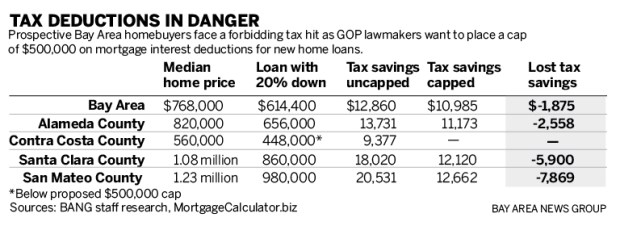
Under the House version, if you took out a home loan on or after Nov. 2, you could deduct interest on only up to $500,000 in debt on a primary residence. You could deduct no interest on a second home or home-equity loan.

Under the Senate version, you could still deduct interest on up to $1 million in acquisition debt on a first or second home. But you could not deduct interest on home-equity debt.

In other words, the House version reduces the mortgage interest deduction but leaves the property tax deduction mostly intact. The Senate version eliminates the property tax deduction but leaves the mortgage interest deduction mostly intact. These differences matter less than they seem because most homeowners who take one of these deductions take the other. “It’s a give and take,” said Skylar Olsen, senior economist from Zillow, a real estate website.

Standard deduction: What matters more is that both versions would roughly double the standard deduction — to $24,000 for married couples filing jointly and $12,000 for single filers.

Today, only about 30 percent of people who file tax returns itemize deductions (in California, about 33 percent do). Under the House version of the bill, only 10 percent would itemize, according to an estimate by the Tax Foundation.

That means fewer homeowners would get any benefit from a mortgage interest or property tax deduction. However, for most people who would switch from itemizing to not itemizing, the value of those deductions probably was not large enough to sway their decision to buy or not buy a home. In most markets, “the value of the mortgage interest deduction is negligible, because the value of the home, the debt you have on that home, the interest that you can deduct does not get you above and beyond the standard deduction, even currently,” Olsen said.

Capital gains: Today, you can exclude up to $250,000 in capital gains ($500,000 if married) when you sell your house, as long as you have owned and used it as your primary residence for at least two of the past five years. Both versions would change this to five of the past eight years. The House (but not the Senate) bill limits this tax break for households with adjusted gross income higher than $500,000 (married) or $250,000 (single).

As a whole, these changes could have a “modest impact on the priciest homes,” but not on the vast majority, said Jared Walczak, a senior policy analyst with the Tax Foundation. “The reasons people buy a home, or make a decision not to, have a lot to do with aspirations and financial resources and very little to do with whether the government has created this express nudge,” he said.

Based on its home-value estimates, Zillow calculates that 100 percent of people who bought a home today in San Francisco, where the median home value is $1.24 million, would take the mortgage interest and property tax deductions in the first year of ownership. Under the House bill, 96 percent would and under the Senate bill, 93 percent would.

In Alameda County, where the median home value is about $783,800, about 99 percent of people who bought today would take the deductions. However, that drops to 78 percent under the House bill and 55 percent under the Senate’s.

Although most people in the Bay Area would still benefit from the deductions, limiting them “might impact your decision to buy a more expensive or less expensive home. The size of the mortgage interest deduction can be significant for a lot of households,” Olsen said. If you limit the deduction “your willingness to outbid at the high end drops.”

That could put downward pressure on high-end home prices. But “it would not take away one of the major drivers” of Bay Area real estate, “which is is constrained inventory in the face of incredibly strong demand,” Olsen added.

Bose George, an analyst with Keefe, Bruyette Woods who follows the real estate industry, said, “We don’t think any of these changes would permanently impact the market,” although they could slow the rate of home-price appreciation in hot markets. “It obviously changes the equation (for) how much you can pay for a home. There could be a bit of a slowdown in markets that have been very strong for a while,” he said.

In the United Kingdom, Australia and Canada, homeowners can’t deduct mortgage interest, but those countries have homeownership rates similar to the United States.

Richard Green, a real estate professor at the University of Southern California, calculated that if Congress got rid of the mortgage interest deduction entirely, it might reduce the U.S. homeownership rate, currently around 64 percent, by about a half a percentage point, but prices could fall by 10 to 11 percent. “You have high-income people outbidding lower-income people for the same house because they get a bigger tax break,” he said. If you remove the deduction, they would still buy a home, but pay less for it. If you cut the maximum deduction in half, “you might knock (prices) down 5 percent. Given that they are rising 3 or 4 percent (a year) it wouldn’t be noticeable,” he said. It could even be good if it makes housing “a tad bit more affordable.”

The bills’ sponsors say that most Americans would receive a net tax cut under their proposals. If that’s true, it could be positive for real estate, because people would have more money to spend on a home, even if they lose some tax deductions.

While that may be the case in most states, it would not be in California, because many people here would pay more federal taxes after losing the state and local tax deduction, said Ken Rosen, chairman of the Fisher Center for Real Estate and Urban Economics at UC Berkeley.

“If either version passes, it’s quite negative for California and other states with high taxes,” he said. California has the highest maximum income tax rate, 13.3 percent. It is one of six states that together claim half the value of the state and local tax deduction.

“Too many blue-state Republicans cannot vote for this,” Rosen said. For that reason, he doesn’t think any bill that passes will eliminate the state and local tax deduction.

Kathleen Pender is a San Francisco Chronicle columnist. Email: kpender@sfchronicle.com Twitter: @kathpender

Article source: http://www.sfchronicle.com/business/networth/article/GOP-tax-bills-could-weigh-on-high-end-housing-in-12347728.php

Posted in SF Bay Area News | Tagged | Leave a comment

Bay Area cities seize the spotlight in new network TV dramas

The new CBS drama “Wisdom of the Crowd” follows Jeffrey Tanner, a Bay Area tech billionaire who has sunk everything he has into the creation of a cutting-edge crowdsourced app that helps to solve crimes.

In the pilot episode, Tanner (Jeremy Piven) invites police detective Tom Cavanaugh (Richard T. Jones) to check out the headquarters for his new endeavor. The cop is stunned to find himself in Oakland, of all places.

“Oakland?” he says, staring at Tanner. “I mean, that’s a little ghetto for you, isn’t it?”

That line of dialogue surely provoked winces from the city’s chamber of commerce members, but even they had to be somewhat surprised. TV viewers, after all, are accustomed to seeing major network series set in Los Angeles or New York. And the few shows that do find their way to the Bay Area almost always leave their hearts in San Francisco. (See: “Full House,” “Party of Five,” “Monk,” “Nash Bridges,” etc.).

But this season, two shows are set in the Bay Area and beyond the land of cable cars. In addition to “Wisdom of the Crowd,” there’s ABC’s “The Good Doctor,” a medical drama starring Freddie Highmore that calls San Jose home.

Highmore plays Shaun Murphy, a brilliant young surgeon with autism and savant syndrome. He has left behind a quiet country life to join St. Bonaventure Hospital in the Bay Area’s biggest city. (The hospital is fictional, of course.) There he uses his extraordinary medical gifts to save lives and challenge the by-the book notions of his colleagues.

“The Good Doctor” was created by David Shore, the same man who gave us “House.” When developing his latest show, he quickly came to believe that San Jose was the perfect locale for his leading man.

“Shaun is a character who asks fundamental questions about our behavior,” Shore says. “He’s curious about why we act the way we do. He’s not challenging, he’s curious — which, of course, has the effect of being challenging.

“San Jose is basically where the future is happening. It’s a place where technology seems to be well on its way to solving all our problems, and people sometimes seem to believe they have the world figured out. What better place to drop a character who asks the most fundamental questions about our nature and our humanity?”

As for “Wisdom of the Crowd,” executive producer Ted Humphrey tapped into both, his character’s mindset and a very real Bay Area real estate trend, to bring Tanner’s offices — known as The Hive — to Oakland.

“The decision to put The Hive in Oakland was about thinking as Jeffrey Tanner would think — reinventing himself and his company,” Humphrey says. “His old company, AllSourcer, is in Palo Alto in a traditional tech campus. He’s done that. But many startups are relocating to Oakland for cheaper real estate and a hip ‘Brooklyn-on-the-West-Coast’ vibe. And that’s what Tanner is doing too.”

21e27 12piven1 Bay Area cities seize the spotlight in new network TV dramas
Natalia Tena and Jeremy Piven in “Wisdom of the Crowd.” (CBS) 

OK, so there’s a there there. But does Oakland bring anything in particular to the story that another city might not?

“There’s a grittiness there that speaks, again, to the upstart nature of what Tanner is doing,” Humphrey says. “The Hive is located in an old canning plant, and the industrial nature of the location is a big part of our production design and the look and feel of our show.”

However, viewers should be aware that a bit of Hollywood make-believe is at play. While they’re set in the Bay Area, both “The Good Doctor” and “Wisdom of the Crowd” are not actually filmed here. The former is shot in Vancouver and the latter on the CBS lot in Studio City.

That’s the way it typically works. Aside from the rare exception, like, say, “Streets of San Francisco” or “Looking,” most Bay Area-set TV shows aren’t based here. They usually spend a few days filming a handful of exterior establishing shots and then flee to finish the bulk of the work elsewhere. “Parenthood,” for example, was set in Berkeley, but the show’s Braverman clan mainly hung out at Universal Studios. And those nerdy bros from “Silicon Valley”? The Sony lot in Culver City.

But why not just set up shop in the Bay Area? Because filming here is ultra expensive, and also often a hassle for production crews. “Parenthood” star Peter Krause once recalled that, while shooting the show’s pilot, Berkeley residents were “not very receptive to having film trucks on their streets.” And when “Trauma,” a short-lived NBC medical series, shut down a stretch of freeway in San Francisco to shoot a big tanker-trailer explosion, a producer talked of angry motorists giving him “the one-fingered salute and yelling, ‘Go back to Hollywood!’”

Interestingly enough, the Netflix drama “13 Reasons Why” actually does film on-location all over the Bay Area, and uses sound stages on Mare Island. But for purposes of the show, the Bay Area doesn’t play itself, instead standing in for the story’s small fictional town.

Both Shore and Humphrey say they hope to shoot occasional scenes in the Bay Area, schedules and budget permitting. Meanwhile, they try to blend some local flavor into their scripts when the stories call for it. For example, a recent episode of “The Good Doctor” had two frantic characters transporting a liver from San Francisco to San Jose and fretting over the traffic gridlock on I-280. (We can relate!) And “Wisdom of the Crowd” features a brainy computer whiz who did her grad work at Stanford. (Cal students undoubtedly will demand equal time.)

Some of that flavor might even include our local teams, as both producers claim to be fervent sports devotees. Shore says he “definitely needs” to drop a shout-out to the Sharks into his show. Humphrey pointed out that he already has a reference to the NBA champion Warriors in at least one episode — even though it hurt to do so.

“I was born and raised in Northeast Ohio,” he says, “and I’m a diehard Cleveland Cavaliers fan.”


Contact Chuck Barney at cbarney@bayareanewsgroup.com. Follow him at Twitter.com/chuckbarney and Facebook.com/bayareanewsgroup.chuckbarney.


‘The Good Doctor’

When: 10 p.m. Mondays

Where: ABC

‘Wisdom of the Crowd’

When: 8 p.m. Sundays

Where: CBS

Article source: http://www.mercurynews.com/2017/11/09/bay-area-cities-seize-the-spotlight-in-new-network-tv-dramas/

Posted in SF Bay Area News | Tagged | Leave a comment

What the Senate’s tax bill means for the Bay Area

In what will seem like manna from heaven for Bay Area homebuyers, the Senate version of the Republicans’ high-stakes tax overhaul is set to be unveiled today with one bit of very good news: the chamber’s version reportedly keeps the mortgage interest deduction limit at $1 million, as compared with the House legislation released last week which placed a cap of $500,000 for new home sales.

Yet while that pain has apparently been averted for anyone wanting to buy a home in the ultra-pricey San Francisco Bay, another element of the Senate plan will put salt in the regions’ wounds.

Rather, make that SALT, for “state and local tax deductions,” a wonderful tax break for residents in this expensive corner of the country that now is going bye-bye if the Senate plan goes through. That could hit Bay Area residents in both bad and not-so-bad ways.

Here are some of the highlights of the bill about to come out of the Senate Finance Committee as its counterpart in the House — the Ways and Means Committee — wraps up work on its version by Friday, according to sources who spoke with the AP.

  • The decision to not lower the cap on deductible mortgage interest might not thrill large swaths of the country, but in the Bay Area, where the median price of a new home now stands at $752,000, the move will be most welcome;
  • Note that this change would only apply to new mortgages, so Bay Area residents who are already homeowners have nothing to worry about; under the House plan, though, house-seekers would pay more to the tax man for a half-million-plus loan. The real-estate lobby has been fighting hard to stop it from happening;
  • On Thursday, the California Building Industry Association released a statement asking that the $1-million cap not be messed with, saying “in states such as California where the median price of a home is $533,000, it is essential for homeowners to be able to deduct the full amount of the mortgage interest deduction.  We are concerned that the limits to the deduction in the Act will create a depressive effect particularly in California which could lead to a nation-wide housing recession.”
  • Again, keeping the limit in place is a big deal for Californians; the rest of the nation didn’t have as much to lose from a lowered cap since the median home price in the United States is about $200,000 and less than three percent of homeowners have more than $500,000 in debt, according to data from CoreLogic;
  • As far as cutting SALT deductions, which are currently used by one in three Californians, the impact on Bay Area taxpayers is more nuanced:  it will hurt the region’s residents, but perhaps not as badly as it’ll hurt residents on the East Coast who pay higher property taxes. The House bill retains deductions for property taxes; the Senate bill reportedly would eliminate them. One estimate says that the one-third of Californians who use the SALT deduction receive an average $18,000 each in benefits;
  • As the LA Times pointed out, California’s “endangered GOP lawmakers have been remarkably muted about the pending assault on their constituents” from the House bill; meanwhile, East Coast moderates are negotiating a compromise that would simultaneously help their states and make California the biggest loser.
  • “Under the compromise,” says the report on the House bill, “Americans will be able to deduct property taxes of up to $10,000, but not income taxes. That’s rough if your state happens to have the nation’s highest income tax and one of the country’s lowest property tax rates. That is, if your state is California.”
  • The Senate bill is likely to include measures to drop the corporate rate to 20 percent (although it reportedly delays that cut until 2019) and give relief to more pass-through businesses; it could also compress the personal income tax brackets from seven to four;
  • Taken together, the two versions, however they end up, constitute the first major overhaul of the American tax code in three decades;
  • On Thursday morning, CBS South Dakota Republican Sen. John Thune told “CBS This Morning” that portions of their bill will “largely follow the House’s action.”
  • “The details are in some cases slightly different than what House did, we took a slightly different approach on some of the major issues but the contours of bill will largely follow the House’s action,” said Thune.
  • Finally, the Senator defended the idea of doing away with deductions for state and local taxes, which would disproportionately impact residents of high-tax states like New York, New Jersey and California. “In terms of that deduction, it’s been around for a while but it also is one that we think subsidizes states that have higher taxes, and by eliminating that deduction it will force states to look at their budgets,” said Thune, adding that it’s a part of the tax code that “needs to go away.”


Here is a look at the potential impact of the House plan to cap the mortgage interest deduction. The Senate plan reportedly retains the tax break.

fd24f sjm mortgage 1103 90 02 What the Senates tax bill means for the Bay Area

Article source: http://www.mercurynews.com/2017/11/09/what-the-senates-tax-bill-means-for-the-bay-area/

Posted in SF Bay Area News | Tagged | Leave a comment