SoCal real estate community reeling from rare December wildfire

Wildfire in December? This is not normal, said seasoned real estate agents in the Southern California this morning. But tell that to the 60 to 70 mile winds blowing through the region since Monday.

At the time of this article’s publication, some 27,000 people had been evacuated from their homes in SoCal’s Ventura county as the fires reached the cities of Santa Paula and Ojai, with 150 structures destroyed, and flames engulfing around 45,000 acres, according to press reports.

Local news helicopters and photographs showed an apocalyptic scene, with fires burning entire homes to the ground while sparing others just next door.

The fires come on the heels of a brutal firestorm overtook the North San Francisco Bay in October and ravaged areas of Sonoma and Napa counties.

Enterprising independent agent Kevin Paffrath, based in east Ventura, didn’t get much sleep last night. He was helping hose down his father-in-law’s block of four units while buildings nearby “went up like candles.” He then drove around to survey the damage, posting the subsequent footage on YouTube (below).

956d5 D BD Agent Inman USDA Hero1984x880 Landscape P871200 1 450x200 SoCal real estate community reeling from rare December wildfire

For Paffrath, his usual Tuesday to-do list has been torn up this morning. The father of a young family, who evacuated south to be on the safe side, managed to buy one of the last generators from his hardware store at 5 a.m. this morning — power outages are widespread — and he is going to be offering it to people who need to charge their mobile phones and the like.

Paffrath has received calls from clients with properties in escrow who are asking for updates, so the agent is going around to check on listings.

As was the case in Northern California, the SoCal fires have hit top-tier properties the hardest so far. In the hills above Ventura, it was the luxury homes that burned down in the night.

“These were $1.5 [million] to $2 million mansions that people are fleeing,” said Paffrath, who said the median home price of Ventura was $500,000.

After seeing homes in flames on the ridge of Ventura city, the biggest danger spot right now are the properties below the hillside, said Paffrath. “The ones on the hill, there is nothing anybody can do,” he added.

Paffrath described the remarkable sight of the Ventura City Hall surrounded by gardens all alight with fire.

Horses were being brought down from the hills to the Wells and Foothill area with their accompanying hay bails — an odd sight to see in the suburban streets.

956d5 map 120517 SoCal real estate community reeling from rare December wildfire

Map of key locations impacted by December 2017 SoCal fires. Credit: Ted Irvine/Inman

Meanwhile in the small town of Santa Paula, 13 miles away to the northeast, Kay Wilson-Bolton from Century 21 Troop Realty was heading off as she always does on Tuesday morning: helping organize lunch for 600 homeless and hungry at the town’s food bank.

This is despite the fact that she had to evacuate her home in the night with her husband and their four small dogs. Together they decamped to her office in the center of Santa Paula where, by chance, a bunch of blankets had been delivered the day before.

“In a crisis, people will need a meal,” Wilson-Bolton said. She had just heard that there is 0 percent containment of the fires near Santa Paula, which was worrying news.

The veteran agent said she has seen wildfires before but “not this intensely.” Wilson-Bolton said she had a chance to check on her home this morning and it was “terribly smoky.” “This came so close to our neighborhood, the closest that we have ever seen.”

In the Ojai community, beloved by Los Angelenos for yoga retreats and getaway weekends, Ojai agent Gabriela “Gaby” Cesena of Berkshire Hathaway HomeServices, managed to sound calm, though she had just evacuated her east Ojai home with her two teen boys 10 minutes before.

During a wildfire, the usual escape routes can be cut off. Ojai Valley normally has three roads out, but these options had been reduced to one today, said Cesena, who was taking her family to another part of Ojai.

She has been fielding calls in the early hours of the morning from clients — one at 2 a.m who had just moved from out of state and was seeking reassurance, and another who asked Cesena to check on their son at boarding school nearby.

“That’s how we as agents can be helpful and valuable right now,” said Cesena. “We have been here 20 years — it’s paradise.”

As they were leaving, the agent was pleased to see emergency vehicles arriving.

Email Gill South.

Article source: https://www.inman.com/2017/12/05/socal-real-estate-community-reeling-from-rare-december-wildfires/

Posted in SF Bay Area News | Tagged | Leave a comment

Wine Country fires: In sad aftermath, for-sale signs go up on burned-out lots

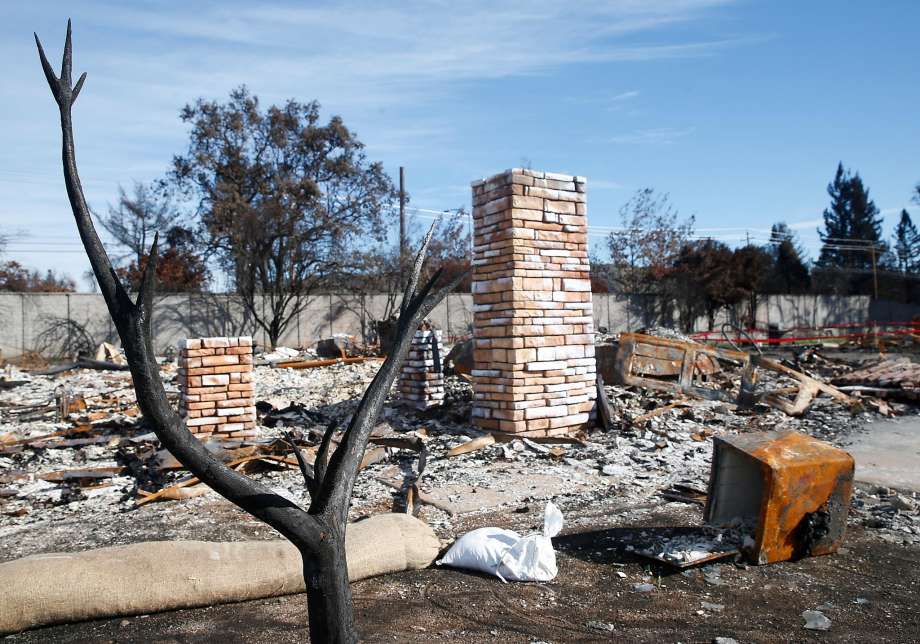
Red caution tape rings the property. The charred husk of a car sits out front. And fragments of a washing machine, patio and chimney are all that’s left of the house that once stood on the parcel in the Larkfield community north of Santa Rosa.


“City will be finished with lot cleanup this week,” the ad reads.

The property is not one of a kind. At least a half a dozen burned-out lots from the most destructive firestorm in California history have hit the market in recent days, a grim reminder of the many altered lives.

The October wildfires killed 44 people and ruined 8,900 structures statewide. With unprecedented losses raising tough questions for thousands of residents in Sonoma, Napa and Mendocino counties, some are deciding that they have no choice but to sell.

Among those are Andrei and Rozalia Bostan, both 67, the owners of the taped-off parcel in Larkfield.

The Bostans, who came to California four decades ago to flee dictatorship in Romania, said they’re leaving their adopted home for Colorado. Despite successful careers in technology, Andrei Bostan said he can’t stretch the family’s finances enough to afford to rebuild with his wife and their 43-year-old son, Emanuel, who has cerebral palsy and uses a wheelchair.

“I thought I had it all figured out,” he said. “I had a house that was paid off and a small retirement payment. But now I’m forced out after I spent 40 years of my life in the Bay Area.”

The burned properties, which real estate experts expect will be the first of scores to hit the market, are priced at about a third of the value they would have fetched if homes still stood — about $160,000 to $300,000. Each will be cleared of fire debris before they’re sold, giving the buyer a clean slate to shake whatever back story came before.

Some sellers simply couldn’t wait the year or two, at minimum, it will take to rebuild, or they didn’t want to embark on the work required to find a contractor and draw up plans. Others cite financial reality, with insurance payouts falling short of what it will cost to build a new home.

Insurance for fire victims vary based on their policies, but generally those who sell their bare land walk away with the proceeds as well as their insurance check, which would typically go toward rebuilding.

For Andrei Bostan, the insurance payment wasn’t what he expected. Turns out he unknowingly bought a policy that covered only part of the home’s value and not the added cost of rebuilding or renting temporary housing. When he learned that constructing a new house would eat through his insurance payout as well as a chunk of his retirement savings, he realized they had to move on.

The couple is selling their lot, located on a once leafy cul-de-sac off Old Redwood Highway now flanked by blackened trees, for $299,000. Just down the street, another resident is selling for $280,000.

The Bostans plan to use the proceeds to buy a home where their daughter lives in Arvada, Colo., for just over $500,000. That doesn’t include the expense of retrofitting for their son’s mobility needs, but is about half of what it would have taken to rebuild in California, they figure.

“Santa Rosa is a great place, and I love the whole Bay Area,” Andrei Bostan said. “But I have no choice.”

b42c2 920x1240 Wine Country fires: In sad aftermath, for sale signs go up on burned out lots


The family’s rush to leave was hastened by the trauma of the fires. Andrei Bostan, a violinist, was touring with an orchestra in Eastern Europe when the Tubbs Fire struck on the night of Oct. 8 and swept west from Calistoga to Santa Rosa. That left his wife to escape the fast-moving flames with their son, who weighs 250 pounds and cannot walk.

After her struggle to get him out and into a Honda Accord — instead of the family’s custom van, which was behind a garage door that wouldn’t open with the power out — both were hospitalized. She underwent emergency surgery for a perforated ulcer.

“Thank God there were no additional complications,” said Rozalia Bostan, who has recovered and whose friends have been collecting donations to help the family. “We’re all going to be much better when we move into our new home.”

A few miles south of Larkfield, in Santa Rosa’s fire-ravaged Coffey Park neighborhood, John Blood and his wife, Denise, have decided reluctantly to sell the property they’ve owned for 26 years because of their age and deteriorating health.

The real estate sign that sits conspicuously on their dirt lot, freshly cleared of debris, went up Wednesday. The $160,000 parcel is flanked by other dirt lots, all in various stages of cleanup.

“I love the neighborhood, love the summers, love the festivals,” said Blood, 68. “But when you get older, your priorities change.”

The couple is hoping that money from the sale, on top of their insurance payment, will allow them to buy a home closer to their son in Southern California.

Blood said he had previously thought about leaving the old house because it was two stories, and he’d prefer just one because he has trouble with stairs. While the city is allowing fire victims to rebuild with expedited permitting and low fees, the new home design must be similar to the old one.

The Bloods are fortunate to own property in Mesa, Ariz., where they’re staying until they figure out their next move.

Their for-sale sign, one of two within a couple of blocks in Coffey Park, has become a stark reminder for neighbors that things won’t be the same.

“You hate to see them leave, but hopefully we’ll see them again,” said resident Brad Reid, whose nearby home survived the fires. “There’s a lot of unknowns around here now. We don’t know what’s going to happen.

The Bloods’ real estate agent, Michael Williams of Coldwell Banker, said he expects to see more empty lots put on the market as people come to terms with their financial situations.

Wine Country Fires

“Some people will walk away,” Williams said. “But I think there’s a strong sense of community and people want to remain.”

Buyers of this type of property typically range from developers wanting to turn a profit to home-seekers looking for a deal, real estate experts said. Unlike vacant land elsewhere, the burned lots offer the benefit of being permitted for development and connected to utilities.

Realtor Shannan Luft, also of Coldwell Banker, recently listed the charred parcel in Larkfield down the street from the Bostans’ property. She acknowledged that the listing was outside her normal trade of modest suburban homes, but said the job was important.

“It’s not your dream sale,” Luft said. “It’s helping people. It’s what we have to do to move Sonoma County forward.”

Kurtis Alexander is a San Francisco Chronicle staff writer. Email: kalexander@sfchronicle.com Twitter: @kurtisalexander

Article source: http://www.sfchronicle.com/bayarea/article/Wine-Country-fires-In-sad-aftermath-for-sale-12402591.php

Posted in SF Bay Area News | Tagged | Leave a comment

Artists are fleeing the Bay Area. Here’s where they’re going.

http://www.sfgate.com/expensive-san-francisco/article/Artists-leaving-sf-bay-area-grass-is-greener-12382578.php

‘It’s harder to be an artist here than ever before.’


Updated 9:32 pm, Sunday, December 3, 2017

  • fc166 920x920 Artists are fleeing the Bay Area. Heres where theyre going.

Caption

Close

Claire George, lead singer of Heartwatch, moved to Seattle from San Francisco one year ago. The musician plans to move to Los Angeles next year.

Claire George, lead singer of Heartwatch, moved to Seattle from San Francisco one year ago. The musician plans to move to Los Angeles next year.

Photo: Courtesy Claire George


Illustrator Anya Sapozhnikov, who grew up in the Bay Area, moved to New York City in 2016. She now resides in Brooklyn.

Illustrator Anya Sapozhnikov, who grew up in the Bay Area, moved to New York City in 2016. She now resides in Brooklyn.

Photo: Courtesy Anya Sapozhnikov


Visual artist Michael Kershnar, who manages the San Francisco artist residency The Growlery, has lived in the Bay Area on and off since 2008. He moves to San Clemente, Calif. in January.

Visual artist Michael Kershnar, who manages the San Francisco artist residency The Growlery, has lived in the Bay Area on and off since 2008. He moves to San Clemente, Calif. in January.

Photo: Fiona Lake


Painter Kate Kuhne called it quits with San Francisco after living in the city for five months. She now lives in Los Angeles.

Painter Kate Kuhne called it quits with San Francisco after living in the city for five months. She now lives in Los Angeles.

Photo: Courtesy Kate Kuhne


Musician Erica Zappia moved to Dallas, Texas, after living in San Francisco for four years.

Musician Erica Zappia moved to Dallas, Texas, after living in San Francisco for four years.

Photo: Courtesy: Erica Zappia


Anne MooreYes, in many ways we were. Bellingham has a wonderful quality of life, close to Canada, people are even healthier there, even more outdoorsy than here, close to Cascades, very creative, lots of beauty, no traffic, friendlier, slower pace, great people. Only ONE thing was wrong with it, and that was enough to make us move back – it is cloudy and gloomy there most of the time! The light is dimmer, you never see a big bowl of clear blue sky, and you can get chilled to the bone with the damp and dark. I so missed our radiant California sun melting the heat into my bones. less

Photo: X-Weinzar, Wikimedia


“The Bay Area arts scene is disappearing.”

It seems that such a grand proclamation is issued every few years with a rotating adjective ­– dying, dwindling or any other d-word that signifies departure and diminishment.

But when artists leave, and they most certainly are leaving the Bay Area, they do not necessarily announce their departures with such vague, spectacular statements. They often go with a whisper, a quiet slinking away.

In the spirit of our ongoing “Grass is Greener” series, which chronicles the stories of those who left the Bay Area for elsewhere, SFGATE spoke to a handful of artists who fled the Bay Area, or plan to leave soon, to learn why they left and where they went. Some lived here a short time, trying the region on for a few months before moving on. Others grew up here, spent their childhoods doodling graffiti in San Francisco’s alleyways and penning songs about the fog to be played at a warehouse gig.

An expensive city like San Francisco sometimes seems as if it’s full of transients – young people looking to give the Bay Area a shot before heading to a place where a house can be purchased and roots laid down.

One study estimated that somebody must make more than $110,000 to live comfortably in the Bay Area, and that’s not necessarily conducive to a thriving arts scene.

“Rent is too steep for a full-time artist without a steady income,” said Michael Kershnar, a visual artist with a background in skateboarding. His artwork is visible throughout the Bay Area, in murals, on skate decks or at The Growlery, an artist residency and gallery space in the Lower Haight, which he manages.

Kershnar lived in the Bay Area from 2008-2011, but left when the cost of living spiked and studio space became hard to come by. He returned two years ago to manage The Growlery, but with his contract up at the end of the year, he’s on to the next residency. Such is the reality for many artists, who must go where opportunity presents itself, whether in the form of a residency, teaching gig or grant.

In January, Kershnar heads to San Clemente, Calif., for a three-month residency at The House of Trestles. After that, he’s not so sure.

Related video: Where people move when they leave the Bay Area 


Bay Area residents are leaving for these US cities.


Media: Ted Andersen, SFGATE, Getty


•••

Claire George, frontwoman of indie band Heartwatch, moved back home to Seattle last year. She lived in San Francisco for five years, and enmeshed herself in the region’s lively music scene. In that time, she says she saw “lots of people leaving,” but at that point, the artist exodus was standard fare — “San Francisco had been hemorrhaging artists for a long time,” she said.

During her San Francisco tenure, George worked a full-time job in addition to making music, which she says was common practice in the scene.

“Pretty much everyone in my band had a full-time job or was in school,” she said.

A high cost of living doesn’t just hamper the ability of an artist to make a living wage, but can also take a toll on the viability of art spaces, which often struggle to compete with the competitive set by other neighborhood tenants, like for-profit companies and businesses.

“Dwindling art space is not the main incentive for artists to leave, but it doesn’t help,” said Erin McElroy, the founder and director of the Anti-Eviction Mapping Project, a Bay Area digital mapping and storytelling collective that charts the effects of gentrification and displacement.

Most art venues, like galleries, concert halls and collectives, do not qualify for rent control because they are not residential spaces. Rent can increase at the whim of a landlord, McElroy says, which she sees as a “big reason” many informal collectives and underground spaces have disappeared in the last 10 years.

“Community land trusts have been really useful in protecting tenant space,” she said, “but it would be great to see more land trusts for art and commercial spaces.”

Local organizations have mobilized in recent years to fight these displacements, including the nonprofit Community Arts Stabilization Trust (CAST). On Thursday, CAST announced a pilot grant that will award $350,000 in funding to 14 Oakland-based arts and cultural organizations seeking real estate assistance. The announcement came just days before the Dec. 2 anniversary of the tragic Ghost Ship warehouse fire, which took the lives of 36 people and spurred a crackdown on underground live-work spaces across the Bay Area.

***

“In many ways, yes, it’s harder to be an artist here than ever before,” McElroy said.

McElroy’s statement is backed, or at least correlated with, statistical trends.

In 2015, the San Francisco Arts Commission (SFAC) surveyed nearly 600 artists living in San Francisco. The results were frightening; Over 70 percent of respondents said they had been or were being displaced from their workplaces, homes or both. Thirty percent feared displacement would happen in the near future.

“One of the things we learned through that study is that artists are very unclear about their tenancy situation, very unclear about their rights, when their leases expired,” said Kate Patterson, director of communications for SFAC. She says the city realized a major pain point in artist housing advocacy was the availability of information, especially when it came to bureaucracy-heavy endeavors like applying for affordable housing.


SFAC was intended to provide grants for local artists to create new work, Patterson explained, “But stability is critical when creating new work, and we don’t yet have a living assistance program,” she said. “That’s a need area that has emerged out of the time that we’re in.”

The commission is exploring the possibility of “developing affordable housing,” but Patterson says it could be years out.

“We need something right now.”

Earlier this month, SFAC announced plans to conduct another, more comprehensive survey of local artists in the coming year.

***

When an influx of people belonging to a certain group leave a place, a more visceral, less visible challenge arises — a lack of community, and a community forced to fight for slim resources.

Within the Bay Area music scene, George says because there are fewer players, fellow musicians aren’t always open to collaboration.

“It becomes more competitive,” she explains.

Then there’s “the monetary thing” in San Francisco, she said, where a lack of opportunity often transforms art-making into a “transactional, grabby process.”

“It can put a damper on your ability to feel open,” she said.

But a small community can create even tighter bonds among those able to make it work, those fighting to stay in the Bay Area. A group mentality materializes.

This mentality can fuel fierce divisions among residents belonging to different communities. Many of those interviewed for this story spoke in terms of us — artists — versus them: Tech.

“Unless I quit music and moved into tech, I would never live comfortably,” said musician Erica Zappia, who moved to Texas in June.

Said artist Michael Kershnar, “I guess my arts and relationship skillset is not as prized as being in tech.”

Painter Kate Kuhne left San Francisco for Los Angeles after half a year. “I found San Francisco to be creatively constipated, infested with tech zombies,” she said.

Related video: What you’ll miss when you leave the Bay Area


You may be thinking of leaving the Bay Area in search of a more affordable to live… but think of all the things you’ll miss!


Media: San Francisco Chronicle


Identifying as an artist can act as a form of cultural currency in the Bay Area, says Anti-Eviction Mapping Project founder McElroy. But the definition varies. “Artist” could be applied to muralists and painters, but also musicians and filmmakers, even those working in the tech industry.

“Designers making six-figure salaries at tech companies might identify as artists, but they’re not living as precariously as someone painting murals or creating art linked to different subcultures,” McElroy said.

“Sometimes the idea of an artist in the Bay Area is a white, bohemian creative person,” she explained, and such a person, though living outside the dominant culture, can contribute to gentrification and displacement.

She advocates for a rejiggering of the identifier “artist,” to include those making political art, or art linked to various subcultures – people of color, the working class, those threatened by redevelopment and gentrification.

Once again, it comes down to a problem of identity. At least that’s how illustrator and Bay Area native Anya Sapozhnikov sees it. She moved to New York City two years ago in pursuit of an art scene with “more freedom” and “innovation.”

“San Francisco is a tech city,” she said. “Not an art city.”

Such designations are ultimately fluid. Cities change, and the transformation of a place can play out over decades, or just a few years.

Change has come quickly to the Bay Area, but also to the places one goes to escape such instability. Said Baudelaire, “The form of a city changes faster than the human heart.”

George, the musician in Seattle, has found many similarities to San Francisco in her new home.

“I left San Francisco excited for this new creative climate,” she said. “And the exact same thing is happening here.”

In January, she’s moving to Los Angeles.

Michelle Robertson is an SFGATE staff writer. Email her at mrobertson@sfchronicle.com or find her on Twitter at @mrobertsonsf.

Article source: http://www.sfgate.com/expensive-san-francisco/article/Artists-leaving-sf-bay-area-grass-is-greener-12382578.php

Posted in SF Bay Area News | Tagged | Leave a comment

Home prices nearly doubled in this surprising California city

Click here if you’re having trouble viewing the video on your mobile device.

As home prices skyrocket across the state, there’s one California city where they’ve shot up more than anywhere else in the U.S. — nearly doubling in the past five years.

No, it’s not San Francisco, San Jose or Oakland. It’s not even in the Bay Area.

It’s Stockton, the Central Valley community twice dubbed America’s “most miserable” city by Forbes Magazine because of its high rates of housing foreclosures, unemployment and violent crime.

The jump in home prices in Stockton and neighboring Lodi — up about 92 percent over the past five years — is dramatic evidence of the ripple effects of the Bay Area’s tight housing market and the increasingly out-of-reach cost of living here. As people flee San Francisco and Silicon Valley in search of cheaper housing, heading to places like Stockton, Oakland and Sacramento, prices in those second-tier markets are rising.

aed09 sjm l stockton 1130 15 Home prices nearly doubled in this surprising California city
New homes under construction in KB Homes’ Montevello development are photographed in Stockton, Calif., on Wednesday, Nov. 29, 2017.  (Doug Duran/Bay Area News Group) 

“There’s flight away from areas where it’s expensive, to areas where it’s relatively cheap,” said Andrew Leventis, deputy chief economist at the Federal Housing Finance Agency, which first noted Stockton’s dramatic rise. “It would be just incredibly improbable if that wasn’t driving up prices in the west by some magnitude.”

The federal agency analyzed housing markets in the country’s 100 largest metropolitan areas. Oakland came in second, boasting an 86 percent jump in prices, according to the report released this week. Sacramento, also a major destination for Bay Area expatriates, is number six, seeing its home prices climb 74 percent.

The San Francisco/South Bay area is high on the list too, coming in at number four with a 77 percent increase — far above the national average of 35 percent.

43672 sjm l stockton 030 Home prices nearly doubled in this surprising California city
Construction for mixed-use residential and business project is seen on Nov. 28, 2017 in downtown, Oakland. Oakland saw a 86 percent jump in home prices in the past five years according to the Federal Housing Finance Agency. (Dai Sugano/Bay Area News Group) 

Lance McHan, a real estate agent in the Stockton area, said Silicon Valley transplants are eating up homes. About half of the 18 homes he sold this year went to buyers from the Bay Area — many of them making the long commute to their Bay Area jobs. That increased demand is changing the area.

“Prices are rising,” McHan said. “Even rentals, the rental market, there’s a shortage as well. People used to pay $1,200 a month for a three-bedroom, two-bath. Now they’re paying $1,500, $1,600, $1,700 for a three-bedroom, two-bath.”

But prices in Stockton have a long way to go before they could give a Bay Area resident sticker-shock. Stockton homes sell for a median price of $260,000, compared to $1.25 million in San Francisco, $860,500 in San Jose, and $697,000 in Oakland, according to Trulia.

When Katrina Gonzalez, a manager at Red Lobster in San Jose, decided earlier this year that she wanted to buy a house, she quickly realized her options were limited. So Gonzalez and her husband, who works as a supervisor at Tesla, started looking at homes in Tracy, Livermore and Pleasanton. To their dismay, even those cities on the far edges of Silicon Valley were too expensive.

Stockton ended up being what the couple could afford. In July they paid $305,000 for a four-bedroom house, where they plan to eventually raise a family. And Gonzalez found she actually likes living in Stockton.

4d512 sjm l stockton 052 Home prices nearly doubled in this surprising California city
Portrait: Katrina Gonzalez, 25, left San Jose earlier this year and moved to Stockton because it was the closest city where she and her husband could afford to buy a home. (Dai Sugano/Bay Area News Group) 

“I know everyone gives Stockton a really bad rap,” she said, “but our neighborhood’s really nice … Everything you have in San Jose, you have here in our area.”

But there is a big downside to the move — Gonzalez now spends at least three hours a day commuting to her job in San Jose, shelling out $150 a week in gas.

Stockton comes from a troubled financial history, which experts say is another factor in its recent soaring housing prices. The city of 300,000, about 80 miles northeast of San Jose, filed for bankruptcy in 2012 after being hit hard by the housing market crash. That year the city had the nation’s highest foreclosure rate — one in every 153 homes had a foreclosure filing, which was more than four times the national average, according to RealtyTrac.

Because home prices plummeted so far, they had farther to rise.

“They fell really hard,” said Ralph McLaughlin, chief economist with real estate website Trulia. “Then they rebounded pretty significantly.”

Seattle is also high on the list. The city comes in at number five, after seeing home prices rise 75 percent in the past five years.

McLaughlin attributed that to Seattle’s status, along with Denver and Austin, Texas, as a “second-tier tech hub” — a city that lures Silicon Valley tech workers with its promise of cheaper housing.

“If you’re in the tech industry, there are jobs in those areas that you could probably get,” he said, “but you wouldn’t have to give up an arm and a leg and a first-born child to get a house.”


Cities where home prices are soaring

Of the country’s 100 largest metropolitan areas, these saw the biggest increases in home prices over the past five years:

  1. Stockton/ Lodi — 91.94 percent
  2. Oakland/ Hayward/ Berkeley — 85.71 percent
  3. Las Vegas/ Henderson/ Paradise — 85.21 percent
  4. San Francisco/ Redwood City/ South San Francisco — 77.07 percent
  5. Seattle/ Bellevue/ Everett — 74.66 percent
  6. Sacramento/ Roseville/ Arden/ Arcade — 74.03 percent
  7. North Port/ Sarasota/ Bradenton, Florida — 72.5 percent
  8. Riverside/ San Bernardino/ Ontario — 70.82 percent
  9. Cape Coral/ Fort Myers, Florida — 70.1 percent
  10. West Palm Beach/ Boca Raton/ Delray Beach, Florida — 69.19 percent

Source: The Federal Housing Finance Agency 


Article source: http://www.mercurynews.com/2017/12/03/home-prices-nearly-doubled-in-this-surprising-california-city/

Posted in SF Bay Area News | Tagged | Leave a comment

One year after the Ghost Ship fire, artists struggle to find housing in Oakland

Carmen Brito wonders whether there’s room for her in the Bay Area.

Three years ago, she returned to Oakland after teaching English abroad and lived out of a car when other housing fell through. Later on, she moved into the attic of a Berkeley house where the kitchen floor had rotted away. And in late 2015, Brito discovered the Ghost Ship warehouse, which had the artistic energy and community she was longing for and a $600 monthly rent she could afford — even though it wasn’t built for people to live there.

Last Dec. 2, during a concert upstairs from her room , Brito woke up choking on smoke. She fled the building and called 911. Minutes later, the deadliest fire in Oakland’s history destroyed the Ghost Ship, killing 36 people.

Though the Ghost Ship fire didn’t reveal the Bay Area’s housing problems, it underscored just how dire they had become. Decades of slow home building left the region unprepared as a tech-fueled economic boom has added more than half a million jobs in the last six years. Prices soared. By the time of the fire, San Francisco’s median home value had topped $1 million, according to real estate website Zillow, and a city study found Oakland’s rents had increased nearly 70% in the eight years prior. Over the last year, costs have gone up even more.

Posted in SF Bay Area News | Tagged | Leave a comment