Bay Area dodges (another) bullet when a powerful quake fails to do much damage

BERKELEY — After nearly 8 million people in the San Francisco Bay Area were shaken — and some awakened — early Thursday when a magnitude 4.4 earthquake centered 8 miles below Berkeley rocked the region, authorities pointed out that the outcome could have been much more dramatic had the shaking that accompanied it been stronger.

At the same time, federal officials continue to warn Californians that there’s a 72-percent likelihood that at least one monster temblor of magnitude 6.7 or greater is destined to strike somewhere in the San Francisco Bay region before 2043. And the Hayward Fault is a prime suspect when it comes to potentially deadly fault lines.

“The thing that makes us worried about the Hayward Fault and makes it the most dangerous is that everybody is built on top of the Hayward Fault — it’s a very urban area,” said U.S. Geological Survey spokeswoman Leslie Gordon, who characterized Thursday morning’s shaker as “minor/moderate. Whereas if you look at the San Andreas Fault, it’s mostly on a lot of open space — going up the spine of the Peninsula; there’s not a heavy population right on top of the fault.”

No serious damage or injuries were reported Thursday in the aftermath of the 2:39 a.m. shaker, but the USGS said the temblor could be felt more than 150 miles away from the epicenter, which was located below the historic Claremont Hotel near the Oakland-Berkeley border. People reportedly felt the shaking for between five and 10 seconds, according to the agency.

At the hotel, an iconic architectural masterpiece originally built as a private residence during the California Gold Rush, the night staff reported feeling a good jolt as the quake emanated from eight miles below them. Hotel spokeswoman Julie Abramovic, who lives nearby, said she experienced her first earthquake since moving recently to California.

“It was scary,” she said. “It woke us up. We kind of realized what was happening, and then we were wondering, ‘What’s next?’?”

Abramovic and her family moved a year ago from Pennsylvania and though they were aware and as prepared as possible for a shake, she said there really wasn’t anything that could’ve gotten her ready for the experience of it.

She added: “This was my first big one, so I’ve got it under my belt now.’’

The quake struck in the thick of the Hayward Fault, an underground ribbon notorious for seismic risk, and it once again served as a reminder of the threat lurking from a fault that’s the Bay Area’s most overdue for a major quake. Using information from recent earthquakes, improved mapping of active faults, and a new model for estimating earthquake probabilities, the USGS in 2014 updated its 30-year earthquake forecast for California. It concluded that there is a 72 percent probability (or likelihood) of at least one earthquake of magnitude 6.7 or greater striking somewhere in the San Francisco Bay region before 2043.

“It woke me up,’’ said Albany resident Keith Knudson, who is also the deputy director of the earthquake science center at the USGS. “I have to admit I was wondering if it was a larger event.’’

He said a good rule of thumb is: How intense is the shaking and how long does it last?

In general, Knudson noted, there is a 1 to 5 percent chance that any earthquake will be followed by a bigger one.

He said USGS data indicates that the probability of an earthquake with a magnitude greater than Thursday’s 4.4 quake is 10 percent over the next several days.

“But the probability of a big earthquake, say with a magnitude 6.0 is really quite low — a 0.4 percent chance,’’ he said.

Still, he cautioned that “we live in earthquake country, so it makes sense to recognize that and take reasonable actions.’’

As in many disaster-prone areas, he said, “some people are not going to be available to help them — from police to firefighters, or hospitals — they are going to be overwhelmed. So we need to be ready to be self-sufficient.’’

Thursday’s early morning jolt “got me straight out of bed,’’ said Cupertino resident Nan Serrato, prompting the 70-year-old to turn on the lights in her home and begin taking stock of her earthquake emergency supplies. “I dug out my flashlight and made sure I had good batteries, and I double-checked the water. I have canned goods for eons.’’

She said she thought the quake might be a “pre-warning,’’ so she turned on the TV to watch the news coverage; she was surprised to find out the epicenter was not in San Jose but in the East Bay.

Already up, Serrato said she couldn’t go back to sleep. None of her grown children living in the area had contacted her, which did not surprise her because she said they were all heavy sleepers.

Daughter Jeanette Ingalls, who lives in South San Jose, slept right through the event.

“I didn’t feel a thing,’’ said the 52-year-old insurance adjustor who found out about the quake through Facebook and qualified to her friends on the social media site that “I’m a heavy sleeper.’’

Asked about her mother’s industrious reaction, Ingalls chuckled. “I”m not as prepared as my mother, that’s for sure — but we do have a five-day supply of stuff in the garage.’’

The last Bay Area earthquake that was higher than 4.4 magnitude occurred on Aug. 24, 2014, when residents of Napa were jolted awake by a strong, magnitude 6.0 earthquake — the largest in the San Francisco Bay Area since the 1989 magnitude 6.9 Loma Prieta quake.

A USGS report said the South Napa earthquake shifted houses off their foundations, damaged chimneys, started fires and broke water mains throughout the city, causing hundreds of millions of dollars in economic losses.

Thursday’s quake was originally reported as 4.7, but was later downgraded to 4.4 by the USGS. It was widely felt from Santa Rosa to Gilroy.

“One would expect a lot of people to feel this size quake in the Bay Area,” said USGS geophysicist Jack Boatwright, who awoke to a few seconds of shaking at his San Francisco home. But, he said, “the motions look about half as strong as you would expect for this size earthquake.”

Boatwright said the strongest ground motions were felt in the Emeryville area.

“Because of the size of the earthquake, we’re on alert if it will possibly be a foreshock of a bigger quake,” Boatwright said. “But there have been no aftershocks yet.”

Oakland Fire Department Lieutenant Dan Robertson tweeted: “Nothing like being upstairs in a 106-year-old firehouse made of poured concrete, despite having been “Retrofitted” in the early 90’s … The brass fire poles were rattling!”

There were no immediate reports of damage, according to the California Department of Emergency Services.  Although BART initially said in a statement that commuters should expect “major delays with our first trains this morning,” the system’s tracks were quickly inspected and all trains were back running on schedule by about 4:45 a.m., the agency said on its Twitter account. BART said  that “in an abundance of caution” they were running the first trains at reduced speed “for another visual inspection by the operator.”

Along Domingo Avenue, directly across from the historic Claremont Hotel up the hill, workers opening the Peet’s Coffee shop and Rick and Ann’s restaurant around 7 a.m. said that there was no damage to their businesses.

Fred Tealdi, a longtime employee at Montclair Village Hardware off Highway 13 and not far from the epicenter, said several customers on Thursday had mentioned being awoken by the quake, but nobody was stocking up on things like devices to strap bookshelves to walls.

“We all live on the fault up here,’’ he said. “And while a couple of people mentioned the rattling that woke them up, nobody was really panicked, knowing it was only a 4.5.’’

Come with the territory, said Tealdi.

“Most of our customers know what to expect living around here,’’ he said of the middle-of-the-night shaking. “We all get used to it.’’

For Northern Californians, the Hayward Fault is the most likely source of a dangerous quake, with a 33 percent chance in the next 30 years.

The Hayward Fault, part of the larger San Andreas Fault system, runs from San Pablo Bay in the north to Fremont in the south — passing through the heart of Berkeley, Oakland, Hayward, Fremont and other East Bay cities.

The USGS said the last large quake on the Hayward Fault was in 1868, with an estimated 6.8 magnitude. It killed about 30 people and caused major property damage.

But the population of the East Bay is now about 100 times larger — so many more people will be affected by the next major quake.

The region is a place of ongoing and often imperceptible earthen creeping, as evidenced by routinely broken sidewalks in Hayward and Fremont. If you stand in the Bay Area and look toward the Sierra, over time you’d see the mountains move to the right.

The Hayward Fault creeps about one-fifth of an inch a year.

Local utilities reported no structural damage from Thursday’s quake. CalTrans spokesman Bob Haus said 4.4 magnitude quakes “usually doesn’t do too much damage’’ to roads or bridges; anything under 5.5. magnitude or less. “But you always build in flexibility on things like that,’’ he said, adding that CalTrans crews will go out and do inspections if there is other reported damage in the area. So far, that did not appear to be the case.

And Jenesse Miller, a spokesperson for EBMUD, said the quake had no “impact on EBMUD operations or facilities. Per EBMUD’s standard response protocols after an earthquake, staff conducted inspections of the water treatment plants, wastewater treatment plant, and other critical facilities. Though the epicenter was near several EBMUD reservoirs and pumping plants, there were no operational impacts or damage to our facilities.

Miller identified the reservoirs in question as: San Pablo, Lafayette, Briones, Upper San Leandro and Chabot.

Staff writers Rick Hurd, Kathleen Kirkwood and Matthias Gafni also contributed to this story.

Article source: https://www.mercurynews.com/2018/01/04/4-5-quake-jolts-east-bay/
Posted in SF Bay Area News | Tagged | Leave a comment

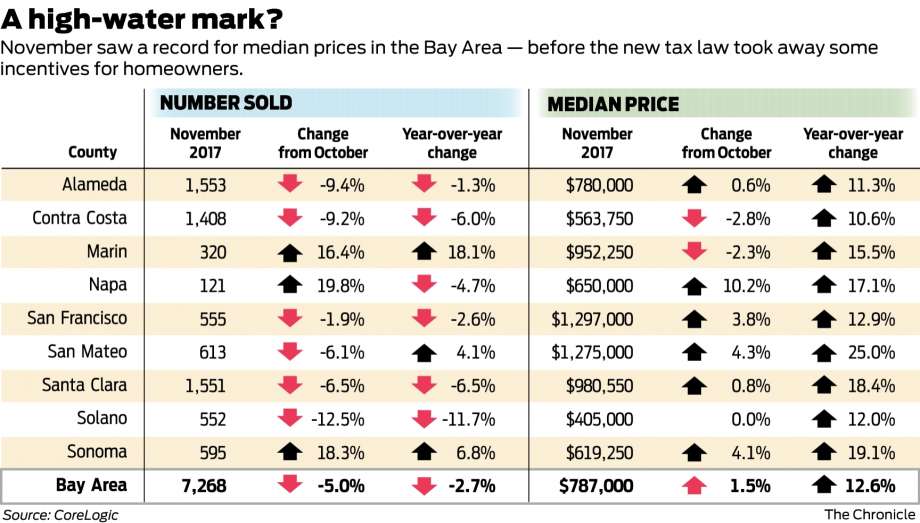
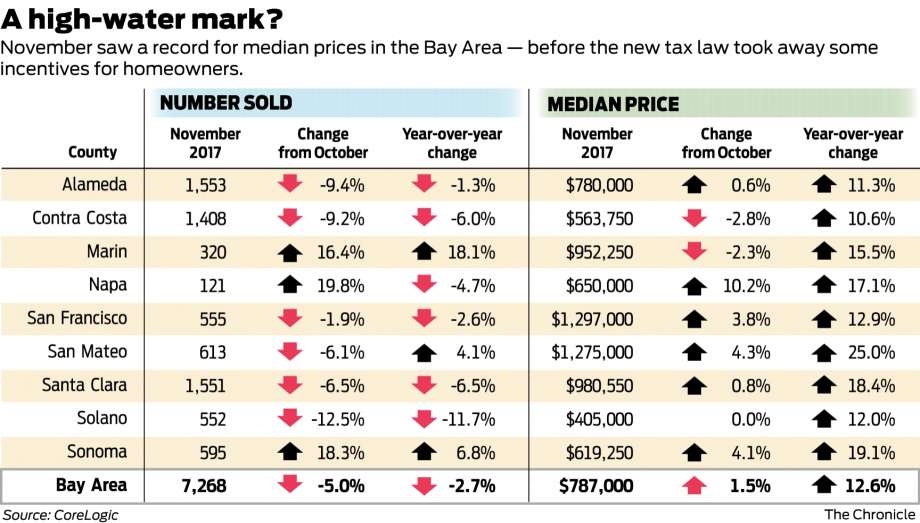
Bay Area home prices hit record in November. Will they stay there?

Some say that could turn out to be a high-water mark until buyers and sellers sort out the impact of the federal tax overhaul, which eliminates some tax benefits of homeownership. Others say the bill won’t put enough downward pressure on the seemingly insatiable demand for Bay Area homes to cause prices to fall.


“I think it’s going to be wait and see in January and February,” said Michael Barnacle, managing broker of the Zephyr Real Estate office in Pacific Heights. “We have had some evidence in recent weeks of people deciding they weren’t going to sell as a consequence of the new taxes.” They might be worried that they will have to pay higher property taxes on a new home, yet be able to deduct less of them, if any.

Buyers, especially first-timers, “are probably going to hold off until they can entirely figure out the whole rent-versus-own situation as a consequence of the tax changes,” Barnacle said.

Ultimately, most people he talks to expect “lower but steady appreciation,” but in the short term, prices may plateau “until people figure this out,” he said.

On the other hand, Gregg Lynn, an agent with Sotheby’s International Realty in San Francisco, has seen no impact from the new tax bill. “San Francisco has the most constrained inventory of any housing market in the continental United States. There are still a lot of people moving here,” many to work in technology. “We are seeing no sign of that abating.”

In November and December, he said he signed up eight new clients who want to list their homes for sale in January. Their reasons ranged from a second home no longer being used, death of a grandparent, moving to a smaller or larger place or an investment property being sold. “All of these are normal life-cycle reasons, he said.” Over the last two weeks, “we have put four buyers into pending contracts,” including three who are relocating here for jobs.

The tax bill “is not affecting anybody’s decisions so far,” Lynn said. “I don’t think it will put upward or downward pressure outside the normal constraints of supply and demand in our market.”

If the bill does have any impact, it won’t be seen in CoreLogic’s monthly housing report for some time. It’s based on data from county recorders’ offices and generally reflects sales that were entered into weeks earlier.

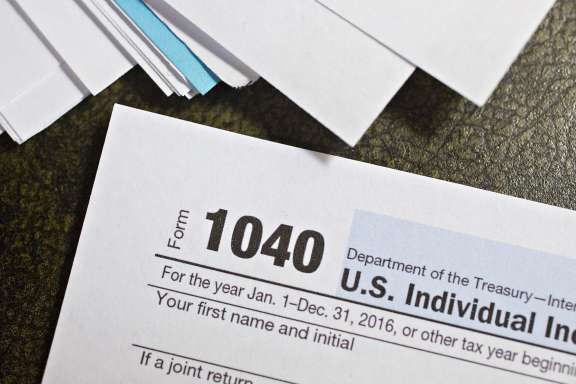
President Trump signed the tax bill only a week ago and almost all of the changes don’t take effect until 2018.

The new law generally lowers tax rates, but some people could still pay higher taxes if the loss of deductions and exemptions pushes their taxable income higher.

There are two big changes directly affecting homeownership. Under the new bill, homeowners can deduct interest on up to $750,000 in mortgage debt used to buy or improve one or two homes. That’s down from $1 million under the old law. The new rule applies to mortgages taken out after Dec. 14, 2017. Older loans are grandfathered in under the old limits. (Homeowners can refinance these older loans up to $1 million and still deduct interest as long as the balance on the new loans is not bigger than the balance on the old one — in other words, if you’re not doing a cash-out refinance.)

In addition, the final bill repeals the itemized deduction for up to $100,000 in home-equity debt not used to buy or improve a home, including existing home-equity loans and lines of credit.

Starting next year, taxpayers who itemize can deduct a total of $10,000 in all state and local taxes combined. This includes state income and property taxes. Today, taxpayers who itemize can deduct all of their state and local taxes, unless they are in Alternative Minimum Tax, which disallows the deduction.

People who can afford to buy a home in the Bay Area could easily pay more than $10,000 a year in state and local income and property taxes combined. The tax on a newly purchased $1 million home would be more than $10,000 by itself.

11d6a 920x1240 Bay Area home prices hit record in November. Will they stay there?


In a win for homeowners, the final bill preserved the existing rules that apply to capital gains tax on a primary residence. Homeowners pay no tax on the first $250,000 of capital gains ($500,000 for married couples) as long as they have lived in the home as their primary residence for at least two of the past five years before the sale date. The Senate version of the bill would have changed that to five of the past eight years, but it was stricken from the final bill.

If the tax bill has an impact, it’s most likely to be on homes priced between $900,000 and $2 million, said Andrew LePage, a CoreLogic research analyst.

Above $2 million is speculation, but below $900,000, the loan amount with 20 percent down would be less than $750,000 and the interest would be fully deductible.

More by Kathleen Pender

For each California county, LePage looked at what percent of home-purchase mortgages taken out in the first 11 months of 2017 exceeded $750,000. The counties with the largest shares were San Francisco (54.3 percent), San Mateo (51.5 percent), Marin (43.9 percent), Santa Clara (40.2 percent), Alameda (22.1 percent) and Contra Costa (16 percent). The average for all counties was 10.6 percent.

From this it’s clear that the tax bill could hit some counties harder than others. “We might be seeing a high point for the foreseeable future,” LePage said.

He added, however, that the Bay Area’s record high price posted in November could go still higher if there is a change in the market mix. A median price is the point at which half of homes sold went for more and half went for less. If more sales in a particular month take place at the higher end of the market than in the previous month, this shift can cause the median price to go up even if prices overall have not changed.

Kathleen Pender is a San Francisco Chronicle columnist. Email: kpender@sfchronicle.com Twitter: @kathpender

Article source: http://www.sfchronicle.com/business/networth/article/Bay-Area-home-prices-hit-record-in-November-Will-12460408.php

Posted in SF Bay Area News | Tagged | Leave a comment

How Joseph Eichler Introduced Stylish Housing for the Masses

Suburbia: The very word conjures up rows and rows of cookie-cutter houses, laid out on a vast, grim grid of blah. At the time they were built, after World War II, the nation was desperate for new housing. But some of those homes are considered architectural treasures today, especially if they were made by one particular Silicon Valley real estate developer.

Birth of the Eichler

Let’s travel back in time to the 1940s, when a Bay Area businessman named Joseph Eichler rented the Bazett house in Hillsborough, designed by rock star architect Frank Lloyd Wright. Eichler fell in love. He hired the Wright-loving architecture firm of Anshen and Allen to make him something along the same lines.

Then Eichler started thinking about making homes for other people.

48a96 RS28401 Bazett house 1 qut 800x600 How Joseph Eichler Introduced Stylish Housing for the Masses
The Bazett house of Hillsborough was designed by Frank Lloyd Wright. After renting it, Joseph Eichler was so impressed, he launchd into a new career as a design-savvy tract house developer. (Courtesy of David Weinstein)

“He was looking around for something to do. A lot of people at that time from other professions were going into homebuilding,” says David Weinstein, who writes for the Eichler Network, a website for Eichler enthusiasts.

Eichler’s vision developed gradually, and the homes he built initially in Sunnyvale weren’t much to look at.

“His very first subdivisions don’t look like Eichlers at all,” Weinstein says.

But then Robert Anshen convinced Eichler to use architects and designers for his tract houses, too — something that most developers were not doing at the time. That’s what pushed Eichler homes onto a different plane of development: the people he had working for him. If that makes him sound a little like Steve Jobs at Apple, well, that would be an apt comparison.

48a96 Screen Shot 2017 12 08 at 7.19.28 AM 800x507 How Joseph Eichler Introduced Stylish Housing for the Masses
Ads like this one enticed young families to scrimp and save for something better than your average tract house. (Courtesy of Page Turnbull)

“They were always innovating, coming up with new ways for space arrangement. It’s really the spirit of Silicon Valley. These were experimental houses,” says Weinstein.

Between 1949 and 1974, when Eichler died, his group built roughly 11,000 homes in California, mostly in the San Francisco Bay Area.

You’ll find them north, east and south of San Francisco, but Palo Alto is home to more Eichlers than anyplace else: more than 2,700 houses, packing the tightly curving streets and cul-de-sacs Eichler preferred because they encourage people to hang out with each other.

Two of Palo Alto’s Eichler neighborhoods, Green Gables and Greenmeadow, are historic districts listed in the National Register of Historic Places.

48a96 6a00d8341c796653ef01156ed30e77970c How Joseph Eichler Introduced Stylish Housing for the Masses
As blogger Stephen Coles points out on The Mid-Century Modernist, when the Pixar team wanted a midcentury modern home for Bob and Helen Parr in “The Incredibles,” they opted for an Eichler. (Courtesy of Pixar Animation Studios)

The Eichler Look

From the outside, Eichlers appear modest, crisp, angular. But step inside, and your attention is drawn to floor-to-ceiling windows that look out onto the backyard, taking full advantage of California’s year-round sunshine. You know that phrase “indoor/outdoor living”? This is that.

“The openness, the airiness, looking up from a window and seeing the sky when you’re in the house,” says Bonnie Borton, an Eichler owner who moved in right after the neighborhood in Palo Alto was built in 1959-1960.

8de6b RS28399 Photo Sep 06 11 12 12 AM 2 qut 800x450 How Joseph Eichler Introduced Stylish Housing for the Masses
The exterior of Edita Donnelly’s remodeled Eichler home in Palo Alto. (Rachael Myrow/KQED)

If your parents — or grandparents — subscribed to Sunset Magazine, you’ve seen an Eichler, because for more than two decades, Sunset’s vision of the California Dream House looked like an Eichler: open floor plans, clean lines stretching in every direction. It’s a style that has come to be known as midcentury modern.

Even today, when people buy Eichlers and remodel them, they often use Sunset for inspiration.

8de6b Photo Oct 04 2 11 25 PM 800x572 How Joseph Eichler Introduced Stylish Housing for the Masses
Eichler homes makes the most of “indoor/outdoor living.” (Rachael Myrow/KQED)

“We replaced everything,” says Edita Donnelly of Palo Alto, who wanted her Eichler to look even more “Eichler-esque” if you will, than it was when she bought it. That is to say, she did things like raise the ceiling in the living room, and she added sliding glass doors to every room in the house.

“We designed it so that every room has access to the outside, and I think that idea came from a Sunset Magazine model house for me,” Donnelly says.

8de6b RS28398 Photo Sep 06 11 14 28 AM 2 qut 800x450 How Joseph Eichler Introduced Stylish Housing for the Masses
Floor-to-ceiling windows in Edita Donnelly’s Palo Alto living room draw the eye to the backyard. This is what “indoor/outdoor” living means. (Rachael Myrow/KQED)

They Used to Be Affordable

When Bonnie Borton bought her Eichler in 1960, she paid $19,500. Let that sink in for a moment. Today in Palo Alto, one of these homes can sell for up to $3 million. Eichlers in less affluent cities aren’t quite as pricey, but it’s all a far cry from the days when these homes were sold to people in the middle class.

(Lovely side note: Eichler also had a nondiscrimination policy and insisted on selling to people of all ethnicities and religions — a progressive attitude that wasn’t matched by many other tract home developers at the time.)

And in even wealthier neighborhoods, like Atherton and Hillsborough, some people have bought the property and bulldozed the Eichler to make way for something bigger, newer, whatever.

So in recent years, a number of Eichler-rich neighborhoods in Silicon Valley have developed design guidelines, zoning overlays or even historic districts in an attempt to keep their neighborhoods aesthetically cohesive.

8de6b Screen Shot 2017 12 08 at 6.23.20 AM 800x529 How Joseph Eichler Introduced Stylish Housing for the Masses
Palo Alto is home to more Eichlers than anyplace else: more than 2,700 homes. (Courtesy of Page Turnbull)

“People who like the Eichlers aren’t saying the wealthy shouldn’t have big houses. They should just do it someplace else,” Weinstein says drolly.

Rebecca Thompson, another Palo Alto Eichler owner, explains that something as ostensibly simple as adding another story can “ruin” the neighborhood for others, even if tastefully done.

“Because our homes have these floor-to-ceiling windows in the primary living areas, in the master bedroom, in the kitchen, in the living room. Most people don’t have blinds,” she says.

Most Eichlers are only one story. If you have to install drapes or blinds to block the neighbor’s view, you lose that “indoor/outdoor” space you bought your house to enjoy.

On the flip side, you might be thinking: Why would someone who can afford to buy an Eichler in Silicon Valley these days want to buy one? After all, they’re modestly sized, aging tract homes — some of which now come with zoning restrictions. I asked Thompson, who moved from Seattle to Palo Alto with her husband about eight years ago.

8de6b RS28396 Photo Oct 04 2 14 22 PM 2 qut 800x450 How Joseph Eichler Introduced Stylish Housing for the Masses
Indoor atriums like this one in the home of Dorene Loew and Jennifer Brown of Palo function as a second living room, outdoors. Californians may take it for granted, but for those who move here, this is jaw-droppingly desirable. (Rachael Myrow/KQED)

“Most people, if they move here from elsewhere, they downsize, because the cost of living is so much more expensive. So we downsized into a smaller house than we had in Seattle. However, we gained access to a large atrium, a front yard, a backyard that we could use for most months out of the year. So we really don’t miss the extra space,” Thompson says.

But over the years, Thompson adds, it’s the neighbors they’ve come to appreciate most: the block parties, book clubs, not to mention shared Rolodexes of plumbers, electricians and interior decorators who specialize in Eichlers. “This is something that doesn’t exist as much anymore in this country. You don’t just buy a home. You’re buying into a community!

To be fair, a lot of tract developers thought they were building communities back in the 1940s, ’50s and ’60s. What’s different about Eichlers? Distinctive design and that definite sense, if you live in one, that you’re living the California Dream.

8de6b RS28397 Photo Sep 06 11 13 53 AM 2 qut 800x450 How Joseph Eichler Introduced Stylish Housing for the Masses
If you sense a Japanese aesthetic to Eichlers, you’re not imagining things. Joseph Eichler was originally inspired by a rock star American architect who loved Japanese art and design, Frank Lloyd Wright. (Rachael Myrow/KQED)

===

Ask Bay Curious a question …

Article source: https://ww2.kqed.org/news/2018/01/03/how-joseph-eichler-introduced-stylish-housing-for-the-masses/

Posted in SF Bay Area News | Tagged | Leave a comment

Bay Area home prices hit record in November. Will they stay there …

Some say that could turn out to be a high-water mark until buyers and sellers sort out the impact of the federal tax overhaul, which eliminates some tax benefits of homeownership. Others say the bill won’t put enough downward pressure on the seemingly insatiable demand for Bay Area homes to cause prices to fall.


“I think it’s going to be wait and see in January and February,” said Michael Barnacle, managing broker of the Zephyr Real Estate office in Pacific Heights. “We have had some evidence in recent weeks of people deciding they weren’t going to sell as a consequence of the new taxes.” They might be worried that they will have to pay higher property taxes on a new home, yet be able to deduct less of them, if any.

Buyers, especially first-timers, “are probably going to hold off until they can entirely figure out the whole rent-versus-own situation as a consequence of the tax changes,” Barnacle said.

Ultimately, most people he talks to expect “lower but steady appreciation,” but in the short term, prices may plateau “until people figure this out,” he said.

On the other hand, Gregg Lynn, an agent with Sotheby’s International Realty in San Francisco, has seen no impact from the new tax bill. “San Francisco has the most constrained inventory of any housing market in the continental United States. There are still a lot of people moving here,” many to work in technology. “We are seeing no sign of that abating.”

In November and December, he said he signed up eight new clients who want to list their homes for sale in January. Their reasons ranged from a second home no longer being used, death of a grandparent, moving to a smaller or larger place or an investment property being sold. “All of these are normal life-cycle reasons, he said.” Over the last two weeks, “we have put four buyers into pending contracts,” including three who are relocating here for jobs.

The tax bill “is not affecting anybody’s decisions so far,” Lynn said. “I don’t think it will put upward or downward pressure outside the normal constraints of supply and demand in our market.”

If the bill does have any impact, it won’t be seen in CoreLogic’s monthly housing report for some time. It’s based on data from county recorders’ offices and generally reflects sales that were entered into weeks earlier.

President Trump signed the tax bill only a week ago and almost all of the changes don’t take effect until 2018.

The new law generally lowers tax rates, but some people could still pay higher taxes if the loss of deductions and exemptions pushes their taxable income higher.

There are two big changes directly affecting homeownership. Under the new bill, homeowners can deduct interest on up to $750,000 in mortgage debt used to buy or improve one or two homes. That’s down from $1 million under the old law. The new rule applies to mortgages taken out after Dec. 14, 2017. Older loans are grandfathered in under the old limits. (Homeowners can refinance these older loans up to $1 million and still deduct interest as long as the balance on the new loans is not bigger than the balance on the old one — in other words, if you’re not doing a cash-out refinance.)

In addition, the final bill repeals the itemized deduction for up to $100,000 in home-equity debt not used to buy or improve a home, including existing home-equity loans and lines of credit.

Starting next year, taxpayers who itemize can deduct a total of $10,000 in all state and local taxes combined. This includes state income and property taxes. Today, taxpayers who itemize can deduct all of their state and local taxes, unless they are in Alternative Minimum Tax, which disallows the deduction.

People who can afford to buy a home in the Bay Area could easily pay more than $10,000 a year in state and local income and property taxes combined. The tax on a newly purchased $1 million home would be more than $10,000 by itself.

d8977 920x1240 Bay Area home prices hit record in November. Will they stay there ...


In a win for homeowners, the final bill preserved the existing rules that apply to capital gains tax on a primary residence. Homeowners pay no tax on the first $250,000 of capital gains ($500,000 for married couples) as long as they have lived in the home as their primary residence for at least two of the past five years before the sale date. The Senate version of the bill would have changed that to five of the past eight years, but it was stricken from the final bill.

If the tax bill has an impact, it’s most likely to be on homes priced between $900,000 and $2 million, said Andrew LePage, a CoreLogic research analyst.

Above $2 million is speculation, but below $900,000, the loan amount with 20 percent down would be less than $750,000 and the interest would be fully deductible.

More by Kathleen Pender

For each California county, LePage looked at what percent of home-purchase mortgages taken out in the first 11 months of 2017 exceeded $750,000. The counties with the largest shares were San Francisco (54.3 percent), San Mateo (51.5 percent), Marin (43.9 percent), Santa Clara (40.2 percent), Alameda (22.1 percent) and Contra Costa (16 percent). The average for all counties was 10.6 percent.

From this it’s clear that the tax bill could hit some counties harder than others. “We might be seeing a high point for the foreseeable future,” LePage said.

He added, however, that the Bay Area’s record high price posted in November could go still higher if there is a change in the market mix. A median price is the point at which half of homes sold went for more and half went for less. If more sales in a particular month take place at the higher end of the market than in the previous month, this shift can cause the median price to go up even if prices overall have not changed.

Kathleen Pender is a San Francisco Chronicle columnist. Email: kpender@sfchronicle.com Twitter: @kathpender

Article source: http://www.sfchronicle.com/business/networth/article/Bay-Area-home-prices-hit-record-in-November-Will-12460408.php

Posted in SF Bay Area News | Tagged | Leave a comment

GOP tax bill shorts Bay Area homebuyers

On Tuesday, the United States Senate and House of Representatives passed a bill that would restructure America’s tax code. But in the process of negotiating the details, the two houses ended up with a tax break for homebuyers that prices out most Bay Area properties.

Earlier this week, California Sen. Dianne Feinstein noted the most recent version of the tax bill (which will likely pass its final House vote today) includes a mortgage interest deduction for homes that cost $750,000 or less.

That’s a huge amount of money most places in America, but not in some of California’s largest metro areas.

“In California, seven counties have average home prices that are more than $750,000: Alameda, Marin, Orange, San Francisco, San Mateo, Santa Clara and Santa Cruz counties,” Feinstein said via Twitter.

Feinstein is right about the numbers. The final version of the mortgage interest deduction is a compromise figure: The House bill put in a cap of $500,000 and the Senate bill had $1 million (which is the present cap), so the two bodies ended up with $750K in the end.

And Feinstein is also right about the price of real estate in those seven California counties, according to the California Association of Realtors (CAR). In fact, CAR estimates the median price of a home in the Bay Area was over $900,000 in November.

Of 424 San Francisco properties presently listed on real estate site Redfin, only 61 are priced at $750K or less and six of those are just vacant land. Under the present, $1 million cap, the number of potentially eligible properties rises to 164.

[Update: Reader Aaron Master notes that Feinstein’s tweet appears to misinterpret how the deduction cap operates: “The way caps work is that you only get the first $750k of interest on your mortgage. For example, if you are so fortunate as to buy a $1M house you usually put 20 percent down leaving you with a $800000 mortgage. Under the new plan, interest on $750000 of the $800000 is deductible.

[...] “Therefore to figure out the max purchase price if you want to deduct all $750k worth of interest you take 750000/0.8 to get $937,500, which is higher than the 750k number.” Although notably still less than most houses in San Francisco.]

Some of the responses to Feinstein’s tweet noted that those buying $750,000 homes—more than twice the median home price in the US, according to the U.S. Census—in San Francisco or Marin may not really need the tax break.


9810c shutterstock 777668779 GOP tax bill shorts Bay Area homebuyers

By

As Beacon Economics co-founder Christopher Thornberg told the LA Times, “If you are borrowing a million bucks to get a home, the write-off is not your primary concern.”

But it is one more case where the spiraling price of buying in the Bay Area turns values and expectations upside down.

Docking the mortgage cap is supposed to be a hit at luxury real estate. However, as Jordan Weissman wrote for Slate, buyers “stuck house-hunting in San Francisco or New York” end up swept up by default. Because any new rule aimed at high-end luxury homes is going to hit most of San Francisco—even the teardowns.

Article source: https://sf.curbed.com/2017/12/20/16801772/gop-tax-bill-feinstein-mortgate-deduction

Posted in SF Bay Area News | Tagged | Leave a comment