I-Team investigates the largest landlord in San Francisco – KGO

Chaos erupts after a measure that would have strengthened rent control failed to pass the State Assembly Housing Committee three weeks ago — a major setback for tenants in the midst of the housing crisis.

Dozens of those protesters live in buildings owned by the largest landlord in San Francisco, Veritas Investments. I-Team Reporter Dan Noyes has been investigating complaints about the company.

Veritas is quite open about their target audience — it’s high-tech workers from out of state. And that leaves some long-time tenants feeling left out and worried about their future.

Forty-nine-year-old Yat-Pang Au founded Veritas Investments in 2007 — you see signs for the leasing arm of his company, RentSFNow, all over San Francisco. He explained in a Pension Real Estate Association profile that millennials are his target demographic.

“About 70 to 80 percent of them are those young techies,” Au said. “And more often than not, they are not from the San Francisco Bay Area and they’re moving into San Francisco.”

Veritas now owns about 240 buildings across San Francisco — more than 5,000 apartments — and just bought its first building in Oakland.

“A lot of the stories are heart-wrenching stories,” San Francisco Supervisor Aaron Peskin told Dan Noyes. He’s been hearing complaints about the company.

“They’re buying these buildings at extremely high prices,” said Peskin. “And under San Francisco rent control laws are passing on the debt on those buildings to their tenants.”
With rent control, landlords are allowed annual increases tied to the rate of inflation. This year, the approved rent increase is 1.6 percent.

But, Peskin explains San Francisco allows landlords to pass on their loan debt to tenants, along with operation and maintenance costs. He has co-sponsored a measure to stop these so-called “pass-throughs.”

Retired hospice worker Pat Magee has lived in the same rent-controlled Powell Street studio for 37 years. Veritas bought her building and in December, with pass-throughs, her rent climbed from $383 a month to $818 — a 114 percent increase.

“I couldn’t believe it at first,” said Magee. ” I was just kind a like, yeah, OK, sure.”

Her rent will settle in with a 34 percent increase for this coming year.

Dan Noyes asked, “How hard was it paying that extra amount of money for you?”

Magee answered, “It was hard because I’m still kind a like — the money had to come out of my little savings, I’ve been trying to save up for my teeth.”

Yat-Pang Au declined the I-Team’s request for an interview, but provided his Vice President of Asset Management.

Dan Noyes: “It was a huge shock to her, what do you say to Pat Magee?”

Joan Cress: “So, I can’t talk about specific renters.”

Cress cited privacy concerns, even though Noyes explained Pat Magee agreed to have her story told. Cress emphasized that pass-throughs are currently allowed under San Francisco law, and that tenants can apply to the Rent Board for an exemption.

Cress said, “What I can tell you is that we make every effort to work with every single resident in the buildings that we own.”

“They don’t see the relationships, the community, the contributions these tenants have made,” Brad Hirn of Housing Rights Committee of San Francisco told Dan Noyes. “They see dollar signs.”

Hirn says, while Veritas concentrates on renovating vacant apartments to attract new clients, some long-time tenants paying below-market rents feel neglected. “We see tenants fed up, tired, exhausted and angry.”

Take three examples:

Doris Johnson is disabled, uses a walker. She says her old landlord kept the elevator running, but after Veritas bought the building, the elevator was out 65 days in a row, essentially trapping Doris in her apartment.

Doris: “I could not schedule any of those appointments due to the fact that I couldn’t get out of the building.”

Dan: “You missed doctor’s appointments?”

Doris: “Hmm-mmm.”

Dan: “She was trapped in her apartment for two months straight. How does that happen?”

Joan Cress: “It’s a very unusual situation, it is a very unfortunate situation.”

Cress explains that the company had to have custom parts made, and that perhaps in the future, Veritas should have replacement parts standing by for these old elevators.

“We’re not perfect,” Cress says. “So we take instances like this to heart.”

Example number two: Greg Lawler says his old landlord used to fix the trash chutes when they got clogged, but the same week they took over, Veritas just closed them off for good.

“Immediately we noticed a change in this building as far as amenities being taken away from us,” Lawler said.

Dan Noyes: “Why block over trash chutes?”

Joan Cress: “Why block over trash chutes? That is not a question that I was anticipating, Dan.”

Cress says tenants sometimes stuff too much into the trash chutes, blocking them and causing a fire hazard, but that Veritas may consider reopening the trash chutes because of feedback from tenants.

Example three: water damage in Amina Rubio’s apartment.

Amina: “It came down through here. That was the first thing.”

Dan: “Just coming down?”

Amina: “Yeah, it was just like being in a storm.”

She was concerned about mold setting in, and asked Veritas for repairs.

Rubio said, “I asked for it to be looked at and they didn’t start looking at it for approximately six months.”

The apartment is now repaired. Joan Cress wouldn’t comment on Amina’s case specifically, but said they sometimes have to prioritize repair calls.

“If it’s something that may not be life/safety related, then our goal would be to respond to that within 48 hours,” Cress said.

One other note — Veritas chose this furnished apartment across from the Ritz Carlton Hotel as the setting for our interview.

Joan: “So, somebody could come in and rent this for a month or two months or three months.”

Dan: “So, a corporate rental.”

Joan: “It is a corporate rental, yes.”

Veritas confirms they have 200 apartments they rent for short-term corporate housing. Supervisor Peskin calls that “deeply concerning,” and that the units should for people who want to live and work here. Veritas insists they want all their tenants to remain as long as they want, no matter what they pay.

Click here for a look at more stories by Dan Noyes and the ABC7 News I-Team.

Article source: http://abc7news.com/realestate/i-team-investigates-the-largest-landlord-in-sf/3019532/

Posted in SF Bay Area News | Tagged | Leave a comment

Bay Area rents soared 40 to 50 percent since 2012 – Curbed SF

In a study released last week with the delicate title, “The Rent Is Getting Too Damn High,” Trulia says that, well, Bay Area rents are indeed getting too high.

The real estate site sifted through its own rental data between 2012—the year that prices bottomed out after the housing crisis and started their alarming ascent to present levels—and 2017 for perspective on precisely what’s happened.

Perhaps surprisingly, San Francisco has not seen the largest margin of increase over the past five years. That dubious honor goes to Cape Coral (somewhere in Florida) where prices on the site vaulted 61.9 percent in five years.

And in second place is none other than Oakland, which suffered a 51.1 percent price spike during the same period, from a median rent of $1,952/month in 2012 up to $2,500/month now.

San Jose fared not much better with the fifth largest increase overall, a margin of 40 percent. In practice this adds up to almost the exact same price appreciation as in the East Bay—a $2,500/month San Jose home in 2012 now costs $3,500/month.

And San Francisco comes in at seventh place—cold comfort, indeed—with a 37.9 percent spike, from $2,900/month on average to $4,000/month even.

Sacramento also makes the top ten, with a 35.8 percent increase landing it in the number nine spot.

For perspective, Trulia also reports that the average rent spike nationwide is 19.6 percent, which, of course, is already quite a bit, but by local standards looks an awful lot like easy street.

However, renters should note that Trulia’s figures represent only homes on Trulia, which tend to be relatively new, high-end, and more expensive than the average San Francisco home—because after all, those are the sorts of homes most likely to have vacancies in this economy.


65fd2 Nan728 Bay Area rents soared 40 to 50 percent since 2012   Curbed SF

The United States Census provides median rent figures that are much closer to what the average San Francisco renter actually pays. Figures for 2017 aren’t yet available, but we can reference data from 2012 through 2016, which should be comparable.

Here’s how much median gross rents went up in San Francisco and in surrounding counties in that four-year period:

  • San Francisco: 10.49 percent (from $1,477/month to $1,632/month)
  • Alameda County: 13.2 percent (from $1,265/month to $1,432/month)
  • Santa Clara County: 20.22 percent ($1,508/month to $1,813/month)
  • Contra Costa County: 12.3 percent ($1,340/month to $1,506/month)
  • San Mateo County: 17 percent ($1,541/month to $1,803/month)
  • Solano County: Seven percent ($1,249/month to $1,337/month)

In December, the Census reported that gross rents nationwide rose $21 since 2012—which is quite a bit within this context—although the released figures don’t go into further detail.

The reason why the actual rents recorded in the census are so much lower than those on sites like Trulia—and the reason the increases so much less severe—is because they reflect the influence of longtime leases and (wait for it) rent control, the kinds of deals that rarely come up on modern rental sites.

So while Trulia’s report tells us a little bit about the price of trying to find a new lease after the city’s boom of new construction, it also ends up telling us much more about the value that older housing stock offers to renters by comparison.

Article source: https://sf.curbed.com/2018/1/30/16950444/bay-area-rent-san-francisco-oakland-san-jose

Posted in SF Bay Area News | Tagged | Leave a comment

San Jose could be this year’s most insane housing market

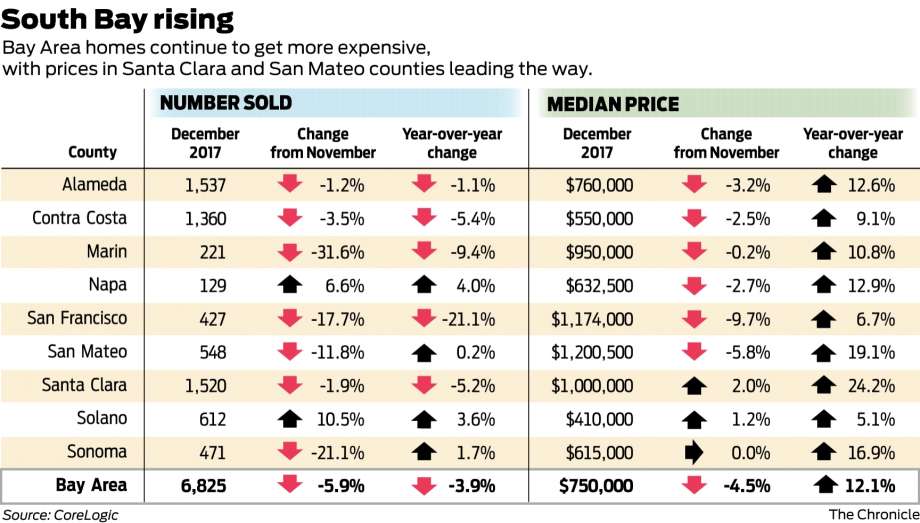
Home prices in Santa Clara County hit a record $1 million in December, up 24.2 percent from December 2016, according to a CoreLogic report released Wednesday. That was the largest year-over-year increase of any Bay Area county.


For the nine-county region as a whole, the median price paid for a new or existing home or condo in December was $750,000, down 4.5 percent from a record high of $785,000 in November but up 12.1 percent from December 2016.

Redfin predicted this week that nine of the 10 hottest neighborhoods in the nation this year will be in or near San Jose. The 10th is San Francisco’s Sunnyside neighborhood. The forecast is based on page views and favorites on its house-hunting website.

“We’ve done this report for six years straight and we’ve never seen a concentration of hottest neighborhoods like this before,” Redfin spokesman Jon Whitely said.

bb2f5 920x1240 San Jose could be this years most insane housing market


This time last year, Redfin identified neighborhoods in 10 different cities, in six states and the District of Columbia, as the hottest for 2017.

More by Kathleen Pender

The San Jose metro area “seems like it’s blowing up,” Whitely said. “It’s just crazy.” Large employers, including Apple, Google and Adobe, have purchased land or announced plans to expand in San Jose. And it’s still relatively affordable compared with San Francisco and San Mateo counties, where the median prices in December were $1,174,000 and $1,200,500, respectively, according to CoreLogic.

Zillow, another real estate website, also predicted that San Jose will be the hottest market this year. “Home values in the Silicon Valley hub gained 17.4 percent over the past year — the fastest growth among the 50 largest metro areas — and it tops Zillow’s list of hot markets for 2018, as high-paying tech jobs continue to keep pace with climbing housing costs,” it said in a report. San Francisco ranked fifth on Zillow’s hot-places list.

Home prices in the Bay Area often spurt in January, because buyers hit the market after the holiday slowdown faster than sellers can list their homes.

But this January, “it’s been a little nuts,” said Kalena Masching, a Redfin agent in Silicon Valley. “I’m starting to see homes selling the day they come on the market, or three days later. That was not the case last year, even a couple months ago.”

Masching said some sellers are accepting offers before the first open house, before the official offer deadline, even before homes are listed. These preemptive offers “are so good they are not worth the seller waiting to see other offers,” she said.

“Los Altos, in the last 30 days, has had three homes sell before hitting the market and a couple went into contract less than a week after listing,” she added. In Mountain View, “we have 10 sales that went pending in six days or less.”

Kevin Cole, a broker with Alain Pinel in Saratoga, was not surprised to see the San Jose neighborhoods of Bucknall, Cambrian and White Oak at the top of Redfin’s list of hot markets. Those areas, along with Lakewood in Sunnyvale, “used to be lower-priced neighborhoods,” he said. “Now they are equaling or surpassing the median price in Santa Clara County. As Sunnyvale gets too hot, buyers shuffle over to Cambrian. As Cambrian gets too hot, they shuffle over to Bucknall.”

Two of his children sold homes in Cambrian at double the price they paid four or five years ago, he said.

First-time buyers Karishma Salver and her husband were outbid on five or six homes in the San Jose area last year before landing one at the end of November in south San Jose, the “last affordable neighborhood before Morgan Hill or Gilroy,” she said. “It was challenging, stressful. The market was moving so quickly that we would see a house and it would be gone by the next week.”

Sometimes they’d show up at open houses and be told the house was already sold. “At some point, we were considering going further south,” Salver said, but “we got lucky.” Although they paid $34,000 more than the asking price, they got a four-bedroom, 1,800-square-foot home for under $1 million. But they’ll still have to endure long commutes to their jobs near the San Jose airport and in San Ramon.

For the year as a whole, the median Bay Area home price rose 10.2 percent in 2017, compared with a 5.5 percent gain in 2016, according to CoreLogic. The counties with the highest appreciation rates last year were San Mateo (16.3 percent), followed by Santa Clara (11.9 percent), Sonoma (11.7 percent) and Alameda (10.3 percent). San Francisco had the lowest rate, 4.3 percent, but the highest full-year median home price, $1.2 million.

It’s still too soon to say what impact, if any, the new federal tax law will have on Bay Area home prices. The law erodes some of the tax benefits of homeownership, primarily for higher-end homes.

But most homes sold in December went into contract before the law was signed Dec. 22. Anecdotally, agents say it doesn’t seem to be discouraging buyers. San Francisco Realtor Craig Ackerman said he listed a home on Dolores Street at just under $1.6 million on Jan. 8 that will close Friday at $1.9 million. He listed one on McAllister Street at $899,000 on Jan. 12 with a pending contract at more than $1.2 million.

“From everything I hear, inventory is so low and demand is still strong, people are feverishly buying those few homes that are available,” said Patrick Carlisle, chief market analyst with Paragon Real Estate Group in San Francisco. “That’s the short term.”

Longer term, the tax law could have an impact if it affects how people and businesses think about moving to the Bay Area. The other big question mark is immigration, which has fueled the Bay Area’s population growth, Carlisle said. If Trump’s policies discourage immigrants’ decision to stay or relocate here, it could impact the market.

Kathleen Pender is a San Francisco Chronicle columnist. Email: kpender@sfchronicle.com Twitter: @kathpender

Article source: https://www.sfchronicle.com/business/networth/article/San-Jose-could-be-this-year-s-most-insane-12541492.php

Posted in SF Bay Area News | Tagged | Leave a comment

Oakland House is Selling for Bitcoin

Think the Bay Area real estate market can’t get any more inflated, speculative, and discriminatory to anyone outside the tech bro community? Enter Bitcoin, the celebrated cryptocurrency that’s created a few overnight millionaires and untold legions of wannabes, speculators, and mansplainers who can’t shut up about it. An Oakland home near San Leandro is on the market and available for Bitcoin, and the real estate agents said in the first days since the home’s listing he’s received calls on the property “every five minutes.”

Since the four-bedroom at 2559 Oliver Ave. was listed Friday, the phenomenon of the “Bitcoin house” has been covered by the East Bay Times, the San Francisco Business Times, and FOX 2. But despite the supposed cryptocurrency-fueled feeding frenzy, the asking price of the property remains unchanged at its initial $648,000.

Though for all SF Weekly knows, higher offers may have rolled in unreported. “I’ve never had so many people calling from out of the area, who have no idea where Oakland even is, except that it’s close to San Francisco,” realtor Sean Beattie told Bay Area News Group. “They saw ‘bitcoin’ and that’s it.” (SF Weekly has reached out to Beattie on the unchanged asking price, and we’ll update this article with any response.)

The Bay Area News Group reports that offers have come in from “Italy, China and elsewhere across the globe.” If an international investor buys that home, you can bet your bottom Bitcoin that the property is going straight to Airbnb and will not be occupied by locals.

The seller, though, is a Fremont native, and a real estate investor himself. “I try to stay in the lead in terms of how trends are going, and I try to understand new technology,” seller Eric Wang  told Bay Area News Group. “There’s a lot to figure out, but I’m willing to be the test case.”

This is not the first home in the Bay Area to be offered for cryptocurrency. According to Mashable, “Carina Isentaeva, a Redfin agent in San Francisco, is in the center of the crypto-mania. In a call she said it’s all about ‘crypto homes’ now. She had a deal that fell through because the buyer’s ICO flopped.”

That last sentence seems to undermine the entire premise of selling a home for cryptocoin. But hey, maybe SF Weekly is just too old school. Admittedly, we find this whole tulip mania to be rather cryptic.

Posted in SF Bay Area News | Tagged | Leave a comment

Bay Area rents soared 40 to 50 percent since 2012

In a study released last week with the delicate title, “The Rent Is Getting Too Damn High,” Trulia says that, well, Bay Area rents are indeed getting too high.

The real estate site sifted through its own rental data between 2012—the year that prices bottomed out after the housing crisis and started their alarming ascent to present levels—and 2017 for perspective on precisely what’s happened.

Perhaps surprisingly, San Francisco has not seen the largest margin of increase over the past five years. That dubious honor goes to Cape Coral (somewhere in Florida) where prices on the site vaulted 61.9 percent in five years.

And in second place is none other than Oakland, which suffered a 51.1 percent price spike during the same period, from a median rent of $1,952/month in 2012 up to $2,500/month now.

San Jose fared not much better with the fifth largest increase overall, a margin of 40 percent. In practice this adds up to almost the exact same price appreciation as in the East Bay—a $2,500/month San Jose home in 2012 now costs $3,500/month.

And San Francisco comes in at seventh place—cold comfort, indeed—with a 37.9 percent spike, from $2,900/month on average to $4,000/month even.

Sacramento also makes the top ten, with a 35.8 percent increase landing it in the number nine spot.

For perspective, Trulia also reports that the average rent spike nationwide is 19.6 percent, which, of course, is already quite a bit, but by local standards looks an awful lot like easy street.

However, renters should note that Trulia’s figures represent only homes on Trulia, which tend to be relatively new, high-end, and more expensive than the average San Francisco home—because after all, those are the sorts of homes most likely to have vacancies in this economy.


505a0 Nan728 Bay Area rents soared 40 to 50 percent since 2012

The United States Census provides median rent figures that are much closer to what the average San Francisco renter actually pays. Figures for 2017 aren’t yet available, but we can reference data from 2012 through 2016, which should be comparable.

Here’s how much median gross rents went up in San Francisco and in surrounding counties in that four-year period:

  • San Francisco: 10.49 percent (from $1,477/month to $1,632/month)
  • Alameda County: 13.2 percent (from $1,265/month to $1,432/month)
  • Santa Clara County: 20.22 percent ($1,508/month to $1,813/month)
  • Contra Costa County: 12.3 percent ($1,340/month to $1,506/month)
  • San Mateo County: 17 percent ($1,541/month to $1,803/month)
  • Solano County: Seven percent ($1,249/month to $1,337/month)

In December, the Census reported that gross rents nationwide rose $21 since 2012—which is quite a bit within this context—although the released figures don’t go into further detail.

The reason why the actual rents recorded in the census are so much lower than those on sites like Trulia—and the reason the increases so much less severe—is because they reflect the influence of longtime leases and (wait for it) rent control, the kinds of deals that rarely come up on modern rental sites.

So while Trulia’s report tells us a little bit about the price of trying to find a new lease after the city’s boom of new construction, it also ends up telling us much more about the value that older housing stock offers to renters by comparison.

Article source: https://sf.curbed.com/2018/1/30/16950444/bay-area-rent-san-francisco-oakland-san-jose

Posted in SF Bay Area News | Tagged | Leave a comment