Housing in 2018: San Jose neighborhoods top the nation’s ‘hottest’ list

SAN JOSE — More bad news for people house-hunting in the Bay Area: Of the 10 hottest neighborhoods in the country this year, according to the real estate website Redfin, nine are in the San Jose metro area.

The last is in San Francisco.

Redfin experts say that’s largely because tech workers, even very well compensated ones, are getting priced out of the San Francisco Peninsula. Others are drawn by new jobs from companies such as Google and Apple — or by Google’s plans to build a downtown campus around San Jose’s largest transit hub, Diridon Station.

“While the San Francisco Peninsula has traditionally been the hottest of the hot places, we’re seeing it become unaffordable for even the tech giants that helped create its demand in the first place,” said Redfin Silicon Valley agent Kalena Masching.

Compared to Palo Alto, where the median sale price last year topped $2.5 million, and San Francisco, where the average home sold for $1.3 million, San Jose’s median home price of over $1 million (and rising) apparently looks like a deal.

Topping the list is San Jose’s Bucknall neighborhood, where the median sale price last year was $1.57 million and 100 percent of homes sold for above list price.

In recent weeks, Masching said, open houses have been swamped, homes have been getting 15 to 20 offers each, and people have taken off work to check out houses the moment they come on the market.

She’s also noticed something else: “What we’re seeing is a disregard for recent comparable sales and people deciding what the home is worth to them and just giving that as their offer.”

The demand for real estate in the South Bay has been well documented; late last year, Zillow predicted the San Jose metropolitan area would be the hottest housing market in the country in 2018. But that it landed nine neighborhoods out of 10 on Redfin’s latest list surprised even Redfin economist Nela Richardson.

The interest, she said, is fueled by a lack of housing supply throughout the Bay Area — and “speculative interest” in Google’s expansion. “Basically Google’s just extending its tentacles,” Richardson said, “and yet it’s having a dramatic effect on one city.”

Redfin created the list based on the increase in the number of homes marked as “favorites” in each area and the number of page views on Redfin.com.

As Redfin noted, this further uptick in interest will only put more pressure on the housing market.

In December, the San Jose area had the lowest rate of homes per sale that Redfin had ever recorded — anywhere in the country — and its home prices rose a whopping 31.9 percent from the previous year.

With two neighborhoods on the list, San Jose’s prominence was worrisome to the city’s mayor, Sam Liccardo.

“We typically would welcome being on a top 10 list of hottest anything,” Liccardo said, “but in this case our housing market has been plenty hot for plenty long enough, and we need to get about the business of cooling the market by building the supply that’s needed for the thousands of families who are struggling to survive.”

Editor’s note: Are you house-hunting in the San Jose area? We’d love to hear your story. Send a note to reporter Katy Murphy at kmurphy@bayareanewsgroup.com.


REDFIN’S 2018 HOTTEST NEIGHBORHOODS LIST

1. Bucknall (San Jose)

Median sale price (Dec. 2017): $1,565,000

Percent of homes that sold above list price (Dec. 2017): 100 percent

How much above list price: 23.8 percent

2. Cambrian (San Jose)

Median sale price (Dec. 2017): $1,244,000

Percent of homes that sold above list price (Dec. 2017): 100 percent

How much above list price: 18 percent

3. White Oak (Campbell)

Median sale price (Dec. 2017): $1,010,000

Percent of homes that sold above list price (Dec. 2017): 66.7 percent

How much above list price: 5.7 percent

4. Ortega (Sunnyvale, San Jose metro area)

Median sale price (Dec. 2017): $1,920,000

Percent of homes that sold above list price (Dec. 2017): 100 percent

How much above list price: 16.5 percent

5. West Santa Clara (San Jose metro area)

Median sale price (Dec. 2017): $1,237,500

Percent of homes that sold above list price (Dec. 2017): 90.3 percent

How much above list price: 16.1 percent

6. Sunnyvale West (San Jose metro area)

Median sale price (Dec. 2017): $1,945,000

Percent of homes that sold above list price (Dec. 2017): 91.3 percent

How much above list price: 18.3 percent

7. Lakewood (Sunnyvale, San Jose metro area)

Median sale price (Dec. 2017): $1,200,000

Percent of homes that sold above list price (Dec. 2017): 92.3 percent

How much above list price: 21.3 percent

8. Sunnyside (San Francisco)

Median sale price (Dec. 2017): $1,272,500

Percent of homes that sold above list price (Dec. 2017): 89.5 percent

How much above list price: 25 percent

9. Blacow (Fremont, San Jose metro area)

Median sale price (Dec. 2017): $1,005,000

Percent of homes that sold above list price (Dec. 2017): 91.7 percent

How much above list price: 9.4 percent

10. Rex Manor (Mountain View, San Jose metro area)

Median sale price (Dec. 2017): $1,500,000

Percent of homes that sold above list price (Dec. 2017): 83.9 percent

How much above list price? 14.4 percent

Source: Redfin

Article source: https://www.mercurynews.com/2018/01/29/housing-in-2018-san-jose-neighborhoods-top-the-nations-hottest-list/

Posted in SF Bay Area News | Tagged | Leave a comment

Solano County remains nation’s third hottest real estate market

The Vallejo-Fairfield area is still among the country’s hottest real estate markets, but hovers in third place, according to Realtor.com.

This only means that home-buyers are still flocking to the area, Solano Association of Reators President Johnny Walker said Thursday.

“The Realtor.com Hottest Markets List is a snapshot in any given month of active listings viewed by prospective buyers versus the days on market as an indicator of supply,” he said. “Compared to the super hot markets in San Francisco/Oakland and San Jose/South Bay, landing in the number three position these past two months actually bodes quite well for Vallejo as we continue to benefit from buyers seeking more affordable areas.”

As local inventory increases and we enter the more active spring-summer buying season, we should see the area’s rankings climb, he said.

Nadine Woloshin, senior vice president of Realtor.com, said the Vallejo-Fairfield area is one of 13 in California to make the firm’s top 20 list in January.

“Spurred by the years-long tech boom in the San Francisco Bay Area, the top three spots on realtor.com’s monthly list were San Francisco, San Jose, and Vallejo,” she said. “During January, homes in those metropolitan areas sold 45 to 50 days more quickly than homes in the rest of the country, on average.”

Only five other states — Colorado, Texas, Ohio, Michigan and Idaho — made the most recent top 20 list.

Chico moved up 13 spots since December, tying it with Midland, Texas for the top movers spot for the month, the report shows. This puts Chico into the top 20 for the first time since last April, it says.

“There is no doubt that housing in many parts of California is as hot as the Mojave in August,” realtor.com economic research director Javier Vivas said in a news release. “Even with sky-high prices, homes in places like the Bay Area typically sell twice as quickly as homes in the rest of the country, thanks to a supercharged economy and a major dearth of available properties. Barring a major change in the state’s economic strength, we expect these housing market conditions to continue for the foreseeable future.”

The report shows that it takes a home in the top-ranked San Francisco-Oakland-Hayward area a median of 39 days to sell, down from 44 in December, when the area ranked second.

The area switched spots with now second-ranked San Jose-Sunnyvale, Santa Clara, where the median age of inventory fell from 36 to 33 days.

The average age of inventory in Solano County is 44 days, unchanged from December.

Ranked 20, Boise City, Idaho’s median age of inventory rose to 66 from 59 days in December, when it ranked 26.

Article source: https://www.eastbaytimes.com/2018/01/29/solano-county-remains-nations-third-hottest-real-estate-market/

Posted in SF Bay Area News | Tagged | Leave a comment

Bay Area housing market shows no signs of cooling

Housing in America’s most expensive region is going to get even pricier.

For all the talk of the U.S. tax overhaul hitting wealthy blue-state real estate, the Bay Area is set for more home-price gains. Its technology-fueled economy and persistent housing shortage are sending values ever higher — and that may get even more pronounced as tech share sales mint more millionaires.

“The scale of the wealth created here and the scale of the technology sector is going to outweigh the effect of the tax plan,” said Patrick Carlisle, chief market analyst with Paragon Real Estate Group in San Francisco. “The Bay Area is unique because we have companies that didn’t exist five years ago and that are now the biggest the world. There’s no place on Earth that has a similar dynamic.”

Even after a years-long boom that has already priced out many residents, the San Jose metropolitan area is expected to be the hottest U.S. housing market in 2018, according to a report this month by Zillow that factors in home values, rents and jobs. San Francisco ranks as No. 5.


The areas led Realtor.com’s list of the top U.S. markets in January, based on listing views and the length of time homes were for sale.

The San Jose region — which includes Palo Alto and Cupertino — saw the median home value soar 21 percent last year to $1.17 million, while inventory dropped 41 percent to “crisis levels,” according to Zillow. In areas from Oakland to Marin County, the story is the same: too much demand and too little supply.

Prices will keep rising as more startups go public or sell shares privately, generating cash for investors and workers, according to Carlisle. Dropbox, the San Francisco file-sharing company valued at $10 billion, has filed confidentially for an initial public offering and aims to list in the first half of the year, according to people familiar with the matter. Investors led by SoftBank Group Corp. this month completed an $8 billion purchase of stock from Uber shareholders, bringing a flush of money to early investors. The Japanese conglomerate, meanwhile, is hungry for more deals.

In San Francisco, low unemployment, at 2.2 percent, and the expansion of large employers such as Dropbox, Facebook and Google is likely to ensure demand for housing will continue to outstrip supply. The median home price soared 11 percent to a record $1.5 million in the fourth quarter, while the average time it took to sell fell to two weeks from 22 days a year earlier, according to a Paragon report.

The rapid speed of transactions came as a surprise to Tania Fowler, who in September sold the Edwardian three-story house she grew up in. The Inner Sunset home, which sold for $200,000 above the asking price in a cash deal, was on the market for two weeks.

“From the time we accepted the offer to close of escrow was seven days,” Fowler said. “I used to sell real estate in the Sacramento area and had seen 20-day COEs at the height of the market bubble, but never seven days.”

At the high end of the market, with prices above $3.5 million, there’s already preparation for IPOs, said Gregg Lynn, an agent with Sotheby’s International Realty in San Francisco. Several tech executives have hired agents at his brokerage to locate homes for them in anticipation of “liquidity events” in the near future, he said.

“They want properties ready to go,” Lynn said.

Such demand is expected to outweigh the concerns that the U.S. tax revamp will hit home prices. The new law limits deductions for state and local taxes, including property taxes, and also caps deductions on mortgage interest at loans up to $750,000 — an amount that’s easily exceeded in the pricey Bay Area market.

“The market is so strong, it’s not changing people’s outlook,” said Paul Barbagelata of Barbagelata Real Estate in San Francisco. “Everybody is kind of dealing with it.”

Home values in the city could go up 5 to 10 percent more this year, Barbagelata said.

Tracy McLaughlin, an agent specializing in Marin County, said that even during the normally quiet weeks around the holidays she was getting calls for listings that she temporarily had taken off the market, and even had a potential buyer fly in from Italy to look at a property.

She discounted the impact of the tax bill on the Marin County market because many of the homes sell for more than $3 million, often in cash transactions, making the loss of tax benefits a minor factor.

“Consumer confidence is what drives the market here,” McLaughlin said.

Still, there’s plenty of concern about the tax law’s effect, according to Michael Repka, chief executive officer of DeLeon Realty in Palo Alto. This month about 850 people showed up for a real estate tax seminar his company organizes, compared with the 60 to 80 people such events normally draw, he said. Some people he’s talked to are considering selling their homes and moving out of state to save money on taxes, Repko said.

“These are retired people but also people with more flexible work arrangements,” Repko said. “Some people are considering selling because they are worried about prices falling.”

The ultimate effect on people’s taxes might be close to zero, however, because Bay Area buyers tend to be wealthy individuals who also stand to benefit from reductions in their federal tax rate, said Ralph McLaughlin, chief economist for Trulia. In addition, these people may make buying decisions on other factors, such as family and status, he said.

“We have a healthy economy, with a healthy, often well-compensated workforce boosting demand,” McLaughlin said. “Unless there’s a major correction in the tech sector, we’ll see prices continue to go up.”


Edvard Pettersson is a Bloomberg writer. Email: epettersson@bloomberg.net

Article source: https://www.sfgate.com/business/article/Bay-Area-housing-market-shows-no-signs-of-cooling-12529895.php

Posted in SF Bay Area News | Tagged | Leave a comment

America’s priciest housing market shows no signs of cooling

By Edvard Pettersson • Bloomberg

Housing in America’s most expensive region is going to get even pricier.

For all the talk of the U.S. tax overhaul hitting wealthy blue-state real estate, the San Francisco Bay area is set for more home-price gains. Its technology-fueled economy and persistent housing shortage are sending values ever higher — and that may get even more pronounced as tech share sales mint millionaires in San Francisco and Silicon Valley.

“The scale of the wealth created here and the scale of the technology sector is going to outweigh the effect of the tax plan,” said Patrick Carlisle, chief market analyst with Paragon Real Estate Group in San Francisco. “The Bay Area is unique because we have companies that didn’t exist five years ago and that are now the biggest the world. There’s no place on Earth that has a similar dynamic.”

Even after a years-long boom that has already priced out many residents, the San Jose metropolitan area is expected to be the hottest U.S. housing market in 2018, according to a report this month by Zillow that factors in home values, rents and jobs. San Francisco ranks as No. 5.

The areas led Realtor.com’s list of the top U.S. markets in January, based on listing views and the length of time homes were for sale.

The San Jose region — which includes Silicon Valley towns such as Palo Alto and Cupertino — saw the median home value soar 21 percent last year to $1.17 million, while inventory dropped 41 percent to “crisis levels,” according to Zillow. In areas from Oakland to Marin County, the story is the same: too much demand and too little supply.

Home prices will keep rising as more startups go public or sell shares privately, generating cash for tech investors and workers, according to Carlisle. Dropbox, the San Francisco-based file-sharing company valued at $10 billion, has filed confidentially for an initial public offering and aims to list in the first half of the year, according to people familiar with the matter.

Investors led by SoftBank Group this month completed an $8 billion purchase of stock from Uber Technologies Inc. shareholders, bringing a flush of money to early investors in the massive startup.

The Japanese conglomerate, meanwhile, is hungry for more deals.

In San Francisco, low unemployment, at 2.2 percent, and the expansion of large employers such as Dropbox, Facebook and Google is likely to ensure demand for housing will continue outstrip supply. The median house price in the city soared 11 percent to a record $1.5 million in the fourth quarter, while the average time it took to sell fell to two weeks from 22 days a year earlier, according to a Paragon report.

The rapid speed of transactions came as a surprise to Tania Fowler, who in September sold the Edwardian three-story house she grew up in. The Inner Sunset home, which sold for $200,000 above the asking price in an all-cash deal, was on the market for two weeks.

“From the time we accepted the offer to close of escrow was seven days,” Fowler said. “I used to sell real estate in the Sacramento area and had seen 20-day COEs at the height of the market bubble, but never seven days.”

At the high end of the market, with prices above $3.5 million, there’s already preparation for IPOs, said Gregg Lynn, an agent with Sotheby’s International Realty in San Francisco. Several executives with high-tech companies have hired agents at his brokerage to locate homes for them in anticipation of “liquidity events” in the near future, he said.

“They want properties ready to go,” Lynn said.

Such demand is expected to outweigh the concerns that the U.S. tax revamp will hit home prices. The new law limits deductions for state and local taxes, including property taxes, and also caps deductions on mortgage interest at loans up to $750,000 — an amount that’s easily exceeded in the pricey Bay Area market.

“The market is so strong, it’s not changing people’s outlook,” said Paul Barbagelata of Barbagelata Real Estate in San Francisco. “Everybody is kind of dealing with it.”

Home values in the city could go up by another 5 percent to 10 percent this year, Barbagelata said.

Across the Golden Gate Bridge, Tracy McLaughlin, an agent specializing in Marin County, said that even during the normally quiet weeks around the holidays she was getting calls for listings that she temporarily had taken off the market and had a potential buyer fly in from Italy to look at a property.

She discounted the impact of the tax bill on the Marin County market because many of the homes sell for more than $3 million, often in cash transactions, making the loss of tax benefits a minor factor for the buyers.

“Consumer confidence is what drives the market here,” McLaughlin said.

Still, there’s plenty of concern about the tax law’s effect in the heart of Silicon Valley, according to Michael Repka, chief executive officer of DeLeon Realty in Palo Alto. Earlier this month, about 850 people showed up for a real estate tax seminar his company organizes, compared with the 60 to 80 people such events normally draw, he said. Some people he’s talked to are considering selling their home and moving out of state to save money on taxes, Repko said.

“These are retired people but also people with more flexible work arrangements,” Repko said. “Some people are considering selling because they are worried about prices falling.”

The ultimate effect on people’s taxes might be close to zero, however, because homebuyers in the Bay Area tend to be wealthy individuals who also stand to benefit from reductions in their federal tax rate, said Ralph McLaughlin, chief economist for Trulia. In addition, these people may make homebuying decisions on other factors, such as family and status, he said.

“We have a healthy economy, with a healthy, often well-compensated workforce boosting demand,” McLaughlin said. “Unless there’s a major correction in the tech sector, we’ll see prices continue to go up.”

Article source: http://www.bendbulletin.com/business/5954239-151/americas-priciest-housing-market-shows-no-signs-of

Posted in SF Bay Area News | Tagged | Leave a comment

Buying a Home in San Francisco Is About to Get Even Harder …

Housing in America’s most expensive region is going to get even pricier.

For all the talk of the U.S. tax overhaul hitting wealthy blue-state real estate, the San Francisco Bay area is set for more home-price gains. Its technology-fueled economy and persistent housing shortage are sending values ever higher — and that may get even more pronounced as tech share sales mint millionaires in San Francisco and Silicon Valley.

“The scale of the wealth created here and the scale of the technology sector is going to outweigh the effect of the tax plan,” said Patrick Carlisle, chief market analyst with Paragon Real Estate Group in San Francisco. “The Bay Area is unique because we have companies that didn’t exist five years ago and that are now the biggest the world. There’s no place on Earth that has a similar dynamic.”

Even after a years-long boom that has already priced out many residents, the San Jose metropolitan area is expected to be the hottest U.S. housing market in 2018, according to a report this month by Zillow that factors in home values, rents and jobs. San Francisco ranks as No. 5.

The areas led Realtor.com’s list of the top U.S. markets in January, based on listing views and the length of time homes were for sale.

The San Jose region — which includes Silicon Valley towns such as Palo Alto and Cupertino — saw the median home value soar 21 percent last year to $1.17 million, while inventory dropped 41 percent to “crisis levels,” according to Zillow. In areas from Oakland to Marin County, the story is the same: too much demand and too little supply.

Share Sales

Home prices will keep rising as more startups go public or sell shares privately, generating cash for tech investors and workers, according to Carlisle. Dropbox Inc., the San Francisco-based file-sharing company valued at $10 billion, has filed confidentially for an initial public offering and aims to list in the first half of the year, according to people familiar with the matter. Investors led by SoftBank Group Corp. this month completed an $8 billion purchase of stock from Uber Technologies Inc. shareholders, bringing a flush of money to early investors in the massive startup. The Japanese conglomerate, meanwhile, is hungry for more deals.

95f3d 60x 1 Buying a Home in San Francisco Is About to Get Even Harder ...

Homes in San Francisco.

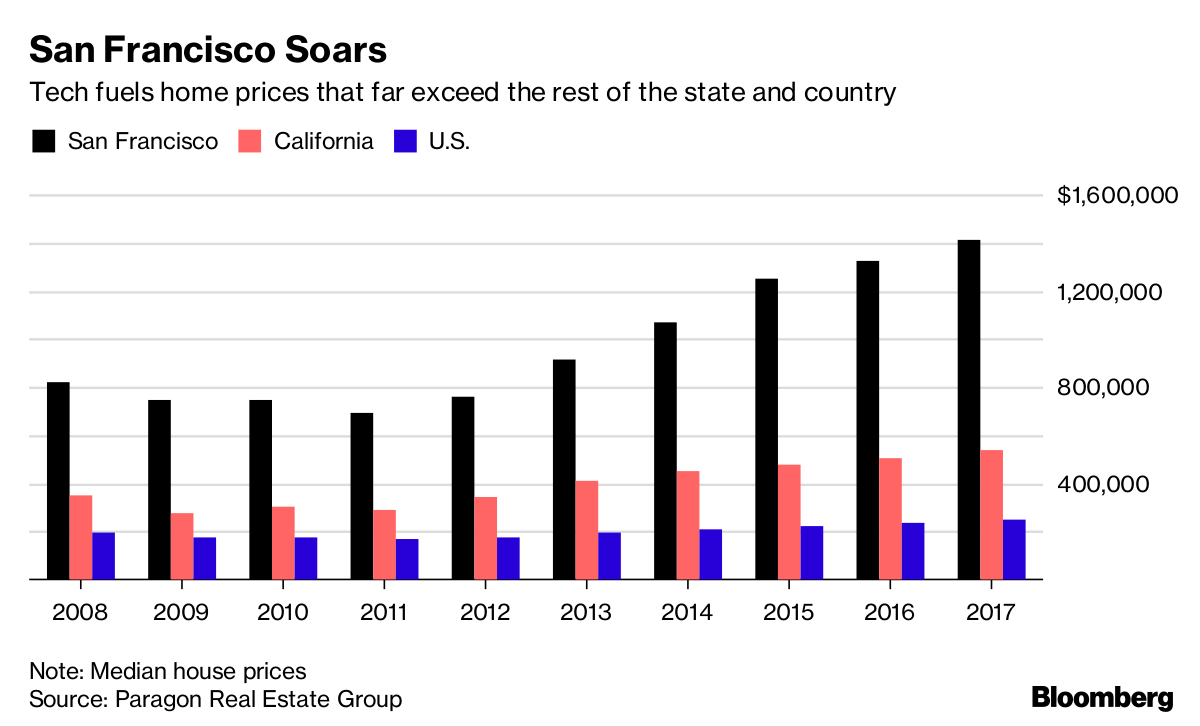
In San Francisco, low unemployment, at 2.2 percent, and the expansion of large employers such as Dropbox, Facebook Inc. and Google is likely to ensure demand for housing will continue outstrip supply. The median house price in the city soared 11 percent to a record $1.5 million in the fourth quarter, while the average time it took to sell fell to two weeks from 22 days a year earlier, according to a Paragon report.

San Francisco Soars

Tech fuels home prices that far exceed the rest of the state and country

Source: Paragon Real Estate Group

Note: Median house prices

95f3d  1x 1 Buying a Home in San Francisco Is About to Get Even Harder ...

The rapid speed of transactions came as a surprise to Tania Fowler, who in September sold the Edwardian three-story house she grew up in. The Inner Sunset home, which sold for $200,000 above the asking price in an all-cash deal, was on the market for two weeks.

“From the time we accepted the offer to close of escrow was seven days,” Fowler said. “I used to sell real estate in the Sacramento area and had seen 20-day COEs at the height of the market bubble, but never seven days.”

At the high end of the market, with prices above $3.5 million, there’s already preparation for IPOs, said Gregg Lynn, an agent with Sotheby’s International Realty in San Francisco. Several executives with high-tech companies have hired agents at his brokerage to locate homes for them in anticipation of “liquidity events” in the near future, he said.

“They want properties ready to go,” Lynn said.

‘Dealing With It’

Such demand is expected to outweigh the concerns that the U.S. tax revamp will hit home prices. The new law limits deductions for state and local taxes, including property taxes, and also caps deductions on mortgage interest at loans up to $750,000 — an amount that’s easily exceeded in the pricey Bay Area market.

“The market is so strong, it’s not changing people’s outlook,” said Paul Barbagelata of Barbagelata Real Estate in San Francisco. “Everybody is kind of dealing with it.”

Home values in the city could go up by another 5 percent to 10 percent this year, Barbagelata said.

Across the Golden Gate Bridge, Tracy McLaughlin, an agent specializing in Marin County, said that even during the normally quiet weeks around the holidays she was getting calls for listings that she temporarily had taken off the market and had a potential buyer fly in from Italy to look at a property.

She discounted the impact of the tax bill on the Marin County market because many of the homes sell for more than $3 million, often in cash transactions, making the loss of tax benefits a minor factor for the buyers.

“Consumer confidence is what drives the market here,” McLaughlin said.

Some Worries

Posted in SF Bay Area News | Tagged | Leave a comment