Income inequality in the Bay Area is among nation’s highest

The San Francisco and San Jose metro areas have two of the highest levels of income inequality in the country, according to a recent study — a dubious distinction that helps explain why it’s so hard for many to afford housing here.

In the San Francisco area, which includes San Francisco, San Mateo, Alameda, Contra Costa and Marin Counties, families on the high end of the income spectrum earn 11 times more than families on the low end — making it the third most unequal region in the U.S., according to a Brookings Institution analysis of data from 2016, released earlier this month.

The San Jose area, which includes all of Santa Clara County, ranked sixth, with the region’s highest earners making 10.5 times more than its lowest earners. In the San Jose area, the gap between the haves and have-nots widened between 2014 and 2016 — with the salaries of high earners increasing by more than $60,000, while the salaries of low earners crept up by less than $2,000.

Axios reported on the data early Wednesday.

“The tech economy is heaping substantial rewards on people who were already earning high salaries,” said Alan Berube, the Brookings Institution senior fellow who wrote the study.

In Santa Clara County, households in the 95th percentile earned $428,729 in 2016, while those in the 20th earned $40,807, according to the study. Earnings for those in the top income bracket jumped up from $368,043 in 2014 — an increase of $60,686. But those on the lower end saw their salaries increase by just $1,726 during that time.

Silicon Valley as a whole is wealthier than the rest of the state. The poverty rate was 8.6 percent in the region in 2016, compared to 14.4 percent in California and 14.1 percent in the U.S., according to the 2018 Silicon Valley Index released by Joint Venture Silicon Valley. Even so, nearly a third of Silicon Valley households don’t earn enough to meet their basic needs without assistance, and more than 10 percent of the population lacks regular access to nutritionally adequate food, according to the report.

The gaping gully between the area’s rich and poor shows that wealth generated from the booming high-tech industry isn’t trickling down to the rest of the population, Berube said. The discrepancy feeds into the region’s housing woes, partially explaining why home prices have shot up in recent years and landed out of reach for many local residents.

“When we’ve looked at these data in the past, there’s definitely a strong relationship between the income inequality in a city and the lack of affordable housing,” Berube said. “So as a city grows more unequal, its housing market grows more unequal too. It definitely makes it more difficult for people who are stuck on that low end to afford housing, or to remain in that city.”


Household income inequality, by metro area

  1. Bridgeport, CT — Households in the 95th percentile ($485,657) make 14.2 times as much as those in the 20th percentile ($34,258)
  2. New York, NY — Households in the 95th percentile ($304,292) make 12 times as much as those in the 20th percentile ($25,391)
  3. San Francisco, CA — Households in the 95th percentile ($397,594) make 11 times as much as those in the 20th percentile ($36,273)
  4. Los Angeles, CA — Households in the 95th percentile ($271,041) make 10.8 times as much as those in the 20th percentile ($25,190)
  5. New Orleans, LA — Households in the 95th percentile ($197,190) make 10.6 times as much as those in the 20th percentile ($18,644)
  6. San Jose, CA — Households in the 95th percentile ($428,729) make 10.5 times as much as those in the 20th percentile ($40,807)

Source: Brookings Institution analysis of data from 2016


Article source: https://www.mercurynews.com/2018/02/15/income-inequality-in-the-bay-area-is-among-nations-highest/

Posted in SF Bay Area News | Tagged | Leave a comment

Buying a Bay Area home now a struggle even for Apple, Google engineers

Click here if you are having trouble viewing the photos or video on your mobile device.

Bay Area home prices are out of reach for many middle-income families, but surely if you’re a highly prized engineer at Apple or Google you can afford a house here, right?

Not so fast.

These days even high-paid tech workers — the very people often blamed for driving up home prices — have to stretch to buy a house, according to a new study by Los Angeles-based real estate startup Open Listings. Techies do come closer to affording a pricey Silicon Valley home than teachers, service industry workers and scores of other workers. But home ownership may not be a given for them anymore, a shift that signals how the region’s explosive housing costs are shutting out even the prosperous.

“These highly paid, highly coveted people that are being recruited from all over the country or the world … they’re unable to afford the housing that’s available nearby,” said Open Listings CEO Judd Schoenholtz.

Software engineers at Bay Area tech companies including Apple, Google and Facebook would have to fork over more than 28 percent of their monthly salaries — a move frowned upon by financial experts — to pay for a home within a 20-minute commuting distance from their office, according to the study. The average software engineer at Apple, for example, makes $188,000 a year, and would have to spend 33 percent of his or her salary to afford a median-priced home in Cupertino, the study said. For software engineers at Reddit and Google, the mortgage and tax payments would total 32 percent of their income. Twitter engineers would have to fork over 30 percent, and Facebook engineers 29 percent.

Techies are unlikely to get much sympathy from other Bay Area workers struggling to make ends meet. Teachers, for example, who make a median salary of $72,340 a year, could afford just 0.4 percent of homes in San Francisco, according to an April study by Trulia.

But people whose mortgage payments exceed the recommended 28 percent of their income may have a hard time getting a home loan, Schoenholtz said. If they do get a loan, it may not be for the full amount of the price, which would force them to pony up more for a down payment. And for residents already paying high rent prices, saving up a standard 20 percent down payment is hard enough — not to mention a payment of 30 or 40 percent.

That means the dream of home ownership likely will elude some high-tech workers, which could hurt local companies’ abilities to recruit and retain employees, Schoenholtz said.

“If that’s not going to be attainable, I wonder what the long-term viability of these companies (is),” he said.

It’s an issue already on the radar of many Bay Area tech companies. Last month, more than 100 tech executives and venture capitalists signed a letter supporting a bill by Sen. Scott Wiener, D-San Francisco, that would make it easier to build dense housing near transit stations.

“The lack of homebuilding in California imperils our ability to hire employees and grow our companies,” the leaders wrote. “We recognize that the housing shortage leads to displacement, crushing rent burdens, long commutes and environmental harm, and we want to be part of the solution.”

In Apple’s hometown of Cupertino, for example, Zillow estimates the median home value is $2.2 million — up more than 20 percent from a year ago.

Several companies are taking the matter into their own hands. Facebook is planning to build 1,500 homes on its expanded Willow Campus in Menlo Park, and Google is backing the development of nearly 10,000 homes as part of its new office development at North Bayshore, in Mountain View.

For smaller companies without the resources to build housing of their own, leaving the area is a more cost-efficient option. That’s what happened to Open Listings, the online real estate brokerage that authored the study. The startup was headquartered in the Bay Area in 2015 as it went through Mountain View-based accelerator Y Combinator. When the program was over, the founders decided to head down to Los Angeles instead of sticking around.

“We deliberately moved away from the Bay Area,” Schoenholtz  said. “We felt that it would be more affordable for our current and future employees to be located in a more diversely affordable location.”


Can techies afford a home here?

Apple, based in Cupertino — 

Median price of a home within a 20-minute commuting distance: $1.2 million

Average software engineer salary: $188,000

Monthly mortgage (based on a 30-year fixed loan with a 4 percent interest rate) and taxes: $5,211

Percent of monthly income: 33 percent

Google, Mountain View —

Median price of a home: $1.3 million

Average software engineer salary: $212,000

Monthly mortgage and taxes: $5,619

Percent of monthly income: 32 percent

Twitter, San Francisco — 

Median price of a home: $1.2 million

Average software engineer salary: $209,000

Monthly mortgage and taxes: $5,296

Percent of monthly income: 30 percent

Facebook, Menlo Park — 

Median price of a home: $1.2 million

Average software engineer salary: $221,000

Monthly mortgage and taxes: $5,431

Percent of monthly income: 29 percent

Uber, San Francisco — 

Median price of a home: $1.2 million

Average software engineer salary: $246,000

Monthly mortgage and taxes: $5,296

Percent of monthly income: 26 percent

Airbnb, San Francisco —

Median price of a home: $1.2 million

Average software engineer salary: $287,000

Monthly mortgage and taxes: $5,252

Percent of monthly income: 22 percent


Article source: https://www.mercurynews.com/2018/02/14/buying-a-bay-area-home-now-a-struggle-even-for-apple-google-engineers/

Posted in SF Bay Area News | Tagged | Leave a comment

Buying a Bay Area home now a struggle even for Apple, Google engineers

Click here if you are having trouble viewing the photos or video on your mobile device.

Bay Area home prices are out of reach for many middle-income families, but surely if you’re a highly prized engineer at Apple or Google you can afford a house here, right?

Not so fast.

These days even high-paid tech workers — the very people often blamed for driving up home prices — have to stretch to buy a house, according to a new study by Los Angeles-based real estate startup Open Listings. Techies do come closer to affording a pricey Silicon Valley home than teachers, service industry workers and scores of other workers. But home ownership may not be a given for them anymore, a shift that signals how the region’s explosive housing costs are shutting out even the prosperous.

“These highly paid, highly coveted people that are being recruited from all over the country or the world … they’re unable to afford the housing that’s available nearby,” said Open Listings CEO Judd Schoenholtz.

Software engineers at Bay Area tech companies including Apple, Google and Facebook would have to fork over more than 28 percent of their monthly salaries — a move frowned upon by financial experts — to pay for a home within a 20-minute commuting distance from their office, according to the study. The average software engineer at Apple, for example, makes $188,000 a year, and would have to spend 33 percent of his or her salary to afford a median-priced home in Cupertino, the study said. For software engineers at Reddit and Google, the mortgage and tax payments would total 32 percent of their income. Twitter engineers would have to fork over 30 percent, and Facebook engineers 29 percent.

Techies are unlikely to get much sympathy from other Bay Area workers struggling to make ends meet. Teachers, for example, who make a median salary of $72,340 a year, could afford just 0.4 percent of homes in San Francisco, according to an April study by Trulia.

But people whose mortgage payments exceed the recommended 28 percent of their income may have a hard time getting a home loan, Schoenholtz said. If they do get a loan, it may not be for the full amount of the price, which would force them to pony up more for a down payment. And for residents already paying high rent prices, saving up a standard 20 percent down payment is hard enough — not to mention a payment of 30 or 40 percent.

That means the dream of home ownership likely will elude some high-tech workers, which could hurt local companies’ abilities to recruit and retain employees, Schoenholtz said.

“If that’s not going to be attainable, I wonder what the long-term viability of these companies (is),” he said.

It’s an issue already on the radar of many Bay Area tech companies. Last month, more than 100 tech executives and venture capitalists signed a letter supporting a bill by Sen. Scott Wiener, D-San Francisco, that would make it easier to build dense housing near transit stations.

“The lack of homebuilding in California imperils our ability to hire employees and grow our companies,” the leaders wrote. “We recognize that the housing shortage leads to displacement, crushing rent burdens, long commutes and environmental harm, and we want to be part of the solution.”

In Apple’s hometown of Cupertino, for example, Zillow estimates the median home value is $2.2 million — up more than 20 percent from a year ago.

Several companies are taking the matter into their own hands. Facebook is planning to build 1,500 homes on its expanded Willow Campus in Menlo Park, and Google is backing the development of nearly 10,000 homes as part of its new office development at North Bayshore, in Mountain View.

For smaller companies without the resources to build housing of their own, leaving the area is a more cost-efficient option. That’s what happened to Open Listings, the online real estate brokerage that authored the study. The startup was headquartered in the Bay Area in 2015 as it went through Mountain View-based accelerator Y Combinator. When the program was over, the founders decided to head down to Los Angeles instead of sticking around.

“We deliberately moved away from the Bay Area,” Schoenholtz  said. “We felt that it would be more affordable for our current and future employees to be located in a more diversely affordable location.”


Can techies afford a home here?

Apple, based in Cupertino — 

Median price of a home within a 20-minute commuting distance: $1.2 million

Average software engineer salary: $188,000

Monthly mortgage (based on a 30-year fixed loan with a 4 percent interest rate) and taxes: $5,211

Percent of monthly income: 33 percent

Google, Mountain View —

Median price of a home: $1.3 million

Average software engineer salary: $212,000

Monthly mortgage and taxes: $5,619

Percent of monthly income: 32 percent

Twitter, San Francisco — 

Median price of a home: $1.2 million

Average software engineer salary: $209,000

Monthly mortgage and taxes: $5,296

Percent of monthly income: 30 percent

Facebook, Menlo Park — 

Median price of a home: $1.2 million

Average software engineer salary: $221,000

Monthly mortgage and taxes: $5,431

Percent of monthly income: 29 percent

Uber, San Francisco — 

Median price of a home: $1.2 million

Average software engineer salary: $246,000

Monthly mortgage and taxes: $5,296

Percent of monthly income: 26 percent

Airbnb, San Francisco —

Median price of a home: $1.2 million

Average software engineer salary: $287,000

Monthly mortgage and taxes: $5,252

Percent of monthly income: 22 percent


Article source: https://www.mercurynews.com/2018/02/14/buying-a-bay-area-home-now-a-struggle-even-for-apple-google-engineers/

Posted in SF Bay Area News | Tagged | Leave a comment

Buying a Bay Area home now a struggle even for Apple, Google engineers

Click here if you are having trouble viewing the photos or video on your mobile device.

Bay Area home prices are out of reach for many middle-income families, but surely if you’re a highly prized engineer at Apple or Google you can afford a house here, right?

Not so fast.

These days even high-paid tech workers — the very people often blamed for driving up home prices — have to stretch to buy a house, according to a new study by Los Angeles-based real estate startup Open Listings. Techies do come closer to affording a pricey Silicon Valley home than teachers, service industry workers and scores of other workers. But home ownership may not be a given for them anymore, a shift that signals how the region’s explosive housing costs are shutting out even the prosperous.

“These highly paid, highly coveted people that are being recruited from all over the country or the world … they’re unable to afford the housing that’s available nearby,” said Open Listings CEO Judd Schoenholtz.

Software engineers at Bay Area tech companies including Apple, Google and Facebook would have to fork over more than 28 percent of their monthly salaries — a move frowned upon by financial experts — to pay for a home within a 20-minute commuting distance from their office, according to the study. The average software engineer at Apple, for example, makes $188,000 a year, and would have to spend 33 percent of his or her salary to afford a median-priced home in Cupertino, the study said. For software engineers at Reddit and Google, the mortgage and tax payments would total 32 percent of their income. Twitter engineers would have to fork over 30 percent, and Facebook engineers 29 percent.

Techies are unlikely to get much sympathy from other Bay Area workers struggling to make ends meet. Teachers, for example, who make a median salary of $72,340 a year, could afford just 0.4 percent of homes in San Francisco, according to an April study by Trulia.

But people whose mortgage payments exceed the recommended 28 percent of their income may have a hard time getting a home loan, Schoenholtz said. If they do get a loan, it may not be for the full amount of the price, which would force them to pony up more for a down payment. And for residents already paying high rent prices, saving up a standard 20 percent down payment is hard enough — not to mention a payment of 30 or 40 percent.

That means the dream of home ownership likely will elude some high-tech workers, which could hurt local companies’ abilities to recruit and retain employees, Schoenholtz said.

“If that’s not going to be attainable, I wonder what the long-term viability of these companies (is),” he said.

It’s an issue already on the radar of many Bay Area tech companies. Last month, more than 100 tech executives and venture capitalists signed a letter supporting a bill by Sen. Scott Wiener, D-San Francisco, that would make it easier to build dense housing near transit stations.

“The lack of homebuilding in California imperils our ability to hire employees and grow our companies,” the leaders wrote. “We recognize that the housing shortage leads to displacement, crushing rent burdens, long commutes and environmental harm, and we want to be part of the solution.”

In Apple’s hometown of Cupertino, for example, Zillow estimates the median home value is $2.2 million — up more than 20 percent from a year ago.

Several companies are taking the matter into their own hands. Facebook is planning to build 1,500 homes on its expanded Willow Campus in Menlo Park, and Google is backing the development of nearly 10,000 homes as part of its new office development at North Bayshore, in Mountain View.

For smaller companies without the resources to build housing of their own, leaving the area is a more cost-efficient option. That’s what happened to Open Listings, the online real estate brokerage that authored the study. The startup was headquartered in the Bay Area in 2015 as it went through Mountain View-based accelerator Y Combinator. When the program was over, the founders decided to head down to Los Angeles instead of sticking around.

“We deliberately moved away from the Bay Area,” Schoenholtz  said. “We felt that it would be more affordable for our current and future employees to be located in a more diversely affordable location.”


Can techies afford a home here?

Apple, based in Cupertino — 

Median price of a home within a 20-minute commuting distance: $1.2 million

Average software engineer salary: $188,000

Monthly mortgage (based on a 30-year fixed loan with a 4 percent interest rate) and taxes: $5,211

Percent of monthly income: 33 percent

Google, Mountain View —

Median price of a home: $1.3 million

Average software engineer salary: $212,000

Monthly mortgage and taxes: $5,619

Percent of monthly income: 32 percent

Twitter, San Francisco — 

Median price of a home: $1.2 million

Average software engineer salary: $209,000

Monthly mortgage and taxes: $5,296

Percent of monthly income: 30 percent

Facebook, Menlo Park — 

Median price of a home: $1.2 million

Average software engineer salary: $221,000

Monthly mortgage and taxes: $5,431

Percent of monthly income: 29 percent

Uber, San Francisco — 

Median price of a home: $1.2 million

Average software engineer salary: $246,000

Monthly mortgage and taxes: $5,296

Percent of monthly income: 26 percent

Airbnb, San Francisco —

Median price of a home: $1.2 million

Average software engineer salary: $287,000

Monthly mortgage and taxes: $5,252

Percent of monthly income: 22 percent


Article source: https://www.mercurynews.com/2018/02/14/buying-a-bay-area-home-now-a-struggle-even-for-apple-google-engineers/

Posted in SF Bay Area News | Tagged | Leave a comment

San Francisco singles need 27.8 years to save a down payment


  • ffd4b 920x920 San Francisco singles need 27.8 years to save a down payment

Caption

Close

Zillow’s data on affordability is enough to make a single person cry.

Zillow’s data on affordability is enough to make a single person cry.

Photo: Zillow


Zillow’s data on affordability is enough to make a single person cry.

Zillow’s data on affordability is enough to make a single person cry.

Photo: Zillow


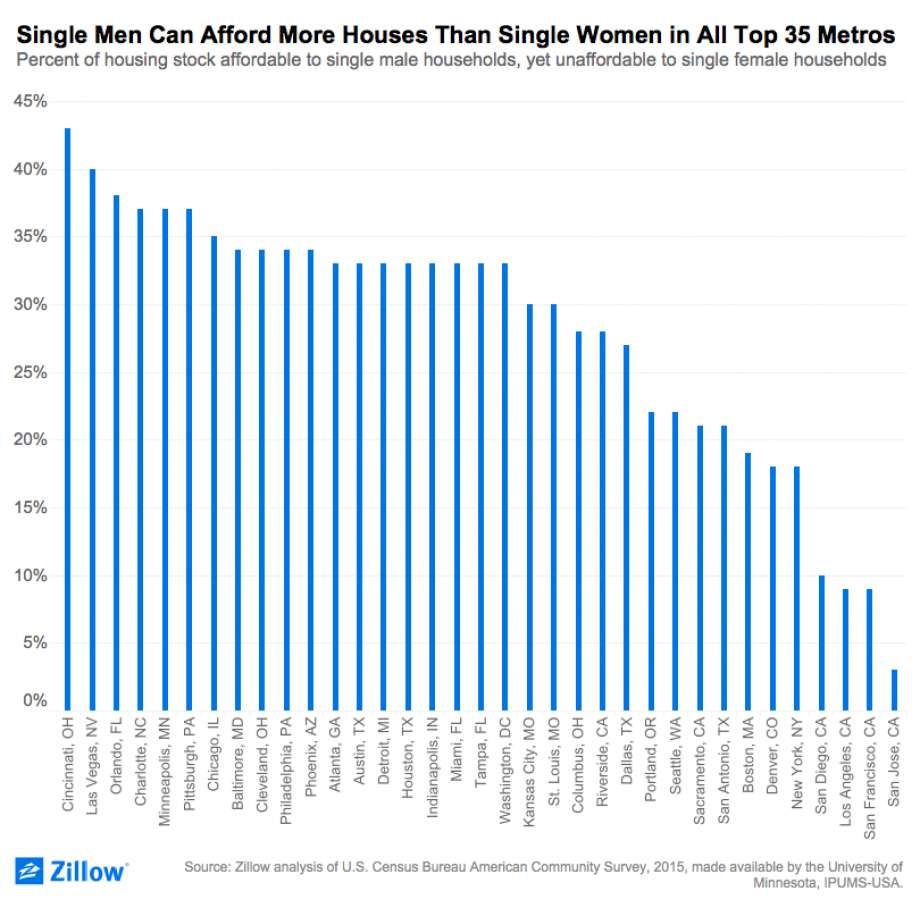
Zillow’s data on affordability is enough to make a single woman cry.

Zillow’s data on affordability is enough to make a single woman cry.

Photo: Zillow


If being single on Valentine’s Day isn’t enough of a slap in the face, this Zillow study may suit the masochist in you: According to the data, a single homebuyer needs 27.8 years to save for a down payment on a house in San Francisco, compared to 12.6 years for a couple.

The study

Zillow’s study combines numbers pulled from home prices in certain American metros in comparison with income in those metros, as reported in the most recent Census.

For purposes of determining how long it would take a single person to save for a downpayment in these cities, Zillow focused on a 20 percent down payment on the median-priced home, and projected that the buyer (single) or buyers (couple) would save 10 percent of their income every year.


Are you looking for housing in San Francisco? If you’re not up to date with some of the code words created by realtors, leasing agents, or landlords, you might find yourself in an unfortunate tenant situation. Here are some translations of code words found in SF Bay Area housing posts.


Media: San Francisco Chronicle


Clearly, the study only offers an estimate. Who can be sure their income will remain the same for any span of time? And since home prices won’t, that the relative income to median home price ratio will stay static?

Even so, SF numbers are enough to make a single person feel pretty bleak.

Local data

Zillow projects that in the San Francisco metro:

  • A single homebuyer needs 27.8 years to save for a down payment, compared to 12.6 years for a couple.
  • A single buyer could afford a $286329 home, or just 2 percent of homes.
  • A couple could afford to buy a $656277 home, or 33 percent of homes.
  • In San Jose, California, a single buyer would need more than 30 years to save for a down payment – longer than the lifespan of a typical home loan.

The study goes hand in dismal hand with another recent study highlighting the sharp uptick in renters vs buyers in the SF Bay Area and nation.

National data

Singles in American cities are largely out of luck if they seek to own a home, per this study:

The number of homes for sale is limited across the country, down nearly 11 percent over the past year, and nearly 18 percent for the least expensive homes. A single person could afford to buy less than half (45 percent) of the U.S. housing stock, compared to a married or partnered couple, who could afford 82 percent of all homes.

Portland, Oregon and Sacramento, California are the two hardest cities for single would-be homebuyers. In Portland, 73 percent of homes are affordable to a couple, but only 6 percent are affordable to a single buyer. In Sacramento, that same ratio is 75 percent vs 8 percent of homes.

Incidentally, Zillow also finds that single men can afford more homes than single women in all 35 metros studied.

The national depressing nutshell: a single homebuyer, on average in America, needs 11 years to reach a 20 percent down payment. For couples, it would take less than five years.

Anna Marie Erwert writes from both the renter and new buyer perspective, having (finally) achieved both statuses. She focuses on national real estate trends, specializing in the San Francisco Bay Area and Pacific Northwest. Follow Anna on Twitter: @AnnaMarieErwert

Article source: https://www.sfgate.com/realestate/article/San-Francisco-Bay-Area-housing-down-payment-12570800.php

Posted in SF Bay Area News | Tagged | Leave a comment