Lower income families priced out of California housing market – KGO

A new study confirms a trend that many have suspected.

With a median home price more than twice the national average, the Bay Area housing market is so expensive, many low and middle income families simply can’t afford to live here anymore.

It’s an economic cycle that’s driving low and middle income residents out of California. As home prices go up, those who can’t afford them leave, while those who can take their place.

VIDEO: Survey reveals 40 percent of Bay Area residents are thinking of leaving
“One million people net left California between 2006 and 2016,” said Noel Perry, the founder of Next 10, a non-partisan think tank that conducted a study for Beacon Economics on demographic shifts in California over the past decade.

“The San Francisco Bay Area was the only area that had a net inflow of people and the reason for that was because of the increasing number of high wage jobs,” explained Perry.

The study found disparate rates of wage growth among California workers over the past decade.

Wages rose just 17 percent for low-income workers, 29 percent for middle income and 43 percent for those at the high end.

RELATED: Oakland mayor says protecting the most vulnerable starts with housing

Deidre Joyner with Oakland’s Red Oak Realty acknowledges many of her sellers are moving away, but those determined to stay are finding ways to finance, including getting loans from family members.
“If you get creative, I’ve been able to get people into houses,” said Joyner, “And I also think part of it is not selling your family house.”

RELATED: SF home prices jump over 10 percent amid inventory shortage

Richard Marcantonio with San Francisco’s Public Advocates Inc says all Bay Area residents should be concerned about the changing demographics, including those at the higher end of the economic scale.

“Careworkers, nurses, teachers,” said Marcantonio, “We’re all impoverished when the people we need to fill those roles are not our neighbors.”

Part of the issue, between 2011 and 2016, California has added just 171 homes for every 1000 people.

Click here for more stories related to housing.

Article source: http://abc7news.com/realestate/lower-income-families-priced-out-of-calif-housing-market/3425645/

Posted in SF Bay Area News | Tagged | Leave a comment

Why the Bay Area is the epicenter of California’s housing crisis

2d1c7 sjm l migration 0503 90 Why the Bay Area is the epicenter of Californias housing crisisThe same story is playing out, over and over: People are flocking to the Bay Area for high-skilled, highly paid jobs, while cashiers, teachers and construction workers are, increasingly, saying goodbye to a place they no longer can afford.

A new study released Thursday points to why the California housing crisis is so acute, particularly in the Bay Area — where a home destroyed by fire sold for more than $900,000 and it would take four minimum wage jobs to afford an apartment: More people are moving in from other states than moving out. No other region in California has experienced such explosive growth of high-paying jobs. Statewide, between 2011 and 2016, California added just 171 homes for every 1,000 people.

“The boom is so ferocious that it exaggerates the driving up of the rents and the cost of living,” said Richard Walker, a geography professor emeritus at UC Berkeley and author of a new book, “Pictures of a Gone City: Tech and the Dark Side of Prosperity in the San Francisco Bay Area.”

The new research by Beacon Economics weaves together housing, economic and migration data, highlighting the underproduction of homes and cost pressures facing low- and middle-income workers amid the housing crisis. It examines the dilemma of the nation’s biggest economic engine, which is providing so much opportunity for some, while shutting so many out.

The study, commissioned by the San Francisco public policy group Next 10, documented a growing economic divide. While pay for California’s low-wage earners grew by just 17 percent over the past decade, wages rose by 29 percent for middle-income workers and nearly 43 percent for high-wage earners.

The key question for California is, “How do you manage the effects of success?” said Michael Storper, an economic geographer at UCLA’s Luskin School of Public Affairs. “At the moment we are a winner economy. California is amazing in how much it attracts high-wage, high-skill industries. Who wouldn’t want to be like that?”

At the same time, he said, how do you preserve housing for the majority of residents who don’t command high salaries? Or find a way to pay them more?

Carmelita Reyes, principal of Oakland’s International High School, said that when she started teaching in the city in 2001, many of the young teachers rented apartments by Lake Merritt.

“No one was getting rich being a teacher, but you could afford to live in Oakland,” she said. The narrative back then, she said, was “teachers are never going to buy a house. And now it’s `teachers can’t afford an apartment.’ ”

One of her teachers commutes from Napa County, where she found a cheap place to rent. A fellow Oakland principal has decided to open her home to travelers, renting out a bedroom on Airbnb.

Fed up with housing costs, some Californians are leaving the state altogether. The study found that between 2006 and 2016, more than 1 million more people left California for other states than moved in from the rest of the U.S.

“These high home prices and high rents are forcing more low and middle-income Californians to leave the state for more affordable housing in states like Texas and Washington and Arizona,” said Noel Perry, Next 10’s Founder.

Researchers found similar patterns for international migration: Higher-skilled migrants from other countries are replacing lower-skilled migrants in California.

And though the Bay Area has grown in recent years, that pattern may be shifting. The new study, along with a recent report from the Joint Venture Silicon Valley think tank, found that nearly as many people are leaving Silicon Valley as are coming in. The think tank found the biggest drops were for residents between the ages of 18 and 24, and between 45 and 64.

The Bay Area always has been a high-wage economy, Walker notes, but the latest boom has attracted such an enormous level of investment in tech and other lucrative sectors that “the whole thing has gotten out of hand.”

“You can’t keep that economy going — you can’t feed people, you can’t get them the things they want, you can’t deal with the tourists, you can’t drive buses — without lower and middle-income workers to do those kinds of jobs,” he said.

The Next 10 report did not include recommendations. Perry, its founder, said the study was intended to help state and local policymakers try to solve some of these challenges.

“In order to support long-term, sustainable economic growth in California, our state needs to support a diverse economy — that means jobs and housing for people at all income levels,” he said.

The insatiable demand for housing that has uprooted so many Californians is forcing an 80-year-old Pleasanton resident to leave the house he has rented for 46 years, his daughter said. Tricia Davis said her father and stepmother got a letter in April saying that they could stay in the home — if they agreed to a $1,000 rent hike. They considered moving to Montana, where Davis lives, and then to Fresno, near another relative, before discovering an apartment for people over 62, in town, that they could afford.

“For them to have to try to just move, it’s been pretty traumatic,” Davis said.

Davis, an agent for Delta Air Lines, said she long ago gave up on living in the East Bay city where she grew up. “Pleasanton, as great of a town as it is, even with a college degree I couldn’t afford to live there.”

Article source: https://www.mercurynews.com/2018/05/03/why-the-bay-area-is-the-epicenter-of-californias-housing-crisis/

Posted in SF Bay Area News | Tagged | Leave a comment

Bay Area home prices soar to new record

  • 3a750 920x920 Bay Area home prices soar to new record

Caption

Close


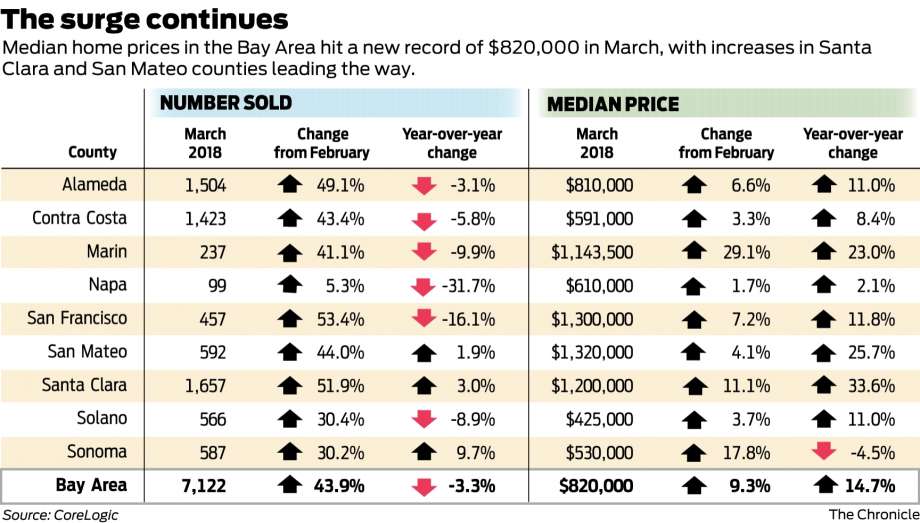
The median Bay Area home price surged to an all-time high of $820,000 in March, up 9.3 percent from February and up 14.7 percent from March of last year, research firm CoreLogic reported Tuesday.

The previous peak was $784,000 in November. The report includes newly built and existing homes and condos sold in all nine counties. For the past six months, the median price has risen 12.8 percent year over year on average.


For the fourth consecutive month, Santa Clara and San Mateo counties showed the steepest year over year gains: 33.6 and 25.7 percent, respectively.

New home construction in Silicon Valley hasn’t come close to keeping up with the growth in high-paying jobs. Facebook, based in Menlo Park, disclosed in an April 13 filing that its employees earned a median pay package of $240,430 last year.

More by Kathleen Pender

Rising mortgage rates and shrinking tax breaks for mortgages were expected to put a damper on home prices, but so far that has not proved to be true in the Bay Area.

The yield on the 10-year Treasury note, which serves as a benchmark for mortgage rates, surpassed 3 percent Tuesday for the first time since January 2014. Coincidentally, Freddie Mac reported on Thursday that the average 30-year fixed mortgage rate increased 0.05 percentage points to 4.47 percent last week, its highest level since January 2014.

The federal tax law passed in December was expected to discourage home buying. It limited the itemized deduction for all state and local property and income tax combined to $10,000 per year (previously there was no cap) and reduced the basic mortgage-interest deduction to interest on up to $750,000 in debt, from $1 million previously.

People “are trying to desperately buy something before it becomes completely unaffordable,” said Scott Anderson, chief economist with Bank of the West. “Six months, a year from now, you will see more of the downside from rising rates.”

A 650-square-foot home in South San Francisco with no garage that fronts an alley went on the market this month for $599,000, or nearly $1,000 per square foot. After a busy open house last weekend, listing agent Kent Flinn expects it to sell for much more.

South San Francisco, the erstwhile “industrial city,” and neighboring San Bruno have traditionally been two of the more affordable cities in San Mateo County, but like everywhere else in the Bay Area, “demand is heavy and supply is limited,” Flinn said.

As demand has grown in those cities, it also has changed. “It used to be a three-bedroom, two-bath home in a certain district would sell better in one area than another,” Flinn said. Today buyers “are less concerned about neighborhood and more about size.” They want enough space for their family or a spare room to rent out.

In the past, people didn’t want to live near Caltrain in those cities. Now it’s a draw. People want to be able to walk to BART or Caltrain, said Flinn’s wife and business partner, Beverly Flinn.

March’s 14.7 percent increase in median home prices across the region “was the highest year over year for any month since last September, when it was also 14.7 percent,” CoreLogic analyst Andrew LePage said.

That increase “is significant, and it stands out statewide and nationally, but there is a mix issue,” he said. The median price is the halfway point between the highest and lowest prices homes sold for in a particular month. In recent months, “there has been a shift toward more mid- to high-price homes selling and less in the lower end,” LePage said. That tends to raise the median price.
bc860 920x1240 Bay Area home prices soar to new record


The number of homes and condos sold last month was 7,122, up 43.9 percent from February but down 3.3 percent from last March. An increase between February and March is typical, as the spring selling season heats up. Since 1988, the average increase between those months is 39.8 percent, CoreLogic said.

But last month’s sales were 17.1 percent below the March average of 8,590 sales since 1988.

The Bay Area has been sheltered from rising rates and the new tax law because its housing market “is chronically undersupplied,” Anderson said.

The California Association of Realtors reported this week that the median time a home in the Bay Area sat on the market before an offer was accepted was just 12 days in March, down from 13 in February and 14 a year ago. At the current pace of sales, it would take just 1.9 months to sell every Bay Area home on the market, down from 2.6 months in February and 2.2 last March.

Home prices haven’t been hurt by rising mortgage rates because at 4.5 percent, they are still low by historical standards, said Aaron Terrazas, chief economist with Zillow, a real estate website. He expects mortgage rates will peak at 5.5 to 6 percent in a year or two.

“We think mortgage rates can go up to 5 percent or a little above before we see any headwind on the housing market,” Terrazas said. When that happens, “I don’t think it will cause a decline in prices; it will cause a slowdown (nationwide). The risks are bigger in the Bay Area because home prices are so high.”

On a $650,000 mortgage, going to 5 percent from 4 percent would add $386 to the monthly payment.

Anderson predicts that the new tax law eventually will depress home prices — by about 4 percent nationwide over two years — by raising the after-tax cost of homeownership. “In higher cost areas, the impact would be greater,” he said.

People have been leaving California for other states, but its population has continued to grow thanks to immigration from other countries and the natural increase from births minus deaths. But “we expect more out-migration from the Bay Area and the state as a result of high housing costs,” Anderson said. “I think by the end of this year,” the state’s population will decline for this first time in this economic expansion.

Kathleen Pender is a San Francisco Chronicle columnist. Email: kpender@sfchronicle.com Twitter: @kathpender

Article source: https://www.sfchronicle.com/business/networth/article/Bay-Area-home-prices-surge-median-now-820-000-12860694.php

Posted in SF Bay Area News | Tagged | Leave a comment

No surprises: Bay Area dominates list of best cities for real estate agents


  • 8b95f 920x920 No surprises: Bay Area dominates list of best cities for real estate agents

Caption

Close


15. Boston, Massachusetts

‘Job opportunity and competition’ rank: 7
Market health rank: 91

15. Boston, Massachusetts

‘Job opportunity and competition’ rank: 7
Market health rank: 91

Photo: Boston Globe/Boston Globe Via Getty Images


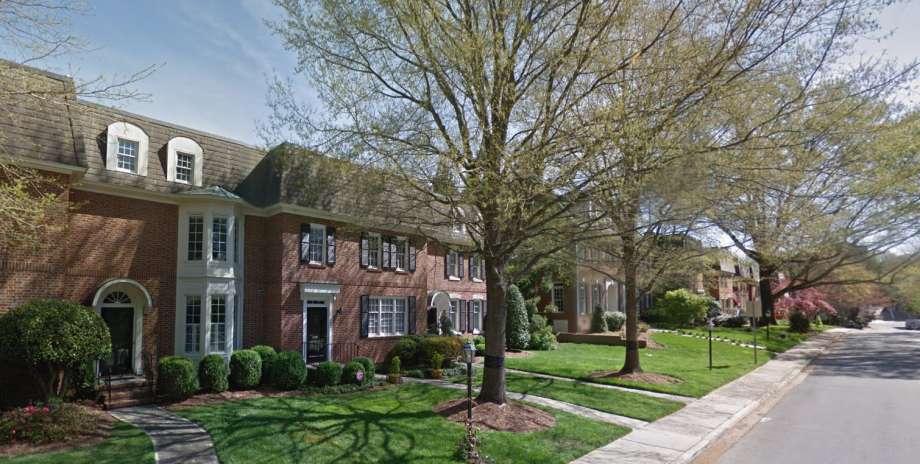
14. Charlotte, North Carolina 

‘Job opportunity and competition’ rank: 20
Market health rank: 15

14. Charlotte, North Carolina 

‘Job opportunity and competition’ rank: 20
Market health rank: 15

Photo: Google Street View


11. Irvine, California

‘Job opportunity and competition’ rank: 35
Market health rank: 4

11. Irvine, California

‘Job opportunity and competition’ rank: 35
Market health rank: 4

Photo: Geraldine Wilkins/LA Times Via Getty Images


9. Nashville, Tennessee

‘Job opportunity and competition’ rank: 40
Market health rank: 3

9. Nashville, Tennessee

‘Job opportunity and competition’ rank: 40
Market health rank: 3

Photo: Ray Sandusky / Brentwood, TN/Getty Images


6. New York City

‘Job opportunity and competition’ rank: 1
Market health rank: 157

6. New York City

‘Job opportunity and competition’ rank: 1
Market health rank: 157

Photo: Mario Tama/Getty Images


3. San Jose, California

‘Job opportunity and competition’ rank: 8
Market health rank: 5

3. San Jose, California

‘Job opportunity and competition’ rank: 8
Market health rank: 5


If the unending boom of  of West Coast real estate markets has made you think more than once about becoming an agent yourself, you’re probably wise.

A new ranking from financial data site WalletHub put says the West is home to all of the best places to be a real estate agent.

WalletHub looked at 170 U.S. cities and evaluated each on the health of the real estate environment. While San Francisco ranked in the top overall spot – thanks to the highest median price – it actually tied with both San Jose and Seattle for fewest days on the market.

For anyone who’s bought or sold a house in the Seattle area recently, that should be no surprise. Seattle’s median sale price rose to more than $736,000 in March, according to data from Zillow. And demand for housing remained stunningly high.

The city of Vallejo is one of the last Bay Area cities where real estate is affordable. But that may be changing. Tom Vacar reports.


Media: JW Player


The health of the market has been something on a lot of people’s minds, especially those who remember well the collapse that triggered the Great Recession. But all signs — continued population growth, shortage of available housing, growing interest rates and the continued rise in housing values — indicate the market will keep up as it has, at least for the foreseeable future.

RELATED: Analysis: Seattle has room for 56,000 affordable homes

We gathered the top 15 cities for real estate agents in the gallery above. Click through to see how they rank.


Daniel DeMay covers Seattle culture, city hall, and transportation for seattlepi.com. He can be reached at 206-448-8362 or danieldemay@seattlepi.com. Follow him on Twitter: @Daniel_DeMay.

Article source: https://www.sfgate.com/realestate/article/Seattle-one-of-best-cities-for-real-estate-agents-12878967.php

Posted in SF Bay Area News | Tagged | Leave a comment

Prologis, commercial real estate giant with Denver ties, snaps up competitor for $8.4 billion

Prologis, a global industrial real estate firm with offices in Denver, announced this week it has acquired a Denver-based competitor and its entire 71 million square-foot portfolio for $8.4 billion. 

The purchase, described in a news release as a “merger agreement,” was announced by Prologis and the now acquired DCT Industrial Trust in a news release Sunday.  The deal, which includes Prologis taking on DCT’s debt, was was stock-for-stock transaction.

Prologis said the buy, which brings in 215 acres of land under contract or option to be developed, strengthens its footprint in high-growth markets like Southern California, the San Francisco Bay Area, South Florida, Seattle and New York.

“DCT’s team is as good as it gets, and we expect a number to join us to help manage the portfolio, execute on
capital deployment activities and make long-term contributions to the Prologis platform,”  Eugene F. Reilly, Prologis CEO for the Americas, said in a news release. “This deal also diversifies our customer roster through the addition of some 500 new relationships.”

Its corporate headquarters is in San Francisco, but Prologis has an operations base in Denver’s Z Block development. It owns Prologis Park 70, a 5.7 million square-foot industrial park in Aurora that is home to Amazon’s first local fulfillment center.

Article source: https://www.denverpost.com/2018/04/30/prologis-dct-industrial-trust-denver/

Posted in SF Bay Area News | Tagged | Leave a comment