The best profession in the San Francisco Bay Area may not be what you think

?SAN FRANCISCO —

We often talk about tech as the most lucrative gig in the Bay Area, but real estate agents might give developers and project managers a run for their money.

The reasons for this should be obvious to anyone who lives in the Bay Area. Housing is expensive — the median home price reached a record high of $820,000 in March — and the housing stock is low. Seven-figure houses sell like hotcakes in a land where cash offers and overbids are commonplace.

To confirm what we already know, WalletHub created a new ranking of the best places to be a real estate agent. No surprises here: Bay Area cities claimed the top spots.

Standard real estate agent salaries are nothing to write home about; the average real estate agent wage in San Francisco is $74,460, according to WalletHub, but that’s not including commission. Experts estimate the typical real estate agent takes just under a 6 percent cut on sales, and San Franciscan real estate agents sell an average of 60 homes a year. You do the math.

WalletHub looked at 170 U.S. cities and evaluated each on the health of the real estate environment. While San Francisco ranked in the top overall spot, thanks to the highest median price, it tied with both San Jose and Seattle for fewest days on the market.

Four Bay Area cities made the top five, but one Pacific Northwestern outpost wedged its way to the No. 2 spot. That would be Seattle, of course, the headquarters of Amazon and a burgeoning tech capital. The coastal city’s housing market shattered records of its own in March, with the median home price hitting $777,000.

Even Santa Rosa, a city on the northern outskirts of the Bay Area, made the top 10, ranking seventh overall. The revelation provides support for a recent regional trend: People are pushing farther and farther away from San Francisco and the heart of Silicon Valley to more inland and suburban areas.

The health of the market has been on a lot of people’s minds, especially those who remember well the collapse that triggered the Great Recession. But all signs — continued population growth, shortage of available housing, growing interest rates and the continued rise in housing values — indicate the market will keep up as it has, at least for the foreseeable future.

Methodology here.

Daniel Demay, a SeattlePI staff writer, contributed to this report.

Michelle Robertson is an SFGATE staff writer. Email her at mrobertson@sfchronicle.com or find her on Twitter at @mrobertsonsf.

Article source: http://www.wmur.com/article/the-best-profession-in-the-san-francisco-bay-area-may-not-be-what-you-think/20197849

Posted in SF Bay Area News | Tagged | Leave a comment

Forget tech, this might be the best profession in the San Francisco …


  • c39ac 920x920 Forget tech, this might be the best profession in the San Francisco ...

Caption

Close

15. Boston, Massachusetts

‘Job opportunity and competition’ rank: 7
Market health rank: 91

15. Boston, Massachusetts

‘Job opportunity and competition’ rank: 7
Market health rank: 91

Photo: Boston Globe/Boston Globe Via Getty Images


14. Charlotte, North Carolina 

‘Job opportunity and competition’ rank: 20
Market health rank: 15

14. Charlotte, North Carolina 

‘Job opportunity and competition’ rank: 20
Market health rank: 15

Photo: Google Street View


11. Irvine, California

‘Job opportunity and competition’ rank: 35
Market health rank: 4

11. Irvine, California

‘Job opportunity and competition’ rank: 35
Market health rank: 4

Photo: Geraldine Wilkins/LA Times Via Getty Images


9. Nashville, Tennessee

‘Job opportunity and competition’ rank: 40
Market health rank: 3

9. Nashville, Tennessee

‘Job opportunity and competition’ rank: 40
Market health rank: 3

Photo: Ray Sandusky / Brentwood, TN/Getty Images


6. New York City

‘Job opportunity and competition’ rank: 1
Market health rank: 157

6. New York City

‘Job opportunity and competition’ rank: 1
Market health rank: 157

Photo: Mario Tama/Getty Images


3. San Jose, California

‘Job opportunity and competition’ rank: 8
Market health rank: 5

3. San Jose, California

‘Job opportunity and competition’ rank: 8
Market health rank: 5


We often talk about tech as the most lucrative gig in the Bay Area, but real estate agents might give developers and project managers a run for their money.

WalletHub created a new ranking of the best places to be a real estate agent. No surprises here: Bay Area cities claimed the top spots.

READ ALSO: To stay housed in the Bay Area, some families and their children turn to squatting

WalletHub looked at 170 U.S. cities and evaluated each on the health of the real estate environment. While San Francisco ranked in the top overall spot — thanks to the highest median price — it tied with both San Jose and Seattle for fewest days on the market.

Are you looking for housing in San Francisco? If you’re not up to date with some of the code words created by realtors, leasing agents, or landlords, you might find yourself in an unfortunate tenant situation. Here are some translations of code words found in SF Bay Area housing posts.


Media: San Francisco Chronicle


Four Bay Area cities made the top five, but one Pacific Northwestern outpost wedged its way to the number two spot. That would be Seattle, of course, the headquarters of Amazon and a burgeoning tech capital. The coastal city’s housing market shattered records of its own in March, with the median home price hitting $777,000. 

Even Santa Rosa, a city on the northern outskirts of the Bay Area, made the top 10, ranking seventh overall. The revelation provides support for a recent regional trend: People are pushing further and further away from San Francisco and the heart of Silicon Valley to more inland and suburban areas. Housing prices are cheaper on the edges of the Bay Area, but commutes are longer.

READ ALSO: Stunning increase in Bay Area ‘super commuters’ in the last decade amid housing crisis

The health of the market has been something on a lot of people’s minds, especially those who remember well the collapse that triggered the Great Recession. But all signs — continued population growth, shortage of available housing, growing interest rates and the continued rise in housing values — indicate the market will keep up as it has, at least for the foreseeable future.

Standard real estate agent salaries are nothing to write home about — the average real estate agent wage in San Francisco real estate agents is $74,460, according to WalletHub — but that’s not including commission (some agents only earn commission, and not a salary). Experts estimate the typical real estate agent takes about a 5-percent cut on sales, which is split with the broker of the listing agent and the broker of the selling agent. Then there’s state and federal taxes, plus regular overhead costs. A high amount of risk is also involved because as the market fluctuates — and it’s prone to do so — so do real estate agents’ incomes.

We gathered the top 15 cities for real estate agents in the gallery above. Click through to see how they rank.

Methodology here.

Daniel Demay, a SeattlePI staff writer, contributed to this report. 

Michelle Robertson is an SFGATE staff writer. Email her at mrobertson@sfchronicle.com or find her on Twitter at @mrobertsonsf.

Article source: https://www.sfgate.com/realestate/article/Forget-tech-the-cushiest-job-in-the-SF-Bay-Area-12879268.php

Posted in SF Bay Area News | Tagged | Leave a comment

If people are fleeing the Bay Area for cheaper housing, why is it still so costly?

  • e869b 920x920 If people are fleeing the Bay Area for cheaper housing, why is it still so costly?

Caption

Close


So which is it: Are people fleeing California and the Bay Area for cheaper housing, or swarming here for high-paying jobs?

The answer is: both. A flurry of recent population reports have painted a confusing picture.


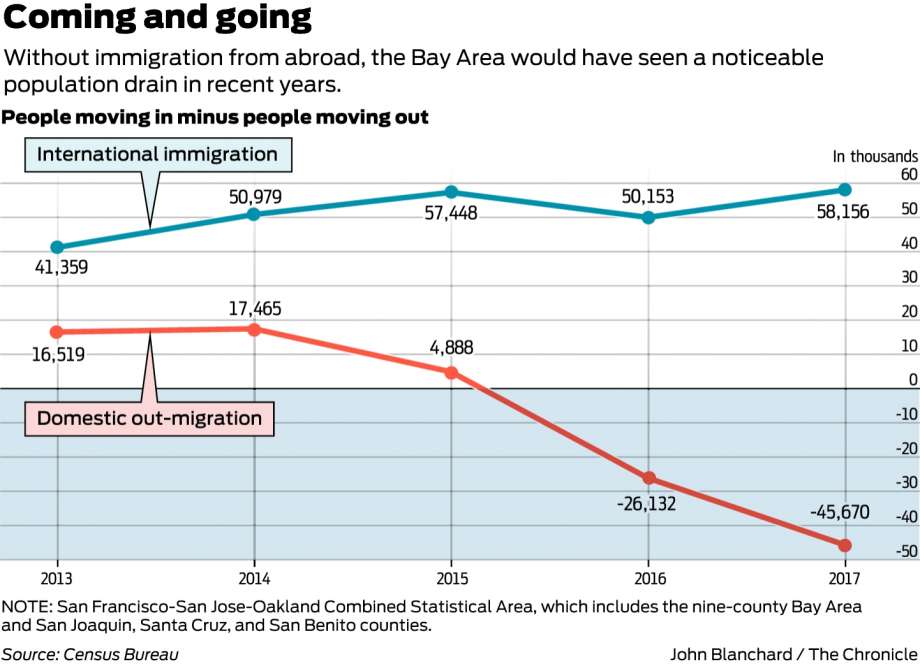
If you look just at domestic migration — people moving around the country — the Bay Area lost about 46,000 people more than it gained during the year that ended July 1, according to U.S. Census Bureau estimates released March 22. That net loss was nearly twice as big as the previous year and marked a turnaround from earlier years, when more people were coming to the Bay Area than leaving.


The national media pounced on this data — throw in some one-way U-Haul prices and dubious survey results — and declared that the Bay Area is losing its appeal, and fast. “They made it sound like the highways are jammed with people trying to get out of the Bay Area right now,” said Patrick Carlisle, chief market analyst with Paragon Real Estate Group. He summarized the coverage in a report, “Will the Last One Leaving Please Turn Out the Lights?”

So if people are leaving the Bay Area in droves, why are home prices still soaring and why aren’t there more houses for sale?

One thing these stories mostly failed to mention is that net immigration — people coming from and leaving for other countries — is still positive in the Bay Area. About 58,000 more people came here from abroad than left last year, surpassing the nearly 46,000 who decamped for other states. (The census estimates included the nine-county Bay Area and three neighboring counties.)

Another reason is that people moving here tend to have higher incomes than people moving out, and so are better able to absorb the ridiculous cost of housing.

Linda Crowe moved from the Bay Area to Boston for a job three years ago, but moved back in December because she missed her friends and community. “I worked my entire career in technology, and a lot of my professional network was here,” she said. And the weather “is so much nicer here.”

She landed a job with IBM, and bought a home in San Francisco’s Cole Valley. It helped that she sold her home in San Carlos a year and a half ago, after renting it out the first year and a half she was gone.

Crowe said housing is somewhat cheaper in Boston, but “I make more money here. Salaries are significantly higher in the Bay Area, particularly in the technology sector. They have to be.”
54f39 920x1240 If people are fleeing the Bay Area for cheaper housing, why is it still so costly?


California has had net domestic out-migration for a much longer period. Since at least 1991, it has lost more people to other states than it has attracted almost every year, according to the California Department of Finance.

Net immigration over that period has been consistently positive — in the hundreds of thousands per year — but it wasn’t always big enough to outweigh domestic out-migration. In 2005 through 2010, the state lost more people to other states and countries combined than it gained each year. But its total population has still grown each year since at least 1991, thanks to “natural” increase — births minus deaths.

More Net Worth

It’s impossible to say definitively why people move out of the area, since there’s no exit poll. A report released last week tried to explain why California, by its calculation, lost nearly 1.1 million more people to other states than it gained from 2006 to 2016.

The report, prepared by Beacon Economics for San Francisco think tank Next 10, looked at housing, migration and employment trends.

It concluded that “the main driver for net out-migration appears to be high housing costs,” not high state income taxes. That’s because the “vast majority of people who moved out of California were concentrated in lower-skilled, lower-paying fields, namely sales, transportation and food preparation.” People moving out probably paid little or no state income tax because California’s tax structure is highly progressive.

7d1ff 920x1240 If people are fleeing the Bay Area for cheaper housing, why is it still so costly?


People moving into the state are higher-income and better educated. They’re much more likely to pay state income tax and better able to afford a home in California, which had the nation’s highest median price in 2016.

“California has seen a net inflow of residents who earn more than $50,000 annually, have bachelor’s or advanced degrees, and work in high-skilled occupations. This is especially true for the Bay Area, where high salaries and abundant job opportunities outweigh the high cost of living,” the report said.

Most places want their working-age population to expand, because economic growth is the sum of growth in the labor force plus productivity growth, said economist Mike Englund of Action Economics.

California benefits from an inflow of younger people (thanks largely to immigration) because they have a future in the labor force. But if a region’s infrastructure does not match the population, problems ensue.

In the Bay Area, housing creation has lagged far behind population growth, which is why home prices and rents are skyrocketing and people are commuting longer distances to work.

But it can also go the other way. “If you build an infrastructure for 1 million and the population drops by half, you still have all the infrastructure to maintain but fewer people to pay for it,” Englund said.

Detroit, he said, “was a classic example of a city designed for one population and ending up with another.” During the recession you could pick up homes in Detroit for $1.

It’s enjoying something of a resurgence now. LinkedIn, based in Mountain View, said last week that it has leased a historic 74,500-square-foot building in Detroit and will expand its workforce there from about 40 to 120 over the next two years.

Although California and the Bay Area still have growing populations, the recent spike in domestic out-migration is raising concerns. The federal tax law passed in December could encourage people to move from California and other higher-tax states to lower-tax states, because the new law severely limits the federal deduction for state and local income and property tax.

In addition, “changes to (federal) immigration policy would likely reduce the growth we get from international migration,” said Jed Kolko, chief economist with job site Indeed. A big drop in immigration, however, “might be offset by less domestic out-migration” because fewer people would be competing for housing, and home prices and rents might drop.

The top five states for outbound Californians in 2016 were Texas, Arizona, Nevada, Oregon and Washington, according to Next 10. These states created an average of 231 new housing units for every 1,000 new residents from 2011 to 2016. California added just 209.

“California is permitting roughly the same number of housing units as Florida, despite having approximately 18 million more residents,” the report said. It added that “the housing shortage would be even worse” if there were no domestic out-migration.

After retiring from a career in technology, Jim DeStefano, 71, sold his San Jose home in December and moved to Fort Myers, Fla. He said he wanted a “better quality of life” and a “less liberal environment.”

Property taxes are higher in Florida, he said, but housing costs about one-third what it does in the Bay Area.

Moving was stressful, and expensive, but worth it, he said. “I haven’t seen one iota of graffiti, no litter on the streets. I haven’t seen a homeless person.”

Kathleen Pender is a San Francisco Chronicle columnist. Email: kpender@sfchronicle.com Twitter: @kathpender

Article source: https://www.sfchronicle.com/business/networth/article/If-people-are-fleeing-the-Bay-Area-for-cheaper-12889909.php


Posted in SF Bay Area News | Tagged | Leave a comment

Rise in PACE lending for commercial real estate lifts Marin’s CleanFund, Sonoma’s Ygrene

Value-added commercial real estate investments have the promise of significant upside with the right amount of TLC and market repositioning.

But the prospect of shelling out money to fix or upgrade things tenants often don’t see can be a tough sell.

Now a Marin County-based investor is finding help from a relatively new layer of a property’s “capital stack”: property-assessed clean energy, or PACE, loans.

San Rafael-based Seagate Properties just inked 30-year PACE loans through Sausalito-based CleanFund for upgrades to two Marin office buildings. Seagate’s portfolio currently includes 2,500 apartments in the Denver area and about 2 million square feet of commercial, office, retail and industrial space in the San Francisco Bay and Sacramento areas.

On its 32,000-square-foot 3030 Bridgeway Building in Sausalito, Seagate installed a 76,000-kilowatt solar electricity array. And at its 11,300-square-foot headquarters building at 980 Fifth Ave. in San Rafael, Seagate put a 49,600-kilowatt photovoltaic array plus a new roof and more-energy-efficient boilers, chillers and mechanical systems.

“It makes economic sense, because you can upgrade buildings and lower the cost of operations,” said Mark Polite, one of three partners at Seagate. “Through PACE, you’re paying for the time you own the building, versus forever.”

As “clean energy” in the name suggests, PACE financing focuses on energy-efficiency projects. It is tied to the property, not the current owner. The loans actually are tax assessments, paid back via the local property-tax authority. The Bay Area helped pioneer PACE financing, and the first voluntary-assessment districts were set up in California in 2008. The Sonoma County Energy Independence Program was launched in early 2009.

The two main varieties of PACE financing are residential (R-PACE) and commercial (C-PACE). Currently, 33 states and the District of Columbia have allowed for PACE financing by law, according to booster PACEnation, which has a board that includes funders such as CleanFund and Petaluma’s Ygrene Energy Fund. C-PACE programs are active in 20 states and D.C., and four more states are developing them. Only three states have R-PACE programs: California, Florida and Missouri.

“Most of these improvements have a 20- to 30-year life,” Polite said. “If you buy a building and own it for 10 years, you’re paying only for the 10 years you own it, then the next owner pays for the next 10 years.”

Pricing for PACE financing often comes in above what’s available from traditional lenders, such as banks, but below equity or “mezzanine” funding often used for property acquisition.

Polite said PACE financing makes it more feasible for a building owner to pursue LEED certification or higher Energy Star ratings. Such loans also can fund geothermal heating and cooling systems, dual- or triple-pane windows, and additional rigid insulation.

“All those flow directly to the bottom line as an owner in saving on expenses,” Polite said. “Also, as agents go out to talk to tenants, that’s another box to check for what tenants are looking for. Every real estate investor and operator sees benefit in putting money into cosmetics and the interiors, but it’s hard to put money into the guts of a building. This makes it an easier decision.”

Energy-efficiency is high on the list of priorities for a growing number of Bay Area tenants, because they want to promote their actions to reduce climate change, Polite said.

Seagate is exploring other properties where PACE-funded upgrades may make sense.

Tracking the PACE

Volume of property-assessed clean energy lending for 2017 and cumulative through April 2018.

Commercial PACE (C-PACE)

2017: $240 million (up 70% from 2016)

2010–YTD 2018: $588 million

Residential PACE (R-PACE)

2017: $1.26 billion (up 37% from 2016)

2010–YTD 2018: $4.89 billion

Source: PACENation

Article source: http://www.northbaybusinessjournal.com/northbay/sonomacounty/8287639-181/commercial-real-estate-pace-lending

Posted in SF Bay Area News | Tagged | Leave a comment

Rise in PACE lending for commercial real estate lifts Marin’s CleanFund, Sonoma’s Ygrene

Value-added commercial real estate investments have the promise of significant upside with the right amount of TLC and market repositioning.

But the prospect of shelling out money to fix or upgrade things tenants often don’t see can be a tough sell.

Now a Marin County-based investor is finding help from a relatively new layer of a property’s “capital stack”: property-assessed clean energy, or PACE, loans.

San Rafael-based Seagate Properties just inked 30-year PACE loans through Sausalito-based CleanFund for upgrades to two Marin office buildings. Seagate’s portfolio currently includes 2,500 apartments in the Denver area and about 2 million square feet of commercial, office, retail and industrial space in the San Francisco Bay and Sacramento areas.

On its 32,000-square-foot 3030 Bridgeway Building in Sausalito, Seagate installed a 76,000-kilowatt solar electricity array. And at its 11,300-square-foot headquarters building at 980 Fifth Ave. in San Rafael, Seagate put a 49,600-kilowatt photovoltaic array plus a new roof and more-energy-efficient boilers, chillers and mechanical systems.

“It makes economic sense, because you can upgrade buildings and lower the cost of operations,” said Mark Polite, one of three partners at Seagate. “Through PACE, you’re paying for the time you own the building, versus forever.”

As “clean energy” in the name suggests, PACE financing focuses on energy-efficiency projects. It is tied to the property, not the current owner. The loans actually are tax assessments, paid back via the local property-tax authority. The Bay Area helped pioneer PACE financing, and the first voluntary-assessment districts were set up in California in 2008. The Sonoma County Energy Independence Program was launched in early 2009.

The two main varieties of PACE financing are residential (R-PACE) and commercial (C-PACE). Currently, 33 states and the District of Columbia have allowed for PACE financing by law, according to booster PACEnation, which has a board that includes funders such as CleanFund and Petaluma’s Ygrene Energy Fund. C-PACE programs are active in 20 states and D.C., and four more states are developing them. Only three states have R-PACE programs: California, Florida and Missouri.

“Most of these improvements have a 20- to 30-year life,” Polite said. “If you buy a building and own it for 10 years, you’re paying only for the 10 years you own it, then the next owner pays for the next 10 years.”

Pricing for PACE financing often comes in above what’s available from traditional lenders, such as banks, but below equity or “mezzanine” funding often used for property acquisition.

Polite said PACE financing makes it more feasible for a building owner to pursue LEED certification or higher Energy Star ratings. Such loans also can fund geothermal heating and cooling systems, dual- or triple-pane windows, and additional rigid insulation.

“All those flow directly to the bottom line as an owner in saving on expenses,” Polite said. “Also, as agents go out to talk to tenants, that’s another box to check for what tenants are looking for. Every real estate investor and operator sees benefit in putting money into cosmetics and the interiors, but it’s hard to put money into the guts of a building. This makes it an easier decision.”

Energy-efficiency is high on the list of priorities for a growing number of Bay Area tenants, because they want to promote their actions to reduce climate change, Polite said.

Seagate is exploring other properties where PACE-funded upgrades may make sense.

Tracking the PACE

Volume of property-assessed clean energy lending for 2017 and cumulative through April 2018.

Commercial PACE (C-PACE)

2017: $240 million (up 70% from 2016)

2010–YTD 2018: $588 million

Residential PACE (R-PACE)

2017: $1.26 billion (up 37% from 2016)

2010–YTD 2018: $4.89 billion

Source: PACENation

Article source: http://www.northbaybusinessjournal.com/northbay/sonomacounty/8287639-181/commercial-real-estate-pace-lending

Posted in SF Bay Area News | Tagged | Leave a comment