No easy sailing to restore Embarcadero’s piers

The underlying dilemma of San Francisco’s Embarcadero — an abundance of desires for using its historic piers but a scarcity of resources to make things happen — was on full view Tuesday at the city’s Port Commission.

Port officials described the range of the 52 responses to the “request for interest” received last month, while proponents of various concepts made their case. The commissioners who oversee the autonomous city agency, though, focused on how to move from ideas to implementation.

“It’s obvious this is an exciting opportunity with lots of interest,” commission President Kimberly Brandon told port staffers at the end of the session. “Your team has a lot of work to do.”

The unusual public exercise is part of a larger effort to restore and upgrade more than a dozen underused piers along the 3-mile Embarcadero — a bayside promenade that in the past 20 years has become a cherished Bay Area destination. However, there’s also a wish to provide space for activities that probably wouldn’t generate the revenues to bring the century-old structures up to current codes.

This goal was a priority of the advisory committee that spent the past three years discussing how best to update the port’s waterfront land use plan from 1997.

“We heard loud and clear from our working group that they want more piers open to a wider variety of uses,” said Rebecca Benassini, the port’s manager for the project.

Her presentation touched on a few of the ideas submitted, emphasizing they were not formal proposals and that no detailed financial information was required. The mix included miniature golf and in-bay swimming pools, a variety of museums, and pitches from a pasta maker and a purveyor of Japanese street food.

Benassini also acknowledged interest from developers who might seek to devote much of a pier to private offices while including waterfront walkways and public activities.

“The reason we need these partners is that our capital resources are limited,” Benassini said of the port, which is financially independent and has limited access to city funds. “We can’t do these projects on our own.”

Port officials are aiming to launch a formal set of requests for proposals in the spring. That was one reason for Tuesday’s presentation at this year’s final port commission hearing.

One approach would be to focus on two or three piers that seem popular, ask for proposals and see what comes in. Another would emphasize desired activities rather than specific piers.

Ideas for the piers

The Port of San Francisco’s Embarcadero Historic District Facilities Request for Interest — and the set of 52 responses — is at www.sfport.com.

After The Chronicle’s piece on the topic last week, several readers chimed in with ideas of their own:

“Just thought I would throw in Art Agnos’ idea for retrofitting a retired cruise ship and docking it at one of these dilapidated piers” to provide housing and service for homeless people, wrote John Hogg of Larkspur, referring to a proposal floated by the former mayor in 2016.

“Whatever final decision is made for the development of the piers, at least one pier should include a public fish market, similar to Pike Place in Seattle,” suggested San Francisco resident Bruce Slesinger.

“Barges could be purchased and retrofitted with hotel trappings,” according to Glenn Rogers of San Francisco. Among the advantages: “Boats would rise and fall with the tide. … Many future problems caused by climate change would be eliminated.”

Steve Lawton of Hercules was succinct: “More clam chowder.”

“One criteria might be, ‘We want an active recreational use,’” Benassini said in response to a question from port commissioner Gail Gilman. “Another might be (to tell would-be developers), ‘We bring certain categories of people to the Embarcadero already. Bring us a use for different members of the public.’”

Members of one such segment — the city’s tennis players — turned out in support of an idea floated by Alexandria Real Estate Equities and the Bay Club to convert Pier 29 into an indoor tennis facility.

“There’s an opportunity to reuse Pier 29 in a way that attracts national attention,” Steve Jamison, a longtime member of the San Francisco Tennis Club, told the commission. He said that the courts could be used by low-income city youth at times and there could be a Bay Area-focused tennis museum: “A combination of these elements would be a sensation if done right.”

Also on hand was Dianne Washington, part of a team that would like to see space reserved for what it calls “the International House of Prayer for Children.”

“There’s a great need in San Francisco, as well as the nation, for people to learn how to pray,” said Washington, a teacher in Marin. “It allows children to be who they are.”

People have until Jan. 31 to respond to the current batch of ideas. The commission will then decide what course to pursue — which would open up additional rounds of reviews if the commission does seek proposals for specific piers or uses.

“We’re still interacting with the public,” Benassini said. “This isn’t over by any means.”

John King is The San Francisco Chronicle’s urban design critic. Email: jking@sfchronicle.com Twitter: @johnkingsfchron

Article source: https://www.sfchronicle.com/bayarea/article/Range-of-ideas-from-public-on-suggestions-for-13461980.php
Posted in SF Bay Area News | Tagged | Leave a comment

Police deem bomb threats to businesses across SF not credible


Police have determined that a chain of bomb threats sent over email Thursday morning were not credible after searching nearly 20 locations across San Francisco.

A seemingly random assortment of businesses around The City received an anonymous threat in the email at around 10 a.m., according to Sgt. Michael Andraychak, a police spokesperson. Andraychak said police have searched every business that reported the threat to authorities.

“No suspicious devices have been found,” Andraychak said. “If no device is found then I would have to say that it’s not a credible threat.”

The threats were not only reported in San Francisco but in other cities across the U.S. Andraychak said the San Francisco Police Department is cooperating with an FBI investigation into the emails.

In San Francisco, the locations included corporate offices, a technology company and a parking garage. Andraychak declined to provide details of the emails but said all were similar.

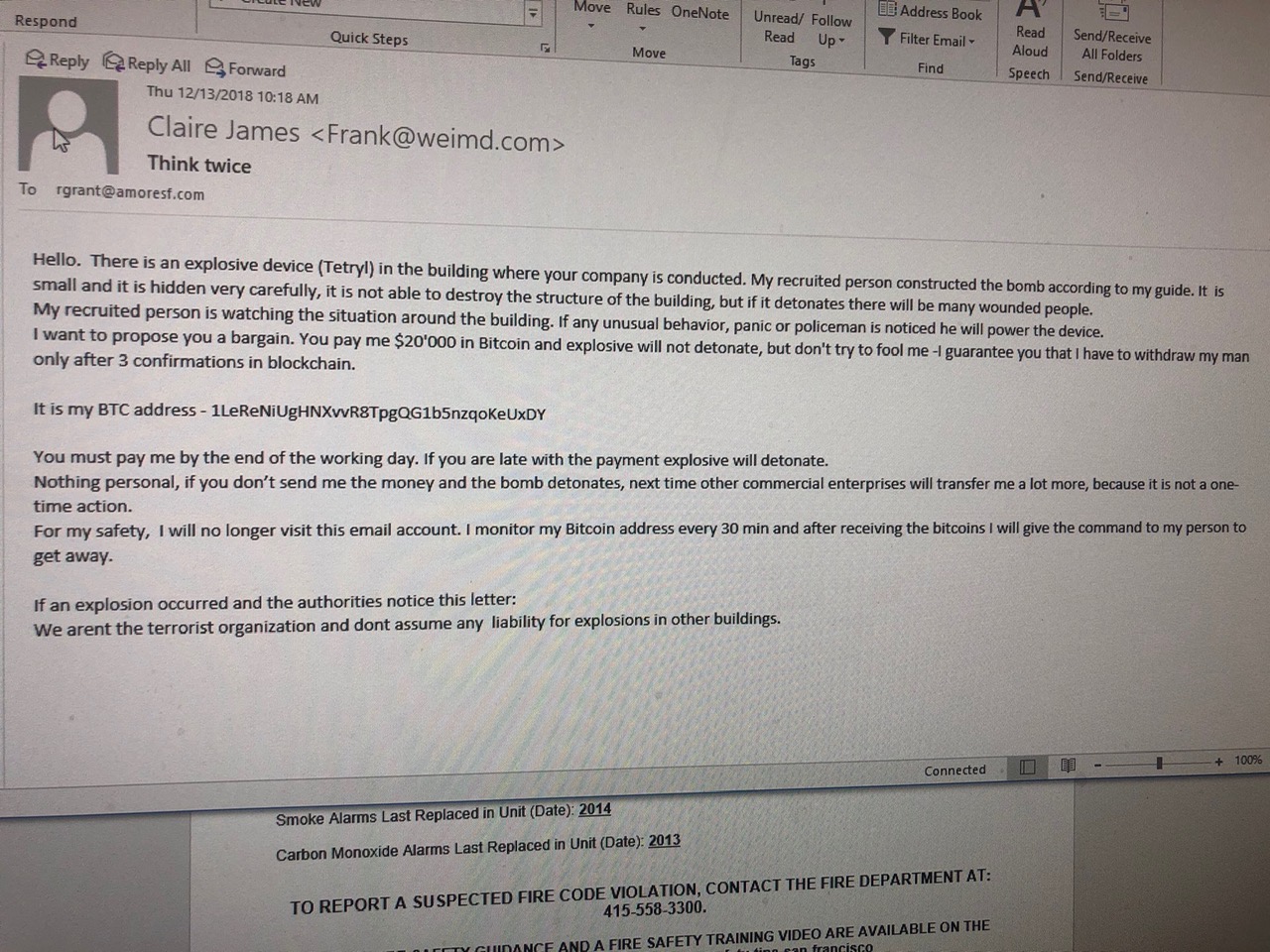
Ryan Grant, an employee at Amore Real Estate near the Marina, said he received a bomb threat in his email. The message had the subject line “Think twice.”

“There is an explosive device (Tetryl) in the building where your company is conducted,” the email read. “It is small and it is hidden carefully, it is not able to destroy the structure of the building, but if it detonates there will be many wounded people.”

The email demanded $20,000 be sent in Bitcoin by the end of the day.

“To be honest my office made a joke out of it just because we’ve all received scam emails before but never a threat as large as this,” Grant said. “Of course terrorism is no laughing matter, and I hope whoever is behind this scam is brought to light. I’m sure this email scared a number of San Franciscans.”

039ed IMG 4157 Police deem bomb threats to businesses across SF not credible

(Courtesy Ryan Grant @TheeRyanGrant )

Supervisor Aaron Peskin said he was briefed on the matter by police, who told him that the email threats demanded $20,000.

As of morning, Peskin said the threats had been sent to four businesses in the Central Police District, four in the Southern Police District and one in the Richmond Police District.

Among the places that received the threats were One Maritime Plaza, an office tower in the Financial District, 360 Post St., a retail and office building in Union Square and 609 Sutter St., where the Marine’s Memorial Club is located, according to Peskin.

The Jewish Community Center, which is located on California Street near Presidio Avenue, posted on Facebook that the San Francisco Fire Credit Union across the street had received a bomb threat.

mbarba@sfexaminer.com

This story has been updated to include additional information.

Click here or scroll down to comment


<!–

(function() {
var referer=”";try{if(referer=document.referrer,”undefined”==typeof referer)throw”undefined”}catch(exception){referer=document.location.href,(“”==referer||”undefined”==typeof referer)&&(referer=document.URL)}referer=referer.substr(0,700);
var rcel = document.createElement(“script”);
rcel.id = ‘rc_’ + Math.floor(Math.random() * 1000);
rcel.type = ‘text/javascript’;
rcel.src = “http://trends.revcontent.com/serve.js.php?w=67023&t=”+rcel.id+”&c=”+(new Date()).getTime()+”&width=”+(window.outerWidth || document.documentElement.clientWidth)+”&referer=”+referer;
rcel.async = true;
var rcds = document.getElementById(“rcjsload_65947b”); rcds.appendChild(rcel);
})();
–>


<!–

–>


Article source: http://www.sfexaminer.com/police-respond-series-bomb-threats-demanding-20k-across-sf/

Posted in SF Bay Area News | Tagged | Leave a comment

Novato: A Glimpse into Marin’s Development Pressures

The town is a microcosm of what’s going on in the North Bay

94550 1%2Aukw14 rAasw0h33yb4WZqg Novato: A Glimpse into Marins Development Pressures

 Novato: A Glimpse into Marins Development Pressures
Photo courtesy of the Novato Visitor’s Center

The North Bay tends to fly under the radar in most discussions about tech and the ever-rising costs of living in the Bay Area. But there’s a lot of change going on in Marin?—?and not everyone, as you’d expect, is a fan of it.

Take Novato, a town just north of San Rafael, where I lived for 21 years. Despite being a city of nearly 56,000 people, it has a look and self-image that have always been very much small town. However, that may be quickly shifting. I’m constantly fielding questions from people who are curious about the feasibility of moving to northern Marin, especially young workers packed into apartments in SF. The commute is unappealing, yes. But a tight-knit community completely surrounded by open space where you can still buy a detached home for under $1 million? That sounds intriguing to a lot of people.

The trend isn’t new; tech workers have been catching on to Novato’s appeal for a while now, given that it’s still somewhat affordable; the schools are excellent; hiking trails (and nature in general) are plentiful; and Point Reyes and Tomales Bay are just a 15-minute drive through the hills and dairy farms of west Marin. The downtown area, Old Town Novato, has a decent mix of solid restaurants you’d expect to find in the Bay Area: sushi, Thai, Indian and Mexican, as well as wine bars and beer joints.

The attractive mix of rural and urban has been catching the attention of Bay Area businesses, too, that don’t want to pay SF’s exorbitant commercial real estate prices. Gaming companies, start-ups and?—?for some reason?—?especially biotech firms are taking over much of the office space and light-industrial buildings around the area, including in Petaluma and San Rafael.

This clash is one taking place throughout the North Bay, and Novato is just one example of a place where these larger forces are at work.

The SMART train, which began service between Sonoma County and downtown San Rafael in 2017, made commutes within the North Bay easier and shorter for many. That added to the perception among locals that the balance between the old and the new is shifting.

Not surprisingly, these urbanizing trends and Novato’s population growth?—?up around 20 percent since 1990?—?are bringing changes that are only likely to accelerate. In recent years, development pressures have sharpened tensions between longtime residents and newer arrivals. Older Novatans, who remember riding their horses through town when Redwood Boulevard was still highway 101, regard the YIMBY (“Yes in My Backyard”) attitude—the favoring of dense housing as a solution to rising rent?—?as unwelcome.

This clash is one taking place throughout the North Bay, and Novato is just one example of a place where these larger forces are at work.

Article source: https://thebolditalic.com/novato-a-glimpse-into-marins-development-pressures-7d7aede8b5c1

Posted in SF Bay Area News | Tagged | Leave a comment

WeWork opens SF headquarters in Salesforce Tower

WeWork has opened offices in San Francisco’s Salesforce Tower — another milestone for a young company that is now the city’s fourth-largest office tenant.

The three-story space in the city’s tallest building isn’t just rented out to clients; it will house a major cluster of WeWork employees, and will share headquarters status with New York, where the company was founded in 2010.

In less than a decade, WeWork has become the world’s largest operator of co-working space. It has transformed real estate around the world by building out shared offices and renting them out to both single-person startups and major companies like Facebook and Bank of America.

WeWork says it now has 1.43 million square feet leased and owned in San Francisco, behind only Salesforce, Wells Fargo and Uber, according to brokerage data. WeWork has almost twice as much space in San Francisco as it did at the end of last year, and also has offices in Berkeley, Emeryville, Mill Valley, Mountain View, Oakland, San Mateo and San Jose.

 WeWork opens SF headquarters in Salesforce Tower

WeWork arrived in San Francisco in 2011 with a small deal in a century-old six-story building at 156 Second St., just a few blocks from Salesforce Tower.

“The original roots of WeWork in San Francisco are a much more old-school building,” said Jon Slavet, WeWork managing director of U.S. and Canada West. Salesforce Tower “is a bridge to the future of the city,” he said.

The Salesforce Tower location will have around 700 desks, with half occupied by WeWork staff, including an engineering team that will work on building technology systems.

The other half will be co-working space, which is sold out despite having one of the most expensive rates in the world. A single desk is $800 per month and a private office starts at $1,400 per month, according to WeWork’s website.

WeWork will open a fitness club, called Rise by We, along with a coffee shop in the space in the next few months. The company also plans to hold a communal meal each week for co-working customers and employees. WeWork is also planning to host nonprofits in the space, as it does in other locations.

 WeWork opens SF headquarters in Salesforce Tower

Slavet said WeWork is competitively priced compared with traditional long-term leases.

“Our business is full speed ahead. We continue to have record-breaking months for new members globally,” Slavet said.

Last month, the Japanese conglomerate Softbank agreed to invest $3 billion in WeWork, valuing the privately held company at $45 billion — making it the second most valuable U.S. startup behind Uber, according to the Wall Street Journal.

Real estate experts say WeWork and other co-working operators will suffer if a recession hits, and recent stock market volatility has made investors nervous. Many of WeWork’s deals have been signed as office rents have set records in the Bay Area.

“The economic downturn is the biggest risk,” said Colin Yasukochi, research director at brokerage CBRE in San Francisco. “There is going to be less demand for office space. How much it affects the different users and owners of real estate — that’s something that’s difficult to ascertain.”

But premier buildings like Salesforce Tower have advantages during recessions, he said.

“The highest-quality locations and assets tend to perform better during an economic downtown,” said Yasukochi.

Slavet said WeWork is well positioned because it’s offering short-term deals and working with larger businesses.

“In the midst of a correction, what do companies want? Flexibility. We offer that,” he said.

Roland Li is a Chronicle staff writer. Email: roland.li@sfchronicle.com Twitter: @rolandlisf

Article source: https://www.sfchronicle.com/business/article/WeWork-opens-SF-headquarters-in-Salesforce-Tower-13455609.php

Posted in SF Bay Area News | Tagged | Leave a comment

SF supervisor’s bill takes aim at illegal home demolitions

A San Francisco lawmaker is pushing back against what he says is the growing trend of real estate speculators illegally knocking down homes and replacing them with much larger and more expensive “monster” houses.

On Tuesday Supervisor Aaron Peskin will introduce the Housing Preservation and Expansion Reform Act, legislation that increases fines for illegal demolitions and also requires a conditional use authorization for any home expansion that increases the square footage by more than 10 percent.

The bill comes after several high-profile, historic homes have been essentially demolished through “serial permitting” — a practice of pulling multiple permits for smaller remodels that if, taken together, are tantamount to allowing a new building.

The legislation is “aimed at preserving the most affordable housing that San Francisco has, creating incentives for more density at neighborhood scale, and punishing and holding accountable bad actors who have been demolishing some of the city’s most important housing stock,” Peskin said.

Examples of homes that have been demolished without permits include a Willis Polk-designed home at 950 Lombard St. on Russian Hill and the 1935 modernist home at 49 Hopkins Ave., which was designed by Richard Neutra.

At 49 Hopkins, which was a 1935 modernist residence just east of Twin Peaks, an investment group that bought the property filed an application to demolish the home but not until two months after it had already been knocked down.

In the case of 950 Lombard, developer Troon Pacific purchased the home for $4.5 million and proceeded to remove all of the building’s exterior walls and windows, even though the permit mandated that the northeast and west facades be preserved, including the windows. The developer eventually agreed to pay a fine of $400,000 for the illegal work. The home is now on the market for $45 million.

The legislation comes at a time when the city, over the past 10 years, has averaged the loss of about 350 rent control housing units a year through a combination of evictions, mergers and demolitions. That represents about six units lost for every new affordable housing unit created, according to a recent city housing balance report.

“The biggest piece to take away is that this will help preserve existing housing that our city can’t afford to lose to the speculative market,” said Maya Chupkov, a spokesperson for the Council of Community Housing Organizations, which advocates for affordable housing and supports Peskin’s bill. “Monster homes fuel speculative development and the displacement of residents in our neighborhoods.”

The legislation also takes aim at developers who use “dry rot” as an excuse to tear down homes. Under the legislation, a city inspector would have to inspect the dry rot and sign off on a plan to remove it. It also targets “sham mergers” — where two or three units are essentially morphed into a single jumbo unit even though the units are still legally separate.

“You don’t technically lose a unit if it shrinks to 10 percent of it’s original size, but for all intents and purposes, it’s lost,” said Lee Hepner, an attorney and aide to Peskin who spent a year working on the legislation.

Peskin said that inconsistent definitions of “demolition” and inadequate penalties are “actually incentivizing rampant abuse of the planning and building codes.” The legislation would make the definitions of “demolition” consistent, expanding it to mean any loss of residential housing, irrespective of means of removal.

In addition to a $500,000 administrative fine, property owners found to be have done an illegal demolition would be subject to fines of up to $2,000 a day.

Kathleen Courtney of the Russian Hill Community Association said the legislation would give city planning and building staff a tool to stop illegal demolition and enforce current laws.

“The demolition of historic properties and not-so-historic properties is occurring throughout the city,” she said.

Peskin emphasized that the purpose of the legislation is not to suppress housing development. In fact, projects that expand the number of units would be fast-tracked through the approval process, although the additional units created would have to be of a similar size of the existing unit.

“We are not trying to inhibit or prevent development,” Peskin said. “We are absolutely willing to see expansions that add units of housing.”

A building trades representative had some doubts about the proposed law.

“After being briefed on the legislation there are parts that I will not like,” said Sean Keighran, president of the Residential Builders Association. “However, something needs to be done about the mostly out-of-town developers who come in and perform illegal demolitions because they are not aware of San Francisco’s policies and rules. This type of behavior casts a dark cloud over the entire industry.”

J.K. Dineen is a San Francisco Chronicle staff writer. Email: jdineen@sfchronicle.com Twitter: @SFjkdineen

Article source: https://www.sfchronicle.com/bayarea/article/SF-supervisor-s-bill-takes-aim-at-illegal-home-13455786.php

Posted in SF Bay Area News | Tagged | Leave a comment