Bay Area’s runaway housing market taps the brakes. Will the lull last?

Click HERE if you’re having trouble viewing the gallery on your mobile device.

When Sean Cook put his family’s San Jose home up for sale for more than $3 million this summer, he assumed it would fly off the shelf in a week or two. A similar house in his neighborhood took just three days to sell for $3.3 million in the spring.

But two months after Cook’s four-bedroom home in the desirable Willow Glen neighborhood hit the market, he still hasn’t received a single offer — even after he shaved $200,000 off the price last month. “Given the way the market has been,” he says, “you feel a wee bit disappointed.”

After a record-setting run-up, the Bay Area’s red-hot housing market appears to be cooling. “For sale” signs are lingering longer in homeowners’ front yards, and alerts of price reductions — sometimes for hundreds of thousands of dollars — are cropping up on Zillow. And an array of market data — including sale prices, inventory numbers and tallies of discounted listings — supports the notion that the market has shifted in some counties.

Local agents blame an increase in inventory, buyer fatigue, rising mortgage interest rates and over-eager sellers inflating their prices higher than even the region’s turbo-charged market can support.

c4722 SJM L COOLING 0916 05 Bay Area’s runaway housing market taps the brakes. Will the lull last?
Homeowners Sean and Leslie Cook, not pictured, are selling their home in San Jose, Calif., on Wednesday, Sept. 12, 2018. The married couple haven’t had luck in selling their home for $3,199,000 since they put it on the market two months ago. They recently reduced the price by $200,000 to attract a buyer. According to local realtors, homes aren’t selling for as much as they did several months ago and are taking longer to sell. (Ray Chavez/Bay Area News Group) 

Even at a cooler pace, the Bay Area’s market continues to generate a heat that would be described as scalding anywhere else in the country. But the recent slowdown has left sellers scratching their heads, and potential buyers breathing sighs of relief.

“This is a market shift of sorts,” said Oakland-based agent Kerri Naslund-Monday of Keller Williams Realty. “For the Bay Area it won’t be dramatic; it will just be a pause.”

Wannabe buyers, discouraged after getting outbid again and again, are pulling back, said Sean Manning, a San Jose-based real estate agent with Sereno Group.

“They kind of got fed up and threw their hands up in the air and said ‘OK, we’ve got to take a break here,’” Manning said.

An increase in inventory also is allowing buyers to be more selective. More homeowners — unaware that the market has cooled slightly, and excited by the high offers their neighbors scored in previous months — are deciding to list their own properties, Manning said.

In Oakland, for example, the number of single-family homes for sale last month jumped 18 percent over the year before, according to MLS data from the Bay East Association of Realtors. Meanwhile, the number of homes sold decreased 11 percent.

In Santa Clara County last month, 25 percent of homes sold for less than their asking price, up from 19 percent in August 2017, according to MLSListings. Meanwhile, 68 percent of Santa Clara County homes sold above their asking price last month, down from 75 percent in August 2017.

That trend didn’t show up in San Francisco or San Mateo counties.

c4722 SJM L COOLING 0916 90 011 Bay Area’s runaway housing market taps the brakes. Will the lull last? Agents say buyers aren’t willing to pay quite as much as they were several months ago. In Alameda County, 27 percent of homes sold for less than their asking price last month, up from 21 percent in August 2017, according to the Contra Costa Association of Realtors. Sixty-four percent sold for more than their asking price last month, down from 70 percent in August 2017.

And more sellers — disappointed with a lack of interest in their properties — are offering discounts in an attempt to attract buyers. A recent Zillow report found that sellers in 9.5 percent of San Jose area listings slashed their prices in June, up from 7.2 percent a year ago. Rates of price cuts remained steady in the Oakland and San Francisco areas.

Janet Negrete, 37, has noticed the price cuts while browsing homes for sale online, but she’s not letting herself get too excited.

“It gives you some hope that maybe there will be a point where you can afford something,” she said. “But at the same time, you’re like ‘ahh I don’t think they’ll go down enough.”

Negrete, who rents an apartment in Santa Clara with her husband and two children, started trying to buy a home in 2011. She made at least seven offers — searching from Fremont to Concord to Gilroy, but kept getting outbid. Eventually, she gave up.

For 31-year-old Jasmine Porter, who recently started looking for a home to buy in Richmond, the price cuts are great news. She feels like she can take her time picking out her dream home, rather than rushing into a contract before prices climb any higher.

“It’s exciting,” Porter said, “because I was getting a little discouraged.”

d10fd SJM L COOLING 0916 04 Bay Area’s runaway housing market taps the brakes. Will the lull last?
Jasmine Porter with her son Dontae Butler, 11, stand on the porch of the apartment where they live in Richmond, Calif., on Tuesday, Sept. 11, 2018. According to local realtors, homes aren’t selling for as much as they did several months ago and are taking longer to sell. Porter is looking to buy a house. (Ray Chavez/Bay Area News Group) 

The housing market is still extremely strong — it’s just not quite as strong as it once was, Manning said. He sold a house in San Jose this month for $1.36 million, after receiving three offers. Four months ago he sold the house next door — which was the same size — for $1.5 million, with eight offers.

The season likely is partly to blame. August is traditionally a slow month for real estate transactions, because few families want to buy a house so close to the start of the school year. But the recent slowdown feels like more than the usual summer slump, said Naslund-Monday.  And this summer has been slower than last summer, said San Mateo County-based realtor Debbie Wilhelm.

Median sale prices for single-family homes have been falling since March in Santa Clara County, according to MLSListings. Last year, prices didn’t start dropping until May. Meanwhile, homes spent a median 13 days on the market last month, marking the slowest sale time since January 2017.

Real estate agent Joel Garcia, who recently slashed the price of a house in Oakland — twice — said those price cuts are the first he’s made since 2009.

“It’s been sitting on the market for two months now,” Garcia said of the five-bedroom home, now priced at just under $1 million. “Normally it only takes a week, two weeks, and it’s gone.”

The seller tried to drum up interest by offering to cover the buyer’s closing costs — paying for the realtor and other transaction fees — but to no avail, Garcia said.

d10fd SJM L COOLING 2 Bay Area’s runaway housing market taps the brakes. Will the lull last?
The real estate agent selling this five-bedroom home on Golf Links Road in Oakland (pictured on the right) reduced the price $100,000 since putting it on the market two months ago, but has yet to receive an offer. The price now is $998,888. (Photo courtesy of Joel Garcia of Coldwell Banker) 

Diane Whitney, 55, put her San Jose condo up for sale in early July, hoping to cash out at the peak of the market and use her windfall to buy a cheaper home outright in Oregon or Washington. Two months later, after dropping the price $45,000, Whitney worries she missed the peak.

“I wasn’t prepared for it, I’ll be honest,” Whitney said, of the disappointing reception her home has received. “I’m revisiting why I’m moving, and what my feeling is.”

Four months ago, Whitney’s condo would have sold in days with multiple offers, said Mike Gaines, her real estate agent.

Whitney listed her two-bedroom condo for $735,000, and after seeing no offers, reduced the price to $690,000 at the end of August. But even with the discount, Whitney, who paid $115,000 for the home in a foreclosure sale 22 years ago, will walk away with a hefty profit.

Cook, the owner of the San Jose home that’s been on the market for two months, is in a similar position — he and his wife paid $1.9 million in 2012 for the house now listed at $2.995 million.

“We’re still quite a healthy market,” said Jim Harrison, CEO of MLSListings. “It’s just instead of bringing 50 offers to the seller, it might be five now. It’s not quite the bidding war it was before.”


Article source: https://www.mercurynews.com/2018/09/16/bay-areas-runaway-housing-market-is-pumping-the-brakes-will-the-lull-last/

Posted in SF Bay Area News | Tagged | Leave a comment

Nearly half of 100 priciest U.S. zip codes are in the Bay Area, including #1


  • 0c197 920x920 Nearly half of 100 priciest U.S. zip codes are in the Bay Area, including #1


    Photo: File Photo

  •  Nearly half of 100 priciest U.S. zip codes are in the Bay Area, including #1

Caption

Close


Photo: File Photo


Of the 100 most expensive zip codes in the nation, 43 are located in the Bay Area, a new report from PropertyShark finds.

The real estate listing site compiled the median home sale prices of zip codes across the nation in 2018. The Bay Area — and California at-large — dominate the ranking.


To determine the ranking, PropertyShark looked at all residential transactions closed in 2018, including condos, co-ops, and single- and two-family homes. Due to ties, their full top-100 ranking includes a total of 117 zip codes. The Bay Area is actually home to 47 of the top 117.

If that’s not startling enough, wrap your head around these numbers:

  • Of the top 117 ranked zip codes, California contributed 82
  • Santa Clara County is home to 16 of the country’s most expensive zip codes, 3 of which made the top-10
  • San Francisco has 9 of the priciest zip codes, tying with New York City
  • 11 of the 117 most expensive zip codes are located in San Mateo County


To put this all in perspective, New York state boasts the second highest concentration of pricy zip codes behind California. It has 19. Massachusetts and Connecticut followed with six and four zip codes respectively.


San Mateo and Santa Clara counties dominate the top of the list, with Atherton ranking first thanks to its outrageous median sale price of $6.7 million — nearly $1 million more than the next zip code on the list in Sagponack, New York. Palo Alto, Los Altos, Portola Valley and Los Altos rounded out the top 10 by snagging spots #6 through #9. Home prices in these zip codes ranged between $3.25 and $3.75 million this year.

San Francisco doesn’t make an appearance on the list until #40, with the Marina District’s median sale price in 2018 coming in at $2.1 million. The Presidio Heights zip area trailed four spots behind. The average home in the seaside community costs $1.97 million, the study found.

The Bay Area has only gotten more expensive over the last year, according to PropertyShark‘s ranking. In 2017, California laid claim to 77 of the top-100 priciest zip codes, 25 of which were in Silicon Valley, which the real estate site define as Santa Clara and San Mateo Counties combined. The Bay Area added five new communities to the list this year. (Note: The 2017 ranking includes 100 zip codes, compared to this year’s 117.)


You can see the top 15 most expensive Bay Area zip codes in the above gallery. Read the full ranking here.

Read Michelle Robertson’s latest stories and send her news tips at mrobertson@sfchronicle.com.

Start receiving breaking news emails on wildfires, civil emergencies, riots, national breaking news, Amber Alerts, weather emergencies, and other critical events with the SFGATE breaking news email. Click here to make sure you get the news.


Article source: https://www.sfgate.com/realestate/article/priciest-expensive-zip-codes-bay-area-california-13425607.php

Posted in SF Bay Area News | Tagged | Leave a comment

Gift of $26.8 million from real estate mogul and wife biggest in SFSU history

Half a century after graduating from San Francisco State University, a pair of alumni are giving their old school $26.8 million — the largest gift in campus history.

The bulk of the donation from George and Judy Marcus, $25 million, will support an area of academics that is often neglected in this technological era: the liberal arts. The remaining $1.8 million will establish an athletics scholarship fund.

“We are extremely grateful for the Marcuses’ generosity,” said President Leslie Wong in a statement Monday. “Their steadfast support has had a profound impact on our students, faculty, staff and programs.”

The money will establish the George and Judy Marcus Funds for Excellence in the Liberal Arts, which in turn will support student and faculty research within the College of Liberal Creative Arts on campus. The university will also create four endowed chairs, and will use the gift for improvements in the department of Creative Writing and the School of Cinema.

Judy Otten Marcus graduated from San Francisco State in 1962 with a degree in recreation, and is a former physical education teacher.

George Marcus graduated in 1965 with a degree in economics. He co-founded and co-chairs the Marcus Millichap Co., the parent company of a group of real estate, service, investment and development firms. He was a California State University trustee during the 1980s and is a member of the CSU Foundation’s Board of Governors. He also served 12 years as a University of California regent.

Nanette Asimov is a San Francisco Chronicle staff writer. Email: nasimov@sfchronicle.com Twitter: @NanetteAsimov

Article source: https://www.sfchronicle.com/bayarea/article/Gift-of-26-8-million-from-real-estate-mogul-and-13422996.php

Posted in SF Bay Area News | Tagged | Leave a comment

Feds making it harder to launder cash through Bay Area homes

The federal government has made it virtually impossible for buyers of homes in three Bay Area counties to hide their identities from law enforcement by using a shell company and paying all cash — or cryptocurrency.

The Treasury Department’s Financial Crimes Enforcement Network announced last month it expanded a program designed to hunt down tax evaders, drug dealers and other criminals who try to hide cash by purchasing homes through shell companies without a mortgage, thereby avoiding the banking system’s know-your-customer and anti-money-laundering rules.

Under the expanded program, title insurance companies must identify any customer who owns at least 25 percent of a legal entity — such as a limited liability company or corporation — that purchases a home for at least $300,000 in one of 22 counties nationwide including San Francisco, San Mateo and Santa Clara.

Previously, different dollar thresholds applied in different areas. In the Bay Area counties, it was $2 million and up. This year, only 3 percent of homes and condos sold in those three counties combined cost less than $300,000, according to research firm CoreLogic. It’s not known how many were purchased by legal entities for all cash.

 Feds making it harder to launder cash through Bay Area homes

Many people purchase homes through LLCs for legitimate reasons, such as anonymity, liability and estate-planning strategies. But Fincen said they are also used to purchase homes by people implicated or suspected of “various illicit enterprises” including foreign corruption, organized crime, fraud and narcotics trafficking.

In January 2016, Fincen announced a “geographic targeting order” that required title companies to report to Fincen the “true beneficial owner behind a legal entity involved in certain high-end” home purchases in Manhattan and Miami-Dade County. In July of that year, it expanded the order to 12 more counties in California, Florida, New York and Texas. Fincen added Honolulu in August 2017. Last month it added counties surrounding Boston and Seattle and purchases made, at least in part, with virtual currency.

These reports are not made public. Fincen puts them into a database where they can be cross-referenced against reports filed by banks, mortgage brokers, casinos and other companies under the Bank Secrecy Act. These include “suspicious activity” reports and cash transactions over $10,000, Fincen spokesman Steve Hudak said.

In February 2017, Fincen announced that 30 percent of transactions covered by its order involved a person who “is also the subject of a previous suspicious activity report.”

Fincen is not required to announce changes to this program, and sometimes it doesn’t. Earlier this year, it issued a confidential order to title companies that, among other things, dropped the purchase-price threshold to $300,000 nationwide, said Steve Gottheim, senior counsel for the American Land Title Association, which represents title companies.

The secretive nature of the order “created problems for us,” Gottheim said. “You can imagine someone trying to buy a home in San Francisco and sees that the only public version they know of said $2 million was the threshold.” If they are buying a lower-priced home through an LLC, “they don’t think they should be reporting” their identity. After hearing about those issues, Fincen decided “to no longer require the terms to be confidential,” he said. The November order “did not change anything from what we were doing” since earlier this year.

In May, Fincen confidentially expanded the order to include trusts, which created another set of problems because so many people purchase homes that way, said a San Francisco title agent who asked not to be named because she is not authorized to speak publicly. That was reversed in the November order.

Hudak would only confirm that Fincen’s latest order does not apply to revocable or irrevocable trusts.

It’s hard to gauge whether the expanded order will drive buyers out of Bay Area real estate. “If was going to have an impact, this is one of the places it would have one,” said Alina Laguna, a lawyer and broker associate with RE/MAX in San Francisco. “In San Francisco we have a lot of buyers from outside the United States. A lot are very private people. They make a lot of cash purchases.”

Jordan Levine, senior economist with the California Association of Realtors, does not think Fincen’s latest order will affect the market. “With the price appreciation we have had, we have seen all-cash deals dwindling for the last couple of years. They are at fairly low levels now,” he said. Many investors who paid cash for homes during the recession to rent out are now putting them back on the market, he said. It’s also become harder for people buying homes to live in to pay all cash.

Tales of the

housing crisis

Housing is the Bay Area’s most troubling issue. Whether you are a buyer, a seller, a renter, a landlord, a builder or an investor, the availability and affordability of housing is an everyday concern. As part of its continuing coverage, The Chronicle wants to hear the story of your housing experience.

Tell us your story: www.sfchronicle.com/

housingstories

People who want to launder money through homes could simply purchase in a county or through a structure not covered by the order, or go without title insurance.

“They could buy in the name of a relative or straw buyer. If it’s not a U.S. person it may be difficult for the United States to get any information on the person,” said Ville Rantala, an assistant finance professor at the University of Miami.

Rantala co-authored a study that estimated the impact of Fincen’s order on the real estate market. It looked at all-cash purchases by corporate entities in 17 states where it could get the necessary data. Before the first order was announced in January 2016, all-cash purchases by corporate entities were about 10 percent of the dollar volume of housing purchases in all 17 states. After the first order was announced, the number purchased that way dropped by 66 percent across all markets and by 95 percent in Miami, one of the first two markets targeted. “The decline started immediately after the order took effect in March 2016,” he said.

The drop coincided with an increase in non-corporate cash buyers.

Even though it targeted only two cities, the move seemed to “scare away” corporate buyers elsewhere, perhaps because “they worried further regulation may be coming,” Rantala said.

There was “very little change” across all markets after the second wave of counties was announced in July 2016, although there was a small drop in the metro areas targeted in the second round, Rantala said.

The report also estimated that high-end home prices in the 14 counties targeted in the first two waves grew 4.2 percent less than in other metro areas nationwide in the year ending March 2017.

Rantala does not think the latest order will have much impact on the real estate markets, but a bill in Congress that essentially would expand the targeting orders nationwide could. If it passes, however, fraudsters would probably find another place to put their money.

“Money laundering is always a game of whack-a-mole,” Gottheim said.

Kathleen Pender is a San Francisco Chronicle columnist. Email: kpender@sfchronicle.com Twitter: @kathpender

Article source: https://www.sfchronicle.com/business/networth/article/Feds-making-it-harder-to-launder-cash-through-Bay-13451150.php

Posted in SF Bay Area News | Tagged | Leave a comment

SF City Attorney: Couple Rented Out Affordable Unit While Living In $2.8M Home

SAN FRANCISCO (CBS SF) – San Francisco City Attorney Dennis Herrera filed a lawsuit against a Bay Area couple, accusing them of illegally taking advantage of the city’s affordable housing program.

The lawsuit claims Caroline Novak and Igor Lotsvin illegally obtained an affordable studio unit on the 300 block of Beale Street and illegally rented it out, while they lived in a $2.8 million home in the exclusive Redwood City neighborhood of Emerald Hills.

“The entire purchase was predicated on a lie. She lied not only on her initial application saying that she didn’t own property but she continued with a series of lies over the years,” spokesperson for the City Attorney’s office John Cote said.

In a 2017 report, KPIX 5 caught up with Novak at the Redwood City home.

84531 caroline novak 120618 SF City Attorney: Couple Rented Out Affordable Unit While Living In $2.8M Home

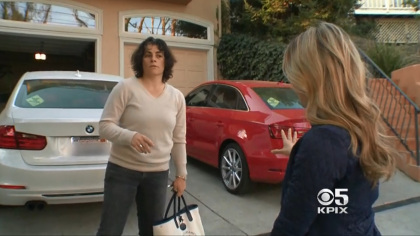
KPIX 5 reporter Susie Steimle speaks with Caroline Novak in front of a home in Redwood City. (CBS)

“Basically we wanted to understand how the system works for you guys, because we have heard that you are supposed to live in the unit,” KPIX 5 said to her.

Novak responded: “I do live there.”

KPIX 5: “So this is not your house?”

Novak: “I am just staying here, for a couple days.”

“The fact that you were able to talk to her in her driveway was beneficial and shows she was in fact living in this house,” said Cote.

“San Francisco is grappling with an unprecedented housing crisis,” Herrera said in a statement. “The City’s affordable housing program is not an investment scheme to be manipulated by would-be real estate moguls looking to profit off the housing crisis.”

“It’s unconscionable that this couple would cheat an eligible San Franciscan out of an affordable home, just so they can keep an investment property and a pied-à-terre,” the city attorney went on to say. “Those days are over.”

The lawsuit alleges that Novak lied on her affordable housing application back in 1999, saying she did not already own a property, when she owned a home in San Mateo.

Along with illegal renting of the unit, Novak and Lotsvin are also accused of leveraging the unit as security for more than $1.5 million in loans and lines of credit.

The lawsuit claims they have lived in Redwood City since 2015.

Herrera is seeking to require the couple to sell the property to a qualified owner, along with civil penalties.

The city attorney’s office said this is the 22nd case so far in Herrera’s investigation into affordable housing fraud.


Article source: https://sanfrancisco.cbslocal.com/2018/12/06/sf-affordable-housing-fraud-lawsuit-redwood-city-couple/

Posted in SF Bay Area News | Tagged | Leave a comment