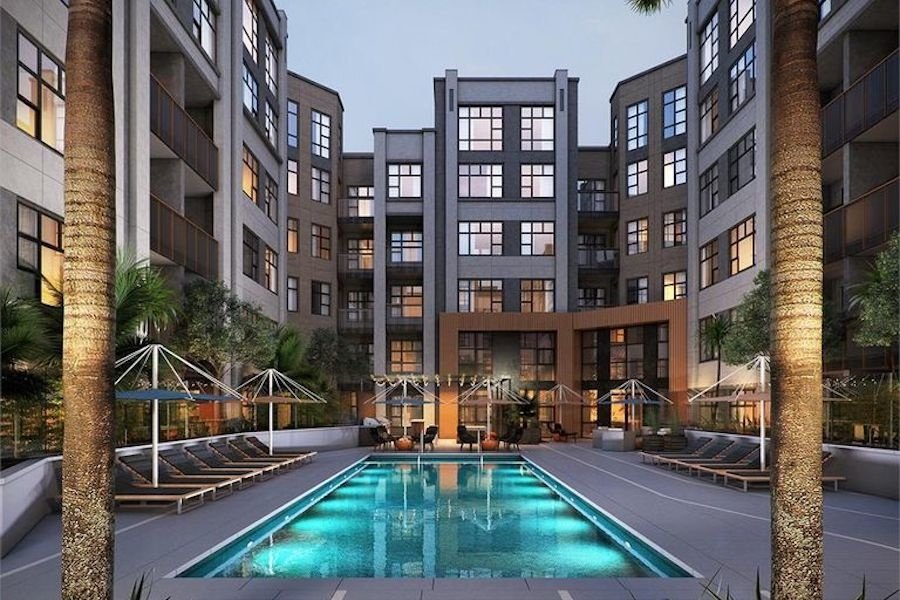
San Francisco’s Most Sustainable Residence ‘Sol Lux Alpha’ For Sale

 San Franciscos Most Sustainable Residence Sol Lux Alpha For Sale11c15 5wpAS4ek San Franciscos Most Sustainable Residence Sol Lux Alpha For Sale
Sol Lux Alpha

Photo Credit: White Oak

With the Sol Lux Alpha, the future of home construction has arrived in the Bay Area. The Mission District property from Club Real Estate is the only luxury residence in the country that runs entirely off the grid. This style of building is known as a passive house, and it produces renewable energy that powers the entire structure. “Climb Real Estate is excited to represent these [units at] Sol Lux Alpha, the future of construction in the country,” Chris Lim, Climb’s founder told Haute Living via email. “We have been awarded the 2018 US Department of Energy ‘Housing Innovation Award,’ and the Passive House Institute US ‘Best Overall Project in North America’ for 2018 which recognizes the brave carbon neutral efforts of this local San Francisco developer.”

 San Franciscos Most Sustainable Residence Sol Lux Alpha For Sale11c15 nMJKIRa0 San Franciscos Most Sustainable Residence Sol Lux Alpha For Sale
The dining room at Sol Lux Alpha

Photo Credit: White Oak

Going beyond the most advanced LEED certification, Sol Lux Alpha features energy efficient amenities such as three Tesla power walls, 21 Sunpreme solar panels, Air Pahoda energy recovery ventilation that circulates a constant supply of fresh air, and motion sensors that turn off appliances when they are not in use. Two Sol Lux Alpha units are currently for sale: the penthouse and third floor going for $2,750,000 and $2,495,000 respectively.

 San Franciscos Most Sustainable Residence Sol Lux Alpha For Sale11c15 FwmMPi04 San Franciscos Most Sustainable Residence Sol Lux Alpha For Sale
The kitchen

Photo Credit: White Oak

RG Architecture is the behind the Alpha’s design which includes 1,760 square-feet of pristine residential living space. The three-bedroom homes feature direct elevator access to a chic foyer. Calacatta marble counters, grained-matched cabinets, and Bosch Benchmark appliances are highlights of the kitchen. Master suites have two walk-in closets and a spacious master bathroom. Private balconies offer a stunning view of the Bay.

 San Franciscos Most Sustainable Residence Sol Lux Alpha For Saleb8eb3 AilFXDEA San Franciscos Most Sustainable Residence Sol Lux Alpha For Sale
A bedroom

Photo Credit: White Oak

What’s the benefit of living in this type of green residence? “The residents of Sol Lux Alpha can live in a sublime luxury and comfort, with the peace of mind that their lifestyles are part of the solution to climate change,” John Sarter, the developer of Sol Lux Alpha told Haute Living.  “The energy system ‘brain’ of the building generates approximately twice the energy required for all living systems, enabling up to 30 thousand miles of emission-free EV driving per year for each home. The indoor air quality afforded by Passive House certification and the energy recovery ventilation—the lungs of the home—adds to the owner’s quality of life potentially even extending their life by this superior air quality. Practically airtight construction, excellent insulation, and thermal modeling create an ultra-quiet interior contributing to an exceptionally relaxing living experience in the urban context.”

 San Franciscos Most Sustainable Residence Sol Lux Alpha For Saleb8eb3 AsIOfQCE San Franciscos Most Sustainable Residence Sol Lux Alpha For Sale
The special ventilation system

Photo Credit: White Oak

 San Franciscos Most Sustainable Residence Sol Lux Alpha For Sale9542f unspecified 33 357x238 San Franciscos Most Sustainable Residence Sol Lux Alpha For Sale

 San Franciscos Most Sustainable Residence Sol Lux Alpha For Sale9542f Nicole  e1545024293409 357x238 San Franciscos Most Sustainable Residence Sol Lux Alpha For Sale

Article source: https://hauteliving.com/2018/12/sol-lux-alpha-sf/664799/

Posted in SF Bay Area News | Tagged | Leave a comment

Should you move to Oakland? Let’s talk.

Is housing really cheaper in Oakland?

4be82 980x Should you move to Oakland? Lets talk.

Modern amenities are to be found at rentals around Oakland’s Jack London Square. At Fourth Street East, apartments range from $2,775 for a studio to $5,000 for a three-bedroom.

(Via Zillow)

Absolutely, if for no other reason than SF’s population density is more than five times higher than Oakland’s. The City packs 875,000 people into roughly 47 square miles, while Oakland has 426,000 people living in 125 square miles. This helps explain not only why SF housing is more expensive but why driving and parking are suckier here.

As of October, the average rent for a one bedroom apartment in SF was $3,200. In Oakland, it was $2,300. But neighborhoods vary a lot even in the same city, so it’s more accurate to consider comparable neighborhoods. Probably the closest sister neighborhoods, which include new-builds that face the Bay, are SF’s South Beach ($3,600 for a one bedroom) and Oakland’s Jack London Square ($2,100). Oakland, like San Francisco, does have rent control, but it’s generally less favorable to renters.

If you are looking to buy, Oakland is significantly cheaper, with an average home price of $740,000 vs SF’s $1,370,000. As with renting, prices depend on neighborhoods, but even so, you can get a lot more for your money on the East side of the Bay, including outdoor space.

Article source: https://www.7x7.com/reasons-to-move-to-oakland-2620766526.html

Posted in SF Bay Area News | Tagged | Leave a comment

Kushner-linked firm targets richer areas in program for poor

WASHINGTON (AP) — A real estate investment firm co-founded by President Donald Trump’s son-in-law and adviser, Jared Kushner, is betting big on the administration’s Opportunity Zone tax breaks but isn’t that interested in steering its investors to the poorest, most-downtrodden areas that the program seeks to revitalize.

New York-based Cadre, in which Kushner still holds at least a $25 million passive stake, made it clear to potential investors in recent marketing materials that it doesn’t plan to look for development deals in most of those zones because of their “unfavorable growth prospects.”

Instead, Cadre says it will target a “small subset” of zones in such cities as Los Angeles, Seattle and Miami where both populations and incomes are already set to rise faster than the national average.

Cadre is a high-profile example of how early investor interest in the program appears focused on the places that need it the least: zones that qualified for the tax breaks despite already drawing substantial investment or are undergoing obvious gentrification.

Among the examples of such zones is a swath of the Upper East Side of Manhattan that includes the top of Fifth Avenue’s Museum Mile, where three-bedroom apartments overlooking Central Park sell for $4 million. Another is Ledroit Park in the nation’s capital, which falls mostly in what real estate blog Curbed has anointed Washington’s “most gentrified” ZIP code. Yet another Opportunity Zone includes part of The Willows neighborhood of Menlo Park, California, less than 2 miles (3.2 kilometers) from Stanford’s campus, where the tech boom has driven home prices to $1,500 per square foot, 10 times the national average. The Opportunity Zone where Amazon put its New York City headquarters in Queens has a median household income of more than $130,000.

“It’s hard to imagine why we should be subsidizing that,” said Brett Theodos, a researcher whose Urban Institute analysis found nearly one-third of the nation’s more than 8,700 Opportunity Zones are showing signs of pre-existing heavy investment. “These investors are not bad people. They are responding to the incentives.”

Such is the major criticism of the Investing in Opportunity Act, which became law last December as part of the Republican-sponsored tax overhaul. Promoted by Trump in a White House event this past week, it offers developers potentially millions of dollars in capital gains tax breaks to invest in zones selected by states based on such factors as high poverty and low income.

While the program highlights an average 32 percent poverty rate in the zones, it includes a wide range of areas — and allows “contiguous” tracts that might not be low-income but are close enough to distressed areas to qualify.

Cadre said in a statement to The Associated Press that the neighborhoods it is targeting for investment may be poised for growth but still exhibit low median incomes and are “capital deprived.”

“At the end of the day, the Opportunity Zone tax benefits only kick in if we succeed for the communities in which we invest,” the statement said.

There’s no evidence the administration sought to include better-off Opportunity Zones in the program. A White House spokesman told the AP this past week that the choice of the zones was up to the states. The Treasury Department, which certified the final roster of zones, declined to comment on the presence of gentrified areas in the program.

For some funds, the obvious gentrification of some zones was an explicit selling point, a much safer bet than putting money in seriously distressed areas.

Anthony Scaramucci, the hedge fund executive who was briefly the White House’s communications director for Trump, is trying to raise as much as $3 billion for Opportunity Zone projects. On a marketing call this past week, he pitched both a warehouse project in Savannah, Georgia, and a “swanky” hotel project in Oakland, California.

“For those of you who have yet to go to that part of the Bay Area, I can tell you that it is fully gentrifying,” Scaramucci said.

Fundrise, another Opportunity Zone fund that is trying to raise $500 million for investments, is targeting many of the same areas as Cadre, ranking its “Top Ten” targets for Opportunity Zone investing based on which have the fastest-rising housing costs.

One measure of how much the zones overlap with developers’ pre-existing interests is how much they overlap with their current holdings. An AP review of Kushner’s holdings found that he holds stakes in 13 Opportunity Zone properties, all in locations deemed by the Urban Institute to be showing indications of rapid change or full-out gentrification.

An AP investigation found that Kushner and his wife, Ivanka Trump, both helped push for the program and as a couple stand to benefit financially from it. Even though Kushner gave up any management role in Cadre, ethics watchdogs say it is a conflict that arose from their decision to become presidential advisers without divesting from their extensive investments.

Marcy Hart, a Philadelphia real estate tax lawyer who has advised clients on the Opportunity Zone program, says she hasn’t seen much indication that the program is redirecting investment to places that lacked it before.

“There are some projects that have probably come online because they’re in Opportunity Zones,” she said. “But my clients were already investing in these areas.”

Even some of the program’s strongest proponents have acknowledged that not all the Opportunity Zones are equally needy. At a Kemp Foundation gala last month honoring Sean Parker, a San Francisco venture capitalist who helped push for the Opportunity Zone’s creation, Parker himself said that the zones included some “low hanging fruit,” neighborhoods that were already clearly drawing investment.

But the program’s incentives are great enough, he said, that after the obvious opportunities are exhausted, investors will eventually turn their attention to needier areas.

“There will be a lot of capital sitting in opportunity funds, and it’s going to have to find a place to go,” he said.

___

AP Business Writer Bernard Condon in New York contributed to this report.

Article source: https://www.sfchronicle.com/news/article/Kushner-linked-firm-targets-richer-areas-in-13470014.php

Posted in SF Bay Area News | Tagged | Leave a comment

SF to developer who tore down landmark house: Rebuild it exactly as it was

A property owner who illegally demolished a 1936 Twin Peaks house designed by a renowned modernist must rebuild an exact replica of the home rather than the much larger structure the property owner had proposed replacing it with, the City Planning Commission ruled this week.

In a unanimous 5-0 vote late Thursday night, the commission also ordered that the property owner — Ross Johnston, through his 49 Hopkins LLC — include a sidewalk plaque telling the story of the original house designed by architect Richard Neutra, the demolition and the replica.

The commission directive, unprecedented in San Francisco, comes more than a year after the home at 49 Hopkins Ave., known as the Largent House, was almost entirely knocked down. All that remained of the white, two-story redwood-and-concrete-block home was a garage door and frame.

Johnston had received planning permission only to remodel with a design that would have largely kept the first floor of the existing home intact.

Two months after the demolition, Johnston applied for a retroactive demolition permit and for permission to construct a new home that would increase the size from about 1,300 square feet to nearly 4,000 square feet.

The case attracted attention because Neutra is considered one of the most important modern architects and because it highlighted the trend of speculators illegally razing modest homes with the intention of replacing them with mega-homes. The new houses can fetch upward of $5 million, double or triple the price of an average house in already expensive San Francisco.

Planning Commissioner Dennis Richards said he hopes the commission’s action in the 49 Hopkins case will send a message to speculators accustomed to ignoring city planning and building laws with few or no repercussions.

“We are tired of seeing this happening in the city and are drawing a line in the sand,” said Richards. “You can have all the rules in the world, but if you don’t enforce them, the rules are worthless.”

Justin Zucker, attorney for the property owner, said that 49 Hopkins LLC is not a real estate speculation group but an entity solely owned by Johnston, who had hoped to move his family into the larger home. Johnston’s LLC bought the home for $1.7 million in 2017.

Johnston briefly addressed the commission, saying that he had bought the property “as a family home that would enable my family of six to move back to San Francisco,” he said.

“I have been stuck in limbo for over a year,” he said.

Zucker argued that the historic integrity of the Neutra design had been erased over time — first in a 1968 fire and later in a series of remodels in the 1980s and 1990s. The approved 2014 plan — proposed by a previous owner — allowed for the removal of most of the existing structure, he said. “We acknowledge and apologize for the fact that a small portion of the work exceeded the scope in the approved plans,” he said, adding that the decision was made “for life-safety reasons.”

The decision comes a few days after Supervisor Aaron Peskin introduced legislation designed to crack down on illegal demolitions. That bill, the Housing Preservation and Expansion Reform Act, increases fines for illegal demolitions and requires a conditional use authorization for any home expansion that increases the square footage by more than 10 percent.

Peskin said that he was “very impressed” by the Planning Commission’s vote.

“The fact that it was a unanimous vote should send a message to everyone that is playing fast and loose that the game is over,” said Peskin. “We want to preserve iconic, historic structures, but even more important, we want to protect our reservoir of more affordable housing stock. You want a 1,300-square-foot house to be worth what a 1,300-square-foot house is worth, rather than a mega-mansion.”

While replicas are controversial among architectural historians, the Planning Commission decision was applauded by historic preservationists. In a statement read at the commission meeting, SF Heritage Executive Director Michael Buhler said that approving the proposed project would have “sent a strong message that existing planning and building laws can be ignored and there will be no repercussions.”

“The question before you once again is whether a person can demolish existing housing stock with impunity and then be rewarded,” said Buhler.

Planning Commissioner Kathrin Moore said she is confident that a replica could be “executed beautifully in a way that would be consistent with the home’s original expression.”

Neutra, who did most of his work in Southern California, designed five San Francisco homes. The Largent House was designed for a husband and wife who were teachers and artists. Neutra was known for his obsessive attention to the needs of his clients, whether it was a multimillion-dollar home or a modest structure like the one in Twin Peaks.

J.K. Dineen is a San Francisco Chronicle staff writer. Email: jdineen@sfchronicle.com Twitter: @sfjkdineen

Article source: https://www.sfchronicle.com/bayarea/article/City-requires-property-owner-who-demolished-13467909.php

Posted in SF Bay Area News | Tagged | Leave a comment

Park Central, SF’s 6th-largest hotel, sells for $315 million

Another large San Francisco hotel has been sold amid record tourism and the impending completion of Moscone Center’s $500 million expansion.

The Park Central San Francisco at 50 Third St. traded this month for $315.2 million, according to property records analyzed by CoStar, a real estate data firm.

Pebblebrook Hotel Trust sold the 681-room hotel to Highgate Hotels LP. Neither company immediately responded to requests for comment. It isn’t clear if the hotel will change its name or undergo other changes.

The hotel is two blocks from Moscone Center, which is opening its final new wing next month, a boost for convention business and hotel bookings.

The Bay Area has led the nation in hotel growth. In September, revenue per available room in the San Francisco and San Mateo metro area jumped 13.3 percent to $239.64 per night, the largest increase in the country, according to STR, a research firm.

 Park Central, SF’s 6th largest hotel, sells for $315 million

It isn’t clear whether the two-month-long Marriott strike at seven San Francisco hotels will affect room rates. The strike ended earlier this month.

Investors have continued to be active. In September, Woodridge Capital bought the Huntington Hotel on Nob Hill. The landmark Westin St. Francis Hotel next to Union Square is also being sold by Chinese owner Anbang Insurance Group.

Park Central was built in 1983 during the redevelopment of the area now known as Yerba Buena Center. It has changed names over the decades and was last known as Westin Market Street until 2015, when LaSalle Hotel Properties bought the property for $350 million. The hotel is the city’s sixth-largest by room count, according to the San Francisco Business Times.

Pebblebrook’s sale of the Park Central came after its $5.2 billion acquisition of LaSalle. Pebblebrook sold five hotels for a combined $820.8 million, including the Park Central, three hotels in New York and one in Philadelphia.

Pebblebrook is planning to sell more hotels valued between $750 million to $1.25 billion in the next six to 12 months.

“Our completed property sales demonstrate our ability to quickly execute on our strategic disposition program,” said Thomas Fisher, chief investment officer of Pebblebrook, in a statement last month. “We continue to be encouraged with the level of buyer interest in the assets that we are actively marketing for disposition.”

Roland Li is a San Francisco Chronicle staff writer. Email: roland.li@sfchronicle.com Twitter: @rolandlisf

Article source: https://www.sfchronicle.com/business/article/SF-s-sixth-largest-hotel-sold-for-315-million-13467742.php

Posted in SF Bay Area News | Tagged | Leave a comment