Real SF Properties Team from Zephyr Real Estate Ranks High in America’s Best

SAN FRANCISCO, July 22, 2019 (GLOBE NEWSWIRE) — Real SF Properties has been a Top Team Producer at Zephyr Real Estate for years, and recently the august team received statewide acclaim in the 2019 REAL Trends America’s Best Real Estate Professionals list. This list ranks the most productive teams by state, based on closed sales volume.

Real SF Properties is a powerhouse group that ranks in the Top 1% of Bay Area realtors, and includes principals Daniel Fernandez Acebo, Kira Mead and Harry Clark, and team member Donna Solen. The team placed at No. 224 on America’s Best, in a list of 762 throughout California, with $66,745,003 in closed volume.

“Congratulations to everyone who made the America’s Best list,” says Tom Ferry, owner and founder of Tom Ferry International and co-producer of the list. “There are multiple ways to become successful in real estate. Yet, despite the differences, the real estate professionals on this list have one thing in common—they are the best.”

Real SF Properties has an impressive skill set that proves the expression, “The whole is greater than the sum of its parts.” Daniel Fernandez Acebo has a degree in Landscape Architecture from UC Davis. Harry Clark is a Harvard graduate with over 27 years’ experience in the design, development and sales of residential properties. Kira Mead is an avid advocate for home ownership with a background in design and marketing. They work from Zephyr’s Upper Market office and have been and continue to be Top Producers consistently.

Over 14,000 real estate professionals from across the country are considered. Teams must have closed a minimum of 75 transaction sides or $30 million in closed sales volume. The rankings are based on surveys from national branded networks, state and local associations of Realtors®, multiple listing services, previous rankings, and the largest brokerage firms in the country. Verification from an independent source is required and REAL Trends senior staff reviews all submissions for completeness and accuracy.

“We congratulate Kira, Harry and Danny on this milestone achievement,” commented Randall Kostick, CEO and President of Zephyr. “They are all so passionate about what they do, and their collaborative skills are truly remarkable.”

Real SF Properties is based at Zephyr’s Upper Market office and may be reached via their website, www.realsfproperties.com.

About Zephyr Real Estate
Founded in 1978, Zephyr Real Estate is San Francisco’s No. 1 independent real estate firm with over $2.4 billion in gross sales and a current roster of more than 350 full-time agents. Zephyr’s highly-visited website has earned two web design awards, including the prestigious Interactive Media Award. Zephyr Real Estate is a member of the international relocation network, Leading Real Estate Companies of the World; global luxury affiliate; the local luxury marketing association, the Luxury Marketing Council of San Francisco; and the regional luxury real estate affiliation, the Artisan Group. Zephyr has nine locations across San Francisco, Marin, Alameda and San Mateo Counties and two brokerage affiliates in Sonoma County, all strategically positioned to serve a large customer base throughout the San Francisco Bay Area. For more information, visit www.ZephyrRE.com.

A photo accompanying this announcement is available at https://www.globenewswire.com/NewsRoom/AttachmentNg/25b64e86-914c-495a-ae2d-cda5bdc3afe6

Article source: https://globenewswire.com/news-release/2019/07/22/1885945/0/en/Real-SF-Properties-Team-from-Zephyr-Real-Estate-Ranks-High-in-America-s-Best.html
Posted in SF Bay Area News | Tagged | Leave a comment

What you can buy for $860,000 in 7 cities including San Francisco, New Orleans and Boise


  • 870dc 920x920 What you can buy for $860,000 in 7 cities including San Francisco, New Orleans and Boise

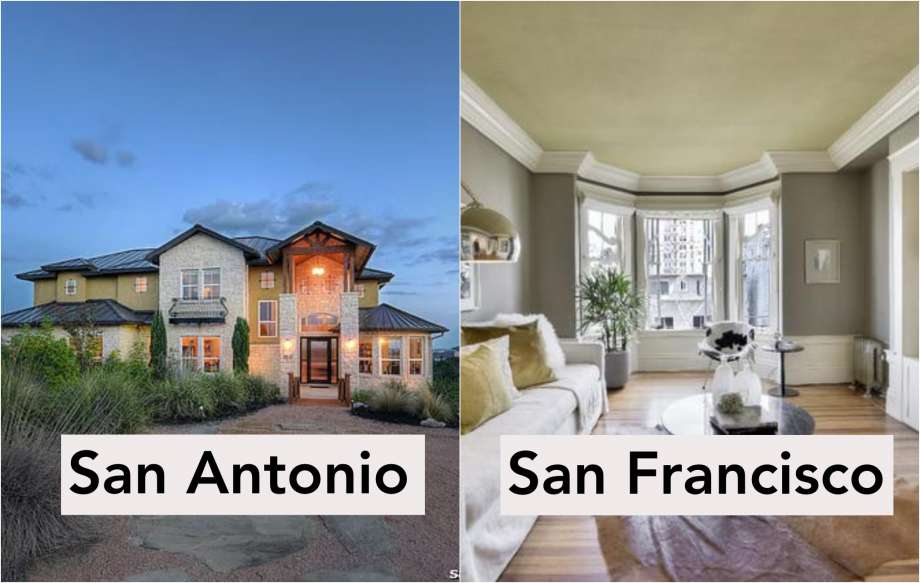
    What does the price range $860,000 to $900,000 buy you in cities around the country? New construction in San Antonio or antique charm in San Francisco.

    What does the price range $860,000 to $900,000 buy you in cities around the country? New construction in San Antonio or antique charm in San Francisco.


    Photo: My San Antonio, F8

  •  What you can buy for $860,000 in 7 cities including San Francisco, New Orleans and Boise

Caption

Close

What does the price range $860,000 to $900,000 buy you in cities around the country? New construction in San Antonio or antique charm in San Francisco.

What does the price range $860,000 to $900,000 buy you in cities around the country? New construction in San Antonio or antique charm in San Francisco.


Photo: My San Antonio, F8


The median price for a home or condo in the San Francisco Bay Area is $860,000.

Depending on which city you’re in, this amount puts you in very different types of abodes.


In Concord, you can live in a three-bedroom home and spend weekends barbecuing in your spacious backyard, maybe even swimming in your pool. In San Francisco, $860,000 puts you in a cozy condo within walking distance of cafes, boutiques, or possibly even your job.

There are tradeoffs to both places. In the city, your money buys less house, but usually a shorter commute. While in the suburbs, the square footage goes up, but so does the commute time.

What about in other cities around the country? The San Francisco Bay Area is the most expensive real estate market in the United States, so obviously your money in most any other place, except Manhattan, buys you more house, more charm, and more backyard.


In the gallery above, you’ll find what $860,000 affords you in seven cities around the country.  In Portland, Ore., you can buy a 3,200-square-foot historic craftsman, while in Santa Fe you can scoop up a new construction mansion.

ALSO: What $2,800 rents you in 11 cities including San Francisco, Austin and Louisville

Information service CoreLogic crunches the real estate numbers every month and found the median price paid for a Bay Area home or condo in May was $860,000, up 1.2 percent from $850,000 in April 2019 and down 1.7 percent from $874,750 in May 2018.

This marks the biggest year-over-year percentage decline in more than seven years.

Read more about the report over at the San Francisco Chronicle.

Amy Graff is a news producer for SFGATE. Email her at agraff@sfgate.com.


Article source: https://www.sfgate.com/realestate/article/What-you-can-buy-for-860000-in-america-14059259.php

Posted in SF Bay Area News | Tagged | Leave a comment

Bay Area real estate mogul hosts high-dollar Trump-Pence fundraiser in Nob Hill

Donald Trump Jr. and former Fox News anchor Kimberly Guilfoyle were the guests of honor at a fundraiser for the Trump-Pence campaign last night in Nob Hill.

Carole McNeil, a longtime real estate investor, hosted the event at her luxurious California Street residence. The building is advertised as the “Crown Jewel of Nob Hill,” and another unit similar to McNeil’s has been on the market since last November, with a list price of $10.9 million. 

Other hosts included former Fine Arts Museums president Dede Wilsey; Debby Magowan, part-owner of the San Francisco Giants; and Elizabeth and Clarke Swanson, of Swanson frozen food fame.

“It was terrific, it was very interesting,” attendee Greg Mendez said. “They said great things about our country and great things about our President.”

Tickets for the event started at $1,000, but couples who contributed $15,000  to the campaign got a photo opportunity with Trump Jr. and Guilfoyle. Couples who contributed more than $35,000 qualified for “Team 100 Membership.”

A staff member at the event told reporters that there were 52 attendees in all, with a likely fundraising total in the hundreds of thousands of dollars.

The event invitation, obtained exclusively by the San Francisco Examiner.

On Tuesday, the Trump campaign and the Republican National Convention (RNC) reported raising $105 million in the second quarter of 2019. This puts the Trump campaign ahead of both its 2016 fundraising totals and the Obama campaign’s fundraising pace for the comparable quarter in 2011.

RNC chairwoman Ronna McDaniel told the New York Times that she is optimistic about the total.

“The RNC’s record-breaking fundraising has allowed us to identify troves of new supporters online and continue investing in our unprecedented field program,” she said. “Our grassroots army is already hard at work — putting us in prime position to re-elect President Trump and Republicans across the country.”

Far from observing a grassroots army in the Bay Area, attendees told a Hoodline reporter that they’ve experienced social consequences for their support of the President.

“I have to watch everything I say,” said Michele Larsen of Marin County, who cites tax cuts and immigration policy as her primary reasons for supporting Trump. “You get attacked all the time.”

The nonprofit Tax Foundation cites the President’s 2017 Tax Cuts and Jobs Act (TCJA) as the most significant overhaul of American tax law in recent history. Though the White House touted the act as beneficial to the middle class, a recent report  from the Congressional Research Service found that the TCJA primarily resulted in substantial tax breaks for corporations, with little impact on individual income earners.

Deportations have increased under President Trump, and the administration has been harshly criticized for its family separation policy.

Photo: Sotheby’s International Realty

Wednesday’s fundraiser drew a number of San Francisco’s major political donors, many of whom have also contributed to local Democrats.

Attendee Dede Wilsey was the biggest donor in 2016′s local Democratic County Central Committee elections, supporting a slate of moderate Democrats backed by then-Mayor Ed Lee.

According to the San Francisco Ethics Commission, the event’s host, Carole McNeil, has maxed out donations since 2014 to reelect Mark Farrell, Scott Wiener, and London Breed as city Supervisors. McNeil also supported Lee and Breed’s mayoral campaigns.

McNeil and her late husband, Robert McNeil, are also major donors to the Hoover Institute, Stanford University’s conservative economic think tank.

Out-of-town guests, including 25-year-old Turning Point USA founder Charlie Kirk, also made the rounds at the fundraiser. 

“[San Francisco] is a beautiful city with a lot of problems,” Kirk told Hoodline. His advice? “Stop electing Democrats.”

Article source: https://hoodline.com/2019/07/bay-area-real-estate-mogul-hosts-high-dollar-trump-pence-fundraiser-in-nob-hill

Posted in SF Bay Area News | Tagged | Leave a comment

Targeting Bay Area gridlock, groups floating $100 billion tax measure

From BART trains packed to capacity during the commute to freeways that jam well before dawn, the strain on the Bay Area’s transportation backbone is intensifying.

And with the region’s population expected to swell from 7.75 million to nearly 10 million by 2040, big engineering fantasies like a second trans-bay rail crossing and a stretch of Caltrain tracks through downtown San Francisco have become urgent needs. But the projects won’t come cheap: The Bay Area needs hundreds of billions of dollars to build them.

“This isn’t a problem that’s going to wait for us — we really need to run at it,” said Jim Wunderman, president and chief executive of the Bay Area Council, an advocacy group for major employers like Google and Kaiser Permanente.

Sensing an opportunity to harness frustration, he and other business leaders recently collaborated with transportation agencies and nonprofits to develop a ballot measure for November 2020 dubbed Faster Bay Area. It aims to generate at least $100 billion in 40 years.

Though in its early stages, the measure would likely be a penny sales tax to fund a wish list of infrastructure projects. Among them: the downtown extension of Caltrain into the Transbay Transit Center, a project that has long intrigued and eluded political leaders in San Francisco and San Mateo counties.

Faster Bay Area would first require state legislation to grant taxing authority to a regional agency. This initial bill would have to pass early next year so that Faster Bay Area could place the initiative on the November 2020 ballot.

The timeline is aggressive, in part due to pressure to compete with Los Angeles, which enacted a similar sales tax. Mayor Eric Garcetti hopes to complete 28 transportation infrastructure projects by 2028, the year the city hosts the summer Olympics. That goal, propelled by sales-tax revenue, puts Los Angeles in a strong position to obtain federal grants. The Bay Area would vie for the same pot of money.

 Targeting Bay Area gridlock, groups floating $100 billion tax measure

While Bay Area voters don’t have the singular focus of a sporting event, they’re still hungry for efficient mass transit and traffic relief. Last year’s Regional Measure 3 bridge-toll increases won with 55% of the vote, showing that people are willing to reach into their wallets for new BART cars and ferryboats and a latticework of freeway express lanes, among other improvements.

Policymakers view Regional Measure 3 as their first stab at a deep, complicated, expensive problem.

“We’ve seen in focus groups that people identify traffic as one of their top quality-of-life concerns,” said Alicia John-Baptiste, president and chief executive of the urban think tank SPUR, which is working on the ballot measure. “They want to see big solutions, not incremental solutions.”

Big, audacious ideas tend to draw opposition, and taxpayer advocacy groups that fought Regional Measure 3 are already wary of this one.

“This whole regional approach to transportation funding is problematic to me,” said Jack Weir, president of the Contra Costa Taxpayers Association.

Faster Bay Area may also clash with local governments that want to pitch their own sales tax measures for things like road repair, parks and flood control. Voters sometimes get turned off or baffled when staring down at a tax-heavy ballot, which leads people to vote “no” on everything. Some supporters of Contra Costa’s ill-fated Measure X — a 2016 sales tax that would have fixed potholes and paid for other local transportation improvements — say it went down because of competition from BART’s regional Measure RR.

Commuters standing at the bus stop outside El Cerrito Del Norte BART Station on Thursday night said they might vote to approve a new sales tax, so long as they see the benefits. Some wanted BART to extend to Hercules and Vallejo. Others just want the Bay Area’s hodge-podge transit systems to better align with one another, so they don’t have to walk a distance or wait 15 minutes to make a transfer.

“Just make the schedules more compatible,” said Michelle Square, a nurse at Kaiser’s Richmond Medical Center who commutes from her home in Suisun City. She stood waiting for the Green Express bus, alongside other riders who trek from Solano County — where real estate is cheaper — to work in the inner Bay Area.

Among them was Cathy Jensen, an interior designer from Vallejo. She said she does not have a working car and relies on buses to travel throughout the Bay Area, often with two suitcases full of samples.

On Thursday, Jensen took three buses to get to a client’s house in Novato — about 20 miles from her home — a journey that took 2½ hours. At 6 p.m., she braced for the same long trip back home.

Demand for synchronized schedules and a better bus network has grown as long-distance commutes become the new normal. At the same time, early-morning traffic is getting heavier on Bay Area freeways.

Data from the Metropolitan Transportation Commission shows a dramatic increase in vehicles crossing the Bay Bridge between 3 and 4 a.m. — from 1,500 a day during the third week of May 2015 to 2,256 a day in the same week this year.

Traffic over the Altamont Pass between Tracy and Livermore has grown by 43% in seven years, owing to people driving into the Bay Area from the more affordable Central Valley, said Stuart Cohen, a transportation policy expert who is helping steer the Faster Bay Area campaign.

Revenue from a new sales tax could provide some relief for these super-commuters. One project in the works is the Valley Link rail, which would run from Lathrop in San Joaquin County to the Dublin/Pleasanton BART Station.

Another solution is to build a better network of freeway express lanes, which allow buses to bypass traffic. Officials could add additional tracks to railways like the Capitol Corridor. The system’s passenger trains, which run from San Jose to Placer County, currently share tracks with freight cars, which limits service.

While the ballot measure is driven largely by companies trying to get their employees to work, it will also have ramifications for working-class people in the suburbs. That population pays a greater share of its wealth to sales taxes, so the measure might include some form of low-income rebate, said Cohen.

He and John-Baptiste are cognizant of the economic injustice built into the Bay Area’s transportation system, in which lower-income people generally have longer, costlier commutes. Faster Bay Area will need their buy-in if it stands a chance of success.

“Honestly, to win passage it’s going to need to benefit every county,” Cohen said. “We want to act and move as a region.”

Rachel Swan is a San Francisco Chronicle staff writer. Email: rswan@sfchronicle.com Twitter: @rachelswan

Article source: https://www.sfchronicle.com/bayarea/article/Targeting-Bay-Area-gridlock-groups-floating-100-14109782.php

Posted in SF Bay Area News | Tagged | Leave a comment

After lull, Bay Area rents charge back up

A dearth of new apartments and a swell of new jobs have pushed Bay Area rents higher in recent months, keeping the region’s title as the most expensive place in the country for renters.

Median rents rose 4.2 percent in San Jose, year-over-year, in the second quarter of 2019. In the Oakland and San Francisco metro area, monthly apartment payments grew 3.7 percent from the previous year, according to a new survey from listing site HotPads.

The median rent for all apartments — from studios to multi-bedroom units — in San Jose was $3,760, while in San Francisco and the East Bay prices rose to $3,560 a month. Those rents top the U.S. market, more than doubling the $1,545 median across the country.

Strong prices in the Bay Area rental market — a boon to property owners and bane to renters — have picked back up after a lull a year ago. Between 2016 and 2018, new high-rise apartments and development added supply, and many property managers offered discounts to fill space, said HotPads economist Joshua Clark.

But applications for Bay Area building permits — the start of the long construction process — have slowed from a peak in 2015, he said. With tech companies adding jobs to the swelling Bay Area economy, he added, it’s hard to see the rising-rent trend reversing.

Higher rental costs have driven California lawmakers to consider wider rent control and more protections for apartment dwellers. A bill sponsored by Assemblyman David Chiu, D-San Francisco, would limit annual rent hikes to about 10 percent on certain properties and make it harder to evict tenants. The measure, AB 1482, has faced stiff opposition from property owners but has won preliminary support in the state senate.

Voters rejected a state-wide expansion of rent control at the ballot in November.

Little help has come to add new apartments, especially for low-income families.

Michael Lane, deputy director of the housing advocacy group SV@Home, said builders face several challenges developing market rate and affordable residential units in the Bay Area. Submitting plans and winning approval from local city councils takes at least three years and sometimes twice as long, he said.

Developers face challenges with few construction workers and higher costs for land and materials, he said.

And right now, commercial buildings are more lucrative to build and easier to win approval from local governments, he said. Construction workers are pulled to commercial sites, leaving some residential developers with labor shortages.

“Unfortunately, the housing has never caught up,” Lane said.

Four of the five hottest neighborhoods in Santa Clara County were within San Jose city limits: East San Jose rents jumped 8 percent, Santa Teresa grew 7.8 percent, Evergreen increased 6.8 percent, and North San Jose went up 4.7 percent, according to HotPads.

In the East Bay and San Francisco, the Longfellow neighborhood in Oakland saw rents rise 10 percent, followed by San Francisco neighborhoods, Bernal Heights (8.9 percent), Outer Sunset (6.3 percent), Inner Sunset (5 percent) and Nob Hill (4.6 percent), according to HotPads.

Neighborhoods near transit, such as Longfellow, with a livelier restaurant and entertainment scene have tended to see greater increases in price, Clark said. The influx of new residents, many younger, single and willing to rent, also has pushed housing costs higher. “There’s no real cracks in the labor market,” he said.

Cities trailing San Jose and San Francisco in the nation’s top median rents in the second quarter were the Los Angeles metro ($2,985 per month), San Diego ($2,765), Boston ($2,450) and New York ($2,400), according to HotPads.

The sun belt had 9 of the top 10 fastest rising areas. Rents in Phoenix grew 6.9 percent from the same period last year, to a median of $1,545.


Article source: https://www.mercurynews.com/2019/07/18/after-lull-bay-area-rents-charge-back-up/

Posted in SF Bay Area News | Tagged | Leave a comment