The CAR data, which reflects MLS sales of single-family homes, found a median price of more than $1.76 million for an SF house in June, an 8.8 percent hike from this time last year, when the figure was $1.62 million.
The price also went up 3.8 percent compared to May, which was a 4.8 percent increase year over year. April’s figures saw prices decline in SF year over year, but only by 1.1 percent—noteworthy at the time, but seemingly only a blip on the radar.
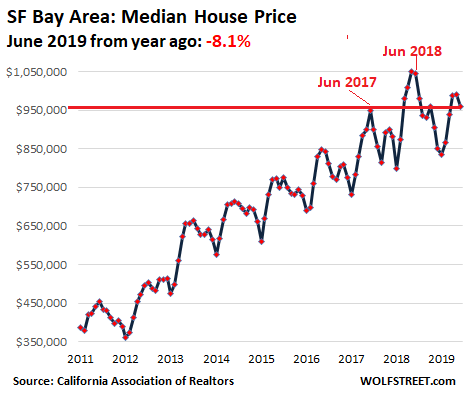
At the same time, prices across other Bay Area counties declined significantly, down 8.1 percent (to $960,000) from June 2018 for the combined region.
The drop is even bigger if you factor out SF, since all eight other counties saw year-over-year drops, ranging from a barely noticeable 0.4 percent in Solano County to more robust six percent in Sonoma.
San Mateo County had the highest median prices besides SF at $1.62 million, down from more than $1.65 million last year and $1.76 million the previous month.
As usual, it doesn’t pay to fret to much about the numbers from just one month or even a couple of months, as sharp and dramatic changes are often anomalies; a real trend needs more time (and perspective) to develop.
These numbers do track with those released last week by the SF-based real estate group Compass, which estimated a roughly $1.7 million average for an SF house and $1.3 million for a condo.
Although those medians are up compared to June of 2018, in a more general sense they represent essentially a 12-month break even, as Compass economist Patrick Carlisle noted that “both houses and condos are basically back up to the peak prices they hit last year at this time.”
Prices wobbled up and down since then, but have now ended up back where they were, at least in San Francisco.
One other thing worth noting is that the number of homes sold in SF did drop drastically year over year in June, down 21.1 percent as part of a year-long trend in similar declines.
For the 9 counties, the median price in June dropped back to June 2017 levels.
Today we got the final numbers from the California Association of Realtors (CAR) about the status of the housing bubble in the nine-county San Francisco Bay Area, which includes some of the most expensive sub-markets in the US, such as the most expensive zip code in the US, plus the Wine Country (Napa and Sonoma), Silicon Valley (Santa Clara and San Mateo), San Francisco itself, beautiful Marin just across the Golden Gate Bridge from San Francisco, the East Bay (Alameda and Contra Costa), and Solano County, toward Sacramento.
In eight of these nine counties, house prices fell in June compared to June last year. June is around the seasonal peak in terms of prices, but by Bay Area standards, it just wasn’t very peaky. The median price of house sales that closed in June dropped 8.1% compared to June last year, which put it back on the same level as June two years ago:
Sales volume of houses in the SF Bay Area fell 9% in June compared to a year ago. If June was the seasonal peak in prices, the housing market might face an iffy summer and winter as potential sellers are apparently running out of willing and able buyers at these prices.
Sales volume of condos fell 16% in June compared to last year. And condo prices fell 3%.
The Wine Country first, to get us in the mood.
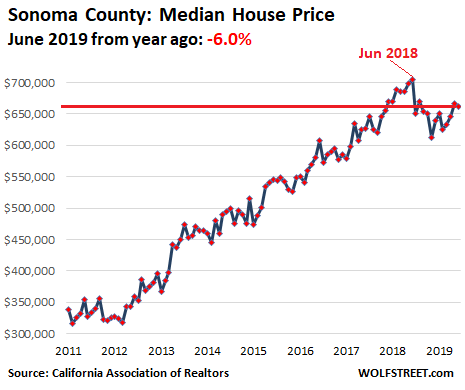
Last summer I stuck my neck out to describe the end of the housing bubble in Sonoma County in practically real time, and it has progressed nicely. In June, the median house price fell 6% year-over-year to $662,500:
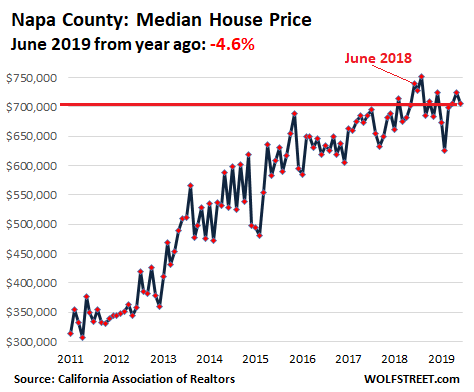
In Napa County, the median house price fell 4.6% year-over-year to $705,750:
Silicon Valley next, because…
This is where house prices were going to explode because all the IPO billionaires and millionaires from Uber, Lyft, and a bunch of other companies would be suddenly buying homes, a time-honored real-estate hype theory that had been proven wrong before. And the results from those IPO billionaires and millionaires are trickling in.
In Santa Clara county, the southern part of Silicon Valley and the most populous county of the Bay Area, the median house price in June fell 3.6% year-over-year, to $1.35 million, and is down 7.2% from the peak in April last year:
In San Mateo County, the northern part of Silicon Valley, the median house price in June declined 1.8% year-over-year, to $1.62 million. This price is on par with February 2018, and is down 8.5% from the peak in April 2018:
San Francisco
Back in February 2018, house price in San Francisco went on a one-month nutter, jumping without rhyme or reason $400,000 from January to February, or by 30% just in one month, to a fabulous $1.73 million. Then the median price spent the next 11 months climbing down, dropping by $354,000 in the process, to $1.376 million by January 2019.
Then spring buying season kicked in, and in June, the median price reached $1.76 million, up 8.8% from June last year, but up only 1.7% from the prior record in February 2018. This was the only county of the nine Bay Area counties with a year-over-year price gain. And, well, sales volume in June plunged 21% year-over-year.
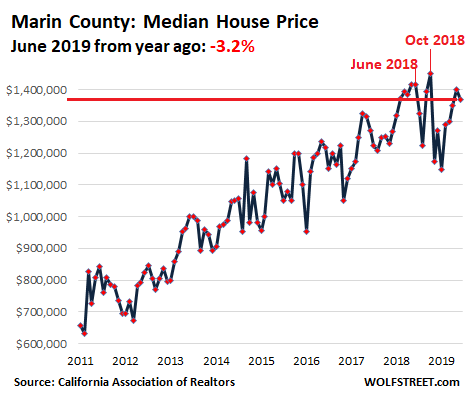
Marin County is famous for Sausalito, Mount Tam, National Monument Muir Woods, and its Pacific Coast among other places. So it’s not exactly a focal point of modern industry and it doesn’t have a lot of high-paying jobs. But it’s only a bridge or a gorgeous ferry-ride away from San Francisco, and so it serves as bedroom community for San Francisco and other parts of the Bay Area and ranks among the most expensive places in the Bay Area. The median house price in June fell 3.2% to $1.37 million. This is on par with February 2018 and down 5.5% from the peak last October:
The East Bay
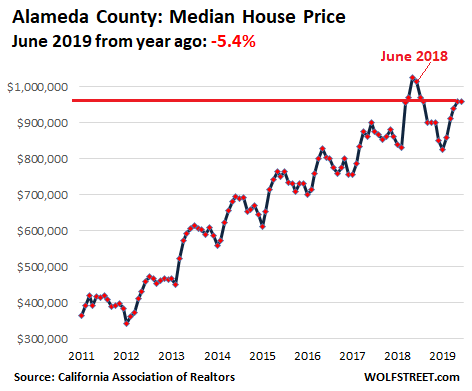
In Alameda County – where Oakland and Berkeley are – the median house price in June dropped 5.4% year-over-year to $960,000 and is down 6.3% from the peak in May 2018:
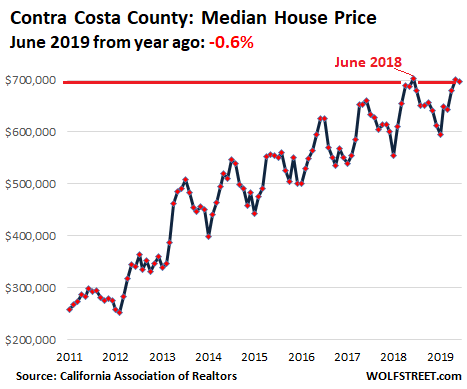
In Contra Costa County, the median home price in June ticked down 0.6% year-over-year to $698,000,
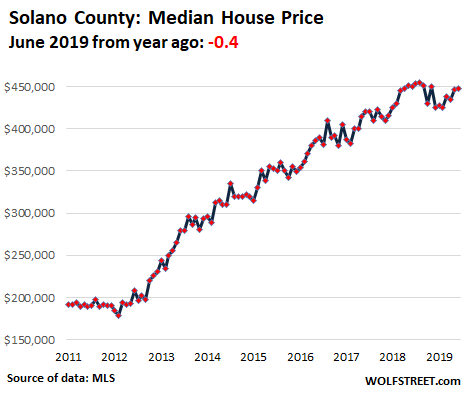
In Solano County, the median home price in June ticked down 0.4% year-over-year, to $448,000 and is down 1.6% from the peak in August 2018:
For the nine-county Bay Area, the year-over-year decline of 8.1% is the steepest decline since November 2011, during the trough of Housing Bust 1. December last year was the first month with year-over-year declines of any kind since March 2012. During the headiest days of Housing Bubble 2, year-over-year price increases of 20% were not uncommon and maxed out at 38% in May 2013. So this situation is not a sudden collapse or anything, but clearly, the Bay Area’s Housing Bubble 2 has lost its mojo.
Enjoy reading WOLF STREET and want to support it? Using ad blockers – I totally get why – but want to support the site? You can donate “beer money.” I appreciate it immensely. Click on the beer mug to find out how:
Would you like to be notified via email when WOLF STREET publishes a new article? Sign up here.
One of the thousand or so rental data sources out there has called our attention to how “average rents” around the Bay Area currently compare. And while this data has to be taken in context, it provides support for what many have complained about in recent years about the South Bay — namely that housing is even more scarce and expensive down there than in the city.
The data source this time is Yardi Matrix, which provides rental data to developers and real estate investors based on surveys of buildings with 50+ units in 133 markets nationwide. Curbed SF picked up the new figures via the RentCafe Blog, which mapped out the Bay averages for comparison. And it should also be noted that Yardi Matrix’s data is only based on some small sample sizes, so could be skewed.
But with all that in mind, the highest average rents in the Bay right now are in Palo Alto ($3,857/mo) and Menlo Park ($4,368/mo), with San Francisco clocking in at $3,697 according to this data for June. That SF figure is actually right in line with what SF-based Zumper found as its median rent figure for June, $3,700/mo — but again, this is likely based almost entirely on big, newer buildings, and not on the kind of flats you find in Victorians on Craigslist.
For perspective, back in June 2015, a full four years ago, Zumper said that the median one-bedroom rent in SF was $3,500/mo, and median two-bedrooms were $4,700. That same month, Socketsite quoted the median rent as $3,458. And this was while SFGate and others were parroting a sensational headline, borne out of Zillow data, that SF’s median rent was $4,225 — a figure that was based only on condos and single-family homes for rent.
In short, the rent is too damn high, still, and so it goes.
Jory Segal has been dreaming of remodeling her 2,700-square-foot San Jose home for years. The 68-year-old longed to brighten her living space and gussy up her kitchen and bathrooms with trendy upgrades, but it took time to decide on the perfect design. Just last week, after a six-month project, she finally completed her renovation.
“I’m not embarrassed to have people come over anymore,” says Segal with a big sigh. She opened up the kitchen and dining room, updated her windows and appliances and picked out a chic “leathered” black granite with dazzling swirls of brown and rust for her kitchen countertops. “After 25 years, everything gets dated. Now, I love it. It’s gorgeous and amazing. I got just what I wanted.”
She’s got lots of company. The San Jose and San Francisco metro areas were tops in the nation last year for the amount spent on renovations, with San Jose and San Francisco spending a median of $25,000, according to a survey of 140,000 Houzz users released this month by the home remodel website. In its report, Palo Alto-based Houzz includes the full range of home renovations, from small DIY-projects to full house remodels, as long as they don’t add any square footage.
Last year’s median in San Jose and San Francisco is slightly less than the $30,000 median spent in San Jose in 2017, but it’s still higher than the national median of $15,000. The two metro areas have come in first and second in the nation since 2015, the first year Houzz tracked the data.
At the higher end of the spectrum, the top 10 percent of spenders nationally forked over a median of $80,000 in 2018, according to the Houzz report. The National Association of the Remodeling Industry estimates the median cost of remodeling at $25,000 for a bathroom to $200,000 for a whole house renovation, according to a 2018 survey that includes additions to houses.
“Pent up demand continues to be the biggest trigger for renovations today,” says Nino Sitchinava, Houzz principal economist. “Homeowners in the Bay Area wait a long time to find the right house. When they finally have it, they want to make it their dream home. They want a certain quality of life. Silicon Valley is the engine of the U.S. economy. That’s why the spend here is significantly higher than in the rest of the country.”
Another factor pushing up the price of renovations is the rising cost of construction. The Bay Area is now the most expensive place in the world to build, according to a recent report from UK-based consultant Turner Townsend.
Jory Segal’s home in San Jose, Calif., on Monday, June 3, 2019. Segal, 68, is one of many Bay Area homeowners remodeling their long-time homes. This trend is helping lift the remodeling industry to record breaking figures. (Randy Vazquez/Bay Area News Group)
Despite flattening home sales, business is booming for Bay Area remodelers. Some contractors take days to return calls, clients say, while others have long waiting lists.
“It’s crazy busy. I’ve got more clients than I can handle,” says Rob Gamble, owner of RR Development in San Jose, who remodeled Segal’s house. He has a year-long waiting list right now. “And I was slammed last year too.”
“It’s hard,” says Vivian Costa, a designer at Kitchen Remodeling Authority in Tracy, which also has a waiting list, “but I try to get people in as soon as I can.”
Many homeowners are making long-awaited nips and tucks to older houses that are showing their age, experts say. That has helped push the remodeling market to $424 billion in 2017, a 6.5 percent increase from 2016, according to the most recent report from Harvard’s Joint Center for Housing Studies. Nationally, 13.5 percent of houses were built before 1940, but it’s 48 percent in San Francisco and 42 percent in San Jose, the Houzz survey reports.
“The Bay Area has a lot of older homes and many homeowners planning to do the renovations and stay put,” notes Sitchinava. “That is especially true of Baby Boomers who are planning to age in place.”
Segal is a case in point. She and her husband are fond of their house and their Almaden neighborhood and have no intention of leaving. If need be, she says, someday they will install an elevator. She declined to say how much her remodeling project cost.
“The Bay Area is our home, our children live here,” says Segal, who has taken a walk along the Alameda Creek trail almost every day for years. “We plan to spend another 20 years here.”
Gamble says his high-end client base doesn’t blink at what’s involved in a home renovation project.
“Everything is super expensive right now. You have to have real money to do this kind of remodel,” says the San Jose contractor who estimates his projects range from $30,000 to $1 million. “Right now my clients want the fancy stuff, the high-end materials and the upscale features.”
Many are chasing the latest trends in home design, says Costa, such as smart tech features like thermostats, lighting and digital security systems, and gourmet kitchens. Spending on the kitchen, the heart of the house, has jumped 27 percent in the past year to a median of $14,000 nationally, according to the Houzz survey.
“New trends are definitely the driver,” says Costa, adding that many homeowners want to recreate the designer looks they have seen in home remodel television shows and on Pinterest pages.
Richa Tagra, who worked with Costa on a $25,000 remodel of the kitchen and staircase in her 2,200-square-foot San Ramon home, says it was important to get the best materials possible.
“I need that with the rigor I put my kitchen through,” says Tagra, 43, who ditched her old cabinets for custom maple wood cabinets and traded her unfinished concrete counters for a shiny quartz countertop.
Cost can be a sticking point these days, but Costa says she tries her best to stay within a client’s budget even though a shortage of construction workers has put pressure on the cost of remodeling.
“There is a labor shortage, and that shortage is a key reason it is hard for contractors to meet demand,” says Paul Emrath, vice president of surveys and housing policy research for the National Association of Home Builders. “Compared to a year earlier, the share of our remodelers reporting labor shortages was down very slightly, but it was down from a very high level, and well over 80 percent are still reporting shortages.”
This pressure, coupled with a cooling housing market and a spike in the cost of imported materials, could cause a dip in the demand for remodeling in the next few years, experts say. On the heels of a long, steady rise in remodeling, many are projecting that the rate of growth will likely slow. The national backlog for contractors already has shrunk, from 12 weeks last year to 5 weeks this year, says the Houzz report.
“We are getting to the point where we may be reaching a peak in home renovation activity,” says Sitchinava. “We don’t anticipate a decline, but as home prices plateau, we expect to see a softening of growth and a return to a more sustainable level of activity.”
New York, San Francisco condo prices fall year-over-year. Seattle house prices flat year-over-year. After earlier declines, Denver, Boston hit new highs. Miami, Phoenix, Las Vegas try to regain nutty peaks of Housing Bubble 1.
Seasonal price spikes are cropping up in many of the most splendid housing bubbles in America, but in some metros they were not nearly large enough and prices fell compared to the same month last year, the first such declines since Housing Bust 1, and in others, they produced new all-time highs, and in others got them closer to the crazy highs of Housing Bubble 1.
New York Condo Prices:
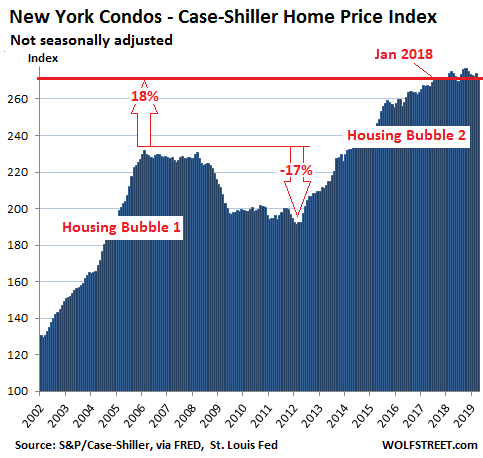
In the New York City metro, condo prices dropped 0.8% in April from March, according to the CoreLogic Case-Shiller Home Price Index released this morning. This drop pushed the index down 1.8% from the peak in October 2018, and a tad (0.7%) below where it had been in April 2018, the first year-over-year decline since the end of Housing Bust 1. The index is now below where it had first been in January 2018:
The Core-Logic Case-Shiller Home Price Index is a rolling three-month average; today’s release represents closings that were entered into public records in February, March, and April.
San Francisco Bay Area Condo Prices
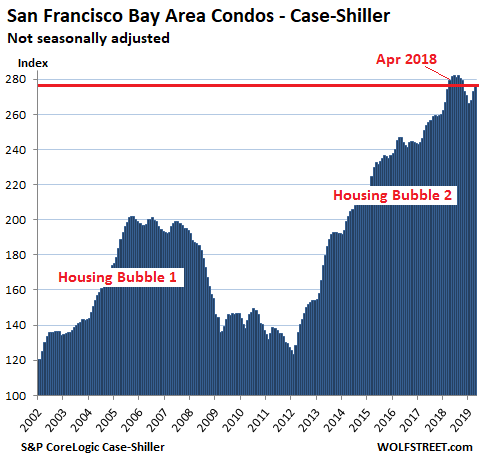
Condo prices in the five-county San Francisco Bay Area – the counties of San Francisco, San Mateo (northern part of Silicon Valley), Alameda and Contra Costa (East Bay), and Marin (North Bay) – jumped 1.5% in April from March, according to the Case-Shiller index. But it wasn’t enough to beat the seasonal surge last year, and compared to April 2018, the index declined 0.7%. This was the second month in a row of year-over-year declines – the first such event since April 2012 at the end of Housing Bust 1:
San Francisco Bay Area House Prices
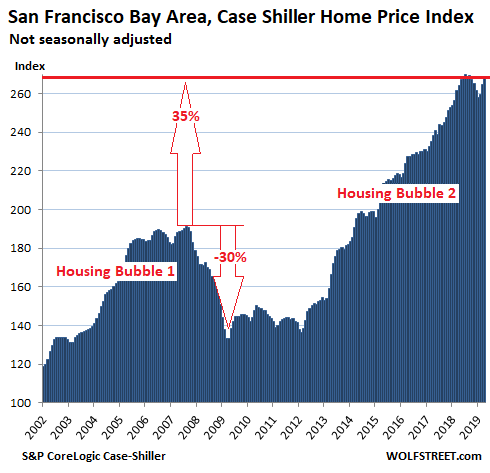
The Case-Shiller index for single-family house prices in the five-county San Francisco Bay Area jumped 1.6% in April from March. But it wasn’t enough and further eroded the year-over-year price gains, which are now down to just 1.8% compared to April 2018. The index remains below its peak of July 2018:
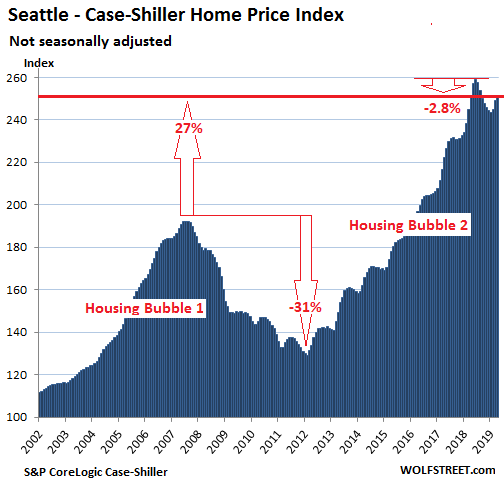
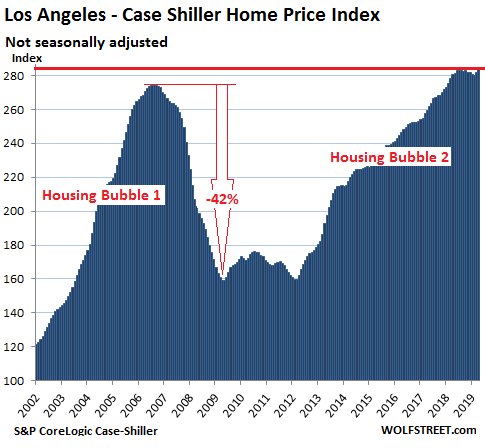
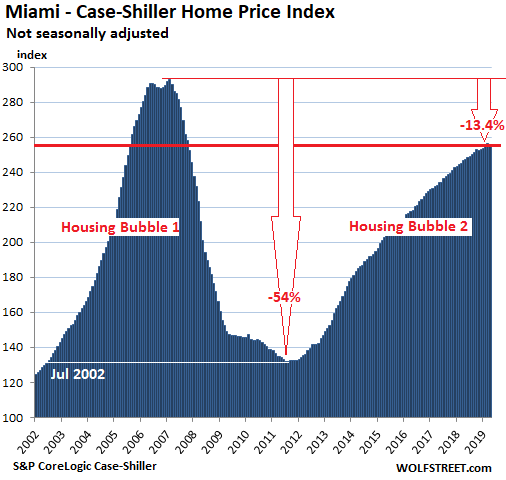
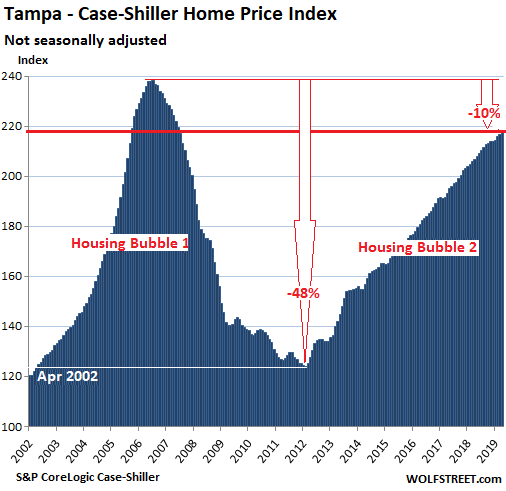
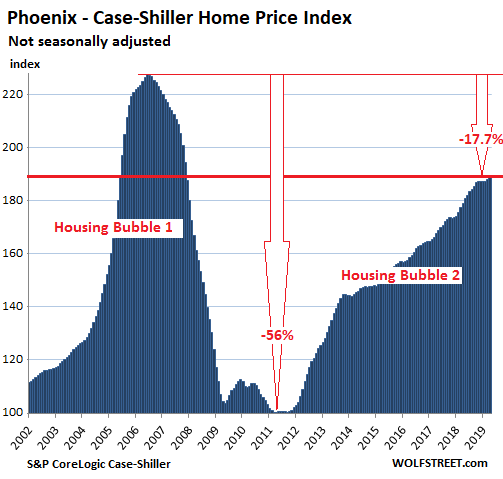
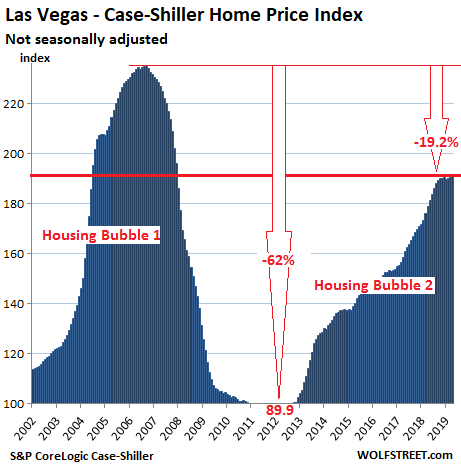
The Case Shiller index was set at 100 for January 2000; a value of 200 indicates that prices have doubled since January 2000. Every housing market on this list of the most splendid housing bubbles in America has an index value somewhere in its history of over 200, either during Housing Bubble 1 or during Housing Bubble 2, the minimum requirement for this list.
Seattle House Prices:
Prices of single-family houses in the Seattle metro rose 1.1% in April from March. But it wasn’t enough to keep up with the seasonal spring surge last year. This left the index flat with April 2018, the first year-over-year flat-reading since the end of Housing Bust 1 in April 2012. The index is down 2.8% from the peak in June 2018:
Los Angeles House Prices:
House prices in the Los Angeles metro rose 1.0% in April from March, thus beating by a tiny fraction the old record of August 2018, according to the Case-Shiller index. This moved the index up 1.5% from April 2018:
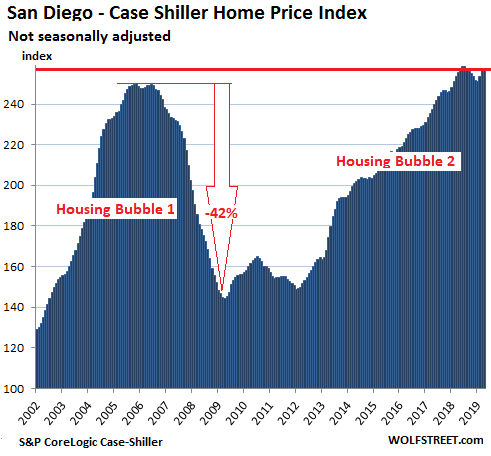
San Diego House Prices:
House prices in the San Diego metro ticked up 0.5% in April from March, less than the seasonal jump a year ago, which eroded the year-over-year gain further, now down to just 0.8% compared to April 2018. The index remained down a smidgen from its peak in July last year:
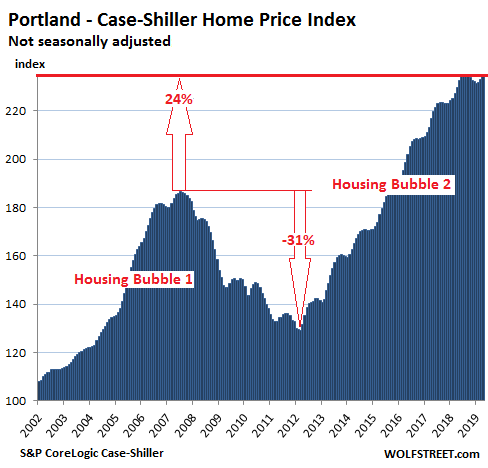
Portland House Prices:
The Case Shiller index for house prices in the Portland metro rose 1.1% in April from March, in line with the seasonal jump last year, leaving the year-over-year gain at 2.6%, but it allowed the index to barely squeak past its record of July 2018 to a new record by the thinnest of margins — and has the chart shows, has been essentially flat since July last year:
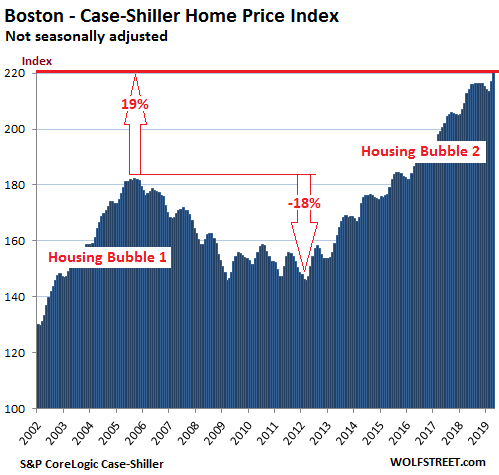
Boston House Prices:
After declining three months in a row from their November peak, house prices in the Boston metro started rising again in March, in line with seasonal moves. In April, the Case Shiller index jumped 1.9% from March to a new high, for a year-over-year gain of 3.9%:
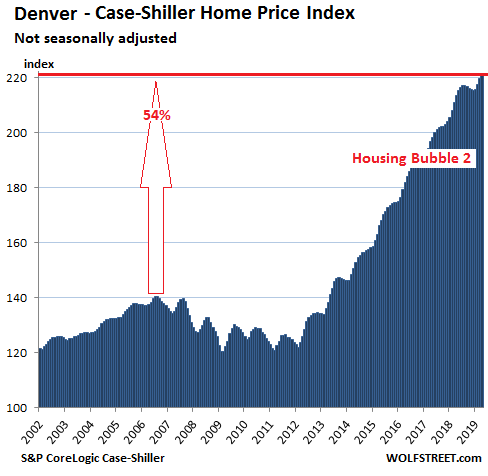
Denver House Prices:
House prices in the Denver metro rose 0.8% in April from March, but the seasonal gain was smaller than last year, and the year-over-year gain of the Case Shiller index was whittled down to 3.8%, the smallest gain since May 2012:
Miami House Prices:
House prices in the Miami metro in April ticked up a smidgen from March but remained a smidgen below February, creating a three-month flat spot that has now whittled the year-over-year gain down to 3.7%. This leaves the index 13.4% below the nutty peak of Housing Bubble 1:
Tampa House Prices:
House prices in Tampa rose 0.7% in April from March and are up 5.6% year-over-year, but remain down 10% from their mind-bendingly nutty peak during Housing Bubble 1:
Phoenix House Prices:
The Case Shiller index for the Phoenix metro rose 0.8% in April from March, for a year-over-year again of 6.0%, leaving the index 17.7% from its crazy peak during Housing Bubble 1:
Las Vegas House Prices:
House prices in the Las Vegas metro rose 0.6% in April from March, for a 7.1% year-over-year gain, but that was down from February’s 9.7% and March’s 8.2% year-over-year gain. The index has been essentially flat since October last year:
Washington DC:
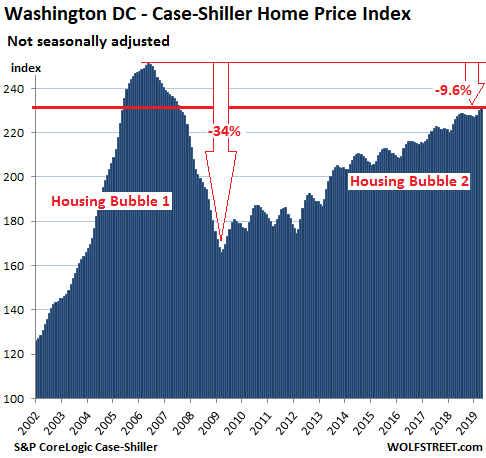
The Case Shiller index for the Washington D.C. metro rose 0.9% in April from March, but this gain was less than the seasonal gain last year, and the year-over-year gain was whittled down to 2.6%. The index remains 9.6% below its nutty peak of Housing Bubble 1:
The Case Shiller Index, a measure of house price inflation
The Case-Shiller methodology is based on “sales pairs”: It compares the sales price of a house in the current month to the last transaction of the same house years ago, thus tracking price changes of the same house over time. When the price of a house doubles, it’s not because the house grew to be twice its former size, but because it takes twice as many dollars to buy the same house. So the index tracks the purchasing power of the dollar with regards to the same house, which makes it an effective measure of house-price inflation.
Enjoy reading WOLF STREET and want to support it? Using ad blockers – I totally get why – but want to support the site? You can donate “beer money.” I appreciate it immensely. Click on the beer mug to find out how:
Would you like to be notified via email when WOLF STREET publishes a new article? Sign up here.