Amid trade wars, foreign investment in pricey California homes falls

b1be5 SJM L FOREIGN 0812 90 01 Amid trade wars, foreign investment in pricey California homes fallsForeign buyers have cooled on the U.S. residential home market, dropping investments by more than one-third over the previous year and spending less in expensive California.

The share of foreign investment going into California residential real estate slipped in 2018 and 2019, as Chinese buyers moved out of the country’s most expensive housing market, according to a new survey by the National Association of Realtors.

About one-third of foreign purchases in California during a recent 12-month period were made by Chinese citizens. In the midst of a growing trade war, overall Chinese investment in U.S. residential real estate fell from $30.4 billion to $13.4 billion in the last year.

“It’s just a big drop,” Gay Cororaton, senior economist for the association. Political and commercial uncertainty during the trade disputes likely drove away Chinese investors. “If they don’t know how business conditions will be, they might not invest.”

Foreign buyers, defined as non-U.S. residents and visa-holding foreigners living in the U.S., cut their spending by more than one-third, from $121 billion to $78 billion between the 12 months periods of 2017-18 and 2018-19, according to the survey. The weariness of overseas buyers also could be attributed to rising home prices, a stronger dollar, and ongoing Chinese restrictions on moving currency out of the country, Cororaton said.

California was the second most popular destination for non-citizen buyers, trailing Florida. Roughly 12 percent of foreign investors purchased in California, a decline from 14 percent the previous year, according to the study.

Soaring real estate prices in California have driven many buyers to the sidelines. Bay Area home sales in June dipped to the lowest levels for that month since the depths of the financial crisis and recession in 2008. In a region with 7 million residents, just 7,300 home and condos were sold in June.

Median sale prices for existing homes in the nine-county region fell slightly in the first half of the year, to $900,000 in June, according to real estate data firm CoreLogic. The median home price peaked in May 2018 at $928,000.

Nearly a decade ago, absentee owners, including many foreign investors, began snapping up homes and condos in the wake of the home mortgage crisis. Investor purchases in the Bay Area — including vacation homes and non-owner occupied units — peaked in February 2013, according to a CoreLogic analysis for this news organization.

Investors bought at least 1 in 5 units in Alameda, Contra Costa, San Mateo and Santa Clara counties in that month. More than one-third of the homes sold in Contra Costa County were bought by investors, according to the analysis.

“There were a lot of distressed properties to buy,” said CoreLogic analyst Andrew LePage, noting many homeowners owed more on their mortgages than their homes were worth. The real estate market has since been on a record streak.

In June, purchases by absentee owners fell to 15 percent of all deals, below the historic average of 16.5 percent, according to CoreLogic. Bay Area investment home purchases ranged from 12.6 percent in Santa Clara County to 17.1 percent in San Mateo County for the month.

Real estate agents report that the mix of foreign investors has changed. The new wave, often international business executives, is looking for luxury properties over $5 million in the Bay Area.

But even wealthier clients couldn’t make up for a fall in activity.

The NAR report broke down investment by state, but not by region. Overall, foreign buyers accounted for 5 percent of sales of existing U.S. homes. About 6 in 10 are recent immigrants, drawn by jobs and higher education, according to the survey.

Foreign buyers spent roughly $280,000 for a home, higher than the $259,000 national median price. About 20 percent of investors bought in Florida, and 10 percent in Texas. They were more than twice as likely as others to buy a $1 million home. Less than half of the buyers — 47 percent — bought properties as their primary residence.

The survey found that about 34 percent of Chinese investors bought in California, followed by United Kingdom buyers (20 percent), and Indian and Mexican citizens (10 percent each).

The data is drawn from an annual survey of real estate agents and transactions. Foreign purchasers are generally not required to disclose country of origin.

For some overseas buyers the Bay Area is a bargain. Homes in the San Jose metro are about one-quarter as expensive as comparably-sized homes in London and Hong Kong, and about half the price of similar units in Tokyo and Singapore, according to the survey.

San Francisco and East Bay cities had even bigger bargains for international home shoppers.

Cororaton said the large drop surprised researchers. In California, she said, “we’re attributing that drop to Chinese buyers.”


Article source: https://www.mercurynews.com/2019/08/12/amid-trade-wars-foreign-investment-in-pricey-california-homes-falls/

Posted in SF Bay Area News | Tagged | Leave a comment

Bay Area Housing Market Hits Brief Cooling Trend: Report

Is the hot Bay Area housing market starting to cool? New research shows not only are there fewer bidding wars compared to last year, but also houses are taking longer to sell.

For example, a house in Mountain View was on the market for 70 days, and only after the list price was reduced did the owner get multiple offers. The sale is now pending.

Real estate agents say that’s something that likely would not have happened last year. And bidding wars in the Bay Area are not nearly as common as a year ago, according to a new report by real estate brokerage Redfin.

Last year, a whopping 80% of homes sold by Redfin agents in San Jose had multiple offers, and this year, that number plummeted to just over 13 percent, Redfin found.

Also, homes aren’t selling as fast compared to last year, something Intero Realtor Nancy Carlson is seeing in Los Altos.

“The average days on the market is increasing,” she said. “Last year, it was seven to nine days. Now it’s up, 10 to 14 days.”

Gustavo Gonzalez, the president of the Santa Clara County Association of Realtors, acknowledged there is a recent trend of fewer bidding wars and homes staying longer on the market. But he added that homes that are staged well and priced correctly are still selling fast.

The chief economist for Redfin said these new trends may help buyers.

“If you’re looking to buy in the Bay Area, now is a good time because there is less competition than last year,” Daryl Fairweather said.

But she says its a short window of opportunity because the market is likely to heat up again, with bidding wars similar to last year.

San Francisco continued to see bidding wars last month. In July, 35% of all homes sold by Redfin agents received multiple offers.

Get the latest from NBC Bay Area anywhere, anytime

  • 53757 bay area icon Bay Area Housing Market Hits Brief Cooling Trend: Report

    Download the App

    Available for IOS and Android

Posted in SF Bay Area News | Tagged | Leave a comment

You need to make $343,000 to afford a home in San Francisco, new study says


  • b1a33 920x920 You need to make $343,000 to afford a home in San Francisco, new study says

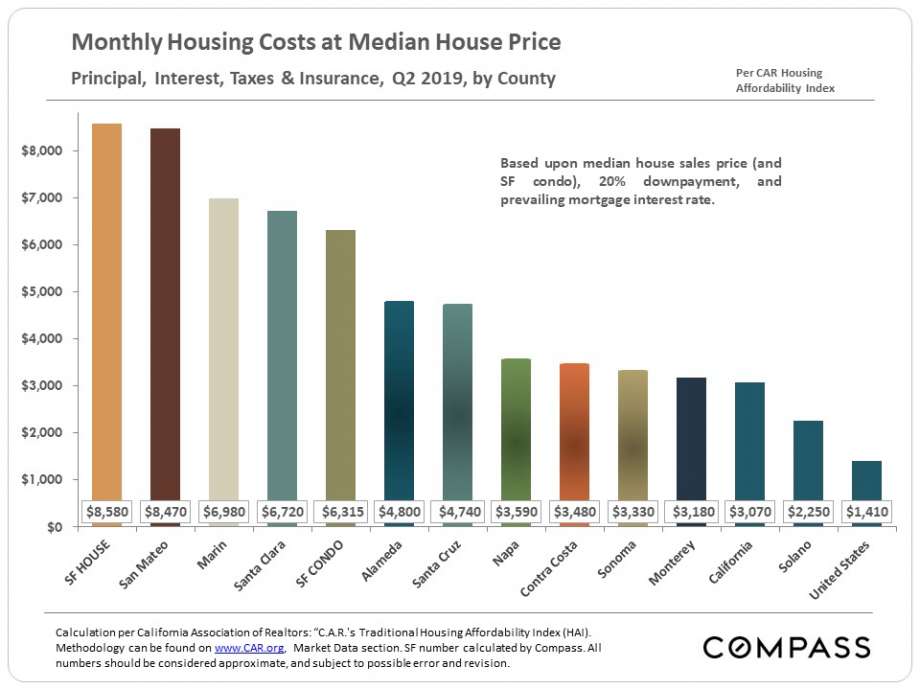
    Homes are slightly more affordable than they used to be as wages have gone up and mortgage rates have come down. But it still takes about $200,000 to afford a median-priced home in the Bay Area, and significantly more than that in San Francisco, San Mateo, central Contra Costa, Santa Clara and Marin.

    less

    Homes are slightly more affordable than they used to be as wages have gone up and mortgage rates have come down. But it still takes about $200,000 to afford a median-priced home in the Bay Area, and

    … more


    Photo: Patrick Carlisle/Compass

  •  You need to make $343,000 to afford a home in San Francisco, new study says

Caption

Close

Homes are slightly more affordable than they used to be as wages have gone up and mortgage rates have come down. But it still takes about $200,000 to afford a median-priced home in the Bay Area, and significantly more than that in San Francisco, San Mateo, central Contra Costa, Santa Clara and Marin.

less

Homes are slightly more affordable than they used to be as wages have gone up and mortgage rates have come down. But it still takes about $200,000 to afford a median-priced home in the Bay Area, and

… more


Photo: Patrick Carlisle/Compass


We’re used to hearing that homeownership is out of reach for many in the Bay Area. But it’s still shocking to read a new report that says you need to make just over $343,000 in order to afford a median-priced home in San Francisco.

The report was compiled by Compass but uses data from the California Association of Realtors, which took into account median home sale prices and prevailing mortgage rates in the second quarter of 2019. It assumed a 20 percent down payment and also includes taxes and insurance in monthly costs. With all those figures taken into account, it should run $8,580 a month for a median-priced home in SF.

Only 17 percent of San Franciscans can afford these payments, which is actually an increase over what we’ve seen in the past few years. The recent uptick can mainly be attributed to a significant drop in mortgage rates over the last year, according to the report, as well as stagnating home prices and wage growth as lower-income residents have been forced to leave the area and higher-income households move in.


ALSOThis $18 million Seacliff home was the second-biggest real estate deal in San Francisco this year

Home affordability in San Francisco hovered between 10 and 15 percent between 2012 and 2018. It hit an all-time low of 8 percent in the third quarter of 2007, just before the financial crisis hit, as many people were getting loans beyond their means.

San Francisco condo prices are lower and therefore more affordable — though not by much. Households with an income of just over $252,oo0 can afford a median-priced condo in San Francisco. That gets buyers a median of 1,143 square feet, compared with a median of 1,734 square feet in a home.

For the biggest bang for your buck in the Bay Area, check out central Contra Costa cities like Moraga and Orinda. You might need an income over $270,000 to afford a home there, but you get substantially more space — a median of 2,460 square feet.

Across the Bay Area in general, it takes about a $200,000 income to afford a home. Alameda, Santa Cruz, Contra Costa, Sonoma and Monterey counties come in under that amount and San Mateo, Marin and Santa Clara join San Francisco above.

Only Solano County was affordable for those making under $100,000 a year.

Emily Landes is a writer and editor who is obsessed with all things real estate.

Article source: https://www.sfgate.com/ontheblock/article/san-francisco-median-home-price-salary-bay-area-14301047.php

Posted in SF Bay Area News | Tagged | Leave a comment

Housing affordability at “historic low” in Bay Area

It’s technically, slightly more affordable to buy a home at prevailing prices in the Bay Area compared to this same time last year, per the most recent word from SF-based Compass real estate group.

But the improvement year over year is so slight, and the scale of home prices across all nine counties so intimidating, that the marginal improvements reflected in Compass economist Patrick Carlisle’s paper “Housing Affordability in the San Francisco Bay Area” seem almost insulting.

On one hand, “the percentage of households who could afford to purchase a median-priced house ticked up in Q2 2019 as compared to Q2 2018,” Carlisle writes, citing hop from about 15 percent of households affording a home up to 17 percent.

But he’s quick to add, “affordability percentages remain low by historical standards, and the Bay Area typically has among the lowest in the nation.”

For example, drawing on the California Association of Realtor’s (CAR) “traditional housing affordability index,” Compass estimates that in Q2 of 2019, the average homebuyer in the Bay Area should make at least $198,000 per year (taxes not included) in order to truly afford a median-priced house, assuming a 20 percent down payment and median rates on variables like property taxes.

In San Francisco that recommended income balloons to more than $343,000, except when it comes to buyers specifically looking for condos, in which case $252,500 per year will scrape by.

The next most prohibitive area is San Mateo County, where Carlisle suggests making just under $339,000 per year. As always, the determination of who can afford what is based on the federally recommended guideline that residents commit no more than 30 percent of their monthly income to housing costs.

Compass cites CAR projections that the median income for the Bay Area will climb to $105,800 per year across the nine counties, up from $97,250 in 2018.

Right now the US Census estimates that the average San Francisco household makes $96,265 per year, but that figure is from 2017 (still the most recent census number released).

In April of 2018, the Mayor’s Office of Housing adjusted its income limits for affordable housing defined a median income as $82,900 for a single person or $118,400 for a house of four.

For Q2, a median SF home sale price hit $1.7 million per CAR, and exceeded $1.76 million just in June. For the entire Bay Area the price was $960,000—actually down compared to last year’s $1.04 million around the same time, but still an ordeal most earners can’t imagine making.

The mortgage firm HSH, which evaluates housing prices and recommended incomes almost every month, estimates that Compass has overshot the mark.

In May, HSH recommended that SF earners make just more than $186,000 per year before buying. But since few few people manage that either it’s hard to qualify as good news.

Article source: https://sf.curbed.com/2019/8/12/20802296/housing-affordability-compass-carlisle-san-francisco-q2-2019

Posted in SF Bay Area News | Tagged | Leave a comment

Oakland’s artist warehouses, targeted after Ghost Ship, face new threat from pot

Nearly three years after the Ghost Ship fire, the scruffy, low-rent art spaces that helped give Oakland its edge are disappearing. Building inspectors shut some of them down after the blaze that engulfed the Fruitvale warehouse in December 2016, killing 36 people and prompting the trial of two men who now await a jury’s decision on whether they were criminally negligent.

But other artist colonies have succumbed to a new, more persistent threat: marijuana.

In the past year, the city has issued permits to 87 cannabis operations, including greenhouses, farms, laboratories, dispensaries and delivery services — many of which are willing to pay a premium for rent.

And more could come: Since May 2017, 124 businesses applied for permits to run indoor cultivation facilities. Though Oakland won’t make their addresses public, city officials say that most are vying for old manufacturing sites and abandoned warehouses. Oakland’s “green zone” — the areas where cannabis businesses can legally operate — encompasses much of the industrial hinterland in East and West Oakland, where artists sought cheap space to work and live.

The shift worries some artists, who say that a city long steeped in bohemian subcultures is now pinning its hopes on an industry that might not pan out. Even cannabis growers say they’ve noticed a visible change in the landscape.

“You used to see the Burning Man-type people walking down to the Fruitvale BART Station,” said Alexis Bronson, a small-time cannabis grower who works out of a large dispensary.

“There is a lot less of that now,” he continued. “It seems like every warehouse is a pot grow, and now it’s even worse because the big real estate investors, they came in and bought up these whole swaths of buildings.”

 Oakland’s artist warehouses, targeted after Ghost Ship, face new threat from pot

Nowhere is the tension more apparent than the Nimby warehouse in East Oakland, where artist-tenants are packing up their saws, sculptures and glass-blowing equipment. They have two months to leave before rent on the property jumps significantly, said Michael Snook, the group’s founder and leaseholder. Landlord Murray Hill Partners is making electrical upgrades to accommodate a “broad range” of potential tenants, including those from the cannabis industry, said Steven Wolmark, a principal at the firm.

When Nimby sculptor and volunteer security guard Clody Cates saw the building’s new meters and wiring, she winced.

“Oakland decided to turn its artistic zone into a green zone, and we just don’t know where to go next,” she said. Nimby already shares its property with a cannabis grow house. Another one sits next door, abutting a refrigeration firm.

City officials have tried to fend off displacement, passing an ordinance last year to bar cannabis businesses from operating in places previously used as homes. It came after a marijuana-focused real estate company bought the Oakland Cannery, a big brick artists hub inside a former fruit processing plant on San Leandro Street. The landlord, Green Sage, threatened to push out the artists, but the city protected them.

“We want to protect the breadth of live-work communities in Oakland, because they hold so much of our creative, artistic and small business communities,” said Kelley Kahn, the city’s policy director of art spaces. Mayor Libby Schaaf established herself as a guardian of the city’s art and maker colonies from the moment she took office, occasionally riding around Lake Merritt in an art car that resembles a fire-breathing snail. Like other officials, she has also embraced cannabis as a source of jobs and badly needed tax revenue.

Some skeptics say Oakland’s ordinance may do little to shield its creative class from new economic pressures. The law doesn’t apply to nonresidential work studios like Nimby. And it might not help scores of live-work spaces operating without permits that have held on despite the city’s push to find them and bring the buildings up to code. Nearly 100 such dwellings still exist in Oakland, said David Keenan, founder of Safer DIY Spaces, a nonprofit that helps residents of these buildings bring them up to code. But because the city doesn’t have a way of tracking them, the residents could easily be displaced by marijuana entrepreneurs with deeper pockets.

 Oakland’s artist warehouses, targeted after Ghost Ship, face new threat from pot

That’s what happened at 2650 Magnolia St., a squat brick structure near McClymonds High School in West Oakland. It’s subdivided into nine units that the landlord traditionally rented to artists or other creative types who live on the margins. As the inhabitants move out, they’re being replaced by cannabis growers, said Kimball Stone, one of the last remaining residents.

His unit, which costs him about $2,800 a month and he shares with a friend, has two bedrooms, a bathroom with laundry, a kitchen and a living room with space for Stone’s “garage hobbies.”

“Where are you going to find a place where you can have motorcycles and bicycles and two big dogs? Parking for a big truck?” Stone said, pointing to piles of tools near the motorcycles stowed several feet from his couch. “I don’t know where we can find that. The rental market has gone insane. I have been on Craigslist constantly for months looking for places to live, and we can start to afford at Petaluma or Vallejo.”

Neighbors frequently complain that 2650 Magnolia has become a magnet for crime. Jon Sarriugarte, a blacksmith who lives across the street and built Schaaf’s fire-breathing snail, fears that the building will become another Ghost Ship.

Even before Oakland’s green rush, growing anxiety about building safety made it difficult to sustain spaces operating without permits. In the immediate aftermath of the Ghost Ship fire, city officials reviewed a backlog of complaints and found 32 commercial buildings or warehouses where people were living or working illegally. Eight were ultimately cleared of violations, three were issued permits, one building was red-tagged, and the other cases remain unresolved. Some owners chose to evict their tenants instead of fixing problems, even if they hadn’t received a notice of violation from the city, Keenan said.

Displaced artists often have nowhere to go. Vacant buildings that once housed canneries or steel mills now command $1.20 per square foot, a steep rise from previous years. In 2017 alone, industrial rents soared by 70%, according to the city.

One of the last remaining work studios, a building in the Fruitvale neighborhood called Moxy, burned down Friday.

Some of the demand comes from e-commerce companies that want to open distribution centers near the port and the Bay Bridge. But cannabis tenants are also vying for property and paying rents of $2 to $5 per square foot — a price that landlords set to cover the extra risk, because these companies can’t secure bank loans and some landlords fear the possibility of federal raids. Outdoor lots that used to be dirt cheap are now valuable, Snook said, because marijuana growers use them for greenhouses.

Cannabis fever swept through Oakland as soon as commercial sales became legal in 2018: A stretch of warehouses along San Leandro Street between High Street and 66th Avenue earned the nickname “Green Row,” because developers converted so many of them into cannabis incubators and nurseries.

As the warehouse scene dries up, some artists are fleeing to rural areas. Snook, the founder of Nimby, moved his collection of off-road vehicles to Doyle, a small Northern California town where social events include lizard racing and chicken bingo. He recently bought a shuttered cafe. Other artists are clearing their tools from shipping containers that served as studios, some decked with shelves and French doors. One tenant, leather crafter Rex Goulet, may wind up working out of his car or the living room in his San Leandro apartment.

“I know it doesn’t look like it, but a lot of people have left already,” said Cates, the volunteer security guard, who lives in a trailer on the Nimby lot. She surveyed what was left of the warehouse’s colorful menagerie on a recent morning: wood scraps, sculptures made from rebar and hard foam, toy pirate ships poached from a bumper boat ride at a carnival.

Cates paced through the building, its floors strewn with wooden pallets. She stopped at an empty shipping container that had belonged to a glass blower. It was packed with supplies only days before.

Something shiny glinted from the floor, and Cates bent down to pick it up: a penny, a nickel and a quarter.

“Always lucky to find money,” she said. “Maybe I’ll use it at my next place.”

NOTE: This story has been updated to reflect Kelley Kahn’s proper title, policy director of art spaces for the city of Oakland.

Rachel Swan and Sarah Ravani are San Francisco Chronicle staff writers. Email: rswan@sfchronicle.com, sravani@sfchronicle.com Twitter: @rachelswan, @SarRavani

Article source: https://www.sfchronicle.com/bayarea/article/Oakland-shuttered-artist-warehouses-after-Ghost-14295697.php

Posted in SF Bay Area News | Tagged | Leave a comment