This former Googler is tired of the crazy, Bay Area housing prices

Adam Singer is tired of San Francisco.

The former Google marketing manager says after living in the Bay Area for over a decade, he’s had enough of the astronomical home prices and the city not making progress to improve living conditions.

In a tweetstorm last Wednesday, Singer aired his hang-ups with San Francisco and announced that after a trip to Austin, he and his wife (and their rescue dog, Dash the Dingo) would be moving to the Texas capital, which is increasingly known for its hot startup scene as much as it’s bar-b-que.

“So Austin suburbs are beautiful. Houses really reasonably priced. Easy ride to the city. Great food and music scene nearby. What’s the catch,” Singer tweeted. “For same price of your SF rental you can afford basically as much house as you want here. Crazy.”

Singer says he recently purchased land in Austin and will be working with a local design center on the construction of his home.

Read more: 11 facts about San Francisco’s housing market that will make you glad you live somewhere else

With housing prices in the San Francisco Bay Area continuing to reach record highs, many, like Singer, are questioning whether it’s worth it to live in the region at all. A recent study found that 44% of Bay Area residents polled said they’re likely to leave within the next few years. High housing prices were the top reason residents were feeling the pressure to move.

Another report by the real estate company Compass found just how costly it can be to buy a home in the San Francisco Bay Area. Including mortgage payments, taxes, and insurance, owning a median-priced home in the Bay Area runs around $8,500 per month. And in order to afford that kind of monthly expense, a person would need to earn more than $340,000 per year, the report said.

The former Googler told Business Insider in an interview this week that after two years of househunting across the Bay Area, seeing the type of homes they could actually afford became all too frustrating.

“I’m not paying two million dollars to live in some [baby] boomer’s starter home next to a strip mall,” Singer said, in reference to certain houses he looked at south of San Francisco, near San Jose.

In Austin, Singer says he was able to find “gorgeous” homes for under a half-million dollars.

A “NIMBY” state

The former Googler puts much of the blame of San Francisco’s housing prices on city officials who he says don’t want to increase the number of condos and apartments in the area. Other cities, like Austin and Seattle, Singer says, have been able to keep housing prices from reaching untouchable rates because they’ve been willing to develop.

“People think supply and demand economics don’t exist as soon as you get into the Bay Area,” Singer said. “It’s not a thing here.”

Singer also points the finger at long-time San Francisco residents who bought their homes years before prices spiked. Those owners are cashing on the demand from renters, Singer says, and thus have little incentive to advocate for the city to increase its supply of homes.

“For the people who already own here, I think they quietly don’t give a f—-,” Singer said. “They have theirs. Whether they want to admit it or not, this is a NIMBY state. What they will accomplish — they will squeeze out the middle of San Francisco.” (NIMBY is an acronym for “not in my backyard,” often used to describe opposition to development in a particular area.”)

On top of the extravagant housing costs, the Bay Area faces major problems like how to best support its homeless population and provide adequate transportation options for residents, Singer says. He also sees much of what initially appealed to him about San Francisco — like local cafes and eateries — being displaced trendy restaurants with “$500 prix fixe menus.”

Good weather and FOMO

So why are some San Franciscans still choosing to stick around?

Besides the weather, Singer says he thinks some people, especially those in tech, stay in the Bay Area because of FOMO, or fear of missing out. The thought, he says, is that if you’re not in San Francisco, you won’t have the chance to work for top tech companies like Uber or Pinterest or Google.

That might be true for those just starting their careers, said Singer, who now works as a digital marketing lead at the biotech company Invitae. But for someone who has worked at a company for at least a couple years and has proven to be a “linchpin” for their teams, Singer says it’s unlikely that a company wouldn’t let that person work remotely.

“The unwritten rule at any given mega-corp is if you’re a talented individual contributor, they will let you work from whereever you want,” Singer said. “It is not posted on their website. They will not admit that to you ever. But I’ve never seen that not be true at any big company.”

As for reaction to his Austin relocation, Singer tells us that none of his friends or family were all to shocked.

“The biggest reaction is, ‘Why did you stay in San Francisco so long?’ from all my non-San Francisco friends,” Singer said. “None of my San Francisco or Bay Area friends were surprised. They’re like, ‘It’s totally reasonable to leave.’ No one’s fighting to keep me here.”

Article source: https://www.businessinsider.com/former-googler-leaves-bay-area-buys-land-austin-texas-2019-8
Posted in SF Bay Area News | Tagged | Leave a comment

The Bay Area is booming — and bracing for a slowdown

Bay Area companies are bracing for a rough time as ominous early warning signs of recession emerge amid trade wars, international tensions and stock market gyrations. Wall Street recorded a turbulent week, with a stunning 800-point plunge in the Dow Jones industrial average on Wednesday followed by gains that still left the major indexes down for the third week in a row.

“If we were driving down the freeway together, there would be a sign that says, ‘Caution, bumpy roads ahead,’” said Carl Guardino, CEO of Silicon Valley Leadership Group, a public policy trade association representing more than 350 major employers.

He emailed several CEOs of companies Thursday across a range of sectors — hardware, software, semiconductors, venture capital, financial services, renewable energy and a startup — seeking their perspective on the economy.

All said their companies are taking steps, such as curtailing spending, to weather a slowdown. “There was not a single ‘All is well,’” he said.

Some rank-and-file workers said they already see belt-tightening. Blind, an app for workers to discuss their companies anonymously, conducted a poll for The Chronicle this week asking workers at major tech companies whether their employers were cutting costs. It drew 2,601 responses.

An overwhelming number of workers at some companies reported a new frugality. More than four-fifths of respondents at Uber, Adobe, job site Indeed, Zillow Group, Symantec, Intel, Oracle and Cisco said they’re seeing cutbacks. Many cited hiring freezes and fewer perks. Some mentioned layoffs. San Jose’s Cisco, which makes networking hardware, cut almost 500 Bay Area jobs last week, its second round of layoffs in a year.

The numbers were smaller, but still significant, at other enterprises, with 75% at Google, 59% at Microsoft, 52% at Apple, 45% at Amazon, 40% at LinkedIn and 37% at Facebook reporting cutbacks.

At Uber, several employees mentioned hiring freezes and layoffs (it axed 400 marketing employees last month). Uber told workers last week it will no longer celebrate work anniversaries with helium balloons, saving $200,000 a year in San Francisco alone. Uber said that it “temporarily hit pause” on hiring for some engineering teams in the U.S. and Canada, but continues “to aggressively hire talent, including many engineers, all over the world.”

Of course, Uber, which went public in May and faces Wall Street scrutiny over its vast losses, has many reasons to practice thrift unrelated to the world economic situation.

While the widespread layoffs typical of a recession haven’t occurred, some recruiters said companies are adding employees in a more measured way.

“We’re so accustomed to tech companies saying, ‘We need 10 people yesterday,’” said Lauren Skuchas, managing director of the San Francisco office of Betts Recruiting, which finds employees for early stage venture-backed companies. “Over the past few months, we’ve seen a decrease in that crazy amount of exaggerated need.”

Likewise, Genine Wilson, vice president of Pacific markets for temporary-agent giant Kelly Services, said demand is starting to temper, but it’s not a steep decline. “A lot of people are being cautious,” she said. Hiring “is less than the prior year, but not yet alarming.”

For manufacturing and distribution temporary jobs, more requests are coming in at the last minute as companies wait to see the impact of tariffs and other trade challenges, Wilson said.

Other recruiters said hiring is continuing unabated.

“We have not seen any significant shifts in hiring that would point to a slowdown,” Mehul Patel, CEO of Hired, a marketplace for tech jobs, said in an email. “The reality is and continues to be that demand for tech workers outpaces supply, which contributes to hiring remaining very competitive. And where there’s an increase in demand, we’ve found there is also an increase in salaries.”

Will Hunsinger, CEO of Riviera Partners, which focuses on finding engineers and executives for venture-backed companies, said demand remains strong, but he hears many more people expressing concern about the future. “There’s a lot of discussion about whether we are at the top of the cycle,” he said.

A downturn is hardly imminent. This month’s emergence of an inverted yield curve, an indicator of expected slower growth, ignited the jitters. It happened Wednesday when interest rates on two-year Treasury bonds were higher than those on 10-year bonds, showing investors’ pessimism about the future. Normally, longer-term bonds pay higher yields to compensate for locking up money for longer.

But the inversion happened just briefly — and many experts say it matters only when it persists for several weeks or months. Although an extended inverted yield curve has occurred before every U.S. recession since 1955, the time lags were sometimes as high as two years.

Meanwhile, the nation and region enjoy historic low unemployment rates, while office rentals and residential sales and rentals continue to go through the roof. On Friday, the state said California’s unemployment rate was 4.4% in July (the seasonally adjusted rate was lower), while the San Francisco rate was 2.4%.

“The Bay Area still feels pretty boom-y,” said Ken Rosen, chairman of the Berkeley Haas Fisher Center for Real Estate and Urban Economics. “We haven’t seen any real signs of recession yet.”

But as the stock market falls, “companies will realize they have to be more cost-efficient,” he said, predicting a recession within two years.

“We’re more likely to see something mild this time (compared with the recession of 2007-09) but the Bay Area won’t be insulated or immune,” Rosen said. “Technology has huge excesses in valuations. When the capital markets say ‘no more,’ people will cut back hiring and use of space.”

Carolyn Said is a San Francisco Chronicle staff writer. Email: csaid@sfchronicle.com Twitter: @csaid

Article source: https://www.sfchronicle.com/business/article/The-Bay-Area-is-booming-and-bracing-for-a-14339525.php

Posted in SF Bay Area News | Tagged | Leave a comment

Uptown Oakland Reportedly Getting a Shake Shack

New York burger chain Shake Shack will bestow a location upon Oakland’s Uptown Station complex, anonymous, salivating sources tell the Chronicle. The plan is for an outpost of the restaurant, which now runs two stores in the Bay Area, to occupy a portion of the ground floor real estate at 1955 Broadway, formerly a Sears building.

It’s the latest, and juiciest, development in a serious of twists and turns for the former department store space. First, Uber bought the 1929 Beaux-Arts building with plans for an East Bay headquarters, then changed its plans and sold it to a real estate firm. Last year, payments company Square signed a lease on the office space — and now it sounds like Square employees will be enjoying some “Shackburgers” and crinkle cut fries at lunch.

While the Bay Area doesn’t lack for mid-range burger options like Shake Shack — homegrown option Super Duper, for example, occupies the same niche — the well-known chain’s arrival in the area has caused a flurry of excitement. A Palo Alto Shake Shack, then a Marin County location, were met with massive lines. A San Francisco location is bound for the Marina, and likely to experience the same buzz. Whether or not the novelty wears off by the time Shake Shack gets to Oakland remains to be seen.

Article source: https://sf.eater.com/2019/8/13/20804407/uptown-oakland-shake-shack-coming-rumor-lease

Posted in SF Bay Area News | Tagged | Leave a comment

I-TEAM EXCLUSIVE: Redfin closes several Bay Area offices because of gun threat – KGO

SAN FRANCISCO (KGO) — Real estate firm Redfin closed four Bay Area offices this week, after a contractor who had been fired made a veiled threat about shooting employees.

An anonymous source told ABC7′s I-team this week that a fellow Redfin employee told a manager, “this is why people bring shotguns to work” after that person got fired.

Redin is a Seattle-based real estate app and brokerage company with offices all over the country.

Sgt. Robert Shuffield, with the Pleasanton Police Department, says the fired employee who made the alleged threat worked out of Redfin’s Dublin office.

Redfin Vice President of Communications Mariam Sughayer tells the I-Team’s Dan Noyes its San Francisco office reopened Wednesday, but three offices in the East Bay will remain closed this week, and perhaps reopen next week.

Sughayer emailed this statement from Redfin’s Seattle headquarters saying, “On Friday August 9th, a Redfin contractor made concerning comments over the phone to a local Redfin manager. In response to the comments, we took swift action and worked closely with law enforcement to ensure our Bay Area employees were safe. Out of an abundance of caution, we closed four of our Bay Area offices. Our San Francisco office has reopened and we will reopen the remainder of our offices by early next week, all with additional security measures.”

Sughayer did not answer the I-Team’s follow-up question asking which law enforcement agency the company contacted. An FBI official tells the I-Team the agency did not know about the reported threat, until Dan Noyes called.

This story started with a tip to the I-Team from a Redfin employee who complained about a lack of information from the company, telling Dan Noyes, “They will not describe who this former employee is and refuse to communicate the threat to their extended workforce. This is just another example of their poor corporate practices, putting dollars over the health and safety of their workforce. It’s frightening.”

The source described the fired contractor as an associate agent.

While three East Bay offices remain closed, San Francisco’s office reopened Wednesday. On Thursday, employees leaving the office said they were aware of the threat.

“I’m not too concerned, I’m not too frightened. I feel like people get upset all the time,” said Jason Zhou, a Redfin Software Engineer. He says because of the incident, there is a security guard on their office floor this week, as well as counselors.

“I feel safe, yeah. Especially with security guards, and all the attention, and caring that our management have given us,” said Zhou.

Pleasonton PD said they have been in touch with the fired employee. They say they checked and have no reason to believe he has access to any weapons. No criminal charges have been filed, but the investigation is ongoing.

Redfin says they will reopen the East Bay offices early next week, with additional security measures.

This is a developing story; we will update when warranted.

For a look at more stories and videos by Dan Noyes and the ABC7 News I-Team.

Article source: https://abc7news.com/i-team-exclusive-redfin-closes-several-bay-area-offices-because-of-gun-threat/5471028/

Posted in SF Bay Area News | Tagged | Leave a comment

Housing Bubble 2 in San Francisco Bay Area & Silicon Valley Pops Despite Startup Millionaires & Low Mortgage Rates

House prices dropped again – and ironically the most in San Francisco and Silicon Valley.

In the San Francisco Bay Area overall, house prices dropped again in July compared to July last year. They dropped in eight of the nine counties on a year-over-year basis: Silicon Valley (Santa Clara and San Mateo), San Francisco, Marin, the Wine Country of Napa and Sonoma, and the East Bay (Alameda and Contra Costa). The only county where house prices ticked up year-over-year was in the least expensive county, Solano.

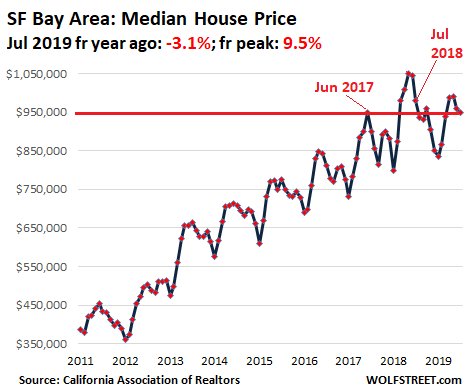
The drops pushed the median house price for the Bay area 3.1% below where it had been in July 2018, and 9.5% below the peak in May 2018, according to the final data by the California Association of Realtors (C.A.R.). The median price is now back where it had first been in June 2017:

c215d US California House price 2019 07 SF Bay Area Housing Bubble 2 in San Francisco Bay Area & Silicon Valley Pops Despite Startup Millionaires & Low Mortgage Rates

Sales volume of houses in the SF Bay Area ticked down 0.6% in July from the already depressed levels a year ago.

“The market will continue to be challenged by an overarching affordability issue, especially in high cost areas such as the Bay Area, which requires a minimum annual income well into the six figures to purchase a home,” the CAR’s report said.

In California overall, there is now a bifurcation: Condo prices are already falling on a year-over-year basis, and house prices are still rising. The median condo price in California fell 3.1% in July compared to a year earlier. But the median house price rose 2.8%.

The median house price by major region other than the Bay Area, in July year-over-year:

  • Central Valley and Inland Empire: Biggest gains in the least expensive regions: +5.2% and +4.1% respectively.
  • Central Coast: -2.0%.
  • Los Angeles metro +2.8%.

But some parts of the Bay Area are starting to have a wild ride. This is a vast region with a population of nearly 8 million people, separated by the various Bays. The big convoluted body of water with just a handful of infamous bottle-neck bridges has a hefty impact on congestion and commute times, and therefore on the dizzying magnitude of home prices. These prices get less dizzying the more time the commute to San Francisco and Silicon Valley takes during morning rush hour.

San Francisco

In San Francisco and in Silicon Valley, house prices were supposed to explode, fueled by the lowest mortgage rates in nearly three years and by the IPO billionaires and millionaires from Uber, Lyft, and other companies that would suddenly be buying homes, a time-honored real-estate hype that had been proven wrong before (here is my take: Why the Wave of Mega-IPOs Won’t Bail Out the San Francisco Silicon Valley Housing Bubbles). And little by little, the results are trickling in.

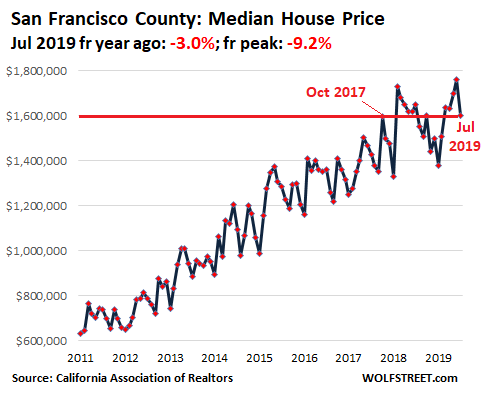
In San Francisco, the median price of single-family houses plunged 9.2%, to $1.6 million, from the record in June that had beaten by a hair the last record set in February 2018. The median house price is now 3.0% below where it had been a year ago and 9.2% below the peak. It’s back where it had first been in October 2017:

c766c US California House price 2019 07 San Francisco Housing Bubble 2 in San Francisco Bay Area & Silicon Valley Pops Despite Startup Millionaires & Low Mortgage Rates

Silicon Valley

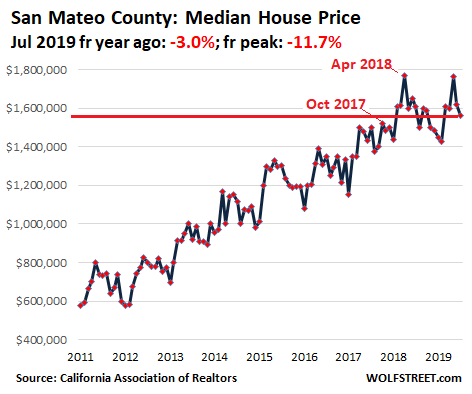
In San Mateo County, the northern part of Silicon Valley, the median house price in July fell 3.0% year-over-year, to $1.56 million. House prices are now down 11.7% from the peak in April 2018 and just above where they had first been in October 2017:

c766c US California House price 2019 07 San Mateo Housing Bubble 2 in San Francisco Bay Area & Silicon Valley Pops Despite Startup Millionaires & Low Mortgage Rates

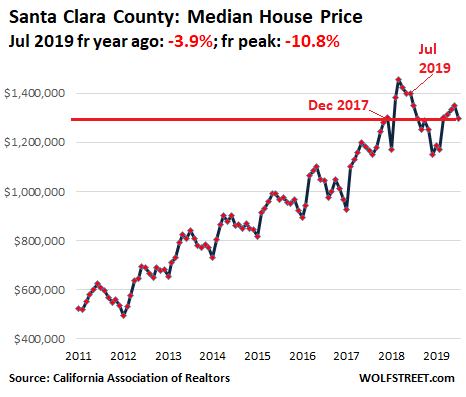
In Santa Clara County, the southern part of Silicon Valley and the most populous county of the Bay Area, the median price of single-family houses dropped 3.9% year-over-year, to $1.298 million. It is down 10.8% from the peak in April 2018 and just below where it had first been in December 2017:

c766c US California House price 2019 07 santa clara Housing Bubble 2 in San Francisco Bay Area & Silicon Valley Pops Despite Startup Millionaires & Low Mortgage Rates

North Bay Wine Country

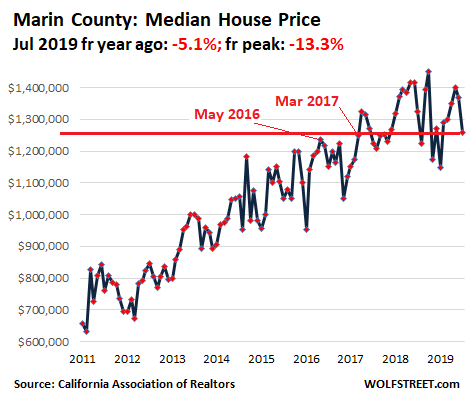
Marin County – think Sausalito, Mount Tamalpais, National Monument Muir Woods, Stinson Beach, and Highway 1 along the Pacific Coast – connected to San Francisco via the Golden Gate Bridge and ferry service, ranks among the most expensive places in the Bay Area. The median house price fell 5.1% in July from a year ago, to $1.257 million. This is down 13.3% from the peak in October 2018, is below where it had first been in March 2017, and is just 1.6% above where it had been in May 2016:

64881 US California House price 2019 07 Marin Housing Bubble 2 in San Francisco Bay Area & Silicon Valley Pops Despite Startup Millionaires & Low Mortgage Rates

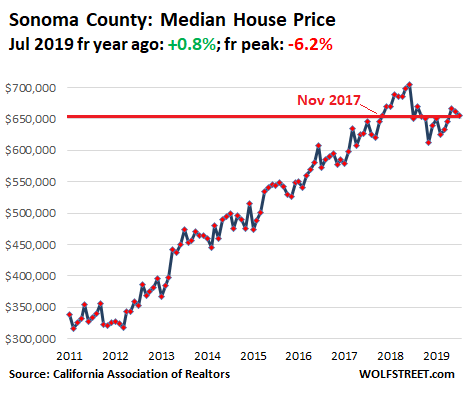
In Sonoma County, which forms part of Wine Country, the median price of a single-family house edged up 0.8% from July last year, to $655,000, but this was down 6.2% from the peak in May 2018 and was back where it had first been in November 2017:

64881 US California House price 2019 07 Sonoma Housing Bubble 2 in San Francisco Bay Area & Silicon Valley Pops Despite Startup Millionaires & Low Mortgage Rates

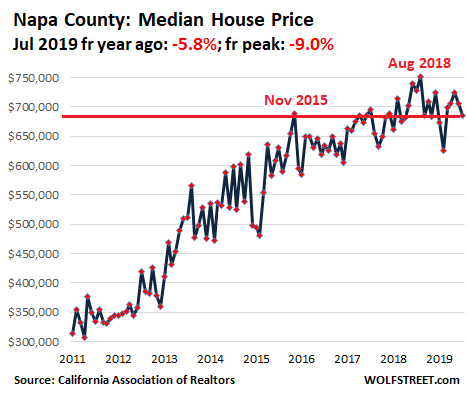
In Napa County, the median house price fell 5.8% year-over-year to $685,000. This was down 9.0% from the peak in August 2018 and was below where it had first been in November 2015:

64881 US California House price 2019 07 Napa Housing Bubble 2 in San Francisco Bay Area & Silicon Valley Pops Despite Startup Millionaires & Low Mortgage Rates

The East Bay

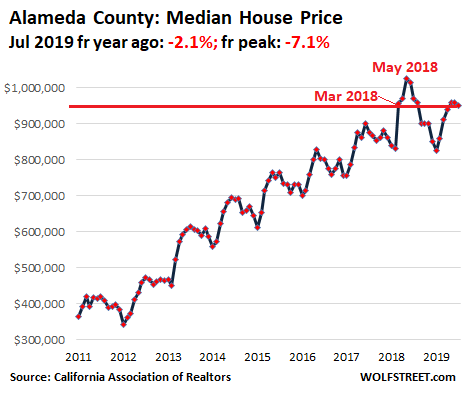
In Alameda County – think Oakland and Berkeley – the median house price dropped 2.1% from a year ago and 7.1% from the peak in May 2018, to $950,000. The price is now back where it had first been in March 2018:

64881 US California House price 2019 07 Alameda Housing Bubble 2 in San Francisco Bay Area & Silicon Valley Pops Despite Startup Millionaires & Low Mortgage Rates

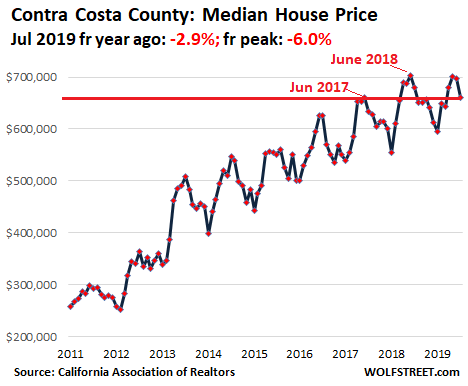
In Contra Costa County, the median house price fell 2.9% from July 2018 to $660,000, and 6.0% from the peak in June 2018. The median price is now back where it had first been in June 2017:

4293f US California House price 2019 07 Contra Costa  Housing Bubble 2 in San Francisco Bay Area & Silicon Valley Pops Despite Startup Millionaires & Low Mortgage Rates

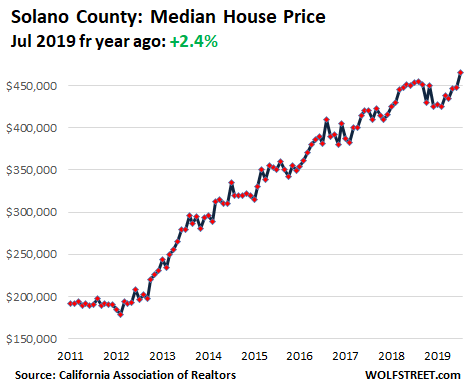
In Solano County, which extends inland toward Sacramento and is the least expensive county in the Bay Area, the median home price rose 2.4% year-over-year, to $465,000, a new record:

4293f US California House price 2019 07 Solano Housing Bubble 2 in San Francisco Bay Area & Silicon Valley Pops Despite Startup Millionaires & Low Mortgage Rates

Cash-out “refi” hype is back full-blast. And for the first time since early 2006, people are doing it in large numbers. Read… Fuel for the Next Mortgage Bust?

Enjoy reading WOLF STREET and want to support it? Using ad blockers – I totally get why – but want to support the site? You can donate “beer money.” I appreciate it immensely. Click on the beer mug to find out how:

4293f BeerMug1 Housing Bubble 2 in San Francisco Bay Area & Silicon Valley Pops Despite Startup Millionaires & Low Mortgage Rates

Would you like to be notified via email when WOLF STREET publishes a new article? Sign up here.


Article source: https://wolfstreet.com/2019/08/15/housing-bubble-2-in-san-francisco-bay-area-silicon-valley-is-cooked/

Posted in SF Bay Area News | Tagged | Leave a comment