Take a look at the cheapest house in San Francisco right now (the price just dropped!)


  • e265a 920x920 Take a look at the cheapest house in San Francisco right now (the price just dropped!)

    “Cheapest single family home in San Francisco! 1 bedroom 1 bathroom house in desirable Glen Park neighborhood. Recently remodeled kitchen and bathroom,” reads the real estate listing for 17 Laidley St. in San Francisco.

    less

    “Cheapest single family home in San Francisco! 1 bedroom 1 bathroom house in desirable Glen Park neighborhood. Recently remodeled kitchen and bathroom,” reads the real estate listing for 17 Laidley St. in San

    … more


    Photo: Jeff Appenrodt

  •  Take a look at the cheapest house in San Francisco right now (the price just dropped!)

Caption

Close

“Cheapest single family home in San Francisco! 1 bedroom 1 bathroom house in desirable Glen Park neighborhood. Recently remodeled kitchen and bathroom,” reads the real estate listing for 17 Laidley St. in San Francisco.

less

“Cheapest single family home in San Francisco! 1 bedroom 1 bathroom house in desirable Glen Park neighborhood. Recently remodeled kitchen and bathroom,” reads the real estate listing for 17 Laidley St. in San

… more


Photo: Jeff Appenrodt


It’s currently the least expensive house on the market in San Francisco.

A 570-square-foot Glen Park cottage with one-bedroom, one-bathroom and no backyard or garage to speak of is listed for $599,000.

The property at 17 Laidley St. was originally listed in March for $675,000 and sat for 146 days without a buyer.

After a two-week break from the MLS, real estate agent Jeff Appenrodt of Laurel Realty has put it back on the market at a lower price.

“We went in and spruced it up and staged it,” says Appenrodt. “We’ve been getting all kinds of activity. I’m getting calls form people down south and they’re saying hey, I can get a house in SF for $599,000 I want it now. Some people are saying I don’t even know what I’d do with it yet, but I want it.”

The home is located within a pocket of Glen Park that real estate agents have dubbed Laidley Heights. In recent years, the area has attracted buyers with big money, and in 2017, CBS News called the “microhood” the “hottest street in San Francisco for high-roller tech executives.”


ALSO: Northern California home of legendary Tower Records founder listed for $2.45 million

The appeal is the neighborhood’s easy access to Silicon Valley, and its quiet location. It’s also very walkable, with Muni, restaurants, shops and the Upper Noe park and recreation center less than a five-minute walk away.

Many of the homes have skyline views of downtown, and have been remodeled extensively or torn down and rebuilt into massive modern masterpieces. Take 1783 Noe St. An 875-foot -square-foot, brown-shingle cottage once stood on the 40-foot-wide lot. Now there’s a five-bedroom home that sold in 2018 for $7.4 million. A five-bedroom 4,400-square-foot home sold at 80 Laidley for $5.4 million in May 2017, and a four-bedroom at 537 Laidley sold for $3.795 million in July 2017.

While the home at 17 Laidley could never be transformed into a gargantuan mansion, as the lot is only 614 square feet, Appenrodt says there’s potential to add additional living space by finishing the basement and attic, depending on what the city allows.

Amy Graff is a digital editor for SFGATE. Email her at agraff@sfgate.com.

Article source: https://www.sfgate.com/realestate/article/Take-a-look-at-the-cheapest-house-in-San-14429488.php

Posted in SF Bay Area News | Tagged | Leave a comment

Bay Area home market, getting looser, is still tight

Despite falling prices and sluggish sales, Bay Area homebuyers can’t expect to sniff out too many bargains.

Name almost any city in the nine-county region — say, San Jose, Oakland, San Francisco or Concord — and it’s where buyers are most likely in the country to pay over list price, waive contingencies, buy quickly and generate a windfall for long-time homeowners, according to a new study from Redfin.

The hottest spots for sellers include San Carlos, Mountain View, Daly City, Palo Alto and Belmont on the Peninsula, and Contra Costa Centre (a transit community near Walnut Creek), San Lorenzo, Alameda, San Leandro, Pleasant Hill and Albany in the East Bay, according to the national brokerage. The cities ranked at least 92 out of 100 in Redfin’s competition index. Nearly 70 Bay Area cities have markets rated at 90 or above, a mark the company ranks as most competitive in the country.

The national real estate firm ranked more than 1,000 cities across the U.S. The company considered information reported from Redfin agents and other listing and sales data to figure the amount of time a property spent on the market, how many offers were made, whether buyers waived contingencies to the sale and other factors.

The Bay Area housing market has downshifted from last year’s peak but is still making millionaires of long-time homeowners and frustrating buyers with near-record prices. Bidding wars have cooled in the region, but relative to the rest of the country, the Bay Area is still among the hardest places to buy into.

Redfin chief economist Daryl Fairweather compared the region’s market to a weather report: Bay Area real estate temperatures may have slipped from 100 to 90 degrees, while the rest of the country has inched up from 50 to 55 degrees.

A year ago, the Bay Area was also the most competitive real estate market in the country, along with Seattle, San Diego and Denver, said Redfin lead economist Taylor Marr. But higher interest rates last fall and a general slowdown have pushed other western cities toward a market with more choices and some lower prices for buyers.

The Bay Area, however, has remained resilient. The nine-county region added nearly 5,000 jobs in July, led by hiring in Santa Clara County, and also strong employment growth in San Francisco and the East Bay, according to state economists. The region was responsible for 4 in 10 of the state’s new jobs in the first half of 2019.

“The jobs are there,” Marr said. “It’s still a competitive market.”

He added that while the effect of tech IPOs on the market is hard to measure, the new wealth unleashed can stabilize and bring higher prices to the market in the long term.

Agents say the market has cooled — but not enough to slow down multiple offers in desirable cities. San Carlos, for example, had just 11 homes newly listed for sale in July, a roughly two weeks supply to satisfy buyers.

Redfin manager Julie Zubiate said San Carlos has a thriving downtown and good schools — two amenities popular with tech workers with young families.

The markets in San Mateo and Santa Clara counties popular with tech workers have shifted in the past 12 months. A property that once received nearly 20 offers might attract 5 to 10 today, Zubiate said. “It’s cooled a tiny bit.”

Sophia Niu, a Keller Williams agent specializing in Alameda, said competition in the island city has pushed inventory down to about 30 homes on the market — about 2 to 4 weeks worth of sales, she said. Well-priced, single-family homes offered at around $1 million typically draw between 5 to 7 bids, she said.

Although Alameda sales have slowed from last year’s peak, she said, “right now, the market is still strong.”

Alameda has become more attractive to San Francisco residents tired of paying high rents for small apartments. Niu even saw a bumper sticker around town recently: “Alameda: Where hipsters come to breed.”


Article source: https://www.mercurynews.com/2019/09/09/bay-area-home-market-getting-looser-is-still-tight/

Posted in SF Bay Area News | Tagged | Leave a comment

The Most Splendid Housing Bubbles in America, August Update: West Coast Markets “See the Dip”

Seattle house prices fall year-over-year. New York condos drop to Aug 2017 level. San Francisco Bay Area near-flat. Los Angeles, Denver, Boston reach new highs. Las Vegas, Phoenix dream of crazy Housing Bubble 1. Miami stalls

“Prices are cooling, and Western states are starting to see the dip,” said CoreLogic in a statement when it released its SP CoreLogic Case-Shiller Home Price Index this morning. But prices are not cooling everywhere. So let’s see.

Seattle House Prices:

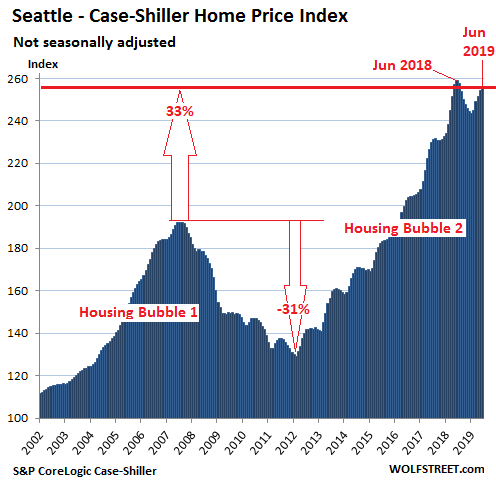
Prices of single-family houses in the Seattle metro ticked up 0.6% in June from May, according to the Case-Shiller Index. This was a much smaller increase than the seasonal increases in prior years. So, compared to June 2018, house prices fell 1.3%, the second year-over-year decline in a row, after May’s 1.2% year-over-year decline – and the first such event since Housing Bust 1:

e9257 US Housing Case Shiller Seattle 2019 08 27 The Most Splendid Housing Bubbles in America, August Update: West Coast Markets “See the Dip”

The Case-Shiller Index is a rolling three-month average. Today’s release represents closings that were entered into public records in April, May, and June. So the data roughly coincides with the peak of spring and early summer home buying season.

San Francisco Bay Area Single-Family House Prices

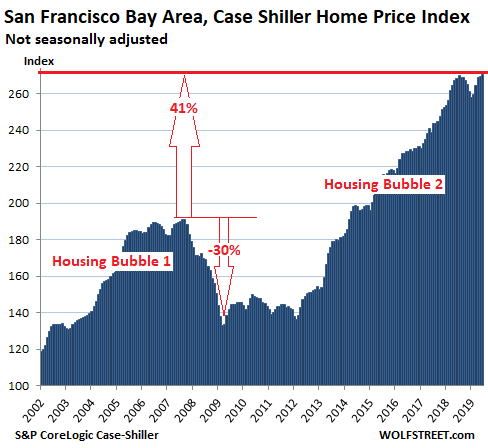
Single-family house prices in the five-county San Francisco Bay Area – the counties of San Francisco, San Mateo (northern part of Silicon Valley), Alameda and Contra Costa (East Bay), and Marin (North Bay) – inched up 0.3% in June from May, about half of last year’s seasonal increase in June. And it eroded the year-over-year price gains to just 0.8%:

e9257 US Housing Case Shiller San Francisco Bay Area 2019 08 27 The Most Splendid Housing Bubbles in America, August Update: West Coast Markets “See the Dip”

San Francisco Bay Area Condo Prices

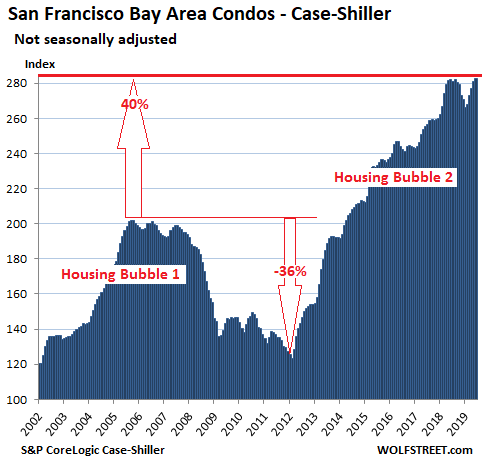
In most of the 20 markets in the Case-Shiller series, the index covers only single-family houses. But in a handful of big markets where condos play are large role, it also covers condos. Condo prices in the five-county San Francisco Bay Area ticked up 0.6% in June from May and were flat compared to June 2018:

2cf98 US Housing Case Shiller San Francisco Bay Area Condos 2019 08 27 The Most Splendid Housing Bubbles in America, August Update: West Coast Markets “See the Dip”

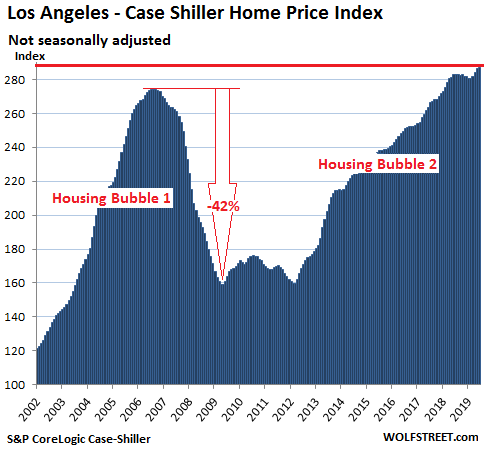
The Case-Shiller index was set at 100 for January 2000; an index value of 200 indicates prices have doubled since January 2000. Every housing market among these most splendid housing bubbles in America has or had an index value of over 200, either during Housing Bubble 2 or during Housing Bubble 1, which is the minimum requirement to make this list.

Los Angeles House Prices:

House prices in the Los Angeles metro edged up 0.2% in June from May, to a new record. This seasonal increase was comparatively small, and it whittled down the year-over-year increase to 1.6%:

2cf98 US Housing Case Shiller Los Angeles 2019 08 27 The Most Splendid Housing Bubbles in America, August Update: West Coast Markets “See the Dip”

San Diego House Prices:

The Case-Shiller index for the San Diego metro rose 0.7% in June from May to a new record, which was only 1.3% higher than the prior record set in July 2018, and it was also up by 1.3% from June 2018:

2cf98 US Housing Case Shiller San Diego 2019 08 26 The Most Splendid Housing Bubbles in America, August Update: West Coast Markets “See the Dip”

Portland House Prices:

In the Portland metro, house prices remained flat in June compared to May, and were up 1.7% from June 2018, the smallest year-over-year increase since May 2012:

db7c3 US Housing Case Shiller Portland 2019 08 27 The Most Splendid Housing Bubbles in America, August Update: West Coast Markets “See the Dip”

The index as a measure of house price inflation:

The Case-Shiller Index (methodology) is based on “sales pairs,” comparing the sales price of a house in the current month to the last transaction of the same house, which may have been years ago. In other words, it tracks how many more dollars it takes to buy the same house over time. In this manner, the index tracks the purchasing power of the dollar with regards to houses in various markets. This makes it a measure of a specific type of inflation: “House-price inflation.”

Las Vegas House Prices:

In the Las Vegas metro, house prices rose 0.5% in June from May, whittling down the year-over-year gain to 5.5%, from 6.4% in May. While the 5.5% gain is still out of whack, it was the smallest such gain since August 2016. There are not many markets in the US that embody crazy gambling in the housing market quite as well as Las Vegas (though below we’ll get to a couple of charts that are nearly as crazy):

db7c3 US Housing Case Shiller Las Vegas 2019 08 27 The Most Splendid Housing Bubbles in America, August Update: West Coast Markets “See the Dip”

Denver House Prices:

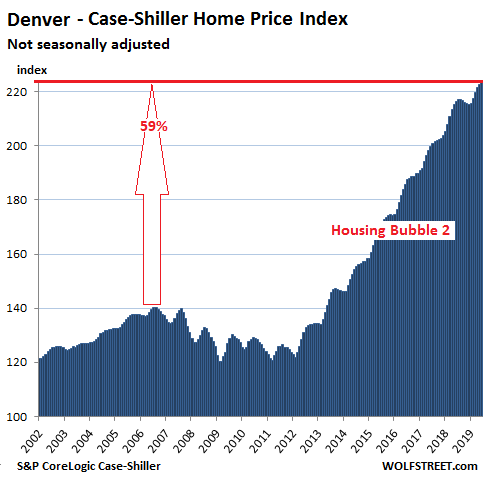
In the Denver metro, house prices rose 0.4% in June from May, which whittled the year-over-year gain down further to 3.4%. While still a big-fat gain, it was the smallest year-over-year gain since April 2012:

db7c3 US Housing Case Shiller Denver 2019 08 27 The Most Splendid Housing Bubbles in America, August Update: West Coast Markets “See the Dip”

New York Condo Prices:

The Case-Shiller index for condos in the New York City metro, instead of rising seasonally, fell in June compared to May. While the index is still up 0.4% from June 2018 (which had been a dip, as you can see in the chart), it is now down 2.2% from its peak in October 2018 and is back where it had first been in August 2017:

84030 US Housing Case Shiller New York condos 2019 08 27 The Most Splendid Housing Bubbles in America, August Update: West Coast Markets “See the Dip”

Washington DC:

In the Washington D.C. metro, house prices rose 0.5% in June from May, and were up 2.9% from June last year:

84030 US Housing Case Shiller Wash DC 2019 08 27 The Most Splendid Housing Bubbles in America, August Update: West Coast Markets “See the Dip”

Boston House Prices:

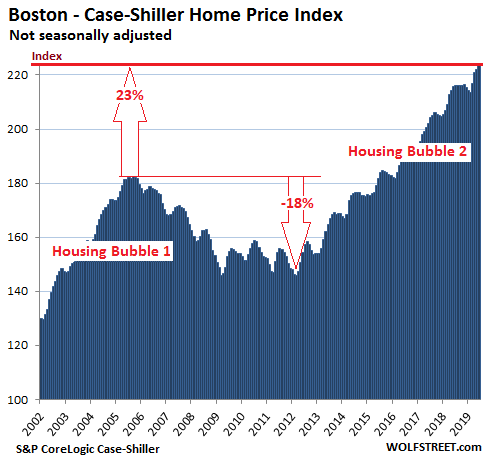
House prices in the Boston metro rose 1.1% in June from May to a new record, and were up 3.9% year-over-year:

84030 US Housing Case Shiller Boston 2019 08 27 The Most Splendid Housing Bubbles in America, August Update: West Coast Markets “See the Dip”

Phoenix House Prices:

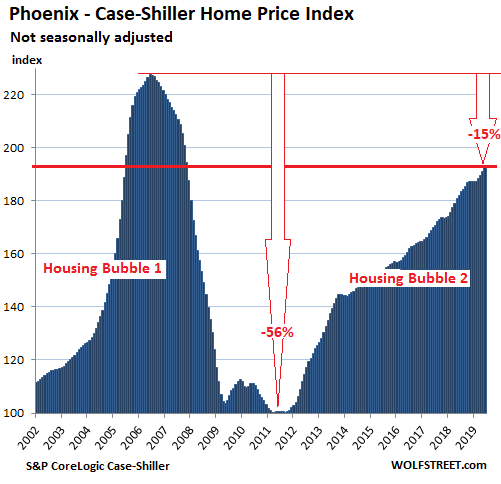
House prices in the Phoenix metro rose 0.9% in June from May and were up 5.8% from June 2018. In terms of nuttiness, the Phoenix housing market – along with Miami and Tampa below – ranks near the top but can’t quite match the nuttiness of the Las Vegas market:

f59f8 US Housing Case Shiller Phoenix 2019 08 27 The Most Splendid Housing Bubbles in America, August Update: West Coast Markets “See the Dip”

Miami House Prices:

In the Miami metro, house prices were flat in June compared to May, stalling efforts to catch up with the crazy peak of Housing Bubble 1. The stall reduced the year-over-year gain to 3.3%, the slowest such gain since May 2012:

f59f8 US Housing Case Shiller Miami 2019 08 27 The Most Splendid Housing Bubbles in America, August Update: West Coast Markets “See the Dip”

Tampa House Prices:

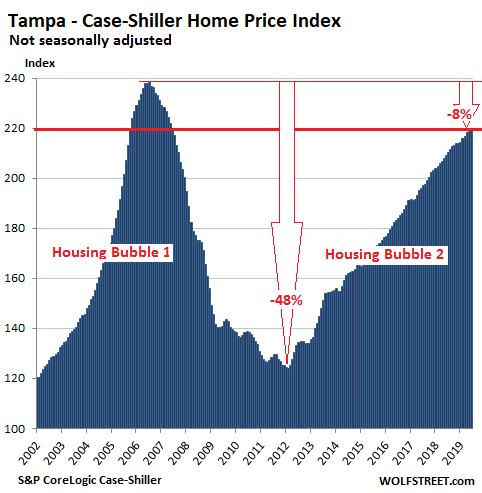
House prices in the Tampa metro inched up 0.2% in June from May, which whittled the year-over-year gain down to 4.7%. As big as this gain is, it’s the slowest such gain since August 2012:

f59f8 US Housing Case Shiller Tampa 2019 08 27 The Most Splendid Housing Bubbles in America, August Update: West Coast Markets “See the Dip”

Last time this happened was during the Financial Crisis. Now it’s happening in a kinder and gentler way, but there is no crisis. Read…  Near-Record Low Mortgage Rates No Relief for Dropping New House Prices

Enjoy reading WOLF STREET and want to support it? Using ad blockers – I totally get why – but want to support the site? You can donate “beer money.” I appreciate it immensely. Click on the beer mug to find out how:

3f516 BeerMug1 The Most Splendid Housing Bubbles in America, August Update: West Coast Markets “See the Dip”

Would you like to be notified via email when WOLF STREET publishes a new article? Sign up here.


Article source: https://wolfstreet.com/2019/08/27/the-most-splendid-house-price-bubbles-in-america-august-update-western-markets-see-the-dip/

Posted in SF Bay Area News | Tagged | Leave a comment

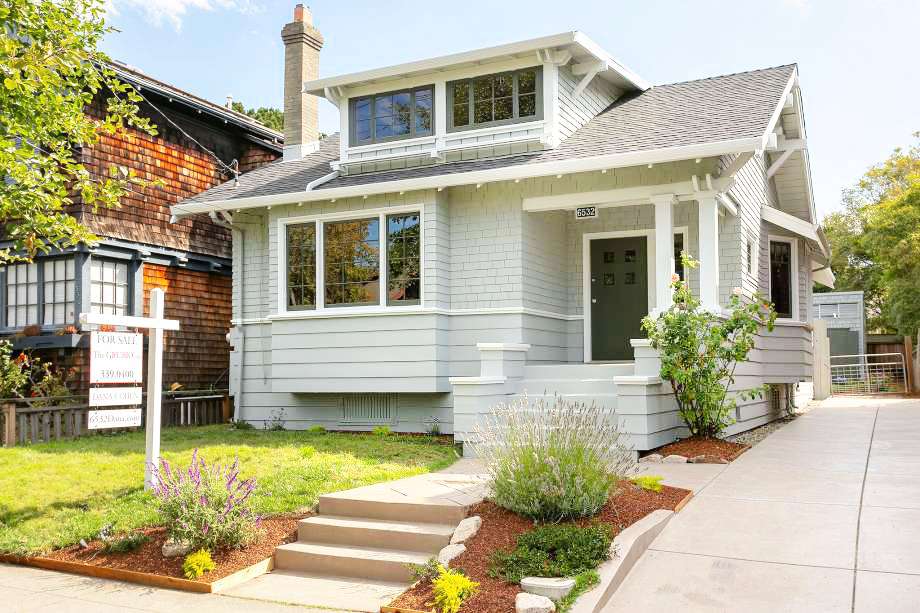
Forget the modern makeover: This Oakland Craftsman asking $898K is lovingly restored


  • 0a44a 920x920 Forget the modern makeover: This Oakland Craftsman asking $898K is lovingly restored

    With original Craftsman charm, this Oakland bungalow asks $898K

    With original Craftsman charm, this Oakland bungalow asks $898K


    Photo: Liz Rusby/The Grubb Co.

  •  Forget the modern makeover: This Oakland Craftsman asking $898K is lovingly restored

Caption

Close

With original Craftsman charm, this Oakland bungalow asks $898K

With original Craftsman charm, this Oakland bungalow asks $898K


Photo: Liz Rusby/The Grubb Co.


So many of the original craftsman homes around the San Francisco Bay Area have been gutted and refashioned to a ubiquitous minimalist, modern aesthetic that obliterates their original charm. That’s not the case at 6532 Dana St., a charming 1914 home in Oakland’s buzzing Rockridge neighborhood listed for under $1 million.

The home

The home is a two-bedroom, one-bathroom, 1296 square-foot bungalow built in 1914.

Original details abound: Dark wood paneling begins in the foyer and carries through to the living room. The same rich wood is used in the beamed ceilings and frames the leaded glass windows.

Under foot are hardwood floors inlaid with a geometric pattern. There are built-ins everywhere, another hallmark of craftsman genius.

The formal dining room also looks largely original with wainscoting and ceiling detail. There’s a fireplace in both the living room and dining room. The kitchen and breakfast nook are both clearly updated for modern cooking but don’t clash with the vintage appeal of the home.


One of the bedrooms opens to the back deck.

Though the home has clearly maintained its original charm, there are a few updates that today’s buyers would enjoy. The first is a low-maintenance landscaped yard with raised beds and even a clever built-in dog wash station. The second is a large studio that offers many possibilities, including potential rental income.

The property

The home is situated on a 5,200 square-foot lot between College and Telegraph Avenues in lower Rockridge. This is one of Oakland most popular and convenient locations for both enjoying local amenities and commuting to those further away.

The deal

In the last 30 days, the medium list price for the 94609 zip code has been $999,000 and the median sale-to-list ratio has been 113%.

Homes have been commanding $692 per square foot. With all of that in mind, it’s easy to believe 6532 Dana St. will sell over its asking price of $898,000 — possibly for over $1 million.

Check out the complete listing here.

Anna Marie Erwert writes from both the renter and new buyer perspective, having (finally) achieved both statuses. She focuses on national real estate trends, specializing in the San Francisco Bay Area and Pacific Northwest. Follow Anna on Twitter: @AnnaMarieErwert.

Article source: https://www.sfgate.com/realestate/article/6532-Dana-St-Oakland-real-estate-for-sale-14421688.php

Posted in SF Bay Area News | Tagged | Leave a comment

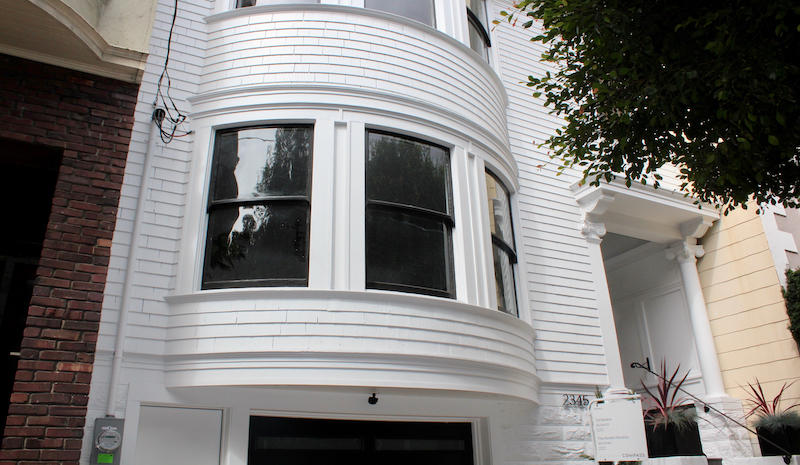
San Francisco Is Turning Gray — One House At A Time

When Sergio De La Torre first moved to San Francisco, he was struck by the variety of colors that dressed the city’s homes. In his neighborhood, houses were painted with every color of the spectrum. Today, though, one color is taking over the rest: Gray.

Sergio is an artist and photographer, who in the last year has documented at least 175 freshly painted gray homes around the Mission District. But why gray and why now?

SERGIO DE LA TORRE: Buenos dias. We are going to go to the left.

I’m on a walk with Sergio around his neighborhood. There’s something he wants to show me. 

DE LA TORRE: This is the one

He points to a house down the street. I spy it over a line of ficus trees that shade the city block.

DE LA TORRE: So I woke up one morning and that house was painted gray, and you can see it from here. That was the first gray house that I saw. 

The house he points out looks like a typical old San Francisco Victorian. Well, in its shape at least. It reminds me of the famous Painted Ladies, which are these extravagantly detailed, colorful houses. But this house isn’t colorful.

DE LA TORRE: And I saw the scaffolding, I saw them painting every single day. And I was like, what was happening?

Sergio tells me that this house used to be a recovery house, for people with mental illness, its residents would walk around the neighborhood…

DE LA TORRE: You could see them, they were mentally unstable. They were wearing pajamas, their hair was all messed up, smoking cigarettes, scratching their heads, making random movements. And they were part of the neighborhood.

Sergio grew up around all kinds of people in his family’s neighborhood in Tijuana, Mexico. 

DE LA TORRE: You see people that were not necessarily, you know, quote-on-quote “normal,” but they are part of who you are in this neighborhood. 

Now, the recovery house has been split into multiple units, and each flat goes for more than $4,000. Sergio sees only one of the prior residents still hanging around the Mission.

DE LA TORRE: Walking around the neighborhood I notice more gray houses.

  Mission District, San Francisco, 2019. 

Within just a couple of blocks, we see several. 

DE LA TORRE: We can cross

There’s a dark gray house.

DE LA TORRE: It’s like a charcoal house

There’s a big gray house.

DE LA TORRE: There’s another gray building, the entire building is gray, two-story.

Almost all of them have a few key features: Dark to light gray paint. House numbers made of out metal…

DE LA TORRE: That’s another one. Another gray house with san serif numbers.

Often, you find a colorful accent.

DE LA TORRE: And a yellow door.

I prepare for these gray houses to follow me home. It’s one of those things where once you notice it, you see it everywhere. 

DE LA TORRE: Oh my god another one.

Pacific Heights, San Francisco, 2019. 

The paint looks fresh. Many still have a “For Sale” sign in the front yard. But as I leave Sergio, I wonder: How new is this gray, really?

TANU SANKALIA: Let’s just go back to the choice of color and let’s look at it historically.

Tanu Sankalia is the program director of Urban Studies at the University of San Francisco. I sit with him at his home-office in Berkeley.

SANKALIA: So, 1850 to let’s say 1905 you get this great period of construction. 

With the invention of new tools, wood could be bent and curved and shaped as desired – for the first time. That’s why we get the detailed, ornamental style Victorians are known for. And significantly for this story, wood begs for paint, more than other building materials.

SANKALIA: We have a number of somewhere close to 50,000 houses being built during this period.

San Francisco’s historic Haas-Lilienthal House, built in 1886, was recently restored to its original color, pictured here: A sedate olive green-gray called “armored steel.”

…And they’re painted with subdued, earthy colors, including gray. By the 1940s, the second World War, the Bay Area emerges as a hub for building ships for the navy, which leaves behind a surplus of paint – battleship gray paint.

SANKALIA: And a lot of people got their hands on it and painted their houses gray. There was a kind of a desire to be austere, during the austerity measures during the world war. There was probably a desire to stay somewhat unnoticed. 

Two decades later, the tone of the country changed.

SANKALIA: People who emerge in the 60s with the hippie era, and the sort of freedom and self-expression and so on, and they take on these houses and start doing something with them.

It’s called the Colorist Movement. The paint on Victorians during this time made them feel funky and resplendent. Now, that’s how a lot of people think San Francisco houses should feel. 

SANKALIA: We also think of color as perhaps representative of certain ethnic groups.

Think of the colorful buildings of Mexico… I ask Tanu about the gray houses that artist Sergio de la Torre has been photographing in the Mission, a neighborhood that for the last few decades has been made up of largely low to middle-income Latin Americans.

SANKALIA: It instantly becomes a signifier for something, and we want it to be a signifier of something. There’s a tendency to reduce that signifier very quickly to the idea of gentrification.

….That’s because so many people moving in are younger and wealthier, and may like their houses as gray as their MacBook computers.

CAROL KOFFEL: I wouldn’t mind buying that one, that’s the problem being in this business 2.9, 2.3 that’s good…

Carol Koffel and I are huddled over her laptop in an office of her real estate company, Vanguard. Carol is a real estate agent and a color consultant. 

KOFFEL: Okay, welp, here’s one.

We scan open house listings and Pinterest, seeing the gray trend way beyond San Francisco.

KOFFEL: Gray Victorians … In London, they’ve been doing this for years.

Same thing in Toronto. You can see the grey on Washington, DC row houses, and in Trondheim, Norway, where the gray trend has spread like an oil spill since the early 2000s. 

KOFFEL: We live in a world that’s so full of information and when you look at a Victorian home that’s fully painted, it’s a little busy for our eye.

With gray paint, she says, you let the architecture speak for itself, you draw the eye upward with lighter values, to give the illusion of increased height, and done correctly…

KOFFEL: …Your own home is standing out because it is different but in a quiet way.

But what about when there are multiple houses on the same block, that are all painted gray?

KOFFEL: If the house next door is painted gray and your house is gray and the one next door is gray, it won’t work.

Just like fashion goes from the runway to the department store, the gray trend has spread from architects to house flippers. At the start of the trend in 2014, a real estate site, Curbed SF, mapped the city’s most money-making housing flips. More than one-third of the houses they listed had a gray exterior.

And while Carol still believes that gray paint can quiet the mind, as the trend multiplies, artist Sergio de la Torre can’t help but see the opposite.

DE LA TORRE: Yellow house, green house, blue house, gray house — you know — they’re very loud.

Gray can be considered a mute color, a non-color, even. But to Sergio, these gray houses are loud, as loud as the changes happening in his city. Like the evictions, police brutality, fires, and the threat from Immigration and Customs Enforcement, ICE.

DE LA TORRE: All of these events that are loud and violent and really affecting the neighborhood, suddenly there they are these gray houses, kind of mute color. And I question that. Why a mute color now? If anything, you cannot be mute, you cannot be non-color, you cannot be simple right now.

But Sergio knows that equating gray with gentrification is oversimplifying things, too. He’s looked into the backstory of 60 of the houses he’s photographed. Only 4 were evictions. Actually, Sergio’s neighbor’s house was hidden behind scaffolding when we walked by. Do I even have to tell you what color he’s painting it? 

DE LA TORRE: And I was like, why gray? Because it’s a simple color. How is it simple? I don’t know, it’s just, like, modern and elegant. I’m tired of these Painted Ladies. I don’t want color like this house next door, I just want a flat house.

Houses are typically repainted every seven or so years. And although gray has a long history here, the next trend in house paint has already arrived: All-white. Fair to say I don’t think Sergio will be happy about this color, either.

Article source: https://www.kalw.org/post/san-francisco-turning-gray-one-house-time

Posted in SF Bay Area News | Tagged | Leave a comment