Home Truths, a quarterly report on the state of the Berkeley real estate market, is brought to you by Red Oak Realty.
The East Bay has perhaps the most unusual real estate pricing culture of any market in the San Francisco Bay Area.
To fully understand East Bay home prices — and to participate in the market effectively — you’ll need to understand the unique way real estate agents and sellers price their homes here.
Inner East Bay listing agents (as they advise their homeowners) routinely list the homes they represent at from 10 to 20 percent below the actual price they expect the home will fetch. Yes, you read that correctly.
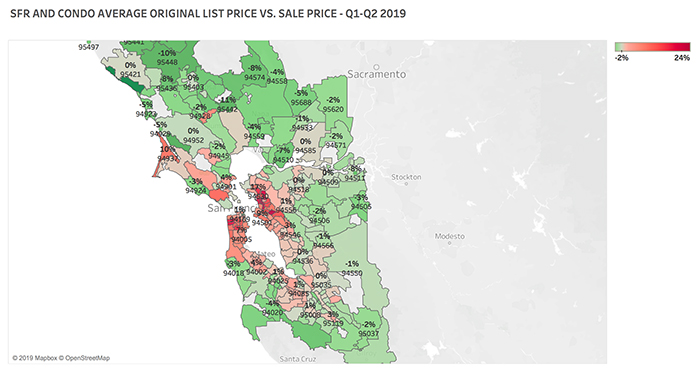
For example, in the first half of 2019, Berkeley single-family homes went for an average of 19 percent over list price, the highest percentage list price of any Bay Area city that quarter, according to MLS data analyzed by Red Oak Realty. Three Inner East Bay cities followed: El Cerrito (17 percent), Albany (15 percent) and Kensington (13 percent).
The Inner East Bay has the highest concentration of homes that sell for the highest over list price. Red denotes areas with higher sale-to-list-price ratios. Source: Red Oak Realty analysis of MLS data.
The Inner East Bay has the highest concentration of homes that sell for the highest over list price. Red denotes areas with higher sale-to-list-price ratios. Source: Red Oak Realty analysis of MLS data.
This over-list-price trend has been happening in the Inner East Bay (the East Bay stretching from Richmond to San Leandro west of the East Bay hills) for decades. Homes have been listed under their expected price for so long that the practice is now fully baked into the real estate culture here.
Why? There’s no good answer, but the practice does have its logic.
With more attractive prices, properties attract attention from more buyers, and the likelihood of a bidding war goes up. Playing with the rules of supply and demand, this pricing strategy posits that popularity breeds increased demand and competition, which helps sellers get top dollar.
The catch is that all experienced East Bay buyer’s agents know this tradition well. If their buyer really wants a home, they’ll advise entering an over-list price-offer because they know how the market works.
It’s debatable whether this leads to higher prices for sellers, because it has become such a standard, widespread and anticipated practice.
Assessing the list-to-sale price metric
Skilled local agents know the trajectory and size of the over-list-price trend. The area’s average over-list price percentage can range from closer to 10 percent to 20 percent and above; it also varies depending on a neighborhood’s relative popularity at any given time.
Six of the eight Bay Area cities with highest sale-to-list-price ratios were in the Inner East Bay in the first half of 2019. Source: Red Oak Realty analysis of MLS data. Chart: Red Oak Realty
Currently, East Bay sellers are listing homes closer to expected sales price than in recent years. We think this started when a flood of inventory hit the market in fall 2018 and continues to influence seller strategy.
Want an expert pricing opinion on your home or a home you’re looking to buy? Reach out to us; we’ll help you price homes accurately with our deep, nuanced knowledge of our Inner East Bay home.
Home Truths is written and sponsored by Red Oak Realty, the largest independent real estate broker in the East Bay, serving the community since 1976. Read more in this series. If you are interested in learning more about the local real estate market or are considering buying or selling a home, contact Red Oak at hello@redoakrealty.com, 510-250 8780.
LOS ALTOS, Calif. (KGO) — One of the most expensive homes in Silicon Valley just went through a massive price cut at now 55 percent less than its original $88 million asking price. With a surge of interest from potential overseas buyers, there’s a new interest in the past several months from one country in particular.
Tucked privately away on eight-acres 27500 La Liva Real in Los Altos Hills is a 21,000 square foot estate that could easily be mistaken for a resort.
“The house wraps around this expansive courtyard then off to the left we have the bedroom wing and the master suite with its own indoor pool,” says CEO of Deleon Realty, Michael Repka.
The estate was built from the ground up over the course or four-years, from the pool with automatic skylight to all five bedrooms and seven full bathrooms and grand kitchen space.
“Notice the kitchen is very functional as is the butler pantry– so a lot of time it’s perfectly set up for the caterer,” says Repka.
When the property first hit the market in 2015, the owner, the founder of a tech company, listed it at $88 million. Today, the price is reduced 55 percent to just under $40 million.
The home’s custom features such as an array of sculptures outside, indoor sauna and separate office building on the grounds appeals to a specific buyer. There has been interest from all over the globe-and a rise in inquiries from Hong Kong.
“We’ve seen significant increases in buyers coming from over in Hong Kong. With the political tensions over there and the protests people are looking to get some money out of Hong Kong and possibly reconsider where they want to live,” says Repka.
Michael says while there is still a pool of buyers from the Bay Area, many in the range of $5 million to $10 million are choosing to retire out of state.
“The market has definitely softened up and with the tax changes in the state and local tax deductions has had quite an impact on Silicon Valley.”
While Michael and his team are getting ready to travel overseas to meet with a potential buyer, they are confident that they will sell because of the price reduction and interest from Asia and the Middle East.
“I’m very confident it’s going to sell– it’s such a spectacular property,” smiles Repka.
Deleon Realty is also currently listing another $40 million home in Palo Alto. You can learn more about it and La Vida Real here. https://deleonrealty.com/
Nine of the ten highest-rent cities in the U.S. are in California. USA TODAY
SAN FRANCISCO — Social media influencer Sarah Tripp and her husband, Robbie Tripp, moved to San Francisco in 2016 brimming with optimism.
“We thought, here’s a city full of opportunities and connections where you go to work hard and succeed,” says Tripp, 27, founder of the lifestyle blog Sassy Red Lipstick.
But after a year-long hunt for suitable housing in San Francisco only turned up “places for $1 million that looked like rundown shacks and needed a remodel,” the couple packed up and moved to Phoenix.
They went from paying San Francisco rents of $2,500 for a one-bedroom, one-bath apartment that was far from shopping and other amenities, to purchasing a newly constructed 3,000-square-foot, four-bedroom, four-bathroom home where they’ll raise their newly arrived baby boy.
“It was cool to be living near all those high-tech startups,” Tripp says of her Bay Area years. “But you quickly saw that if you weren’t part of that, you’d be pushed out. It’s just sad.”
For the better part of two decades, the Bay Area has been a magnet for newcomers lured by a modern-day technology Gold Rush. But increasingly only those who have struck it rich can afford to stay.
Once a bohemian mecca that welcomed the Beat poets and ’60s hippies, San Francisco now lays claim to the most expensive housing in the West, with a median home price of $1.4 million. There’s also $5 a gallon gas, private schools priced like universities and chic restaurants that cost nearly double the national average.
Earlier this year, the San Francisco Bay Area was second only to New York — and ahead of Los Angeles, Washington, D.C., and Chicago — when it came to people leaving major U.S. cities. More than 28,190 departed in the second quarter of 2019, almost double 2017′s rate, according to real estate brokerage Redfin.
The most popular in-state option for San Franciscans fleeing high costs is Sacramento, where the median home price is $350,000. Out of state, Seattle, at a $580,000 median, offers the biggest draw, Redfin data shows.
Yet another popular destination is even farther afield: Austin, a capital city with no state taxes and a booming tech scene that is home to Apple’s latest HQ. The most recent quarter, which ended July 30, saw Austin receive 5,403 newcomers, the majority of whom came from San Francisco, Redfin says.
California overall also is losing residents. In 2018, 38,000 more people left the Golden State than entered, the second year in a row for this negative trend, according to the U.S. Census. A recent Edelman Trust Barometer survey found 53% of residents and 63% of millennials were considering leaving because of the high cost of living.
“The great tragedy is this place was a middle-class paradise, and now you’ve got the flight of the middle class with all their aspirations, leaving the poor, the rich and a transient population,” says Joel Kotkin, presidential fellow in Urban Futures at Chapman University in Orange, California.
In the Bay Area, median household income is around $100,000, a tidy sum in most cities. But after federal and state taxes, residents have to cover rents that range from $3,600 a month in San Francisco to $4,600 in Silicon Valley, according to rental site Rent Cafe. That economic reality has left many of the city’s low-income residents living in their cars or on the streets.
“I don’t recognize my city, to be honest,” says Shannon Way, executive director of HomeownershipSF, a non-profit umbrella group that helps residents secure housing. “When you only have people at the extremes, it tears at the very fiber of what it means to live in a community.”
Way says her organization does what it can to steer locals toward the city’s few below market rate housing options, as well as a city down payment assistance loan program. “We focus on those who really want to stay,” she says. “But it’s getting harder and harder to survive here.”
That desire to leave also hits the wealthiest of San Francisco residents, some of whom are perched in Pacific Heights mansions that fetch as much as $39 million.
Over the past year, a wave of initial public offerings have involved San Francisco-based tech companies such as Lyft and Airbnb (and, coming soon, Uber). Some of those newly minted millionaires aren’t keen to lose “a lot of their windfalls to state taxes, so they start looking elsewhere,” says Daryl Fairweather, chief economist at Redfin. Typical tax-free landing spots include Jackson Hole, Wyoming, and Incline Village, Nevada.
California’s biggest challenge
Business and political leaders — from Salesforce billionaire Marc Benioff to Gov. Gavin Newsom — have sounded the alarm over the growing housing crisis.
Last year, Benioff lobbied to pass a controversial San Francisco corporate tax to fund homelessness initiatives. And Newsom, who in his State of the State address early this year called housing “our most overwhelming challenge,” has committed $1.75 billion to fund new building projects.
During a statewide tour in October, Newsom signed various housing bills, including one that puts an annual cap on rent increases at 5% plus inflation, and another that aims to block predatory evictions.
“We’re living in the wealthiest as well as the poorest state in America,” Newsom said as he signed the bills at a ceremony in Oakland. “Cost of living. It is the issue that defines more issues than any other issue in this state.”
San Jose natives Halie and Jim Casey assumed that by getting into the housing market they could keep costs under control. They had purchased a small house well suited to the two of them and were happy. But then Halie got pregnant.
“We quickly saw we couldn’t afford anything bigger,” she says.
Their appreciating asset served as a ticket out. The couple had purchased their home for $700,000, and two years later it was worth $1 million thanks in part to Google buying up land in San Jose.
Jim, 40, decided to become a stay at home dad for a spell, while Halie, 32, arranged to transfer in May 2018 with her employer, Apple, to the company’s new Austin offices.
“We got a great house with a nice yard, have great schools, and all for less money which allowed us to pay off our debts,” she says. “There’s also a flexible, family-friendly nature to life here that doesn’t exist in the intense, pressurized world of Bay Area tech.”
Housing threatens booming economy
For some experts, families opting to leave the state foreshadows larger problems. They worry a lack of affordable housing could jeopardize a state growth rate — one fueled in large part by Bay Area tech giants — that typically outpaces the national average. That could mean fewer jobs for those who stay.
“The Bay Area’s strength is also its greatest weakness,” says Jordan Levine, deputy chief economist of the California Association of Realtors. “The area has a strong economy and some of the most innovative companies in the nation, but it’s also a poster child for housing supply issues that haven’t kept up with growth.”
Chapman University’s Kotkin says he’s alarmed by the growing number of California companies moving to states where cheap housing and sometimes no state taxes make it easier to pay middle-managers a living wage. These include automakers (Mitsubishi leaving L.A. for Tennessee), defense contractors (Parsons leaving Pasadena for Washington, D.C.), and technology enterprises (Apple building in Austin).
“In the end, you want a middle class in your state,” Kotkin says. “Because a society without one is unstable.”
Solutions will have to come from public officials and citizens alike, says Dowell Myers, professor of policy, planning and demography at the University of Southern California’s Sol Price School of Public Policy.
“I’m not despondent, but it requires many people to see how their interests are negatively impacted,” he says. “If you own a house, you benefit as your value goes up in a housing shortage. But your children and grandchildren will be impacted, they may not be able to live and work here. So that’ll be the way things will change.”
The alternative is bleak, says state Sen. Scott Wiener, D-San Francisco.
“We’re headed to a future where the middle class won’t be able to raise families here, where restaurants increasingly will close because they can’t hire workers, where teachers and police officers can’t live anywhere near where they work,” he says. “We need a much greater sense of urgency.”
Wiener, who has been criticized by housing activists who claim his various housing bills haven’t been accommodating enough to low-income residents, says, “it’s easy to just blame someone else when we need to look in the mirror.”
He notes that tech companies such as Facebook and Google have put forth plans to build housing near their headquarters, only to be stopped by local zoning laws.
“Tech companies didn’t cause our housing problems or create bad housing laws,” Wiener says. “This whole thing won’t be easy politically or financially, and it won’t happen fast.”
West Seattle = New California
But time is of the essence. Many young, educated, upwardly mobile workers in San Francisco say they can’t afford to wait around for government officials and business leader to come up with solutions.
Deborah Neisuler, 42, never really thought she would leave her beloved San Francisco.
In 2006, she and her husband Justin, 44 — he’s in banking, she’s a curriculum developer — bought a small house south of town that had easy access to local freeways leading to Silicon Valley.
As the years passed, two children arrived, and suddenly the house started to feel cramped. What’s more, the prospect of private school tuition loomed given the city’s lottery system doesn’t guarantee a first-choice public school.
That’s when a real estate agent friend offered to quietly test the waters for a sale, given their house had gone up in value 66%. Although “no one had heard of our neighborhood when we bought there, it was close to the freeway and offered a good commute to Silicon Valley,” Deborah Neisuler says.
The house sold quickly. Since both worked largely from home, their options were wide open. The couple didn’t want to move back East, where they are both from, and Bay Area suburbs did not appeal.
“We are city people,” she says.
Instead, lured by a body of water and a sense of community, the family chose West Seattle. The area has become so popular with newcomers from down south “people call it New California, because it seems people from there are taking over,” Neisuler says with a laugh. “And I’m like, ‘Yup, that’s us.’”
Although over the past few years she has longed for San Francisco’s hip urban culture and sometimes struggles with Seattle’s dark winters, Neisuler is thrilled with the change.
“I do really miss San Francisco, it holds a special place in my heart and we were there 13 years,” Neisuler says. “But I know it’s not the best place for my family.”
Follow USA TODAY national correspondent Marco della Cava: @marcodellcava
We are entering new territory when it comes to home sales based on the latest data crunched by the Bay East Association of Realtors.
Experts say what’s unusual is that we look to be entering a “normal” real estate market where prices are stable instead of rocketing up. Year-to-year median sales prices are down 9 percent in Oakland, 15 percent in San Ramon and 18 percent in El Sobrante.
“Homebuyers and home sellers are so used to prices going up year over year it is me that when prices drop a little bit or stabilize, people are freaking out,” said David Stark with the Bay East Association of Realtors.
Here’s what’s going on.
According to data from 34 East Bay cities, many of them had more homes on the market in August when compared to last August. But 21 of them saw prices drop, some by double digits.
With the lower prices, you’d expect increased sales and maybe bidding wars. It was the opposite. Fewer sales and homes sat on the market in 23 of these cities for much longer than usual. A year ago the average home was up for sale for 14 days. Now it’s 30 days.
Does that mean bad luck for sellers?
Not really according to Legacy real estate broker Sheila Cunha.
“Look how rapidly it went up. Let’s say we’re looking at a more normal market. A year ago there would be multiple offers if I put a handmade for sale sign out front,” she said.
Because it required no work or upgrades, she says a house she listed in San Lorenzo went up for sale only 10 days ago and got an offer this morning. The owner is elated. But the agent knows this house would have fetched at least $50,000 more a year ago.
Stark added, “The last time we saw price stability in real estate was during the recession and the short sale and foreclosure crisis. Economic conditions are completely different now. What is driving price stability is buyer behavior and buyer patience.”
Bucking the trend of price decreases in the East Bay were Alamo up 5 percent, Walnut Creek up 10 percent, and San Pablo up 19 percent.
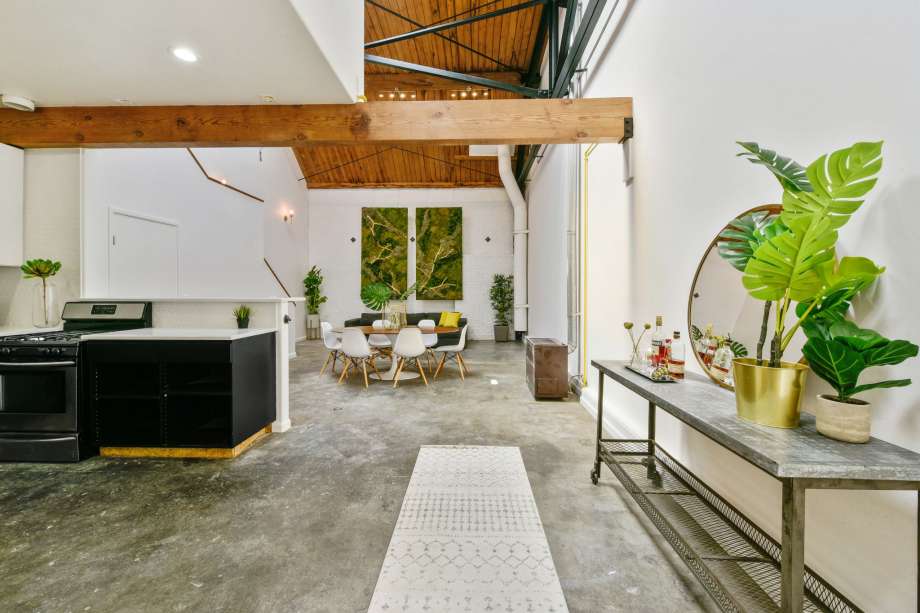
What lofts lack in walls, they typically make up for in style. This converted loft in a former manufacturing building in West Oakland features ample natural light for a reduced price of $619,000. But if windows are something you require, this one isn’t for you.
The loft
In true loft style, 3015 Myrtle St., No. 2 has an open-floor plan with high ceilings.
On the lower level of the 1,084-square-foot unit, there is a living room, kitchen, dining area and half bathroom.
The industrial feel of concrete floors is offset by warm-wood beams overhead.
While the space has no windows, three large skylights inset in the 21-foot-high ceilings illuminate the space brightly.
Upstairs, the bedroom level features a full bath and walk-in closet.
The building
There are 19 units now sharing the converted space of this former manufacturing building built in 1930. The exterior of 3015 Myrtle showcases an artistic upgrade that is both a nod to its industrial past and its modern incarnation.
The location is excellent for enjoying West Oakland by foot or bike. It’s also close to BART and freeways for commuting. The People’s Community Grocery Market is next-door for easy shopping.
The deal
The unit comes with its own parking space and an HOA fee of $390.
Since its debut on the market over a month ago, this loft has dropped its price from $649,000 to $619,000.
Anna Marie Erwert writes from both the renter and new buyer perspective, having (finally) achieved both statuses. She focuses on national real estate trends, specializing in the San Francisco Bay Area and Pacific Northwest. Follow Anna on Twitter: @AnnaMarieErwert.