Chinese developer suspends construction on one of SF’s tallest towers

Chinese developer Oceanwide Holdings suspended construction on a 605-foot tower in San Francisco’s Transbay district, one of the city’s largest projects, as it grapples with rising construction costs.

The Beijing company said Wednesday that work has stopped indefinitely on the shorter tower at its Oceanwide Center project. Oceanwide is studying ways to lower construction costs to resume work. The stalled tower at 512 Mission St. includes 156 condos and a Waldorf Astoria hotel.

Construction is continuing on a 910-foot office and condo tower that will be the city’s second-tallest, after Salesforce Tower. It is set to open in mid-2023 — about two years later than earlier estimates.

“In light of local market changes and economic uncertainties, Oceanwide has determined that a realignment of the work scope on the Oceanwide Center project is necessary to keep the project sustainable,” the company said in a statement.

Oceanwide Center is a high-profile example of how spiking costs are threatening the Bay Area’s building boom. A construction labor shortage and new U.S. tariffs on building materials have exacerbated already high costs. San Francisco is the world’s most expensive place to build, according to a survey by consulting firm Turner Townsend. Delayed and canceled projects reduce the supply of housing and office space, potentially pushing up already record-high rents.

Oceanwide has been seeking additional financing for the project. Oceanwide declined to disclose the project’s total budget or how much it has invested to date. The Chronicle reported a budget estimate of $1.6 billion earlier this year.

Oceanwide bought the project site for $296 million in 2015. Construction began in late 2016.

At the same time, funding U.S. real estate projects became more difficult for Chinese companies after the Chinese government imposed capital restrictions on moving money out of the country, said Darlene Chiu Bryant, an executive director of GlobalSF, a nonprofit that works with international investors.

Chinese firms such as Greenland and Anbang have been forced to sell U.S. properties as a result, she said. Another Chinese developer, ZL Properties, has had numerous project delays and lawsuits in San Francisco.

Oceanwide has never completed a project in San Francisco and made the atypical move of managing one of the largest developments in city history without a local partner. Other Chinese companies, such as Vanke, Gemdale and SRE Group, have partnered with American developers and appear to have more successful projects, said Bryant.

“I typically tell Chinese investors to work with a local partner,” she said.

It isn’t the first time Oceanwide has stopped work. In February, construction stopped on its Los Angeles project, Oceanwide Plaza. Work has since resumed.

Roland Li is a San Francisco Chronicle staff writer. Email: roland.li@sfchronicle.com Twitter: @rolandlisf

Article source: https://www.sfchronicle.com/business/article/Chinese-developer-suspends-construction-on-one-of-14539726.php

Posted in SF Bay Area News | Tagged | Leave a comment

Housing Bubble in Silicon Valley & San Francisco Bay Area Turns to Bust Despite Low Mortgage Rates & Startup Millionaires

Ironically, house prices dropped the most in Silicon Valley.

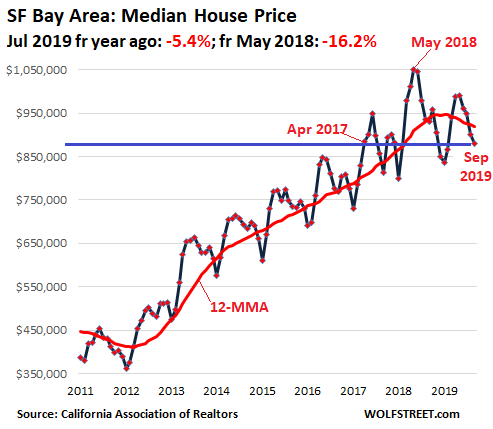
In the nine-county San Francisco Bay Area, house prices – as measured by the median price where half of the houses sold for more and half sold for less – dropped 5.4% in September compared to September last year, to $880,000, according to the final data by the California Association of Realtors (C.A.R.) released today. It was the eighth month in a row of year-over-year declines. The median price in September was down 16.2% from the peak in May 2018 and has now fallen below April 2017.

The 12-month moving average (red line to the chart below), by definition, lags behind but shows longer-term trends more clearly. After double-digit year-over-year gains in 2018, the 12-month moving average began to taper in early 2019, approached zero growth in June and July, turned negative on a year-over-year basis in August (-0.8%), for the first time since July 2012 when the Bay Area was emerging from Housing Bust 1, and fell 2.3% in September compared to September last year:
1aa9d US California House price 2019 09 SF Bay Area Housing Bubble in Silicon Valley & San Francisco Bay Area Turns to Bust Despite Low Mortgage Rates & Startup Millionaires

In California overall, the market has split: Single family house prices are still rising: The median price at $605,680 in September, was up 4.7% from September last year; but condo prices have been falling for months, with the median price down 2.1% year-over-year.

In California’s major regions except the SF Bay Area, median prices of single-family houses (SFH) and condos rose in September compared to a year ago. The Bay Area sticks out like sore thumb:

  • Los Angeles metro: SFH +4.8% ($545,000). Condo +2.1% ($438,000)
  • Central Coast: SFH +2.4% ($695,000). Condo +5.4% ($575,000)
  • Central Valley: SFH +4.7% ($340,250). Condo +11.1% ($220,000)
  • Inland Empire: SFH +4.6% ($385,000). Condo +5.9% ($303,000)
  • F. Bay Area: SFH -5.4% ($880,000). Condo -1.9% ($705,000)

So here we go county by county for the San Francisco Bay Area.

The Bay Area is vast: Nine counties spread around a series of bays, of which the “San Francisco Bay” is only one. There are only a handful of bridges across the bays. In addition, there are mountains. “Commutes can be hellish” is an understatement. And more arduous the commute to San Francisco and Silicon Valley, the less ludicrously expensive the housing market.

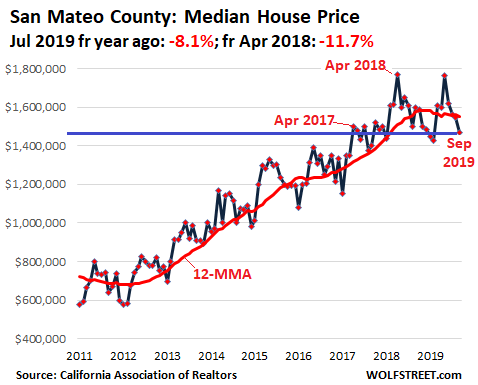
In San Mateo County, the northern part of Silicon Valley, the median house price in September fell 8.1% year-over-year, to $1.47 million. This is down 16.9% from the peak in April 2018 and just below where it had first been in April 2017.

The 12-month moving average (12-MMA) of the median house price fell in September on a year-over-year basis for the first time since June 2012, after double-digit year-over-year gains through November last year:
1aa9d US California House price 2019 09 San Mateo Housing Bubble in Silicon Valley & San Francisco Bay Area Turns to Bust Despite Low Mortgage Rates & Startup Millionaires

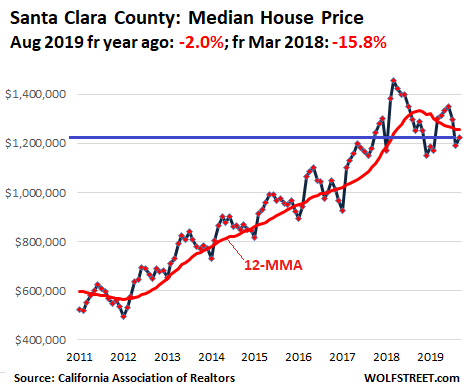
In Santa Clara County, the southern part of Silicon Valley and the most populous county in the Bay Area, the median house price dropped 2.0% year-over-year, to $1.22 million, which is down 15.8% from the peak in April 2018 and just below where it had first been in October 2017.

The 12-MMA dropped 5.6% year-over-year, the fifth month in a row of ever larger year-over-year declines. The county includes San Jose, and ranges from Palo Alto in the north to Gilroy in the south. In mid-2018, the 12-MMA had still surged at rates of over 20%:
762e7 US California House price 2019 09 santa clara Housing Bubble in Silicon Valley & San Francisco Bay Area Turns to Bust Despite Low Mortgage Rates & Startup Millionaires

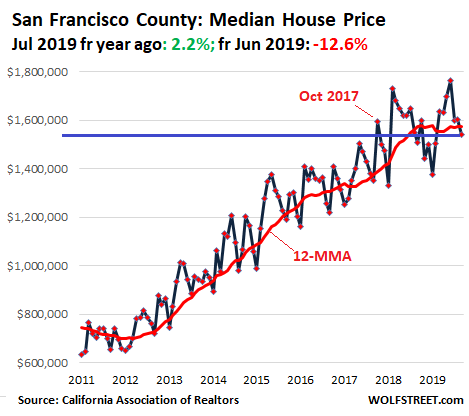
In San Francisco, the median house price has been extremely volatile over the past two years, even by San Francisco standards, dropping in January of $1.376 million and then spiking 28% in six months to $1.76 million in June. And now it’s in the process of giving up those gains again. In September, the median house price fell to $1.54 million, down 12.6% from June, but still up 2.2% from a year ago, though it’s below where it had been in October two years ago. So yes, whiplash. The 12-MMA dipped into the negative for the first time since June 2012:
762e7 US California House price 2019 09 San Francisco Housing Bubble in Silicon Valley & San Francisco Bay Area Turns to Bust Despite Low Mortgage Rates & Startup Millionaires

The thing is, house prices were supposed to explode in Silicon Valley and San Francisco, ignited by the lowest mortgage rates in about three years and by the hordes of IPO millionaires from Uber, Lyft, and all the other companies that would all of a sudden get house-hunting fever, though they’ve been millionaires for years, and had access to this money long before the IPO.  This time-honored real-estate hype about IPO millionaires was proven wrong during the last two tech-bubble peaks. Those episodes were both followed by housing busts. And a similar scenario is starting to build up on the horizon.

In Contra Costa County, the median house price ticked up 0.9% in September compared to a year ago, to $656,000 but was down 6.6% from the peak in June 2018 and is now back where it had first been in May 2017. The 12-MMA has declined for the third month in a row on a year-over-year basis, now down 1.8% from September 2018, the first declines since early 2012:

762e7 US California House price 2019 09 Contra Costa  Housing Bubble in Silicon Valley & San Francisco Bay Area Turns to Bust Despite Low Mortgage Rates & Startup Millionaires

In Alameda County, where Oakland and Berkeley are, the median house price has also been exceptionally volatile over the past two years. In September, it was up 1.1% from a year ago, but was down 11.2% from the peak in May 2018 and is back where it had first been in June 2017. The 12-MMA fell for the third month in a row (-1.8%), something not seen since mid-2012:
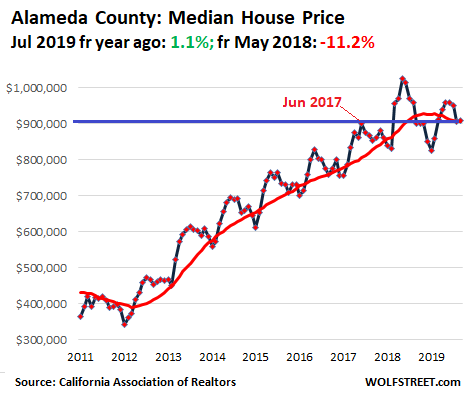
71947 US California House price 2019 09 Alameda Housing Bubble in Silicon Valley & San Francisco Bay Area Turns to Bust Despite Low Mortgage Rates & Startup Millionaires

In Sonoma County, which forms part of Wine Country, something funny happened in August: The median price suddenly spiked out of nowhere, and folks thought the boom was back, but in September that spike collapsed back into nowhere. This left the median price flat year-over-year and down 7.0% from the peak in June 2018 and back where it had first been in November 2017. The 12-MMA fell 3.3% from a year ago, its sixth month in a row of declines:
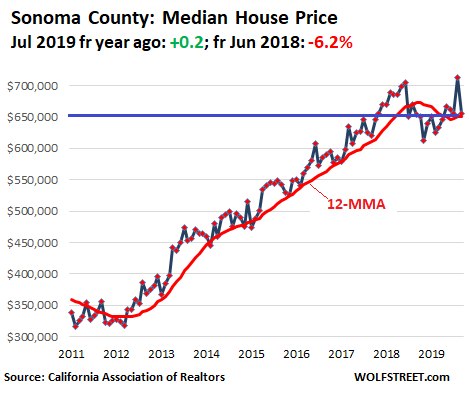
71947 US California House price 2019 09 Sonoma Housing Bubble in Silicon Valley & San Francisco Bay Area Turns to Bust Despite Low Mortgage Rates & Startup Millionaires

In Napa County, the median house price in September did what it had done in Sonoma County in August: It spiked hugely, up 12.6% in just one month, which left it up 14.9% from a year ago, and it will certainly get unwound over the next few months:
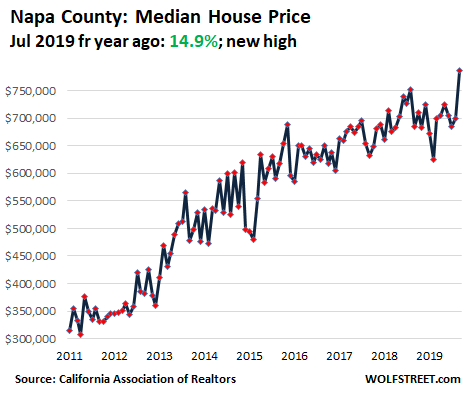
71947 US California House price 2019 09 Napa Housing Bubble in Silicon Valley & San Francisco Bay Area Turns to Bust Despite Low Mortgage Rates & Startup Millionaires

Marin County, connected to San Francisco via the Golden Gate Bridge and ferry service, is among the most expensive places in the Bay Area. It has not been spared the house price declines. The median house price fell 2.5% in September from a year ago, to $1.36 million and is down 6.2% from the peak in October 2018:

0c75e US California House price 2019 09 Marin Housing Bubble in Silicon Valley & San Francisco Bay Area Turns to Bust Despite Low Mortgage Rates & Startup Millionaires

In Solano County, extending east and north from the city of Vallejo – which filed for bankruptcy in 2008 – is the least expensive county in the Bay Area. The median home price at $455,000, is about flat with May 2018 and is up only about 1.5% since July 2017, despite the dip and rise in between:
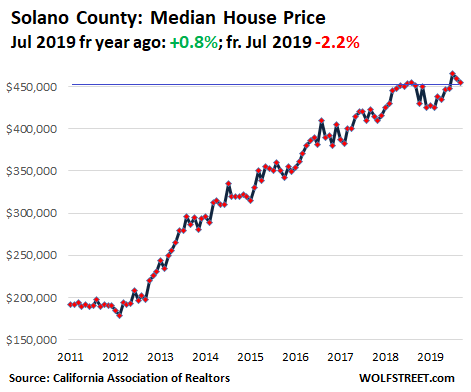
0c75e US California House price 2019 09 Solano Housing Bubble in Silicon Valley & San Francisco Bay Area Turns to Bust Despite Low Mortgage Rates & Startup Millionaires

Enjoy reading WOLF STREET and want to support it? Using ad blockers – I totally get why – but want to support the site? You can donate “beer money.” I appreciate it immensely. Click on the beer mug to find out how:

0c75e BeerMug1 Housing Bubble in Silicon Valley & San Francisco Bay Area Turns to Bust Despite Low Mortgage Rates & Startup Millionaires

Would you like to be notified via email when WOLF STREET publishes a new article? Sign up here.


Article source: https://wolfstreet.com/2019/10/16/housing-bubble-in-silicon-valley-san-francisco-bay-area-turns-to-bust-despite-low-mortgage-rates-startup-millionaires/

Posted in SF Bay Area News | Tagged | Leave a comment

5 No Power? Then Say Goodbye To Security, NorCal CRE Says San Francisco San Francisco October

Want to get a jump-start on upcoming deals? Meet the major San Francisco players at one of our upcoming events!

In the throes of PGE’s unprecedented Public Safety Power Shut-Off, office and multifamily experts say security was their primary concern until power could be restored.

The silver lining of this kind of outage, which commercial real estate fears may be the region’s new normal, compared to a natural disaster is the modicum of forewarning the bankrupt company can provide a few days ahead of time, but constantly changing weather forecasts rendered part of that seeming advantage useless.

“It seems really haphazard,” Transwestern Northern California Vice President of Asset Services Blake Peterson said of PGE’s notifications and plans. 

Indeed, PGE CEO Bill Johnson admitted as much Thursday night during a press conference.  

“Our website crashed several times. Our maps are inconsistent and maybe incorrect. Our call centers were overloaded,” Johnson said. “To put it simply, we were not adequately prepared to support the operational event.”

The result, according to multiple property management sources, was a scramble to provide darkened buildings the bare-essential services, like security and elevator power. Fortunately for tenants and owners, most property managers had protocol ready. 

“We’re used to anything,” Institute of Real Estate Management San Francisco President Vanessa Honey told Bisnow. ”We never know what’s going to happen in a business day. At least IREM as a whole, especially in the Bay Area, is used to emergencies. We have evacuation plans and are generally well-equipped.”

By the weekend, more than a few such plans had to be activated across the Bay Area and Northern California. As of Friday afternoon, PGE had restored power to 543,000 customers, or 74%, of the total 738,000 affected, but over a million residents and thousands of businesses still endured long hours without power. By Saturday night, the utility company had restored the power to all shut-off-impacted customers

The greater Bay Area includes 18,641 office buildings, according to Transwestern Research Analyst Jerry Milenbach. Comparing PGE’s shut-off map with office inventory that falls within outage zones, Milenbach found that more than 5,200 office buildings comprising 73.5M SF were likely affected.

That makes 28.5% of total Bay Area office buildings, approximately 16% of total office square footage, much of which isn’t covered by a backup generator, essentially disabled, Honey and Peterson said.

And a commercial generator in itself burns fuel at about $6 per gallon with a 250-gallon tank that can run for about two days, depending on a building’s needs, according to Peterson. That comes out to $1,500 — a relatively small price to pay compared to older buildings without the backup power.

In addition to a tenant’s missed productivity for the duration of the shut-off, money is lost on an owner’s need to provide 24/7 emergency services.

“Buildings that don’t have backup power do risk elevator entrapments and need to hire trained ‘fire watch’ personnel to rove the building 24/7 until the fire life safety system is back online,” Peterson said. 

Honey said security costs skyrocketed and risk increased for unpowered buildings, which often rely on power for access control. Instead, more staff provides security. “We have people working longer shifts,” she said. 

All this results in sky-high costs to the commercial real estate industry and the broader economy. Judging by the inflation-adjusted costs to businesses of outages from the Loma Prieta earthquake in 1989, the two days or so of outages by Friday could have resulted in over $10B in lost business throughout the region, Bisnow reported on Wednesday

On Wednesday, a Stanford Woods Institute energy expert predicted up to $2.5B of losses, even excluding large commercial customers from his calculation, the San Francisco Chronicle reported.

In addition, occupancy growth likely slowed to a grinding halt starting Wednesday morning, Honey said. 

“It’s going to slow things down on the leasing end of things,” she said. “Folks are going to be less interested, in the multifamily side at least, in taking that time while the power is out unless they’re hard-pressed to do so.”

Looking ahead, where PGE’s Johnson said it is “very likely” more PSPS’s occur, the region’s CRE industry sees a grim future many employers may try to avoid or escape. A positive for the Bay Area is its proclivity for remote work, but Peterson says that far from makes up for the lost productivity of being locked out of your office building. 

“Fortunately most of [the Bay Area’s] tenants and employers are pretty technologically savvy, and most of us can deal with not physically being in the workplace for a couple days,” Peterson said. “Beyond that, this doesn’t work.”

Article source: https://bisnow.com/san-francisco/news/commercial-real-estate/norcal-cre-on-top-concerns-during-widespread-power-shut-offs-101259

Posted in SF Bay Area News | Tagged | Leave a comment

House Prices Are Under Pressure in the Bay Area

We’ve detected unusual activity from your computer network

To continue, please click the box below to let us know you’re not a robot.

Article source: https://www.bloomberg.com/news/articles/2019-08-16/california-s-san-francisco-bay-area-home-prices-under-pressure

Posted in SF Bay Area News | Tagged | Leave a comment

No Power? Then Say Goodbye To Security, NorCal CRE Says

Want to get a jump-start on upcoming deals? Meet the major San Francisco players at one of our upcoming events!

In the throes of PGE’s unprecedented Public Safety Power Shut-Off, office and multifamily experts say security was their primary concern until power could be restored.

The silver lining of this kind of outage, which commercial real estate fears may be the region’s new normal, compared to a natural disaster is the modicum of forewarning the bankrupt company can provide a few days ahead of time, but constantly changing weather forecasts rendered part of that seeming advantage useless.

“It seems really haphazard,” Transwestern Northern California Vice President of Asset Services Blake Peterson said of PGE’s notifications and plans. 

Indeed, PGE CEO Bill Johnson admitted as much Thursday night during a press conference.  

“Our website crashed several times. Our maps are inconsistent and maybe incorrect. Our call centers were overloaded,” Johnson said. “To put it simply, we were not adequately prepared to support the operational event.”

The result, according to multiple property management sources, was a scramble to provide darkened buildings the bare-essential services, like security and elevator power. Fortunately for tenants and owners, most property managers had protocol ready. 

“We’re used to anything,” Institute of Real Estate Management San Francisco President Vanessa Honey told Bisnow. ”We never know what’s going to happen in a business day. At least IREM as a whole, especially in the Bay Area, is used to emergencies. We have evacuation plans and are generally well-equipped.”

By the weekend, more than a few such plans had to be activated across the Bay Area and Northern California. As of Friday afternoon, PGE had restored power to 543,000 customers, or 74%, of the total 738,000 affected, but over a million residents and thousands of businesses still endured long hours without power. By Saturday night, the utility company had restored the power to all shut-off-impacted customers

The greater Bay Area includes 18,641 office buildings, according to Transwestern Research Analyst Jerry Milenbach. Comparing PGE’s shut-off map with office inventory that falls within outage zones, Milenbach found that more than 5,200 office buildings comprising 73.5M SF were likely affected.

That makes 28.5% of total Bay Area office buildings, approximately 16% of total office square footage, much of which isn’t covered by a backup generator, essentially disabled, Honey and Peterson said.

And a commercial generator in itself burns fuel at about $6 per gallon with a 250-gallon tank that can run for about two days, depending on a building’s needs, according to Peterson. That comes out to $1,500 — a relatively small price to pay compared to older buildings without the backup power.

In addition to a tenant’s missed productivity for the duration of the shut-off, money is lost on an owner’s need to provide 24/7 emergency services.

“Buildings that don’t have backup power do risk elevator entrapments and need to hire trained ‘fire watch’ personnel to rove the building 24/7 until the fire life safety system is back online,” Peterson said. 

Honey said security costs skyrocketed and risk increased for unpowered buildings, which often rely on power for access control. Instead, more staff provides security. “We have people working longer shifts,” she said. 

All this results in sky-high costs to the commercial real estate industry and the broader economy. Judging by the inflation-adjusted costs to businesses of outages from the Loma Prieta earthquake in 1989, the two days or so of outages by Friday could have resulted in over $10B in lost business throughout the region, Bisnow reported on Wednesday

On Wednesday, a Stanford Woods Institute energy expert predicted up to $2.5B of losses, even excluding large commercial customers from his calculation, the San Francisco Chronicle reported.

In addition, occupancy growth likely slowed to a grinding halt starting Wednesday morning, Honey said. 

“It’s going to slow things down on the leasing end of things,” she said. “Folks are going to be less interested, in the multifamily side at least, in taking that time while the power is out unless they’re hard-pressed to do so.”

Looking ahead, where PGE’s Johnson said it is “very likely” more PSPS’s occur, the region’s CRE industry sees a grim future many employers may try to avoid or escape. A positive for the Bay Area is its proclivity for remote work, but Peterson says that far from makes up for the lost productivity of being locked out of your office building. 

“Fortunately most of [the Bay Area’s] tenants and employers are pretty technologically savvy, and most of us can deal with not physically being in the workplace for a couple days,” Peterson said. “Beyond that, this doesn’t work.”

Article source: https://www.bisnow.com/san-francisco/news/commercial-real-estate/norcal-cre-on-top-concerns-during-widespread-power-shut-offs-101259

Posted in SF Bay Area News | Tagged | Leave a comment