SF is one of the most expensive places in the world to build housing. Here’s why

Adrian Caratowsa was lucky.

After six years of trying and failing to score an affordable apartment in San Francisco, he won the lottery for a city-subsidized apartment in the Transbay district.

Caratowsa, who once lived in a South of Market warehouse with 27 roommates, now pays around $1,000 a month for a one-bedroom at 255 Fremont St. Nearly 70 people applied for each apartment in the building.

“I can’t imagine living in the city if I didn’t have it,” said Caratowsa.

San Francisco is struggling with a herculean task: creating as much housing as possible for people like Caratowsa to make up for decades of underproduction. But the enormous cost of building in the city has meant that developers can’t create nearly enough affordable or market-rate homes. More than 30,000 homes that have been approved haven’t yet started construction, as developers try to find financing and enough workers to build.

The Chronicle found numerous factors that contribute to San Francisco’s now astronomical housing development costs. Interviews with experts and those in the building industry and a review of the data point to the culprits: a worker shortage, long waits for permits, restrictive zoning and high fees, among other things. The result is a city consistently failing to produce enough housing to meet its needs.

Caratowsa lives in Natalie Gubb Commons, a project that cost a total of $58 million to design, obtain approvals for and build. Nonprofit developer Mercy Housing relied on federal, state and city financing to build the project at a cost of nearly $500,000 per unit. The per unit price would have been far higher if the city hadn’t donated the land. The cost to build one new apartment or condo unit in San Francisco today — whether market-rate or affordable — tops $700,000, nearly triple what it cost about 10 years ago.

e5ceb 1280x0 SF is one of the most expensive places in the world to build housing. Here’s whye5ceb 767x0 SF is one of the most expensive places in the world to build housing. Here’s why

That means that this year, San Francisco surpassed New York for the highest construction costs in the world, according to consulting firm Turner Townsend.

By contrast, the cost to build the average U.S. single-family house was $237,760 in 2017, according to the National Association of Homebuilders.

Construction costs are one of the primary reasons that so little housing is getting built in San Francisco. From January to September this year, construction began on just 1,281 market-rate homes, down 62% from that period last year, according to real estate data firm CoStar.

Here’s a breakdown of the factors taking San Francisco housing costs to record highs.

Key elements: It’s not surprising that actually building a structure is one of the biggest costs. “Hard costs” — paying for construction workers and materials like lumber, concrete and steel — account for about half of the total price tag, said Mark Hogan, an architect at OpenScope Studio.

Land costs vary, but on average account for around 20% of the budget. The remaining 30% are “soft costs” that include city fees and hiring consultants, attorneys, architects and other professionals.

Developer Patrick Kennedy of Panoramic Interests said market-rate developers seek around 5% annual returns, so an apartment that costs $750,000 to build would need to generate $37,500 a year after operating expenses and taxes. Rents would have to exceed $5,000 a month to make it feasible to build.

e5ceb 1280x0 SF is one of the most expensive places in the world to build housing. Here’s whye5ceb 767x0 SF is one of the most expensive places in the world to build housing. Here’s why

Construction costs: Labor costs have jumped 5% a year because of a shortage of workers. The 2008 recession devastated the construction industry, forcing many workers to switch careers. The Bay Area’s commercial building boom has made the problem more severe.

In recent years, projects like Salesforce Tower and Apple Park competed with housing developments for the same pool of workers, from carpenters to electricians to plumbers.

Kennedy, who has a 200-unit project under construction at 333 12th St. in San Francisco, said that a skilled worker can cost as much as $1,000 for an eight-hour day. Panoramic, he said, may spend $300,000 just on parking for its workers over an 18-month period.

Construction workers also must contend with high housing costs, which create a vicious cycle. Workers needed to build new housing must earn enough money to afford to live in the area.

Workers who move to the Bay Area from outside California require more time to be trained. They don’t know the local building codes or earthquake safety requirements, said Joseph Olla, a vice president at San Francisco general contractor Nibbi Brothers.

That level of inexperience has added to the overall cost of labor, said Kennedy. It takes up to 25% more workers today to be as productive as a decade ago, he said.

According to the McKinsey Institute, the construction industry’s labor productivity grew only 1% per year over the last 20 years, compared with 2.8% for the total world economy.

“We’re building wood framing pretty much the same way we did in 1833,” Kennedy said.

The average worker hasn’t seen huge benefits, despite the need for labor, said Scott Littlehale, senior research analyst for the Northern California Carpenters Regional Council, a construction union group. Average annual wages for construction jobs have increased 4% a year since 2012, below the 4.7% rise in the overall Bay Area economy, he said.

Olla of Nibbi Brothers said he sees higher profits for subcontractors specializing in scarcer, high-skilled jobs, such as plumbers and electricians.

Land purchase: San Francisco has among the highest land costs in the country. One extreme example: In 2017, a Chinese developer bought majority ownership of a waterfront condo site valued at a record $916,000 per unit — just for land.

Skyrocketing land costs are partially tied to how few areas in the city are zoned for apartments. Buildings with three or more apartments are allowed on only about a quarter of San Francisco’s land.

e5ceb 1280x0 SF is one of the most expensive places in the world to build housing. Here’s whye5ceb 767x0 SF is one of the most expensive places in the world to build housing. Here’s why

“If there’s a limited area where you are allowed to build multifamily, the prices for those areas are going to be much higher than they would be otherwise,” said David Garcia, policy director at UC Berkeley’s Terner Center for Housing Innovation. Allowing apartments in more areas could bring down the cost of housing, he said.

Fees and permits: Residents in new housing use transit, parks, schools, police and other vital services, so cities charge fees to offset the costs.

“We are trying to solve so many problems —all important — through housing” that it’s costing a lot, said Doug Shoemaker, president of Mercy Housing, the nonprofit developer that built Natalie Gubb Commons.

San Francisco fees add up to around $50,000 per unit for market-rate projects in the most active development areas, according to the Planning Department. Market-rate projects must also provide around 20% of units for low-income tenants — the highest proportion in the country — or pay fees to help fund affordable units elsewhere. Those fees add another $50,000 to $75,000 per unit.

Another factor driving up costs is San Francisco’s approval process. Developers say it is one of the most difficult in the world. Opponents of projects are empowered to easily delay them by requesting additional reviews or filing lawsuits.

Kennedy of Panoramic said these rules boost the cost of housing. “The lack of housing is a largely self-inflicted problem,” he said.

e5ceb 1280x0 SF is one of the most expensive places in the world to build housing. Here’s why6d560 767x0 SF is one of the most expensive places in the world to build housing. Here’s why

To navigate the approvals process, a slew of expensive professionals are usually required, including land use attorneys, architects, shadow consultants, open space designers and lobbyists.

Affordable projects can cost more per unit than some market-rate projects. They have additional open space and disabled-accessibility requirements, and there’s pressure for top-notch design, said Garcia of Terner Center.

“We have really high expectations of design quality that range from incredibly important to probably unnecessary,” Shoemaker said.

How to slash costs: San Francisco and California could make it cheaper to build housing by streamlining approvals, experts say. The city could adopt more “area plans,” which can speed up the process by establishing ground rules, and local officials and state legislatures could limit the ability of opponents to delay projects.

“Cities don’t control the price of materials and labor,” Garcia said, but they do have the authority to speed up approvals.

The average environmental review process, now lasting about two years, could be cut down to a few months through area plans.

Another way to save money: reduce parking requirements. Each space costs $50,000 to $100,000, Kennedy said.

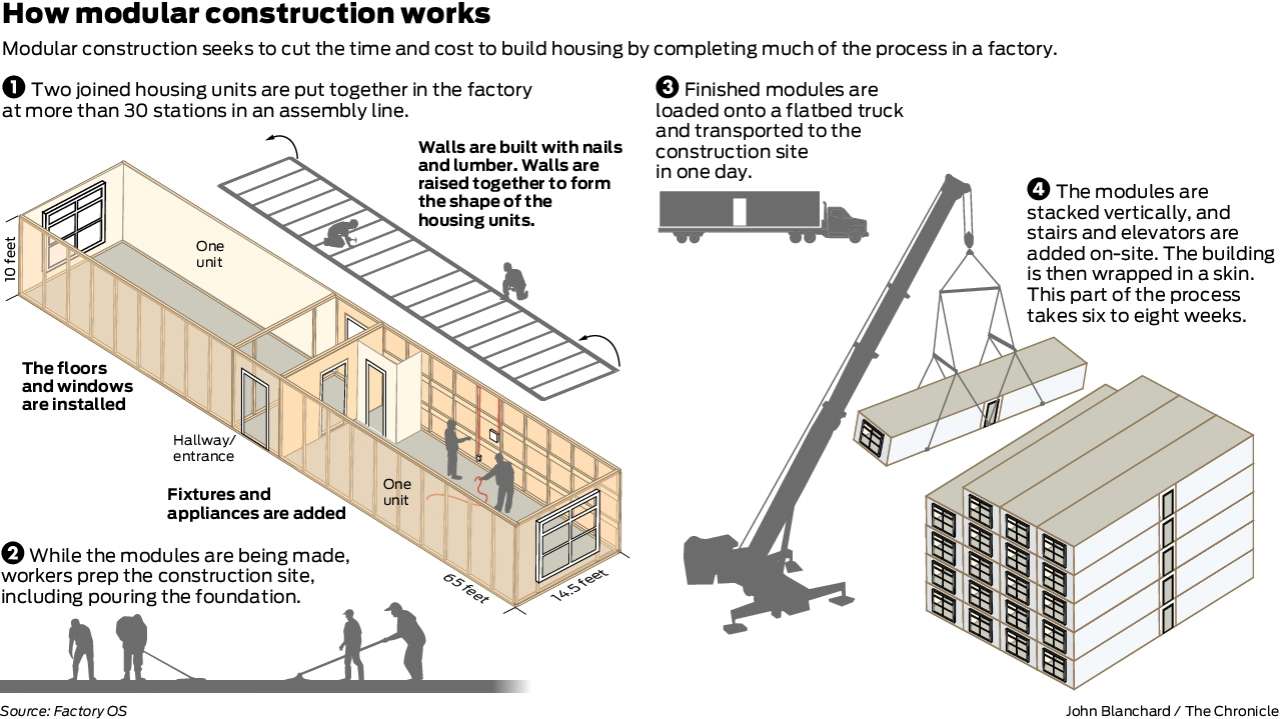
Developers are also exploring modular construction, where modules are assembled elsewhere and shipped in. Kennedy said the practice can lead to a 20% savings, and cut 50% off of the construction time.
6d560 1280x0 SF is one of the most expensive places in the world to build housing. Here’s why6d560 767x0 SF is one of the most expensive places in the world to build housing. Here’s why

But that strategy has run into union opposition because some work on the modules is done in another city or overseas.

So for now, costs will probably keep climbing.

A San Francisco high-rise can now cost $1 million per apartment to build, about 20% higher than what is feasible, said Oz Erickson, chairman of developer Emerald Fund. With rents and home prices hitting a plateau and costs continuing to rise, he said, development is approaching “impossible.”

Roland Li is a San Francisco Chronicle staff writer. Email: roland.li@sfchronicle.com Twitter: @rolandlisf

Article source: https://www.sfchronicle.com/bayarea/article/SF-is-one-of-the-most-expensive-places-in-the-14888205.php

Posted in SF Bay Area News | Tagged | Leave a comment

Bay Area Weekend Fun | 8 Holiday Events

This week’s round-up of fun Bay Area Events (HERE) includes a variety of festive things to get out and do, from Christmas in the Park in downtown San Jose to the Teddy Bear Tea in the festively decorated Terrace Room at The Ritz-Carlton SF. And if you love a good Pop-Up shop, today (12/6), marks the opening of the SF Etsy’s Winter Pop Up Shopwhich is scheduled to run thru December 22nd. Featuring goods from the SF Etsy Team and tenants of Makers Workspace, you’ll find products from 50+ local artists including jewelry, home goods, art prints, t-shirts, candles, bath and body, and so much more.


2019 Christmas in the Park | San Jose

Have you always wanted to experience the holidays in Europe? Mark your calendar, the German International School of Silicon Valley’s German Holiday Market (Weihnachtsmarkt) will take place in Mountain View on Saturday, December 14, 2019. Read more (HERE).

Other fun holiday events include Kepler’s Annual Holiday Party in Menlo Park, SantaCon San Francisco, and free holiday family portraits at the Santa Clara City Library.

For the complete list of what’s happening locally his weekend visit,

The Bay Area This Week |8 Fun Holiday Events (HERE).


Read more at RIckandSuzanneBell.com | HERE

Planning a trip to the City? Be sure to check out our list of 12 Fun Things to Do in San Francisco This Holiday Season |(HERE).


Holiday Fun Guide SF at RickandSuzanneBell.com | HERE

Note: Before heading to any event, it’s always best to check the individual event website to confirm details or changes.

About Us: Rick and Suzanne Bell share a marriage and real estate partnership at COMPASS out of the Los Altos office, where they serve Los Altos, Los Altos Hills, Palo Alto, Mountain View and surrounding Silicon Valley and Bay Area communities, Rick and Suzanne deliver a diverse and unique skill set when assisting clients in the marketing of their homes.

We devote a great deal of our resources toward the production of superior marketing collateral, which is then promoted through a multitude of social media channels. Social media marketing can become complex very quickly and we believe that we can demonstrate how our expertise in this area is unique, compelling and adds significant value for our clients in the marketing of their homes.

Rick’s background in both commercial and residential real estate marketing, coupled with his personal experience in real estate investment and home renovation empowers Rick’s clients with creative, unique and practical solutions when preparing and marketing their homes for sale.

Having managed nearly 500 employees as a Nordstrom store manager, Suzanne’s background in leadership, problem solving customer service provides for a very unique skill set in addressing the challenges often faced during a modern real estate transaction. Suzanne strives to reflect the Nordstrom customer service pledge within her real estate practice.

Article source: https://patch.com/california/losaltos/bay-area-weekend-fun-8-holiday-events

Posted in SF Bay Area News | Tagged | Leave a comment

Malls are yielding to office space. SF’s Westfield is the latest example

Stores are struggling, but the office market is booming.

Those two trends aligned this week when the San Francisco Planning Commission unanimously approved the conversion of two upper floors at Westfield mall, the city’s largest shopping center, into office space.

It’s the latest example of sites built for retail making way for offices. The recently sold 6X6 mall, a block away at Sixth and Market streets, has received approval to convert nearly 50,000 square feet of space to offices. The former Macy’s Men’s Store at 120 Stockton St., the former Saks Fifth Avenue Men’s Store at 220 Post St., the former Britex Fabrics building at 146 Geary St. and former retailer Loehmann’s outpost at 222 Sutter St. have all sought approval to convert some of their upper floors to offices.

The Westfield mall plans to convert 49,999 square feet of space on the seventh and eighth floors to offices. The floors, currently used for retail, storage and meetings, are part of a larger $75 million renovation that includes a facade with more glass and three rooftop terraces facing Market Street.

The mall, formally known as Westfield San Francisco Centre, consists of two parts: the nine-story 865 Market St. building anchored by Nordstrom, and the former Emporium building at 845 Market, anchored by Bloomingdale’s and Century Theatres. The Nordstrom building on the corner of Fifth and Market is where the changes are planned, essentially converting the department store’s top two floors.

“Office use is good for retail. In this case, offices on the upper floors will benefit Nordstrom and the other retail tenants by increasing the community of consumers around and directly within the center,” Chris Kitchen, Westfield’s vice president for development, told The Chronicle.

 Malls are yielding to office space. SF’s Westfield is the latest example

San Francisco office buildings have filled up with tenants in the fast-growing tech industry. Demand is soaring, but a 1986 city law, Proposition M, limits the total amount of office space that can be approved each year.

By proposing about 50,000 square feet, Westfield had an easier time with the Prop. M restriction than some larger projects.

Mayor London Breed has a measure on the March ballot that would increase the amount of office space the city can approve, which is now 875,000 square feet annually. A countermeasure on the ballot from San Francisco nonprofit Todco would restrict office development if the city fails to meet its affordable housing goals.

The Bay Area is home to the nation’s most competitive office market, according to a recent report by Colliers International, a commercial real estate firm. A third-quarter report showed the Bay Area with the lowest office vacancy rate, at 5.4%, and an average asking rent of $86.22 per square foot, ahead of Manhattan and Seattle, its closest competitors.

“The biggest demand for office space comes from tech companies,” said Stephen Newbold, director of office research for Colliers.

 Malls are yielding to office space. SF’s Westfield is the latest example

Meanwhile, retail isn’t doing too well. San Francisco is littered with empty storefronts as retailers grapple with the shift to online shopping, along with city permit processes that can take up to 18 months and sky-high rents. Unused or underused retail space could help meet office demand, Newbold said.

Even the posh Union Square shopping district has seen more offices arrive.

“There is less demand for retail space in Union Square, and it is particularly hard to find retail tenants who are interested in filling the upper floors of a building — even in a shopping center,” said Karin Flood, executive director of the Union Square Business Improvement District. She said she supports Westfield’s efforts and would rather see spaces filled than be empty or underused.

Jesse Gundersheim, San Francisco director of market analytics at CoStar, said in an email that while there is strong demand for office space, compared with retail, it is “directly beneficial to fewer (people), and adds little to neighborhood appeal.” But the space being converted to offices was unsuccessful at drawing retail, he noted — so offices are certainly better for the neighborhood and the economy than vacant store space.

Some malls, like Stonestown Galleria on the west side of San Francisco, are looking to add housing, in another attempt to stabilize the customer base for stores. Other malls nationwide are even turning to hotels, according to Julie Taylor, executive vice president at Colliers.

“I think people desire a setting where they can live, work and play all within walking distance,” she said.

“A large-size mall property allows the creation of an urban village that can’t really be developed elsewhere in major cities,” she added. “Mall properties are often easy to access and they are close to freeways. When you bring in housing, jobs and hotel rooms, you’re extending how much time people spend at the mall itself, creating more opportunities for businesses, which can be crucial, for retailers particularly.”

At the Westfield mall, Nordstrom will remain the second-largest tenant behind Bloomingdale’s despite losing floors 7 and 8. It would occupy floors 4 through 6. The shopping center already has office tenants on its Emporium side, including San Francisco State University, SF Media Co., TrustArc and Hyperdrive Agile Leadership.

Kitchen said there is already strong interest in the new office space from a variety of different businesses, though he declined to give names.

“The location, its direct connection to transit and the shopping center amenities make it particularly appealing to office tenants,” Kitchen said.

Shwanika Narayan is a San Francisco Chronicle staff writer. Email: shwanika.narayan@sfchronicle.com Twitter: @shwanika

Article source: https://www.sfchronicle.com/business/article/SF-approves-plan-to-convert-two-Nordstrom-floors-14886160.php

Posted in SF Bay Area News | Tagged | Leave a comment

Gentrification watchdog accused of violations in multimillion-dollar SF home flip

San Francisco Planning Commissioner Dennis Richards, who has made a name for himself as a watchdog of building code scofflaws and a crusader against of gentrifying speculators, finds himself in an uncomfortable position these days.

He is facing allegations that an investment group he’s a member of is guilty of what he publicly rails against: ignoring city planning and building codes to make millions of dollars on a quick real estate flip.

Richards says that the violations were relatively minor and that he is being targeted because of his frequent criticism of the Department of Building Inspection.

The fight, which has been simmering since September, flared up Wednesday night during a public hearing on the property’s permits. Richards is part of a group of investors, Six Dogs LLC, that attempted to get the city’s Board of Appeals to overturn a decision to yank the permits for 3426-3432 22nd St., a four-unit historic Italianate building near Guerrero Street.

Six Dogs LLC, a partnership that includes Richards and Noe Valley real estate agent Rachel Swann, bought the 22nd Street property in June of 2017 for $2.7 million. The group spent $350,000 buying out four tenants and put the building through a “multi-million dollar renovation,” which included remodeled interiors, new bathrooms and kitchens, windows and siding, roof and decks. Six Dogs is now marketing it as “a trophy collection of residences” for $7.88 million.

While Richards regularly rails against speculators and property-flippers, who drive out long-term tenants through evictions or lucrative buyouts, he scoffed at the notion that he was engaged in a similar practice. He said all the tenants requested to be bought out and that he had hoped the tenants paying the lowest rent — a family of Mexican immigrants paying less than $600 a month — would stay, but they wanted to relocate.

“Nothing had been done to the building in decades,” he said. “It was slum conditions. People can throw rocks at me if they like, but I go to bed knowing that everyone won here.”

The project was going as planned until September when city building inspectors revoked nine permits on the building on the same day they issued notices of violations on the property. While builders generally have 30 days to come up with a plan to correct violations before permits are revoked, in this case the notice of violation and the permit revocation both happened Sept. 30. Only one or two permits a year are ever revoked.

Richards and his supporters said the decision to revoke the permits so quickly shows that the building department has a personal vendetta against him. Richards said that officials started attacking him after a contentious May 9 Planning Commission hearing at which he blasted the department for allowing unpermitted work on an 18th Street building.

Richards said building inspectors were “trying to get back at me” and accused the inspectors of “out of control criminal activity.”

“It will be investigated,” Richards said at the Board of Appeals meeting. “I look to you to help my plight, my financial safety and to protect me from this Trumpism that has been a cancer on this city going on for decades and nothing has been done about it.”

The news website Mission Local was the first to report on the case.

Senior Building Inspector Joseph Duffy said that the revocation was necessary because Six Dogs didn’t cooperate when asked to consolidate the nine permits into a single permit displaying the full scope of work.

“We wanted a full set of drawings and Mr. Richards pushed back and didn’t cooperate,” said Duffy.

Another city official, Zoning Administrator Scott Sanchez, said that the 22nd Street violations are serious and need to be corrected. This includes 14 windows installed in the rear of the building that don’t conform to historic standards. Also, the investment group needs permission for four skylights that were added to the roof without permits, Sanchez said. Six Dogs must remove six parking spaces from the building’s garage. Marketing materials tout the property’s 12 parking spaces, but the city allows only six spots in the building.

“There are clear violations here of the planning code and the building code and other issues,” said Sanchez.

Richards called the city’s complaints “the biggest crock I’ve ever heard.”

He said that the issues were minor and said that he had left the details to the contractor and project engineer Patrick Buscovich. At the same time, he acknowledged that he was ultimately responsible as the property owner.

“I hold project sponsors responsible for the actions of their contractors, so I can’t stand here and say, ‘This is Pat’s fault,’ he said. “We hired him. Was it sloppy? Did we hire someone who was sloppy? Maybe. But as screwed-up projects go, this is not a 10 on a scale of 1 to 10. It might be a 3 or a 4, but it’s not a 10.”

The Board of Appeals ultimately decided to continue the matter to a future hearing, and Rick Swig, the board president, urged the two sides to come together and resolve the dispute.

“What we have here is a sloppy mess,” said Swig.

During public comment, a half dozen residents, all longtime critics of the building department, supported Richards.

Jerry Dratler said the rules are “not consistently enforced,” pointing to the case of 49 Hopkins in Twin Peaks, where a home designed by famed architect Richard Neutra was demolished without a permit. In that case, the permit was not revoked.

Noe Valley resident Ozzie Rohm said that the building department regularly lets developers and investors get away with illegal demolitions and unapproved additions that are “far more egregious” than Six Dogs’ alleged violations.

“It’s hard for the public when the rules are not consistent,” said Rohm.

J.K. Dineen is a San Francisco Chronicle staff writer. Email: jdineen@sfchronicle.com Twitter: @sfjkdineen

Article source: https://www.sfchronicle.com/bayarea/article/Gentrification-watchdog-accused-of-violations-in-14885837.php

Posted in SF Bay Area News | Tagged | Leave a comment

Report predicts slower Bay Area housing market in 2020 – KGO

WALNUT CREEK, Calif. (KGO) — Just when you thought the Bay Area housing market might never cool, there’s a new report from Realtor.com that says that’s exactly what could happen in 2020, here and across the country.

According to Realtor.com, 2020 home sales will drop nationwide by 1.8%, but more than twice that–4.5%– in the San Francisco Metro area and down 3% in the South Bay.

RELATED: Report: You need to earn $309K to afford a home in San Francisco

Home prices will change less dramatically– up .8% nationwide, but down .4% in the San Francisco metro market and up more than 2% in the San Jose Area.

The Realtor.com report indicates the market will cool because economic uncertainty will prompt consumers to cut back on spending…and inventory will reach historic lows, especially in the entry-level category.

The report also states the slowdown will be prompted in part by Millennials, who drive the buying market, reaching key milestones in their lives, such as turning 30.

“I can’t refute all of it,” said Danville realtor Paul Burgess with Compass Realty. Burgess says the report may be accurate to some extent, but that no one trend or prediction– especially at the national level– applies to all of the micro-markets in the already high-priced Bay Area.

RELATED: Apple’s $2.5B pledge for affordable housing unprecedented

“Our market is very specific,” explained Burgess. “This corridor, which we call 680-24 corridor. We’re seeing buyers coming in from San Francisco, from Santa Clara Valley because we are more affordable. We have excellent schools, quality of life. Starter homes like this one, or even in the higher-priced markets, are a great value.”

Burgess said he and his wife Pat Burgess just listed a 1400 square foot rancher in Walnut Creek for $898,000 and have already had multiple inquiries, including one offer, before holding even one open house.

Check out more stories and videos about Building a Better Bay Area.

Article source: https://abc7news.com/realestate/report-predicts-slower-bay-area-housing-market-in-2020/5734219/

Posted in SF Bay Area News | Tagged | Leave a comment