SF Nonprofits Band Together to Purchase Historic Mission District Building

San Francisco city officials on Wednesday celebrated the purchase of a historic building in the city’s Mission District by several local nonprofit organizations.

The purchase of the historic Centro Social Obrero building at 2929 19th St., by the real estate holding entity 701 Alabama Consortium restores the building to nonprofit ownership.

The organizations involved in the purchase include Jamestown Community Center, the Mission Economic Development Agency and Mission Neighborhood Centers, and the Mission Language and Vocational School Inc.

Local


1ddc4 e cig 1215 SF Nonprofits Band Together to Purchase Historic Mission District Building


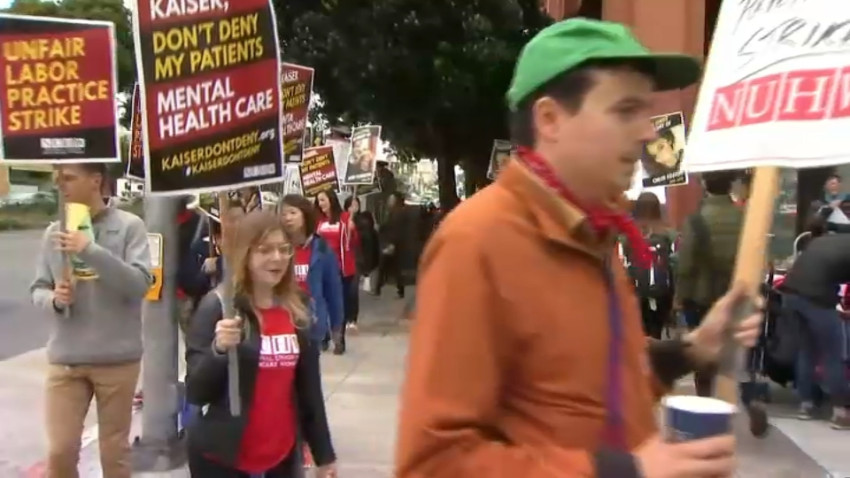
1ddc4 kaiser strike 1215 SF Nonprofits Band Together to Purchase Historic Mission District Building

The Mission Language and Vocational School has operated out of the 12,902 square foot Centro Social Obrero property for the last 40 years. The new purchase will help protect and expand the services MLVS provides to low-income Latino and immigrant families, services such as career counseling, language and vocational training and job placement.

“The acquisition of this property shows us what’s possible when we all work together. Our city wouldn’t be the same without community resources like the Mission Language and Vocational School, and now these organizations will be able to offer even more services and resources for San Franciscans,” Mayor London Breed said in a statement.

In addition to housing the MLVS, the building also houses the Jamestown Community Center, Five Keys Charter School, the Roadmap to Peace Initiative and the Bay Area Community Resource Access Center.

“The effort to preserve this space has been complex, but today’s announcement ensures our communities will be able to benefit from these incredible organizations for years to come,” Assemblymember David Chiu, D-San Francisco, said.

Supervisor Hillary Ronen, whose district includes the Mission District, said, “By taking complete ownership of this building, the nonprofit organizations that make up the 701 Alabama Consortium are sending a clear message that they are not going anywhere, and will continue investing in the futures of our most vulnerable families in the Mission and throughout the city.”

The purchase was made possible thanks to the mayor’s Nonprofit Sustainability Initiative, which provided $1 million in early funding as well as technical assistance. In addition, the entity of organizations was able to obtain a loan from the Bank of San Francisco to successfully purchase the $4.75 million property.

“This last year and a half, the community worked hard to save this space and programs and it became very personal to me,” said Tracy Brown-Gallardo, the MLVS’s board chair.

MLVS was first founded in 1968 and, since then, it has helped thousands of graduates become economically self sufficient through teaching English and employment training.

Article source: https://www.nbcbayarea.com/news/local/sf-nonprofits-band-together-to-purchase-historic-mission-district-building/2152387/

Posted in SF Bay Area News | Tagged | Leave a comment

Chinese Investment Nosedives In Bay Area, While Dropping By Half In SoCal

Want to get a jump-start on upcoming deals? Meet the major Los Angeles players at one of our upcoming events!

The flow of mainland Chinese capital in amounts of $2.5M or larger into commercial real estate dropped by more than 50% in SoCal markets, and vanished almost entirely in San Francisco, in 2019.

A Real Capital Analytics report based on independent reports of properties and portfolios of $2.5M and greater found that investment dollars in the Los Angeles Metropolitan area have dropped by 57% in the third quarter of 2019 compared to a year prior.

In the Inland Empire, where Chinese investors had long sought to capture a share of the region’s booming industrial market, investments were down 50%. 

San Francisco has experienced a similar story, but at much more dire levels. The Golden State’s other economic hub, and neighboring San Mateo County, saw Chinese investments of that size in CRE fall to almost nothing in 2019. That’s a sharp drop from a peak of $1.8B invested in both counties just three years earlier, according to RCA’s report. 

Nationwide, Chinese investments in CRE have nosedived by 76%, according to RCA

“The retreat by Chinese investors can be summarized with the phrase: ‘It’s not you, it’s me,’” the report states. 

RCA Senior Vice President Jim Costello, who authored the report, told Bisnow that Chinese investment has been pulling back in every city. But Costello cautioned that the U.S.-China trade war is not the reason for the decline in investments from China. Instead, Costello said capital controls instituted by the Chinese government trying to protect its currency is the biggest factor.

Cushman Wakefield Vice President David Bitner, who works out of the company’s San Francisco offices as its Americas head of capital markets research, said currency strength concerns and a slowing national economy led China’s government to implement restrictions on capital outflows, which aren’t U.S.-specific.

“On the one hand, [China’s slowing economy] makes outbound investment more attractive,” Bitner said. “And on the other, it means less wealth is being created in China that can then be allocated to real estate investment, either foreign or domestic.”

It also “doesn’t take a massive leap of the imagination” to think China’s capital controls have been applied more rigorously to U.S. assets in light of the two countries’ ongoing trade disputes, Bitner said.

Despite the decline, Costello said investors from China are still the 11th-largest group of cross-border investors in the U.S. commercial real estate market. Mainland China’s pullback has a minimal impact on market pricing. 

“The RCA Capital Liquidity Scores show that even as Chinese investors withdrew from the U.S., market liquidity remained high,” according to the report.

The new data come as a number of high-profile Chinese investments in Los Angeles have sold or stalled in the past year. According to RCA, Chinese investments have dropped from $265.5M in 2018 to $113.3M year-over-year. 

California, particularly in the Los Angeles and San Francisco markets, has been a popular investment destination for the Chinese. From 2012 to 2017, Chinese investors poured more than $5B in investments into commercial real estate, according to Cushman Wakefield

“When the Chinese were coming over here in a big way, they targeted markets where there was a large Chinese American community and the potential to hire staff,” Costello said.

But the once booming market in recent years waned as government restrictions put a chokehold on capital outflows.

In the fourth quarter of last year, Chinese megadeveloper Dalian Wanda sold an 8-acre development site in Beverly Hills to an entity controlled by a JV of Cain International and Alagem Capital Group.

Wanda had acquired the site at 9900 Wilshire Blvd., across the street from a Waldorf Astoria hotel, in 2014 for $420M. The China-based group had plans to build a $1.2B mixed-use residential, hotel and retail megaproject called One Beverly Hills on the site.

According to commercial real estate data site Reonomy, Wanda sold the land four years later to BH Luxury Residences for $445M, without building anything.

The new owners said they planned to “stick with the outline” of Wanda’s original plan. 

Earlier this year, Oceanwide Holdings stopped construction on its Oceanwide Plaza project in the heart of Downtown Los Angeles. On a recent visit, a couple of construction cranes towered over unfinished skeletal building structures. Oceanwide had plans to build a Park Hyatt hotel, a residential tower with retail and restaurants.

RCA’s report shows that type of moonshot optimism to be hamstrung by regulations, at least for now.

“The typical cross-border investor in the past had come here with the notion of buying something just for the prospective of the yield being a little better than the bond,” Costello said. “They tended to buy safe, stable-yielding assets. The Chinese investors came here swinging for the fences trying to become developers. They were taking on risks that other folks would not.”

In San Francisco, once a focal point of Chinese capital, the country’s investors have also been cowed by the city’s arduous permitting process, which has stopped several projects in their tracks, according to the San Francisco Chronicle.

One such project is Oceanwide Center, which is now part of China-based Oceanwide Holdings’ massive U.S. portfolio, which is reportedly for sale.

In S.F., the sudden vanishing of large-scale investment from China shouldn’t distract from the city’s increase in cross-border flows, or from California and the U.S. as a whole, still being a hot real estate market, Bitner said.

“The organic, true, underlying demand is much higher than is suggested by the statistics that we see,” he said.

The outlook also remains rosy further north. While investments from China are down in Los Angeles, Canadian companies are picking up the slack. Canada made up almost half, or about $1.4B of the $3.2B cross-border investment, that flowed into Los Angeles commercial real estate in 2019, according to RCA.

Filling that gap some are Middle Eastern investors, who contributed about $333M into Los Angeles commercial real estate, and European cross-border investors, who plunked down $1.3B in the San Francisco market in the past year, RCA reported. 

Related Topics: Cushman Wakefield, foreign capital, Inland Empire, San Francisco, Real Capital Analytics, Jim Costello, Chinese investments, David Bitner, Chinese investments Los Angeles, Chinese investments San Francisco, San Francisco Chinese investments

Article source: https://www.bisnow.com/los-angeles/news/commercial-real-estate/its-a-golden-state-but-not-for-china-flow-of-cre-investments-from-china-to-california-is-down-102223


Posted in SF Bay Area News | Tagged | Leave a comment

California housing crisis: Why do San Francisco homes go vacant?

The fact that San Francisco had a census-estimated 38,651 vacant homes in 2018 sounds like a surefire recipe for outrage. There’s a housing crisis and thousands of people live on the streets—are we really letting millions of dollars worth of real estate go to waste?

Potentially, yes. But investigating the numbers reveals that there’s no easy answer to that question. Whether vacant homes are a betrayal or just part of the ordinary makeup of a housing market depends greatly on our expectations.

Why does it matter?

Moms 4 Housing, an Oakland-based housing activist group, allege that the number of empty houses in the Bay Area is proof that the homelessness crisis could be resolved simply using existing housing stock.

In fact, Moms 4 Housing claim that the West Oakland house they’re currently occupying has been empty and off the market for years. And indeed, the number of vacant homes in the Bay Area’s most populous cities outstrips the estimated number of homeless residents.

At the same time, NIMBY interests sometimes wield statistics about housing vacancies as supposed evidence that more housing development isn’t needed (although this argument ignores the practical fact that, by definition, vacant homes aren’t helping relieve housing shortages).

The catch is, not all vacancies are created equal.

What is a vacant home?

Some people will tell you that almost all vacant Bay Area homes aren’t vacant at all, and that they’re simply the result of “churn,” which is when homes on the market linger for new buyers or tenants.

This is not true. But “vacant units for rent” and “vacant units for sale” are indeed two of the ways that the U.S. Census defines a vacant home.

Other definitions include “vacant units rented or sold”—i.e., homes with legal tenants or owners that are for some reason empty anyway—and ”occasional use” homes that include timeshares, many Airbnbs, or just second (or third, or more) homes that owners live in less than half the year.

Perhaps most critical of all is the broad “other vacant” category that includes some legitimately fallow units but also a dizzying variety of other uses/non-uses ranging from foreclosures to uninhabitable homes in need of repair to homes being used simply for storage.

Why are so many homes vacant?

Economist Tendayi Kapfidze crunched vacancy numbers nationwide in March at the behest of online lending site Lending Tree. His report concluded that San Francisco, along with San Jose, has one of the lowest vacancy rates in the country.

Kapfidze based this off of 2017 census data, at the time the most recent figures available. Of the approximately 100,000 homes he identified as vacancies, roughly 28,000 were on the market.

Another 20,000 were “occasional use” homes. And more than 37,700 homes fell into the broad, opaque category of “other vacant.”

When sites like Lending Tree say “San Francisco,” they’re talking about the larger San Francisco metro area, which includes San Mateo County and all East Bay counties as well. So what about the city of San Francisco itself?

In 2018, Paige Dow, a master’s student at UC Berkeley—the school’s Terner Center For Housing Innovation singled Dow’s work out as “exceptional student work that connects to our mission and research agenda”—dissected SF-specific vacancies in a report for the San Francisco Planning Department.

Using census data from 2015, Dow noted that seasonal use and “other vacant” were the fastest growing type of home vacancy in SF, with both doubling as a percentage of overall vacancies since 2000.

Dow also says that the number of vacancies due to homes currently listed for sale or for rent is relatively low in SF—a combined total of fewer than 8,000 for that year, out of more than 30,000 empties citywide.

However, Dow also cautions that the reasons for various types of vacancies are varied and difficult to track.


14390 Screen Shot 2019 12 12 at 10.32.25 AM California housing crisis: Why do San Francisco homes go vacant?

Courtesy SF Planning

Also in 2018, the San Francisco Planning Department’s “Housing Trends and Need” report found that as recently as 2005, the combined “for sale/rent” metrics made up a plurality of SF vacancies; by 2015 both had declined to only a few thousand units.

Noting the wide growth in “rented or sold, not occupied” homes, planners said that potential explanations for these vacancies include recent deaths and foreclosures, and added, “An increase in major renovations to properties may be part of the cause of the increase in these types of vacancies.”

In 2014, SPUR studied the city’s supply of “non-primary residences.” Of the 9,000 or so “occasional use” homes in the city at the time, SPUR noted, “There has been some public discussion as to whether housing units in San Francisco are being held off the market as investment properties.”

At the time they could only find four such units out of nearly 2,000 surveyed. However, a significant number of condos—13 percent in most buildings, and up to 36 percent in those offering more services and amenities—were homes described as “pieds-à-terre” and unoccupied most of the year.

Value judgements about home vacancies tend to turn on certain points of view. Vacancies from renovations and repairs might be just inevitable hassles, some might argue. Or they could arouse suspicion of rampant gentrification or landlords using renovation as a cover for eviction.

“Occasional use” homes might be a practical reality of free markets—or an indicator of decadent wealth hoarding critical resources. Homes empty from foreclosure might be necessary evils that, unfortunately, help make the American Dream possible—or a symptom of predatory lending and the ghosts of the most recent recession.

One way or the other, a lot of homes are probably going to waste. But few parties will agree on what the nature of the waste actually is.

Article source: https://sf.curbed.com/2019/12/13/21012824/san-francisco-home-vacancies-homeless-housing-crisis

Posted in SF Bay Area News | Tagged | Leave a comment

Number of homes for sale in San Francisco Bay Area plummets from 2018

San Francisco and its surrounding counties are flush with employment, the housing supply is tight, so conventional economic wisdom has it that demand should drive offers across the board.

Instead, the listing aggregate site Realtor.com reported this week that both SF and San Jose areas saw huge declines in the number of listings year over year in November, continuing the region’s weird 2019 trends.

According to figures released by the site on Tuesday, the San Jose metro area saw the fourth biggest decline in the “active listings count” metric in November, down 22.2 percent compared to the same time last year.

The SF-Oakland-Hayward area (which encompasses all of SF, San Mateo, Contra Costa, Alameda, and Solano counties) saw a less drastic but still marked drop, down 17 percent from 2018.

The declining inventory isn’t unusual relative to the rest of the country—Realtor notes that “only four of the 50 largest metros saw inventory increase year over year” that same month.

However, the decline in and around SF has been long-term; in July of this year, Orange County-based data firm Core Logic (whose figures represent more homes than Realtor’s, as Realtor reports reflect only homes listed on that particularly site) said that the number of homes sold—not just listed—in SF dropped 12 months in a row.

Luxury real estate site Mansion Global even declared 2019 “the year of the vanishing buyer.” That’s probably a touch too dramatic—the California Association of Realtor reported the number of sales up year over year in October in SF and most (but not all) of the Bay Area.

Still, the fact remains that most of the time, housing demand doesn’t seem to be driving a frenzy in 2019.

The Realtor figures also estimated that for the San Jose area, a median-priced listing (not sale) in November was just less than $1.1 million, up 1.5 percent from 2018.

In the SF area, median asking price was roughly $933,000, up 5.1 percent.

Article source: https://sf.curbed.com/2019/12/11/21010863/realtor-homes-listed-san-francisco-bay-area-decline-2019

Posted in SF Bay Area News | Tagged | Leave a comment

Is It Possible to Retire Early in the Bay Area?

To find out, I reached out to locals pursuing FIRE through a Facebook group for the popular ChooseFI podcast. About half the people I spoke with worked in tech, while others were tech-adjacent, working indirectly with the industry. They included marketing professionals, chiropractors, pediatricians, real estate brokers, and, yes, software and hardware engineers — it’s unavoidable. But no one had received a big payout, or else they wouldn’t have been lurking on Facebook groups trying to maximize their paths to FIRE.

The moderator of the group is Allison, age 49, who FIRE’d four years ago with her husband, Dylin. Out of everyone I interviewed, they are the only people who had fully retired and were still able to live in the Bay Area. She was a project manager, and he was a marketing professional. “Unfortunately, none of these startups [they worked for] IPO’d or made it big,” said Allison, “so the main source of our net worth came from our salaries, not stock options.”

How did they do it? “We started investing in the stock market as soon as we got real jobs that offered 401(k) plans,” she said. “We maximized our income potential by taking advantage of the hot tech industry, and in several cases, changing jobs to increase our earning potential.” They also brought in extra income with side hustles, automated investments and bills—and kept their expenses low as well.

Is this method replicable in today’s San Francisco? Allison and Dylin bought their first home in 1999, when prices were, if not affordable, at least not totally bat-shit insane. They were able to buy that first home — a one-bedroom condo in the Oakland Hills for $186,000 — by saving 30% of their salaries, ending up with a 10% down payment. Then they bought and sold multiple times over the years, until they sold another condo in Mission Bay to pay off the Oakland condo in full.

Making smart housing choices seems to be key for many people pursuing FIRE. Susan, 52, a former fashion/textile designer and current nonprofit employee, owns her own condo in Potrero Hill. “I have always had housemates,” Susan said, “which is how I can afford to be a homeowner as a single woman with a moderate income…I’d rather have housemates and retire early than be locked in paycheck prison just for the luxury of living by myself.”

Susan is financially independent, but not yet at early retirement. “The numbers tell me I am technically ‘FI’ for the lifestyle I’d like to transition to,” she said, “but that won’t be in San Francisco.”

For another perspective, I spoke with Ben, 41, who is both a commercial real estate agent and a landlord. He bought and rents out two multi-unit apartment buildings in the Central Valley, which takes a lot of guts. I asked him about buying a home, and he said, “Buying a house is overrated. I’m fortunate to be in such a position that I can rent out a room to somebody else. Not everybody who is married or has a family is willing or able to do that. That certainly helps.” He pointed out that it’s cheaper to rent these days than to purchase a property.

In other words, sticking it out in my rent-controlled apartment, despite my, ahem, eccentric landlord could still lead me to FIRE. As long as I don’t plan to retire here — nearly everyone I interviewed cited leaving the Bay Area as part of their early retirement strategy.

Dave, 30, an intellectual-property protection data manager, is about to FIRE next year. He is the youngest person I interviewed, and he freely admitted that there’s privilege required to do something like this at such a young age. “I would be completely remiss to speak about my FIRE successes without acknowledging the overwhelming amount of luck and privilege I’ve had along the way.” He points out that he is white, male, and able-bodied, and that he has financially stable parents. Although not everyone I spoke with had all these boxes checked, everyone had some.

But privilege alone generally creates the opposite effect. Dave could easily blow all his money in the Bay Area and still complain about making ends meet. FIRE, in any area and in any economy, requires a lot of planning. “I will be moving into a 710-square-foot mobile home in Santa Cruz that I purchased for $216,000 earlier this year,” Dave told me. His housing expenses will go from almost $1,500/month to only $400/month, less than one-third of the cost of his current living situation. He said that the home also has a 210-square-foot room that could be rented out to cover housing expenses, if needed.

Plans within plans within plans. Some refer to this as living by design, not by default. While the Bay Area is expensive, it also hosts a wealth of opportunities.

Ben, the realtor, said that he might be able to FIRE faster elsewhere, but in his line of work, he makes more money here. “Commercial lease rates and property values are higher here, meaning that if I’m able to build the right type of relationships, I can earn more money doing less work here.” He added that being in the Bay Area made him somewhat recession-proof compared to working in the Central Valley during a recession, which he described as “tough.”

Article source: https://thebolditalic.com/is-it-possible-to-retire-early-in-the-bay-area-99fb81aec9db

Posted in SF Bay Area News | Tagged | Leave a comment