San Francisco’s ‘Fresh Air Bed Company’: A con artist and a different plague


  • 8e049 920x920 San Franciscos Fresh Air Bed Company: A con artist and a different plague

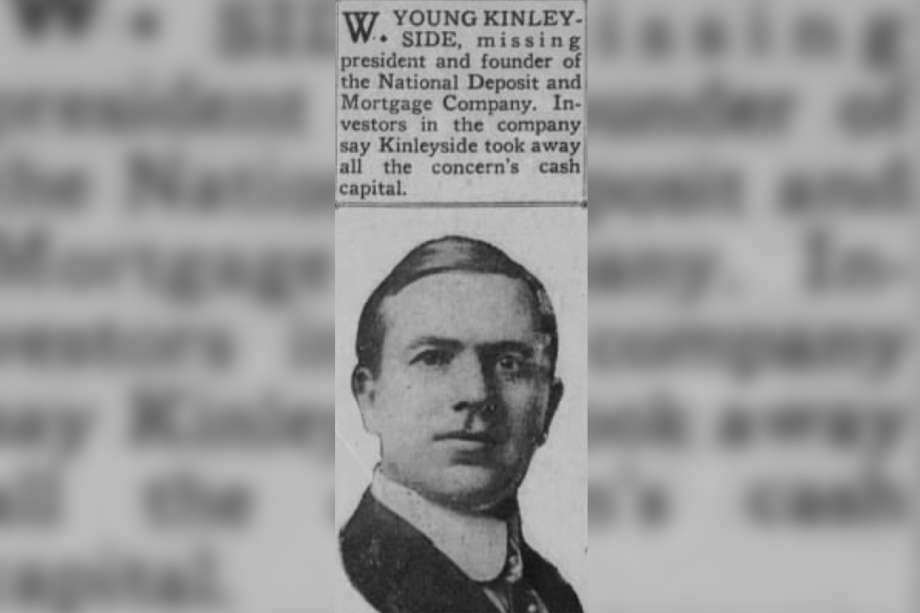
    A photo of William Young Kinleyside in the April 1, 1915 San Francisco Examiner after he had fled the city when his stock scheme was exposed. “If I could get hold of Kinleyside now I would horsewhip him,” said the wife of one of his unwitting employees.

    less

    A photo of William Young Kinleyside in the April 1, 1915 San Francisco Examiner after he had fled the city when his stock scheme was exposed. “If I could get hold of Kinleyside now I would horsewhip him,”

    … more


    Photo: San Francisco Examiner

Caption

Close

A photo of William Young Kinleyside in the April 1, 1915 San Francisco Examiner after he had fled the city when his stock scheme was exposed. “If I could get hold of Kinleyside now I would horsewhip him,” said the wife of one of his unwitting employees.

less

A photo of William Young Kinleyside in the April 1, 1915 San Francisco Examiner after he had fled the city when his stock scheme was exposed. “If I could get hold of Kinleyside now I would horsewhip him,”

… more


Photo: San Francisco Examiner


About a century before COVID-19 sent the Bay Area indoors, a different respiratory plague drove people to sleeping outdoors in the name of good health. It inspired an entire architectural movement, as well as a San Francisco con artist who tried cashing in on it.

The “California Fresh Air Bed Company,” based in San Francisco and promising apartment dwellers a convertible outdoor bed, was apparently just another of his investment scams.


Tuberculosis was the second-leading cause of death in the United States in 1900, just behind pneumonia. It’s the reason the American Lung Association was founded in 1904. Like the coronavirus, it especially preyed on the urban poor, and the lack of a vaccine terrified the country for decades.

Physicians endorsed lots of fresh air as a way to ward off the disease, and it was during this time that the sleeping porch became a trend in Bay Area houses, led by Bernard Maybeck’s Arts and Crafts style.


The sleeping porch was essentially a screen-enclosed, open-air bedroom. It was preferably on the second floor, because the air was believed to be purer at higher altitudes. Many homes built from 1895 to 1920 had them, and they experienced a revival in the early 2000s.


8e049 920x1240 San Franciscos Fresh Air Bed Company: A con artist and a different plague

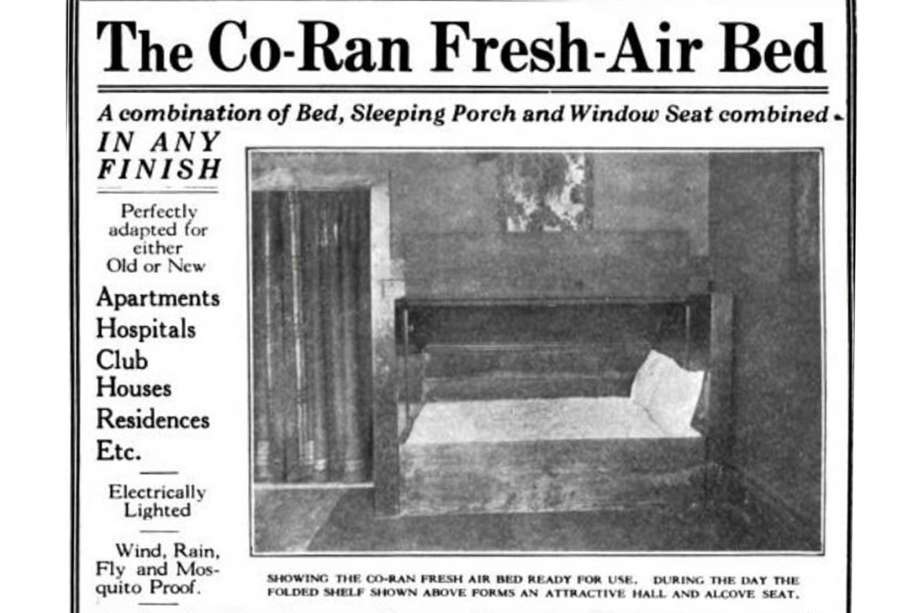
An ad for the Fresh Air Bed in the February 1912 Western Architect and Engineer

An ad for the Fresh Air Bed in the February 1912 Western Architect…


In 1919 the U.S. Health Service published a series of recommendations on avoiding TB, and first on the list was “Sleep with windows up in bedroom or use a sleeping porch. Allow plenty of fresh air in the place where you work.”


San Francisco’s mild winters made the sleeping porch a year-round favorite, and the city demonstrated a zeal for fresh air in the name of wellness. (It was also around this time that indoor saltwater baths were a wildly popular local health activity.)


The Chronicle ran a full-page spread on fresh air in 1911, including this portion on the city’s women: “The San Francisco girl looks upon fresh air as her birthright. … The San Francisco girl is not afraid of drafts, but rather apoplexy, pneumonia, and tuberculosis and the injury of her complexion through lack of sufficient cold air.”

San Francisco historian and native John Freeman told SFGATE his father-in-law, born in 1920, often slept with the window open while growing up in the Richmond District.

“He said his life was horrible under that regime,” Freeman said. “His nose ran constantly during the day, and as an adult he had asthma. He had a lifetime of respiratory problems, which he attributed to the medically recommended ‘fresh air’ sleeping practices promoted in San Francisco.”


In March 1915, an entrepreneur named William Young Kinleyside and his partner, R.W. Michaels, vanished from San Francisco after it came to light they were selling bogus stocks to investors.

Mrs. H.S. Comfort, whose husband was scammed to the equivalent of over $20,000 in today’s money, told the San Francisco Examiner, “If I could get hold of Kinleyside now I would horsewhip him. That is the only way men of his caliber must be treated.”


ffbb4 920x1240 San Franciscos Fresh Air Bed Company: A con artist and a different plague

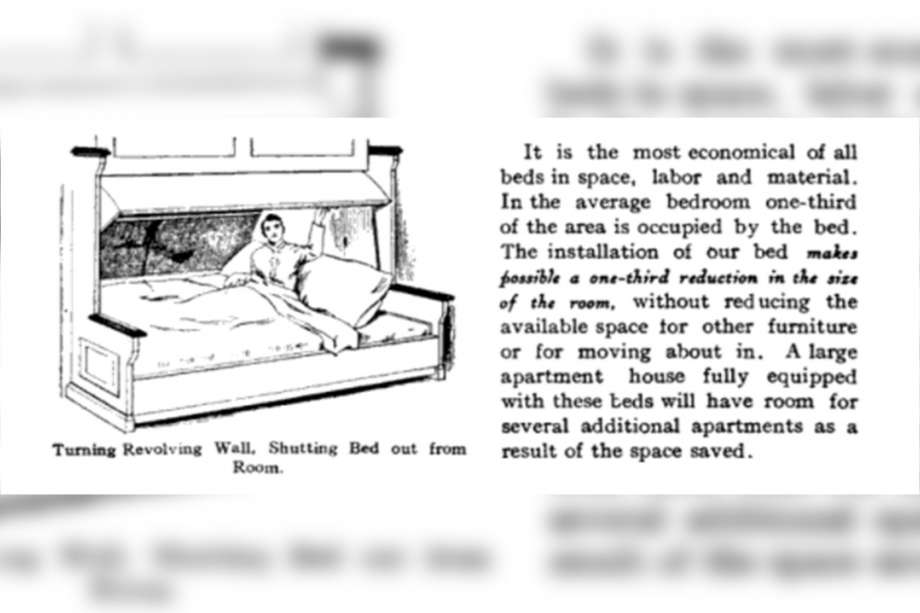
An ad for the Fresh Air Bed in the January 1914 Pacific Medical Journal

An ad for the Fresh Air Bed in the January 1914 Pacific Medical…


The San Francisco Chronicle reported Kinleyside was also attempting to sell physicians on another venture of his: the California Fresh Air Bed Company. “The value of which,” the Chronicle reported, “to say the least, has not been proven.”

Multi-page ads for the Fresh Air Bed Company can still be found in online archives for two trade journals: In the February 1912 Western Architect and Engineer, and the January 1914 Pacific Medical Journal. Prototype images depict a revolving, dome-shaped wall separating the bed between the indoors and outdoors. When outside, the sleeper would be protected by a wire screen and storm curtains.

Also advertised as the Co-Ran Fresh Air Bed, the listings claim in large type it was “highly endorsed by architects and doctors” and its owners could save space with “no more cold and leaky sleeping porches.”

The ad in Western Architect claims that 600 Fresh Air Beds were sold during its first public demonstration at the Architectural League of the Pacific Coast exhibition in Los Angeles. The company claims two Bay Area addresses: One on 833 Market Street in San Francisco and one at 1764 Broadway in Oakland.

ALSO: She admitted to stalking and murdering an SF tycoon. A jury acquitted her.

The Fresh Air Bed also appeared dozens of times in the Los Angeles Herald’s apartment listings from 1912 to 1913. Though it sounded more like an ad for the bed itself than an actual room for rent: “Enjoy the exhilaration of sleeping in a Co-Ran Fresh Air Bed at the LOHMAN APARTMENTS, Tenth and Georgia streets.”

Kinleyside had come to San Francisco from Los Angeles where, according to a person quoted in the Chronicle’s story, he also ran a women’s tailoring business.

The only possible evidence that the bed entered a Bay Area home could be found in an apartment listing for the Oakland Tribune in 1913, though again it sounds more like product placement: “The only apartment house in Oakland with the Co Ran fresh air beds (you go to bed in your warm room and by moving the canopy you find yourself outdoors, completely protected from drafts or storm).”

Whatever Kinleyside’s intentions with the Fresh Air Bed Company – we found only one article linking him with it and there may have been other collaborators – neither he nor his beds are heard from again after March 1915.  Four months after he came to San Francisco and started the National Deposit and Mortgage Company, his victims began realizing the $100 “Founders’ Certificates” they bought from him were worthless.

Homer S. Comfort, a solicitor for Kinleyside who also lost money to him, said he reported to work in mid-March to find everything gone, including Kinleyside. As none of Kinleyside’s victims were wealthy, they didn’t have the means to pursue him.

Could a more legitimate businessman have made the indoor-outdoor bed work in San Francisco? Not likely, said the historian Freeman.

“It might have had traction somewhere, but his timing and the way housing was changing in the Bay Area was horrible,” he said. “In a boom period, if you need space, you don’t add on a combo window seat/window bed. You move on. It also looks like it would have only worked for a small child.”

Greg Keraghosian is an SFGATE homepage editor. Email: greg.keraghosian@sfgate.com 

Article source: https://www.sfgate.com/bayarea/article/San-Francisco-Fresh-Air-Bed-Company-scam-15248291.php

Posted in SF Bay Area News | Tagged | Leave a comment

Market Musings: Are buyers purchasing homes through ‘virtual” open houses? – The San Francisco Examiner

We’re two months into the new, hopefully temporary, world order and the future of real estate couldn’t be murkier. Some agents tell me the market is at a standstill; others say they’re moving properties, albeit with some challenges. Housing prices have not yet fallen (data from March shows a revved up market flaunting an 11 percent gain from February) because there’s very little left on the market for the few remaining active buyers to purchase.

And who’s buying homes? I spoke with an agent last week who said the San Mateo County Association of Realtors had urged agents to only complete “essential” sales, which can be interpreted however you’d like. He also said he’d just sold a listing after just a few days on the market, having shown it once to some gloved-up, masked-up buyers loaded to the gills with Purell. “I had two more showings scheduled, but we got an offer,” he said.

What’s that? You can show properties? Yes, as long as the owners and/or tenants no longer live there and no more than two shoppers and one Realtor are on hand. Showing occupied homes is verboten, even if the owners are hiding out at their place in Tahoe. It’s got to be empty.

What to do?

Early on, I thought the revolution was going to be televised, that is, that agents would start using virtual tours as stand-ins for actual tours. After all, I’d been hearing tales of international buyers snapping up listings sight-unseen for years; would it be so strange for “essential” buyers to be satisfied with a video?

Virtual tours are not what they once were. Gone are the days when agents would slap together a slideshow, add some Kenny G, throw it up on YouTube and call it a virtual tour. Even the most basic 2020 virtual tour does a pretty good job of showing an entire home, and that’s not even considering high-end 3D tours that show floor plans, take viewers through rooms, offer a tool for measuring rooms and even, in some cases, take you inside cabinets and refrigerators. You could argue that a Matteport 3D tour is “the next best thing to being there.” But is it enough?

So far the answer seems to be “no.” As one San Francisco agent told me, “(virtual tours) can create great buzz, but it’s pretty rare for a buyer to pull the trigger without seeing the property and possibly having an emotional reaction.”

“I’ve heard of it,” another agent said about buying sight-unseen, “but it seems a little crazy (to purchase a home) without a walk-through contingency.” It is possible to add that contingency, say, agree to the purchase pending a walk-through when shelter-in-place lifts, but that adds a layer of uncertainty (i.e., how long will it take for shelter-in-place to lift?) that only a desperate seller, say, someone listing their home during a nationwide quarantine, could stomach.

But I may have seen the future of real estate, or at least of open houses, recently when Ed Gory of Intero in San Carlos invited me to sit in on a “virtual open house.” I joined six agents and one set of buyers on a Zoom call where we watched as a seller, armed with an iPad, took us around his home. We definitely got a good sense of the house, the neighborhood, specifics about the work the seller had done, plus a nice story about some wood he’d purchased from Neil Young. Gory followed up with a more streamlined tour, to fill in some blanks.

I’m not sure it could replace public open houses, but I could see the virtual tour replacing Broker’s Open, the weekly cavalcade of Realtors touring available homes to gauge the market. Hire a spokesmodel, write a script, set up a stream and off you go. Agents know what they’re looking for.

And so do some buyers. The virtual open house might be enough for them to whittle down their choices, saving time and hassles, so that the Bay Area horror story — “We’ve spent all of the past three months looking at open houses!” — could became an unnecessary relic of the home-buying past.

I don’t think the future of real estate is a work-from-home version of home buying. It’s one thing to step into a home and picture yourself living there; it’s another to do it watching a video on your iPad. But there may be a smaller revolution, based on technology, that does streamline the process for agents and their clients. Historically, realtors’ relationship with technology has been long on enthusiasm but short on application. Virtual home buying aside, this might be a good time to explore what technology can do for real estate.

The Market Musings real estate column appears every other Wednesday. Larry Rosen is a San Francisco-based writer, editor, podcaster and recovering former Realtor. He is a guest columnist and his viewpoint is not necessarily that of the Examiner.

Bay Area NewsCoronavirussan francisco news

Article source: https://www.sfexaminer.com/news-columnists/market-musings-are-buyers-purchasing-homes-through-virtual-open-houses/

Posted in SF Bay Area News | Tagged | Leave a comment

New Bay Area Housing Law Is Both Polarizing And Sweeping

Lauded by nonprofits as a game changer and decried by some brokers as a nuisance, a new law gives a handful of San Francisco nonprofits first and second dibs on most multifamily properties hitting the market. 

Passed in June and in effect since September, S.F.’s Community Opportunity to Purchase Act gives eight qualified nonprofits the rights of first offer and first refusal on properties that have or could eventually have three or more residential units.

Nonprofits and seasoned San Francisco investment sales brokers each have their disagreements with the policy, but COPA involving hundreds of listings per year probably isn’t one one of them.

“It’s quite a sweeping law when you think about it,” Mayor’s Office of Housing and Community Development Project Manager Caroline McCormack said during a recent webinar on COPA hosted by urban policy think tank SPUR. “Any building or vacant land [with] three-plus units is a big swath of properties.” 

COPA is complementary to San Francisco’s Small Sites program, which itself is a loan program administered by the MOHCD. It’s also another way for the city to pursue its anti-displacement goals, according to McCormack.

Per COPA, before a seller can market a property to private investors, they must first notify the list of (currently) eight designated nonprofits, giving those organizations five days to notify the seller of their intent to consider making an offer. 

The nonprofit then has 25 days to make its own offer, which the seller can either accept or reject. If they reject, the nonprofit will eventually get a chance to exercise their right of first refusal, buying the property on terms offered by a private investor and accepted by the seller.

COPA mandates that nonprofits making such an offer have at least 60 days to release contingencies and close escrow. 

The law’s most recent flash point happened at the end of 2019, when Veritas, San Francisco’s largest residential landlord, was pushed by City Supervisor Dean Preston to delay a 76-building portfolio sale beyond the timeline called for by COPA.

Lamont said TNDC and a few other qualified nonprofits became aware once a broker alerted them to the notices, with TNDC itself responding to notices for six of the Veritas buildings.

Neither Preston’s office nor Veritas responded to requests for comment.

Nonprofits, several of which said they are optimistic about COPA’s potential, say that they have been unequipped to field the number of COPA notices they get on a weekly basis.

Between September and mid-April, qualified nonprofits like Mission Economic Development Agency and San Francisco Housing Development Corp. received over 150 COPA notices, according to MEDA. Thus far, nonprofits have put only seven properties under contract through the COPA process, according to Richard Hurlburt, founder of IMPACT, an affordable housing brokerage.

“For me, it’s really about the potential more than the actual thus far,” SFHDC CEO David Sobel said. “We have fairly ambitious goals of taking on about 10 properties over the next several years through the Small Sites program, and the COPA legislation will enable us to compete for those properties in a much more meaningful and impactful way.”

Tenderloin Neighborhood Development Corp., a qualified nonprofit that typically develops and invests in communities of well over 20 units, has issued offers on two buildings since September, both of which were rejected, according to TNDC Director of Housing Development Katie Lamont.

“One challenge has been the volume of stuff that comes through and having a system for looking at it,” Lamont told Bisnow.

Lamont said she isn’t certain whether TNDC received notices from owners of those properties finding a buyer they want to sell to, which would give TNDC and other previously interested nonprofits a chance to exercise their rights of first refusal. 

Like Sobel, Lamont said she sees COPA as an important affordability preservation tool that has yet to reach its full potential. It would be one thing if COPA took effect early last decade, when city funding for preservation was really lacking, but that is much less the case now, Lamont said. 

“I remember touring [a portfolio of buildings in 2012] and being like, ‘This is hopeless, this place is just crawling with institutional investors,’” she said. “Now, we’re in a different situation, where there is money.”

Most state and city money continues to go toward ground-up development, but the city has begun earmarking more toward preservation, Lamont said. 

For instance, upward of $30M of the $600M housing bond passed by S.F. voters last year is going toward the preservation of existing affordable housing

Thus far, one of the more prolific champions of preservation — and active users of COPA — is MEDA, which is behind six of the seven properties to go under contract through COPA.

Before COPA, MEDA, a Mission District-based organization focused on preservation affordability for low- and moderate-income Latino families, had apparently missed out on off-market opportunities to do so, according to Associate Director of Community Real Estate Johnny Oliver

Then COPA triggered an inundation of notices, revealing to Oliver and MEDA that S.F. previously must have had a good deal of off-market listings that never reached its Multiple Listing Service, Oliver wrote in a recent blog post on COPA.  

“Other communities and municipalities need to look at this model,” he told Bisnow. “COPA ensures that a [nonprofit] such as MEDA has an opportunity to put its best and highest offer through.”

Some in the brokerage industry believe that opportunity was already there, and that COPA is slowing San Francisco’s brisk multifamily investment market.

“There’s been very little activity for [qualified nonprofits] to actually get excited about,” Marcus Millichap First Vice President of Investments Clinton Textor said. “We’re using a sledgehammer to put in a little nail.” 

For Textor and other multifamily brokers, there is the dwindling interest in buildings that ostensibly might appeal to nonprofit investors and thus possibly be subjected to a right of first refusal, Textor said. 

Given time sensitivities, 1031 exchange buyers, too, have especially avoided such properties, according to Textor and Marcus Millichap First Vice President Ramon Kochavi, who both estimate that, pre-COPA, 90% of properties hit the MLS anyway. 

“Our job is to create the highest price for our seller,” Kochavi said. “If buyers don’t participate, it’s very hard for them to push the price up, and that’s not really fair for the seller. You made a law to find [qualified nonprofits] 10% of the deals, and they’ll buy a half-percent of those … OK.”

Textor also said 30 days still often isn’t sufficient time for nonprofit investors to conduct due diligence of buildings, which involves a list of tasks including building inspection and tenant income verification. Not all owners are fans of their tenants being subjected to those tasks.

Hurlburt, who represents MEDA through the COPA process, said he sees things differently. The law is imperfect, but features like the timeline afforded to nonprofits represent a compromise with the real estate industry, he said. 

Other local governments that have or plan to have tenant opportunity to purchase laws, like Washington, D.C., or Oakland, call for a more protracted process. San Francisco’s use of nonprofits that are set up to move more quickly is meant to enable less of a delay.

As of now, some nonprofits said the next six months of COPA will be telling, as it weathers the current market-wide uncertainty brought on by the coronavirus pandemic. SFHCD’s Sobel said COPA will give it and peers more of a fighting chance for distressed assets coming to market as a result of the downturn.

Textor and Kochavi said that right now, they see COPA mostly as a nuisance without serious effects on the market. Should nonprofits start exercising their right of first refusal, that could change. So far, none have, Hurlburt said.

A more pressing issue is market sentiment, according to Kochavi.

“If the nonprofit wants to buy, by all means,” he said. “Right now, if I can get anybody to buy at an aggressive cap rate and close escrow and they have a lender in tow, by God, they can have the deal.”

Related Topics: SPUR, Marcus Millichap, Tenderloin Neighborhood Development Corp., Mission District, Katie Lamont, Mission Economic Development Agency, San Francisco Housing Development Corp., David Sobel, Dean Preston, Clinton Textor, Ramon Kochavi, COPA, Caroline McCormack, Richard Hurlburt, IMPACT, Johnny Oliver

Article source: https://www.bisnow.com/san-francisco/news/multifamily/copa-104119

Posted in SF Bay Area News | Tagged | Leave a comment

Industry Experts Discuss California Real Estate Market

next-hop.forbes.com | Access denied (403)

Current session has been terminated.

For further information, do not hesitate to contact us.

Ref: 184.154.46.66 1588943243

Article source: https://www.forbes.com/sites/ellenparis/2020/04/22/q--a-industry-experts-discuss-california-real-estate-market/

Posted in SF Bay Area News | Tagged | Leave a comment

Bay Area Layoff Tracker: Database shows job cuts during coronavirus crisis

Audience Editors

Jess Shaw • jess.shaw@sfchronicle.com  • @jessmarmor

Jenna Fowler • jenna.fowler@sfchronicle.com  • @jennamfowler

Article source: https://projects.sfchronicle.com/2020/layoff-tracker/

Posted in SF Bay Area News | Tagged | Leave a comment