Ultra-low mortgage rates and pent-up demand for single-family homes will offset continued economic uncertainty and a supply shortage in 2021, with the net result being a 3.3% increase in California home sales and a modest 1.3% increase in the median price next year versus 2020, according to a California Association of Realtors forecast published Tuesday.
With only a few months left to go, sales this year are expected to be 4.5% lower than last year but prices are likely to be 8.1% higher. Last year at this time, the association predicted that 2020 sales would increase 0.8% and prices would rise 2.5%, but that was before the coronavirus pandemic upended forecasts of all kinds.
Sales this year were weaker than expected mainly because shelter-in-place orders brought the real estate market to a near standstill for several months starting in March, although sales have since rebounded.
“Prices were a lot stronger (than anticipated) because we were not forecasting mortgage rates to go down to 2.8%,” said Jordan Levine, the association’s deputy chief economist.
Some of this year’s price increase was driven by sales of luxury and second homes. The median is the price at which half of homes sold for more and half for less, and can be influenced by a change in the mix of high- and low-end homes being sold. Robust sales of multimillion-dollar homes are “pumping up the median price,” Levine said. “The stock market came back a lot faster than the labor market. That enabled a quicker recovery at the upper end.”
It’s more evidence that pandemic “really had a disproportionate impact. People in professional services tend to be higher-income individuals and were able to carry on” better than people in lower-paying occupations.
In 2021, “we do expect the market to shift more toward owner-occupant, entry-level homes,” Levine said. That’s why price gains next year will be “a little more muted” than this year.
Rising interest rates could threaten affordability, but the association predicts that 30-year fixed mortgage rates will average 3.1% in 2021, down from 3.2% in 2020 and from 3.9% in 2019, and still low by historical standards.
The association’s forecast covers existing single-family homes, not condos or new construction. It did not break out forecasts for regions within the state, but San Francisco is expected to be the strongest in the state, according to Selma Hepp, deputy chief economist with CoreLogic.
She predicted that between August 2020 and August 2021, the median price of existing, single-family homes and condos will rise 7.8% in San Francisco and San Mateo counties, 6.9% in Santa Clara and San Benito counties, 4.5% in Alameda and Contra Costa counties, 2% in Marin County, 13.2% in Napa County and 0.6% in Sonoma County.
By comparison, she expects prices will be 5% higher throughout California and flat nationwide.
One reason the Bay Area will do better than most is because it has a lower percentage of homes in forbearance and higher average homeowner equity than most places.
Homeowners with government-backed mortgages who have a financial hardship because of the coronavirus can request a forbearance, which allows them to postpone payments, without incurring penalties, for up to 12 months. Next year, as their forbearance period expires, many will be able to work out a modification and keep their homes, but if they can’t, some may be forced to sell and that could put downward pressure on prices.
The more equity they have in their homes, the more options they will have, such as refinancing, Hepp said. The average homeowner equity in San Francisco and San Mateo counties is just over $1 million, she said. The statewide average in the second quarter of this year was $408,000, second only to Hawaii with $450,000 in average homeowner equity. The U.S. average was $185,000.
In September, economists with the UCLA Anderson School of Management said construction of new housing will be an area “of particular strength” in the California economy next year. They predicted “a quick recovery to pre-recession levels, with residential building permits almost back to their 2020 first quarter level by year’s end.”
Jerry Nickelsburg, director of the UCLA Anderson Forecast, said low interest rates, the state’s chronic housing shortage, pent-up demand and “some movement on the regulatory side,” making it easier to build new units, will encourage developers to build. By the fourth quarter of 2022, he expects permit issuance, for rental and owner-occupied housing statewide, will hit 130,000 units on an annualized basis, compared with an estimated 117,400 units at the end of this year and 110,000 units at the end of last year. That increase of about 12,600 units over the next two years includes the replacement of some homes destroyed by wildfires.
“That means an increase in demand for construction workers. That is a bright spot when some of our sectors that are lagging behind,” Nickelsburg said. “It’s not a barn-burner, but it’s a bright spot.”
Kathleen Pender is a San Francisco Chronicle columnist. Email: kpender@sfchronicle.com Twitter: @kathpender
“It’s not always going to be easy,” says Matt Beall, principal broker of Hawaii Life, the real estate agency featured in the eponymous HGTV show. “Safe to say, there’s some nuance and some value structures that go on with moving to Hawaii.”
For someone moving from the mainland, Beall notes, “it can be hard to drop ship into an entirely new value structure and have it make sense, especially in small communities where nearly everybody knows everybody, and many are multigenerational families that have known each other for generations.” In particular, he points out that individualistic mainland Americans may need to adjust to the more relationship-centered cultures of native Hawaiians and the Chinese, Japanese and Filipino communities that have immigrated there for hundreds of years.
To help the growing number of buyers from outside of Hawaii, Hawaii Life is “building a curriculum … to identify these distinctions,” Beall says. “It makes things a little bit easier, and can be simple as, ‘When your neighbor brings over banana bread in Tupperware, you return it with something in it,’ or, ‘If you catch a big fish, be sure the people on your street get some.’”
Patricia Ravarra, who moved from Oakland with her husband to the Big Island of Hawaii a year ago to build their retirement home, says they visited annually for 13 years before buying land in rural Honokaa in 2017. A student of the Academy of Hawaiian Arts hula halau (school) in Oakland for many years, she now shares advice on several Facebook groups to those considering a move to the islands.
“The big tip that I try to offer is to encourage people to learn as much about the history of Hawaii as possible. Don’t come here without the knowledge of the effect of the United States on the history of Hawaii,” Ravarra says. “The interactions of the kingdom of Hawaii and the United States of America are still a problem for a lot of people who live here.”
She noted that most Americans don’t know or understand the hostilities that have arisen from that history. “There’s an ongoing resentment of having the kingdom illegally overthrown by the United States (in 1893), and few people who want to move here have any idea of that. They’re like, ‘What?’”
The “Hawaiian Kingdom still exists” stone sits on frozen lava from a Mauna Loa volcano eruption. Hawaii is a place rich in its history and culture, with its customs and traditions still valued today.
MNStudio/Getty Images/iStockphoto
She also recommends that newcomers to Hawaii “pay attention to how people behave with one another,” including smiling more. “People are friendlier to one another and it helps to be open to it,” Ravarra says. “If you have your basic Bay Area city face, people will avoid you and you’ll wonder why you are not making any friends.”
Another critical social skill may already be familiar to those Californians with Asian or Pacific Islander backgrounds. Ravarra, who is Black, says she and her husband first learned “deference” from his Japanese American community in Alameda. “To wait to ask a question, to step back instead of step forward, to be willing to wait politely and quietly and not be demanding … that’s not typical mainland behavior for the most part,” she explains.
Another key trait to develop is patience, according to Ravarra. “That whole thing about being a rush? You have to leave that behind. You can’t be in a rush here,” she says.
Bay Area buyers in particular are drawn to Hawaii Island, a.k.a. the Big Island, where many have vacationed for years on the leeward side’s Kona and Kohala coasts. But that familiarity with Hawaii as a playground doesn’t ensure an easy transition to full-time residency.
The sun sets along Alii Drive on the beach town of Kailua Kona on the Big Island of Hawaii.
Sam Antonio Photography/Getty Images
“Many people come here with the idea of perpetual ‘mai tai sunset,’ then the honeymoon period is over and the island of Hawaii decides whether you are worthy of living here,” says Greg Colden, who moved to Kona with his husband from Oakland 16 years ago. “It is not a matter of coming here with a suitcase of money or a suitcase of rags, hoping that life will be perfect from the day you step onto the tarmac at the airport. There is a kuleana (responsibility) to give back to the island, to the people who call this home.”
Overview shot of the starting line during the Hapalua 2017 — Hawaii’s Half Marathon on April 9, 2017, in Honolulu.
Ron Jenkins
Colden and his spouse, Marty Corrigan, created Kona Natural Soap Company, turning a former quarry into a sustainable coffee and cacao farm. They’re supporters of the Hawaii Island Humane Society, while their business has a kuleana to embody the “aloha spirit,” according to Corrigan, which means “to be kind and to talk with people, to discuss things and not talk ill of people.” It also means supporting the island economy: “We work with a lot of people locally, we hire local woodworkers and make sure they’re using local wood,” Corrigan says.
The influx of West Coast buyers has put pressure on an already low inventory of homes on Hawaii Island, but the financial impact is not necessarily the great concern to kama‘aina — Native Hawaiians, others born in the islands and long-term residents.
“The home price points they’re purchasing are waaay more than most locals can afford,” notes Vicky Kometani, who lives in North Kohala with her husband, who grew up there. “Of course, these sales drive all real estate prices up, and that is not so good for local families seeking a new home, (but) this is not a new problem.”
Instead, she finds it “sad” that people escaping problems such COVID-19 and wildfires on the mainland “more than likely have little interest in becoming a real part of our communities. There will be exceptions, of course, but history indicates otherwise.”
Since living in Hawaii is so much different than visiting it, she adds, “Time will tell if these moves last. My hope is that whoever is moving here, particularly to North Kohala, will take their time to meet people, listen to people, and be patient with ‘island style.’”
SOUTH SAN FRANCISCO — In a mega-deal, a big investor has bought a landmark office center that features two prominent office towers in South San Francisco near Oyster Point, paying $1 billion for the trophy property.
Ventas, a real estate investment trust, through one of its subsidiary funds, has bought the Genesis South San Francisco office campus, which consists of two big office buildings, including a tower and an amenities center, the buyer said Thursday.
“We are pleased to further expand our growing research and innovation footprint into the premier South San Francisco life science cluster with the acquisition of this outstanding portfolio,” said Debra Cafaro, chief executive officer with Ventas.
The seller was an affiliate headed by Boston-based Bain Capital and San Diego-based Phase 3 Real Estate Partners, San Mateo County property documents show.
The deal includes the 21-story North Tower, which totals 375,000 square feet, and the 12-story South Tower, which are on the west side of U.S. Highway 101; and a four-story, 72,000-square-foot office building on the east side of the freeway on Shoreline Court.
“Strong and growing capital flows into the life science sector are accelerating innovation and discovery,” Cafaro said. “These flows support the demand for first-class lab space in dynamic markets like South San Francisco.”
The deal indicates that big-time investors remain hungry for top commercial properties, despite the economic uncertainties that the coronavirus has unleashed.
Even with a mammoth price tag of $1 billion, Ventas believes it can harvest plenty of upside from the three office buildings. The two towers were customized to suit the needs of biotech, life sciences, and tech firms.
Nearly half of the tenant base consists of public companies averaging over $10 billion in market cap, according to Ventas. The buyer described the remaining tenants as early-stage and mid-stage life sciences companies backed by robust venture capital and private equity firms.
“The South San Francisco market consistently ranks as one of the elite life science clusters in the world,” Ventas said.
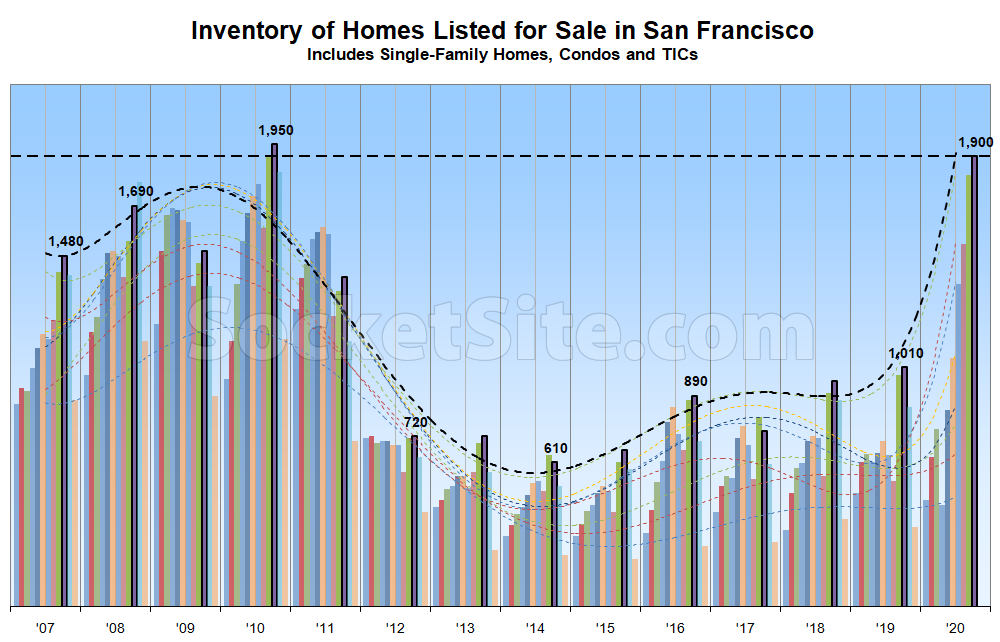
Having jumped over 20 percent in September, a move which shouldn’t have caught any plugged-in readers by surprise, the number of homes on the market in San Francisco, net of all sales, both pending and closed, has just ticked up to 1,900 for the first time in a decade and is within 5 percent of hitting a two-decade (plus) high.
In addition to running 90 percent higher on a year-over-year basis, versus nearly 20 percent lower nationwide, listed inventory levels in San Francisco are now over 200 percent higher than they were in October of 2015 and roughly 20 percent higher than during the Great Recession, with the number of condos on the market (1,460) now up 110 percent on a year-over-year basis and single-family home inventory (450) up a little over 40 percent, year-over-year.
At the same time, with 31 percent of the homes on the market in San Francisco having been reduced at least once, which is 14 percentage points higher than at the same time last year, the number of reduced listings has jumped 26 percent over the past month to a 10-year high in the absolute.
All that being said, while inventory levels will likely continue to tick up over the next couple of weeks, inventory levels typically peak in October. We’ll keep you posted and plugged-in.