Inventory Levels Drop in SF, Reductions Poised To Rise

5e71c SF Inventory Chart 11 09 20 Inventory Levels Drop in SF, Reductions Poised To Rise

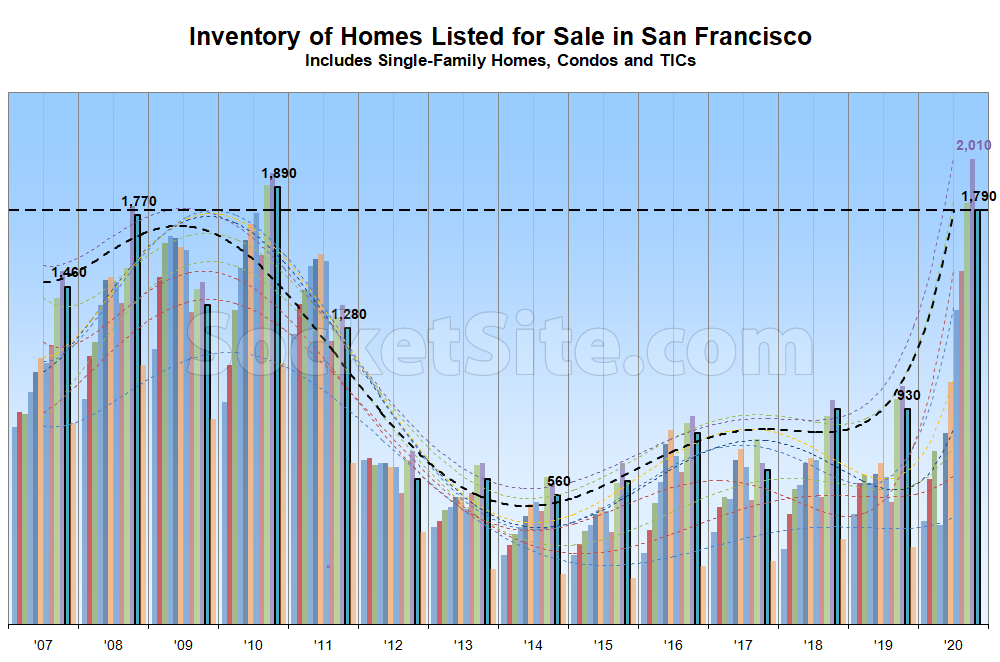
As was to be expected, the number of homes on the market in San Francisco, net of new sales and contract activity, both pending and closed, ticked down another 3 percent over the past week to 1,790, which is down 11.1 percent from a two-decade high in the absolute last month with typical seasonality in play but still over 90 percent higher than at the same time last year.

On a more granular level, the number of condos on the market, which remains a leading indicator for the market as a whole, now totals 1,380, representing 125 percent more inventory than at the same time last year, while the number of single-family homes on the market has dropped to 410 but remains 30 percent higher, year-over-year.

And having hit a 10-year high in the absolute last month, the percentage of homes on the market which have been reduced at least once, which now includes 31 percent of the single family homes, is holding at 35 percent, which remains the highest percentage of reduced listings since the first quarter of 2012 and 7 percentage points higher than at the same time last year.

Expect inventory levels to continue to drop over the next two months, and reductions to rise, before climbing again in January.

Article source: http://socketsite.com/archives/2020/11/number-of-homes-on-the-market-in-san-francisco-has-dropped.html

Posted in SF Bay Area News | Tagged | Leave a comment

Here’s how much it cost to buy a house in the Bay Area (before the outbreak)

Market watchers in the Bay Area are curious to see what the ongoing pandemic will do to home sales in the near future.

Even for those unable to buy or sell property, what happens to home value is a critical indicator of what’s happening to the rest of the economy. In March, Compass Real Estate updated its exhaustive map of sales activity across the Bay Area, crunching median sales prices for the previous 12 months.

What’s most interesting here is the timing: These numbers represent activity up through the second week of March—shortly before the Bay Area began sheltering in place. That means that when we compare the effects of the COVID-19 outbreak on the home market (whatever they may be), these numbers are what we’ll be comparing them to, a time capsule of Bay Area homes as they were just days before everything changed.

Here’s what the market looked liked shortly before shelter-in-place orders went into effect/.

  • In San Francisco, the 12-month average for a single-family house was $1.6 million. Breaking things down by neighborhood reveals a vast spectrum of prices, all the way up to $5.7 million for a house in Pac Heights on the high end, which was the second highest house price in the entire Bay Area. Note that the gap between Pac Heights and the rest of the city remains particularly dramatic; SF’s second priciest block was St. Francis Wood, where a home cost more than $3.2 million
  • SF’s cheapest place to buy was in Bayview, with a median price of $994,500 making it the only San Francisco neighborhood still averaging less than a $1 million for a house. Even in the Excelsior, the average cost of housing climbed to more than $1.16 million. A more detailed SF map that breaks Bayview down to smaller sub-neighborhoods finds houses cheapest in Bayview Heights ($945,000).
  • If anyone’s curious, the sole SF neighborhood with a median roughly the same as the city was Bernal Heights, with a $1.6 million average. The Outer Richmond was close to the middle mark with $1.58 million.
  • The most expensive place for homes in the Bay Area was Atherton, which, over the course of a year, averaged $6 million for a homes—no surprise, as this small, exclusive Peninsula city often gets singled out as the single most expensive place to buy nationwide.
  • The most affordable place to buy regionally was Vallejo at $427,000. In Contra Costa County, the most affordable redoubt was Pittsburg ($462,000). And in Alameda County, the subregion of southeast Oakland was cheapest at $496,000.
  • In the North Bay, southeast Santa Rosa was the cheapest spot at $620,000, while Belvedere proved priciest at $3.58 million.
  • San Jose’s average was $1.1 million, with the highest prices coming in the Almaden Valley neighborhood (more than $1.52 million), with Alum Rock the cheapest ($770,000).

The Compass figures were similar to the California Association of Realtors (CAR)’s figures from the same time, although CAR’s numbers are less comprehensive and represent monthly sales data instead of longer trends.

For example, the CAR average for SF houses sold in February was $1.61 million, nearly the same number as the Compass report and up $105,000 from the same time last year. With the exception of Contra Costa County, which dipped 2.2 percent from February 2019, every Bay Area County saw significant price appreciation year over year, up to 15.4 percent in Santa Clara County.

Almost all prices were up, just as has been the case consistently for years. But then, over the course of just a few weeks, almost everything about life in the Bay Area changed, and where we go from here remains to be seen.

Posted in SF Bay Area News | Tagged | Leave a comment

San Francisco turned ghost town? Here’s what’s happening with housing, real estate amid pandemic – KGO

SAN FRANCISCO (KGO) — Walking through San Francisco’s South of Market and Financial District feels like a ghost town.

90-percent of the city’s workforce is working from home and people are leaving the city.

The ABC7 I-Team is digging into how this is impacting real estate.

RELATED: COVID-19 creates housing crisis in San Francisco’s Tenderloin

Before the pandemic hit, San Francisco had the highest building occupancy rate in the country. Now, most of the city’s skyscrapers sit empty. How long will it stay that way? Is all this emptiness driving prices down everywhere?

“It went severely over asking… $400,000 over asking,” said Jason and Stephanie Hicks. “We were shocked.”

In the midst of the pandemic, the two newlyweds decided to leave SOMA for a better value in Alameda.

“We are both working from home now,” Hicks said. “We need more space.”

RELATED: Solution to affordable housing in San Francisco could be modular units, construction company says

The Hicks fell in love with a house in downtown Alameda and felt hopeful about the market.

“Ultimately, 85 folks were interested in the same property… We were shocked.”

In this case, it’s a seller’s market in Alameda.

Real estate agents Neil and Daryll Canlas of The Canlas Brothers explain it varies depending on where you look in San Francisco.

“Property values have taken a little bit of a hit, but there are pockets… certain areas that are stronger than others,” said Neil Canlas.

One pocket hit the hardest? South Beach.

RELATED: Building a Better Bay Area: The Housing Shift

According to an ABC7 data analysis of real estate data, there are 147 luxury condos on the market in South Beach.

“Comparing it to the last 5 years, it’s really unheard of… it’s so rare for any to come up,” Canlas said.

In just the last two days, 25 people posted on the Rincon Hill (South Beach) Nextdoor feed stating they are moving out of South Beach citing everything from, “work from home,” “high costs,” and “there’s nothing to do.”

“It’s all about supply and demand,” said Daryll Canlas.

There’s plenty of supply in Soma, South Beach, and Mission Bay. Of the more than 1,300 active listings in San Francisco, nearly one-third are in those areas.

With inventory high, prices are taking a slight dip.

RELATED: Planning groups get creative as demand for affordable Bay Area housing rises

Before COVID-19, the average listing price for a two-bedroom condo in South Beach was around $1.95 million. Now, the average price has dipped down $30,000 to $1.92 million. For one bedroom condos, the average price is down $15,000.

“We’ll continue to see a vacancy rate, because people don’t need to live in the city,” Canlas said.

No need to live or work in the city, especially as some companies are gone for good.

We know that from San Francisco’s building vacancy rate.

ABC7′s data analysis shows at the end of last year, vacancy rates were 5.4 percent.

Now, vacancy rates are nearly 10 percent.

To put those rates in perspective, San Francisco’s building vacancy is comparable to other major cities like Seattle and Boston.

75702 6341293 pic2web San Francisco turned ghost town? Heres whats happening with housing, real estate amid pandemic   KGO

KGO-TV

“It probably seems much worse than it really is,” said Robert Sammons, a senior researcher with commercial real estate group Cushman and Wakefield. “Most of these spaces have leases in place, long-term leases from very well-funded companies… that’s the good part.”

Sammons said most of the 7,500 companies leasing building space in the city and county have been able to keep their lease agreements during the pandemic. But, not all of them are as well-funded as others and these leases are six to seven-year commitments.

The question is – how much longer will those tenants last?

“That’s the tough question,” said Sammons. “Without a vaccine, without other things in place…we just don’t know.”

Assuming there’s progress with a COVID-19 vaccine, Sammons anticipates companies (big and small) could start allowing 25 percent of employees back in the office by the fall. But, it will be gradual and depend on guidance from the city.

If you have a question or comment about the coronavirus pandemic, submit yours via the form below or here.

Get the latest news, information and videos about the novel coronavirus pandemic here

RELATED STORIES VIDEOS:

Article source: https://abc7news.com/san-francisco-housing-market-coronavirus-california-real-estate-affordable/6341378/

Posted in SF Bay Area News | Tagged | Leave a comment

Thinking of moving? You’re not alone. | A New Shade of Green | Sherry Listgarten

This would be funny if it weren’t also true. Just today (1), I got:
- A warning about extreme heat (a “Heat advisory”)
- A notice about “public safety power shutoffs” in Santa Clara County
- A cancelled morning hike due to a “Red Flag warning” day (fire danger)
- An email about “The Great Shakeout” (practice for earthquakes)
- A nice beefy property tax bill

All that was missing was an alert that our home value is dropping due to rising Bay waters, or maybe that taxes are going up due to the need to prepare for droughts. (Oh wait, isn’t that part of Measure S?)


SF Chronicle’s map showing fire risk areas and power outages on Thursday, October 15

In our house, air filters and uninterruptible power supplies are plugged in, ready to be used. We’ve got poles out so we can easily close our skylights. We pulled down our shades first thing this morning to keep it cool inside. I gave some extra water to a few plants and set up a protective screen for another. I know how to do this now. The question is, do I want to?

I bet a lot of you have friends who took an extended break from this area recently due to smoke or COVID or some combination. Did that inspire thoughts of moving? There’s a lot of inertia to packing up. People often don’t move when economists believe they “should”. A reporter who has done years of research on climate migration, Abrahm Lustgarten, lives in a high-risk fire area in Marin County, an “imperiled tinderbox” as he puts it. He asked Jesse Keenan, an expert on the effects of climate change on real estate markets, if he should be selling his house, and got an immediate “Yes”. But when he discussed the situation with his wife: “The facts were clear and increasingly foreboding. Yet there were so many intangibles — a love of nature, the busy pace of life, the high cost of moving — that conspired to keep us from leaving.”

I’m sure many of us feel similar inertia. I wouldn’t go anywhere until my daughter’s done high school. But after that? Is it a good time to be ahead of the curve? I love cooler weather and the outdoors, so New England or the northwest (the part not on fire) seem appealing. I’m also Canadian, which opens up more possibilities assuming I could swallow the exit tax. I expect all those places dread an influx of California refugees. But could it happen?

Climate migration is not just theoretical; it’s happening today. Drought is impacting rural livelihoods in places as far-flung as Guatemala, where people are moving north, and the African Sahel (2), where people are moving to cities and the coast. Storms and floods are causing urban migrations in India and Bangladesh. Migrations are starting to happen in the States as well. We tend to ignore climate impacts here, assuming that technology will keep us comfortable and productive. But the costs of that can be prohibitive. People are beginning to abandon coastal areas in Louisiana, moving to drier land in the interior. Real-estate prices in high-risk areas of Florida are dropping. Flooding along the Missouri and the eastern seaboard has led to contentious discussions about managed retreat. Lustgarten suggests that people move when they are forced to, for example when insurance coverage disappears, when decreased property tax reduces local services, when subsidies and loans dry up. He quotes Keenan as saying “Once this flips, it’s likely to flip very quickly.”

By some measures, it’s pretty good where we live. ProPublica shares some county-by-county data predicting the impacts of climate change in the next 20-40 years assuming the (highly unlikely) worst-case IPCC scenario. San Francisco and Santa Cruz counties are among the least impacted in California. San Mateo County is impacted by sea level rise, and Santa Clara County by fire. But places like Fresno County fare much worse, with impacts from heat, fires, and low-yield agriculture. Southern states including Florida and Texas are even worse off. Lustgarten writes “One influential 2018 study, published in The Journal of the Association of Environmental and Resource Economists, suggests that one in 12 Americans in the Southern half of the country will move toward California, the Mountain West or the Northwest over the next 45 years because of climate influences alone.”

There’s no doubt that as people leave the Bay Area, others will move in. This region is, and will remain, more livable than many others. But the ProPublica data does not reflect air quality, or power shut-offs, or closed recreational areas, or cancelled outdoor activities, or the many other responses to changing climate that etch away at quality of life. By those measures, it’s for each of us to determine whether we stay or go. Has anyone been thinking about this?

Notes and References
0. Just in time for the holidays, Acterra is hosting an event with six local Bay Area chefs explaining how to prepare their favorite plant-based holiday dishes. In addition to live cooking demonstrations, the hosts will discuss practical tips and tricks on how to embrace a more plant-forward diet, reduce food waste, and work with an induction stove. See here for more information and to register.

1. I started writing this post a few days ago.

2. The African Sahel is the band of Africa just below the Sahara, going from Mauritania across Niger to Sudan.

3. Two good places to read about climate migration are ProPublica’s coverage and Quartz’s coverage. They talk not only about the impact on people who are forced to migrate but also about the impact on cities and people in areas less affected by climate, and how they can adapt to better handle an influx of climate migrants. Rolling Stone has a great article cautioning that a tendency to overstate the migration problem is feeding nationalism, pointing out (with many examples) that most migration happens within a country. And the Brookings Institution has a policy brief that highlights the lack of concerted effort, particularly by the US, on this issue.

Current Climate Data (September 2020)
Global impacts, US impacts, CO2 metric, Climate dashboard (updated annually)

August 2020 and September 2020 were the hottest on record in California. October is on the same track. It’s 95 in mid-October as I write this.

The Earth didn’t fare much better, with the warmest September temperatures since record-keeping started in 1880.

Comment Guidelines
I hope that your contributions will be an important part of this blog. To keep the discussion productive, please adhere to these guidelines or your comment may be moderated:
- Avoid disrespectful, disparaging, snide, angry, or ad hominem comments.
- Stay fact-based and refer to reputable sources.
- Stay on topic.
- In general, maintain this as a welcoming space for all readers.

Article source: https://www.paloaltoonline.com/blogs/p/2020/10/18/thinking-of-moving-youre-not-alone

Posted in SF Bay Area News | Tagged | Leave a comment

Yes, people are leaving San Francisco. After decades of growth, is the city on the decline?

Plunging BART and Muni ridership. The weakest online sales tax collections in the state. A 20% drop in apartment rents. Spiking office vacancies.

San Francisco’s bleak economic vital signs over the past six months strongly suggest residents are leaving amid record job losses, the entrenchment of remote work, and a coronavirus pandemic that shows no signs of ending.

It’s still unclear how many people have left, but moving vans and Medium posts tell the story of an ongoing migration. Weakness in the rental market and virtually flat online spending during shelter-in-place show that residents aren’t just staying home, they’re leaving, experts say. The city’s ability to attract new residents or lure old ones to return will be critical to avoid punching a giant hole in a local budget that has swelled to almost $14 billion.

In an increasingly virtual economy where daily goods are delivered not for convenience but out of pandemic-driven necessity, all you have to do is count the Amazon boxes.

 Yes, people are leaving San Francisco. After decades of growth, is the city on the decline?

Between April and June, the nine counties across the Bay Area saw big drops in brick-and-mortar sales taxes as orders to stay home took effect, ranging from a 17% drop in Santa Clara County to a 53% drop in San Francisco, compared to the prior year. But eight of the counties — everywhere but San Francisco — saw major jumps in online sales taxes, as high as 36% for Contra Costa County.

San Francisco saw only a 1% increase in the tax collected on online sales. That figure was by far the worst not only in the region, but among California’s 20 largest counties. Los Angeles County saw a 31% increase in online sales taxes, San Diego County saw a 38% jump and Sacramento County saw a 32% spike.

“That’s a sign to me that people aren’t here,” said Ted Egan, San Francisco’s chief economist.

The empty streets are reminiscent of the aftermath of the dot-com bust of the early 2000s, said Noni Richen, president of the Small Property Owners of San Francisco, an advocacy group.

Her members have former tenants who have left the city because, after losing their jobs or having classes shifted to online, they saw no reason to stay.

“There is a decline in occupancy,” Richen said. “They’re moving home to mom and dad or somewhere cheaper.”

Real estate data firm Zumper reported a 20% annual decline in San Francisco’s median one-bedroom rents this month, the largest drop among major cities. Inventory of for-sale homes and condos reached a 15-year high amid a flood of new listings, though prices for single-family homes are still rising, according to brokerage Compass.

 Yes, people are leaving San Francisco. After decades of growth, is the city on the decline?

One difference compared to the dot-com days is that tech titans like Google and Facebook, which have major offices in both San Francisco and Silicon Valley, have not cut jobs. Richen said she was encouraged that the companies have not scaled back, though they are allowing workers to stay remote until next summer.

“I think San Francisco will recover,” Richen said. “I think they will bounce back.”

Between February and August, the labor force in the San Francisco-Redwood City-South San Francisco metro area was down 4.5%, higher than the 4.1% drop for the state and 2.3% drop nationally. It’s consistent with evidence that urban areas have been hit harder than the rest of the country and could reflect people moving out of San Francisco, according to the Federal Reserve Bank of San Francisco.

Chris Thornberg, founding partner of research firm Beacon Economics, said talk of San Francisco’s doom and decline is overblown.

“As soon as the virus is under control, the economy is going to bounce back like nobody’s business,” he said, predicting a recovery in San Francisco by next spring. “I don’t think you need a vaccine.”

He said that excessive restrictions on business reopenings were unnecessary and ineffective. “I don’t think there’s any way to stamp this disease out by shutting down the economy,” he said.

But San Francisco officials remain cautious. There is still no timetable for when nonessential office workers can return. More tech companies — who now dominate the ranks of San Francisco’s largest private employers — are embracing remote work, for longer time periods or in some cases indefinitely.

“That opens up a huge question: When are they going to come back? Are they going to come back?” Egan said.

Telltale taxes

Online sales tax collections in the Bay Area and other major California counties showed big increases during the pandemic — except in San Francisco, where they were virtually flat.

Source: San Francisco Office of the Controller

Roland Li is a San Francisco Chronicle staff writer. Email: roland.li@.com Twitter: @rolandlisf

Article source: https://www.sfchronicle.com/business/article/Yes-people-are-leaving-San-Francisco-After-15635160.php

Posted in SF Bay Area News | Tagged | Leave a comment