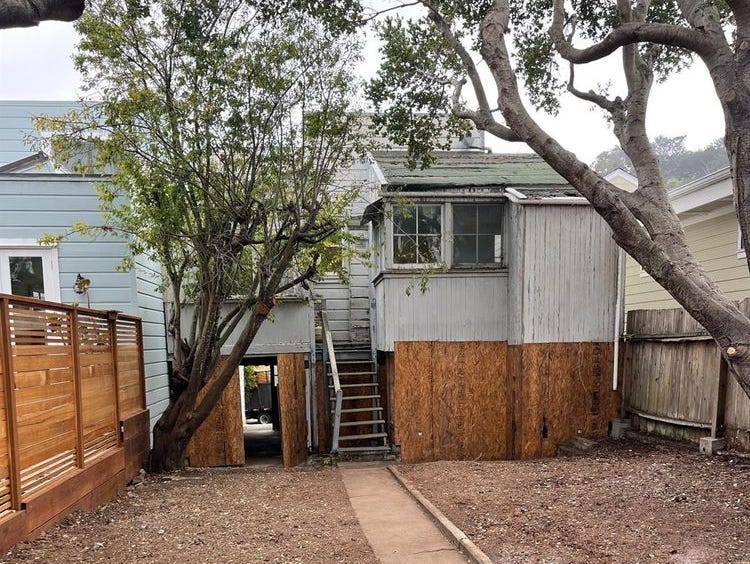
The “worst house on the best block” in San Francisco sold last week for $1.97 million.
The home built in 1900 on 320 Day St. has no bedrooms and just one bathroom.
Because of its condition, the property will likely be overhauled.
In a deal that one Instagram user called “peak San Francisco,” a 120-year-old home sold last week for just shy of $2 million.
The property is notable not so much for what it has but for what it doesn’t: a bedroom.
According to its listing, the boarded-up “contractors special” at 320 Day St. has zero bedrooms, one bathroom, and a kitchen that appears to date to World War II.
Compass
It is “the worst house on the best block making it a fantastic opportunity,” the Compass real-estate agents Todd and Kim Wiley wrote, adding that the “extreme deferred state” meant the buyer needed to make an all-cash offer.
Todd Wiley told Insider the conservatorship sale, which is a process that involves the California probate court, helped push the price to more than double what they had proposed at the outset.
“We thought the property would sell at $1.6 million — we had data for that,” Wiley said. “But then the human spirit of competition took over.”
In short, Wiley said the conservatorship-sale process subjected the property to a live-auction environment not once but twice, which led to the “head-scratcher” closing price of $1.97 million.
The house is in the Noe Valley neighborhood, which is peppered with multimillion-dollar homes. Single-family homes there sell for a median price of about $2.7 million, according to Redfin.
Nearby, renovated single-family homes with similar space often sell for more than $4 million and can fetch over $6 million, The Real Deal reported, but Wiley said the more appropriate comparisons were the updated homes that sell for $2.8 million and fixer-uppers going for $1.4 million to $1.6 million.
Compass
The property’s other key selling point is its lot size of 2,800 square feet, which is spacious in San Francisco terms. The lot is also zoned for up to two residences.
The “worst house on the best block” in San Francisco sold last week for $1.97 million.
The home built in 1900 on 320 Day St. has no bedrooms and just one bathroom.
Because of its condition, the property will likely be overhauled.
In a deal that one Instagram user called “peak San Francisco,” a 120-year-old home sold last week for just shy of $2 million.
The property is notable not so much for what it has but for what it doesn’t: a bedroom.
According to its listing, the boarded-up “contractors special” at 320 Day St. has zero bedrooms, one bathroom, and a kitchen that appears to date to World War II.
Compass
It is “the worst house on the best block making it a fantastic opportunity,” the Compass real-estate agents Todd and Kim Wiley wrote, adding that the “extreme deferred state” meant the buyer needed to make an all-cash offer.
Todd Wiley told Insider the conservatorship sale, which is a process that involves the California probate court, helped push the price to more than double what they had proposed at the outset.
“We thought the property would sell at $1.6 million — we had data for that,” Wiley said. “But then the human spirit of competition took over.”
In short, Wiley said the conservatorship-sale process subjected the property to a live-auction environment not once but twice, which led to the “head-scratcher” closing price of $1.97 million.
The house is in the Noe Valley neighborhood, which is peppered with multimillion-dollar homes. Single-family homes there sell for a median price of about $2.7 million, according to Redfin.
Nearby, renovated single-family homes with similar space often sell for more than $4 million and can fetch over $6 million, The Real Deal reported, but Wiley said the more appropriate comparisons were the updated homes that sell for $2.8 million and fixer-uppers going for $1.4 million to $1.6 million.
Compass
The property’s other key selling point is its lot size of 2,800 square feet, which is spacious in San Francisco terms. The lot is also zoned for up to two residences.
But while officials are trying to address the region’s housing and homelessness crisis by pushing density and all kinds of housing, the city has struggled to get homes built. Its challenges underscore what cities throughout the region face in generating housing even when they have the political will.
Berkeley’s mayor is an example of the shift among city leaders. Mayor Jesse Arreguín said his “perspective has evolved over the years from being skeptical of supporting market-rate development to now embracing housing for all income levels because I recognize that we have a shortage of housing for everyone.”
David Garcia, a policy director at UC Berkeley’s Terner Center for Housing Innovation, said the city has gone through a “dramatic” shift in a relatively short time from having a “skeptical viewpoint of pro-housing policies to embracing” more progressive zoning and land use changes.
“That shift in attitude is necessary before you would see a significant change in production,” Garcia said.
Berkeley Mayor Jesse Arreguín stands outside of the newly-developed affordable housing project Berkeley Way in Berkeley, Calif. Friday, Jan. 28, 2022. Berkeley Way is the city’s largest affordable housing project that is expected to open later this year.
Jessica Christian/The Chronicle
Council Member Lori Droste, who authored the resolution to eventually end single-family zoning, said since her election in 2014, more council members are pushing for pro-housing policies.
Still, it’s difficult to tell how much progress has been made. There are two main measures of the city’s progress: how many units have been approved and how many have been built.
From 2015 to 2020, Berkeley issued permits for 2,943 units, city staff said. Data from 2021 was not yet available, said Jordan Klein, the director of the city’s planning department. Klein said when permits from last year, this year and next year are factored in, Berkeley will “far exceed” the state mandated goal for total units permitted for 2015-2023.
But while Berkeley might be permitting more units, those units don’t do any good if they don’t get built. Experts say skyrocketing construction costs and slow approvals are big reasons housing doesn’t get built — which Arreguín said he wants to find solutions for.
Officials said data on how many homes have been built in the city since 2015 was not readily available. There was data on a limited area. Two areas where the city allowed more density over the last decade —downtown and San Pablo Avenue — saw more new housing. From 2018 to 2020, 242 housing units on San Pablo Avenue and 316 units in the downtown area were completed, said Jordan Klein, the director of the city’s planning department. While that’s almost as much as was built from 1970 to 2000 in the entire city, the city needs to be producing an average of a thousand of units a year to meet their state goals.
Berkeley City Councilmember Terry Taplin walks past a row of single-level homes against a newly-constructed apartment complex duirng a walking tour with Berkeley Planning and Development Director Jordan Klein to discuss Berkeley’s next housing element and how to plan zoning for 9,000 new units while walking through a neighborhood in West Berkeley, Calif. Monday, Jan. 31, 2022. Berkeley has evolved its stance on housing over the years as new leaders like Taplin get elected and push for more pro-housing policies that ensure Black and POC families can afford to stay in the city they grew up in.
Jessica Christian / The Chronicle
To meet state mandates, Berkeley needs to plan for nearly 9,000 more units over the next decade, which Garcia said would be tough to pull off. City staff is exploring allowing multi-unit buildings in certain areas, building middle-income housing and prioritizing transit corridors for new homes.
To that end, Berkeley officials are now working on two potentially large projects at the Ashby and North Berkeley BART stations that could generate 1,200 new units at each station — with the council’s backing. That’s a shift. In 2018, the council voted to oppose a state law, AB2923, to make it easier to build housing at BART stations.
The council is also considering a $500 million bond to put on the November ballot to fund affordable housing and infrastructure.
In addition, a Georgia-based developer has proposed a 25-story project downtown with 326 units and 33 affordable units that would be the tallest building in Berkeley. Jason Overman, a spokesman for the project who has previously worked on housing in Berkeley, said the city has “impressed a lot of people” with its shift in attitude to be more welcoming to housing.
The problem is that the deficit of housing is decades in the making and it will take many years to undo. In 1973, Berkeley voters passed the Neighborhood Preservation Ordinance, which established restrictions on new housing. The policy stalled massive housing development for years, said Councilmember Ben Bartlett. From about 1970 to 2000, only about 600 new housing units were built in the city, Bartlett said.
The city’s housing crisis has also been exacerbated by the university as enrollment numbers have increased and the university’s housing production hasn’t kept up. UC Berkeley houses just 23% of its students, the lowest of all UC campuses. In September, UC Berkeley approved a controversial $312 million plan to build housing on the historic People’s Park. This week, UC Berkeley asked the state Supreme Court to block a judge’s order that resulted in a win for neighborhood groups. The order required the university to cap enrollment and stop a $126 million project to build classrooms and housing for professors.
But rent-burdened residents are still struggling. More than half of renters are paying more than 30% of their income on rent. In the city of 124,000 people, more than 57% of residents are renters, city staff said.
Darrell Owens, an activist with East Bay for Everyone, a pro-housing nonprofit organization, said while “Berkeley’s attitudes have changed pretty drastically in the last five years,” it’s not clear if the shift will result in more housing.
And despite its advances, neighborhood opposition can still sway policy. For example, the City Council voted on Jan. 26 to limit construction of the accessory dwelling unit in the Berkeley hills, citing fire danger. ADUs are small dwellings located on the same lot as an existing home.
Council Member Rashi Kesarwani, who was elected in 2018, said she is focusing this year on plans to build at the North Berkeley BART Station. Kesarwani said some residents support the project, but others have expressed concern because they worry it will be too dense.
In the past, some council members would cave to neighborhood pressure, but Kesarwani said while she’s willing to listen to neighbor’s concerns and discuss alternatives, she’s not going to say “that we are not going to have housing at this site or that it’s going to be so limited (that it) wastes the opportunity there.”
The council is also focused on affordable housing. It voted in December to allocate $67.5 million from a 2018 voter-approved bond toward 406 new affordable and permanent supportive housing units, as well as the renovation of 66 affordable units.
Dan Sawislak, the executive director of Resources for Community Development, an affordable housing nonprofit, received some funds to help finance a 119-unit supportive housing project at People’s Park. Sawislak said that voters’ concerns around homelessness and affordability have escalated in the past decade, prompting them to approve affordable housing funding measures.
Newly elected Council Member Terry Taplin said housing is a big reason why he decided to run for council. Taplin, elected in 2021, introduced legislation to speed up permits for affordable housing projects. And his staff is studying a social housing program.
“Change is really hard, especially in Berkeley where we have people who are very comfortable and very familiar with how to game the process to keep housing out of their neighborhoods,” Taplin said. “We have to be on the lookout for that.”
Sarah Ravani is a San Francisco Chronicle staff writer. Email: sravani@sfchronicle.com Twitter: @SarRavani
The property, seen from above, is clearly an impressive estate.
Paul Rollins, Listing photos: Paul Rollins; luxury report: Compass
This is a true “estate,” a study in over-the-top opulence. The main residence offers five beds and eight bathrooms; there is also a detached fitness center, hair salon and massage room; a separate executive office and conference center; and a two bedroom-suite guest house with a full kitchen.
The inside is palatial, blending high-end interiors with full access to the exterior property through walls of glass.
Paul Rollins, Listing photos: Paul Rollins; luxury report: Compass
The bathrooms (a total of 12 on the estate) are spa-like, and feature amenities like this deep soaking tub.
Paul Rollins, Listing photos: Paul Rollins; luxury report: Compass
In the main home, the kitchen and dining area rest under soaring paneled ceilings. Floors are made of French white oak and limestone.
Paul Rollins, Listing photos: Paul Rollins; luxury report: Compass
Aside from the abundant living and working spaces, the property offers a plethora of entertaining features as well: a 6,000 bottle “wine salon,” a movie theater, a golf simulator lounge as well as outdoor luxe in the 65-foot pool and spa, dining pavilion with outdoor kitchen and fire pit.
The pool and spa glimmer in the tremendous backyard and patio area.
Paul Rollins, Listing photos: Paul Rollins; luxury report: Compass
An outdoor kitchen is fit for tech royalty.
Paul Rollins, Listing photos: Paul Rollins; luxury report: Compass
Want to work on your golf game? You can do that right here.
Paul Rollins, Listing photos: Paul Rollins; luxury report: Compass
Local real estate market followers are well aware of the increase in demand for luxury property: in fact, SFGATE dubbed 2021 the year of the luxury home, noting the striking uptick in prices as well as the number of high-end homes sold in the San Francisco Bay Area.
A 2021 report released by Compass confirms this. The Ultra-Luxury Real Estate Report compared sales activity of homes priced at $10M and above from 2020 and 2021 in 30 markets across the country including Tahoe and the San Francisco Bay Area. The data compiled points to shocking year-over-year gains in this already shockingly high-end of the market.
These numbers exemplify how hot the luxury market has really become.
Paul Rollins, Listing photos: Paul Rollins; luxury report: Compass
Whoever buys this “Jewel of the Silicon Valley” will be purchasing the priciest local residential property of 2022 — so far.
Anna Marie Erwert writes from both the renter and new buyer perspective, having (finally) achieved both statuses. She focuses on national real estate trends, specializing in the San Francisco Bay Area and Pacific Northwest. Follow Anna on Twitter: @AnnaMarieErwert.
The firm bought the property in three separate transactions totaling $328 million, the Mercury News reported. $105.25 million went toward the site of the JCPenney store in September 2021, while another $128 million secured anchor tenant Sears. The remaining $95.2 million covered the cost of the rest of the retail and restaurant complex in a final purchase that took place this week.
“The retail apocalypse,” exacerbated by the pandemic and a major shift to online shopping, had long negatively impacted shopping centers like Tanforan, Jovan Grogan, San Bruno’s city manager, said in a statement.
“Then the impact of shelter-at-home and other public health restrictions since March 2020 led to the closure of many of Tanforan’s stores,” including Sears, Grogan added.
In response, the San Bruno City Council adopted a Reimagining Tanforan Land Use Fact Sheet in July 2021 to encourage investors to assess the shopping center’s potential for mixed-use development.
It’s a historical site that traces back to the Tanforan racetrack made famous by Seabiscuit. The track was also sometimes utilized as an airfield and was home to the first successful shipboard aircraft landing, a feat accomplished by aviator Eugene Ely. “It’s A Wonderful Life” director Frank Capra filmed scenes for two of his movies there, “Broadway Bill” and “Riding High.” Later, the area was used as a temporary detention center for Japanese Americans before they were sent to prison camps during World War II, as a plaque in a garden outside of the mall notes. It will be replaced with a new memorial later this spring.
It’s not immediately clear when the mall will close its doors, but Grogan is optimistic about the change and said it “sets the stage for the City of San Bruno to initiate a public master planning process that will crystalize the vision for this important piece of land in the heart of San Bruno and the thriving Peninsula economic corridor.”
The Bay City News Service contributed to this report.