Wooden Shack in San Francisco Sells for $408000

It appears the old adage holds true: when it comes to real estate, it’s all about location, location, location.

The wooden shack that was on sale for $350,000 in San Francisco’s trendy Outer Mission neighborhood is officially off the market. The deal for the 765-square-foot residence closed on Thursday, with a pair of investors nabbing the property for a cool $408,000, according to Vanguard realtors.

“There was a fight for it,” realtor Brian Tran said. “But they made us an offer we couldn’t refuse.”

The 16 De Long St. property was on the market for 10 days and received six offers from potential buyers, according to realtor Alex Han. He added that the other offers also came from investors, most of whom wanted to rehab the two-bedroom property and then put it back on the market as a rental.

Top News Photos of the Week

8ecd6 topNews AP 948340523521 Wooden Shack in San Francisco Sells for $408000

There was one man who wanted to purchase the home to live in it, but he lost the bidding war, Han said.

The dilapidated shack was built as relief housing in 1906 after a devastating 7.8 earthquake ripped through San Francisco and destroyed more than 80 percent of the city. As such, the fixer upper is considered a historical property and cannot be torn down or undergo significant changes.

“[The new owners] are very limited to what they can do,” Han said. “But they are going to fix the foundation, the roof, plumbing…it needs a complete overhaul.”

He added that he has never seen a house in the city go for such a low price.

San Francisco is widely reported to be one of the most expensive places to live in the country. Aside from having to cope with high-priced real estate, city dwellers also pay more than the national average for movie tickets, steak, beer, gas, gym memberships, and even dogs, the San Francisco business Times reported.

8ecd6 connect nbcbayarea main Wooden Shack in San Francisco Sells for $4080008ecd6 bay connect twitter Wooden Shack in San Francisco Sells for $4080008ecd6 bay connect facebook Wooden Shack in San Francisco Sells for $4080008ecd6 bay connect googleplus Wooden Shack in San Francisco Sells for $4080008ecd6 bay connect instagram Wooden Shack in San Francisco Sells for $4080008ecd6 bay connect tumblr Wooden Shack in San Francisco Sells for $4080008ecd6 bay connect pinterest Wooden Shack in San Francisco Sells for $4080008ecd6 bay connect rss Wooden Shack in San Francisco Sells for $4080008ecd6 bay connect newsletters Wooden Shack in San Francisco Sells for $4080008ecd6 bay connect apps Wooden Shack in San Francisco Sells for $4080008ecd6 bay connect celljournalist Wooden Shack in San Francisco Sells for $408000


Article source: http://www.nbcbayarea.com/news/local/Wooden-Shack-in-San-Francisco-Sells-For-408000-336400291.html

Posted in SF Bay Area News | Tagged | Leave a comment

Despite rent control, S.F. apartment buildings prove solid investments

“);
$(“.gallery_outer_overlay_dynamic”).css(“position”,”absolute”);
$(“.gallery_outer_overlay_dynamic”).css(“z-index”,”500″);
$(“.gallery_outer_overlay_dynamic”).css(“top”,”0″);
$(“.gallery_outer_overlay_dynamic”).css(“left”,”0″);
$(“.gallery_outer_overlay_dynamic”).css(“height”,”"+$(document).height()+”px”);
$(“.gallery_outer_overlay_dynamic”).css(“width”,”"+$(document).width()+”px”);
$(“.gallery_outer_overlay_dynamic”).css(“backgroundColor”,”rgba(0,0,0,1)”);
$(“.gallery_outer_overlay_dynamic”).css(“overflow”,”hidden”);
OUTER_OVERLAY_ON = true;
}

  • fb8ee a Despite rent control, S.F. apartment buildings prove solid investments


Courtesy: Paragon Real Estate Group

Image 1 of 15 – Apartment buildings:solid gold investing

Courtesy: Paragon Real Estate Group

Courtesy: Paragon Real Estate Group

Courtesy: Paragon Real Estate Group

Image 2 of 15 – Apartment buildings:solid gold investing

Courtesy: Paragon Real Estate Group

Courtesy: Paragon Real Estate Group

Courtesy: Paragon Real Estate Group

Image 3 of 15 – Apartment buildings:solid gold investing

Courtesy: Paragon Real Estate Group

Courtesy: Paragon Real Estate Group

Courtesy: Paragon Real Estate Group

Image 4 of 15 – Apartment buildings:solid gold investing

Courtesy: Paragon Real Estate Group

Courtesy: Paragon Real Estate Group

Courtesy: Paragon Real Estate Group

Image 5 of 15 – Apartment buildings:solid gold investing

Courtesy: Paragon Real Estate Group

Courtesy: Paragon Real Estate Group

Courtesy: Paragon Real Estate Group

Image 6 of 15 – Apartment buildings:solid gold investing

Courtesy: Paragon Real Estate Group

Courtesy: Paragon Real Estate Group

Courtesy: Paragon Real Estate Group

Image 7 of 15 – Apartment buildings:solid gold investing

Courtesy: Paragon Real Estate Group

Courtesy: Paragon Real Estate Group

Courtesy: Paragon Real Estate Group

Image 8 of 15 – Apartment buildings:solid gold investing

Courtesy: Paragon Real Estate Group

Courtesy: Paragon Real Estate Group

Courtesy: Paragon Real Estate Group

Image 9 of 15 – Apartment buildings:solid gold investing

Courtesy: Paragon Real Estate Group

Courtesy: Paragon Real Estate Group

Courtesy: Paragon Real Estate Group

Image 10 of 15 – Apartment buildings:solid gold investing

Courtesy: Paragon Real Estate Group

Courtesy: Paragon Real Estate Group

Courtesy: Paragon Real Estate Group

Image 11 of 15 – Apartment buildings:solid gold investing

Courtesy: Paragon Real Estate Group

Courtesy: Paragon Real Estate Group

Courtesy: Paragon Real Estate Group

Image 12 of 15 – Apartment buildings:solid gold investing

Courtesy: Paragon Real Estate Group

Courtesy: Paragon Real Estate Group

Courtesy: Paragon Real Estate Group

Image 13 of 15 – Apartment buildings:solid gold investing

Courtesy: Paragon Real Estate Group

Courtesy: Paragon Real Estate Group

Courtesy: Paragon Real Estate Group

Image 14 of 15 – Apartment buildings:solid gold investing

Courtesy: Paragon Real Estate Group

Courtesy: Paragon Real Estate Group

Courtesy: Paragon Real Estate Group

Image 15 of 15 – Apartment buildings:solid gold investing

Courtesy: Paragon Real Estate Group

Courtesy: Paragon Real Estate Group

One of the most important factors that always has driven San Francisco rents higher than other American cities is scarce inventory.

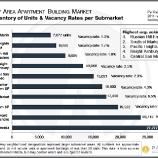
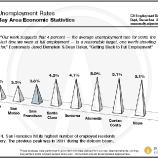
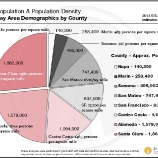
“San Francisco is very much a boutique market of smaller buildings,” says Paragon Real Estate Group in its third quarter S.F. Bay Area Apartment Market Report. And indeed, the vast majority of multi-units sold this year are 5-12 units. Such low volume doesn’t exactly flood the area with available units. Prices, then, stay high, and indeed get much higher as demand grows. As seen in the gallery above, the Bay Area is a heavily populated area, and growing more so, as the income and employment rates also grow.

Another factor influencing rents is rent control. Though readers will differ (vociferously) on whether said control helps or hurts tenants in the rental marketplace, the fact remains that these ordinances must have some pressure on overall rents, simply for the fact that so many of San Francisco’s apartment buildings are subject to them.

“Our residential investment stock is much older than most cities,” says Paragon. “Eighty-two percent of the city’s multi-units were built prior to 1935 — and over 50% are of pre-1920 vintage.” By this third quarter of 2015, “18% of  apartment building sales were of buildings constructed between 1950 and 1978 and none thereafter. All are subject to the S.F. Rent Control Ordinance, which covers building constructed prior to 1979.”

Building values appreciating along with appreciating rent

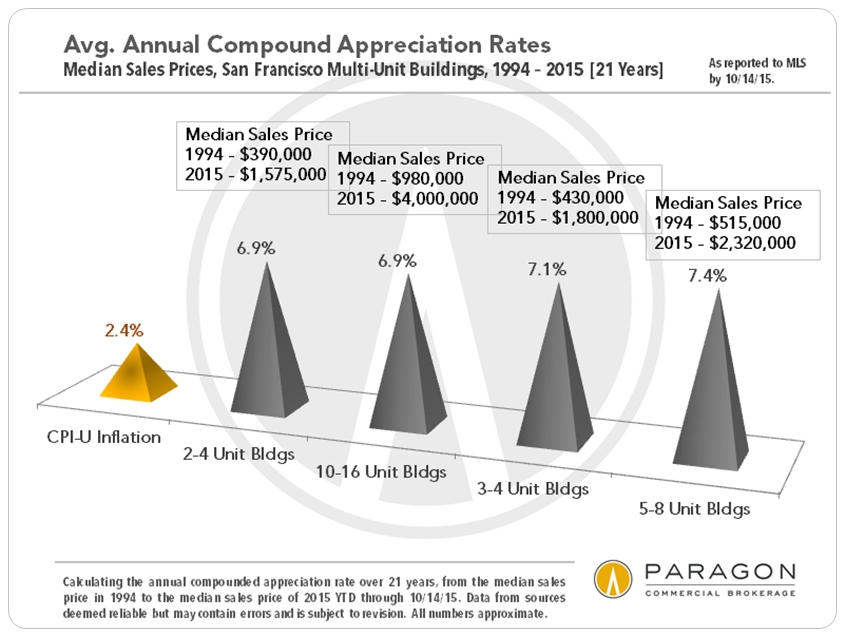
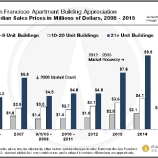
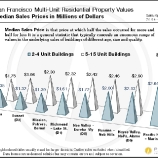
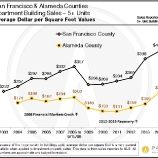
Multi-units, for those who buy and sell them in San Francisco, have proven themselves to be excellent investments, as evidenced in the gallery above. Sellers of such properties enjoy now-record appreciation; but also, owners, too, are enjoying record returns. Paragon’s data shows the values of San Francisco apartment buildings appreciating far beyond the annual compound appreciation inflation rate over the past 21 years. “Adding the huge appreciation in rents, the various tax advantages of rental property ownership and the recent availability of extremely low-interest-rate financing, have made such properties very good investments indeed.”

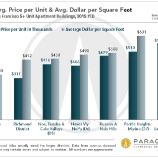
Unsurprisingly, the value of such buildings per square-foot has shot up, almost doubling since 2003 in San Francisco County and rising from $174 to $227 in Alameda County in the same period.

Rents: way, way up

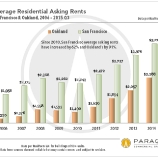
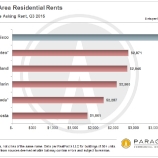
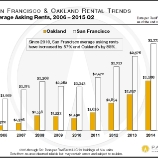
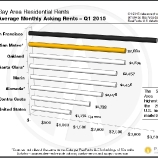
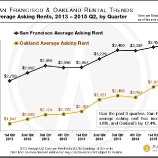
Apartment buildings can appreciate in value primarily because rent has shot through the roof. We’re all aware of recent increases pushing the Bay Area rental market into the stratosphere (and San Francisco into first place as the most expensive city in the U.S.), but Paragon’s figures are still startling. Since 2010, San Francisco rents have increased 61%. And Oakland? You might want to sit down for this: up 91%.

What’s to come?

New laws in San Francisco on eviction and the Ellis Act relocation procedures recently passed and will impact the local market. Twitter’s recent lay-offs also may be a sign of shift. We’ll revisit this topic more in future blogs. In the meantime, though, it’s been quite a banner year for landlords in the Bay Area, especially in San Francisco.

Anna Marie Erwert writes from both the renter and new buyer perspective, having (finally) achieved both statuses. She focuses on national real estate trends, specializing in the San Francisco Bay Area and Pacific Northwest. Follow Anna on Twitter: @AnnaMarieErwert

Article source: http://blog.sfgate.com/ontheblock/2015/10/22/despite-rent-control-s-f-apartment-buildings-prove-solid-gold-investments/


Posted in SF Bay Area News | Tagged | Leave a comment

‘Million Dollar Shack’ documentary looks at Bay Area’s insane housing market

  • e31fa 920x920 Million Dollar Shack documentary looks at Bay Areas insane housing market

Caption

Close


‘Million Dollar Shack’ filmmaker Michelle Joyce says: ‘We’re in the middle of a tech bubble and we’re in the middle
of a housing bubble. Both of these things have happened in the past and right
now they’re happening together and what comes next scares me and I don’t think
it’s going to be good for anybody.’


You’ve already heard the stories told in the new documentary Million Dollar Shack.

Rentals are scarce; home prices are staggering. The wealthy elite are scooping up Silicon Valley properties. These investment homes are sitting empty or rented by people who spend more time on the road than at home, turning neighborhoods into ghost towns. Members of the middle class are leaving the Bay Area in droves, searching for a more realistic reality, a place where they can actually afford a home.

Over the past decade, the media has jumped on these stories helter-skelter. This self-funded, homespun documentary on YouTube packs the insanity into 22 minutes and tells the harrowing tale through the eyes of the filmmakers, Michelle Joyce and Steve Fyffe, a married couple with two kids, who’ve been trying to buy a house in the Bay Area for five years.

Michelle said she and her hussband, who worked as journalist before becoming a communications manager at Stanford University, decided to make the movie because, “The crazy housing situation in the Bay Area is all we talked about and all anyone we know talked about.”

“We didn’t have to go far to find examples of everything we show in the video,” Michelle said. “Many of the people we interview in the video are personal friends. We hoped we could get a more honest conversation started about it.

“We notice stories in the media about ghost houses, rental prices and commuting, but we hadn’t seen a story that put it all together. I don’t think people realize all the pieces of this puzzle.”

***

With the tech economy booming, home and rental prices in the Bay Area have soared in recent years, creating the country’s hottest and most expensive housing market. In San Jose, for example, rents have gone up 26 percent in the past year, the highest increase in the U.S., according to Zumper.

This is all bad news for middle-class families. A household earning the region’s median income — $86,944 annually — can afford only 12 percent of the homes for sale in San Francisco, Marin and San Mateo counties, as of Sept. 2015, according to real estate website Trulia

Million Dollar Shack aims to share the plight of the Bay Area’s middle class who are slowly being squeezed out by the high-priced cost of living. “The bigger the tech industry gets, the less room there is for families like us,” Michelle says at start of the film.

The message is communicated through a collection of personal anecdotes from Bay Area locals. There’s the story of Deb Follingstad whose San Francisco landlord raised the rent on her home in San Francisco’s Bernal Heights over 300 percent. And there’s the tale of Maryann Creasy Rieger who was forced to commute some 180 miles a day between her home in Fairfield and her job at Yahoo on the Peninsula when CEO Marissa Mayer put an end to telecommuting. Maryann couldn’t afford to move closer to her job. 

A realtor featured in the film named Ken DeLeon doesn’t offer much hope. “As crazy as these prices might seem, I think you’re going to see them double in the next six to 10 years. The amazing part — I don’t think, it’s going to end. I think the fundamental lack of supply and strong demand are going to drive this market forever.”

***

Michelle grew up in Saratoga, an idyllic town with elegant homes and a charming shopping strip tucked against the Santa Cruz Mountains. After the birth of her first child five years ago, she and her husband assumed they’d buy a home in the Bay Area close to her parents and siblings and her husband’s Palo Alto office. When they started looking, they quickly realized that with Michelle’s part-time income, Steve’s full-time salary and small savings, they could only afford a home under a half-million dollars in the Santa Cruz Mountains. The couple went into escrow on a Ben Lomond property, but backed out realizing they preferred to continue saving money to buy a home closer to Steve’s job at Stanford. 

“My husband didn’t want to spend hours in the car everyday away from the kids,” Michelle explained. 

Michelle and Steve are currently renting a home in Mountain View, and Michelle says they’re paying 30 percent below market rate.

“It felt really expensive when we moved in, but now, if our landlord raised our rent to market rate, we’d have to leave the Bay Area,” Michelle said. “It’s awful. It’s not a stable way to live.” 

After Michelle recently sold her small film production company specializing in dance instruction videos, the couple hoped they could explore buying a house again and learned they were priced out of the Bay Area.

“We were always kind of led to believe that when you’re an adult you buy a house,” Michelle said. “But really our generation is the first that’s supposed to do worse than our parents generation since World War II. We don’t feel like we’re grownups. We don’t have stability in our lives. The rental market is going crazy and our livelihood is at the mercy of our landlord who has been kind enough to not raise our rent.”

***

Million Dollar Shack has received an overwhelming positive response and Michelle says they’ve heard from many people who are struggling to stay in the Bay Area due to the housing situation and who’ve thanked them for telling their story.

“About 95 percent of the people commenting say they’re in the same boat and say that it’s a shame,” Michelle said.

They’ve also heard from people who’ve called them “whiners who don’t understand the laws of supply and demand” and told them to stop complaining about their “rich white problem.”  

“Sounds like a first-world problem,” one Facebook user wrote. 

Michelle realizes that she’s not at the bottom of the economic totem pole. She worked as a social worker for some 10 years and had jobs in homeless shelters where she helped the most destitute members of the Bay Area. But she says the film isn’t about exposing the region’s poverty, and instead it’s meant to start a discussion about the Bay Area middle class, a group of people that has traditionally been associated with comfort and optimism and is now stressed with economic insecurity.

The middle class has long been made up of many people who support and inspire a community, such as teachers, social workers and artists. Michelle fears that as these people can no longer afford to live in the Bay Area and leave, the region will lose its economic diversity and have a population mirroring a third world country. 

“Any society with gross economic disparity isn’t going to be a healthy place to live,” Michelle said. “I drive a Toyota Corolla that’s about eight years old, and I’ve been noticing recently that all the cars driving by me are Teslas and Mercedes. Something just isn’t right.”

Article source: http://www.sfgate.com/news/article/Million-Dollar-Shack-documentary-Bay-Area-housing-6582122.php

Posted in SF Bay Area News | Tagged | Leave a comment

Tech Firms Spy New Bay Area Frontier: Oakland

5dc35 BN KV430 1020oa P 20151020101232 Tech Firms Spy New Bay Area Frontier: Oakland
ENLARGE

For much of the technology boom, Oakland’s office market has been curiously sluggish, even as rents and occupancies in nearby San Francisco rocketed.

Finally, the bounty of the tech sector is spilling over across the bay.

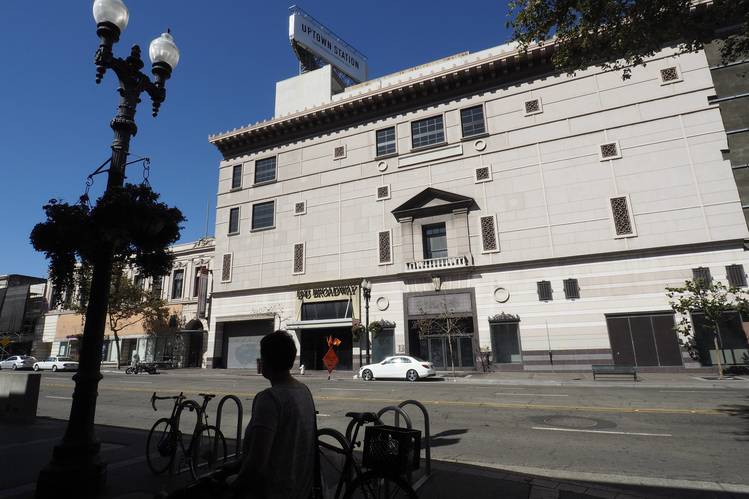
Uber Technologies Inc. late last month announced it was buying a 330,000 square foot former department store in downtown Oakland for $124 million. While its ambitions are far larger in San Francisco—it is developing a new building there—it plans to have up to 3,000 employees in the Oakland location, more than the 2,000 it has in the Bay Area today.

More broadly, the Oakland market has lost its lethargy and is kicking into gear, largely fueled by smaller companies escaping San Francisco’s high rents.

Employers have moved into more than 600,000 square feet of additional space in Oakland’s central business district in the past 12 months, bringing the vacancy rate down to 5.8% from 10.9%, according to brokerage Cushman Wakefield. Rent growth is picking up, and developers are gearing up to build in what they think is a market finally hitting its stride.

“It has been a long time coming,” said Daniel Harvey, a broker at CBRE who advises technology companies on their real estate.

The apparent embrace of Oakland as an acceptable venue by San Francisco companies illustrates the rapidly expanding geography of tech within the Bay Area, where space is at a premium and development is a lengthy endeavor. After first having filed up downtown and much of the gritty mid-Market neighborhood by City Hall, tech companies recently have been signing deals with developers for space in Mission Bay, a sterile-feeling neighborhood far from subways that once was meant to be a hub of scientific research.

Meanwhile, real-estate professionals expect tech giants in the prime cities of Silicon Valley to push further south as they expand, following the lead of Apple Inc.,
AAPL


-0.01
%


which has been buying property around San Jose.

‘It has been a long time coming.’

—Daniel Harvey, a broker at CBRE who advises tech companies on their real estate

Downtown Oakland long has proved a bridge too far, despite being just a 12-minute ride on the subway from San Francisco. Office rents illustrate the tepid demand. While San Francisco rents citywide increased 113% to $66 a square foot since the end of 2009, Oakland and surrounding cities grew just 17.5% to $30.13, according to Cushman Wakefield.

Its also-ran status owes to an array of factors. It is far away from venture capitalists in Silicon Valley, has a reputation for higher crime, and can present a frustrating commute for workers in San Francisco.

But increasingly, Oakland’s housing stock is filling up with those who can’t afford San Francisco’s high housing costs, meaning that more of the natural tech workforce lives in the East Bay. Uber, for instance, expects one out of four of its workers to reside in the East Bay by the time the new Oakland building is ready for occupancy.

This movement has added to housing pressures in the city, fanning gentrification concerns and igniting protests over fast-rising rents.

But at the same time, the strengthening housing market has given investors confidence that offices will continue to fill up.

“You have to feel like there’s legs to the momentum—and there’s definitely legs,” said Sam Hamilton, who runs West Coast acquisitions for investor DivcoWest.

DivcoWest bought the 27-story Oakland office tower Lake Merritt Plaza early last year. Since then, it has wooed multiple San Francisco-based companies, bringing occupancy up from the low-80s to high-90s, Mr. Hamilton said. Rents are up 25%, he said.

Of course, much chatter in the Bay Area is focused on whether the tech sector is in a bubble. If it is—and if it pops—pain would likely spread throughout the market, and could halt Oakland’s recent momentum.

Then again, for now, tech companies are still a small percentage of Oakland’s office market. So few in the East Bay fear the steep losses seen in the post-dotcom bubble, when failed San Francisco startups stopped paying rent on office space throughout the city.

“The good and the bad of it is that not a lot of tech firms have moved out there at this point,” said Robert Sammons, a researcher at Cushman Wakefield.

Write to Eliot Brown at eliot.brown@wsj.com

Article source: http://www.wsj.com/articles/tech-firms-spy-new-bay-area-frontier-oakland-1445355584

Posted in SF Bay Area News | Tagged | Leave a comment

What’s California real estate going to do in 2016?

California’s housing market is expected to improve in 2016, but a shortage of available inventory and continuing high costs are expected to limit the improvement, according to a report released Thursday by the California Association of Realtors.

According to CAR’s 2016 California Housing Market Forecast, existing home sales are expected to rise in 2016 by 6.3% over 2015’s expected total.

Additionally, existing home sales are expected to hit 407,500 in 2015, which would also represent a 6.3% increase over 2014, when there were 383,300 existing home sales.

CAR’s forecast calls for existing home sales to rise to 433,000 in 2016.

The state’s rising prices are predicted to hold back home sales slightly. The California median home price is projected to increase 3.2% to $491,300 in 2016, following a projected 6.5% increase in 2015 to $476,300.

Despite those increasing prices, 2016 is still estimated to have the slowest rate of price appreciation in five years.

CAR’s forecast projects growth in the U.S. gross domestic product of 2.7% in 2016, after a projected gain of 2.4% in 2015.

With projected nonfarm job growth of 2.3% in California in 2016, the state’s unemployment rate should decrease to 5.5% in 2016 from 6.3% in 2015 and 7.5% in 2014, the CAR forecast said.

Additionally, the CAR forecast projects the average interest rate for the 30-year, fixed mortgage will climb only slightly to 4.5%, but should still remain at historically low levels.

With a statewide market as diverse as California, some areas will see the effects of those changes more than others, according to CAR President Chris Kutzkey.

“Solid job growth and favorable interest rates will drive a strong demand for housing next year,” Kutzkey said.

“However, in regions where inventory is tight, such as the San Francisco Bay Area, sales growth could be limited by stiff market competition and diminishing housing affordability,” Kutzkey continued. “On the other hand, demand in less expensive areas such as Solano County, the Central Valley, and Riverside/San Bernardino areas will remain strong thanks to solid job growth in warehousing, transportation, logistics, and manufacturing in these areas.”

CAR Vice President and Chief Economist Leslie Appleton-Young said that there may be a shift in sales to more inland areas of the state in 2016.

“The foundation for California’s housing market remains strong, with moderating home prices, signs of credit easing, and the state continuing to lead the nation in economic and job growth,” Appleton-Young said.

“However, the global economic slowdown, financial market volatility, and the anticipation of higher interest rates are some of the challenges that may have an adverse impact on the market’s momentum next year,” Appleton-Young added. “Additionally, as we see more sales shift to inland regions of the state, the change in mix of sales will keep increases in the statewide median price tempered.”

Click the graph below to enlarge and for the full CAR 2016 housing forecast.

(Source: CAR)

Article source: http://www.housingwire.com/articles/35305-whats-california-real-estate-going-to-do-in-2016

Posted in SF Bay Area News | Tagged | Leave a comment