SAN FRANCISCO–(BUSINESS WIRE)–RealtyShares,
a leading online marketplace for real estate crowdfunding, has financed
a $500,000 preferred equity investment opportunity through its network
of investors nationwide to fund the acquisition and rehabilitation of a
22-unit multi-family property in the San Francisco Bay Area.
The project is sponsored by Tesseract
Capital Group (TCG), a San Francisco-based real estate private
equity firm currently holding ownership interests in more than 1,500
multi-family units nationwide. TCG is a repeat sponsor on the
RealtyShares platform, having successfully funded other projects
including a neighboring property.
Located in Hayward, Calif., Greenleaf Apartments is close to accessible
transportation throughout the San Francisco-Oakland-Fremont metropolitan
area. The apartments are currently leased below market rate, with
significant potential for near-term gains. TCG will do interior and
exterior renovations on the property and will manage rentals during the
term of ownership.
“TCG has now partnered with RealtyShares to fund its last two real
estate projects and we firmly believe that real estate crowdfunding has
tremendous upside as a capital source,” said Benjamin Jiang, Managing
Partner at TCG. “Diversified capital is a critical component to any
successful private equity firm, and RealtyShares has proven capable of
not only providing reliable funding, but also serving as an organic
marketing tool for our firm. We’ve been able to expand our reach to
investors all around the nation through a very simple process, with
ample assistance from the RealtyShares team at every step.”
As the second property acquired by TCG in Hayward, this deal offers
RealtyShares investors a chance to work with a development partner with
first-hand experience in the area.
“This is a unique opportunity for our investors to access an attractive
preferred equity position on a completely off-market acquisition,” said
Bryan Schultz, Vice President of Commercial Equity Investments at
RealtyShares. “The location is ideal for Bay Area commuters, with access
to BART, a key transportation line within walking distance. TCG is
well-equipped to reposition this property for significant potential
near-term gains with a very reasonable loan-to-cost ratio.”
To date, the RealtyShares network of investors have funded $200 million
across more than 400 investment opportunities on the platform, funding
residential and commercial projects in 31 states.
About RealtyShares
RealtyShares is transforming the real estate investment landscape by
connecting borrowers and sponsors to debt and equity capital from
accredited and institutional investors, across an array of financing
products. Private investments are highly illiquid and risky and are not
suitable for all investors. Through the RealtyShares website, these
investors can browse investment opportunities, perform due diligence,
invest online and have 24/7 access to an investor dashboard to watch how
their investments are performing. RealtyShares offers equity securities
through North
Capital Private Securities Corporation, member FINRA/SIPC.
For more information on how to become a real estate investor or to seek
capital through the RealtyShares marketplace, please visit www.realtyshares.com.
The red-hot growth in home prices across the U.S. West is starting to slow in some cities as sticker shock and low inventory put off weary buyers.
Denver, Los Angeles and Austin, Texas, have seen gains in real estate values moderate after years of double-digit increases, according to Zillow. A slowdown in the tech epicenter of San Francisco is becoming even more pronounced, with the median home value in August rising less than 1 percent from a year earlier.
The five-year surge in real estate demand across the West is starting to take its toll in some areas as buyers become more reluctant to purchase a home that would eat up a large chunk of their monthly earnings. With job growth still robust, house hunters are pushing outward from core cities to get more for their money.
“Homebuyers are starting to see a bit of price fatigue and are starting to step back and think twice about making that purchase,” said Svenja Gudell, chief economist at Seattle-based Zillow. “Prices have grown so much over the last few years as part of the recovery that many markets are well beyond their initial 2006 or 2007 peak, so homes are now more expensive than they’ve ever been.”
Western cities have led the nation’s recovery from last decade’s recession with record-setting economic growth and a boom in jobs, particularly in the technology industry, leading to a surge in housing demand. In the past five years, home values have soared 71 percent in Denver, 66 percent in San Francisco and 54 percent in Austin, Zillow data show. Nationwide, the gain was 22 percent.
Buyer Pushback
The prices have gotten too heated for many buyers in Denver, which has seen a slowdown since the beginning of the year, said Wade Perry, a managing broker at Coldwell Banker Devonshire in the area.
“Buyers are starting to push back and say, ‘I’m not going to pay that much for that house,’” Perry said.
The median home value in Denver rose 10 percent in August from a year earlier to $353,300, according to Zillow. While that’s still one of the top increases in the country, it’s down from an almost 16 percent surge in the same period of 2015.
In Austin, which, like Denver, has benefited in part from a spreading tech industry and an influx of well-paid workers, the median climbed 8.1 percent, compared with 12 percent growth a year earlier. Los Angeles’s growth slowed to 6.9 percent from 7.5 percent, while in San Diego it decelerated to 4 percent from 6.3 percent.
For San Francisco, where the median home value has soared to $1.1 million, the increase was just 0.6 percent after a 15 percent jump in August 2015. The city’s price gains have made it the most overvalued housing market in the U.S., UBS Group AG said in a report this week.
Still Hot
Still, there’s no let-up in some other Western tech-heavy markets, such as Portland, Oregon, where home values soared 20 percent in August, compared with 13 percent a year earlier. In Seattle, the 15 percent gain outpaced the roughly 14 percent increase the year before.
Nationwide, the median home value climbed 5.1 percent in August — up from 4.6 percent a year earlier.
A slowdown in home-price appreciation would be a healthy change, said Patrick Carlisle, chief marketing analyst at Paragon Real Estate Group in San Francisco.
“The cooling of a desperately overheated housing market to something closer to normal is not bad news,” he said. “The huge increases in housing prices have created enormous social stresses in the area, as well as leading some of our local high-tech companies and would-be startups to look at locating elsewhere.”
The overheated markets are pushing some buyers to shift their house hunt to the suburbs, fueling faster appreciation in outlying areas than in the neighboring boom cities, Zillow data show. In the Denver suburb of Arvada, for instance, the median home value in August soared 13 percent from a year earlier. It jumped almost 14 percent in Englewood, a short light-rail ride from downtown.
Moving Outward
Ben and Nicole Irwin began looking for homes in the area last year and soon discovered the Denver properties they liked cost $500,000 to $600,000. The couple ended up paying $390,000 for a three-bedroom house in Arvada, where they were attracted to good public schools, a charming old town and the city’s proximity to the Red Rocks Amphitheatre, a popular outdoor concert venue.
“To get the size house we wanted, it would have been out of our price range,” said Ben Irwin, a 37-year-old communications manager for the city of Boulder. “We found that we could get those kinds of houses for $150,000 to $200,000 less” outside of Denver.
In Austin, where home prices are higher but sales are down, surrounding towns “have seen incredible appreciation” as buyers seek out affordability in the city’s outskirts, said Dave Murray, a broker at DMTX Realty.
Murray, a real estate agent in the area since 1984, said he’s shocked when he drives into previously undeveloped suburban areas “and there’s an entire master-planned community and a thousand homes that have popped up in the last two to three years.”
Similar trends are playing out in the San Francisco Bay area, where Oakland is booming while San Francisco slows, and San Diego, where prices are gaining faster in suburbs such as Chula Vista and Escondido.
Rent Slowdown
Rent growth is also tapering off in many Western cities, in part because of a spate of construction in downtowns that added thousands of new apartments to the market. In San Francisco, hiring slowed in the first half of the year and housing prices have hit a level that fewer people are willing to pay, Carlisle said.
The city’s median rent rose 2.5 percent in August, compared with a 17 percent increase a year earlier, according to Zillow. In Austin, rents climbed 2.6 percent, less than the 8.4 percent increase the year before, while Denver’s growth slowed to 4.4 percent from 12 percent. Similar slowdowns were seen in Los Angeles, Phoenix, San Diego, Salt Lake City, Portland and Seattle.
It isn’t for lack of demand that prices are slowing in core Western cities, said Lawrence Yun, chief economist at the National Association of Realtors.
“The tapering off in the downtown areas is due to the fact that it’s very pricey and people are seeking more affordable areas,” Yun said. “If somehow the downtown area were to see any price decline, there would be a rush of buyers coming into downtown again.”
Falling rents? What a concept — especially in the Bay Area, ground zero for out-of-sight rent increases over the past few years.
Yet a new study indicates the trend could be changing. Abodo, an apartment search website, says monthly rents dropped markedly from August to September in San Jose and San Francisco. Those cities were on Abodo’s Top 10 list for the “Biggest Fall” in rents for one-bedroom apartments during that period.
The website’s National Apartment Report for September shows the average monthly rent for a one-bedroom apartment in San Jose dropping from $2,790 to $2,455, a 12 percent decline — and the second-largest decrease among U.S. cities. A one-bedroom in San Francisco fell 6 percent, from $3,952 to $3,698, the seventh-largest decline.
Of course, Abodo’s findings for a single month must be taken in context — as one piece of a continually unfolding picture. Still, the website’s numbers fit a pattern: Over the last year, a variety of organizations and experts have said the pace of rent hikes is slowing in much of the Bay Area, and perhaps is flattening.
Some observers are emphatic: “The prices have reached their saturation point,” said Ron Stern, CEO of Bay Rentals, a housing relocation service. “Tenants cannot be soaked for one extra dollar.”
Particularly in Santa Clara County, he said, “the rental market has slowed down to almost a crawl. We do a lot of credit reports, and the number of reports we’re doing has declined. … Landlords say, ‘Is my price too high? I’m not getting any calls.’ ”
The cooling apparently has yet to reach Oakland. From August to September, according to Abodo, rents climbed from $2,254 to $2,299, a 2 percent increase — the nation’s 23rd-largest increase in rent price.
The notion that Oakland rents still are playing catch-up with the Peninsula and San Francisco was also born out by data reported in July by Novato-based RealFacts. Its second-quarter report showed Oakland rents rising a hefty 5.4 percent on a year-over-year basis. Still, that was down from 7.2 percent and 13.7 percent increases, respectively, in the previous two quarters.
Across the Bay Area, the years-long run-up has put the squeeze on typical income earners, who easily can spend half of their pretax wages on rent.
“While incomes have gone up dramatically, rents also have gone up to the point where we’ve reached an equilibrium,” said Jeffrey M. Mishkin, regional manager at the San Francisco office of Marcus Millichap, a real estate brokerage firm. For much of the region, rents “either can’t or don’t need to go up anymore.”
From August 2015 to August 2016, he said, San Francisco’s rental market “was flat.” “One-bedrooms were down 7.7 percent year-over-year, from $3,395 to $3,150. Two-bedrooms were down from $4,500 to $4,300, a 4.7 percent drop.”
Plus, he just had received an informal report about a “very large owner” of apartments on the Peninsula “who said that rents are down on every one of his properties.”
And yes, Oakland rents have continued to rise as the city attracts young professionals looking for some affordability and easy access to jobs across the bay. Even so, Mishkin said, East Bay brokers sense a slowdown: “The smaller units are renting quickly. The larger, more expensive units are taking longer.”
Stern advised apartment hunters to look in smaller apartment developments, rather than the larger — and often more expensive — complexes.
“You can get a nice place for $1,600 or $1,700, maybe less,” he said. “There’s a nice duplex in Campbell for $1,850 in a good neighborhood. The landlord says, ‘I don’t want to squeeze it for an extra 200 bucks. I just want to get it rented.’”
“Landlords beware,” he warned. “People are shopping price, not quality, right now.”
If so, Abodo’s future reports could show continuing declines. It based its September findings for San Jose, San Francisco and Oakland on a sampling of 6,701 properties, according to Sam Radbil, the website’s spokesperson.
At a glance
Here are a few other highlights of the report:
Miami led the nation for the biggest rise in rent for one-bedroom apartments: a 9 percent increase, from $1,599 to $1,739.
Seattle scored the largest fall in rent: 13 percent, from $2,170 to $1,890.
Three California cities made the Top 10 for “Biggest Rise”: Bakersfield, up 9 percent; Fresno, up 6 percent; Riverside, also up 6 percent.
And four California cities made the Top 10 for “Biggest Fall”: In addition to San Jose and San Francisco, they are Los Angeles, down 8 percent, and Long Beach, down 7 percent.
The Bay Area’s wages are getting higher, far outpacing most of the country, but more residents are finding their paychecks can’t keep up with the region’s skyrocketing cost of living.
The typical Silicon Valley income — well over $100,000 annually — is now double the national average, according to a Bay Area News Group analysis of ten years of federal data. But while pay here is soaring, the cost of housing is rising even faster.
Even workers in technology — the sector driving the region’s economic boom — are finding out that the “haves” don’t always have enough. And for those making far less, the prospects are grim.
“We have a two-income family — we both make good money — but it seems like every month, the expenses keep rising,” said Nicole Tembrevilla, a recruiter for an East Bay tech company. Together, Tembrevilla and her husband, who own a home in San Ramon, make in the low $200,000 range.
“It’s hard to save money,” said Tembrevilla, who lives in San Ramon with her husband and two children, one in high school and the other in middle school. “It’s home improvements, the car, car insurance, tuition — it’s overwhelming. And we’re trying to save up for college.”
Residents say the biggest obstacle to making ends meet is simple: The Bay Area’s mammoth home prices and soaring rents.
“I’m getting good pay raises, but you really have to make around $150,000 a year to be able to afford a house around here,” said Joseph Martin, of Mountain View, a systems administrator with a San Jose tech company. Martin says he makes in the high five-figure range. “The real question is, ‘How do you afford to find a place to live here?’”
For many Bay Area residents, such as Joseph Martin, of Mountain View, the biggest obstacle to making ends meet is simple: the cost of housing. “I’m getting good pay raises, but you really have to make around $150,000 a year to be able to afford a house around here,” said Martin, a systems administrator with a San Jose tech company. “The real question is, ‘How do you afford to find a place to live here?’”
For those making below the average wage, owning a home is out of reach. They’re just trying to survive.
Christine Zeyen and her boyfriend moved to San Jose from Arizona a few months ago, hoping to improve their financial and work situation.
“We are just barely making ends meet,” said Zeyen, as she shopped at a San Jose thrift store. “The expenses here are a real eye-opener.”
Zeyen works about 30 hours a week in behavioral therapy and receives financial help from her father to boost her income to roughly $25,000 annually. Her boyfriend makes about $60,000 a year working for Frito Lay. But in San Jose, that’s far from enough.
“It takes everything we have to pay the bills,” Zeyen said. “We moved here to make a better future for ourselves. It’s hard to say if it’s worth it.”
Over the last five years, average wages in the Bay Area’s five most populous counties have risen by roughly 30 percent. In those same five years, the period of recovery and economic expansion after the Great Recession, home prices in those counties have soared more than 87 percent. In the more affordable East Bay, the median home price has doubled.
The gap between wages and home prices isn’t the only disparity underscored by this news organization’s analysis of wage trends in the Bay Area.
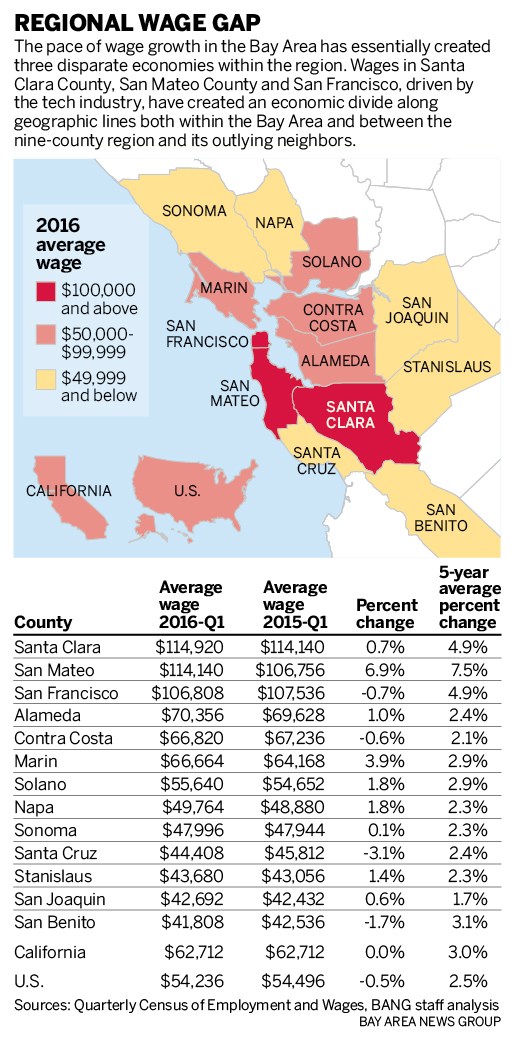
Wages in the three counties with higher concentrations of technology companies far outpace those in counties with relatively few tech jobs. At the end of June, Santa Clara County had 344,700 tech jobs, and the East Bay had 137,400. At the end of March, annual pay averaged $114,920 in Santa Clara County, $114,140 in San Mateo County and $106,808 in San Francisco, according to the federal government’s closely watched Quarterly Census of Employment and Wages.
But in the East Bay, wages averaged $70,356 in Alameda County and $66,820 in Contra Costa County,
“The Bay Area is a tale of three different economies,” said Jon Haveman, principal economist with San Rafael-based Marin Economic Consulting. “You have Santa Clara County, the Peninsula and San Francisco with extremely high-wage jobs. You have the East Bay, which has good wages and is more middle-income, along with Marin.”
And Sonoma and Solano have even lower average wages.
The Quarterly Census figures show the pay gap between the Bay Area region and the rest of the country is accelerating.
In large part, that’s because tech companies fuel the Bay Area’s economic engine — and its surge in wages. Firms often dangle big paychecks, bonuses and stock options as part of the scramble to lure talent and retain prized workers.
“The war for talent is driving all of this,” said Russell Hancock, president of Joint Venture Silicon Valley. “… The tech boom and wage growth have created a class of the uber-rich in the Bay Area.”
Still, strong paydays in the technology industry aren’t always enough, as tech worker Martin has discovered.
Martin said he and his girlfriend, a preschool teacher, hope to buy a house in Mountain View, Sunnyvale, Santa Clara or San Francisco. They want to avoid the grind of commuting from the Central Valley or other outlying areas, but the harsh reality of home prices in the $800,000, $900,000 or even $1 million range has jolted them.
“It’s crazy how expensive homes are,” said Martin, 26. “I don’t know too many people my age who can afford the homes here.”
Case in point: Over the five years that ended in July, the median home price has rocketed up 94 percent in San Mateo County, 74 percent in Santa Clara County and 67 percent in San Francisco, according to figures from the CoreLogic real estate information service. While the median in the East Bay is lower, home prices there have increased even more: up 105 percent in Contra Costa County and up 99 percent in Alameda County.
Bay Area poverty rates dipped for the first time in 10 years, according to recent census data, but in the metropolitan region of San Francisco, Hayward and Oakland alone, there were still 485,000 people living in poverty in 2015. That’s just a slight dip from the 491,000 in poverty in 2014.
“The rising cost of living is creating poverty,” said Micah Weinberg, president of the Bay Area Council Economic Institute, singling out the region’s increasing home prices.
Silicon Valley’s concentration of tech workers, with their top-flight paychecks, increases the chances that people will bid up housing values.
“The high earners who are doing really well, they are paying cash for houses, and the rest of us can’t do that,” Hancock said. “Most people can’t compete in the housing market. That’s created a brutal environment in Silicon Valley.”
Ben Mohr, a San Ramon-based retirement planner who works with a cross-section of people, hears plenty of stories about the challenges of living in this region.
“You have to make a lot of money just to keep up with how much things cost here,” Mohr said. “What’s happening in the Bay Area reminds you of what you see in places like Manhattan.”
Vanessa Cueva, who lives in Tracy and works for a staffing services firm in Pleasanton, would like a shorter commute. But the reality, she says, is you have to go where the jobs are.
“I would try to find a job in the Central Valley, but there really isn’t as much work there,” said Cueva. “So I have to commute back and forth. That is a hard hour, hour-and-a-half of driving.”
The pattern of sharply rising wages in Silicon Valley is likely to persist, experts say.
“Demand for hiring is going to continue,” said Stephen Levy, director of the Palo Alto-based Center for Continuing Study of the California Economy. “And that will keep the upward pressure on wages in Silicon Valley.”
The Bay Area’s wages are getting higher, far outpacing most of the country, but more residents are finding their paychecks can’t keep up with the region’s skyrocketing cost of living.
The typical Silicon Valley income — well over $100,000 annually — is now double the national average, according to a Bay Area News Group analysis of ten years of federal data. But while pay here is soaring, the cost of housing is rising even faster.
Even workers in technology — the sector driving the region’s economic boom — are finding out that the “haves” don’t always have enough. And for those making far less, the prospects are grim.
“We have a two-income family — we both make good money — but it seems like every month, the expenses keep rising,” said Nicole Tembrevilla, a recruiter for an East Bay tech company. Together, Tembrevilla and her husband, who own a home in San Ramon, make in the low $200,000 range.
Together, Nicole Tembrevilla and her husband make well above the average wage in the East Bay, but she says trying to keep up with the region’s cost of living is “overwhelming.” Anda Chu/Staff
“It’s hard to save money,” said Tembrevilla, who lives in San Ramon with her husband and two children, one in high school and the other in middle school. “It’s home improvements, the car, car insurance, tuition — it’s overwhelming. And we’re trying to save up for college.”
Residents say the biggest obstacle to making ends meet is simple: The Bay Area’s mammoth home prices and soaring rents.
“I’m getting good pay raises, but you really have to make around $150,000 a year to be able to afford a house around here,” said Joseph Martin, of Mountain View, a systems administrator with a San Jose tech company. Martin says he makes in the high five-figure range. “The real question is, ‘How do you afford to find a place to live here?’”
For those making below the average wage, owning a home is out of reach. They’re just trying to survive.
Christine Zeyen and her boyfriend moved to San Jose from Arizona a few months ago, hoping to improve their financial and work situation.
“We are just barely making ends meet,” said Zeyen, as she shopped at a San Jose thrift store. “The expenses here are a real eye-opener.”
Zeyen works about 30 hours a week in behavioral therapy and receives financial help from her father to boost her income to roughly $25,000 annually. Her boyfriend makes about $60,000 a year working for Frito Lay. But in San Jose, that’s far from enough.
“It takes everything we have to pay the bills,” Zeyen said. “We moved here to make a better future for ourselves. It’s hard to say if it’s worth it.”
Over the last five years, average wages in the Bay Area’s five most populous counties have risen by roughly 30 percent. In those same five years, the period of recovery and economic expansion after the Great Recession, home prices in those counties have soared more than 87 percent. In the more affordable East Bay, the median home price has doubled.
The gap between wages and home prices isn’t the only disparity underscored by this news organization’s analysis of wage trends in the Bay Area.
Wages in the three counties with higher concentrations of technology companies far outpace those in counties with relatively few tech jobs. At the end of June, Santa Clara County had 344,700 tech jobs, and the East Bay had 137,400. At the end of March, annual pay averaged $114,920 in Santa Clara County, $114,140 in San Mateo County and $106,808 in San Francisco, according to the federal government’s closely watched Quarterly Census of Employment and Wages.
But in the East Bay, wages averaged $70,356 in Alameda County and $66,820 in Contra Costa County,
“The Bay Area is a tale of three different economies,” said Jon Haveman, principal economist with San Rafael-based Marin Economic Consulting. “You have Santa Clara County, the Peninsula and San Francisco with extremely high-wage jobs. You have the East Bay, which has good wages and is more middle-income, along with Marin.”
And Sonoma and Solano have even lower average wages.
The Quarterly Census figures show the pay gap between the Bay Area region and the rest of the country is accelerating.
In large part, that’s because tech companies fuel the Bay Area’s economic engine — and its surge in wages. Firms often dangle big paychecks, bonuses and stock options as part of the scramble to lure talent and retain prized workers.
“The war for talent is driving all of this,” said Russell Hancock, president of Joint Venture Silicon Valley. “… The tech boom and wage growth have created a class of the uber-rich in the Bay Area.”
Still, strong paydays in the technology industry aren’t always enough, as tech worker Martin has discovered.
Martin said he and his girlfriend, a preschool teacher, hope to buy a house in Mountain View, Sunnyvale, Santa Clara or San Francisco. They want to avoid the grind of commuting from the Central Valley or other outlying areas, but the harsh reality of home prices in the $800,000, $900,000 or even $1 million range has jolted them.
“It’s crazy how expensive homes are,” said Martin, 26. “I don’t know too many people my age who can afford the homes here.”
Case in point: Over the five years that ended in July, the median home price has rocketed up 94 percent in San Mateo County, 74 percent in Santa Clara County and 67 percent in San Francisco, according to figures from the CoreLogic real estate information service. While the median in the East Bay is lower, home prices there have increased even more: up 105 percent in Contra Costa County and up 99 percent in Alameda County.
Bay Area poverty rates dipped for the first time in 10 years, according to recent census data, but in the metropolitan region of San Francisco, Hayward and Oakland alone, there were still 485,000 people living in poverty in 2015. That’s just a slight dip from the 491,000 in poverty in 2014.
“The rising cost of living is creating poverty,” said Micah Weinberg, president of the Bay Area Council Economic Institute, singling out the region’s increasing home prices.
Silicon Valley’s concentration of tech workers, with their top-flight paychecks, increases the chances that people will bid up housing values.
“The high earners who are doing really well, they are paying cash for houses, and the rest of us can’t do that,” Hancock said. “Most people can’t compete in the housing market. That’s created a brutal environment in Silicon Valley.”
Ben Mohr, a San Ramon-based retirement planner who works with a cross-section of people, hears plenty of stories about the challenges of living in this region.
“You have to make a lot of money just to keep up with how much things cost here,” Mohr said. “What’s happening in the Bay Area reminds you of what you see in places like Manhattan.”
Vanessa Cueva, who lives in Tracy and works for a staffing services firm in Pleasanton, would like a shorter commute. But the reality, she says, is you have to go where the jobs are.
“I would try to find a job in the Central Valley, but there really isn’t as much work there,” said Cueva. “So I have to commute back and forth. That is a hard hour, hour-and-a-half of driving.”
The pattern of sharply rising wages in Silicon Valley is likely to persist, experts say.
“Demand for hiring is going to continue,” said Stephen Levy, director of the Palo Alto-based Center for Continuing Study of the California Economy. “And that will keep the upward pressure on wages in Silicon Valley.”


 Over the last five years, average wages in the Bay Area’s five most populous counties have risen by roughly 30 percent. In those same five years, the period of recovery and economic expansion after the Great Recession, home prices in those counties have soared more than 87 percent. In the more affordable East Bay, the median home price has doubled.