State of Luxury: California Dominates List of Counties With Most Expensive Real Estate

California is dominating the U.S. luxury market.

While Manhattan still ranks No. 1 when it comes to luxury real estate prices, seven of the top 10 counties were in California, according to Realtor.com’s Luxury Homes Index released Tuesday (News Corp., which owns Mansion Global, also owns Realtor.com).

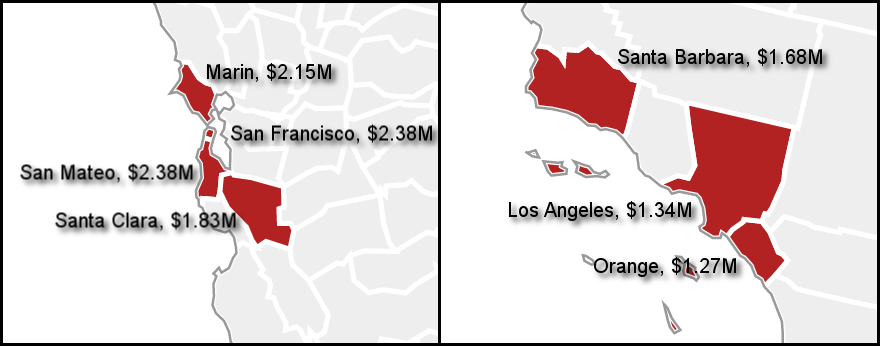
Four San Francisco Bay areas overcame drier IPO activity to make the top 10. Coming in second, after Manhattan, was San Mateo ($2.384 million), followed by San Francisco ($2.383 million) and Marin ($2.154 million), while Santa Clara ($1.83 million) was in sixth place.

More: Vancouver and Five Other Global Cities Facing a Housing Bubble, UBS Finds

Prices in San Mateo and San Francisco have risen by 9% and 6.8% respectively compared with the first six months of last year. In Marin, meanwhile, they were down 7.1%, while they were flat in Santa Clara. According to a Bay Area broker, it is the $3 million-to-$5 million price bracket that’s driving the market, as the ultra-luxury sector slows.

“In the Bay area, $20 million houses will sit there for longer. That market is softening a bit as buyers are nervous about the economy and the election, but the $3 million market is still very active,” Justin Fichelson of Climb Real Estate, and star of Bravo’s “Million Dollar Listing San Francisco”, told Mansion Global.

“San Mateo in Silicon Valley is very expensive and encompasses Hillsborough, while Marin is north across the Golden Gate bridge. They are both wealthy areas with beautiful views and have very active $3 million- to-$5 million markets. Around $3 million won’t buy you a huge house in these areas, but you can certainly pick up a cute little house.”

Los Angeles was also in the top 10 with an average luxury price of $1.337 million, up 3.3% year-over-year and 20.8% on 2013. It has fared better than other markets, although a recent report showed some cracks—albeit small—are now starting to appear in a market that has gone from strength to strength in recent years.

SEVEN OF THE TOP 10 COUNTIES WERE IN CALIFORNIA
aac74 combine images State of Luxury: California Dominates List of Counties With Most Expensive Real Estate

Manhattan, meanwhile, ranked No. 1 despite reports of a real estate cooling in the borough.

More: Manhattan Prices Close to Record High Amid Signs of a Cooling Market

According to Realtor.com’s data, the average price of a high-end property, defined as the top 10% of sales, in Manhattan was $3.85 million in the first six months of 2016. That’s almost a quarter higher than a year earlier and a 40% jump compared to 2013.

This spike has been driven by sales that had been in contract in the last 12 to 18 months in some of Manhattan’s most expensive new developments, such as 432 Park Ave., the tallest residential building in the western hemisphere at 1,396 feet. These pending sales closed in the second quarter, driving prices higher.

However, more recently, there’s been anecdotal evidence of a slowdown in the luxury condo market, fueled by oversupply and waning demand from nervous investors amid global economic uncertainty and the U.S. presidential election.

In addition to Manhattan, Brooklyn and Boston and its surrounding towns were the only areas not in California to make the top 10. Average luxury prices in Brooklyn were $1.439 million, up 6.2% on the year and almost a third higher than in 2013.

Over the past decade, many Manhattanites have flocked to Brooklyn in search of more space for less money, with luxury developers not long behind them. This, however, has pushed up prices across large parts Brooklyn.

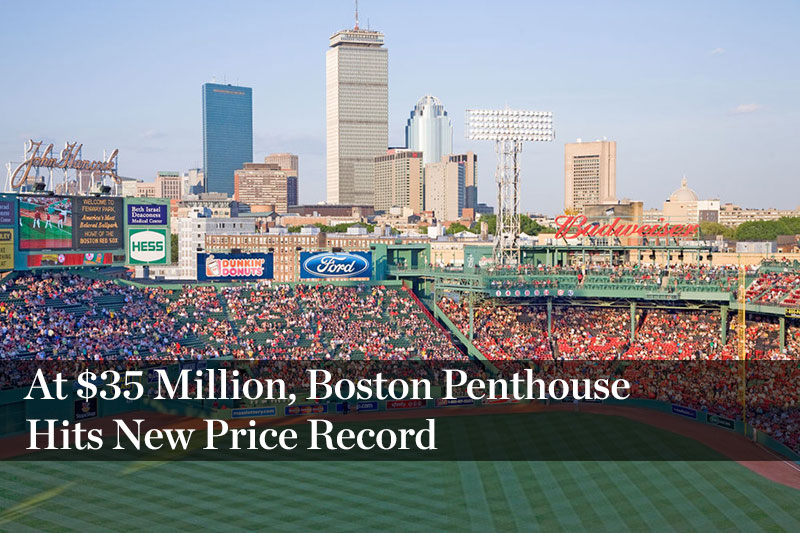
In Boston and its surrounding towns which make up Suffolk County, meanwhile, the average price of a luxury home was $1.158 million in the first half of 2016, up 10.3% from a year earlier and 24% compared with 2013.

It is undergoing its biggest residential boom since the 1920s as recent years have seen more international wealth come to Boston, with large employers, the area’s colleges and even medical centers all playing a role.

Leading the pack is the Four Seasons Private Residences One Dalton Street, atop Boston’s second Four Seasons hotel in the city’s posh Back Bay neighborhood. When completed in the summer of 2018, One Dalton will be New England’s tallest and most expensive residential building.

“Boston is a hub of world-class institutions for higher education, healthcare, technology, and culture, and recently has become a destination of more and more non-stop international flights. Combining all that Boston has to offer with the national trend toward city living, it’s no wonder that buyers are flocking to our new buildings,” Dick Friedman, president and chief executive of Carpenter Company, One Dalton Street’s developer, said.


MORE FROM MANSION GLOBAL:

d6c55 BostonWorldClassMarket Teaser State of Luxury: California Dominates List of Counties With Most Expensive Real Estate

5662b BostonPenthouseRecord Teaser State of Luxury: California Dominates List of Counties With Most Expensive Real Estate

Follow Mansion Global: Twitter | Facebook | Instagram
Write to us: info@mansionglobal.com

Article source: http://www.mansionglobal.com/articles/41841-state-of-luxury-california-dominates-list-of-counties-with-most-expensive-real-estate
Posted in SF Bay Area News | Tagged | Leave a comment

John Kilroy Sr., commercial real estate pioneer and champion sailor …

John B. Kilroy Sr., who rose from a Depression-era childhood to establish Kilroy Realty Corp. as one of the leading commercial real estate firms on the West Coast, has died at age 94, his foundation announced.

Kilroy, who also was a renowned sailor, died Thursday at Cedars-Sinai Medical Center in Los Angeles from complications of aging, said Chris Krogh, a spokesman for the John B. and Nelly Llanos Kilroy Foundation.

Known as Jim, Kilroy was among the developers who tapped into the growth of Southern California’s commercial real estate market, especially in the aerospace and defense industries, after World War II.

Kilroy started in real estate in 1947 – with only $100 in his pocket, according to the company – and founded Kilroy Realty’s predecessor firm in 1952.

 John Kilroy Sr., commercial real estate pioneer and champion sailor ...

Caption Vin Scully makes his last call at ATT Park in San Francisco

Vin Scully broadcasts his final game of a 67-year career with the Dodgers at ATT Park in San Francisco on Sunday afternoon.

Vin Scully broadcasts his final game of a 67-year career with the Dodgers at ATT Park in San Francisco on Sunday afternoon.

 John Kilroy Sr., commercial real estate pioneer and champion sailor ...

Caption Residents confront LAPD after fatal shooting

Video provided by OnScene.tv shows confrontation between community members and police after Los Angeles police shot and killed an armed suspect Saturday in South L.A.

Video provided by OnScene.tv shows confrontation between community members and police after Los Angeles police shot and killed an armed suspect Saturday in South L.A.

 John Kilroy Sr., commercial real estate pioneer and champion sailor ...

Caption LAPD officer discusses fatal shooting

An officer discusses the fatal shooting of an 18-year-old after a pursuit in South L.A.

An officer discusses the fatal shooting of an 18-year-old after a pursuit in South L.A.

 John Kilroy Sr., commercial real estate pioneer and champion sailor ...

Caption Breaking down the Rams 17-13 victory over the Cardinals

The Rams remain in first place in the NFC West after a 17-13 victory over the Arizona Cardinals. 

The Rams remain in first place in the NFC West after a 17-13 victory over the Arizona Cardinals. 

ALSO

Former Chief Justice Malcolm Lucas, who steered state’s top court to the right, dies at 89

Neville Marriner, L.A. Chamber Orchestra music director and ‘Amadeus’ maestro, dies at 92

Gordon Davidson, Mark Taper Forum founder and L.A.’s ‘Moses of theater,’ dies at 83

Article source: http://www.latimes.com/local/obituaries/la-fi-obit-kilroy-20161003-snap-story.html

Posted in SF Bay Area News | Tagged | Leave a comment

How non-tech companies get by in tech-frenzied San Francisco


df840 14270818136 7f8d5b06e4 o How non tech companies get by in tech frenzied San Francisco
Flickr/Nicholas
Raymond


In the past six years San Francisco’s tech-fueled economy has
pushed rents to all-time highs, sparked a massive building boom,
and made the Bay Area one of the most dynamic and expensive
regions in the world.

Tech companies have accounted for virtually all of this expansion
over the past several years, and justifiably most of the media
coverage on the San Francisco economy has focused on how
technology companies have affected the real estate market and the
region. There’s a worthwhile conversation to be had about whether
the San Francisco economy is too exposed to tech; not unlike the
Rust Belt was to manufacturing, or Russia and the Middle East are
to oil.

A commonly overlooked reality is the fact that the San Francisco
economy is pretty diverse. Companies like Salesforce, Twitter,
Uber and Airbnb have fueled massive amounts of job creation and
absorption of office space. However, if one looks at who’s
occupying the 75+ million square feet of office space that is
leased in San Francisco, tech companies occupy less than half of
the space. So how are more traditional companies navigating a
commercial real estate landscape that has been completely
transformed by the booming tech companies?

Corporate Behemoths Provide Stability

In addition to the aforementioned tech stalwarts, the largest
employers in San Francisco include companies like Levi’s, The
Gap, PGE, Williams Sonoma, Wells Fargo and Charles Schwab.
While these companies employ large numbers of people and lease or
own significant amounts of real estate, they tend to not be
active players in the real estate market, and in some cases have
leased or owned the same buildings for decades.

They provide an underlying base of stability for the market, but
for the past decade generally haven’t been consumers of space in
S.F. Occasionally, companies like Schwab have cut back on large
blocks of space – although in the most recent case for Schwab
that space at 215 Fremont was immediately absorbed by a 300,000sf
expansion by Fitbit.

While the overall trend with these types of companies is
stability, recently some large users have re-evaluated how they
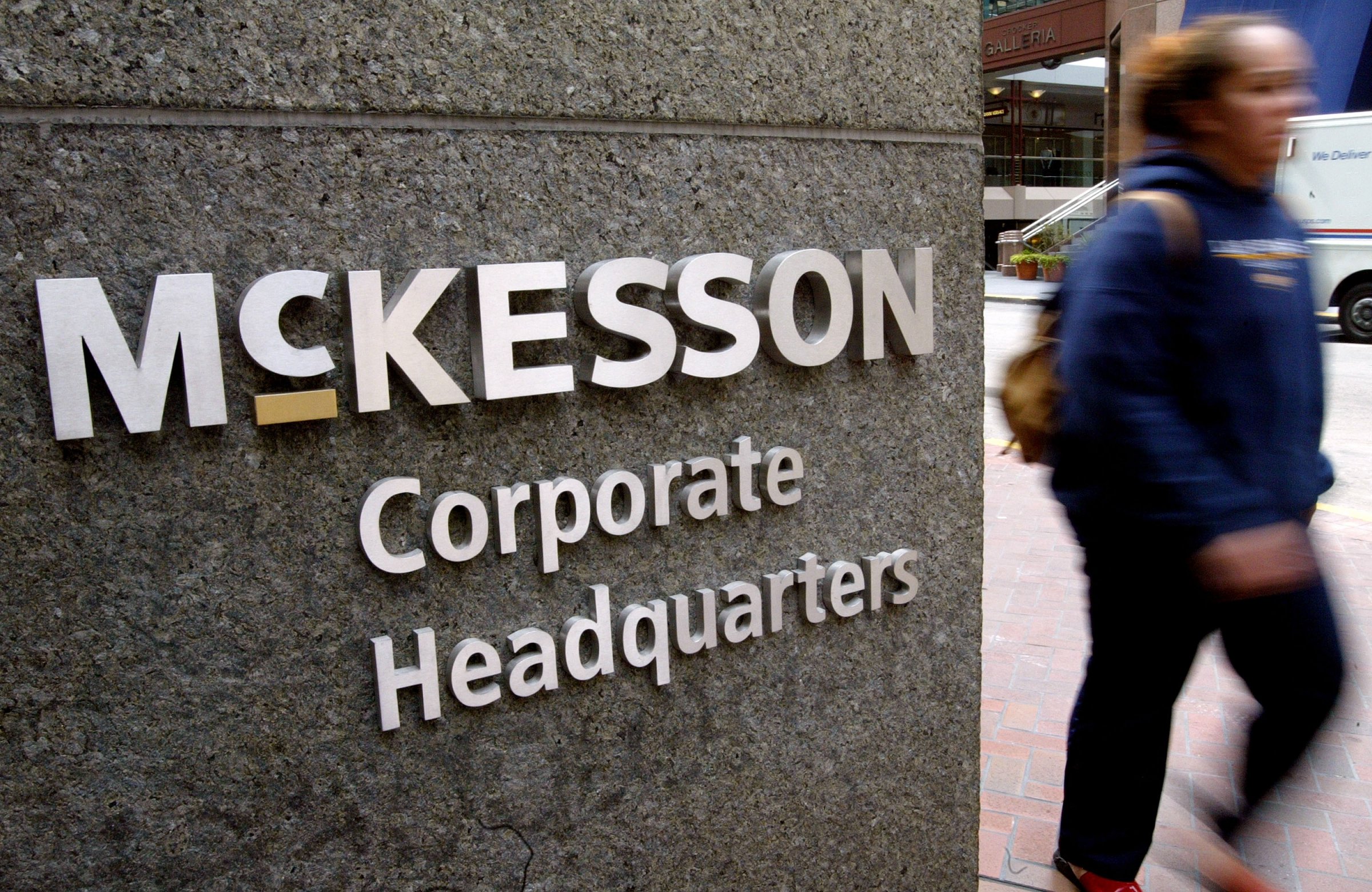
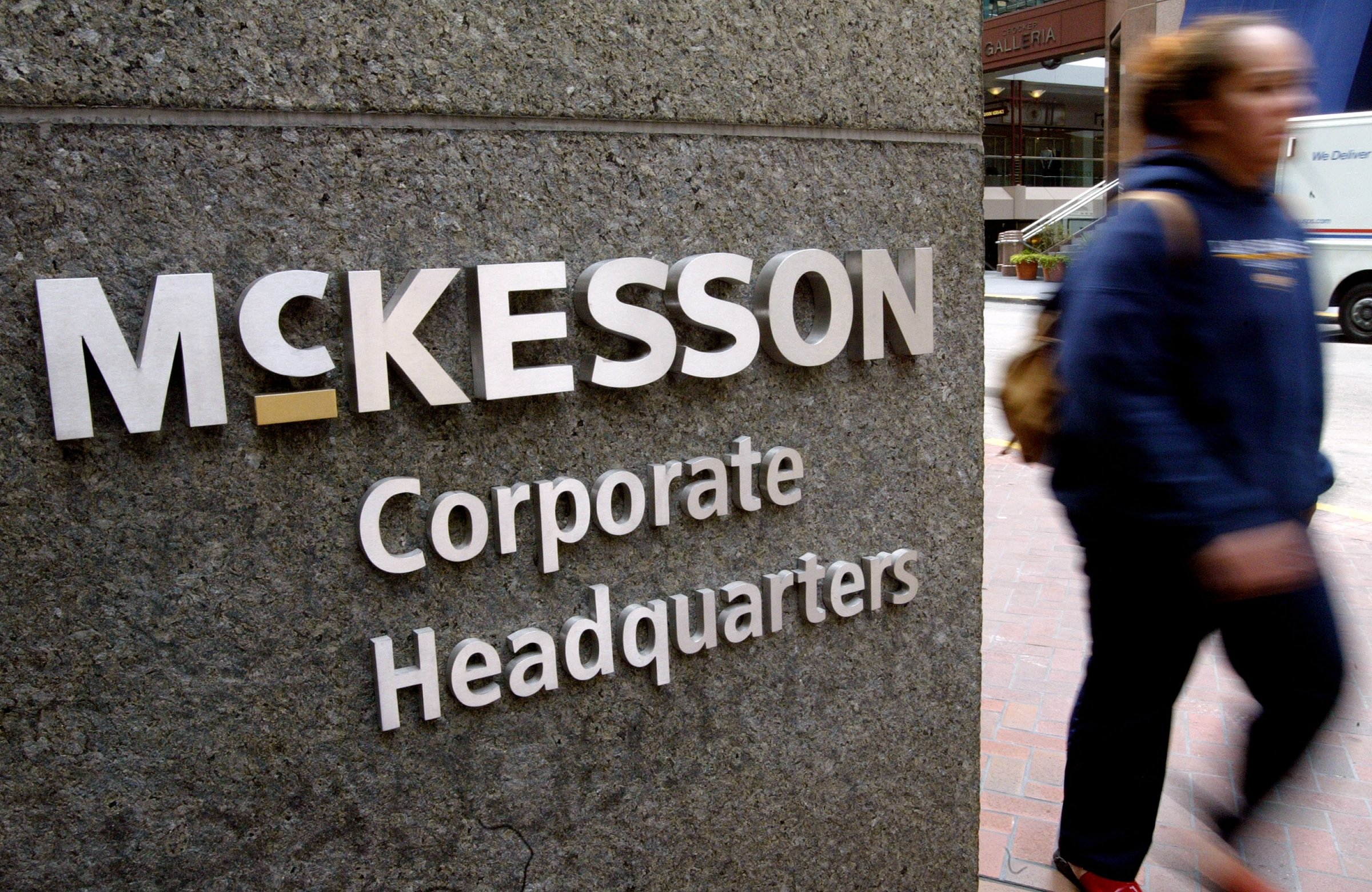
use their space in San Francisco. McKesson, headquartered in San
Francisco since the 1960s and with roots dating back to New York
in the 1830s, is currently pursuing a sale of its headquarters
building at 1 Post in the financial district. This sale would
keep their corporate headquarters in San Francisco, but downsize
their footprint in the building, while cashing out of a long-held
real estate asset that has appreciated considerably in the last
few years.


c01d7 gettyimages 2056355 How non tech companies get by in tech frenzied San FranciscoJustin Sullivan/Getty Images

Union Bank is evaluating a similar strategy at their 400
California building in the heart of the financial district. A
historic bank building overshadowed by a hulking 1960’s concrete
high-rise, the structure would require a significant renovation
in order to be marketable office space.

Union Bank and McKesson offer examples of long-time San Francisco
companies re-evaluating their real estate needs in a changing
market. However, the overall theme with similar large traditional
employers in San Francisco is hunkering down in their current
location and not making significant waves in the real estate
market.

Who’s Active in the Market Other than Tech Companies?

The companies that are considering significant expansions in San
Francisco are still, almost universally, technology companies. Of
the 20 largest companies currently looking for space, 15 of them
are tech companies, and all are looking for 50,000 square feet or
larger. Based on typical occupancy standards, this is space for a
minimum of 300 people for each of those requirements.

If we look at companies that are looking for 10,000-40,000sf –
or, generally speaking, space for about 50 to 250 employees –
there are a lot more non-tech companies in the market. These
include financial services firms, law firms and consumer products
firms, with FIRE (finance, insurance, real estate) and
professional services firms comprising most of the demand. In
this size range, there are still slightly more tech companies in
the market than non-tech companies, but the numbers are closer to
50%/50%.

Looking at who has signed office leases in San Francisco over the
past 6 months highlights the disparity between tech and non-tech.
Of 197 companies that signed leases, 86 are tech companies (44%)
and 111 are non-tech companies (56%) – fairly balanced, with
non-tech companies slightly outnumbering tech.

However, of the 4 million square feet leased by those 197
companies, tech companies leased 3.16 million square feet (77.5%
of the total space) and the 111 non-tech companies leased 918,000
square feet (22.5%). The average tech deal was 36,750sf and the
average non-tech deal was 8,270sf –in other words, the average
tech company is signing a lease that is 4x the size of the
average non-tech company.

“These stats drive home the point that in a market where space is
expensive and scarce, the large tech companies are making it very
hard for the more traditional businesses to compete. 

David Vs. Goliath

In the San Francisco Bay Area, tech companies are Goliath and
non-tech companies are David. How does David compete?

For most of the non-tech companies, San Francisco’s expensive
rents and high cost of living are huge challenges. However, there
are changes happening in San Francisco’s extremely competitive
commercial real estate market that help make this scenario more
favorable to those non-tech businesses.


c01d7 salesforce tower early How non tech companies get by in tech frenzied San Francisco
Pedestrians
walk by the future site of the Salesforce Tower in
2015.

AP

First, landlords are concerned about being overexposed to tech
tenants. Landlords have reaped the rewards of tech companies
causing rents to double over the past 6 years, but they also want
to make sure they’re making a deal with a tenant that will be
paying rent for the next 6 years. That makes established
businesses increasingly attractive as tenants.

In many cases, we’ve seen landlords willing to offer more
attractive terms to a more traditional, stronger credit business
– perhaps a slightly cheaper rent, free rent or more generous
tenant improvement allowance.

Tenant Improvements

Tenant improvements are one of the biggest areas where
established businesses have leverage with landlords. Despite a
recent increase in vacancy, rents in San Francisco haven’t
changed much – essentially they’ve stabilized after years of
massive increases. Many landlords recognize that rents are very
favorable to them, but also that the market has slowed down and
tenants have more options, including move-in ready subleases.

In order to compete, it’s increasingly common for landlords to
agree to a full turnkey renovation or to build a space out
speculatively, as opposed to the typical model of a tenant
improvement allowance where tenants are funding a significant
portion of the build-out costs. As such there are more abundant
opportunities to move into newly renovated and refreshed space
without tenants having to make an investment of their own
capital.

We’ve also found that the challenges of doing business in an
economic boomtown can provide some leverage for tenants in
negotiations with landlords. Many companies that have been in San
Francisco for years and are dealing with burdens like snarled
traffic and the disruption of major construction projects feel
their rents should be going down, not up. For those tenants,
making a compelling case to their landlord that a high rent is
going to be the catalyst that forces them to downsize to a
smaller space or move out of the city can help get concessions in
a lease negotiation.

In short, the cost of doing business in San Francisco is as
challenging as ever, particularly for companies that aren’t in
the tech space.

Companies that understand the changing nature of the commercial
real estate market, and what makes them desirable as a tenant,
can position themselves to take advantage of increased motivation
by many landlords.

Guest Blogger Eli Ceryak is a Senior Vice President and
commercial broker for Cushman Wakefield San
Francisco. He represents a broad and eclectic client base,
ranging from startup growth-stage tech companies to established
Fortune 500 firms. Eli earned his undergraduate degree from
Harvard University and received his Masters of Business
Administration from the Walter A. Haas School of Business at
University of California Berkeley.

Article source: http://www.techinsider.io/san-francisco-commercial-real-estate-tips-non-tech-2016-9

Posted in SF Bay Area News | Tagged | Leave a comment

How non-tech companies get by in tech-frenzied San Francisco


5a9ad 14270818136 7f8d5b06e4 o How non tech companies get by in tech frenzied San Francisco
Flickr/Nicholas
Raymond


In the past six years San Francisco’s tech-fueled economy has
pushed rents to all-time highs, sparked a massive building boom,
and made the Bay Area one of the most dynamic and expensive
regions in the world.

Tech companies have accounted for virtually all of this expansion
over the past several years, and justifiably most of the media
coverage on the San Francisco economy has focused on how
technology companies have affected the real estate market and the
region. There’s a worthwhile conversation to be had about whether
the San Francisco economy is too exposed to tech; not unlike the
Rust Belt was to manufacturing, or Russia and the Middle East are
to oil.

A commonly overlooked reality is the fact that the San Francisco
economy is pretty diverse. Companies like Salesforce, Twitter,
Uber and Airbnb have fueled massive amounts of job creation and
absorption of office space. However, if one looks at who’s
occupying the 75+ million square feet of office space that is
leased in San Francisco, tech companies occupy less than half of
the space. So how are more traditional companies navigating a
commercial real estate landscape that has been completely
transformed by the booming tech companies?

Corporate Behemoths Provide Stability

In addition to the aforementioned tech stalwarts, the largest
employers in San Francisco include companies like Levi’s, The
Gap, PGE, Williams Sonoma, Wells Fargo and Charles Schwab.
While these companies employ large numbers of people and lease or
own significant amounts of real estate, they tend to not be
active players in the real estate market, and in some cases have
leased or owned the same buildings for decades.

They provide an underlying base of stability for the market, but
for the past decade generally haven’t been consumers of space in
S.F. Occasionally, companies like Schwab have cut back on large
blocks of space – although in the most recent case for Schwab
that space at 215 Fremont was immediately absorbed by a 300,000sf
expansion by Fitbit.

While the overall trend with these types of companies is
stability, recently some large users have re-evaluated how they
use their space in San Francisco. McKesson, headquartered in San
Francisco since the 1960s and with roots dating back to New York
in the 1830s, is currently pursuing a sale of its headquarters
building at 1 Post in the financial district. This sale would
keep their corporate headquarters in San Francisco, but downsize
their footprint in the building, while cashing out of a long-held
real estate asset that has appreciated considerably in the last
few years.


5a9ad gettyimages 2056355 How non tech companies get by in tech frenzied San FranciscoJustin Sullivan/Getty Images

Union Bank is evaluating a similar strategy at their 400
California building in the heart of the financial district. A
historic bank building overshadowed by a hulking 1960’s concrete
high-rise, the structure would require a significant renovation
in order to be marketable office space.

Union Bank and McKesson offer examples of long-time San Francisco
companies re-evaluating their real estate needs in a changing
market. However, the overall theme with similar large traditional
employers in San Francisco is hunkering down in their current
location and not making significant waves in the real estate
market.

Who’s Active in the Market Other than Tech Companies?

The companies that are considering significant expansions in San
Francisco are still, almost universally, technology companies. Of
the 20 largest companies currently looking for space, 15 of them
are tech companies, and all are looking for 50,000 square feet or
larger. Based on typical occupancy standards, this is space for a
minimum of 300 people for each of those requirements.

If we look at companies that are looking for 10,000-40,000sf –
or, generally speaking, space for about 50 to 250 employees –
there are a lot more non-tech companies in the market. These
include financial services firms, law firms and consumer products
firms, with FIRE (finance, insurance, real estate) and
professional services firms comprising most of the demand. In
this size range, there are still slightly more tech companies in
the market than non-tech companies, but the numbers are closer to
50%/50%.

Looking at who has signed office leases in San Francisco over the
past 6 months highlights the disparity between tech and non-tech.
Of 197 companies that signed leases, 86 are tech companies (44%)
and 111 are non-tech companies (56%) – fairly balanced, with
non-tech companies slightly outnumbering tech.

However, of the 4 million square feet leased by those 197
companies, tech companies leased 3.16 million square feet (77.5%
of the total space) and the 111 non-tech companies leased 918,000
square feet (22.5%). The average tech deal was 36,750sf and the
average non-tech deal was 8,270sf –in other words, the average
tech company is signing a lease that is 4x the size of the
average non-tech company.

“These stats drive home the point that in a market where space is
expensive and scarce, the large tech companies are making it very
hard for the more traditional businesses to compete. 

David Vs. Goliath

In the San Francisco Bay Area, tech companies are Goliath and
non-tech companies are David. How does David compete?

For most of the non-tech companies, San Francisco’s expensive
rents and high cost of living are huge challenges. However, there
are changes happening in San Francisco’s extremely competitive
commercial real estate market that help make this scenario more
favorable to those non-tech businesses.


58cf2 salesforce tower early How non tech companies get by in tech frenzied San Francisco
Pedestrians
walk by the future site of the Salesforce Tower in
2015.

AP

First, landlords are concerned about being overexposed to tech
tenants. Landlords have reaped the rewards of tech companies
causing rents to double over the past 6 years, but they also want
to make sure they’re making a deal with a tenant that will be
paying rent for the next 6 years. That makes established
businesses increasingly attractive as tenants.

In many cases, we’ve seen landlords willing to offer more
attractive terms to a more traditional, stronger credit business
– perhaps a slightly cheaper rent, free rent or more generous
tenant improvement allowance.

Tenant Improvements

Tenant improvements are one of the biggest areas where
established businesses have leverage with landlords. Despite a
recent increase in vacancy, rents in San Francisco haven’t
changed much – essentially they’ve stabilized after years of
massive increases. Many landlords recognize that rents are very
favorable to them, but also that the market has slowed down and
tenants have more options, including move-in ready subleases.

In order to compete, it’s increasingly common for landlords to
agree to a full turnkey renovation or to build a space out
speculatively, as opposed to the typical model of a tenant
improvement allowance where tenants are funding a significant
portion of the build-out costs. As such there are more abundant
opportunities to move into newly renovated and refreshed space
without tenants having to make an investment of their own
capital.

We’ve also found that the challenges of doing business in an
economic boomtown can provide some leverage for tenants in
negotiations with landlords. Many companies that have been in San
Francisco for years and are dealing with burdens like snarled
traffic and the disruption of major construction projects feel
their rents should be going down, not up. For those tenants,
making a compelling case to their landlord that a high rent is
going to be the catalyst that forces them to downsize to a
smaller space or move out of the city can help get concessions in
a lease negotiation.

In short, the cost of doing business in San Francisco is as
challenging as ever, particularly for companies that aren’t in
the tech space.

Companies that understand the changing nature of the commercial
real estate market, and what makes them desirable as a tenant,
can position themselves to take advantage of increased motivation
by many landlords.

Guest Blogger Eli Ceryak is a Senior Vice President and
commercial broker for Cushman Wakefield San
Francisco. He represents a broad and eclectic client base,
ranging from startup growth-stage tech companies to established
Fortune 500 firms. Eli earned his undergraduate degree from
Harvard University and received his Masters of Business
Administration from the Walter A. Haas School of Business at
University of California Berkeley.

Article source: http://www.businessinsider.com/san-francisco-commercial-real-estate-tips-non-tech-2016-9

Posted in SF Bay Area News | Tagged | Leave a comment

San Francisco Was Hottest Real Estate Market in September

September home sales typically tail off as the summer winds down and the kids head back to school. But September 2016 may have broken the mold — preliminary data indicate that homes are moving 4% more quickly year over year, even with home prices at record highs.

According to preliminary estimates from Realtor.com, the median price for a home in September equaled the August median of $250,000, but that’s up 9% year over year and a record high for the month.

Homes for sale remained on the market a median of 77 days, three days less than a year ago, and nine days slower than in August. With fewer homes coming on the market now and keeping the supply down, buyers have fewer options in a market that already has been pretty tight.

Jonathan Smoke, Realtor.com’s chief economist, noted, “The fundamental trends we have been seeing all year remain solidly in place as we enter the slower time of the year.”

Realtor.com has identified September’s 20 hottest U.S. home markets, those medium-to-large cities where homes sell fastest because buyers are eager to buy. Of the top 20, 10 are in California, and four are located in the San Francisco Bay area, not including Santa Cruz or Sacramento. Here’s the full list:

  1. San Francisco, California
  2. Vallejo, California
  3. Denver, Colorado
  4. Dallas, Texas
  5. San Diego, California
  6. Stockton, California
  7. Fort Wayne, Indiana
  8. Sacramento, California
  9. San Jose, California
  10. Waco, Texas
  11. Modesto, California
  12. Columbus, Ohio
  13. Yuba City, California
  14. Detroit, Michigan
  15. Santa Rosa, California
  16. Colorado Springs, Colorado
  17. Santa Cruz, California
  18. Kennewick, Washington
  19. Nashville, Tennessee
  20. Grand Rapids, Michigan


I’m interested in the
fddd9 247logo clear San Francisco Was Hottest Real Estate Market in September Newsletter

fddd9 envelope San Francisco Was Hottest Real Estate Market in September
terms and conditions

Article source: http://247wallst.com/housing/2016/10/01/san-francisco-was-hottest-real-estate-market-in-september/

Posted in SF Bay Area News | Tagged | Leave a comment