Purchased a FORA.tv video on another website? Login here with the temporary account credentials included in your receipt.
Article source: http://library.fora.tv/event/pacific_union_real_estate_economic_forecast_bay_area_to_2019
Purchased a FORA.tv video on another website? Login here with the temporary account credentials included in your receipt.
Article source: http://library.fora.tv/event/pacific_union_real_estate_economic_forecast_bay_area_to_2019
Caption
Close
A: The election is over. The outcome such a surprise to so many.
How the upcoming presidency of Donald Trump, or the anticipation of it, will affect our local real estate market is the question in my world today.
Here is what I’m reading and hearing:
The economy is likely to continue to create new jobs, even though we are in the seventh year of the “recovery”, as per CEO of Marcus Millichap, Hessam Nadji. Significant investment capital continues to flow into the U.S. due to sustained, inviting returns of 5 to 7 percent.
Interest rate hikes anticipated for December, are likely to have little affect on market zeal. They are predicted to be small and steady over the coming months (a measured pace) as the economy grows and inflation re-appears.
Lack of over-building, in the commercial sector, and inventory, in the residential arena, coupled with continued high demand should support continued appreciation in values.
It is likely that a Republican administration and Congress, will preserve the Home Mortgage tax deduction, supporting greater home-buying affordability.
Whether we like the result of Tuesday’s contest, or not, the Democratic process worked; a peaceful, upcoming transfer of leadership from one party to the other.
Let’s move forward with confidence. Our commitment to making the best of what is will create the successful experiences we have.
Now is the time to find that next, perfect home for you!
Karen Starr, the Grubb Co., (510) 414-6000, starr@grubbco.com.
A: This contentious and hard-fought presidential campaign has been emotional and at times, toxic. Uncertainty world-wide, for any reason, can adversely affect the stock market. This in turn could influence how much disposable income people have to invest in real estate. The inevitable increase in interest rates— in small doses- has already been baked into the market so should not create undue negativity.
What can you do to insulate yourself? Take heart! Do not fear the unknown. Take a long term view of both the real estate and stock markets. Keep cash available should buying opportunities occur in either. The San Francisco Bay Area real estate market will remain very strong, regardless of nation-wide politics. Scarce inventory, still record-low interest rates, a robust job market and our exceptional lifestyle will keep our housing prices on a steady climb.
Jill Gumina, Hill Co. Real Estate, (415) 265-1717, jgumina@hill-co.com.
A: As we wait for the upcoming administration to take form, there is great uncertainty in not only the national and world financial markets, but the real estate market as a whole – and particularly in the Bay Area.
There has been little said about real estate and home buying the national election (ironically as the winner is a real estate mogul) but traditionally, more affluent, liberal, urban areas see a more volatile market when sudden and surprising national changes like this occur. There is the possibility that people will put off their new home purchase or hang on to their home until the dust settles. The dust always settles. The key is to not panic and pull back on the reigns because of the national or local election results. It’s this behavior that actually will slow and potentially downturn the market more than who will live in the White House.
Greggory Onzo, Vanguard Properties, (415) 609-5451, greggory@vanguardsf.com
Article source: http://www.sfgate.com/news/article/Sound-Off-How-will-Trump-s-presidency-affect-10609320.php
Caption
Close
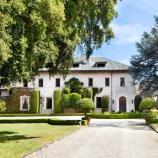
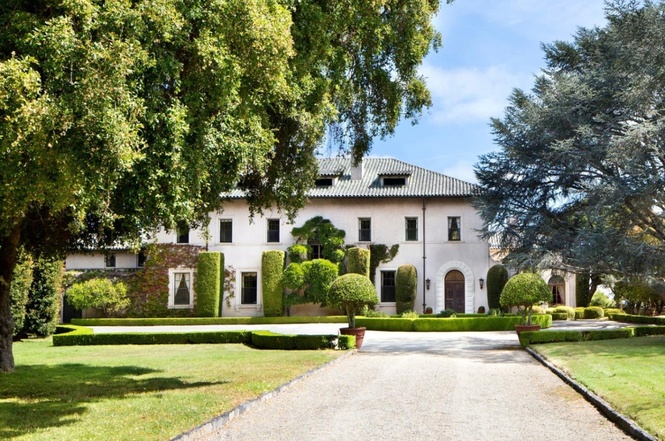
The de Guigne estate is no stranger to the media spotlight — mainly because this property itself is pretty strange.
Its fame began in February of 2013, when the de Guigne estate hit the Hillsborough market at $100 million, making news as one of the five most expensive properties for sale in the nation.
Now, you can buy this fabled property for $29.85 million. That’s a little over $70 million off the original list price.
The life estate years
Owner Christian de Guigne was 75 years old and still living in the home when the home first went on the market in 2013. And even with new buyers, he would continue to do so, because new owners would have to agree to a life estate for de Guigne as part of the sale.
As reported by On the Block, “If indeed he were allowed, via the life estate, to live on in the home until his death, the new owner could potentially wait decades before being able to move in—all the while paying for maintenance of a home with ‘household expenses average[ing] $450,000 a year’ according to the San Jose Mercury News.”
In May of 2015, the listing was canceled.
Queue massive price cuts
Such a property will not go gently in to that good night. In June of 2015, the listing returned, but at $34.9 million, over $6o million off its original price. And, the life estate condition had been removed from the terms of sale.
Still no takers, and this month the price was slashed yet again.
What does your money buy?
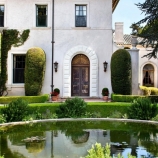
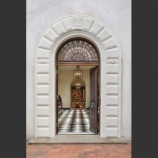
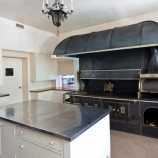
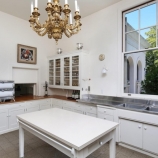
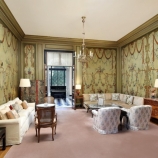
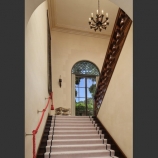
The grand estate was built in 1916 by the San Francisco–based architecture firm Bliss Faville and records describe 10 bedrooms and nine-a-half bathrooms, a ballroom, a grand formal banquet room, a flower-arranging room, a library, and a plethora of additional rooms of vague purpose.
On the 47.5 acre lot, there’s a swimming pool designed by landscape architect Thomas Church, gardens, lawns and hiking trails. The address, listed on a the MLS as 891 Crystal Springs Road, rests on a hilltop overlooking the San Mateo Creek.
Worth it, finally?
Some might say 47.5 acres in San Mateo County alone would fetch any millions. That they come with a 16,000 square foot mansion may add or detract from that value depending on perspective. Readers can share their own perspectives in the comments below.
Anna Marie Erwert writes from both the renter and new buyer perspective, having (finally) achieved both statuses. She focuses on national real estate trends, specializing in the San Francisco Bay Area and Pacific Northwest. Follow Anna on Twitter: @AnnaMarieErwert
Article source: http://blog.sfgate.com/ontheblock/2016/11/14/hillsborough-estate-sees-a-70-million-cut-from-original-listing-price/
SAN FRANCISCO, Nov. 13, 2016 /PRNewswire/ – Dr. Selma Hepp, chief economist for the San Francisco Bay Area’s leading luxury brokerage Pacific Union International, reports that while President-elect Donald Trump did not specifically refer to housing markets in his campaign, there are conclusions that can be drawn from his stance on related subjects.
Hepp posts regular on Pacific Union’s corporate blog, Economic Straight Talk columns offering economic analyses related to the national and Bay Area housing markets. The following executive summary and analysis is from her Friday, Nov. 11 post.
Executive Summary:
America has been disrupted, to say the least. But for a state that is a cradle of disruption, the only thing Californians can do is embrace the challenge. With Donald Trump elected the next President of the United States, the ensuing years will be something of a conundrum, and the future depends on how many of Trump’s campaign stances become actual policies.
After the initial shock, stock markets seemed to have responded favorably. It appears that Trump’s conciliatory speech helped calm investors, and that his confrontational campaign rhetoric may have been simply that. Also, pro-growth administrations are generally viewed favorably by investors. Nevertheless, we can anticipate more uncertainty and volatility ahead.
What Does a Trump Administration Mean for California?
Unfortunately, the impact on California is indeed uncertain and depends on how serious Trump is about abolishing trade agreements, removing favorable regulations on alternative energies, ending the skilled-immigrants visa program, and deporting illegal residents. All of these factors are critical to California’s flourishing economy.
Trump’s trade positions — including opposition to the Trans-Pacific Partnership and declaring China a currency manipulator — support tariffs on China and Mexico, and the resulting trade wars potentially have an enormous adverse impact on California’s future economic growth. So let’s hope that Trump’s conciliatory speech is a truer indication of how he feels. However, given that he outperformed in states with the highest shares of manufacturing employment, he will need to deliver on some of the commitments he made regarding trade agreements. If enacted, the changes will take at least a year to ripple through the economy. Increasing tariffs will cause inflation, which does not bode well for U.S. consumers in general.
But the upcoming administration’s apparent priorities have less impact on California, per se. The first order of business will be repealing Obamacare, and that will take a while since Trump has not proposed a replacement plan. Also, part of Trump’s economic plan is cutting taxes for the wealthiest people and corporations and generally simplifying the tax code. Markets respond well to this, as they anticipate greater levels of corporate investment and profits. Additionally, some pundits argue that the proposed changes may spur productivity growth, a concern since the beginning of the economic recovery.
What Does the Trump Administration Mean for the Housing Market?
That’s a bit of a pickle, since Trump did not mention a housing plan during his campaign.
Housing-policy issues aside, deregulation was a centerpiece of Trump’s campaign. He has talked about dismantling the Dodd-Frank Wall Street Reform and Consumer Protection Act, which has been blamed in large part for severely constraining access to mortgage credit — particularly for those with less than stellar qualifications.
Rep. Jeb Hensarling, a Texas Republican and the chairman of the House Financial Services Committee, is close to Trump and may serve on his administration. Hensarling has sponsored a new legislation, The Financial CHOICE Act, which would roll back significant portions of Dodd-Frank. The legislation is designed to stimulate more private capital into the mortgage market, which means more products but not necessarily wider access to credit for all. The country still lacks solutions for the huge share of the population that has been excluded from access to mortgage credit as a result of current Dodd-Frank rules and the general postfinancial-crisis fear of lending. And given the upcoming administration’s pro-market sentiment, it is doubtful that any specific programs will be put in place to address this issue.
It appears that the largest impact on the housing market will stem from an increase in mortgage rates, which have already started creeping up. The anticipation of more volatility in the financial markets — as well the ripple effects from greater infrastructure spending, more private investment, and higher consumer prices (resulting from higher tariffs) — all suggest that America may be looking at higher interest rates than we anticipated prior to the election outcome. During a serious affordability crisis in the California housing market, higher interest rates are not a welcome outcome.
Still, mortgage rates should remain favorably low and in the range of what pundits have predicted — 4 to 5 percent. To what extent higher interest rates will deter potential homebuyers is hard to guess and will largely still depend on inventory and buyer affordability ceilings. Nevertheless, because of affordability challenges, higher interest rates may dampen home price appreciation going forward.
So far in 2016, California’s median home price appreciated at 6 percent on an annual basis, compared with 4 percent appreciation in the Bay Area, according to data from the California Association of Realtors.
While those appreciation rates were not expected to remain static, upcoming forecasts may show lower price growth than previously projected.
Lastly, something to reflect on given the election outcome is how California approaches new construction. One thing Californians have in common with Trump is a fondness for building walls — in this case walls around their communities that prohibit new construction and restrict the amount of newcomers who can afford to buy homes. This Trump-like attitude toward new development may indeed be more destructive to California’s housing market than many of the potential threats arising from his presidency. Creating new housing units and addressing the affordability challenge are critically important for our state’s continued economic growth and the future of our children.
About Selma Hepp
Selma Hepp is Pacific Union’s Chief Economist and Vice President of Business Intelligence. Her previous positions include Chief Economist at Trulia, senior economist for the California Association of Realtors, and economist and manager of public policy and homeownership at the National Association of Realtors. She holds a Master of Arts in Economics from the State University of New York (SUNY), Buffalo, and a Ph.D. in Urban and Regional Planning and Design from the University of Maryland.
About Pacific Union
Pacific Union is the San Francisco Bay Area’s premier luxury real estate brand operating in eight regions. The brokerage offers a full range of personal and commercial real estate services, including buying, selling, and relocation, and enjoys a relationship with Christie’s International Real Estate as an exclusive affiliate in in the San Francisco, Marin, Sonoma, Napa, Alameda, and Contra Costa counties in the state of California. Locally owned, Pacific Union operates with an entrepreneurial mindset and unwavering commitment to deliver exceptional service and expertise. For more information, please visit us at www.pacificunion.com.
About The Mark Company
The Mark Company is one of the nation’s premier urban residential marketing and sales firms. Founded by Alan Mark in 1997, The Mark Company provides a full range of core consulting services including analytics, design, marketing and sales for urban high-rises and suburban attached properties throughout the Western United States. The firm is a trusted partner to global leaders in residential development and finance, providing buyer-driven sales and marketing strategies that produce industry-leading results. The Mark Company has represented more than 10,000 residences and generated over $5 billion in sales for some of the nation’s most notable and successful developments including The Infinity in San Francisco, Evo in Los Angeles and The Martin in Las Vegas. Current projects include 181 Fremont Residences and The Harrison in San Francisco and Cavalleri in Malibu. A subsidiary of Pacific Union International, one of the San Francisco Bay Area’s top-performing resale brokerages, The Mark Company benefits from an enriched leadership team, enhanced technology and added global reach through its affiliation with Christie’s International. For more information, please visit www.themarkcompany.com.
Photo – http://photos.prnewswire.com/prnh/20161113/438655
To view the original version on PR Newswire, visit:http://www.prnewswire.com/news-releases/trump-and-the-california-housing-market-300361918.html
SOURCE Pacific Union
Article source: http://www.prnewswire.com/news-releases/trump-and-the-california-housing-market-300361918.html
Arreguin beat eight candidates, including a more moderate Democratic city councilman, Laurie Capitelli, who was widely seen as the heir apparent to retiring Mayor Tom Bates. Some insiders saw Arreguin’s win as a changing of the guard in Berkeley: In addition to Arreguin, voters elected two new city council members, Sophie Hahn and Ben Bartlett. Another challenger, Cheryl Davila, is poised to unseat incumbent City Councilman Darryl Moore.
But others viewed the election results as a referendum on downtown development. During his eight-year tenure on the City Council, Arreguin, 32, has opposed Bates’ and Capitelli’s vision of tall, dense buildings near transit corridors. In 2014, he and Hahn, who was then a member of the city’s Zoning Adjustments Board, pushed an ill-fated ballot measure that would have imposed strict affordable housing, labor and environmental requirements on new real estate projects, making them prohibitively expensive to build.
Voters rejected the ballot measure by an overwhelming 74 percent. Two years later, they elected Hahn into city office and backed Arreguin for mayor.

Jesse Arreguin elected Berkeley’s youngest mayor ever
Incumbent Catherine Baker leading in key Assembly race
Oakland’s American Steel Studios sold, artists relieved
Judge orders Oakland councilwoman to release records
Obama endorses 2 Bay Area city council, school board candidates
“You have to ask if this is a reflection of people not wanting change,” said Arreguin’s opponent Capitelli, who holds the North Berkeley district seat that Hahn will take in December. He said two factions of voters found a “natural ally” in Arreguin: One faction wants to stop growth entirely. The other believes the city is not demanding enough from developers in return for their permits to build.
Arreguin, in contrast, saw the election as a race between a young progressive and an old-guard figure. Capitelli is a Realtor who amassed strong support from the industry. Arreguin had the backing of the Service Employees International Union and an endorsement from Sen. Bernie Sanders, which helped propel him to victory.
“It was a very clear choice between me and my opponent, who has literally rubber-stamped every (real estate) project that came before this council,” Arreguin said in an interview Friday.
Capitelli’s campaign manager, Jill Martinucci, recoiled at that depiction. “Laurie doesn’t support razing neighborhoods to build big buildings, but he got characterized that way,” she said. “I think this was a reactionary election.”
The fight over what Berkeley’s downtown should look like has created stark divisions in City Hall for years, with some officials crying out for more housing and commercial projects, while others fear the arrival of wealthy newcomers and tall buildings that will blot out the horizon.
“In talking to thousands of Berkeley voters, development and the housing crisis were their top concerns,” Arreguin said. “People of my generation — the Millennials — were concerned about their ability to afford to live here because of rising rents. Long-term residents were concerned about the changing face of Berkeley: they think these buildings are ugly, they worry about the scale, they think there is no real plan for bringing in thousands of new residents.”
Last year the battle largely hinged on a single project — an 18-story apartment complex at 2211 Harold Way, which drew opposition because of its height, its lack of affordable units, and fears that it would partly block a view of the Golden Gate Bridge from UC Berkeley’s Campanile tower. The City Council approved it in December and asked the developer, HSR Berkeley Investments, to contribute a huge community benefits package, which included union construction labor and $10.5 million for the city’s affordable housing fund. Arreguin abstained from the vote.
Two opponents sued to block 2211 Harold Way in January, but an Alameda County Superior Court judge dismissed their case in October. The project appears to be slowly moving forward.
While some residents in Berkeley despair over big high-rises, the city also faces scrutiny from the other side: A group of build-it city dwellers from the San Francisco Bay Area Renters’ Federation — which goes by the name SFBarf — sued the City Council on Oct. 7 for denying permits to a modest three-house development at 1310 Haskell St. According to the suit, the council violated the state’s Housing Accountability Act, which bars cities from rejecting development for arbitrary reasons — in this case, because neighbors complained. A Superior Court judge ruled in SFBarf’s favor on Oct. 21, ordering the council to schedule a new permit hearing for the project.
Representatives of SFBarf and of another pro-development group called East Bay Forward say they are watching Berkeley closely and will try to influence a special election to fill Arreguin’s council seat early next year.
“I’m extremely disappointed about the local election results,” said Garret Christensen, an economics researcher at UC Berkeley and member of East Bay Forward.
Hahn and Arreguin say they speak for a large and diverse group of Berkeley residents who want new leadership, but don’t want fundamental changes to the city’s skyline.
“People are afraid of losing things that make Berkeley worthwhile — authors, artists, activists, teachers, working families — and they bristle at the thought of a luxury high-rise with not one unit of affordable housing,” Hahn said.
She sees Berkeley’s newly elected leaders as a response to the political dynasty embodied by Bates and his wife, retiring state Sen. Loni Hancock.
“I think politics in Berkeley and in the East Bay have been very dominated by a small group of people for a long time,” Hahn said. “They’re people who have given a lot of good service to the community but who have had power over who gets elected and whose agendas move forward.”
To Bates, the election was mostly about personalities: Arreguin was seen as the new young mayor, while Capitelli was bedeviled by his real estate industry connections.
“In Berkeley, you have ‘left,’ and ‘more left,’” Bates said. “And now the ‘more left’ has taken control, but they’re NIMBYs. So we’ll have to see how that plays out.”
Rachel Swan is a San Francisco Chronicle staff writer. Email: rswan@sfchronicle.com Twitter: @rachelswan
Article source: http://www.sfchronicle.com/bayarea/article/Berkeley-election-symbolizes-a-changing-of-the-10610435.php