Success of SF’s Mission Bay leaves high demand for office space

Success of SF’s Mission Bay leaves high demand for office space


January 5, 2017
Updated: January 5, 2017 9:37pm

  • cd84d 920x920 Success of SFs Mission Bay leaves high demand for office space

Caption

Close

A woman walks past Esposto’s Delicatessen on 16th Street, in the Mission Bay neighborhood, in San Francisco, Calif., on Thursday, Dec. 22, 2016. second pic, below: A model of a buildings in Mission Bay is seen at Alexandria Real Estate offices, in San Francisco, Calif., on Thursday, Dec. 22, 2016. less


Photo: Gabrielle Lurie, The Chronicle


‘);
}

In the dark days of 2010, at the depths of the Great Recession, Mission Bay’s biggest commercial developer did something that seemed prudent at the time: It unloaded 14 acres of land to Salesforce for $287 million.

The deal resulted in a net gain of $60 million for the property owner, Alexandria Real Estate Equities, and reduced risk at a time of uncertain economic outlook. But six years later, Alexandria Chief Operating Officer Stephen Richardson can’t help but wish they had the dirt back.

“I think we would do very well,” he said. “There is more than 2 million square feet of tenant demand for life-science space between here (Mission Bay) and Stanford University.”

‘);
}


For all the complaints about Mission Bay — that it’s sterile, that it lacks retail and street life, that Muni service is insufficient — one thing is certain: Its cluster of commercial biotech development has been a booming success. So much so that demand for space has far outstripped supply and the area’s primary commercial development is pushing north into South of Market.

Mission Bay has about 1.5 million square feet of biotech space, not including UCSF research buildings or affiliated facilities like the California Institute for Quantitative Biosciences, known as QB3, and the J. David Gladstone Institutes, which collaborate with commercial life-science companies.

That space is 100 percent leased to more than 50 tenants. It’s been over two years since there were any vacancies, and any sublease that becomes available is absorbed by neighboring tenants before it hits the market.

b8cd2 920x1240 Success of SFs Mission Bay leaves high demand for office space

“We have no available inventory — the team upstairs is working hard every day to identify new parcels around Mission Bay to see how we can expand,” said Richardson.

But what now seems like the inevitable success of a biotech cluster at Mission Bay was very much a gamble in 2005 when Alexandria acquired 27.5 acres of former Southern Pacific rail yards — a dirt expanse between 16th Street to the south and what would become Mission Bay Boulevard to the north.

At first, Alexandria sublet office space from master developer Catellus in an old Southern Pacific warehouse next to a golf driving range, where designers built a three-dimensional model of all that the neighborhood was to become: sparkling apartment buildings, lush parks, the 43-acre UCSF research campus. Richardson and other executives would talk about how the synergy between UCSF and private biotech firms would create a community similar to the one that had sprung up in Cambridge, Mass., around Harvard and MIT.

“Here we had this vast expanse of dirt and we would say ‘look you’re standing in the middle of UCSF’s campus here. And this will be like Cambridge. And here we’ll have early stage companies and big pharmaceutical companies. We’ll have venture capital people here,’” recalled Richardson. “It was a lot of arm-waving. We were selling the dream.”

Without a tenant in hand, Alexandria started building a 160,000-square-foot building at 1700 Owens St., despite critics saying Mission Bay would never lure tenants from South San Francisco, home to the large Genentech and Amgen biotech campuses. But before the building was complete, the first tenant signed on: Sirna Therapeutics, which was looking to relocate from Colorado to the Bay Area.

In what turned out to be a trend, Sirna was bought by the pharmaceutical giant Merck, which expanded the size of the original lease. One of the next tenants to take a chance on the neighborhood, Pharmion, was acquired by Celgene, a global company with a market capitalization of $92 billion. Those two were followed by Pfizer, Nektar, Bayer and other large pharmaceutical companies.

“That has been a theme. Startup companies move in and big companies acquire them and grow the footprint,” said Richardson.

After 1700 Owens, Alexandria put up 160,000 square feet at 1500 Owens St., 210,000 square feet at 1600 Owens St., and 423,000 square feet at 455 Mission Bay Blvd. In 2011, the group bought 409-499 Illinois St., redeveloping half of the complex and adding Stem Kitchen Garden restaurant, which has become a popular gathering spot for the biotech community. Alexandria is developing 1455-1515 Third St., which will be occupied by Uber.

But while Mission Bay was originally seen as a place that would benefit from spillover of the South of Market boom, it hasn’t turned out that way. Instead, Mission Bay has developed faster than SoMa.

More by J.K. Dineen

“The entitlements were completed in 1998 and it was supposed to be a 40-year development plan.” said Alexandria Vice President Terezia Nemeth. “Here we are 20 years later — and it’s done.”

Only in the last two years, with Mission Bay spoken for, has Alexandria turned north to SoMa. The group is collaborating with TMG Partners on two South of Market developments — 510 Townsend St. and 505 Brannan St. — which are 100 percent leased to tech companies Pinterest and Stripe.

Alexandria is also partnering with TMG on the redevelopment of the San Francisco Tennis Club property at Sixth and Brannan streets, which will include 750,000 square feet of office or biotech space along with affordable housing, a child care center, and a subterranean tennis facility.

“I think SoMa is going to be more of an integrated district with Mission Bay over time. You are going to have a mix of science and tech companies in the same innovation districts,” Richardson said.

Rent for lab space in Mission Bay averages about $65 a square foot for a “triple net” lease, which means that tenants are responsible for expenses. That’s about 8.3 percent higher than last year and about 13 percent higher than the Bay Area’s largest biotech cluster, in South San Francisco.

Christan Basconcillo, research manager for the broker JLL, said it’s gotten to the point where successful biotech startups have to leave Mission Bay in order to grow.

“A lot of them have migrated over to the East Bay,” he said. “It’s tough. There is a lot of pent up demand and not a lot of options.”

J.K. Dineen is a San Francisco Chronicle staff writer. Email: jdineen@sfchronicle.com Twitter: @sfjkdineen

Article source: http://www.sfchronicle.com/bayarea/article/Success-of-SF-s-Mission-Bay-leaves-high-demand-10839077.php
Posted in SF Bay Area News | Tagged | Leave a comment

Zillow predicts hottest neighborhoods in San Jose metro, Oakland

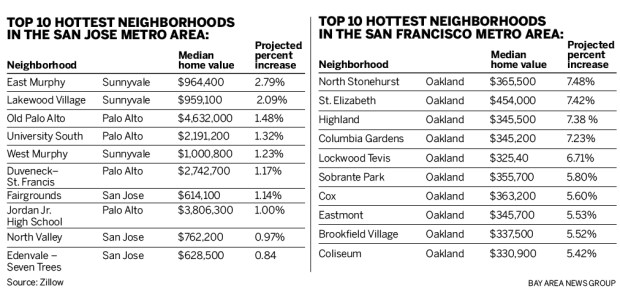
Zillow has just trotted out its 10 hottest neighborhoods for 2017 in the San Jose and San Francisco metro areas — and they’re not necessarily the ones you would have predicted.

Yes, several are in Palo Alto: the Old Palo Alto, University South and Duveneck-St. Francis neighborhoods, all with homes valued in the millions of dollars.

But in the San Jose metro area, the rest are in Sunnyvale and San Jose, in neighborhoods known for modest homes that can still be had for $1 million or less — some in the $600,000 range. The San Jose metro area includes Santa Clara and San Benito counties.

And in the San Francisco metropolitan area — which includes Marin, San Mateo, Contra Costa and Alameda counties — all 10 of the “hottest” neighborhoods are in Oakland, some with prices as low as the $300,000 range.

These are the places where prices are poised to grow the fastest in 2017, Zillow predicts.

“This is a theme we’ve been seeing in many neighborhoods around the country,” said Svenja Gudell, Zillow’s chief economist. “Neighborhoods that are slightly less expensive but still close to other, more desirable neighborhoods are starting to get a spillover effect. … They still have a lot of head-room to grow, value-wise.”

Oakland is the prime example. “So many people are interested in that area, because it’s so easy to commute to San Francisco, and it’s still possible to find a home,” Gudell said.

For this definition of “hotness,” she said, Zillow “simply focused on the price point and how far values are expected to grow. A different definition of hotness might include crime statistics, school ratings, parks, amenities, walkability … . But that’s not what we’re doing here.”

After years of rapid appreciation, home prices in the San Jose metro area are poised to grow by just 0.4 percent in the coming year, Gudell said. In the San Francisco metropolitan area, which includes Oakland, the growth rate is expected to be 1.0 percent.

For Oakland proper, the anticipated growth rate is 3.5 percent.

And East Oakland, where Zillow’s hot neighborhoods are clustered, is “almost like the last frontier,” said Tim Ambrose, president-elect of the Bay East Association of Realtors. “It doesn’t really run that close to BART, and it’s not going to put you into the new, trendy-restaurant kind of area. But look at the prices.”

Zillow puts the median value of a single-family home in Sobrante Park at $355,700.

“You roll the dice,” Ambrose said. “You get to an area that hasn’t been quite gentrified yet and move in there and ride it out. And you have a whole lot of money left over because you haven’t spent $900,000.”

That’s about what it takes to get into some of Sunnyvale’s hot, still relatively affordable neighborhoods. Three of Zillow’s Top 5 for the San Jose metro are in Sunnyvale: the East Murphy, West Murphy and Lakewood Village neighborhoods.

“If you go into any other neighborhoods south of there, the next lowest median price is about $1,360,000,” said Sereno agent Kevin Swartz. “So these are three locations where people can still afford to buy a house, though they’re much smaller.”

The median size of a house sold last year in Lakewood Village, he said, was 1,108 square feet. “They’re flat-topped houses, 1950s-era, but close to the freeway, good for getting to work.”

Likewise, two San Jose neighborhoods on the list — the Fairgrounds and Edenvale-Seven Trees — are places where a new buyer can get a foot in the door, said Intero agent Craig Gorman.

“They’re traditionally more blue-collar neighborhoods,” he said. “They’re areas where the first-time buyer who doesn’t have a $200,000 income can afford to come in and buy a property.”

51278 zillow 010717 01 Zillow predicts hottest neighborhoods in San Jose metro, Oakland

Article source: http://www.mercurynews.com/2017/01/06/zillow-predicts-hottest-neighborhoods-in-san-jose-metro-oakland/

Posted in SF Bay Area News | Tagged | Leave a comment

Zillow predicts Bay Area’s hottest neighborhoods for 2017

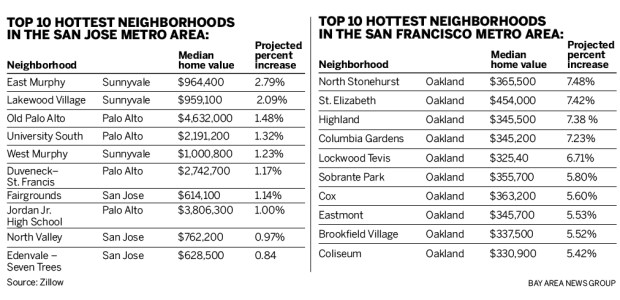
Zillow has just trotted out its 10 hottest neighborhoods for 2017 in the San Jose and San Francisco metro areas — and they’re not necessarily the ones you would have predicted.

Yes, several are in Palo Alto: the Old Palo Alto, University South and Duveneck-St. Francis neighborhoods, all with homes valued in the millions of dollars.

But in the San Jose metro area, the rest are in Sunnyvale and San Jose, in neighborhoods known for modest homes that can still be had for $1 million or less — some in the $600,000 range. The San Jose metro area includes Santa Clara and San Benito counties.

And in the San Francisco metropolitan area — which includes Marin, San Mateo, Contra Costa and Alameda counties — all 10 of the “hottest” neighborhoods are in Oakland, some with prices as low as the $300,000 range.

These are the places where prices are poised to grow the fastest in 2017, Zillow predicts.

“This is a theme we’ve been seeing in many neighborhoods around the country,” said Svenja Gudell, Zillow’s chief economist. “Neighborhoods that are slightly less expensive but still close to other, more desirable neighborhoods are starting to get a spillover effect. … They still have a lot of head-room to grow, value-wise.”

Oakland is the prime example. “So many people are interested in that area, because it’s so easy to commute to San Francisco, and it’s still possible to find a home,” Gudell said.

For this definition of “hotness,” she said, Zillow “simply focused on the price point and how far values are expected to grow. A different definition of hotness might include crime statistics, school ratings, parks, amenities, walkability … . But that’s not what we’re doing here.”

After years of rapid appreciation, home prices in the San Jose metro area are poised to grow by just 0.4 percent in the coming year, Gudell said. In the San Francisco metropolitan area, which includes Oakland, the growth rate is expected to be 1.0 percent.

For Oakland proper, the anticipated growth rate is 3.5 percent.

And East Oakland, where Zillow’s hot neighborhoods are clustered, is “almost like the last frontier,” said Tim Ambrose, president-elect of the Bay East Association of Realtors. “It doesn’t really run that close to BART, and it’s not going to put you into the new, trendy-restaurant kind of area. But look at the prices.”

Zillow puts the median value of a single-family home in Sobrante Park at $355,700.

“You roll the dice,” Ambrose said. “You get to an area that hasn’t been quite gentrified yet and move in there and ride it out. And you have a whole lot of money left over because you haven’t spent $900,000.”

That’s about what it takes to get into some of Sunnyvale’s hot, still relatively affordable neighborhoods. Three of Zillow’s Top 5 for the San Jose metro are in Sunnyvale: the East Murphy, West Murphy and Lakewood Village neighborhoods.

“If you go into any other neighborhoods south of there, the next lowest median price is about $1,360,000,” said Sereno agent Kevin Swartz. “So these are three locations where people can still afford to buy a house, though they’re much smaller.”

The median size of a house sold last year in Lakewood Village, he said, was 1,108 square feet. “They’re flat-topped houses, 1950s-era, but close to the freeway, good for getting to work.”

Likewise, two San Jose neighborhoods on the list — the Fairgrounds and Edenvale-Seven Trees — are places where a new buyer can get a foot in the door, said Intero agent Craig Gorman.

“They’re traditionally more blue-collar neighborhoods,” he said. “They’re areas where the first-time buyer who doesn’t have a $200,000 income can afford to come in and buy a property.”

904a6 zillow 010717 01 Zillow predicts Bay Areas hottest neighborhoods for 2017

Article source: http://www.mercurynews.com/2017/01/06/zillow-predicts-hottest-neighborhoods-in-san-jose-metro-oakland/

Posted in SF Bay Area News | Tagged | Leave a comment

House that sold for one dollar in Bay Area needs a home

bafc4 Historic%2520Houseweb House that sold for one dollar in Bay Area needs a home
Even if it costs $300,000 to fix and move this house that sold in Hercules, Calif. for a dollar, the person who bought it thinks he can make a profit. - Sam Harnett

The median price for a house in the San Francisco Bay Area is around $700,000. Even so, a place just sold there for a buck. The story behind this one-dollar house involves the loss of redevelopment funds and explosives.

The house is located about 10 miles north of Berkeley, in Hercules, a small suburban city on the edge of the bay. The city gets its name from a large explosives company that moved there back in the 1880s, explained Steven Lawton, a local historian and real estate broker. And it’s a relic of that industrial boom.

Lawton said the house is “on the national register of historic places as a contributing structure to the only remaining company town of an explosives factory in the United States.”

The house is perched on a grassy lot where the city moved it to make way for new housing. It is in rough shape, but it has old-growth redwood timber, ornate wooden siding, and bay windows. The city planned to turn it into a community center using state redevelopment money, but in 2011 Gov. Jerry Brown cut those funds.

Lawton said the city now can’t even scrounge up $20,000 to demolish the house, let alone fix it. So the city put it on sale for a dollar.

It’s a little misleading to call this a house for a dollar, Lawton said. The house has no property because it is stranded on a city lot. The building would have to be fixed up and moved to a parcel of land.

“It’s not a house for a dollar,” Lawton said, “it’s a project for a dollar.”

Where some saw a project, Dmitri Belser saw opportunity.

Belser, who lives in Berkeley, restores and then rents out old buildings.

“My first thought when I saw the house was that this is our house, we have to take it,” Belser said.

Belser said certain old houses just have a feel. They aren’t utilitarian like modern homes. He started saving old places as a hobby, but the pastime has paid off. Belser has bought several one-dollar houses, and real estate is so expensive in the Bay Area that Belser has been able to fix them up and turn a profit.

Belser estimated that it might cost around $300,000 to renovate and move the Hercules house. That means it would be a $300,001 house in the end, which may sound like a lot. But this is the Bay Area. So that’s cheap.

Belser wants to keep the house close to Hercules, but he’s having trouble finding affordable property. Unlike this historic house, there’s no land nearby going for anywhere close to a dollar.

Article source: https://www.marketplace.org/2017/01/03/business/house-sold-one-dollar-bay-area-needs-home

Posted in SF Bay Area News | Tagged | Leave a comment

House that sold for one dollar in Bay Area needs a home

The median price for a house in the San Francisco Bay Area is around $700,000. Even so, a place just sold there for a buck. The story behind this one-dollar house involves the loss of redevelopment funds and explosives.

The house is located about 10 miles north of Berkeley, in Hercules, a small suburban city on the edge of the bay. The city gets its name from a large explosives company that moved there back in the 1880s, explained Steven Lawton, a local historian and real estate broker. And it’s a relic of that industrial boom.

Lawton said the house is “on the national register of historic places as a contributing structure to the only remaining company town of an explosives factory in the United States.”

The house is perched on a grassy lot where the city moved it to make way for new housing. It is in rough shape, but it has old-growth redwood timber, ornate wooden siding, and bay windows. The city planned to turn it into a community center using state redevelopment money, but in 2011 Gov. Jerry Brown cut those funds.

Lawton said the city now can’t even scrounge up $20,000 to demolish the house, let alone fix it. So the city put it on sale for a dollar.

It’s a little misleading to call this a house for a dollar, Lawton said. The house has no property because it is stranded on a city lot. The building would have to be fixed up and moved to a parcel of land.

“It’s not a house for a dollar,” Lawton said, “it’s a project for a dollar.”

Where some saw a project, Dmitri Belser saw opportunity.

Belser, who lives in Berkeley, restores and then rents out old buildings.

“My first thought when I saw the house was that this is our house, we have to take it,” Belser said.

Belser said certain old houses just have a feel. They aren’t utilitarian like modern homes. He started saving old places as a hobby, but the pastime has paid off. Belser has bought several one-dollar houses, and real estate is so expensive in the Bay Area that Belser has been able to fix them up and turn a profit.

Belser estimated that it might cost around $300,000 to renovate and move the Hercules house. That means it would be a $300,001 house in the end, which may sound like a lot. But this is the Bay Area. So that’s cheap.

Belser wants to keep the house close to Hercules, but he’s having trouble finding affordable property. Unlike this historic house, there’s no land nearby going for anywhere close to a dollar.

Article source: http://wunc.org/post/house-sold-one-dollar-bay-area-needs-home

Posted in SF Bay Area News | Tagged | Leave a comment