Pleasanton Tops List Of Bay Area Family-Friendly Cities « CBS San …

(CBS SF) — The city of Pleasanton is among the top U.S. cities rated for family-friendliness, according to a real estate website.

The annual ranking of more than 500 U.S. cities was compiled by Apartment List. The website based its rankings on four criteria: safety as determined by FBI data on violent crime; housing affordability, taking into account area income and rental prices; education quality as determined by graduation rates; and child friendliness, gleaned as a percentage of population under age 18.

Pleasanton was the top-ranked Bay Area city, ranking 18th in overall family-friendliness, followed closely by Palo Alto, Fremont and San Ramon.

Palo Alto was determined to have high housing affordability despite its elevated real estate and rental prices, which are somewhat offset by the city’s high median household income of $136,000, according to the U.S. Census Bureau.

Sunnyvale, South San Francisco, Alameda and Daly City were other Bay Area cities that made the top 100 out of 510 cities ranked.

At the opposite end of the family-friendly scale, Vallejo was nearly at the bottom with a rank of 507 while Oakland was ranked at 503.

Apartment List designated Flower Mound, Texas, as the top family-friendly city in the U.S. Flower Mound is just north of Dallas-Fort Worth. Nearby Frisco was ranked as the second-most family-friendly.

Thousand Oaks in Ventura County was the top-rated California city.


Article source: http://sanfrancisco.cbslocal.com/2017/01/24/pleasanton-tops-list-of-bay-area-family-friendly-cities/

Posted in SF Bay Area News | Tagged | Leave a comment

Trump’s swift mortgage move angers real estate industry

Trump’s swift mortgage move angers real estate industry


January 24, 2017
Updated: January 24, 2017 7:00am

cbf02 920x1240 Trumps swift mortgage move angers real estate industry

‘);
}

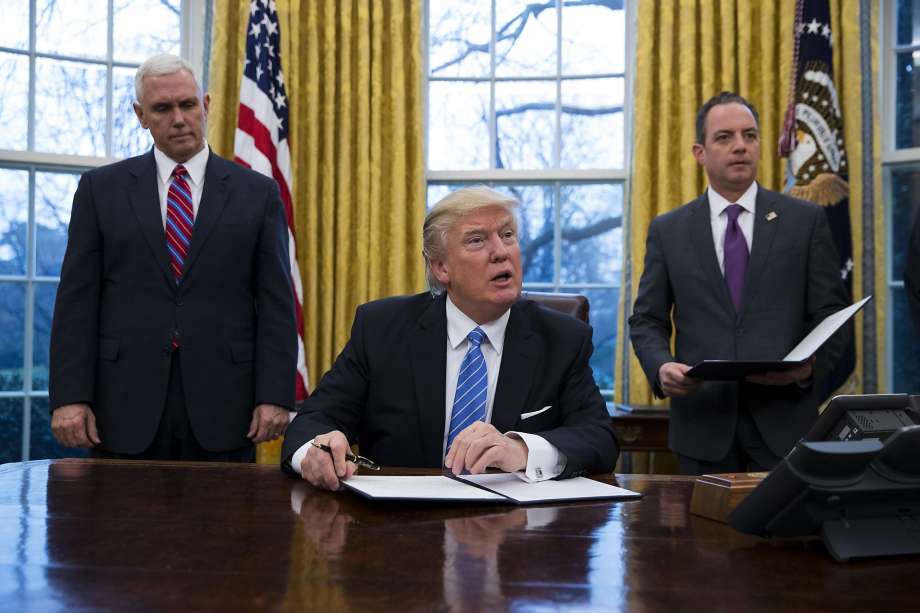
Donald Trump may have made his fortune in real estate, but one of his administration’s first moves has upset the state and national Realtors associations.

Shortly after the inauguration on Friday, the U.S. Department of Housing and Urban Development “suspended indefinitely” a planned cut in the annual mortgage insurance premium on home loans insured by the Federal Housing Administration.

What’s not clear is whether the Trump team is signaling that it wants less government involvement in housing and mortgage markets or whether it was simply reacting to a move the Obama administration made on its way out the door.

‘);
}


The Obama administration announced the cut Jan. 9, and it was supposed to take effect this Friday. It would have reduced the annual insurance premium on most new FHA mortgages to 0.6 percent from the current 0.85 percent. That quarter-point cut would have saved someone with a $500,000 mortgage $1,250 per year.

Realtor groups immediately urged Trump to review its decision and reinstate the cut. “According to our estimates, roughly 750,000 to 850,000 home buyers will face higher costs and 30,000 to 40,000 new home buyers will be left on the sidelines in 2017 without the cut,” National Association of Realtors President William E. Brown said in a statement.

More by Kathleen Pender

“Home buyers in California, who would have saved an average of $860 a year, will be negatively impacted more than any other state by the decision to not reduce the FHA premium,” California of Realtors Association President Geoff McIntosh said in a statement.

On the other hand, Ed Pinto, a resident fellow with the American Enterprise Institute, said that halting the premium cut “is actually good news for first-time buyers.” His research shows that when you cut the mortgage insurance premium in a seller’s market where there’s very little inventory, like we have in most parts of the country, it increases demand for FHA loans and increases home prices, making homes less affordable for FHA borrowers.

FHA loans are popular with first-time home buyers because they require lower down payments (as little as 3.5 percent) and lower credit scores (generally down to 580) than Fannie Mae and Freddie Mac. Fannie and Freddie require mortgage insurance on loans with less than 20 percent down, but it comes from private-sector companies.

The FHA accounted for 12.1 percent of loans in the San Francisco metro area in the 12 months ending in September. That compares with 24.4 percent in California and 22.3 percent nationwide, according to the AEI/First American National Housing Market Index.

FHA loans are somewhat less popular here because the maximum loan amount this year on a one-unit home is $636,150 in all Bay Area counties except Solano, where it’s $431,250, and Sonoma, where it’s $595,700. In November, the median home price across the nine-county region was $695,000 according to CoreLogic.

The FHA charges borrowers a one-time mortgage insurance premium, which can be rolled into the loan, and an annual premium that is added to the monthly payment. These premiums go into the FHA’s Mutual Mortgage Insurance Fund, which absorbs losses on FHA loans.

Before the housing crisis, the annual premium on FHA loans with less than 5 percent down was 0.55 percent, but steep losses forced the FHA to raise this premium as high as 1.35 percent in April 2013. Since then, the fund has improved and the premium was cut.

In November, HUD announced that the fund had a capital ratio of 2.32 percent, marking the second consecutive year it had met its “statutory requirement to maintain at least a 2 percent capital ratio.”

“In fairness to the Trump administration, had the Obama administration felt (a premium cut) was appropriate, they should have done it back in November,” said Guy Cecala, publisher of trade publication Inside Mortgage Finance. He added, however, that the Obama administration could have been responding to the half-point jump in mortgage rates that took place after Trump won the election.

Edward Mills, an analyst with FBR Co., said the move last week “was less about sending a message and more about meeting disclosure timelines required under federal mortgage regulations.” These rules generally require final loan documents to be sent out seven days before closing. “If they had waited until Monday (to suspend the premium cut), loans set to close between the 27th and 30th probably would not be able to close. You would have had to re-disclose,” he said.

Mills said we won’t really know where Trump will stand on real estate “until we see who he chooses as FHA director.”

He said that two potential nominees, Mark Calabria (a director at the libertarian Cato Institute) and House Financial Services Commission staffer Clinton Jones, come from the Republican Party’s conservative wing and would likely back limited federal support for housing. Two other potential nominees, Shawn Krause (a top executive with Quicken Loans) and Edward Brady (an Illinois home builder) come from the mortgage/home building world “and would likely push to expand the FHA’s role in the market,” he said.

Kathleen Pender is a San Francisco Chronicle columnist. Email: kpender@sfchronicle.com Twitter: @kathpender

Article source: http://www.sfchronicle.com/business/networth/article/Trump-s-swift-mortgage-move-angers-real-estate-10878383.php

Posted in SF Bay Area News | Tagged | Leave a comment

Cascade Mall sold a few months after mass shooting

The Cascade Mall in Burlington, site of a mass shooting a few months ago, has sold as part of a deal between two large California real estate firms.

Santa Monica-based Macerich Company sold the Cascade Mall and another shopping mall in the San Francisco Bay Area to San Francisco-based Merlone Geier Partners for $170 million. The exact price for Cascade Mall was not separated out, though the Bay Area mall is bigger and has higher sales per store.

The single-story Cascade Mall opened in 1989 and includes a Target, Macy’s, JC Penney and several smaller stores next to Interstate 5.

It’s about 87 percent leased and generates sales of $319 per square foot, Macerich said. Merlone Geier, which owns malls and retail centers up and down the West Coast, already owns the Burlington North Marketplace next door.

Merlone Geier says on its website it specializes in redevelopment, but the firm declined to comment on its plans are for Cascade. Malls in general are facing tough times as more shoppers move online.

Skagit County records show the sale closed on Wednesday. Macerich bought the mall for $41 million in 1999.

The Cascade Mall was the site of a mass shooting in September and remains in the news as the suspected shooter’s prosecution winds through the court system. An Oak Harbor man is awaiting trial after he was arrested on suspicion of killing five people, opening fire with a rifle near the Macy’s cosmetics counter, prosecutors say.

It’s unclear whether the shooting has affected attendance at the mall or the price of the property; Macerich did not respond to questions. Around the time of the shooting, Cascade already had a higher rate of vacant stores and lower sales per square foot than the average U.S. mall.

Article source: http://www.seattletimes.com/business/real-estate/cascade-mall-sold-a-few-months-after-mass-shooting/

Posted in SF Bay Area News | Tagged | Leave a comment

Will Trump end crackdown on dirty cash in luxury real estate?

Just a month after President Donald Trump’s inauguration, a federal anti-money laundering program that targets luxury real estate is set to expire.

The dragnet monitors pricey home deals for signs of dirty cash, helping detect criminals who launder money through real estate. Manhattan and Miami-Dade County were the first markets scrutinized by the feds.

Here’s the big question: Will Trump — who made his money as a developer — keep the heat on the real estate industry? And if the administration of a developer-turned-president chooses not to renew or expand the regulations, will it be perceived as a conflict of interest?

Unlike other industries where cash changes hands freely, real estate has few checks on buyers.

Drug dealers and corrupt foreign officials have been busted buying condos and mansions in the United States. While the Obama administration rules were blasted by developers and brokers as faulty, they don’t seem to have hurt business as much as first feared since going into effect in March.
f330f 01 23 TrumpRealEstate Will Trump end crackdown on dirty cash in luxury real estate?

Trump’s decision could affect home prices in South Florida and other top markets. Streams of foreign cash are driving up prices beyond what many locals can afford, even as they’ve created jobs in the construction and real estate sectors. More than 70 percent of foreign buyers in South Florida pay cash, according to the Miami Association of Realtors. (Cash deals are vulnerable to money laundering because they don’t involve banks, which are required to report suspicious activity.)

The new president’s team did not respond to interview requests. And the Financial Crimes Enforcement Network (FinCEN) — the U.S. Treasury Department agency responsible for the rules — said it could not comment on its plans.

“As we are still in the data-gathering phase …. we cannot speculate on any future actions,” said Stephen Hudak, a FinCEN spokesman. The agency has described the regulations — renewed for 180 days at a time — as a pilot program to decide if real estate deserves permanent anti-money laundering rules.

Law enforcement supports the push.

We come across real estate being purchased with illicit funds once every other case. John Tobon, U.S. Homeland Security

In the United States, it’s possible for a shell company to buy a home without anyone knowing who the real owner is. That allows criminals to stash cash in real estate, officials say.

“We don’t come across [money laundering in real estate] once every 10 or 12 cases,” said John Tobon, U.S. Homeland Security Investigations Deputy Special Agent in Charge for South Florida. “We come across real estate being purchased with illicit funds once every other case. And then the challenge becomes who is the real owner. … When we knock on the door of the individuals involved in the real estate transaction, they say they don’t know.”

The initiative — known as a geographic targeting order (GTO) because it zeroes in on specific metro areas — is set to expire on Feb. 23. Before then, FinCEN could renew the order for another six months. Or it could announce plans to make the measure permanent. Or it could simply allow the rules to lapse, saying it had accomplished its data-gathering mission.

Another GTO targeting electronics exporters in Doral was not renewed after a year.

FinCEN’s director, Jennifer Shasky Calvery, left the agency last year. That means Trump’s nominee for Treasury secretary, former Goldman Sachs executive Steven Mnuchin, if confirmed, will appoint her successor.

Decision time

Trump staked his presidential campaign on business-friendly policies and support for law enforcement.

But in real estate, those pledges could clash like bulldozers playing chicken.

via GIPHY

In a video address previewing his first 100 days in office, Trump said he would “formulate a rule which says that for every one new regulation, two old regulations must be eliminated.”

“So important,” he added.

In other speeches, he cast himself as a “law and order” candidate.

“On crime, I am going to support more police in our communities, appoint the best prosecutors and judges in the country, pursue strong enforcement of federal laws, and I am going to break up the gangs, the cartels and criminal syndicates terrorizing our neighborhoods,” he said in an August speech.

Laundering money through real estate is a key way criminal organizations hide their profits.

Lee Stapleton, a South Florida attorney and former federal prosecutor, said even with a change to an anti-regulation administration, she feels a reversal is unlikely.

“It’s difficult to un-ring the bell,” Stapleton said. “Once these regulations have been put in place, it’s more likely that they will be expanded to other cities rather than removed from the cities where they already exist. … If it’s something that’s been successful in the test cities, it’s possible to see it nationwide.”

So far, there’s been little indication which way FinCEN will go.

Andrew Ittleman, an attorney who focuses on anti-money laundering compliance, said he was sure the rules were here to stay — when it seemed like Democratic nominee Hillary Clinton would be the next commander-in-chief.

“We now have a president who used to be a real estate developer,” Ittleman said. “That’s a big wild card. … He’s going to have a decision to make as to his priorities: Do we want to curb this kind of money laundering? If so, is it worth curbing future real estate development?”

For the Trump administration, any decision on the issue presents a conflict of interest, said Richard Painter, a former chief ethics lawyer for George W. Bush who has urged Trump to divest his family’s business holdings.

“If the regulation gets rescinded, it could appear Treasury is backing off money laundering in real estate,” Painter said. “And why? Because the president is a real estate developer who sells a lot of high-end units? Or because of a legitimate policy goal? No one will know.”

As a developer, Trump signed licensing deals for several luxury condo towers in South Florida. Among the buyers at three Trump-branded properties in Sunny Isles Beach were members of a Russian-American organized crime group, a Venezuelan oilman convicted in a bribery scheme and a Mexican banker accused of robbing investors of their life savings, a Miami Herald investigation found. (An attorney for Trump said his organization was not involved in sales.)

Crackdown begins

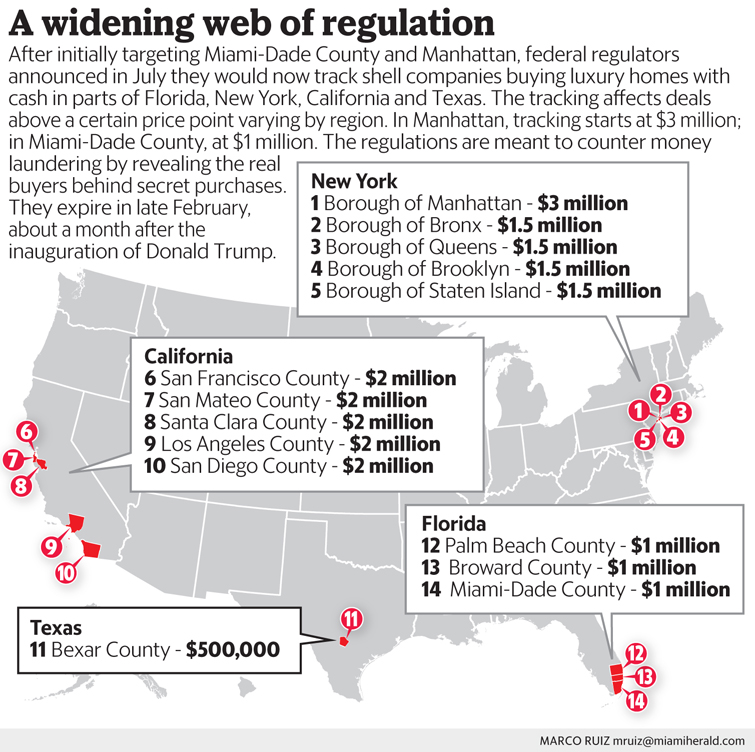
In January 2016, FinCEN announced it would begin monitoring secretive luxury home transactions in two markets: Miami-Dade and Manhattan.

The agency chose Miami and Manhattan because in both places many homes are bought with cash and banks report a high number of suspicious transactions. The regulations were later expanded to other markets in New York, Florida, Texas and California.

The rules require title insurance companies to report the true owners of shell companies using cash to buy luxury homes. In Miami-Dade, the regulations kick in for deals of $1 million or more. In Manhattan, the price point starts at $3 million. (Title insurers play a role in almost all real estate transactions.)

Banks operate under similar “know-your-customer” rules.

At the time, real estate players balked, worried about a negative effect on business and the industry’s reputation. The Miami Realtor’s Association hosted a seminar entitled “How to Avoid the Treasury Trap.”

So far, however, the effect on sales has been muted, according to Realtors, analysts and industry data.

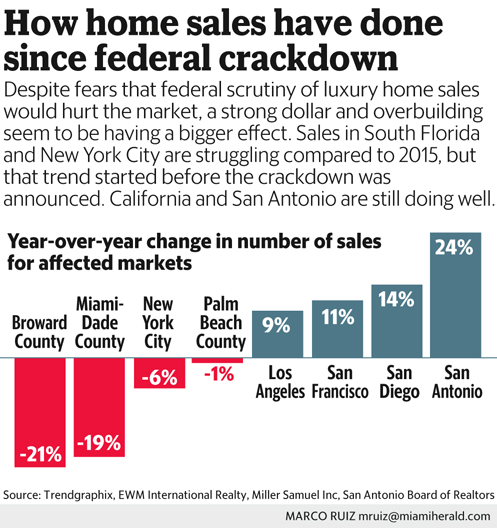
While it’s true that luxe sales fell dramatically in South Florida in 2016, most of the decline is attributable to a strong dollar, economic instability in Latin America and overbuilding, said Ron Shuffield, president and CEO of EWM Realty International, one of South Florida’s top brokerages.

19 percent Decline in sales of $1 million or more in Miami-Dade County since the FinCEN order went into effect

“When you started getting to a point where it was 100 percent more expensive to buy here than it was the year before, many of the big Latin American buyer markets shut down,” Shuffield said.

The number of sales began to fall before the GTO went into effect. Since then, the free-fall has continued. In Miami, sales of more than $1 million fell 19 percent year-over-year since the order began in March 2016, according to EWM and Trendgraphix. In New York City, sales were down 6 percent, appraisal firm Miller Samuel found.

In July, FinCEN announced it would expand its order. Now under heightened scrutiny: all five boroughs of New York City; Miami-Dade, Broward and Palm Beach counties; the San Francisco bay area, Los Angeles and San Diego; and the county that includes San Antonio, Texas.

Sales in affected markets in California and Texas markets have boomed, suggesting the GTO is playing only a small role in the South Florida and New York slowdowns.
f330f 01 23 Trump Will Trump end crackdown on dirty cash in luxury real estate? 

FinCEN hasn’t said how many transactions have been reported. In a conference call with reporters last year, a Treasury official revealed that a quarter of the transactions reported to the agency in Miami-Dade and Manhattan involved people whose banks had also filed suspicious activity reports about their business dealings.

Not so bad for business

The narrowly tailored order hasn’t been as burdensome as the industry feared.

“I don’t think our title companies have had to deal with more than a couple of these transactions,” Shuffield said. “We thought there might be a stigma that would attach to New York and Miami. But I think people have forgotten about it.”

One reason for that: Cash, in FinCEN’s definition includes hard currency, personal checks, business checks, traveler’s checks and money orders. But it does not include bank wire transfers, the most common way buyers pay for pricey homes.

FinCEN’s authority does not allow it to track wire transfers. But it has asked Congress for that power, with the support of law enforcement.

“We’re one of the only countries in the world that doesn’t keep track of incoming and outgoing wires,” said Tobon. “The banks do it, but they do it for their business purposes. I have to get a subpoena, and the info is very limited. If I were working for the [Royal Canadian Mounted Police], I would have that in real time.”

If permanent regulations allow monitoring of wire transfers, the order could have a more dramatic affect, brokers agree.

Some buyers have tried to avoid the disclosure requirements by using wire transfers instead of cash, according to Leonard Prescott, Florida counsel for First American Title Insurance, who spoke at a Greater Miami Chamber of Commerce event last year.

Before this ruling, I don’t think most were aware of the scale of kleptocracy around the world. Jonathan Miller, housing analyst

While the effects of the crackdown are difficult to measure in economic terms, they have helped educate the business community and the public, said Jonathan Miller, a New York-based housing analyst.

“Before this ruling, I don’t think most were aware of the scale of kleptocracy around the world, so it helped shed some light on it,” he said. “With the new administration and their outward goal to reign in regulations, I have to wonder if it will be remain in place indefinitely.”

Richard Steinberg, a luxury broker in New York and Palm Beach, said he doesn’t think the order was well conceived. But he has changed the way he does business since it was issued: Even though the rules apply to title insurers, not brokers, he now insists on knowing the names of all his buyers, not just their lawyers or accountants. So far, he said, clients have agreed.

“Why look for problems?” he asked. “I don’t want anything to come back and haunt me.”

Article source: http://www.miamiherald.com/news/business/biz-monday/article127809744.html

Posted in SF Bay Area News | Tagged | Leave a comment

Bay Area housing: Is renting or buying more affordable?

In two-thirds of the nation’s busiest housing markets, it’s more affordable to buy a house than to rent.

But in the Bay Area, that’s hardly the case.

Given the rapid appreciation of home prices here, it’s still a better deal to rent in eight of the region’s nine counties — even with the shocking increases in rents over the past few years. Only in Contra Costa County — where homes remain relatively affordable, especially in inland areas — is it more affordable to buy than rent.

Those are the conclusions of a new report that draws on 2016 fair-market rent data from the U.S. Department of Housing and Urban Development and wage data from the U.S. Bureau of Labor Statistics, along with public records for home sales in 540 U.S. counties. The report does not consider long-term financial advantages of home ownership, only what it takes to cross the first hurdle and simply buy a house.

“Home prices have become so high so quickly in the Bay Area that renting has become a better option,” said Daren Blomquist, senior vice president of Irvine-based Attom Data Solutions, which analyzed the numbers and wrote the report. “That’s not to say that renting is affordable, but it’s become a more affordable option in most of the Bay Area counties.”

How does he explain the trend?

“Nationally, home prices are consistently outpacing rent growth,” Blomquist said. “Prices for the most part have consistently outpaced wage growth as well during this housing recovery. And we’ve reached a point where that trend has created a sharp divide between the price of homes and what the average wage earner can afford.”

In the Bay Area in 2016, Santa Clara was one of only two counties where wage growth, up 6.8 percent, outpaced home appreciation, up 5.9 percent. (In Napa County, wages were up 5.2 percent, slightly outpacing home-price growth of 5.0 percent.)

But when home prices and wages are examined going back to  2012 — when the housing recovery took off in most of the region — prices get the upper hand, outstripping wages across the nine counties. In Santa Clara County, for instance, home prices have jumped an astounding 92 percent since the first quarter of 2012, while wages have risen just 16 percent. In Contra Costa County, home prices have jumped 113 percent while wages actually fell 4.0 percent.

On top of this, Blomquist added a bleak prediction: “With the prospect of rising interest rates, buying a home is going to become even less affordable than it has been, and I think that’s going to tilt the balance in favor of rent for a lot of people. In the Bay Area, the equation already is favoring renting. But rising interest rates will even further accelerate that trend.”

In fact, rents lately have begun to level off around the Bay Area.

That said, renting still poses a challenge for many wage earners. According to the new report, Marin County is the most rent-challenged county in the United States. The average weekly wage there is $1,243, but the median rent for a three-bedroom home in 2017 is $4,250 — requiring that the typical earner put about 77 percent of his or her gross pay toward rent for a home of that size.

When two or three people rent a home, as would generally be the case, the percentage falls, of course. Still, the numbers are a little unnerving for Bay Area renters.

Article source: http://www.mercurynews.com/2017/01/05/bay-area-housing-report-renting-is-more-affordable-than-buying/

Posted in SF Bay Area News | Tagged | Leave a comment