Sound Off: What synergies exist between China’s and the Bay Area’s real estate markets?

A: The San Francisco Bay Area, a popular location for Chinese investors, continues to attract home buyers. According to the National Association of Realtors, for the sixth consecutive year, China exceeded other countries in both the number of units and the dollar volume of residential housing in the U.S.

California, and in particular, the Bay Area, continues to be the favorite among Chinese home buyers, due to its good weather, strong economic growth and already large concentration of Chinese communities.

According to the NAR’s annual report, 90% of all international investment is on one coast or the other–as it’s more appealing, a better investment and the appreciation is stronger.

Traditionally some wealthy buyers come here to invest in expensive properties, and these days we do find more parents are buying homes for their children who work or study in the Bay Area (and an NAR survey found that Chinese buyers were the most likely to purchase a house for student housing).

However, analysts have pointed to China enacting tight, new restrictions on U.S real estate investment, in which the Bay Area real estate market may now start to feel the effects of—and investment and purchases did slow mid-third quarter of 2018.

Kathleen Daly, Coldwell Banker, 415-519-6074, kdaly@cbnorcal.com; Lisa Lange, Coldwell Banker, 415-847-7770, lisalange@coldwellbanker.com.

A: The United States and China have many synergies and some polarizing differences. Tariffs have certainly been the one common theme we’ve been reading about most recently, and the reliance on both countries to get along so each can benefit from the others products and natural resources.

Both economies depend on exports to keep our economies going. Another economic component is the stability of the U.S. dollar and how the Chinese see this stability as a safe harbor for investing in U.S. real estate. Unlike China, where the land is owned by the government and the home owner basically owns the home with a long term land lease.

The Chinese government also has a large investment in US treasuries because of the stability of the U.S. dollar. On the real estate front both places are very desirable locations to live and there isn’t much excess land in either spot so our real estate both trade at a premium. This premium forces both the U.S. and China to struggle with affordable housing for the working class.

I think this has continued to change not only living arrangements with more people sharing their living accommodations or alternatively forcing longer commutes to reach more affordable areas.

Matt Heafey, the Grubb Co., 510 541-1754, heafey@grubbco.com.

A: Bay Area real estate’s strong ties with Chinese buyers continue at upper end and entry level markets.

This spring home shopping season started off on a cautious note at the tail of the sluggish fourth quarter of 2018, but eventually pulled through with super high-end and entry level homes seeing the most activity.

We are seeing no hesitation by the well-heeled Chinese closing all-cash deals at tens of millions price tags, despite China’s tightened policy. The market is being helped by a welcome phenomenon—an increased supply. Notably, Baby Boomers are finally selling to be close to their grandchildren. The San Francisco and San Jose areas are churning out new construction homes to feed the Chinese entry-level buyer to helping them realize their California Dream.

The energy is likely to carry over to the summer season when overseas Chinese families are coming for summer camps.

Amy Sung, Compass, 650-468-4834, amy@amysung.com.

Article source: https://www.sfchronicle.com/realestate/article/Sound-Off-What-synergies-exist-between-China-s-13913765.php
Posted in SF Bay Area News | Tagged | Leave a comment

Two retro-chic homes on one lot in Corona Heights listed for $2.6M


  • 239b5 920x920 Two retro chic homes on one lot in Corona Heights listed for $2.6M

    Two separate remodeled homes on this single lot one of SF’s most beautiful and centrally located neighborhoods, make for a unique property, asking $2.6M

    Two separate remodeled homes on this single lot one of SF’s most beautiful and centrally located neighborhoods, make for a unique property, asking $2.6M


    Photo: Open Homes Photography

  •  Two retro chic homes on one lot in Corona Heights listed for $2.6M

Caption

Close

Two separate remodeled homes on this single lot one of SF’s most beautiful and centrally located neighborhoods, make for a unique property, asking $2.6M

Two separate remodeled homes on this single lot one of SF’s most beautiful and centrally located neighborhoods, make for a unique property, asking $2.6M


Photo: Open Homes Photography


Just a few blocks from both Duboce and Buena Vista parks in San Francisco’s Corona Heights neighborhood, this mini–and decidedly arty–compound with two separate homes is listed for $2.595 million.

The homes


The property consists of two homes. The first, 2321 15th St. offers two bedrooms, one full-bathroom and two half-bathrooms.

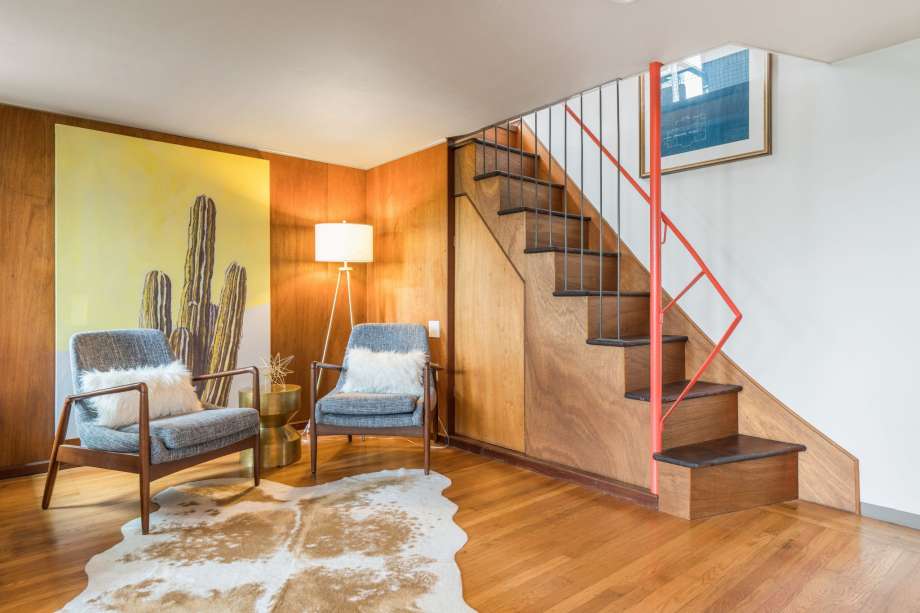
Inside, this bungalow-style abode is a living room with vaulted ceilings rising over original wood-paneled walls, fireplace, and an open loft.

That wood paneling follows through to a formal dining room that in turn leads to an updated garden-view kitchen.

Upstairs is the loft space; downstairs is a bonus bedroom with its own kitchen.

ALSO: Preserved midcentury-modern home in San Rafael overlooks Mt. Tamalpais

Across the shared brick courtyard is the second home: 2321a 15th St. features two-stories with two-bedrooms plus 1.5 bathrooms.


In here is an open floor plan blending main living rooms and kitchen area, the latter decorated with a charming tile mosaic backsplash.

This home has sweeping downtown views.

The artistic, retro-modern vibe of each the property is intriguing, and should be credited to the current owner.

Listing agent Carrie Goodman of Sotheby’s says her client “renovated while maintaining a super cool vibe and using materials that feel like they fit with the two homes.”

The deal

Taken together these structures form a unique property, ideal for an extended family, a TIC set-up, rental income, or investment.

The lot offers 3,088 square feet of land in Corona Heights, with easy access to the Mission, Haight-Ashbury and the Castro neighborhoods.

In 2012, the property changed hands for $1.1 million. Today, you’d need more than twice that, as this rare residence asks $2.585 million.

See the complete listing here. 

Anna Marie Erwert writes from both the renter and new buyer perspective, having (finally) achieved both statuses. She focuses on national real estate trends, specializing in the San Francisco Bay Area and Pacific Northwest. Follow Anna on Twitter: @AnnaMarieErwert.


Article source: https://www.sfgate.com/realestate/article/With-two-separate-retro-chic-cottages-on-one-lot-13961773.php

Posted in SF Bay Area News | Tagged | Leave a comment

In Bay Area, small retail struggles while tech booms

While Silicon Valley’s tech sector is thriving, cranking out IPOs and flooding the region with high-paying jobs, its retail industry is struggling to keep its boutiques and tiny mom and pop shops open.

The number of retail businesses — particularly small retail businesses — has dropped significantly in the Bay Area between 2007 and 2017, according to data from the state Economic Development Department. Experts blame a host of factors, including high rents, increased competition from online vendors, a rising minimum wage and increased health care costs.

The average rent per square foot for retail space in San Jose increased nearly 9 percent between 2015 and 2017, according to commercial real estate firm JLL. It also rose 9 percent in Oakland, and in San Francisco, it inched up almost 5 percent. Even incremental rent hikes can cause trouble for small businesses, which often operate on a thin profit margin.

At the same time, Bay Area home prices and rents have become so expensive that many local retail workers can no longer afford to live near their jobs, forcing them to commute long hours or quit.

“So many of their employees have to live farther and farther away from the work site, and at some point it’s just not cost effective for them to do it,” said Dennis King, executive director of the Small Business Development Center Silicon Valley. “And that makes for an unreliable workforce.”

81a95 SJM L RETAIL 0609 90 011 In Bay Area, small retail struggles while tech boomsThose struggles are hitting very small businesses particularly hard. In the San Jose metropolitan division, the number of so-called micro-businesses — a loose category that generally means businesses with nine or fewer employees — declined 8.1 percent between 2007 and 2017, according to the most recent data available from the state Economic Development Department. For businesses with 4 or fewer workers, the drop was even starker — 12.7 percent in the San Jose metro area, which includes Santa Clara and San Benito counties. The number of micro-businesses in both the San Francisco and Oakland metro areas dropped 6.1 percent. Statewide, retail micro-businesses declined 4.2 percent.

Meanwhile, the tech industry is booming. Employment in the tech-heavy “innovation and information products and services” sector grew by 38.8 percent in Santa Clara and San Mateo counties between 2007 and 2018, according to the Joint Venture Silicon Valley’s 2019 Silicon Valley Index.

Faced with a steep rent hike three years ago in San Jose, Monisha Murray was forced to uproot her vintage clothing store and move to a new location in the city. Murray, owner of Black Brown Clothing Accessories, was paying about $9,000 a month for a 5,500-square-foot space on The Alameda. After five years, the landlord decided to raise the rent to almost $20,000 a month, Murray said. She talked the owner down to $13,000, but it was still too much for her nine-employee business.

So Murray moved her shop a few miles away, to a 4,500-square-foot space on West San Carlos Street, where she now pays about $7,000 a month. Now Murray wonders what she’ll do when her 10-year lease expires and she faces the possibility of another rent hike.

“Business is doing well for me,” Murray said, “but if I keep having to do this, I’m going to have to close my doors. I’m going to have to go online.”

When small businesses like Murray’s struggle, it has a big impact. San Jose’s micro-businesses are a significant part of the region’s retail economy, accounting for 62.3 percent of all retail businesses and 12.4 percent of retail employees, according to the Economic Development Department. Both are down slightly from their share of the retail economy in 2007.

But it’s not just micro-businesses that are feeling the sting. Between 2007 and 2017 the overall number of retail businesses — clothing stores, gas stations, bookstores, etc. — in the San Jose metro area declined by 4.4 percent, to about 4,500. That’s a faster decline than the statewide decrease of 0.6 percent, and it means in the San Jose metro area there were 210 fewer businesses in 2017 than before the Great Recession.

The San Francisco metropolitan division, which includes Redwood City and San Rafael, experienced a similar decline in overall retail businesses of 3.5 percent. In the Oakland metropolitan division, which includes Walnut Creek, Antioch and Fremont, overall retail businesses declined 2.5 percent — a drop that translated to 164 fewer retail businesses in the region.

Most of those closures occurred from 2008 through 2012, during the Great Recession, and the industry never bounced back. As recently as 2017, the Oakland metro lost 50 small retail shops and the San Jose area lost 34 from the preceding year.

Talbot’s Cyclery, a well-known neighborhood bicycle shop in San Mateo, is planning to close its doors for good at the end of June. The company was founded by current owner Gary Moore’s grandfather in 1953 as a toy store, and expanded into a full-service bike shop in the early 1970s. Moore sold his first bike while he was in high school. Now he’s 66 and wants to retire, but he has no one to sell or pass the business on to. His sons, busy with their own careers, aren’t interested.

Moore would have retired anyway, but he said if things weren’t so tough for small businesses in the Bay Area, he might have been more likely to find a buyer. One of the main struggles is the area’s exorbitant cost of living, which makes it hard to retain workers.

“We’ve lost some very good people in the last several years,” Moore said, “where they’re in their late 20s, early 30s, they want to start a family, they want to buy a house, but that’s just not going to happen here on the San Francisco Peninsula.”

He also sees people come into his shop and do what he calls “showrooming” — they see a bicycle they like, then look it up on their phone and find it cheaper online.

That online shopping has taken a toll on brick-and-mortar retail stores nationwide. A recent report from UBS estimated that 75,000 stores will close around the country by 2026 as e-commerce becomes a bigger share of the retail industry.

In 2017 in California, there were 4,496 nonstore retailers, which includes online and mail-order businesses, as well as shops selling out of portable stalls and vending machines — a 61 percent increase from 2007. Still, that’s a fraction of the total retail industry and fewer than, for example, the 6,785 gas stations in the state.

In the Bay Area, it’s “sadly ironic” that the tech sector is booming while small retail businesses struggle, King said.

“It seems like retailers are experiencing the cost of the success,” he said. “We’re kind of victims of the economic success.”


Article source: https://www.mercurynews.com/2019/06/09/in-bay-area-small-retail-struggles-while-tech-booms/

Posted in SF Bay Area News | Tagged | Leave a comment

How Silicon Valley’s Tech Boom Made Real Estate Billionaires

We’ve detected unusual activity from your computer network

To continue, please click the box below to let us know you’re not a robot.

Article source: https://www.bloomberg.com/graphics/2019-silicon-valley-real-estate-boom/

Posted in SF Bay Area News | Tagged | Leave a comment

Sonoma County’s luxury home market poised for coming tech IPOs

“Most of the IPOs are for firms based in and around San Francisco, which is likely where any additional job growth and expansion will take place,” he said.

Gilpin, the owner of the Bennett Valley home, said those with excess wealth often look to buy second homes, airplanes or other luxury items. When he bought the Bennett Valley property, he wasn’t looking for a second or vacation home.

Gilpin said he was able to connect remotely to his work and started looking for property in all the usual locations, including Healdsburg and Sonoma. Bennett Valley offered both a beautiful rural setting that was only minutes away from Santa Rosa.

The nearly 6-acre property is surrounded by vineyards such as Matanzas Creek, Frost Watch and Argot, as well as undeveloped natural spaces that are visible from nearly every vantage point on the property.

Gilpin essentially razed the home that was built on the property but kept the unique, U-shaped footprint. The 5,700-square-foot home includes an open courtyard, a long, spacious kitchen and main dining and living room area, four bedrooms and six bathrooms.

The property also has a 75-foot lap pool, outdoor hot tub, bocce court and a half-acre, deer-fenced orchard that doubles as a dog run and has two dozen fruit trees, including cherry, pear, apple, plum, persimmon, pomegranate and fig.

Gilpin said he’s lived there with his family since it was completed in 2017 and it was supposed to be their “long-term” primary home. But he said he’s moving his family to the Portland area because one of his companies there is growing rapidly. He said he also has relatives in Portland.

“We loved it here,” he said.

Gilpin had the flexibility to live in Sonoma County but work remotely. Not all tech workers and soon-to-be tech millionaires will have that luxury, and many will stay close to their jobs in San Francisco and Silicon Valley, said Kahramaner of Big Data Realtor.

Issi Romen, a chief economist at Trulia, and a fellow with the Terner Center for Housing Innovation at UC Berkeley, said the effects of the economic impact of the coming IPO wave is likely to be dispersed throughout the Bay Area.

Romen said some employees who joined tech companies during their infancy years ago have already moved out of San Francisco. For the vast majority of these workers, as well as those still living in San Francisco and Silicon Valley, commuting all the way to Santa Rosa or some other Sonoma County town or city is unlikely, he said.

The impact of the next injection of IPO wealth will be generalized, he said. “It’s not going to cause a temporary spike, but will likely feed demand in the long-run housing appreciation,” he said.

As housing prices in the SF and core Bay Area rise, people gradually move outward to “cheaper pastures,” Romen said.

“Appreciation comes in the form of IPOs and employee equity,” Romen said. “This is another pump or cycle or influx of that flow of capital into the Bay Area. It’s going to keep supporting the long-term increase in prices.”

That’s been happening for years, said Ned MacDonald, the owner of a 500-acre ranch just east of Gilpin’s property.

During a real estate broker’s tour of Gilpin’s home this week, MacDonald, 67, and his wife, Vivien, got a chance to see the inside of the new home they said “lit up” a good portion of Bennett Valley at night. The MacDonalds said they were viewing the property for a friend.

The couple said they’ve tried to maintain their property much as it was when their home was built around 1900. They could see their horse stables on the other side of Bennett Valley Road from Gilpin’s east wall windows in the living room.

“The landscape of people in Northern California has changed with the money from Silicon Valley, which is kind of the epicenter of the world,” said Ned MacDonald.

You can reach Staff Writer Martin Espinoza at 707-521-5213 or martin.espinoza@pressdemocrat.com.

Article source: https://www.pressdemocrat.com/business/9677467-181/sonoma-countys-luxury-home-market

Posted in SF Bay Area News | Tagged | Leave a comment