Bay Area housing prices: A look at the outrageous numbers – KGO

SAN FRANCISCO (KGO) — We’re committed to finding ways to improve the issues that affect our quality of life. We call it Building a Better Bay Area. Over the course of a week we’re tackling one issue that affects all of us - housing. We all know the real estate market in the Bay Area is wild. But just how bad is it?

RELATED: This woman lives in a closet in San Francisco’s Alamo Square neighborhood

Let’s start with San Francisco. Want to rent a one-bedroom apartment? The median price is more than $3,600 a month — almost a grand more than New York City.

If you think maybe you can escape to San Jose or Oakland, bad news: Both are also two of the top 10 most expensive cities for renters in the country. Average rents there are more than $2,600 per month (which is probably why one out of every five millennial are still living with their parents).

RELATED: Building a Better Bay Area: Housing Crisis

When it comes to buying a house, the median home price in San Francisco is more than $1.3 million. San Jose is not far behind at just over $1 million, and in Oakland it’s (only!) $735,000.

If you do want to buy a house in San Francisco, some assessments show you need to be making $172,000 a year. And if you haven’t started saving for that down payment, co-investment company Unison did the math. It would take someone 40 years to save for a down payment on the average price home in San Francisco. 40 years!

RELATED: Bay Area Housing Crisis: How are you making it work?

Experts say home prices will continue to go up in 2019, but at a slower pace than in 2018.

From Wednesday, July 31 through Wednesday, Aug. 6, ABC7 will have an in-depth look at housing issues throughout the Bay Area. We’re searching for real solutions that will impact our communities.

Take a look at ABC7′s latest stories and videos about efforts to Build a Better Bay Area.

Article source: https://abc7news.com/society/bay-area-housing-prices-a-look-at-the-outrageous-numbers/5419933/

Posted in SF Bay Area News | Tagged | Leave a comment

California home sales fall in June, price growth softens

After rebounding in May, California home sales fell below the 400,000 unit benchmark in June, declining from both the previous month and year. The San Francisco Bay Area saw a 10 percent decline in month to month sales and an 8.8 percent decrease from last year.

The California Association of Realtors reports closed escrow sales of existing, single-family homes in California totaled 389,690 units in June, down 4.2 percent from May and down 5.1 percent from home sales in June 2018. Sales have been under the benchmark for 10 of the past 11 months.

Despite the drop in sales, Realtor officials see improvement in the market for prospective homebuyers, as home prices cool and interest rates remain low. “With softer price growth and interest rates at the lowest levels in nearly three years, monthly mortgage payments on a median-priced home have fallen for four straight months. This allows homebuyers to save hundreds of dollars a month on the same home or to potentially consider a slightly more expensive home for the same monthly cost,” said C.A.R. President Jared Martin. “Combined with the long-term benefits of homeownership on personal wealth and quality of life, 2019 is a good time to purchase a home for the long haul.”

The C.A.R. report indicates while the median price set another record in June, the increase was tempered. June’s median price was $611,420, essentially unchanged from $611,190 in May and up 1.4 percent from $602,770 in June 2018.

In the San Francisco Bay Area, only Napa County had a sales increase of 19.2 percent. Sales were essentially flat in Sonoma County and the other seven counties experienced declines ranging from the low single-digits in Marin to a 21 percent dip in San Francisco.

The Bay Area saw an 8 percent decline in median home prices from a year ago and a 3 percent decline from May. Only San Francisco County recorded a solid 8.8 percent year-over-year price increase, while elsewhere in the region, prices followed the statewide trend of cooling price growth.

In Santa Clara County, June home sales were down 14.4 percent from May and down 14.6 percent from June 2018. The June median sales price was $1,350,000, a 1.1 percent increase from $1,335,000 in May and 3.6 percent lower than the median of $1,400,000 in June last year.

San Mateo County saw home sales decline 6.4 percent from May and down 8.2 percent from June 2018. The county’s June median sales price of $1,620,000 was 8.3 percent lower than the May median of $1,766,500 and 1.8 percent lower than the median of $1,650,500 a year ago.

“Real estate is a cycle. When home prices were rising too quickly, impacting affordability, buyers retreated, causing sales to fall,” said Alan Barbic, president of the Silicon Valley Association of Realtors. “The market today is very different from a couple of years ago and working with an experienced agent, sellers need to realistically set their prices based on the current market. If priced correctly, a home will sell quickly in the Bay Area, due to the strong demand.”

The monthly MLSListings data report indicated “power is slowly shifting from sellers to buyers.” The MLS provider’s partner economist Elliot Eisenberg expects continued price deceleration and, in some cases, mild price depreciation for the next year, even as inventories remain tight and the economy strong.

The 30-year, fixed-mortgage interest rate averaged 3.8 percent in June, down from 4.57 percent in June 2018, according to Freddie Mac. The five-year, adjustable mortgage interest rate was an average of 3.48 percent, compared to 3.82 percent in June 2018.

Rose Meily is the public affairs and communications director for Silicon Valley Association of REALTORS in Cupertino (www.silvar.org). Contact her at rmeily@silvar.org.


Article source: https://www.mercurynews.com/2019/07/26/real-estate-home-sales-fall-in-june-price-growth-softens/

Posted in SF Bay Area News | Tagged | Leave a comment

Where the buyers are: San Francisco’s hottest neighborhoods


  • c359e 920x920 Where the buyers are: San Franciscos hottest neighborhoods

    These are the hottest neighborhoods right now

    These are the hottest neighborhoods right now


    Photo: Itsskin/Getty Images, Getty Images

  •  Where the buyers are: San Franciscos hottest neighborhoods

Caption

Close

These are the hottest neighborhoods right now

These are the hottest neighborhoods right now


Photo: Itsskin/Getty Images, Getty Images


Though it commands some of the most sought after real estate in the world, San Francisco’s diverse market results in certain neighborhoods experiencing more demand than others with would-be homebuyers. Which are San Francisco’s hottest neighborhoods?

As with any real estate market, demand for one S.F. neighborhood over another fluctuates. Factors like seasonality, demographics, gentrification, commercial and urban development — to name a few — affect which areas of a city are most popular at any one period.

But we can make generalizations drawn from an entire quarter’s worth of sales.

What makes “heat”?

Price isn’t everything in this kind of analysis. Patrick Carlisle, Chief Analyst at Compass Realty, told SFGate that he wouldn’t associate “popularity” or market heat with dollar per square-foot value. That measures expensiveness.


“Typically, I’d associate market heat with overbidding and how fast homes were selling,” said Carlisle.

The table included in the gallery above measures this “market heat” based on days on the market (DOM), price-to-sale ratio, and price per square-foot based on data pulled from the close of 2019′s second quarter.

Based on these numbers, no one neighborhood enjoys all three: the lowest DOM, the highest sale-to-list ratio, and the highest price per square foot. However, there are some clearly winning districts (for a list of all neighborhoods within an SF district, see infographic in gallery above):

  • Neighborhoods like Noe, Cole Valley, Ashbury Heights and Glen Park had the lowest DOM of 19 days. That’s compared with 40 days in District 8 North, comprised of such areas as North Beach, Russian Hill, the Financial District and North Waterfront.
  • The highest sell-to-list ratio was in District 2, home to the Sunset and Golden Gate Heights, with sales at 117 percent of asking. The lowest sale-to-list ratio was in District 7 — think Pacific Heights and the Marina — with homes selling at 98 percent of asking.
  • However, D7 was also the most expensive, with homes selling at an average of $1,472 per square foot. District 10, with Bayview and the Outer Mission, was the least expensive, selling homes on average for $740 per square foot, half what D7 commanded.


Which are SF’s hottest neighborhoods right now?

Even though summer is among San Francisco’s slowest seasons, real estate is still selling — so where is it selling best?


Nina Hatvany, S.F.’s top residential agent in from 2008-15 and from 2017-18, agreed that “the most popular neighborhoods do tend to change with the season and depending on what population we’re talking about.”

So what if we’re talking about right now? Summer is slow; still, said Natvany, “It is still an active time for investment properties (2-4 unit buildings) and smaller condominiums, particularly in District 7, which is comprised of the Marina, Cow Hollow, Pacific Heights, and Presidio Heights – as well as in Telegraph Hill, Russian Hill, Lower Pacific Heights, NOPA, Cole Valley, and Inner Richmond/Laurel Heights.”

As for popular areas for single family homes, southern neighborhoods are in demand “because of the sun and proximity to commuting routes.”

Bernal Heights is always very desirable, whatever the season, and the central neighborhoods around Dolores Park are attractive especially in the summer when the weather is nice: Noe Valley, Eureka Valley, Dolores Park, Mission. The single-family home market in the northern neighborhoods like Pacific Heights and Presidio Heights is not as active in the summer months – inventory is low because no one wants to put a bay view house on the market that is fully obstructed by fog, and a lot of families are away for the summer.

All of this, of course, could change soon. September, which is one of the city’s biggest months for real estate, is just around the corner.

Anna Marie Erwert writes from both the renter and new buyer perspective, having (finally) achieved both statuses. She focuses on national real estate trends, specializing in the San Francisco Bay Area and Pacific Northwest. Follow Anna on Twitter: @AnnaMarieErwert.

Article source: https://www.sfgate.com/realestate/article/most-popular-sf-neighborhoods-house-sales-14192059.php

Posted in SF Bay Area News | Tagged | Leave a comment

$50 billion worth of Bay Area homes at risk of rising seas by 2050, says report

Tens of thousands of Bay Area homes worth about $50 billion are at grave risk of chronic coastal flooding by 2050, according to a new analysis by Zillow and Climate Central.

By 2100, the crisis deepens. As the ice caps continue to melt in the wake of global warming, experts project that 81,152 Bay Area homes with a current value of more than $96 billion, may be swamped. If greenhouse gas emissions go unchecked and seas continue to rise as expected, a wide swath of Bay Area real estate will be endangered. Coveted beach houses may well turn into disasters.

7878c SJM L CLOBEACH 1124 011 $50 billion worth of Bay Area homes at risk of rising seas by 2050, says report
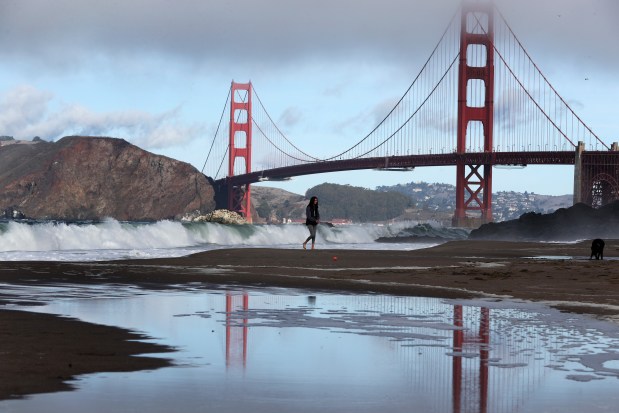
SAN FRANCISCO, CALIFORNIA – NOVEMBER 24: A beach goer tours Baker Beach as the Golden Gate bridge is reflected in a puddle in San Francisco, Calif., on Saturday, Nov. 24, 2018. (Ray Chavez/Bay Area News Group) 

“This research suggests that the impact of climate change on the lives and pocketbooks of homeowners is closer than you think. For home buyers over the next few years, the impact of climate change will be felt within the span of their 30-year mortgage,” said Skylar Olsen, Zillow’s director of economic research and outreach, in the report. “Without intervention, hundreds of thousands of coastal homes will experience regular flooding and the damage will cost billions. Given that a home is most people’s largest and longest-living asset, it takes only one major flood to wipe out a chunk of that long-growing equity.  Rebuilding is expensive, so it’s doubly tragic that we continue to build brand new units in areas likely to flood.”

There are 5,360 San Francisco homes worth more than $8.8 billion at risk by 2100, according to the report. Alameda County has 21,573 homes at risk, valued at $18.4 billion, Marin County has nearly 10,000 more homes, valued at about $14 billion, in the risk zone and Contra Costa has 6,548, valued at about $4 billion.

“The beautiful coastal setting of the Bay Area is a blessing and a curse for the housing market there: residents value the temperate climate and recreation opportunities by the shore, but the steady upward march of sea levels will threaten tens of thousands of coastal homes, worth billions of dollars, with flooding in the coming years,” says Zillow economist Jeff Tucker. “On the bright side, California’s environmental protections limiting coastal development have largely stopped them from making the problem worse, unlike several East Coast states where homes are multiplying faster in flood-prone areas than inland.”

In San Jose, there are 1,308 homes worth nearly $1.2 billion at risk by 2100, the report notes. Experts warn that’s not nearly as long as it sounds. It’s only about a mortgage away. Santa Clara County has 2,617 homes in danger by 2100.

California is on the list of states most likely to be devastated by sea-level rise and 10-year floods, according to this analysis, with 143,217 homes threatened. Florida tops the ranking with about 1.58 million homes impacted by 2100. Also on the endangered list are 282,354 homes in New Jersey, 167,090 in Virginia and 157,050 in Louisiana.

The findings are viewable on this interactive map which displays the flood-risk zones and details the number and value of homes at risk by location across the country.


Article source: https://www.eastbaytimes.com/2019/07/31/50-billion-worth-of-bay-area-homes-at-risk-of-rising-seas-says-report/

Posted in SF Bay Area News | Tagged | Leave a comment

More bad news for renters in SF’s already insane market, report says


  • 5a95b 920x920 More bad news for renters in SFs already insane market, report says

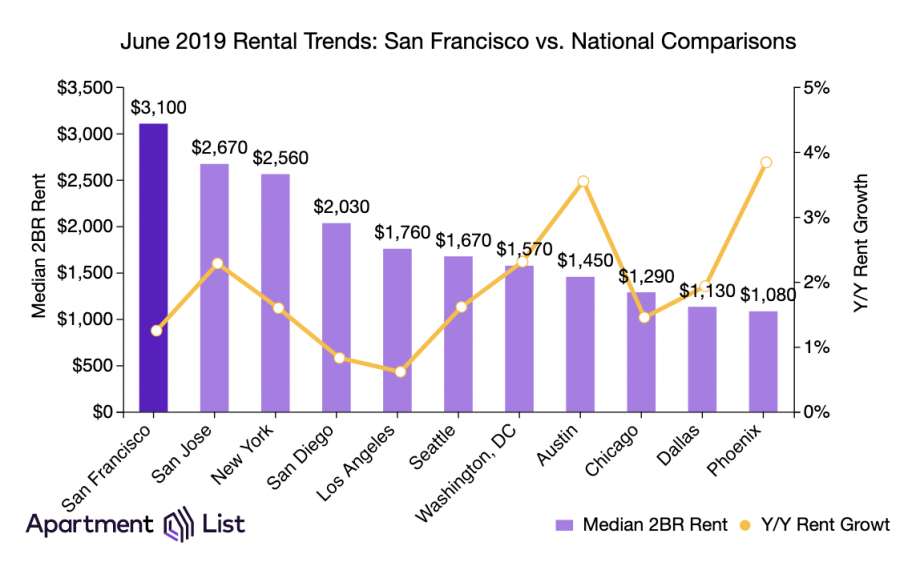
    SF rents in relation to the US.

    Click ahead to see an example of the type of apartment you can get for $3,100 a month in San Francisco.

    SF rents in relation to the US.

    Click ahead to see an example of the type of apartment you can get for $3,100 a month in San Francisco.


    Photo: Apartment List.com

  •  More bad news for renters in SFs already insane market, report says

Caption

Close

SF rents in relation to the US.

Click ahead to see an example of the type of apartment you can get for $3,100 a month in San Francisco.

SF rents in relation to the US.

Click ahead to see an example of the type of apartment you can get for $3,100 a month in San Francisco.


Photo: Apartment List.com


Has San Francisco’s rent finally convinced you that renting a one-bedroom alone isn’t economically feasible? According to a new report, sharing a two-bedroom might not be cheaper for long.

Year over year in SF’s rental market

Overall, San Francisco’s rent didn’t grow dramatically this year: In June rents were up 1.2 percent, according to ApartmentList.com. This is less than the national inflation of 1.6 percent. But what is dramatic is the steady creeping upward of two-bedroom rents. Apartment List found that over the past six years, the median rent for a 2-bedroom apartment in San Francisco has increased by 10.7 percent.

In 2014, the median rent for a two-bedroom in San Francisco was $2,804 … Today, median rents in San Francisco stand at $3,100 for a two-bedroom.


Apartment List isn’t the only online rental site to notice this trend. Rental site Zumper’s most recent National Rent Report showed that “one bedroom rent have another flat month, staying at $3,700. Two bedrooms, on the other hand, jumped 4.9 percent to settle at $4,720.”


Why the disparity?

The disparity in median rent price reports is down to methodology. Every rental site collects data differently, and their findings reflect calculations based on their particular methodology. Zumper says it aggregates data from “over one million active listings [and] includes new constructions but excludes listings that are no longer available or are currently occupied.”

ApartmentList, on the other hand, takes a different approach. “Data from private listing sites, including our own, tends to skew toward luxury apartments, which introduces sample bias when estimates are calculated directly from these listings,” says the site’s methodology section. To address this issue, Apartment List uses median rent statistics from the Census Bureau, then “extrapolate them forward to the current month using a growth rate calculated from our listing data.”


Whichever method we think more accurate, what is not in dispute is that renting a two-bedroom is getting more expensive in San Francisco.

And if the past six years are an indicator, it looks poised to get even more so.

Why? Because, frankly, one bedrooms are already pushing maximum affordability, while previously two bedrooms were more affordable if shared. The relatively less expensive unit has the most room to grow in price, and growing it is.


Moving may not be the answer

Lest you hope that moving south or east of the city will make life easier, you should know that this June, San Jose is the fourth-most expensive city for renters looking to share, with two-bedrooms hovering around $3,000 a month by Zumper’s figures and $2,670 by Apartment List’s.

Oakland comes in sixth, with two-bedrooms at around $2,800 according to Zumper and $2,200 according to Apartment List.

What can you rent for SF’s new median 2-BR rent? 

If we average Zumper and ApartmentList data, we come up with $3,910. That means $46,920 per year on rent alone, sharing a two-bedroom in San Francisco.

The gallery above shows you what you get for your money, as well as data used to make these projections.

Overall, it seems if you want to spend less by renting a two-bedroom, you better do it soon. Renting these units is getting more expensive by the day.

Anna Marie Erwert writes from both the renter and new buyer perspective, having (finally) achieved both statuses. She focuses on national real estate trends, specializing in the San Francisco Bay Area and Pacific Northwest. Follow Anna on Twitter: @AnnaMarieErwert.


Article source: https://www.sfgate.com/realestate/article/Bad-news-if-you-re-planning-to-save-money-on-rent-14082788.php

Posted in SF Bay Area News | Tagged | Leave a comment