HubHaus eviction underscores issues with corporate co-living

The seven housemates found out they were all being evicted when someone slipped envelopes under their bedroom doors with 30-day notices inside.

They were renting rooms in a big house in San Francisco’s tony Monterey Heights through HubHaus, a venture-backed San Francisco company that facilitates “co-living communities.” It’s among a new breed of startups that run shared-living situations, sometimes dubbed “dorms for grownups.” HubHaus and companies such as Bungalow, Common, Starcity and WeLive say they ease the hassles of living with roommates. Essentially, they seek to corporatize the longtime tradition of bunking with others.

“I was devastated,” said Anna Chase, one of the renters in what HubHaus called Ophelia Haus. “I thought, ‘They can’t just kick us out.’ We intended to stay there. We had a Thanksgiving dinner, took a group photo and put it on the fireplace mantel, and said, ‘We’ll do this every year.’”

Now she and her former housemates have joined forces to request mediation with HubHaus, as required in their leases. A lawsuit looms if that doesn’t work out.

Their situation underscores both the promises and the perils of shared co-living managed by corporations.

“What HubHaus is doing is illegal,” said Joe Tobener, a San Francisco attorney representing the tenants. “They wrongfully evicted our clients, and they will do it again to other tenants in other rent-controlled cities. They are profiting by not playing by the rules.”

HubHaus disputed that, saying its approach is legal and it actually helps ease the housing crunch.

The 3-year-old company, which has $13.4 million in venture backing, manages about 1,300 rooms in 218 houses in the Bay Area, Los Angeles and Washington, with the lion’s share in the Bay Area, but just a handful in San Francisco. It leases houses, furnishes the common spaces, screens renters, hires cleaners, collects rents and handles maintenance.

HubHaus CEO Shruti Merchant, who herself lived in a South Bay HubHaus and is on the waiting list with her partner for another one, said the company helps “unlock inventory” by persuading landlords to allow larger groups to reside in their properties.

For instance, the Monterey Heights landlord “would not have worked with a group of seven people, but because we ‘de-risked’ it, they did,” she said. A larger group means a lower cost per square foot, allowing it to offer additional services, she said.

But the size of the group is what caused the eviction and led to a major risk for the landlord — the threat of a big penalty from the city.

Neighbors started complaining to San Francisco as soon as the roommates moved in last August, public records show. The Maywood Drive house, valued at $2.44 million on property site Zillow, is zoned for single-family use. Inspection visits and city notices on the front door became frequent and disconcerting phenomena, Chase said.

HubHaus leased the house for a year last summer and then rented out individual rooms for $950 to $1,590 each, depending on their size and amenities. Four of the housemates moved in during August, and three others moved in during December or March. All had one-year leases that contained a clause allowing either party to terminate early with a $450 lease-break fee.

After months of investigations, the San Francisco Planning Department said the house was an unauthorized group house, subject to a $250-a-day penalty. That spurred the property owner to tell HubHaus it would not renew its master lease, Merchant said.

HubHaus served the eviction notices in mid-June, and the renters moved out by mid-July. Their only compensation was the $450 lease-break fee from HubHaus, which also told them they could use its website to apply for other rooms in its network. “What made me the saddest was that the company didn’t offer help,” Chase said. “We got a lot of runaround and a form email: ‘Click on our website to see what other houses have availability.’”

Merchant said HubHaus lets tenants in existing houses pick their new roommates, so it couldn’t guarantee rooms for the displaced tenants.

“What happened with this house was really unfortunate, and frankly our communication with the members was really poor,” Merchant said. She said the company lost money on Ophelia Haus as it devoted legal resources to fighting the city, but “should have kept (the renters) in the loop.”

She also blames the city for supporting NIMBY neighbors and the homeowner for “buckling under the pressure” of threatened fines.

Tobener said the vintage-1940 house, built before San Francisco passed its strict rent-control laws in 1979, has eviction protection. The city also offers rent-ceiling protections to people who rent individual rooms from a master tenant in a single-family home, seeing them as akin to multiunit dwellings.

Jennifer Fieber, political director of the San Francisco Tenants Union, said boardinghouse situations with separate leases “are a great way to get rent control into single-family homes.” Although she decries shared houses being corporatized, she sees them as “the last bastion of affordability.”

Tobener said that master tenants in rent-controlled properties cannot charge subtenants more than what they pay the landlord. That’s the whole business model for HubHaus and other co-living startups — they make money on the difference between what a house costs them and what they charge renters.

The Maywood Drive residents’ monthly rents ranged from $950 to $1,590, depending on room size, bathroom and other features. Collectively they paid $9,190, while the house probably rented for $7,000, according to a real estate expert hired by Tobener. Merchant wouldn’t say how much HubHaus paid to rent the house, but said she disputes that it cannot take in more money than it pays an owner.

One issue for Ophelia Haus was the definition of family, an issue raised by Mission Local, a news website that first reported the dispute between HubHaus and the renters.

A group of five unrelated people can qualify as a family in San Francisco. Larger groups must control their membership; purchase, prepare and eat their meals collectively; and determine their own rules for their space to meet the city’s definition. HubHaus tried to make changes for its tenants to qualify under that rule, but the city rejected them because ultimately the company was still in charge.

“HubHaus was the lease holder, not the tenants themselves,” said Tina Tam, an enforcement manager with the San Francisco Planning Department.

The city gets about 10 complaints a year about single-family homes being used for group housing, relatively minor among the 800 annual complaints her department handles, Tam said.

“They had this huge, grand vision,” Chase said. “The few people I met (at HubHaus) were the very nicest; so excited about doing things to build community. But they weren’t able to actually run the company in a way that was functional for people who lived in their houses.”

Carolyn Said is a San Francisco Chronicle staff writer. Email: csaid@sfchronicle.com Twitter: @csaid

Article source: https://www.sfchronicle.com/business/article/HubHaus-eviction-underscores-issues-with-14375078.php

Posted in SF Bay Area News | Tagged | Leave a comment

Chase Center’s opening: Nearly 40 years in the works, Mission Bay plan finally realized


The opening of the Warriors’ Chase Center arena is a coming-out party of sorts for San Francisco’s newest neighborhood, nearly 40 years in the works


The opening of the Warriors’ Chase Center arena is a coming-out party of sorts for San Francisco’s newest neighborhood, nearly 40 years in the works


The opening of the Golden State Warriors’ Chase Center next week will mark the flamboyant and unexpected finale of a 40-year exercise in city-building, San Francisco style.

$(‘header’).after(newNav);

$(function() {
window.onscroll = function() {scroll()};
var header = document.getElementById(“new-nav”);
var sticky = header.offsetTop;

function scroll() {
if (window.pageYOffset sticky) {
header.classList.add(“sticky”);
} else {
header.classList.remove(“sticky”);
}
}

$(‘.menuBtn’).click(function(){
$( “.mobile-parts” ).slideToggle( “slow” );
});

// Underline the current part
$(“.part a”).each(function(index, item){
var url = $(item).attr(“href”).replace(“https://www.”, “”);
if (window.location.href.indexOf(url) != -1){
$(item).closest(“.part”).addClass(“current-part”);
$(“.mobile-parts div”).eq(index).addClass(“current-part”);
}
});

// var chapter = $(‘.part.current-part’).data(‘chapter’);
//$(‘h1′).before(”);

});

The scene is Mission Bay, a 60-block area that begins 1 mile south of Market Street and for a century consisted of rail yards and industrial sheds. The debate about how to revive it at one point included a proposal for lagoons and a canal. Even now, despite the presence of more than 10,000 residents and a UCSF campus, many Bay Area residents know it only — if at all — as the blur of stocky buildings between the Giants’ ballpark and Interstate 280.

This is bound to change as Chase Center hosts countless large events. starting with a Sept. 6 kickoff concert featuring Metallica and the San Francisco Symphony and the Warriors’ first preseason game on Oct. 5. Visitors will gauge the young neighborhood by what they see around them — good or bad, exciting or dull — not by comparing it to the plan approved in 1998 that remains on the books.

But the false starts and early expectations are worth revisiting, because Mission Bay — more than any other single piece of San Francisco — shows how difficult it is for cities in today’s America to map out what the future will hold.

Urban planning can lay down rules, but it can’t control cultural shifts or what the economy might bring. Especially in a dynamic but unpredictable region like the Bay Area, real life calls the shots.


b231e 920x1240 Chase Centers opening: Nearly 40 years in the works, Mission Bay plan finally realized

A view looking west down China Basin Street from Fourth Street, which is the main shopping corridor in the new Mission Bay neighborhood of San Francisco.

(Photos By Jessica Christian / The Chronicle | San Francisco Chronicle)

In many ways, Mission Bay’s transformation is remarkable.

The 303 acres created with fill after the Gold Rush form the base for buildings that range in size from five to 16 stories and hold nearly 6,000 apartments and condominiums, as well as 3.5 million square feet of office and laboratory space. More than 60 acres are reserved for a UCSF research campus and an 878,000-square-foot hospital.

A dog park recently was added across from an ebulliently designed playground. The city’s police headquarters opened in 2015, two blocks north of where Uber is building its headquarters. Apartments for formerly homeless people look out on a locally themed miniature golf course that has become a social destination.

But viewed more subjectively — as “another uniquely San Francisco place,” to quote the goal laid out by City Hall in 1987 — there’s less than meets the eye. What was conceived as a neighborhood instead feels like a puzzle, a collection of parts.

Some parts are alluring, to be sure.

A stroll along Mission Creek, a wide tidal waterway where egrets and seals are common, offers an urbane antidote to urban stress. Gus’s Community Market, which opened last winter and specializes in fresh produce and reasonably priced sandwiches, spills out onto the sidewalk at Fourth and Channel streets.

But too many large blocks are filled with monolithic slabs — or, more recently, slabs covered in a variety of colors and facades used by architects to try and suggest you’re viewing multiple buildings. Passageways intended to make large blocks pedestrian-friendly often look stark. The same goes for the small plazas that accompany many of the office blocks.

The newest piece of the puzzle is the most surprising yet: Thrive City.

b231e 920x1240 Chase Centers opening: Nearly 40 years in the works, Mission Bay plan finally realized

Construction workers and nearby buildings are reflected in the windows of the Chase Center, the Warriors’ new arena in the heart of their 11-acre Thrive City along Third Street in Mission Bay.

(Jessica Christian / The Chronicle | San Francisco Chronicle)

That’s the name the Golden State Warriors gave the 11 acres that include their privately funded arena as well as two 11-story office buildings. Restaurants and bars will line a large plaza off Third Street on the west side of the arena, below a 2,500-square-foot video screen.

The Warriors entered the scene in 2014 by purchasing the land from Salesforce, which at one point intended to build its headquarters there. The Thrive City branding comes from a marketing deal with nearby Kaiser Permanente that reportedly will net the team as much as $295 million over the next 20 years.

The only real opposition to the Warriors’ move came from wealthy UCSF supporters, who filed a lawsuit charging that the facility violated the Mission Bay plan. They also warned that event traffic would block access to the huge UCSF Benioff Children’s Hospital San Francisco.

That legal attack failed. Construction began in 2017.

Traffic concerns are legitimate, and Thrive City indeed covers blocks once planned as part of a biotech zone. But the hospital wasn’t part of the 1998 plan, either. Nor was software giant Salesforce, which hadn’t yet been founded.

The presence of the Warriors encapsulates the saga of Mission Bay’s long path to reality: Many elements of the landscape that has emerged could not have been conceived when the developers, politicians and planners started work.


b231e 1280x0 Chase Centers opening: Nearly 40 years in the works, Mission Bay plan finally realizedb231e 767x0 Chase Centers opening: Nearly 40 years in the works, Mission Bay plan finally realized

Mission Bay as solid ground dates to the 1870s, when Southern Pacific Railroad bought tidal flats and filled them with soil and debris to conjure up a rail yard that could serve a fast-growing port in a fast-growing city.

A century later, the port had withered and the freight lines were in decline. Southern Pacific responded by trying to turn its holdings into real estate gold, hiring architects and other consultants to create a plan that would both turn a profit and win public support.

Some of those plans were formulaic. Others, in hindsight, have a fantastical allure — such as the elaborate vision by legendary architect I.M. Pei, released in 1983, to loop a canal through the acreage south of Mission Creek, place an island in the middle and cluster a trio of 40-story towers, intended as corporate icons, at the north end.

The response by Mayor Dianne Feinstein? A chilly letter informing Southern Pacific that the height limit would be eight stories and 30% of all housing units must be affordable.

The city then decided to draw up its own plan, which took until 1990.

By then, Art Agnos was mayor and corporate towers were no longer in demand. Companies wanted what was known as “back-office” space. San Francisco saw Mission Bay as the ideal location.

Catellus, the real estate arm of Southern Pacific, agreed to the new approach. But voters said no, narrowly, and plans were tweaked again (more affordable housing, fewer offices) before City Hall gave the official green light in 1991.

  • 27efa 920x920 Chase Centers opening: Nearly 40 years in the works, Mission Bay plan finally realized

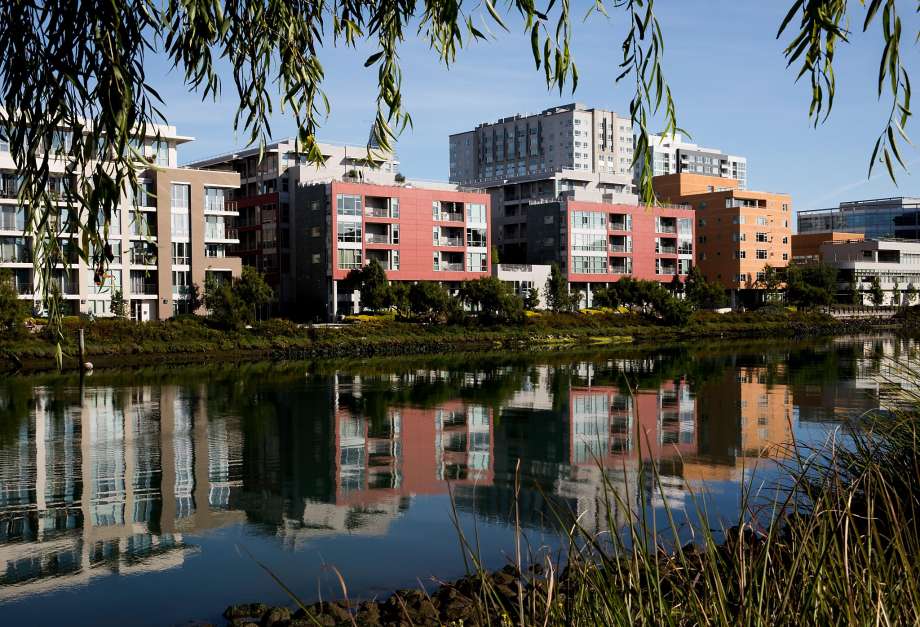
    New apartments and office buildings are seen reflected in the waters of Mission Creek, which is home to the only longtime residents of the Mission Bay neighborhood, a community living aboard 20 houseboats moored in the creek.

    less

    New apartments and office buildings are seen reflected in the waters of Mission Creek, which is home to the only longtime residents of the Mission Bay neighborhood, a community living aboard 20 houseboats

    … more


    Photo: Jessica Christian / The Chronicle

  •  Chase Centers opening: Nearly 40 years in the works, Mission Bay plan finally realized

Caption

Close

New apartments and office buildings are seen reflected in the waters of Mission Creek, which is home to the only longtime residents of the Mission Bay neighborhood, a community living aboard 20 houseboats moored in the creek.

less

New apartments and office buildings are seen reflected in the waters of Mission Creek, which is home to the only longtime residents of the Mission Bay neighborhood, a community living aboard 20 houseboats

… more


Photo: Jessica Christian / The Chronicle

That’s how things stood in 1994, when Nelson Rising became head of Catellus and was confronted by a plan that already seemed obsolete. It was filled with restrictions imposed by developer-wary critics, including a requirement that offices and housing always had to be built simultaneously no matter what the larger economic picture might be.

As for the idea that back-office space could generate the revenue to pay for public benefits like affordable housing, good luck. Technology had advanced so quickly that such outposts of Financial District firms no longer even had to be within the Bay Area.

“I looked at the plan and saw that it wouldn’t work,” Rising, now chairman of Rising Realty Partners, said this summer. “We wanted to have something that would be flexible, to take advantage of alternatives that might come about.”

What broke the logjam, and cleared the way for today’s still-evolving neighborhood, was a new mayor and a new economic model.

Taking stock of Mission Bay

Size

303 acres. This includes 60 acres that form the academic medical center of UCSF Mission Bay.

Open space

41 acres are in the plan — 19 acres have been completed.

Housing

5,789 units completed so far, with 271 more under construction. The neighborhood plan allows 6,500 units, roughly 30% of them affordable.

Offices and research space

2.6 million square feet have been completed with an additional 1.8 million square feet under construction. This includes 913,000 square feet in four buildings along Third Street — all of which will be occupied by Uber.

Civic uses

The headquarters of the San Francisco Police Department is on Third Street, and there is a branch library on Fourth Street near Mission Creek. One block on the neighborhood’s west side is reserved for a public school.

Next up

Besides the obvious answer — Chase Center, new home of the Golden State Warriors — a 250-room hotel is scheduled to open late next year. Work has begun on a 5.4-acre bayfront park with a ferry terminal set to open in 2021.

Source: Mission Bay Development Group and San Francisco’s Office of Community Investment and Infrastructure


Willie Brown took office in 1996. He’d not only been state Assembly speaker, but an attorney with Southern Pacific as a client. He also knew that two large civic players were in a bind: Catellus, which needed something to revive its development efforts, and UCSF, which had almost given up on its search to find room within the city for a new campus.

“We had the serendipity of a new mayor who had experience in deal-making,” said Kofi Bonner, part of Brown’s staff at the time and now a top executive at the development firm FivePoint. “Willie was able to connect the dots.”

Soon there was a new vision: UCSF would receive 43 acres from Catellus and the city if it agreed to build its research campus in Mission Bay. The gamble was that the university’s presence would give the long-stalled project an anchor, while helping to attract biotech firms that instead were setting up shop in places like South San Francisco.

The plan approved unanimously by the Board of Supervisors in 1998 included a districtwide affordable housing requirement of roughly 30%, one holdover from Feinstein’s time. Catellus agreed to build and maintain 43 acres of parks. Mission Bay’s 20 houseboats were protected in perpetuity.

This new approach also made it easier for developers.

Brown made Mission Bay a redevelopment district, a move that helped pay for infrastructure upgrades by using tax revenue that otherwise would have gone to the state. The square footage that Catellus had hoped to build on the UCSF land was spread across the rest of Mission Bay — one reason so many blocks within the neighborhood look so stubby.

The blocks intended for medical research, meanwhile, were zoned so that standard offices could be built as well. This paid off when biotech proved to be a fairly minor presence. The city’s ongoing tech boom has filled the void instead, with recent commercial buildings being designed for the likes of Uber and Dropbox.

Dean Macris, who served Feinstein and Agnos as planning director, takes the various twists and turns in stride.

“A big project like Mission Bay, there are going to be false starts,” said Macris, who also served as the city’s top planner under then-Mayor Gavin Newsom from 2004 until 2008. “As time passes, needs change.”

John Rahaim, who succeeded Macris in 2008 and remains the city’s planning director, admits to mixed feelings about what took shape.

“Mission Bay is definitely of its time,” Rahaim said this summer. “Some parts are interesting, but … it’s not what we would do now.”

I-280 skirts Mariposa Park at the southern end.

(Jessica Christian / The Chronicle | San Francisco Chronicle)


Mission Bay makes two seemingly contradictory points about the value of long-range planning.

It can’t predict the future. But it can lay the groundwork for profound change.

The futility is seen in how plan after plan depended on economic assumptions that were confounded again and again. Corporate towers weren’t the financial engine. Nor was back-office space. The UCSF gamble paid off, but it hasn’t sparked the biomedical boomtown that was anticipated.

Notions of what constitutes “good” urban design aren’t carved in stone, either.

Tall buildings were taboo anywhere outside the Financial District during the 1980s, which is why Feinstein could cap those Mission Bay towers at eight stories. The plan now on the books allows twice that, and 28 acres the Giants now use as a parking lot along China Basin at the north end of Mission Bay will sprout 24-story towers under the plan approved by voters in 2015.

More subtle assumptions, no matter how well-intentioned, can also fall short.

Consider Mission Bay Commons, intended as a five-block grassy stretch modeled on South Park and the Panhandle.

The two blocks that are fully landscaped, closest to the bay, get little use despite lawns and shaded benches. The blocks to the west, where food trucks and the miniature golf course were added on a whim a few years ago, draw people throughout the day.

“If you do a plan well enough to set the table, so to speak, then people find ways to make things work,” said Karen Alschuler, whose firm SMWM worked on the parameters of the 1998 plan. “The details change, but you need to provide the infrastructure.”

At a scale like this, infrastructure refers to more than streets and sewer lines. It’s also the framework of where parks are located or how wide the sidewalks will be — the human touches that can make a place feel inviting.

27efa 920x1240 Chase Centers opening: Nearly 40 years in the works, Mission Bay plan finally realized

Structures made of twigs and other tree materials are inside the busy Mission Bay Kids’ Park, where children swing on monkey bars and other play structures, which opened in 2016 along Long Bridge Street.

(Jessica Christian / The Chronicle | San Francisco Chronicle)

Those elements could be the ones that ultimately define Mission Bay’s public image.

A big part of what makes this area feel so unlike other San Francisco neighborhoods is that it has developed one block at a time, one big piece after another. But as the pieces come together, with trees and shrubs and plants in between, what looks awkward from afar is more comfortable up close.

This is starting to be the case along Fourth Street south of Mission Creek, which seems relatively cozy and is intended to be the neighborhood’s retail corridor. Around the corner on Long Bridge Street, the commotion at the children’s playground makes more of an impression than the architecture around it.

“The public spaces are coming into the foreground and the buildings are settling into the background, and that’s the way it should be,” said Kelley Kahn. Now a policy director for Oakland Mayor Libby Schaaf, Kahn worked on Mission Bay for San Francisco’s Redevelopment Agency from 2006 until 2013.

“Some buildings are better than others, but the collective scale is what’s key,” Kahn commented after a walk through Mission Bay this summer. “This is how it was supposed to feel.”

The aim of planners through the 1980s and early ’90s was to craft a plan for Mission Bay where every possible outcome was preordained. That wasn’t realistic then. It’s even less realistic now as technology and social trends continue to take new forms.

Instead, a 21st century neighborhood has emerged. Mission Bay is home to people of all incomes, while absorbing unexpected elements such as a hospital and a sports arena with relatively little controversy. There’s a lively residential scene in Dogpatch to the south and a mix of new housing and commercial complexes on the other side of I-280 to the west.

With each passing year, it becomes harder to tell Mission Bay apart from its surroundings. In some ways, that’s the best measure of success that a long-range plan can have.

John King is The San Francisco Chronicle’s urban design critic. Email: jking@sfchronicle.com Twitter: @johnkingsfchron


©2019 Hearst

Article source: https://www.sfchronicle.com/bayarea/article/Chase-Center-s-opening-Nearly-40-years-in-the-14372177.php

Posted in SF Bay Area News | Tagged | Leave a comment

Google’s San Jose megaplan: Up to 25,000 new jobs, 5,000 homes

Google unveiled details of its massive plan to remake the area around San Jose’s downtown Diridon Station, a key step in its bid to transform 60 acres and become the largest private employer in the Bay Area’s biggest city.

Plans call for 6.5 million square feet of office space, between 3,000 and 5,000 new homes, and 500,000 square feet of retail, hotel and other cultural uses, along with 15 acres of parks, Google said at a City Hall hearing Thursday. The San Jose City Council could vote on the project by fall 2020, and if approved, construction is expected to last a decade or more.

Google was attracted to the area because of its transit connections. Diridon Station, at the western edge of the city’s downtown, has Amtrak, Altamont Commuter Express, Caltrain, light rail and express bus service, and a BART extension is expected by 2026. It’s a contrast to the tech giant’s Mountain View headquarters, which is not served by rail.

“This is an opportunity for us to really retrofit a city really built for the automobile, for a city built for people,” San Jose Mayor Sam Liccardo, who supports the plan, told The Chronicle last year.

The project would support 20,000 to 25,000 employees from Google and other companies. That’s equivalent to half of downtown San Jose’s existing 43,000 employees, according to city data.

Liccardo said the project would provide much-needed jobs and a tax boost to the city. Over 60% of employed residents commute from San Jose to jobs elsewhere, contributing to rush hour congestion and weakening the city’s tax revenue, according to a city study.

But some San Jose residents fear the plan will exacerbate already high housing costs as tens of thousands of well-paid employees arrive. Protesters briefly interrupted Thursday’s hearing, and speakers called on Google to help fund aid for the homeless and provide more affordable housing. Some want Google to drop the plan entirely.

“Google is not your friend. Google is displacement and poverty,” one protester’s sign read.

The company said at the hearing that it is seeks to build jobs and housing near transit and create opportunity for existing residents.

It plans to turn a former Orchard Supply Hardware store into a job training center before the project begins construction. It also has committed $300 million to support affordable housing and preservation efforts, as part of a $1 billion Bay Area housing plan.

Google is seeking to qualify as an Environmental Leadership Development Project, a designation which streamlines approvals for large projects that create jobs and public benefits. The program, which was also used at the Golden State Warriors’ Chase Center project, quickens the legal process if a project is sued.

Google plans to file a formal proposal in October.

The Diridon Station plan is one of the largest in the Bay Area, but Google’s vast real estate ambitions also include plans for a major expansion near its Mountain View headquarters, more growth in Sunnyvale and 1 million square feet or more in San Francisco office leases, The Chronicle has reported.

Roland Li is a Chronicle staff writer. Email: roland.li@sfchronicle.com Twitter: @rolandlisf

Article source: https://www.sfchronicle.com/business/article/Google-s-San-Jose-megaplan-Up-to-25-000-new-14374038.php

Posted in SF Bay Area News | Tagged | Leave a comment

Multiple offer bidding wars are down considerably in SF, and nationwide


  • b743b 920x920 Multiple offer bidding wars are down considerably in SF, and nationwide

    San Francisco is still the most competitive market in the country, but multiple offer situations are down substantially since the same time last year.

    San Francisco is still the most competitive market in the country, but multiple offer situations are down substantially since the same time last year.


    Photo: Redfin

  •  Multiple offer bidding wars are down considerably in SF, and nationwide

Caption

Close

San Francisco is still the most competitive market in the country, but multiple offer situations are down substantially since the same time last year.

San Francisco is still the most competitive market in the country, but multiple offer situations are down substantially since the same time last year.


Photo: Redfin


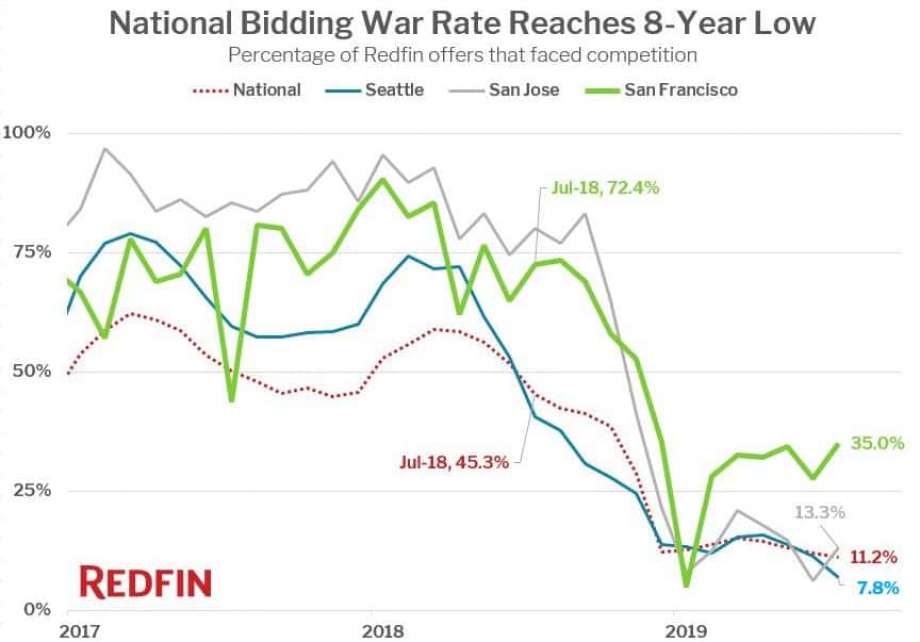
San Francisco is still the most competitive housing market in the country, but even here the bidding frenzy seems to have died down, according to recent Redfin data. Only 35 percent of offers written by Redfin agents for SF buyers faced a bidding war in July 2019, compared with a staggering 72 percent just one year earlier.

However, the lull may not last long. The number of competitive bids is already up from 28 percent in June of this year.

“Although the market isn’t as hot as it was last year, this spring and summer have been busy in San Francisco. That’s partly because homebuyers are feeling pressure to move quickly due to the high-profile tech IPOs, whether that pressure is real or perceived,” said San Francisco Redfin agent Miriam Westberg in the report. “Low interest rates are also a factor in increased homebuyer interest since the beginning of the year. The market has definitely picked up since the winter and it seems like prices and competition are slowly heading back to mid-2018 levels.”


ALSO: These San Francisco streets are tiny, but they have the most expensive real estate

San Francisco, while down from its super-competitive 2018 numbers, is still by far the most competitive market in the country. Second-place San Diego saw only 21.3 percent of Redfin buyers in competition, followed by Boston in third place (16.4 percent), then LA (16 percent), Philadelphia (14.3 percent) and Denver (14 percent). San Jose came in just behind Denver at 13.3 percent.

These figures are all down significantly from one year ago, and in many of the most expensive markets the bidding war rate was down to less than half of what it was one year earlier. Nationwide, the picture for buyers was even rosier. Only 11.2 percent of offers submitted by Redfin agents for their buyers were in competition, down from 45 percent in 2018 and the lowest figure since 2011.

Redfin Chief Economist Daryl Fairweather explained in the report that homebuyer competition began plummeting last year as mortgage rates inched up. As they have flattened, so too has homebuyer demand.

But, just like in SF, many of the most competitive markets saw what could be the beginning of an upward trend between June and July of this year, meaning the housing market may get more competitive as we head into the typically more-robust fall shopping season. “Overall, I expect homebuyer demand to strengthen in the second half of the year as the housing market continues to stabilize, but we may not see a big pop in bidding wars until early next year,” Fairweather said.


Emily Landes is a writer and editor who is obsessed with all things real estate.

Article source: https://www.sfgate.com/ontheblock/article/Multiple-offers-home-buying-san-francisco-bay-area-14373836.php

Posted in SF Bay Area News | Tagged | Leave a comment

Where you can afford a home in the Bay Area based on your salary


  • 8a66e 920x920 Where you can afford a home in the Bay Area based on your salary

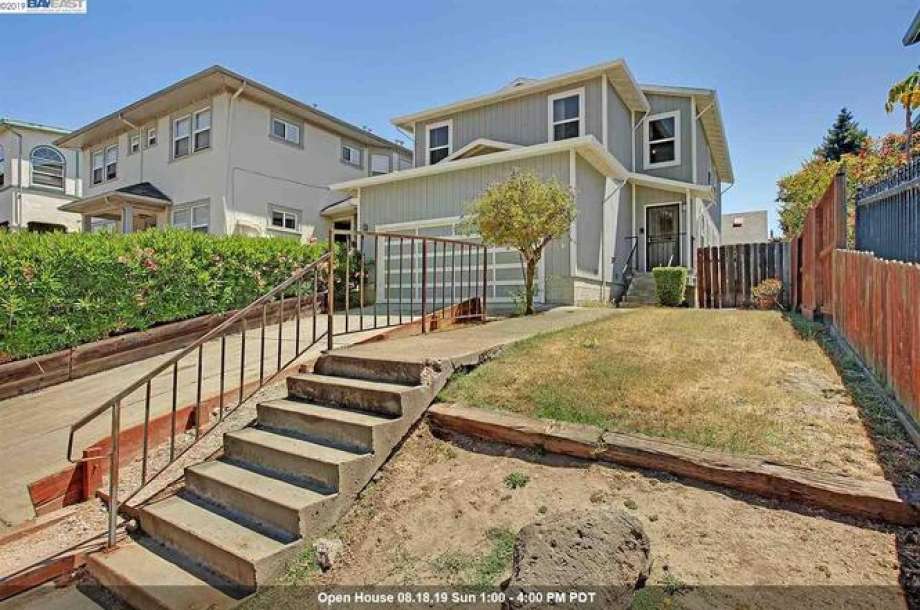
    In Oakland, the current sold median price is $825K and the minimum salary needed to buy a median price home is $154,251. To buy the $825k 4-bed, 2.25-bath home pictured, buyers need 244% 2017′s reported median income.

    less

    In Oakland, the current sold median price is $825K and the minimum salary needed to buy a median price home is $154,251. To buy the $825k 4-bed, 2.25-bath home pictured, buyers need 244% 2017′s reported median

    … more


    Photo: Data: Redfin; Home Photos: MLS Via Redfin

  •  Where you can afford a home in the Bay Area based on your salary

Caption

Close

In Oakland, the current sold median price is $825K and the minimum salary needed to buy a median price home is $154,251. To buy the $825k 4-bed, 2.25-bath home pictured, buyers need 244% 2017′s reported median income.

less

In Oakland, the current sold median price is $825K and the minimum salary needed to buy a median price home is $154,251. To buy the $825k 4-bed, 2.25-bath home pictured, buyers need 244% 2017′s reported median

… more


Photo: Data: Redfin; Home Photos: MLS Via Redfin


A booming job market and increased demand for housing have made living in the San Francisco Bay Area shockingly expensive, and most residents have salaries that don’t cover the cost of buying a home.

An August 2019 report from the California Association of Realtors revealed that while affordability improved in all nine counties in 2019, the picture is still grim.

San Francisco County remains the least affordable, with only 17 percent of households having the minimum qualifying salary of $343,420 to buy a $1.7 million median-priced home.

Solano County is most affordable, with 46 percent of households bringing in $89,900, the salary required to buy a $445,000 median-priced home.

Conventional wisdom tells us that a healthy budget allots no more than 30 percent for housing expenses. But if this is true, most Bay Area real estate creates a very unhealthy ratio of income to expense.


While San Francisco was least affordable among the counties,  a recent Redfin study shows that it doesn’t lead the list of cities. Using data from Redfin, we did some extra number crunching to determine the salary required to buy homes in several other metros. We used the idea that buyers would obtain conventional mortgages, putting down 20 percent the asking price of a home, and accounted for taxes and insurance in calculating the resulting monthly payments.

The median sales price in Palo Alto as of July 2019 was $2.9 million. The salary needed to spend less than 30 percent of your income on a median-priced home is $542,216 a year. This makes a home in the Silicon Valley City unaffordable to the city’s average resident earning $147,537 a year. (Find the breakdown on more cities in the gallery above.)

The gallery above breaks the numbers down in cities all over the Bay. We’ve also included typical homes the median price buys.

Even if we agree that the median price and median income don’t paint the full picture of a city’s affordability, they certainly paint a general one– and in this case, a rather disturbing one.

Anna Marie Erwert writes from both the renter and new buyer perspective, having (finally) achieved both statuses. She focuses on national real estate trends, specializing in the San Francisco Bay Area and Pacific Northwest. Follow Anna on Twitter: @AnnaMarieErwert.

Article source: https://www.sfgate.com/realestate/article/You-may-need-three-times-your-salary-to-afford-14340645.php

Posted in SF Bay Area News | Tagged | Leave a comment