Bay Area homes got slightly more affordable in July as prices and mortgage rates fall

Bay Area homes are getting slightly more affordable thanks to falling prices and lower mortgage rates. The median price paid for all new and existing homes and condos in the nine-county region fell to $815,000 in July, down 4.7% from June and down 4.1% from last July, according to a report released Thursday by CoreLogic.

July was the third consecutive month prices fell on a year-over-year basis, starting with a 1.9% decline in May and a 2.2% dip in June, CoreLogic said in a release.

Last month’s drop was the biggest since December 2011, when the median price fell 10.5% year over year. “Before this March, the median sale price had risen on a year-over-year basis for 83 consecutive months,” it said. The highest recorded median was $875,000 in June.

 Bay Area homes got slightly more affordable in July as prices and mortgage rates fall

The only Bay Area counties where the median price rose year over year were the most and least expensive. In San Francisco, the median gained 3.8% to $1.35 million, and in Solano it was up 4.3% to $450,000. The median is the point at which half of homes sold for more and half sold for less.

Prices for resale condominiums took the biggest price hit in July, falling 10.9% year over year to $668,500. Prices for existing single family homes fell only 1.2% while new-home prices fell 3%, according to CoreLogic data.

Recession fears have sent bond yields lower, and that’s pushing down mortgage rates, too. The average rate on a 30-year fixed-rate mortgage was 3.6% this week, up slightly from 3.55% last week but down almost a full percentage point since this time last year, Freddie Mac reported Thursday.

“Lower mortgage rates and the slowing, if not elimination, of price growth in many areas makes a meaningful difference for some buyers,” CoreLogic analyst Andrew LePage said in a news release.

Anecdotally, real estate agents and buyers say the market remains mixed.

“Some areas are very hot with multiple offers; another house can sit a block away and not get any offers,” said Nicole Aissa, a broker with Keller Williams Peninsula Estates.

Although many homes are still selling for more than the asking price, in some cases they’re getting less than what Realtors and sellers expected.

“The trend is to list homes under market value so when it gets bid up it looks like it went way over asking,” said Gillian Leslie, an agent with Red Oak Realty in the East Bay.

She had clients interested in a home listed at $1.8 million. It sold for $2.175 million, but “the expectation was that it would go for $2.3 or $2.4 million,” Leslie said.

Tiffany Schrader-Brown and her husband bought a two-bedroom, one-bath home in Berkeley about seven years ago. Three years ago, they rented it out and moved to Philadelphia, where her husband did his medical residency. When they came back this year, they wanted a bigger home for their family, which includes three kids ages 11, 6 and 3.

They wanted a fixer-upper, since they are more affordable and she designs homes for a living, but “it seems like every one of them a developer has purchased. A lot have already been purchased and flipped,” Schrader-Brown said.

It’s easier to find duplexes and triplexes that could be turned into a single-family home, but that’s an arduous, time-consuming process and “I don’t want to take away from the housing stock,” she added.

There are some single-family fixer-uppers, she said, but they might be in a slide zone and still cost $1,000 per square foot. Or they have no utilities so they can’t get a bank loan.

But Schrader-Brown is optimistic.

“The market is changing now — I think it’s going to be more hospitable for me in the coming months, I hope. It seems that the smaller homes for people with one or two children seem to stay at a higher price point; the ones that are a little bigger seem to be declining.”

In San Francisco, the condo market “has been pretty stable for the entire year,” said Garrett Frakes, a managing director with brokerage firm Polaris Pacific. Condo prices for the three months ending July are basically flat with the same period last year. “Buyers can potentially get some discounts so instead of paying over list price, maybe they are paying slightly under list price.”

Inventory is creeping up, but still low. In San Francisco it would take just 1.6 months to sell all condos on the market at the current pace of sales. In Santa Clara and San Mateo counties, it would take about four months. “That’s still low from a supply standpoint but a heck of a lot better than two months.”

On the sales front, the number of Bay Area homes and condos that closed in July was 7,404, up 0.5% from June but down 2.2% from the same month last year. That was the lowest number of sales for the month of July since 2011, CoreLogic said. Sales have fallen on a year-over-year basis for 12 consecutive months.

On the bright side, the 2.2% decline in July was the smallest year-over-year decrease for any month since July 2018. Sales typically slow between June and July; since 1988, the average change between those two months is a 5.9% drop, CoreLogic said.

Kathleen Pender is a San Francisco Chronicle columnist. Email: kpender@sfchronicle.com Twitter: @kathpender

Article source: https://www.sfchronicle.com/business/networth/article/Bay-Area-homes-got-slightly-more-affordable-in-14399746.php
Posted in SF Bay Area News | Tagged | Leave a comment

STICKER SHOCK: Most expensive home in San Francisco up for sale – KGO

SAN FRANCISCO (KGO) — We all know housing prices are high in the Bay Area– but if you’re in the market to buy a pricey home we’ve got a doozy for you.

A home at 950 Lombard Street is the most expensive one on the market in San Francisco right now. It’s going for a mere $40.5 million. That’s down from its initial price of $45 million last year.

VIDEO: SF home listed for $45 million in 2018

The median home price in San Francisco is currently $1.3 million.

The home has six bedrooms and eight bathrooms. The entire hillside was excavated to build this 9,500 square foot home.

Here are some other features in the house:

  • Cantilevered swimming pool with UV filtration
  • Two story art gallery/sport court/concert hall
  • Wine wall
  • Glass elevator to all levels
  • Expansive garden irrigated by rainwater collected from the rooftops and decks. Smart drip irrigation.
  • 12,000 gallon rain harvesting tank/cistern to irrigate your garden
  • Wellness center with massage room steam and sauna with a view spa/hot tub
  • Zehnder air filtration system Merv 13 filter for allergens and pollutants
  • Vents underneath sink cabinet to purify the air where most people get cleaning supplies
  • Bedroom level air condition
  • Tensui water filtration to all in house spigots
  • PRE-Certifified LEED Platinum
  • Savant Pro to control your home from anywhere in the world
  • Lutron lighting
  • Art Gallery humidity controlled

Article source: https://abc7news.com/realestate/sticker-shock-most-expensive-home-in-san-francisco-up-for-sale/5499534/

Posted in SF Bay Area News | Tagged | Leave a comment

The Most Splendid Housing Bubbles in America, July Update: Year-Over-Year Declines Spread to Seattle

Seattle House prices fall year-over-year, as do New York San Francisco Bay Area condo prices. Los Angeles, San Diego tick up. Denver, Boston hit new highs. Las Vegas, Miami, Phoenix aspire to their crazy peaks of Housing Bubble 1.

Year-over-year declines have spread to house prices in the Seattle metro, after having cropped up in condo prices in the San Francisco Bay Area and the New York metro in prior months, according to the CoreLogic Case-Shiller Home Price Index released today. These are the first such declines since Housing Bust 1 that followed our fabulous and crazy Housing Bubble 1. In many other markets, year-over-year price gains continued to wither away. So here we go.

Seattle House Prices:

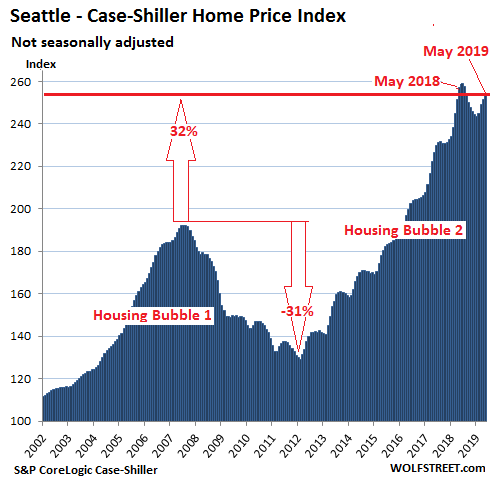
Prices of single-family houses in the Seattle metro ticked up 1.0% in May from April, which was less than half the seasonal increase last year. And so the index fell 1.2% from May last year, the first year-over-year decline since Housing Bust 1.

572f7 US Housing Case Shiller Seattle 2019 07 30 The Most Splendid Housing Bubbles in America, July Update: Year Over Year Declines Spread to Seattle

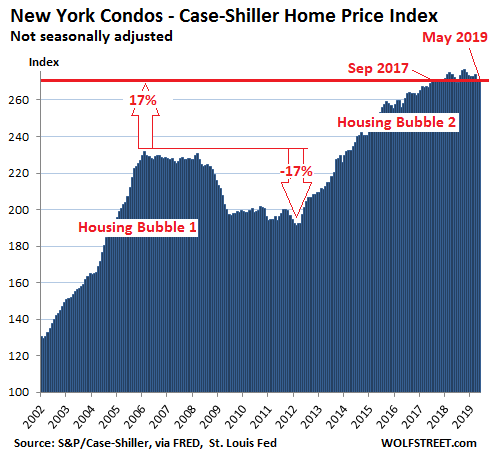
The Case-Shiller Index is a rolling three-month average that is released with one-month delay; today’s release represents closings that were entered into public records in March, April, and May.

The index was set at 100 for January 2000; a value of 200 indicates prices have doubled since January 2000. Every housing market on this list of the most splendid housing bubbles in America has an index value of over 200 in its history, either during Housing Bubble 1 or during Housing Bubble 2. This is the minimum requirement to make this list.

New York Condo Prices:

The Case-Shiller Index, which in most cities only covers single-family houses, also covers condos in a handful of big condo markets. The index for condos in the vast New York City metro, instead of booking a seasonal uptick, remained flat in May compared to April. This left the index down 0.3% from May last year, the fourth month in a row of small year-over-year declines. The index is now back where it had first been in September 2017:

572f7 US Housing Case Shiller New York condos 2019 07 30 The Most Splendid Housing Bubbles in America, July Update: Year Over Year Declines Spread to Seattle

San Francisco Bay Area Condo Prices

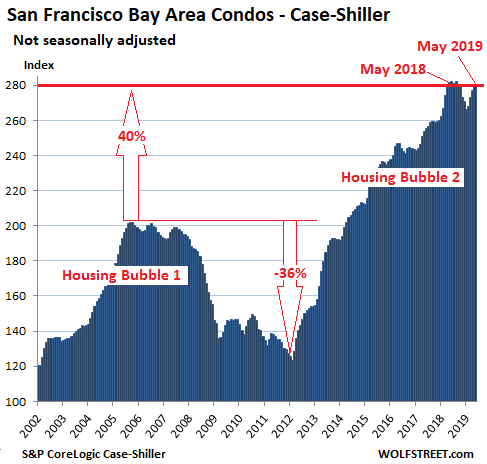
Condo prices in the five-county San Francisco Bay Area – the counties of San Francisco, San Mateo (northern part of Silicon Valley), Alameda and Contra Costa (East Bay), and Marin (North Bay) – rose 1.3% in May from April, according to the Case-Shiller index. But it wasn’t enough. Compared to May last year, prices slipped 0.4%, the third month in a row of year-over-year declines – the first such event since April 2012 at the end of Housing Bust 1:

572f7 US Housing Case Shiller San Francisco Bay Area Condos 2019 07 30 The Most Splendid Housing Bubbles in America, July Update: Year Over Year Declines Spread to Seattle

San Francisco Bay Area Single-Family House Prices

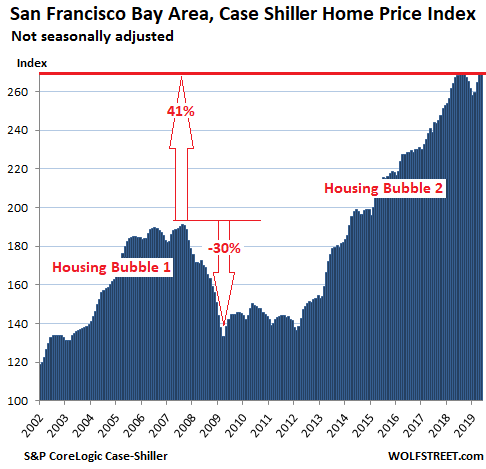
Single-family house prices in the five-county San Francisco Bay Area inched up 0.3% in May from April. This was merely one-third of last year’s increase in May. And it further eroded the year-over-year price gains, down to just 1.0% compared to May 2018 and left the index a tiny tad below its peak of July 2018:

93745 US Housing Case Shiller San Francisco Bay Area 2019 07 30 The Most Splendid Housing Bubbles in America, July Update: Year Over Year Declines Spread to Seattle

Los Angeles House Prices:

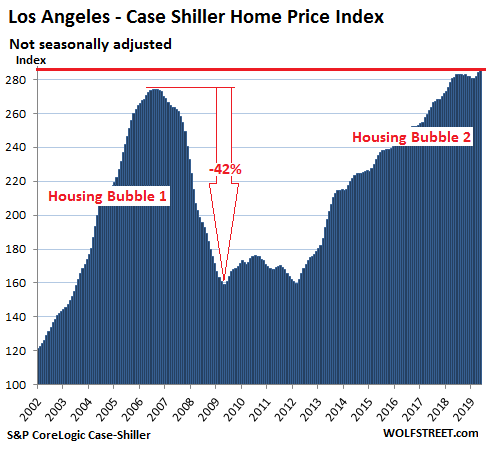
The Case-Shiller index for houses in the Los Angeles metro rose 0.8% in May from April, thus inching to a new record. The index is up 1.8% from May last year:

93745 US Housing Case Shiller Los Angeles 2019 07 30 The Most Splendid Housing Bubbles in America, July Update: Year Over Year Declines Spread to Seattle

San Diego House Prices:

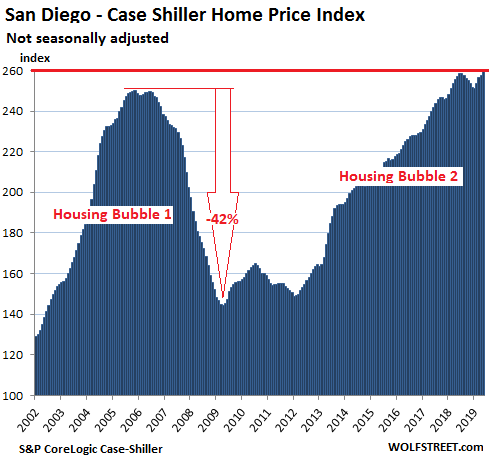
In the San Diego metro, house prices ticked up 1.0% in May from April, and eked past the record set in July last year to a new record, with the index up 1.3% from May last year:

93745 US Housing Case Shiller San Diego 2019 07 30 The Most Splendid Housing Bubbles in America, July Update: Year Over Year Declines Spread to Seattle

Washington DC:

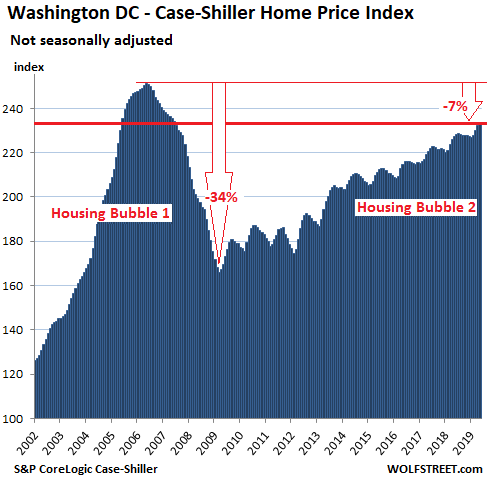
House prices in the Washington D.C. metro rose 0.7% in April from March, and 2.9% from May last year. The index remains 7% below its crazy peak of Housing Bubble 1:

52feb US Housing Case Shiller Wash DC 2019 07 30 The Most Splendid Housing Bubbles in America, July Update: Year Over Year Declines Spread to Seattle

Boston House Prices:

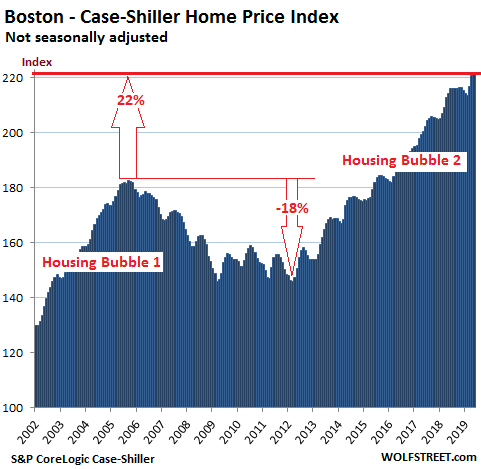
House prices in the Boston metro ticked up 0.5% in May from April to a new record, according to the Case-Shiller Index. The year-over-year increase was whittled down to 3.6%, the smallest year-over-year increase since June 2015:

52feb US Housing Case Shiller Boston 2019 07 30 The Most Splendid Housing Bubbles in America, July Update: Year Over Year Declines Spread to Seattle

Denver House Prices:

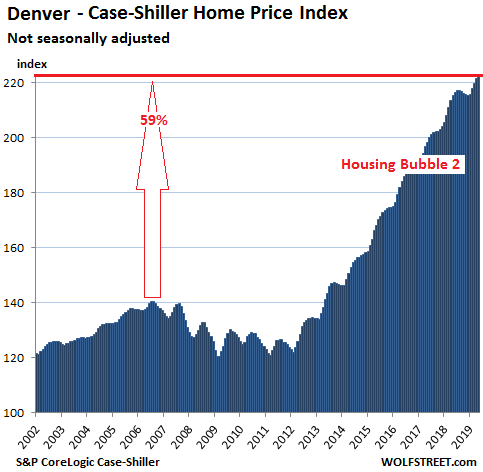
In the Denver metro, house prices rose 0.6% in May from April, and this whittled the year-over-year gain down to 3.6%, the smallest such gain since April 2012:

4e68b US Housing Case Shiller Denver 2019 07 30 The Most Splendid Housing Bubbles in America, July Update: Year Over Year Declines Spread to Seattle

Portland House Prices:

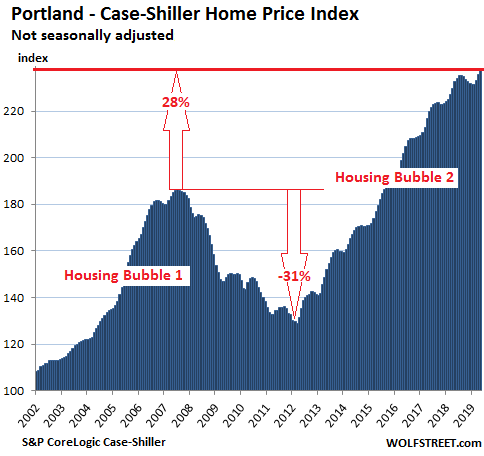
House prices in the Portland metro rose 1.0% in May from April and 2.4% from May last year, the smallest year-over-year increase since September 2012:

4e68b US Housing Case Shiller Portland 2019 07 30 The Most Splendid Housing Bubbles in America, July Update: Year Over Year Declines Spread to Seattle

Phoenix House Prices:

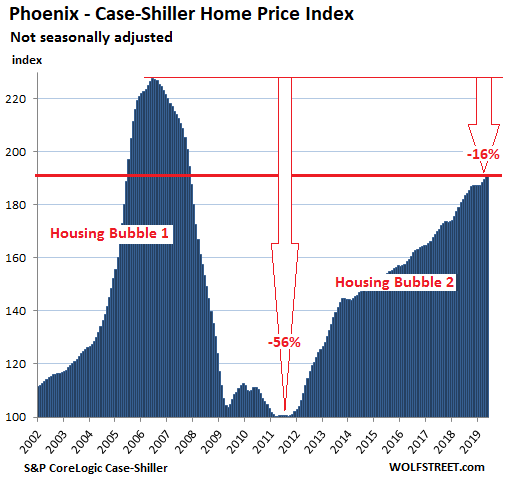
In the Phoenix metro, house prices rose 0.7% in May from April and 5.7% compared to May last year. The Case-Shiller Index remains 16% below its totally nutty peak established during Housing Bubble 1:

c6e76 US Housing Case Shiller Phoenix 2019 07 30 The Most Splendid Housing Bubbles in America, July Update: Year Over Year Declines Spread to Seattle

Miami House Prices:

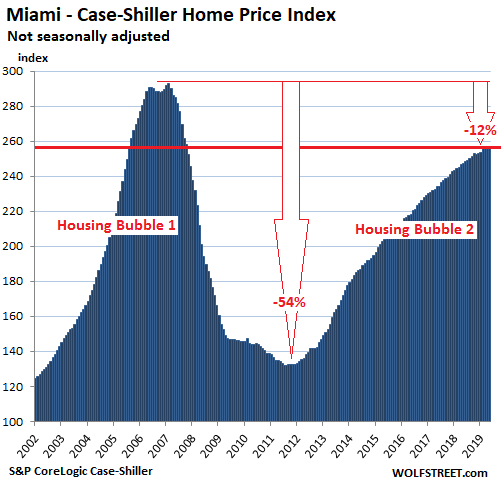
House prices in the Miami metro ticked up 0.4% in May from April and were up 3.8% from May last year. The year-over-year gains in May and April of 3.8% each were the slowest since May 2012. The index remains 12% below the peak of Housing Bubble 1, when the entire housing market turned into a besotted casino, with house prices shooting up 140% in just five years, before they inevitably collapsed. So now the market is desperately trying to get back to those happy days:

c6e76 US Housing Case Shiller Miami 2019 07 30 The Most Splendid Housing Bubbles in America, July Update: Year Over Year Declines Spread to Seattle

Tampa House Prices:

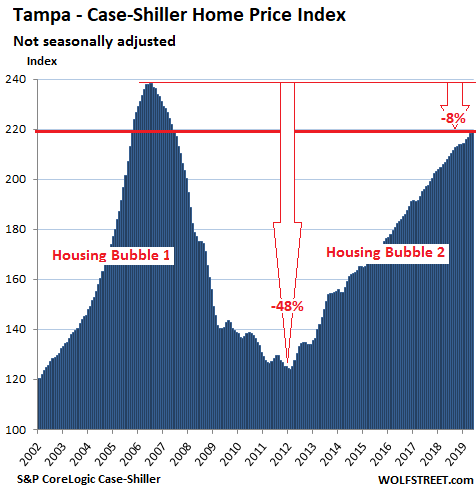
In the Tampa metro, house prices ticked up 0.1% in May from April. This whittled the year-over-year gain down to 5.1%. The index remains 8% below the crazy peak during Housing Bubble 1:

c6e76 US Housing Case Shiller Tampa 2019 07 30 The Most Splendid Housing Bubbles in America, July Update: Year Over Year Declines Spread to Seattle

Las Vegas House Prices:

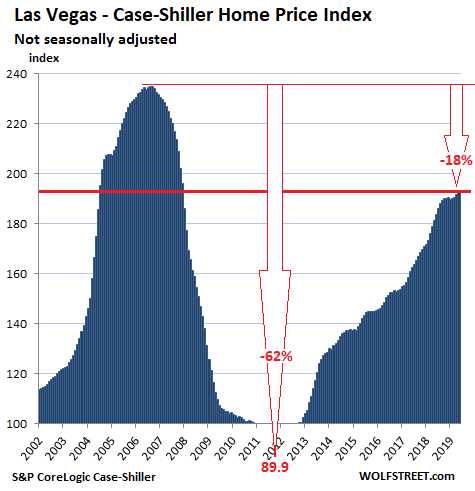
House prices in the Las Vegas metro rose 0.6% in May from April, whittling down the year-over-year gain to 6.4%. As high and out of whack this year-over-year gain may seem, it was the smallest such gain since February 2017, which shows how big the price increases have been. The index remains down 18% from the crazy peak during Housing Bubble 1:

c9bac US Housing Case Shiller Las Vegas 2019 07 30 The Most Splendid Housing Bubbles in America, July Update: Year Over Year Declines Spread to Seattle

The Case-Shiller methodology of “sales pairs” compares the sales price of a house in the current month to the last transaction of the same house years ago, thereby tracking price changes of the same house over time. When the price increases, it’s not because the house got larger. It’s because it takes more dollars to buy the same house. So the index tracks the purchasing power of the dollar with regards to houses and therefore is a measure of one type of inflation: house-price inflation.

Surging prices are a demand killer, but real estate industry laments the medicine didn’t work. Read…  Ultra-Low Mortgage Rates No Relief for Home Sales

Enjoy reading WOLF STREET and want to support it? Using ad blockers – I totally get why – but want to support the site? You can donate “beer money.” I appreciate it immensely. Click on the beer mug to find out how:

c9bac BeerMug1 The Most Splendid Housing Bubbles in America, July Update: Year Over Year Declines Spread to Seattle

Would you like to be notified via email when WOLF STREET publishes a new article? Sign up here.


Article source: https://wolfstreet.com/2019/07/30/housing-bubble-housing-bust-july-update-year-over-year-drops-spread-to-seattle/

Posted in SF Bay Area News | Tagged | Leave a comment

Despite soaring prices, some Bay Area homes still have recession-era property tax break

This may be hard to believe considering how far home prices have risen, but there are properties in every California county — including almost 50,000 in the Bay Area — that are still benefiting from temporary property tax reductions they got during the housing bust.

That’s because the market value of these properties, which are mostly residential, is still below their “Proposition 13 value.” This is where they would be assessed today under Prop. 13, had they not gotten the temporary reduction.

These properties make up a small percentage of the tax base in most Bay Area counties except Contra Costa, where they number 20,920, or 18% of all parcels. San Francisco has the smallest number — 617, or 0.3% of all parcels. Of those, 369 are condo units in the Millennium Tower, where values have sunk along with the building.

Statewide, they make up about 8% of all secured parcels, according to a survey by the California Assessors’ Association. In the Bay Area, they account for just under 2%.

In most counties, they tend to be homes purchased around 2005 to 2007 in areas that were undergoing rapid development and were slower to recover from the housing bust. Think of places like Brentwood and Antioch in Contra Costa and American Canyon in Napa County.

Under Prop. 13, properties in California are generally reassessed for property tax purposes only when they are sold. Assessed value is the amount subject to property tax.

In between sales, the assessed value can’t go up by more than an inflation factor capped at 2% a year, plus the value of additions and major improvements. This adjusted value is called the “factored base year value,” or Prop. 13 value for short.

Although Prop. 13 limited taxes on the upside, Proposition 8 allows for a temporary reduction in a property’s tax assessment when its market value drops below its Prop. 13 value. Properties with these reductions are said to be in “Prop. 8” or “decline in value” status. Reasons for a reduction could include damage by fire or flood, or a downturn in the overall market.

 Despite soaring prices, some Bay Area homes still have recession era property tax break

Once a home has gotten this reduction, the county assessor must reassess it at market value as of Jan. 1 each year — which can result in a further decrease or an increase greater than 2% a year — until it reaches its Prop. 13 value, or where it would have been without the temporary reduction. At that point, “all the protections of Proposition 13 kick in,” said Santa Clara County Assessor Larry Stone. It becomes subject to the 2% annual limit and reassessed only when sold.

Normally, owners must apply for a reduction, but after home prices started falling after 2007, many county assessors applied them automatically to wide swaths of homes purchased near the peak. Most homes didn’t get them because their market values remained above their Prop. 13 values.

Statewide, the number of properties with these reductions soared from about 335,000 in fiscal year 2007 to a peak of nearly 3.6 million in 2012, then dropped to about 1 million in 2018, according to the California Board of Equalization data. It doesn’t have data for this year, but, according to the association’s survey, it’s about 975,000.

In the Bay Area, the median price for homes and condos surpassed its mid-2007 peak of $665,000 in April 2016, then went on to post many new highs, topping out at $875,000 in June 2018, according to CoreLogic. In June, it was $856,000.

Despite this strong rebound, some homes are still in Prop. 8 status because of the inflation factor.

Suppose someone bought a home for $1 million near the peak in 2007 and later got its assessment reduced. Today, its Prop. 13 value would be about 20% higher, or $1.2 million, because of the inflation factor, said Brian Hitomi, Alameda County’s chief deputy assessor.

If the home was worth $1.1 million on Jan. 1 of this year, it would be assessed for $1.1 million, but it would still be in Prop. 8 status — and subject to annual reassessment — because it hasn’t reached its Prop. 13 value.

Alameda County still has about 5,000 properties with a temporary reduction, down from about 108,000 in 2011-12. Some of the 5,000 “have condition problems, but the vast majority were purchased at the peak,” Hitomi said. During the downturn, these reductions took a bite out of property taxes, but today the impact is negligible because they are close to being fully restored.

Solano County still has about 8,900 properties with a temporary tax reduction, or 6% of its total. Some homes that sold for more than $1 million at the peak “now are probably in the $700s. They have quite a ways to catch up,” Assessor Marc Tonnesen said.

Those properties are costing the county money, but at least it has the opportunity to recapture revenue as their market values go up. During the downturn, a lot of people walked away from their homes. When those buildings changed hands, they were reassessed at depressed levels. The county had no opportunity to recapture that value until they were resold at higher prices.

San Mateo County has 1,017 properties with temporary reductions, or 0.5% of all properties. Of those, 245 are residential, 37 are commercial and the rest are mainly mobile homes, apartment buildings and vacant or agricultural land.

In Santa Clara County, 1,843 properties, 0.4% of the total, still have reductions. That’s down from 136,559 properties, or nearly 25%, in 2012-13, Stone said. About 1,400 of the remaining properties are residential, and of those, 43% are in Gilroy and Morgan Hill, which combined have less than 4% of all parcels in the county.

In Sonoma County, 6,641 properties, or 3.6% of the total, still have temporary reductions. Only 982 of those were damaged or destroyed by the 2017 wildfires that consumed more than 5,000 homes in the county. That number is not higher because many fire properties were sold and reassessed, or they were purchased so long ago that their Prop. 13 value is still below market value, said Chief Deputy Assessor Greg Walsh.

In Napa County, 2,242, or 4.3%, of all properties have a reduction. “We aren’t putting many if any (new ones) on Prop. 8, but they are slowly dropping away. Now that the market may be stagnating, they may stay around for a few years,” Assessor John Tuteur said. “In the 1980s, we put a bunch of condominiums on Prop. 8. They stayed on Prop. 8 for 15 years until the market finally caught up.”

In Contra Costa, most of the properties with reductions “are in a select part of Richmond, Oakley and Brentwood, a little in Antioch and Pittsburg,” Assessor Gus Kramer said.

Modoc County, in the northeastern corner of the state, has 54% of its properties with a decline-in-value status, the highest percentage in the state.

About 95% of those properties, however, are in one subdivision called California Pines. “It was built in the 1960s or 70s, but the developer died in a tragic ski accident and all development stopped,” said Modoc County Assessor Kristen DePaul. Over the next several decades, various companies began aggressively marketing the lots, mostly to out-of-town buyers for retirement or vacation homes. The last to do so was National Recreation Properties Inc. of Irvine, which used former “CHiPs” star Erik Estrada as its spokesman.

“They were a hot commodity for years and really inflated the market for this piece of land out in the middle of absolute nowhere,” DePaul said. After NRPI went bankrupt in 2012, “there was just no market” and prices “dropped drastically,” she added. “I really don’t know if the subdivision will ever rebound without another marketing agency behind it.”

Other counties with a significant percentage of properties with temporary reductions include Alpine (30.3%), Butte (18.4%), Calaveras (19.7%), Kern (17.2%), Mono (21.8%), Plumas (24.2%) and Riverside (18.8%).

Kathleen Pender is a San Francisco Chronicle columnist. Email: kpender@sfchronicle.com Twitter: @kathpender

Article source: https://www.sfchronicle.com/business/networth/article/Despite-soaring-prices-some-Bay-Area-homes-still-14374985.php

Posted in SF Bay Area News | Tagged | Leave a comment

San Francisco house price declines year over year again

The California Association of Realtors tabulated house sales across the Bay Area last week and found that, once again, prices overall dropped in July compared to last year in almost every Bay Area county.

The overall drop came in at 3.1 percent from July of 2018, to a Bay Area median sales price of $950,000 year over year.

By and large, this is pretty much what house prices in the nine counties have done all year. The interesting thing is that this time San Francisco saw a dip too, bucking its usual trend of, well, bucking the trend.

The median price for SF was down three percent year over year, dropping to $1.6 million. San Mateo County also slipped three points, down to $1.56 million.

Alameda County declined 2.1 percent to $950,000, while Contra Costa County slipped 5.4 percent to $660,000.

Santa Clara County saw the biggest year-over-year drop outside the North Bay, down 3.9 percent and landing at a median of just less than $1.3 million.

Napa County saw the worst treatment (or best, depending on one’s point of view) in July with a 5.8 percent decline from last year, the new county average coming out to $685,000. Marin County was close at 5.1 percent down and more than $1.25 million for a median.

The only counties that appreciated year over year last month were Sonoma and— surprisingly—Solano.

But Sonoma County’s fractional 0.8 percent increase to $655,000 doesn’t make much of an impression. Solano was up 2.4 percent but remains, as always, the least unaffordable region in the Bay Area, with an average home price of $465,000 for the month.

Prices go up and down all the time, and it’s usually not a good idea to make a big deal over one month’s data.

But whereas prices have generally slipped year over year across most of the Bay Area, it is unusual to see San Francisco join in. Although SF prices have sometimes declined from 2018 peaks in previous months, the city typically resists the sinking trend stubbornly.

This was also significantly larger than the previous drop of just 1.1 percent in April.

Writing for SF-based real estate group Compass’ monthly market report, economist Patrick Carlisle notes that “markets in late 2017 through spring 2018 were very hot virtually throughout the Bay Area—perhaps the hottest they’ve been since 2000, the height of the dotcom boom.”

Since then, he goes on to say, “most markets saw either no significant year-over-year appreciation or year-over-year declines in median house sales prices” across the region.

Most months only “those markets most affected by the slew of local high-tech IPOs” saw housing price appreciation—that is to say, San Francisco and sometimes “the greater Oakland market.”

Carlisle also points out that SF is an odd example, because whereas the city is building significant numbers of condos, townhomes, and other multi-family developments, new single-family home stock is basically at a standstill, meaning that demand still goes up even as new supply becomes available.

In San Francisco, the average sales price for a single-family house rose from approximately $1.3 million in 2015 to around $1.6 million for the whole of the second quarter of 2019.

On the other hand, the median price for a condo during roughly that same period increased from around $1.1 million to about $1.2 million.

But even that number is potentially deceptive; Compass also warns that “SF has a large luxury condo market, which affects median values.” Which is to say, the high end tends to drag the average disproportionately upwards, disguising the realities of cheaper multi-family homes further down the chain.

Article source: https://sf.curbed.com/2019/8/26/20830290/july-sf-housing-price-dropped-2019-car-compass

Posted in SF Bay Area News | Tagged | Leave a comment