Saving for a Bay Area down payment? This is how long it could take

Resolving to become a homeowner in the next few years? Buyers in places like St. Louis and Tampa need only to save a modest amount to make that goal a reality.

But in the Bay Area, you’ll need a stash.

According to a new analysis from Realtor.com, would-be homeowners in the San Francisco-Oakland-Hayward metro area need to sock away $3,379 a month for five years to cobble together a median down payment of $212,000.

If that gives you sticker shock, forget the South Bay.

In the San Jose-Sunnyvale-Santa Clara metro area, where the median home goes for more than $1 million, homebuyers are putting down an average of $265,000. That requires saving $4,224 every month for five years or a whopping $7,170 each month for three years.

And those figures don’t account for any potential change in home prices. So if the market accelerates, those amounts could rise.

Still, it could be worse.

“With recent moves toward lower mortgage rates, home buyers have seen slight relief in the last 12 months in high-priced markets,” Realtor.com’s director of economic research, Javier Vivas Castillo, said in an email. “The lower cost of borrowing along with moderating home-price growth, and in some cases price corrections and builder incentives, have opened up the window to more prospective home buyers.”

Across the 20 or so metro areas Realtor.com analyzed, buyers in the Bay Area are shelling out the largest down payments. The Los Angeles-Long Beach-Anaheim region is the next most expensive. Still, with an average home price of $645,000 and an average down payment of $132,000, buyers need to save a relatively modest $2,104 over five years for the standard down payment.

By comparison, the average U.S. home is worth around $243,000, according to Zillow. In other words, many American homes are worth less than a typical Bay Area down payment.

According to Realtor.com, there’s also a significant variation in the percentage people put down. Despite sky-high housing costs, buyers in the San Francisco area — home to wealthy tech workers who pull in some of the highest salaries in the nation — typically put down a robust 24 percent.

“Generally, buyers in denser, higher-priced markets tend to aim for higher down payments as loan risk, interest and requirements tend to increase with higher home-purchase values,” Vivas Castillo said.

People who put down large down payments can also sometimes avoid buying private mortgage insurance, he added.

Still, “first-time buyers in these markets are particularly forced to be more creative, so scenarios such as BOMAD — bank-of-mom-and-dad — financing, multigenerational mortgages, dual-income, no-kids saving strategies, longer commutes, mortgage helpers and renovations are not uncommon,” Vivas Castillo said.

In other markets, where housing is relatively affordable but salaries are also lower, people put smaller amounts down. In the Philadelphia-Camden, New Jersey-Wilmington, Delaware area, for instance, buyers are putting down $21,900. That’s eight percent of the median sale price of $260,000.

To calculate the amounts, Realtor.com assumed an interest rate of 1.8 percent on the savings.

A growing number of Bay Area residents, particularly millennials, say they are considering leaving the region in part because owning a home is no longer a realistic dream. In the Seattle area, a popular destination for people leaving California, the median down payment is $73,000. In the Phoenix area, another popular choice, it’s just $25,000.

Ultimately, at least in the Bay Area, Vivas Castillo said, “our analysis of the recent down payment data shows home ownership in some markets remains a luxury item.”

A new law makes buying a home a little easier for at least one group of people: veterans.

VA loans have long given active-duty military service members and veterans access to home loans that allow for zero down payment. But in the past, there have been limits. In expensive places like Santa Clara County, where last year the cap was in the $700,000s, down payments have been required for typical, market-rate homes, which were regularly priced above $1 million. As of January 1, those limits are mostly gone and the impact in places like San Jose and Oakland stands to be significant.

“Now, if a veteran can afford a $1.5 million mortgage, they can get that mortgage without putting down a dime and that has not been the case in years past,” said Chris Birk with Veterans United Home Loans, which recently ran an analysis of where veterans will see the largest increase in their ability to purchase without putting any money down.

It’s unclear exactly how many people might benefit. But according to Veterans United figures, in fiscal year 2019, more than 1,300 families relied on VA loans in Contra Costa County. Hundreds more families took out the loans in Alameda, San Mateo and Santa Clara counties that year. Now, Birk said, he’s hearing from borrowers who pushed off closing on property until after the start of 2020 to take advantage of the change.

With the help of the new law and with the GI Bill reducing the need for hefty student loans, young veterans may be in a much better position when it comes to buying a home than their non-military peers who are struggling to put together large down payments while burdened with debt.

“They’re not stuck,” Birk said, “on the sidelines like civilians.”


Article source: https://www.mercurynews.com/saving-for-a-bay-area-down-payment-this-is-how-long-it-could-take
Posted in SF Bay Area News | Tagged | Leave a comment

Bay Area Home Prices Stagnant After Seven-Year Tech Bonanza

We’ve detected unusual activity from your computer network

To continue, please click the box below to let us know you’re not a robot.

Article source: https://www.bloomberg.com/news/articles/2020-01-10/bay-area-home-prices-stagnant-after-seven-year-tech-bonanza

Posted in SF Bay Area News | Tagged | Leave a comment

San Francisco, San Jose among top under-performing metro areas in 2020 US housing market, according to report – KGO

SAN FRANCISCO, Calif. (KGO) — The housing market in the Bay Area will experience a cooling period this year, similar to 2019, according to a national survey conducted by Zillow, an American online real estate data company Zillow.

Zillow consulted a panel of more than 100 economists and real estate experts in the country and asked for their expectations on the housing markets, which cities are going to out-perform or under-perform.

Top 25 metropolitan areas in the country were analyzed and San Francisco, followed by San Jose had the worst scores when it came to expected performance. Oppositely, the hottest housing markets are expected to be Austin, Texas, followed by Atlanta, Ga.

Like any athlete, San Francisco had a “personal best” in the home value growth area, and was achieved before 2019.

“The boom in the country right now is occurring in the Central states and South East,” said Mike Englund of Action Economics in Boulder, Colorado. He was one of the economists asked to give his 2020 expectations for the housing markets.

When surveyed which of the top 25 metro areas are expected to underperform, 64% of them said San Francisco and only 24% thought it might out-perform. Subtracting 24 from 64, San Francisco gets the worst marks in the country, a negative 40.

San Jose didn’t do much better, getting a minus 38.

Fluctuating interest rates and the new tax law which caps your itemized deductions at $10,000 have had an impact on this cooling-off trend.

“Just based on interest rates and stock prices going up and down and fluctuating, I do believe there is a little bit of a slowdown,” Simon Shue, a real estate agent with Compass said. “It’s still in an upward trend but we’re experiencing a little bit of a plateau.”

Mark Calvey, a senior reporter with the San Francisco Business Times said, “You’re looking at saying, ‘Do I want to pay this high price for a Bay Area home or do I want to go to another city when I can save for retirement, save for my children’s college education and still have a nice home?’”

Of the 14 markets that received a positive score, 11 of cities are located in the Southwest, Southeast or Texas, according to the report.

The Times is about to release an article revealing the top cities where California residents are moving to like Denver, Nashville, Atlanta and Dallas.

For those thinking of selling now, Englund says it may be a good idea to wait.

“California real estate has appreciated more than in other regions so I think you sit back and ride out the slow down because there will probably be booms in the pipeline in any case,” added Englund.

Take a look at all of ABC7′s Building a Better Bay Area stories and videos.

Article source: https://abc7news.com/5812497

Posted in SF Bay Area News | Tagged | Leave a comment

Boston Properties, Alexandria Real Estate Equities Bet Big On Biotech

Two of the largest owners and developers of U.S. real estate will co-develop a massive life science campus at a current office space site.

Boston Properties has entered into a joint venture with Alexandria Real Estate Equities to build a 1.7M SF life science campus in South San Francisco.

Boston Properties confirmed the deal in its Q4 2019 earnings call this week.

The project will involve about 640K SF of ground-up development, and the potential repositioning of about 1M SF of office space into new life science buildings, according to Boston Properties.

“Upon completion of the development plan, the joint venture will comprise a significant critical mass of 1.7M SF of office and life science space, and a premier location in one of the strongest life science markets in the U.S,” Boston Properties CEO Owen Thomas said in the company’s earnings call on Wednesday. 

In the joint venture, Boston Properties, now the sole owner of San Francisco’s iconic Salesforce Tower after buying out Hines’ 5% interest last year, will contribute its Gateway Commons campus, which consists of three Class-A office properties along Gateway Boulevard. 

Alexandria, Boston Properties says, has contributed properties totaling about 313K SF, including lab, office and amenity buildings, as well as developable land, all adjacent to Gateway Commons, which allows both owners to end up “creating value just by putting two sites together.”

Alexandria, which has its own earnings call next week, did not immediately respond to a request for comment.

Rebalancing property types in the area also allows both companies to satiate more of the biotech industry’s demand for lab space in South San Francisco. Average asking rents for Class-A office space in South San Francisco last quarter were $46.20 per SF, while Class-A RD space averaged an asking rent of $69 per SF in South City, according to CBRE

“Gateway is a very well-located office park near transit in South San Francisco, which is a very strong lab market and, frankly, a less strong office market,” Thomas said.

Elsewhere in the Bay Area, Boston Properties has big office projects that could soon break ground, including 1.1M SF Platform 16 in San Jose and 4th and Harrison in San Francisco. 

In San Jose, though, things could unfold even sooner. The partnership has already agreed to a plan for one of likely three ground-up lab buildings of about 200K SF and is hopeful it can pull permits in the coming months.

“There is a possibility that we could launch one of these buildings this year,” Thomas said.

Article source: https://www.bisnow.com/san-francisco/news/life-sciences/boston-properties-alexandria-real-estate-equities-join-forces-in-south-city-102766

Posted in SF Bay Area News | Tagged | Leave a comment

Fight ensues over SF landlord’s sale of thousands of rent-controlled apartments


  • 184f6 920x920 Fight ensues over SF landlords sale of thousands of rent controlled apartments

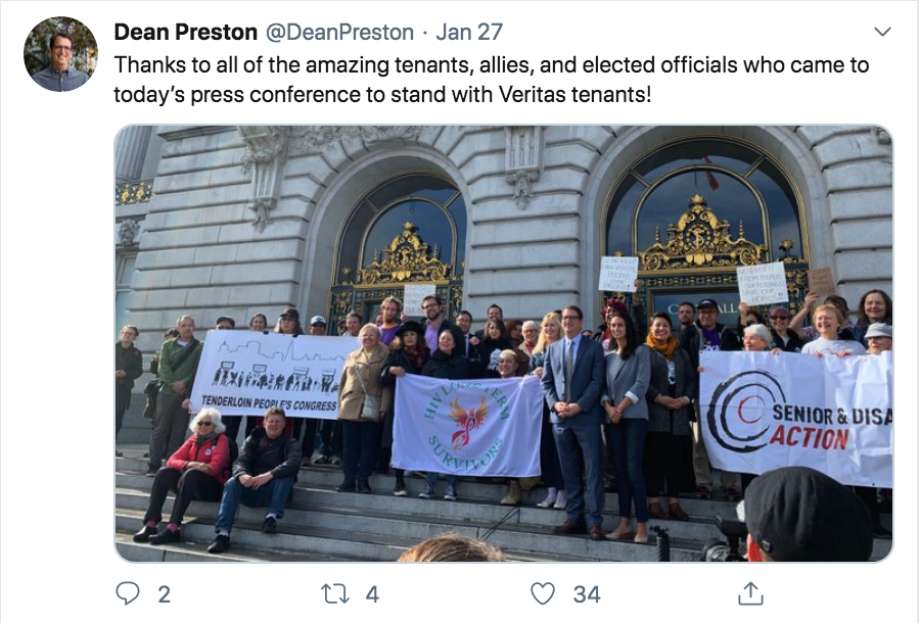
    At a press conference on Jan. 27, Supervisor Dean Preston of District 5 and the Housing Rights Committee asked Veritas to delay the sell-off of 76 buildings for 60 days to allow nonprofits and city leaders time to explore purchasing some or all of the properties.

    less

    At a press conference on Jan. 27, Supervisor Dean Preston of District 5 and the Housing Rights Committee asked Veritas to delay the sell-off of 76 buildings for 60 days to allow nonprofits and city leaders time

    … more


    Photo: Twitter: @DeanPreston

  •  Fight ensues over SF landlords sale of thousands of rent controlled apartments

Caption

Close

At a press conference on Jan. 27, Supervisor Dean Preston of District 5 and the Housing Rights Committee asked Veritas to delay the sell-off of 76 buildings for 60 days to allow nonprofits and city leaders time to explore purchasing some or all of the properties.

less

At a press conference on Jan. 27, Supervisor Dean Preston of District 5 and the Housing Rights Committee asked Veritas to delay the sell-off of 76 buildings for 60 days to allow nonprofits and city leaders time

… more


Photo: Twitter: @DeanPreston


One of San Francisco’s biggest landlords, Veritas Investments, is selling 76 residential properties with more than 2,000 units, nearly a third of the company’s local portfolio.

In a city where housing is scarce, the real estate offering is stirring up a conversation around who should buy these buildings, which are all rent-controlled apartments, according to Veritas.

Supervisor Dean Preston and the Housing Rights Committee are asking Veritas to delay the sell-off for 60 days to allow nonprofits and city leaders time to consider purchasing some or all of the buildings. In a city where some 171,000 units are considered rent-controlled, Preston feels the sale could impact the market and availability of affordable housing.

“This is a huge number of rent-controlled units, and being put on the market all at once like this virtually guarantees the buyer will be another massive corporation,” said Preston, who led a press conference on Monday to call attention to the issue. “This isn’t the sale of one or two buildings. This is a sale of a significant chunk of rent-controlled-stock in the city. The big corporate investors who can buy large portfolios like this, their model is a business practice of generating their profits by aggressively raising rents through pass-throughs and trying to vacate units through evictions.”


Veritas has no plans to delay the sale. The company said it already gave nonprofits the opportunity to buy the buildings and alleges a tenant advocacy group committed a “flagrant” breach of confidentiality in the process.

ALSO: Expert notes ‘sharp deceleration’ in San Francisco Bay Area rent prices

San Francisco’s new Community Opportunity to Purchase Act, approved by the Board of Supervisors last year, requires property owners to give qualified nonprofits the first right to purchase properties during a one-month waiting period. Veritas listed the units to nonprofits on Dec. 20, 2019, and gave them first right of refusal until Jan. 18, 2020.

“Three qualified nonprofits came forward and said, ‘We’re interested in these buildings,’” Veritas spokesperson Juliana Bumim said. “Veritas provided all the information … rent, addresses, contact info, confidential private information. At the end of the 30 days, none of the nonprofits made an offer.”

Bumim alleges that during this process, confidential information — tenants’ names, addresses, rent amount and other information — was illegally released by the Housing Rights Committee of San Francisco. She said this is “deeply problematic and undermines the whole purpose of honestly coming to the table in good faith to negotiate with nonprofits.”


Sarah Sherburn-Zimmer, the director of the Housing Rights Committee, a tenants rights organization, said Veritas is making misleading claims to intimidate tenants from receiving information on their basic rights. Sherburn-Zimmer told The Chronicle earlier this week that the names were posted to give tenants the opportunity to find out that their buildings were for sale and denied the publication of names was illegal.

“Veritas is upset that their tenants are standing up to their plan of speculation led displacement with our help,” Sherburn-Zimmer wrote in an email. “We will continue to get tenants information they need to fight back to stay in SF.”

Veritas maintains that HRC committed a “flagrant violation” of the Community Opportunity to Purchase Act and undermined the company’s ability to work with Supervisor Preston and the Housing Rights Committee.

“We are open to working with the Mayor’s Office of Housing and Community Development, which governs the city’s acquisition of affordable housing projects and has always been a strong partner,” said Justin Sato, chief strategy and portfolio officer of Veritas.

The office has an acquisition and preservation program, but “given limits on available funding, it would be difficult for us to fund the purchase of a significant portion of the overall portfolio, though we are currently evaluating what possibilities there may be,” MOHCD said in a statement.

This story was updated at 6 p.m. on Jan. 30, 2019.

Amy Graff is a digital editor with SFGATE. Email her: agraff@sfgate.com.

Article source: https://www.sfgate.com/realestate/article/San-Francisco-mega-landlord-rent-controlled-units-15011597.php

Posted in SF Bay Area News | Tagged | Leave a comment