
Bay Area coronavirus updates: Lakeshore Elementary in SF to close for 2 weeks


  • ef433 920x920 Bay Area coronavirus updates: Lakeshore Elementary in SF to close for 2 weeks

Caption

Close


This story is no longer being updated. Read the latest on COVID-19 in the Bay Area here, as of March 12. 

For more coverage, visit our complete coronavirus section here.

LATEST, March 11, 11:15 p.m. Lakeshore Elementary School in San Francisco will close for at least two weeks after four students and a number of adult family members reported having respiratory illness, the school district announced Wednesday night.

The SF Department of Public Health is testing the students for coronavirus. There are currently no confirmed cases at Lakeshore, the district said, but the school will be closed for at least 14 days.

March 11, 8 p.m. Marin County is reporting two new cases of coronavirus.

This brings the county’s total to three. Officials said the two new cases lived with the first person to test positive in the county, an individual who was a passenger on the Grand Princess cruise ship in February.


March 11, 7 p.m. The NBA announced it is suspending the 2019-2020 season after Utah Jazz center Rudy Gobert reportedly tested positive for coronavirus.

Earlier in the day, the city of San Francisco banned gatherings of over 1,000 people, which would have stopped the Golden State Warriors from playing home games at Chase Center with fans present.

The Associated Press reported the season will be suspended for at least two weeks.

March 11, 5:10 p.m. Three new cases of coronavirus have been confirmed in Santa Clara County, bringing the county’s total to 48.

County officials did not provide any additional information on the individuals, and stated the number of cases is expected to increase.

March 11, 4:15 p.m.: The Oakland Marathon on March 22 has been canceled due to the Alameda County Health Department issuing new guidance related to large community events to reduce community transmission of COVID-19.

“We know many of you have trained and made sacrifices for months in anticipation of a great personal accomplishment,” marathon organizers said in a statement. “We regret we are unable to host our amazing event, and hope you understand this decision was beyond the control of Corrigan Sports Enterprises.”

Staff is meeting Thursday to review next steps and options.

The Alameda County Health Department released guidance for mass gatherings on Wednesday, recommending that event organizers postpone non-essential mass gatherings and community events.


March 11, 12:55 p.m.: An additional 42 TSA agents at San Jose Mineta International Airport are on paid leave after three of their coworkers at the airport tested positive for the novel coronavirus.

Those three employees are receiving medical care, KTVU reported, and the other 42 employees are being quarantined at home as a precaution while monitoring for symptoms.

All 45 employees were on the evening shift at the Terminal B checkpoint, according to KTVU. A union representative told the TV station he wasn’t sure how long the employees had been working while infected. Alaska Airlines, British Airways, Hainan Airlines and Southwest all fly out of Terminal B.

March 11, 11:30 a.m.: The San Mateo County Public Health Department reported Thursday the county now has 15 known cases of coronavirus. This is up from 9 cases on Wednesday.

As the number of COVID-19 cases continues to rise around the Bay Area, San Mateo County’s top public health official isn’t mincing words.

“I now have evidence of widespread community transmission of COVID-19 in San Mateo County,” wrote Health Officer Scott Morrow. “The only way to stop the spread of COVID-19 in the light of having community transmission is to have everything in our society grind to a halt for an extended period of time, as you have seen done in other countries.”

However, Morrow doesn’t believe it’s time to make that call in San Mateo County, where there are nine known cases of the novel coronavirus as of Wednesday morning. He is asking for the cancellation of all non-essential gatherings and for residents to increase personal hygiene and social distancing.

“At this moment, given what I know, I believe grinding everything to a halt would cause us more harm than good,” Morrow said.

It’s not clear exactly how the six new additional patients contracted the virus.

March 11, 10:45 a.m.: San Francisco Mayor London Breed said Wednesday the city is issuing an order prohibiting all large group events of 1,000 people or more. The ban will apply to all events at Chase Center, including Golden State Warriors games, the mayor is reportedly set to announce.

“This is necessary to slow the spread of COVID-19, and builds on our previous public health recommendations,” Breed wrote on Twitter.

Read the full story here.

March 11, 8:42 a.m. Amazon announced Wednesday morning its Amazon Web Services Summit in San Francisco is canceled. The conference was planned for April 14 at the Moscone Center and will be replaced with a digital conference sometime in May.

Several new coronavirus cases were reported around the Bay Area on Tuesday. Three Transportation Security Officers at Mineta San Jose International Airport tested positive for COVID-19, TSA officials said. It’s unclear if these cases are among the 45 already reported by public health officers in Santa Clara County.

Contra Costa County announced one presumptive case of COVID-19, bringing the county total to 10 residents. A new case was also detected in Alameda County, the county’s third. Another two cases of COVID-19 were confirmed in Santa Clara County, bringing the county’s total to 45. San Francisco public health officials also announced a case; the city total is now 14.

California had 157 cases of coronavirus as of Tuesday; this number doesn’t include passengers from the Grand Princess cruise ship currently docked in Oakland. The Bay Area has about 100 cases.

ALAMEDA COUNTY

Confirmed cases: 3 residents

Fore more information on Alameda County cases, visit the public health department website.

CONTRA COSTA COUNTY

Confirmed cases: 10 residents, 3 people of unknown residence being treated at Contra Costa hospitals

Fore more information on Contra Costa County cases, visit the public health department website.

MARIN COUNTY

Confirmed cases: 3 residents, 1 patient of unknown residence

Fore more information on Marin County cases, visit the public health department website.

NAPA COUNTY

Confirmed cases: 2 patients treated in Napa, then transferred out of county

For more information on Napa County cases, visit the public health department website.

SAN MATEO COUNTY

Confirmed cases: 15 cases, at least 8 patients of unknown residence treated at San Mateo County hospital

For more information on San Mateo County cases, visit the public health department website.

SANTA CLARA COUNTY 

Confirmed cases: 48 residents

Related deaths: 1

This county has the most confirmed cases in the Bay Area. As of March 8, health officials have identified a total of 43: eight were travel-related, 14 were from being in close contact with a known case, and 21 contracted the virus through unspecified community transmission.

One woman died on March 9 at El Camino Hospital in Mountain View. She had been hospitalized for several weeks, officials said.

Fore more information on Santa Clara County cases, visit the public health department website.

SAN FRANCISCO COUNTY

Confirmed cases: 14 cases, 3 out-of-county patients being treated in SF hospitals

For more information on San Francisco County cases, visit the public health department website.

SOLANO COUNTY

Confirmed cases: 6 cases, at least one of them is a non-resident

female Solano County resident was the first case of “unknown origin” in the U.S. and was infected with virus without any travel history or contact with another known case. She first arrived at the North Bay VacaValley Hospital in Vacaville on Feb. 15 and was transferred to UC Davis Medical Center three days later, before being tested.

Two health care workers at the North Bay VacaValley Hospital were also infected with the virus. One is a Solano County resident; the other lives in Alameda County.

For more information on Solano County cases, visit the public health department website.

SONOMA COUNTY

Confirmed cases: 2 residents, 1 patient of unknown residency

For more information on Sonoma County cases, visit the public health department website.

CALIFORNIA DEATHS: 4

Four deaths deaths related to coronavirus in California have been reported.

The first occurred in Placer County on March 4. The Placer County Health Department said the deceased is an elderly resident of the county with underlying health conditions. The patient tested presumptively positive on Tuesday, March 3 at a California lab and was likely exposed on a Princess cruise ship that traveled from San Francisco to Mexico, Feb. 11 to 21, health officials said. The patient was under treatment in isolation at Kaiser Permanente Roseville.

The second California death, the first in the Bay Area, was reported in Santa Clara County in March 9. A woman in her 60s passed away at El Camino Hospital in Mountain View Monday, the first death tied to the novel coronavirus in the Bay Area. The woman was hospitalized for several weeks, Santa Clara County health officials said.

Sacramento County announced on March 10 that a woman in her 90s in an assisted-living facility died from corornavirus. This was the first death in the county and the third in California. Health officials said the patient had an underlying health condition and “died of complications” related to the pneumonia-like virus.

Los Angeles County announced the fourth death on March 11: a woman who had traveled extensively (including a layover in South Korea) and who was visiting Los Angeles from out of town.

The death of a 72-year-old man from Sunnyvale was previously thought to be linked to COVID-19, but test results confirmed the man did not have the virus.

Amy Graff and Alix Martichoux are digital editors with SFGATE. Email them: agraff@sfgate.com, alix.martichoux@sfgate.com. 

MORE CORONAVIRUS COVERAGE

Article source: https://www.sfgate.com/bayarea/article/Bay-Area-SF-coronavirus-updates-news-15121852.php
Posted in SF Bay Area News | Tagged | Leave a comment

Bay Area restaurants weather coronavirus outbreak, some with devastating losses

CLICK HERE if you are having a problem viewing the photos on a mobile device

A San Francisco fast-casual eatery with Michelin cred was forced to close, and business at a swanky SoMA restaurant is down 70 percent. But for one popular chain of gourmet burger joints, it’s business as usual in Marin, Palo Alto and Walnut Creek.

The coronavirus outbreak — declared a global pandemic by the World Health Organization on Wednesday — is affecting Bay Area restaurants in dramatically different ways. The hardest-hit businesses are in city centers, like San Francisco, where large venue closures and event cancellations have caused dining and catering to plummet by as much as 70 percent, the worst drop since just after 9/11.

Neighborhood and 50-seat-or-fewer restaurants that meet the social distancing recommendations put forth by the counties of San Francisco, Santa Clara and Contra Costa are faring slightly better with drops closer to 25 to 50 percent, and many are relying on delivery to make ends meet. Overall, it’s a moving target and one that many in the industry are addressing day by day, be it by reducing staff or implementing stringent cleaning practices to encourage patronage.

On Friday, data released by OpenTable found that restaurant reservations on their platform in San Francisco were down 51 percent comparing March 12, 2019 with Mar 12, 2020 — the largest decline of any city included in their dataset other than New York City and Seattle.

“The problem is, this is something we’ve never seen before and we just don’t know what’s going to happen,” says Laurie Thomas, acting director of the Golden Gate Restaurant Association, which represents approximately 800 restaurants, mostly in San Francisco, as well as chains with locations across the Bay Area. The group recently increased cleaning requirements — including antiseptic wipe-downs on both sides of all doors and handles, multiple times daily — and is asking members to refrain from hugging, high-fiving or even air-kissing customers.

As of Monday, Thomas’ restaurants — Rose’s Café and Terzo, both in the Marina/Cow Hollow area — are seeing a 30 percent drop; she has taken measures to offset that, like reducing alcohol buys. But, she says, larger restaurants that rely on downtown conferences or banquet events are suffering much more. On Tuesday, the San Francisco Board of Supervisors introduced an emergency measure to help, including an ordinance to create small business rent stabilization loans and legislation to supplement income for some employees.

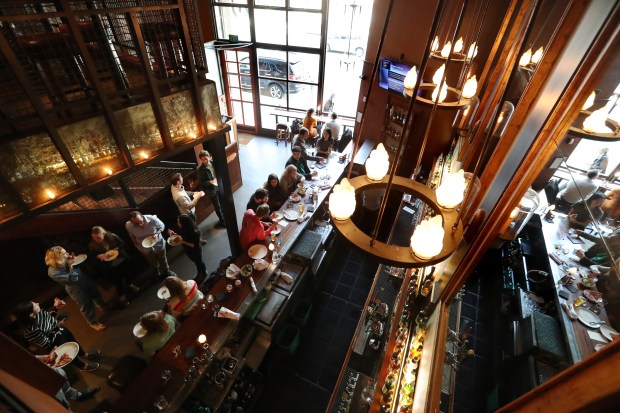
Bruce Hill, owner of Zero Zero in SoMA, is hoping for some kind of economic relief. In the past weeks, business at his swanky Cal-Ital restaurant and bar has been down a devastating 70 to 80 percent. “I’m freaked out,” says Hill, who has been sending staff home early when the restaurant is quiet. He also closed for lunch on Wednesday to deep-clean the restaurant and meet with staff to boost morale. “All this week and part of last week we have not even opened our (95-seat) mezzanine.” Capacity has been contained to the 45 seats downstairs.

53f2e SJM L CORONA 0312 9 Bay Area restaurants weather coronavirus outbreak, some with devastating losses
Customers enjoy appetizers and drinks at the bar at Zero Zero on Wednesday, March 11, 2020. Zero Zero is one of several restaurants whose business has plummeted in the wake of the coronavirus outbreak. (Ray Chavez/Bay Area News Group) 

Last week, Hill jumped on Caviar to offer delivery of Zero Zero’s salads, pasta and wood-fired pizzas for the first time. “The revenue might just soften the blow a little bit,” he says. And then there’s another issue: Like many restaurants, Zero Zero relies on imported Italian goods, including flour and tomato sauce. “None of that stuff is leaving Italy right now,” he says. “It’s just another ripple in this whole thing.”

In the South Bay and on the Peninsula, where commuters are increasingly working from and dining close to home, restaurateurs are hoping stringent cleaning policies and other measures will encourage customers to keep coming in. The Plumed Horse in Saratoga has implemented a “black glove policy” between its Michelin-starred courses and cut its dining room capacity in half, expanding the “social distance” between tables in an effort to keep high-tech spenders coming in.

On Thursday, Cin-Cin, a Los Gatos wine bar, took similar measures, not only reducing the seating capacity of its restaurant but also offering discounts on the DoorDash app so people who are stuck at home can enjoy their food and “have some semblance of normalcy during these trying times,” they said in an email.

And in the East Bay, Bob and Maggie Klein of Oakland’s Oliveto have implemented several strategies to help customers of the Rockridge restaurant feel safe: A one-meter space between tables, hand-sanitizing stations throughout the dining room and single-use menus.

“The Covid-19 virus crisis presents by far the greatest challenge we’ve ever come against, and we are dealing with it head on,” the owners said via e-mail.

At Gott’s Roadside, which operates gourmet burger joints in Walnut Creek as well as Palo Alto, Marin, St. Helena and San Francisco, they’ve reinforced existing cleaning and food safety protocols, mandated employee handwashing every 20 minutes and disinfected high-traffic areas of the restaurant throughout the day.

“It makes people feel safe,” said Gott’s president Chris Walker. “We have seen some sales decreases, but in suburban and rural markets I would say things are good. As corporations implement work-from-home mandates, people are eating around where they live, which is in the suburbs.”

Even at the iconic Ferry Building on the Embarcadero, where fine-dining restaurants are hurting, Gott’s sales are actually up. “We’re in the comfort food business,” Walker says. “And I think people are taking advantage of the summer-like weather and wanting to gather as a community in a high anxiety time.” Another sign of the times? The highest beer and wine sales since the Ferry Building restaurant opened in 2004.

And then there are restaurants for whom the coronavirus outbreak is the final straw in a slow first quarter. AL’s Deli, a fast-casual Israeli eatery from Aaron London of San Francisco’s Michelin-starred AL’s Place, opened with a splash last summer in the Mission District. But, as London first told Eater SF, the concept didn’t catch on as he had hoped. Dwindling corporate catering business in the past few weeks — 100 percent of orders for the past week were canceled — delivered the final blow. AL’s Deli closed March 7.

“A lot of small restaurants don’t have the cushion a large corporation has,” London says. “A couple of slow nights makes a difference. A couple of slow weeks, and I think it’s very uncertain what’s going to happen to a lot of the small restaurants in the city.”


Article source: https://www.mercurynews.com/bay-area-restaurants-weather-coronavirus-outbreak-some-with-devastating-losses

Posted in SF Bay Area News | Tagged | Leave a comment

Famed musician’s former beach property to become a Bay Area park


  • 0adb5 920x920 Famed musicians former beach property to become a Bay Area park

    Tunitas Creek Beach was formerly owned by rocker Chris Isaak. He sold the property to the Peninsula Open Space Trust three years ago and it was recently purchased by San Mateo County to be transformed into a public park.

    less

    Tunitas Creek Beach was formerly owned by rocker Chris Isaak. He sold the property to the Peninsula Open Space Trust three years ago and it was recently purchased by San Mateo County to be transformed into a

    … more


    Photo: POST

Caption

Close

Tunitas Creek Beach was formerly owned by rocker Chris Isaak. He sold the property to the Peninsula Open Space Trust three years ago and it was recently purchased by San Mateo County to be transformed into a public park.

less

Tunitas Creek Beach was formerly owned by rocker Chris Isaak. He sold the property to the Peninsula Open Space Trust three years ago and it was recently purchased by San Mateo County to be transformed into a

… more


Photo: POST


A one-mile-long beach property formerly owned by rocker Chris Isaak is set to become a San Mateo County Park, according to the San Jose Mercury News. It will be the first coastal addition to the San Mateo County parks system since Fitzgerald Marine Reserve in Moss Beach was added in 1969 and the first new park of any kind added to the county parks system since 2013.

A trust associated with the ’90s hitmaker purchased the 58-acre property, which includes both Tunitas Creek Beach and a small home on the bluff above it, in 1998 for $3.1 million. But Isaak never moved in and in the last decade the sandy spot — about halfway between Half Moon Bay and Pescadero — has been the scene of “wild, sometimes dangerous parties,” according to the Mercury News. “Hundreds of people with stereo systems, disco balls, tents, kegs and mattresses left huge amounts of trash, set off fireworks and used Tunitas Creek Beach as a bathroom during all-night raves,” according to the article.


Isaak sold the property for $5 million to the nonprofit Peninsula Open Space Trust (POST) in 2017 and it has been open to the public on an informal basis ever since. The singer didn’t comment on why he purchased or sold the land but San Mateo County Supervisor Don Horsley said Isaak was just looking to get rid of a headache, not make money on the deal.

“It was more trouble than it was worth,” Horsley told the paper. “Landslides cut off the water. The foundation on the house was cracked and unstable, and he didn’t have access to water or sanitation. He didn’t want to make a profit. He just wanted to cover the costs that he incurred in buying it in the first place. I thought it was a fair deal. He wasn’t looking for $15 million or to make any money on it, he just didn’t want to lose any.”


After the sale to POST, county supervisors passed a new ordinance that banned troublesome behavior at the site — like fireworks, camping and dogs — and began increasing patrols and ticketing violators. A non-profit group called TLC locals started leading monthly volunteer cleanups as well.

Now POST is selling the property to the county for $3.2 million, though an additional $7.2 million will be needed to transform the neglected site into a proper park. Those costs include building restrooms, hiking trails, picnic tables, interpretive signs, overlooks and parking at the property. It would also pay for the things Isaak never got a chance to, like setting up a water system and tearing down the dilapidated house on the cliffs above the beach.


“We are so happy that the ambitious vision we laid out for Tunitas Creek Beach more than two years ago has been embraced by the community and is now moving towards reality,” said Noelle Thurlow, senior director of land programs and transactions at POST in a statement. “Now that the property is fully under the county’s stewardship, we look forward to the day when Tunitas Creek Beach is open for everyone to enjoy — to be refreshed by its beauty and amazing natural resources, while knowing that all of the creatures that rely on the creek and beach to survive are able to thrive alongside us.”

A mixture of state and county funding, plus $2.2 million from POST, will pay for the purchase and the renovations. The new park should be open to the public by the fall of 2022. “It is a secluded, wonderful, beautiful spot,” said Horsley, who pushed to preserve the area. “It is an awe-inspiring place. You cannot help but be moved by the cliffs and beach. It is going to be something people are going to really enjoy.”

Emily Landes is a writer and editor who is obsessed with all things real estate.

Article source: https://www.sfgate.com/ontheblock/article/Chris-Isaak-beach-property-to-become-park-15121311.php

Posted in SF Bay Area News | Tagged | Leave a comment

Could Coronavirus lead to a buyers market in the Bay Area?


  • b5fe8 920x920 Could Coronavirus lead to a buyers market in the Bay Area?

    This Feb. 18, 2020, photo shows a sale pending real estate sign in front of homes in San Francisco. On Thursday, Feb. 27.

    This Feb. 18, 2020, photo shows a sale pending real estate sign in front of homes in San Francisco. On Thursday, Feb. 27.


    Photo: Jeff Chiu, AP

Caption

Close

This Feb. 18, 2020, photo shows a sale pending real estate sign in front of homes in San Francisco. On Thursday, Feb. 27.

This Feb. 18, 2020, photo shows a sale pending real estate sign in front of homes in San Francisco. On Thursday, Feb. 27.


Photo: Jeff Chiu, AP


In just a few short weeks, the coronavirus, or more specifically the economic uncertainty resulting from it, has already begun to have an impact on the Bay Area real estate market.

According to local agents, some sellers are waiting to put their homes on the market until the crisis is over, while others want to put their properties on the market swiftly to beat any impending downturn caused by COVID-19. Buyers who were counting on stock market sales to cover their down payments are putting their searches on hold while the market is erratic. Others who have already liquidated and have cash on hand are rushing to put offers in during this brief window where Bay Area buyers may actually have the upper hand.

“I spoke with a few brokers today who mentioned their sellers aren’t looking for multiple bids, and just want their listings sold quickly,” said agent Par Hanji. “International clients are watching from a distance. Out of state parents helping their children buy are pausing too.”


But Hanji said this slowdown seems to be impacting higher-priced homes more than those in the still heated sub-$2-million range. She said people are still showing up in droves for open houses in this price range, not just agents but clients as well. Many other agents reported that they still saw packed open houses last weekend, but wondered how that might change in the days ahead. And some questioned whether holding open houses at all was a responsible practice in light of the easily-spread virus.

In a move that may foreshadow what’s to come, Redfin CEO Glenn Kelman recently announced a new on-demand virtual tour option to try to keep the market moving in a time when people are less and less likely to leave their homes. “Our customers can also complete every part of a contract virtually; in the states where the law allows it, customers who use our mortgage and title service can close electronically,” he wrote. “If you’d rather not meet others except where necessary, we can let you see a home, bid on it, and close on it, all virtually.”

In Seattle, where the company is based and which has been ground zero for coronavirus cases in the U.S., Kelman said there has already been a significant drop in demand from both buyers and sellers since the first COVID-19 deaths there at the end of February.


Since the Bay Area is running a few weeks behind Seattle in terms of novel coronavirus cases, it could be that the worst is yet to come. Agent Cece Blase was fairly confident about the market still moving along at its usual quick clip — right up until the stock market posted another day of losses. “When the market melted down in 2008, I knew I would have to dig in and get serious about my prospecting,” she said. “The headline about the financial markets this morning got me back on the phone doing my ‘touches’ for new business.”


But Blase said in her thirty years in the business she’s lived through repeated economic downturns and pointed to low-interest rates and even lower supply as factors that would keep the market from a major dip.

Even if there is a downturn, the Bay Area real estate market is likely to get moving again fairly swiftly, assuming the crisis and the resulting economic uncertainty can be resolved quickly, said Compass Chief Market Analyst Patrick Carlisle. He pointed to several financial crises over the last few years — everything from oil prices crashing in early 2016 to the stock market drop and interest rate rise of 2018 — that were largely forgotten as soon as they had passed.

Emily Landes is a writer and editor with an obsession for all things real estate. 

Article source: https://www.sfgate.com/ontheblock/article/How-the-Coronavirus-could-lead-to-a-brief-buyers-15126655.php

Posted in SF Bay Area News | Tagged | Leave a comment

Realtors: Coronavirus expected to dampen California home sales, prices and all-cash offers

California home prices and sales are likely to fall as a result of the coronavirus, but they could still eke out gains this year if lower mortgage rates offset tumbling stock prices and economic uncertainty, according to the California Association of Realtors.

The forecast comes as the real estate market enters its crucial spring selling season. The association said Wednesday that it will revise its 2020 forecast downward, “but not dramatically.” It said the situation remains fluid, but “if current economic forecasts of modest declines in GDP growth are realized, the effects of lower rates should help to offset the effects of a slower economy and increased economic uncertainty such that California would still achieve a modest improvement in both home sales and prices this year.”

The association had been expecting a 0.8% increase in single-family home sales and a 2.5% increase in the median price this year over last.

On Thursday, the association released the results of a member survey conducted March 6 to 9. Asked what impact the spreading disease would have on home prices, 45% said no impact, 40% said a negative impact and 15% said a positive impact.

As for the impact on sales, 50% said it would be negative, 36% said no impact and 13% said positive.

The email survey drew 240 responses. It ended Monday, after panic buying in Treasury bonds sent mortgage rates to record lows, but before stocks plunged into a bear market, President Trump banned most noncitizens coming from continental Europe and sports leagues halted their seasons.

Kalena Masching, a Redfin agent in Silicon Valley, saw a sudden shift in the market this week.

“Last week, everything was going very quickly with 10 to 20 offers,” she said. Demand “was really hot due to interest rates and low inventory.”

Last Thursday, on March 5, she listed a home for sale in Mountain View. On Sunday, her client got three strong offers, all over asking price with no contingencies. On Monday, after the Dow Jones industrial average lost nearly 2,000 points, two buyers withdrew their offers. The sellers accepted the third offer, which was all cash. On Thursday, that buyer withdrew and stands to lose the earnest-money deposit, Masching said.

The homeowners have already moved out and are renting a place, which they can do for a few months to see if the market settles down, but not all sellers can afford two homes at once, she said.

Masching said many of her buyers who were planning to make offers last week have pulled back. Most are using stock to fund the down payment “and don’t have the purchasing power they had two weeks ago.”

She added that some sellers who are still living in their homes won’t allow open houses and showings because of coronavirus fears.

Realtors expect homes will take longer to sell as a result of the pandemic — 49% of those surveyed expect the average days on market will increase, compared with 12% who said it will decrease and 38% who expect no change.

D.J. Grubb, owner of the Grubb Co. in Oakland, said homes will take longer to sell because more buyers will get a mortgage instead of paying all cash.

“Up until now, 38% of my sales have been all-cash. I think we are going to see people taking on debt because they don’t want to touch their (stock) portfolios” while prices are down. That will delay closing from 15 to 20 days on average out to 30 to 45 days.

The average rate on a 30-year fixed-rate mortgage dropped to an all-time low of 3.29% last week, according to Freddie Mac. The rate rose this week, to 3.36% “as refinance applications continue to surge and lenders work to manage capacity,” Freddie Mac said Thursday.

Grubb said his company’s open houses were extremely busy last weekend.

One of his agents listed a house in Oakland for $1.05 million and went into escrow Thursday at $1.43 million. That said, “we only got three offers. We typically get five or six.”

Are you looking to buy or sell a house in the Bay Area? I’d love to hear what you’re thinking now. Email me at kpender@sfchronicle.com

Kathleen Pender is a San Francisco Chronicle columnist. Twitter: @kathpender

Article source: https://www.sfchronicle.com/business/networth/article/Realtors-Coronavirus-expected-to-dampen-15126871.php

Posted in SF Bay Area News | Tagged | Leave a comment