Affordable Housing Gurus Take Aim At California Crisis

Efforts to mitigate the Bay Area’s housing crisis are taking an increasingly regional and extremely low-income focus, according to All Home founder and CEO Tomiquia Moss

cac1c placeholder Affordable Housing Gurus Take Aim At California Crisis

After three years as CEO of homelessness-prevention nonprofit Hamilton Families, Moss officially launched All Home in late January, and a two-phase approach by its Regional Impact Council to prescribe anti-homelessness measures for the region is already underway.

The Bay Area nonprofit is focused on homelessness prevention and crafting housing solutions for the hundreds of thousands of Bay Area residents earning less than 30% of area median income. Before the pandemic, its analysis showed about 740,000 fit into that category, around 40% of whom are employed and with scarce housing options, according to Moss.

“You have this whole community of folks who are really struggling in the Bay Area not because of behavioral health issues, necessarily, but because of very clear economic imbalances in our economy and in our housing market,” she said. “We know that we have under-produced housing at all income levels, but we’ve done a really terrible job of producing deeply affordable housing.”

All Home’s Regional Impact Council has some overlap with the Committee to House the Bay Area, or CASA, whose advocacy resulted in several successful state housing bills and also the ambitious but ill-fated SB 50 authored by Sen. Scott Wiener, a Democrat who represents the state’s 11th District. Regional Impact Council leaders include Ken Kirkey, one of the architects of CASA, and also Working Partnerships USA CEO Derecka Mehrens, a CASA member. Moss has also has been involved in CASA. 

The key for All Home’s Regional Impact Council, whose leadership also includes commercial real estate figures like Greystar Senior Development Director Jonathan Fearn, is that its approach is regional, Bay Area Council Vice President of Public Policy Adrian Covert said.

“That’s one of the things that’s important about All Home: that they’re bringing a regional focus to this,” Covert said. “No other metro region in the United States is divided by as many continuums of care as the Bay Area. We’ve got nine, one for every county, and most metro regions around the country have like two or three. That can kind of hide the ball as to the true scale of our homelessness problem.”

The scale of the Bay Area’s homelessness problem was growing even before the coronavirus pandemic. The most recent point-in-time count showed that about 35,000 homeless people were living in the Bay Area as of last January, representing a 24% increase from 2017.

The major cause, Moss and Covert said, is the region’s inability to produce housing at all incomes, which is most severe when it comes to housing output for households at 30% and below area median income. For a four-person household in S.F., that level of AMI comes out to $38.45K this year, according to the U.S. Department of Housing and Urban Development.

cac1c placeholder Affordable Housing Gurus Take Aim At California Crisis

While the Regional Impact Council will propose ways to house the region’s thousands of homeless people and permanent solutions to the crisis, Moss and All Home are also looking at ways the private sector can address the need for deeply affordable housing both through changes to their business models and legislative incentives.   

The government programs that do exist often reward developers of housing affordable at up to 80% AMI, which is important but also neglects the dire need for housing at lower income levels, Moss said.

“It doesn’t leave a lot of resources for that other deeply affordable housing that people need,” Moss said. “We don’t have a way to really meet that market gap with our financing tools that we have in place right now.”

Covert said the Regional Housing Needs Allocation set targets for as low as 50% AMI, leaving production levels of more deeply affordable housing worse and also much less known despite the need. California as a whole has only 23 homes available and affordable for every 100 extremely low-income households, the largest shortfall in the nation, Covert said. 

On top of production, preservation of deeply affordable housing is a crucial ingredient to homelessness prevention, and one that is cheaper and faster than building new units in the Bay Area, Moss said. San Francisco, for instance, has recently begun earmarking more affordable housing funds to preservation in the form of programs like the Community Opportunity to Purchase Act, or COPA, as it continues to struggle with new housing production.

Preservation has taken on even more importance amid the coronavirus pandemic as more affordable units are potentially lost to the speculative market, Moss said.

“I think that’s a huge threat in this moment,” she said. “As people are unable to pay their rents and as landlords and property owners are unable to pay their mortgages, we’re losing an opportunity to keep those housing units in the community for extremely low-income people.”

In San Francisco, a proposal by District 5 Supervisor Dean Preston to double the city’s real estate transfer tax for deals $10M and higher may address the risk of hundreds of units turning unaffordable. The tax hike wouldn’t apply to sales of property to the city or nonprofit housing providers, and revenues from sales that aren’t exempt would go to a rent relief program and as aid to smaller residential landlords impacted by the pandemic. 

In the more stable economic period of 2012 and 2017, the Bay Area lost about 5,000 extremely low-income housing units to the market, Covert said.

“The rapid nature of people actually falling into homelessness is so scary because you just can’t keep up,” Moss said.

Related Topics:
Greystar,

CASA,

Bay Area Council,

Scott Wiener,

Dean Preston,

Adrian Covert,

COPA,

Tomiquia Moss,

All Home,

Hamilton Families,

Jonathan Fearn

Article source: https://www.bisnow.com/san-francisco/news/economic-development/bay-area-group-takes-aim-at-regions-shortage-of-deeply-affordable-housing-105727

Posted in SF Bay Area News | Tagged | Leave a comment

“Pent-up Supply” in San Francisco Turns into Record Glut of Houses & Condos for Sale. Prices Weaken

Why is everyone suddenly trying to sell their home?

By Wolf Richter for WOLF STREET.

We’re going to look at San Francisco’s housing market in two ways: The Case-Shiller Home Price Index released today, which lags months behind but provides good price-movement data for houses and condos; and near-real-time indicators. First the near-real-time indicators:

“Active listings” in San Francisco skyrocketed by 137% year-over-year to 1,995 homes for sale in the week ended August 16, based on weekly data compiled by real-estate brokerage Redfin, from Multiple Listing Service (MLS) and Redfin’s own data. This is the biggest highest most stunning amount of inventory for sale since the very peak of Housing Bust 1 (chart via Redfin):

738c9 US San Francisco housing 2020 08 25 active listings  “Pent up Supply” in San Francisco Turns into Record Glut of Houses & Condos for Sale. Prices Weaken

Note the normal seasonal surge in active listings after Labor Day through late October. But halfway into August, normally a slow time of the year when supply declines, supply instead exploded. This was “pent-up supply” that is now suddenly coming on the market.

Redfin’s data set doesn’t go back to Housing Bust 1. But according to MLS data, the number of homes for sale in August now exceeds the peaks in August 2009 and August 2010 by about 10%, according to local real-estate site SocketSite.

The number of condos for sale (1,160 condos, based on MLS data, net of all new sales and contract activity) is up by 230% from a year ago; and the number of single family houses for sale (390 houses) is up 110%.

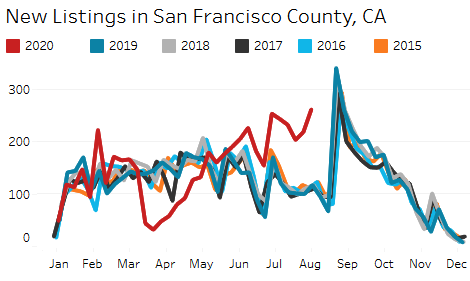
New listings jumped 124% from a year ago to 260 in the week ended August 16, according to Redfin data (chart via Redfin):

738c9 US San Francisco housing 2020 08 25 new listings  “Pent up Supply” in San Francisco Turns into Record Glut of Houses & Condos for Sale. Prices Weaken

Weeks’ supply of homes for sale has more than doubled, from 9.3 weeks last year at this time to 21.2 weeks as of August 16, at the current rate of sales. The spike of supply through early May was a result of sales having collapsed in March and April (chart via Redfin):

db3b3 US San Francisco housing 2020 08 25 weeks supply  “Pent up Supply” in San Francisco Turns into Record Glut of Houses & Condos for Sale. Prices Weaken

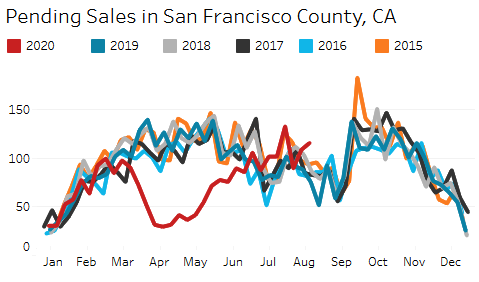
Pending sales rise but not nearly enough. In July and August this year, weekly pending sales have ranged from slightly down year-over-year to up significantly. In the week ended August 16, pending sales, at 115, were up 53% year-over-year. The four-week moving average was up 26%. In July and August, pending sales normally decline. But this year, they’re not declining; they’re coming out of a historic collapse that had maxed out at -77% in April. So there’s some pent-up demand, but not nearly enough to keep up with exploding pent-up supply (chart via Redfin):

db3b3 US San Francisco housing 2020 08 25 pending sales  “Pent up Supply” in San Francisco Turns into Record Glut of Houses & Condos for Sale. Prices Weaken

What would Case-Shiller say?

The SP CoreLogic Case-Shiller Home Price Index, released this morning, provides a different view and other intriguing insights into the San Francisco market, but lags months behind.

The first difference is the geographic area. The Redfin data above was for the County (and City) of San Francisco. The Case-Shiller Index covers the five-county San Francisco Bay Area (counties of San Francisco, San Mateo, Alameda, Contra Costa, and Marin).

The second difference is the methodology. The Case-Shiller Index uses the “repeat sales method.” It compares the sales price of a house that sold in the current month to the price of the same house whenever it had sold previously. To make it into the index, a house has to have been sold at least a second time.

I like sales-pairs as a method because it makes the index immune to changes in the mix of houses that sold. Changes in the mix can heavily skew median price indices. The Case-Shiller Index essentially tracks price changes for each house in the index over time and then builds an index out of the sales-pair data.

The main disadvantage of the Case-Shiller Index is that it lags massively behind. The price data is collected from public records, whenever it is entered into those records. Then the Case-Shiller Index operates on a “three-month rolling average” basis. The release today, titled “June,” was the three-month moving average for deals whose data became available in the county deed recorders in April, May, and June.

Single-family houses.

Prices for single-family houses declined for the second month in a row in June, down 0.7% over the two months, though normally the index rises during those two months. On a seasonally adjusted basis, the index declined for three months in a row, for a total decline over the three-month period of 1.3%. This whittled down the year-over-year gain to 1.4%:

db3b3 US Housing Case Shiller San Francisco Bay Area 2020 08 25 “Pent up Supply” in San Francisco Turns into Record Glut of Houses & Condos for Sale. Prices Weaken

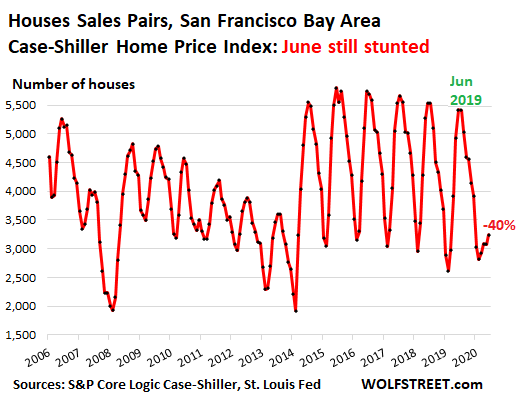
Sales pairs of single-family houses plunged 40.2% year-over-year in June to just 3,242 houses. The percent-changes in “sales pairs” are an indication of changes in sales volume. In the index, June and July reflect the spring selling season and are normally the peak months of the year, as you can see in the chart below, but not this year:

99457 US Housing Case Shiller San Francisco Sales Pairs 2020 08 25 “Pent up Supply” in San Francisco Turns into Record Glut of Houses & Condos for Sale. Prices Weaken

Condos

Condo prices fell 1.1% in June from May, third month in a row of declines, now totaling 1.6%, during what is normally peak season. The index is now down 0.7% from June 2019 and is down 0.2% from June 2018:

99457 US Housing Case Shiller San Francisco Bay Area 2020 08 25 condos “Pent up Supply” in San Francisco Turns into Record Glut of Houses & Condos for Sale. Prices Weaken

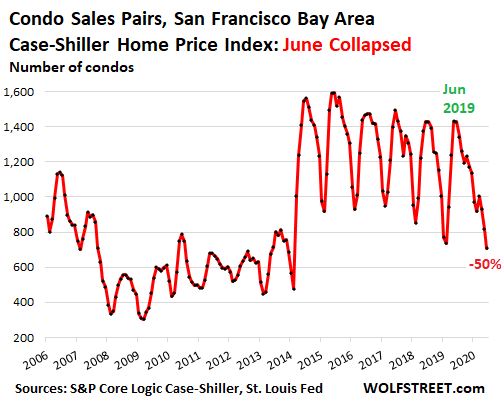
Sales pairs of condos plunged 50.5% year-over-year in June to just 707 condos, during what is normally peak selling season:

99457 US Housing Case Shiller San Francisco Sales Pairs 2020 08 25 condos “Pent up Supply” in San Francisco Turns into Record Glut of Houses & Condos for Sale. Prices Weaken

So what we’re seeing in San Francisco in August…

Is a record onslaught of homes for sale, particularly of condos, that has come out of the woodwork in June, July, and August, per Redfin’s data. Before the Pandemic, there was an inventory “shortage,” as the industry likes to call it, and now there’s a glut, all of a sudden.

The Case-Shiller index is now showing pricing weakness in April, May, and June. This is particularly pronounced with condos, extends back two years, and is now taking on momentum.

Trying to figure out why people are wanting to suddenly sell their homes in San Francisco is going to be an interesting guessing game, and there are likely lots of reasons. Some of those reasons come to mind right off the bat:

  • Investors wanting to get out before prices drop, especially with condos where carrying costs are high due to home-owner association fees;
  • Airbnb hosts that can’t make their mortgage payments off the limited number of guests they might have;
  • People just wanting to get the heck out of dodge, now that they can, since they’re working at home;
  • People who’ve lost their jobs and cannot afford to live in San Francisco any longer;
  • Landlords facing tenants that move out amid dropping rents and high vacancy rates, either to leave the city or to move into a better deal (“upgrades” for the same rent are now a thing for tenants).

I’m standing in the middle of the street to take this photo. Why? Because I can. Read… Haunting Photos of San Francisco’s Desolate Financial District During Morning “Rush Hour”: Visual Effects of Work-from-Home

Enjoy reading WOLF STREET and want to support it? Using ad blockers – I totally get why – but want to support the site? You can donate. I appreciate it immensely. Click on the beer and iced-tea mug to find out how:

99457 BeerMug2 “Pent up Supply” in San Francisco Turns into Record Glut of Houses & Condos for Sale. Prices Weaken

Would you like to be notified via email when WOLF STREET publishes a new article? Sign up here.

2ee47 placeholder2 “Pent up Supply” in San Francisco Turns into Record Glut of Houses & Condos for Sale. Prices Weaken

Article source: https://wolfstreet.com/2020/08/25/pent-up-supply-in-san-francisco-turns-into-glut-of-houses-condos-for-sale-prices-weaken/

Posted in SF Bay Area News | Tagged | Leave a comment

A coastal exodus? These Century 21 San Francisco agents don’t think so

Although many in the real estate industry say that San Franciscans are relocating to places more inland, some Century 21 agents in the San Francisco and Bay Area beg to differ.

Suburban ZIP codes might be more popular these days, as city dwellers forced to work from home during the pandemic want more space in a home.

According to Hanna Ibrahim, who specializes in the San Jose and Silicon Valley market, the MLS said the average listing price in San Francisco is $1.68 million, and the average sale price is $1.72 million, making the sale-to-list ratio more than 100%. Over the last 45 days, there were 418 homes sold in the San Francisco area.

In the San Francisco Bay Area, there is currently a 1.8-months worth of inventory and the median days on the market are 17.

Century 21 Alliance recently merged with Century 21 Marquis and Century 21 Cornerstone, forming one of the largest real estate brokerages in Northern California and the Bay Area.

“We believe in the value of continuing to innovate, adapt to the changing industry and times by delivering extraordinary experiences and providing our family of agents with the latest in tools, training and the technology that they need to continue to defy mediocrity and give 121%,” said Orhan Tolu, Century 21 Real Estate Alliance CEO and owner.

HousingWire spoke to some of these agents about what they are seeing in their respective markets and why they don’t think there is a coastal exodus everyone is buzzing about.

Romeo Aurelio, a general manager and broker associate at Century 21 Real Estate Alliance, said that the exodus is actually in the rental market, as San Francisco is made up of 70% renters. In fact, Aurelio said that this July home sales have outpaced July 2019.

“There’s been such a pent up demand here in the Bay Area, where before the pandemic we received 10, 15, 20 offers on properties,” Aurelio said. “Now during the pandemic, things did take a bit of interest because it was such an unknown, but because interest rates have stayed so low and ended up in demand. Even though there’s maybe a little bit more inventory right now it’s actually making our markets even stronger. So on the sales side of things, things are absolutely fantastic.”

Ibrahim said that the number of listings, pending and escrows show a different story.

“The fact of the matter right now…we have approximately 370 [listings] pending, that’s a huge amount, that’s quite a bit pending,” Ibrahim said.

“It is extremely hot,” Ibrahim said. “There is a lot of purchases going on and offers. Based on the agents that we have and the escrows that we have, [the market] is still going strong, despite the news and negativity we hear about the exodus.”

No. 1 agent with Century 21 and agent specializing in San Jose and Silicon Valley, Kate Davey said that she feels like it’s “la la land” in her market right now, and her clients are selling their smaller homes for bigger ones nearby.

Davey said she’s having her best year in the business in five or six years.

“Most of my buyers are just buying in bigger homes and staying local, they just realize they need more of a home and a lot more space so that they can continue to work from home,” Davey said.

“But, I noticed there’s this big thing about people wanting to leave California, and that could be true, I’m not seeing it,” Davey said. “I’m seeing low inventory, people paying more for homes than what they should, in some cases, especially if they are updated home, and I’m encouraging my potential sellers to update during the shelter-in-place because buyers are looking for homes that are done and they can just move their families into their former home.”

A San Francisco resident for 31 years, Century 21 agent Bailey Cheung specializes in San Francisco and has led the Elite Team, the No. 2 Century 21 team in the world for the last few years.

“I have heard a lot of noise of people leaving the San Francisco, Bay Area,” Cheung said. “But as far as I know, the people I know, nobody has said goodbye to me yet.”

“Some people may leave, but some people might come, you know,” Cheung said.

Both Davey and Aurelio said they are seeing bidding wars, and Davey said that the homes with the most offers are “priced right, and have a lot of value in them.”

“They’re not seeing the 30, 40, 50 offers. . .and that’s mostly because we’re not getting 30, 40, 50 people coming in to see the properties anymore, with all the restrictions on being able to get into property,” Aurelio said. “I would say that the quality of buyer has gone way, way up, and the percentage of buyers that are making offers versus coming to see the properties are way, way up.”

Article source: https://www.housingwire.com/articles/a-coastal-exodus-these-century-21-san-francisco-agents-dont-think-so/

Posted in SF Bay Area News | Tagged | Leave a comment

Leaving San Francisco: will Covid-19 spark an exodus?

Or, if you are already a subscriber


Sign in

Article source: https://www.ft.com/content/5f6679fe-6327-4a18-a7a0-b4a270b34b0f

Posted in SF Bay Area News | Tagged | Leave a comment

A post-pandemic Bay Area concern: Who will be left to shape our communities?

The quarantine view from bedroom windows has pushed many people to peer more closely at our neighborhoods. We notice who lives downstairs, who runs our favorite coffee shops, who sleeps on our streets. We become aware of the daily interactions we miss, as well as the neighbors we never bothered to get to know. The Bay Area has long been a place of comers and goers. Indeed, many of us who live here can attest to that vaguely ominous backdrop of a ticking clock: pre-pandemic commutes that consumed our waking hours, rents that feel untenable and widening inequality. Coronavirus, along with issues highlighted through the protests following the deaths of George Floyd and Breonna Taylor, have made these dynamics more acute and urgent.

“A lot of the positive things we attribute to homeownership — being a good neighbor, knowing your neighbors, becoming involved in your community — these are not actually about ownership. They’re largely about stability,” says Brian McCabe, a sociologist at Georgetown University in Washington, D.C., who studies urban planning. Here in the Bay Area, stability already felt like a luxury for the few — a reality amplified by coronavirus and systemic racism.

As tech behemoths like Twitter and Facebook allow their employees to work remotely, there’s speculation about a mass exodus from the Bay Area. Surely, some will leave — already, inbound migration to San Francisco has dipped since last year — but plenty desperately want to stay. And they want to live in a community that’s reimagined. Across the Bay Area, residents are envisioning how a region at its breaking point can use this tumultuous moment to rebuild a more equitable society.

At the core of their considerations are the questions that feel fundamental to the heartbeat of the Bay Area and foundational to its future: Who gets to stay? How will our communities change?


 A post pandemic Bay Area concern: Who will be left to shape our communities?

In Donna Hunter’s eyes, the San Francisco she’s known and loved has been swept up by a wave of transience. The 60-year-old Stanford University lecturer has lived in the Mission District for 19 years in a rent-controlled apartment that she jokes she’ll never leave.

Staying at home has crystallized Hunter’s focus on her neighborhood, making her aware of how little she knows the people on her block. As highly paid tech workers have flooded her community, it’s grown to feel like a place where newcomers simply pass through. As it’s gotten younger, it’s also gotten whiter. “These are people who are itinerant livers,” says Hunter, whose father was Black and mother a German immigrant. “I want to feel like people are invested in the neighborhood and the community more than just here for a job and to go to the trendiest new restaurant.”

Hunter is first to admit that her simmering resentment toward “tech people” dissuades her from connecting with those neighbors. Her frustration has mounted as she’s watched longtime residents get priced out to be replaced with absentee neighbors who rent their homes as Airbnbs or don’t live there full-time. That frustration is coupled with nostalgia: “It’s not a town full of progressives anymore,” she says.

“Why am I so angry about it? I feel like the diversity has been lost.”

To Hunter, nothing encapsulates this sentiment more than the rigid divide she sees between the Mission’s lower-income renters and wealthy homeowners. But as she began to deliver groceries to at-risk neighbors through coronavirus mutual aid programs, she remembered what a cohesive community felt like — and wonders if this crisis will be a turning point.

Post-COVID, she craves a community that is present. If remote workers leave, she hopes the Mission will fill with people who intend to stick around — though it’s hard to be sure whether they’ll have the means to.

“Are those the people who are going to stay?”


Alina Musgrave is one of the people trying to hang on. The 31-year-old managed a store on Fillmore Street that went out of business during the pandemic.

Musgrave, who identifies as Latina, calls herself a “nomad of the Bay Area.” She grew up shuffling between her parents’ homes in Vacaville and Mill Valley, and lived in Oakland before moving to the Richmond District last year.

Observing the intricacies of different communities has made her value the one she’s chosen. Musgrave often hears Russian and Mandarin throughout her neighborhood, and sees faces that look different from hers. “I grew up speaking three languages, and I love hearing different languages all around me,” Musgrave says.

This welcoming pull and affordability are what drew her to the neighborhood. “I think that’s pretty much why we all live out here,” Musgrave says. Many neighbors also work in service or retail, and she finds comfort in living among people with similar incomes.

When asked why, she sits in a long pause.

“It’s hard to explain,” Musgrave says slowly. Each time a new luxury apartment complex crops up nearby, she feels a pang of anxiety along with a rush of gratitude that she has a place to live. Rising rents are a lingering existential threat for Musgrave and her neighbors. “I know I’m not alone in those feelings,” she says, adding that Sea Cliff — among the city’s priciest real estate, with stunning ocean views — is a few blocks away.

She suspects that any San Francisco exodus would be cyclical. Its consequences would be complicated. The tech boom brought an influx of revenue into the city, including to her store.

“‘How long can I stay where I am?’ is an active thought,” she says. “The uncertainty of it is not lost on me.”

Even so, Musgrave’s stepfather urges her to stay in San Francisco as long as possible. “They always say, ‘Never leave California, because you won’t be able to move back.’’’


When Heather Starnes describes East Palo Alto, she speaks of her community as if it is a person who lives and breathes: “It has a very grassroots, movement-oriented soul,” she says.

East Palo Alto is a tight-knit and connected place, where food and ideas are exchanged eagerly, says Starnes, who is white. People take pride in the community they have cultivated, a place residents fought to incorporate in 1983.

The city remains a middle-class community among affluent Silicon Valley neighbors. It’s also more racially and ethnically diverse in comparison. More than 60% of East Palo Alto residents are Latino, 12% are Black and 11% are Native Hawaiian or Pacific Islanders, according to census data from 2019. These demographics are reflected in East Palo Alto’s leadership: People of color make up the entirety of its City Council and school board. Meanwhile, just across Highway 101, Palo Alto and Menlo Park are majority-white communities.

Starnes’ neighbors show up for one other. A local college student lives in her house for free, while she and her husband rent a below-market rate room to another student’s father. Her nonprofit organization, Live in Peace, has been fundraising to pay three months’ rent for vulnerable neighbors during the pandemic.

This period of instability — between health, economic and equality issues — is “exposing what we know is true: this dual existence in Silicon Valley,” she says, adding, “There’s some comfort, maybe, in knowing that people can see it for what it is.”

How’s your neighborhood?

Tell us how your community has changed during the pandemic, or what concerns you have about it by writing to culture@sfchronicle.com

Her message is both urgent and clear: The region has been teetering on the brink of becoming a monoculture of wealth, and it has reached a breaking point. If Silicon Valley’s tech presence disperses, she worries about “exporting” the injustice here to other burgeoning hubs.

In a post-COVID world, Starnes longs for East Palo Alto to be a place where her community’s college graduates can afford to return and bring their knowledge, capacity and futures. But her neighbors must survive this time of crisis first: “This region deserves a community like East Palo Alto to still be intact when this is over,” she says.

“I really believe that this region has the capacity to not let this community disappear,” she says. But under the weight of all the forces pushing people out, “this could easily be the last nail in the coffin.”


Thornell Washington, a 37-year-old Black homeowner who lives in Oakland’s Eastmont Hills, delivered food to older neighbors before the pandemic. The neighborhood is a place where people keep an eye out for each other.

Members of his community give to each other freely: a carton of peaches, fresh zucchini, canned food. The pandemic has heightened awareness of economic problems that have been compounding in Oakland for a long time, he says: “It feels like a third-world country, where there’s truly no middle class. It’s either the haves or the have-nots.

“You can go three blocks in one direction, and if you were driving in the car and your eyes were closed, when you wake up, you’d probably think you were in a completely different city,” Washington says. Potholes and trash abound in East Oakland, while the Oakland hills look like a “wonderland for the wealthy.”

He points to the duality of renters paying $4,000 a month for apartments downtown, adjacent to homeless encampments where residents lack running water. Many people don’t consider unhoused people living on their blocks a part of their community, Washington says.

But this pandemic has urged Americans to think more deeply about who their neighbors include and what that means, says Claire Herbert, a sociologist at the University of Oregon who studies housing.

“Do you consider people who are visibly homeless a part of your community? Do you feel a sense of responsibility to them?” asks Herbert. “Who’s in my group? Who am I responsible for?” are questions that we’re being forced to reconsider, she says.

The way Washington sees it, Bay Area progressivism has been masquerading as fairness for too long. Oakland has become a place where wealth has been extracted — but post-pandemic, Washington envisions his city as an investment of it. He imagines a place where city programs assist educators with down payments so they can buy a house where they teach. Where city officials and employees, like firefighters and police, spend paychecks in the community where they earn them.

Washington hopes that a wave of departures could be a healthy reset for the region, easing the burden on people who want to be here. “They’re holding onto hope that they can own a piece of their community,” he says.

 A post pandemic Bay Area concern: Who will be left to shape our communities?

Carly Stern is a Bay Area writer. Email: culture@sfchronicle.com

Article source: https://www.sfchronicle.com/culture/article/A-post-pandemic-Bay-Area-concern-Who-will-be-15520623.php

Posted in SF Bay Area News | Tagged | Leave a comment