The doughnut effect of COVID-19 on cities | VOX, CEPR Policy Portal – voxeu.org

Single family home prices in the US have continued their gains since the Great Recession, rising about 7% over the past year. And commercial office demand has remained relatively flat. But underneath these aggregate trends lies a substantial reallocation of housing and office demand away from dense city centres toward city outskirts and suburbs. This is the ‘doughnut effect’ – the rise of the suburbs and the slump of the city centre, driven by a fear of crowds and the growth of working from home (WFH) (Bloom 2020).

The doughnut effect: Reallocation in real estate demand

The news has been full of stories claiming the end of America’s biggest cities as we know it.1 From New York to Chicago to San Francisco to Washington DC, mobile phone data show2 substantial out-migration after the virus struck – with rich areas taking the biggest hits.3 How have these trends affected real estate markets? 

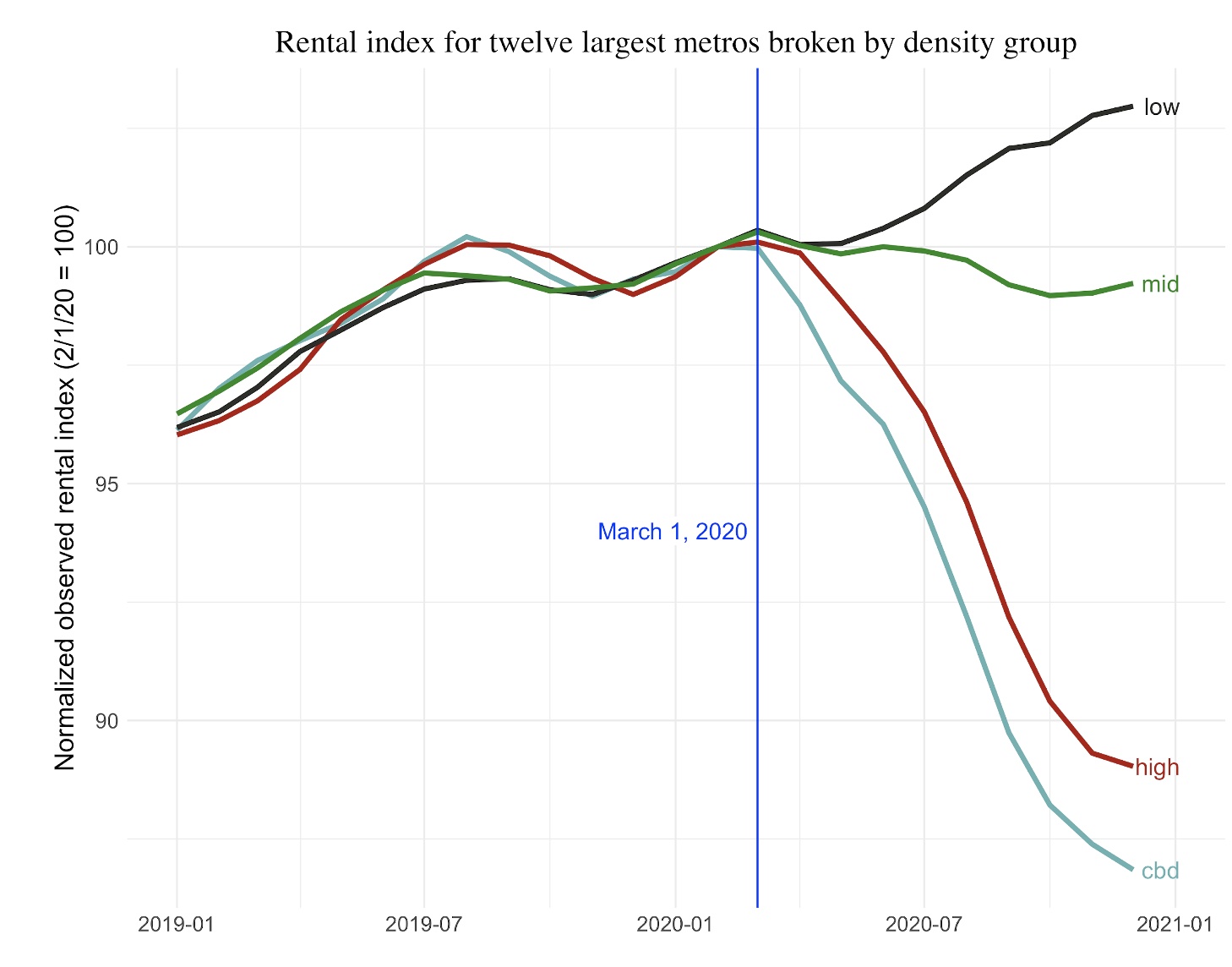
Our research has examined trends across real estate markets. Figure 1 shows Zillow’s rental index for the 12 largest metro areas in the US by population.4 The central business district (CBD) and top 10% of zip codes by population density saw more than a 10% drop in rents confirming that demand for real estate in dense city centres has actually fallen. And other recent research finds that rents are declining in high-density neighbourhoods across the country (Liu and Su 2020).

Figure 1 Normalised Zillow rental index broken down by density group and CBD
f25c7 bloom28janfig1 The doughnut effect of COVID 19 on cities | VOX, CEPR Policy Portal   voxeu.org

Note: 1 February 2020 = 100.

But the outskirts of cities, with cheaper land and more space, have weathered the pandemic without substantial drops with little change in rents since the pandemic.

What is driving the fall in real estate demand? At least four factors are at play, including the economic shock from the virus, the lack of access to city amenities due to lockdowns and social distancing, the aversion to dense areas due to fear of virus spread, and the ability to work from home. The first three factors are likely temporary, which has led some commentators to claim5 that markets could rebound.6 

To test the longer-term effects of the pandemic shock we took a look at real estate transaction price data from Zillow.

Housing prices suggest the trend is longer-term

In theory, property prices should factor in both the short-term and long-term factors that affect the value of property. This is because owning a property is like owning any other asset. You can collect income streams by renting out the property to perpetuity. So just like the stock market is highly forward-looking and weighs future income streams, so do property valuations. And with record-low interest rates, this forward-looking nature is greater than ever.

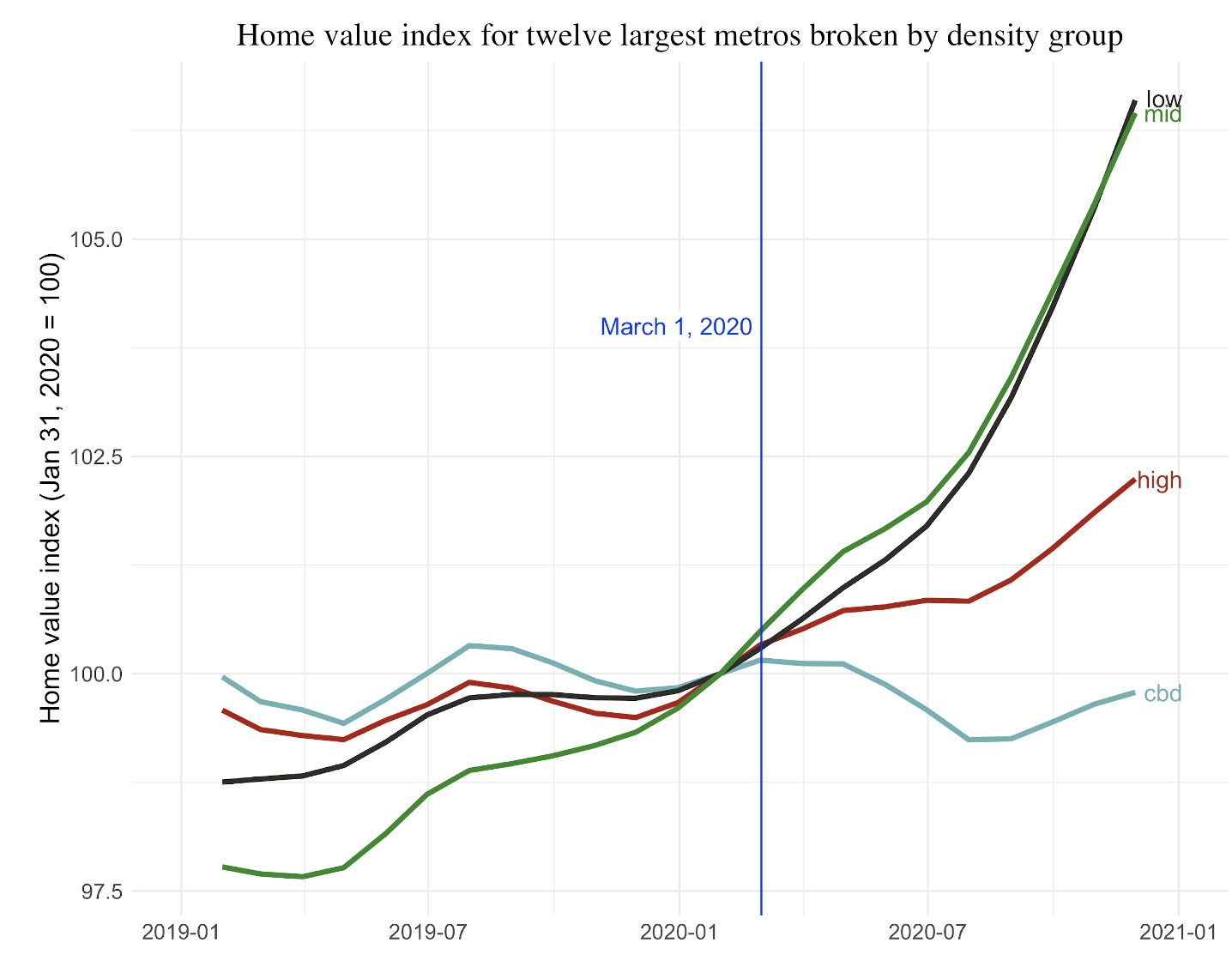
What do the price data show? Though there is less of an aggregate decrease in prices as compared to rents, there is a similar demand reallocation effect where city CBDs and dense areas experience relative price decreases compared to less dense areas. Interestingly, the doughnut effect for prices appears to be limited to highly populated dense cities. We didn’t observe much of an effect for metro areas outside the largest cities.

Figure 2 Normalised Zillow home value index broken down by density group and CBD for 12 largest metros
f25c7 bloom28janfig2 The doughnut effect of COVID 19 on cities | VOX, CEPR Policy Portal   voxeu.org

Note: 31 January 2020 = 100.

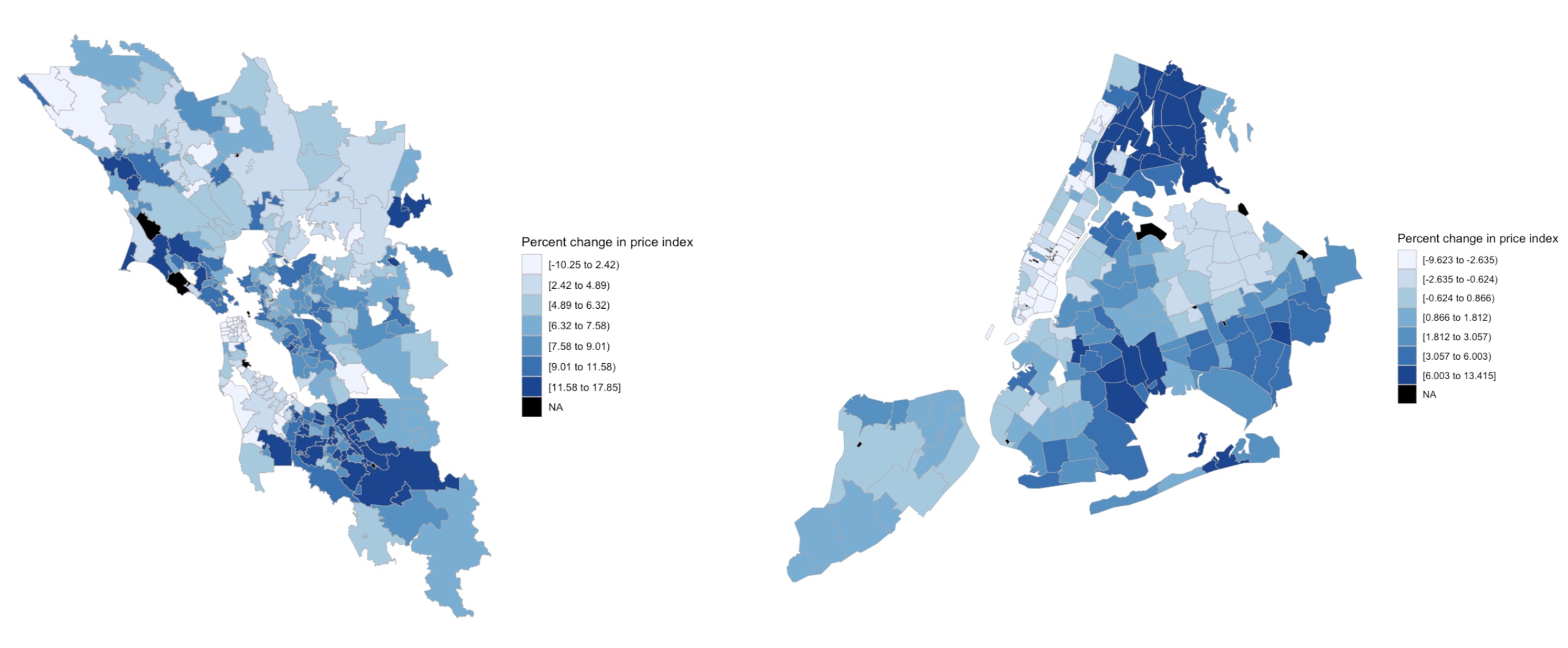
As an example, Battery Park, one of central zip codes of downtown Manhattan, saw a 9.6% decrease in prices from the last three months of 2019 to the last three months of 2020. By contrast, middl- class residential neighbourhoods like suburban Suffolk County in Long Island have boomed. Home prices in Suffolk County are up in every zip code, with an average increase of 7.2% over the same period.

Similarly, the Bay Area of San Francisco has seen moderate decreases in prices. The Presidio, prized for being located directly adjacent to the city centre, has seen price decreases of almost 10%. On the other hand, more remotely located and cheaper Marin County, located right across the Bay, has seen an average increase of over 8%. 

Figure 3 shows heat maps of year over year price changes in both New York City and the Bay Area. In both maps, the city centres, Manhattan and downtown San Francisco, respectively, have taken large hits relative to surrounding areas.

Figure 3 Year-over-year percent change in home price index by zip code for SF Bay Area and New York City
f25c7 bloom28janfig3 The doughnut effect of COVID 19 on cities | VOX, CEPR Policy Portal   voxeu.org

Working from home may be driving price dispersions

Previous research by one of us (Barrero et al., 2020) has shown substantial increases in working from home as a result of the pandemic and this shift will likely be persistent. Indeed, managers expect close to 20% of working days to be done from home post-pandemic. Importantly, though, the types of jobs that can be done from home are not evenly distributed over the different parts of cities. And neither are the people who do them. 

We used data from a recent paper by Dingel and Neiman (2020) that classifies the share of jobs that can be done from home by occupation. Combining this with US Census data on the occupations of people who reside in each zip code, we were able to construct a zip-code level measure of the share of jobs that can be done from home which we term the WFH exposure of a zip code.7

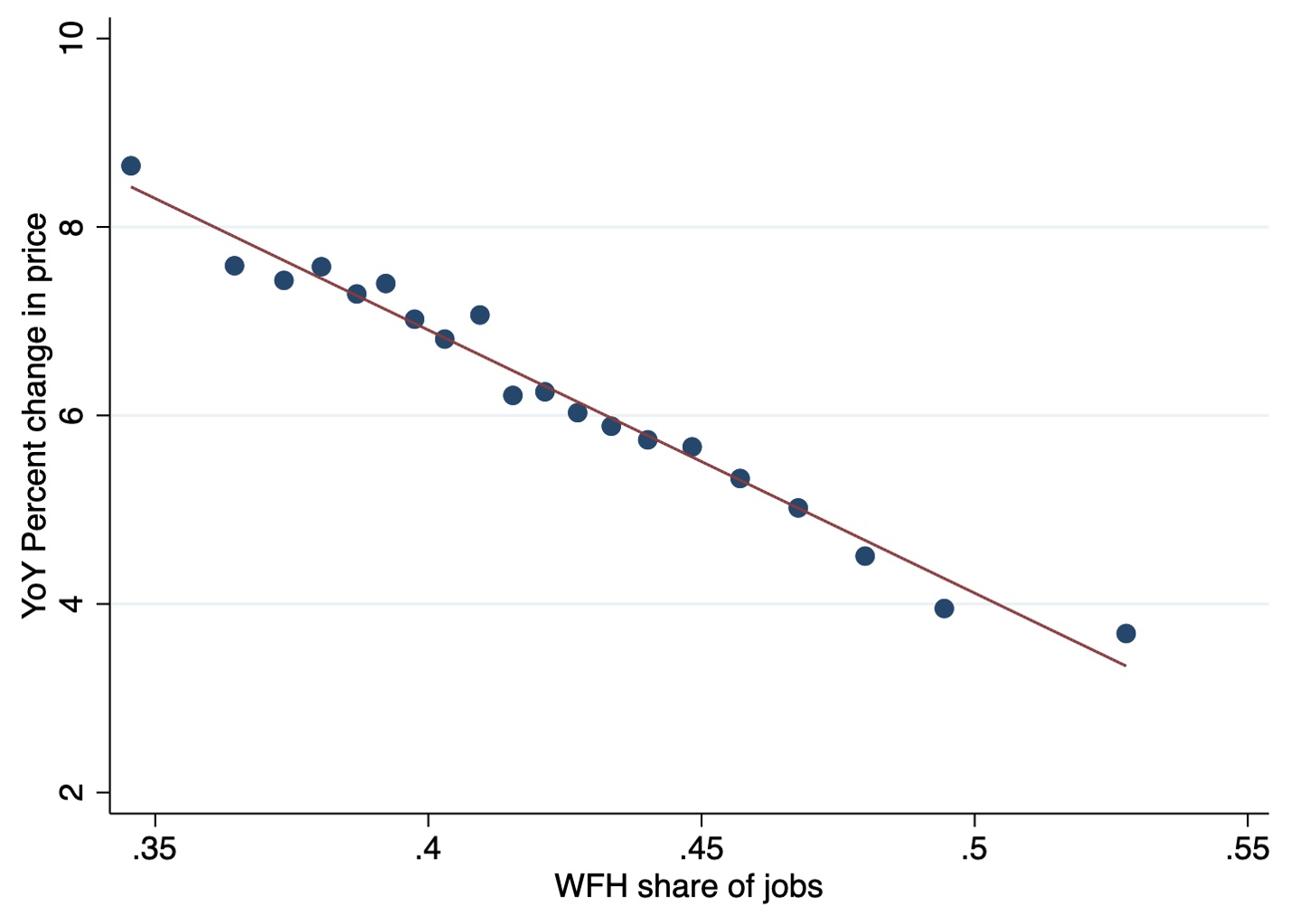
We also found that most of the changes in property prices across different zip codes can be explained by the share of jobs that can be done from home, with density only contributing a small amount. We take this as evidence that people with the ability to work from home are reallocating away from city centres to lower-cost areas on city outskirts because they will not have to commute as frequently. As seen in Figure 4, even after we control for the metro region and the population density of a zip code, the share of jobs that can be done from home exhibits a striking negative relationship with the year over year change in home value index.

Figure 4 Price changes at the zip code level are negatively correlated with the share of jobs that can be done from home after controlling for population density and metro region
c44b4 bloom28janfig4 The doughnut effect of COVID 19 on cities | VOX, CEPR Policy Portal   voxeu.org

Note: Chart bins across zip codes for 12 largest metros into 20 points.

Flight from San Francisco to Austin? Longer-term reallocation is likely within metro areas

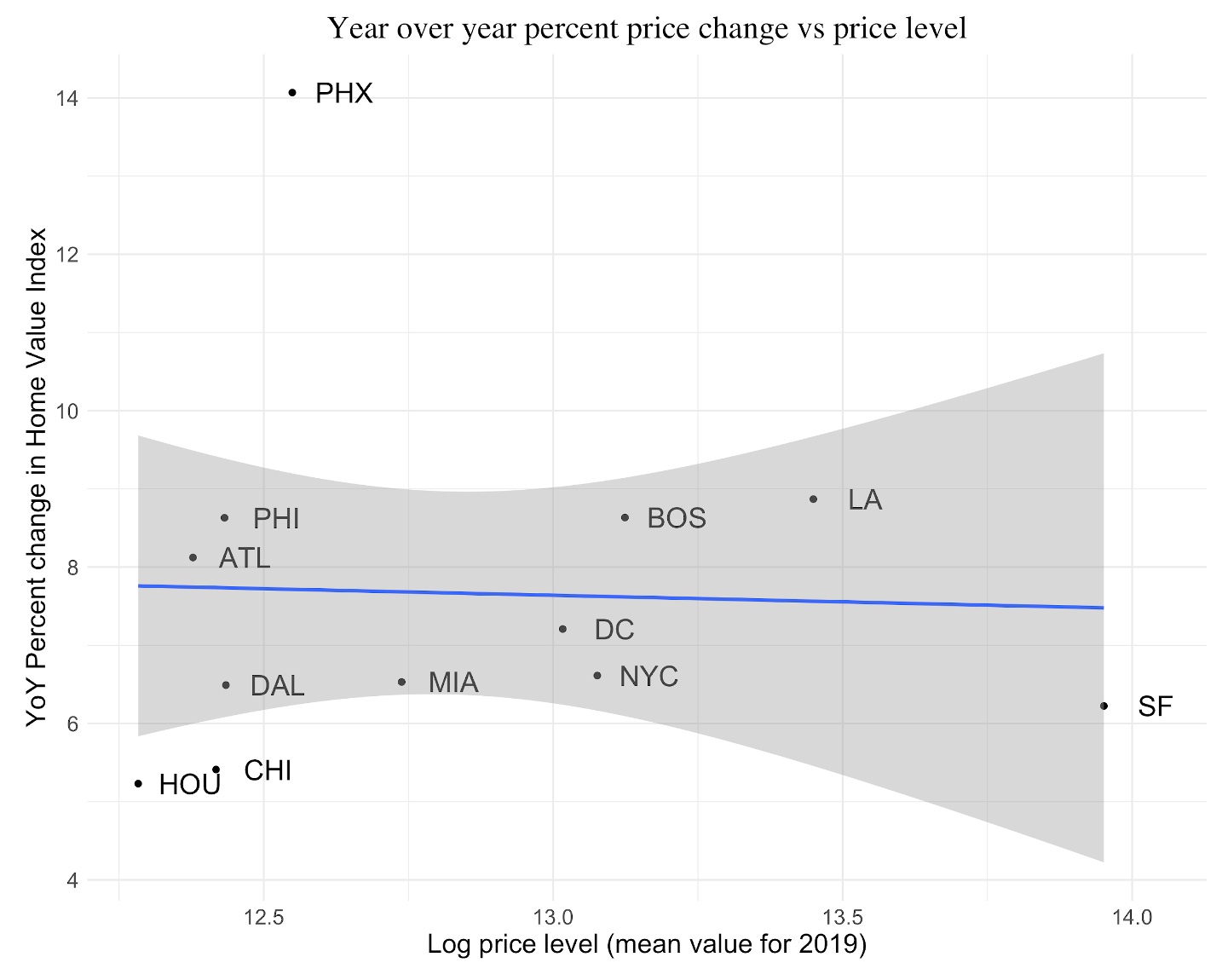
So far, we have presented evidence on the reallocation of real estate demand among zip codes within metro areas like the greater New York City area. But what about the stories of people moving away from expensive metro areas like New York or San Francisco to cheaper ones like Austin? To test this, we look at Zillow’s Metro area wide housing price index across different metro areas and plotted the change in the price index over the past year against the mean price level for 2019. If there were a long-term reallocation of demand from expensive metros to cheaper metros we would expect a negative correlation – but we actually observed a relatively flat relationship.

Figure 5 Price changes vs price levels across major US metro areas
5b6c5 bloom28janfig5 The doughnut effect of COVID 19 on cities | VOX, CEPR Policy Portal   voxeu.org

We now have two pieces of preliminary evidence that we can put together. We’ve observed within-city reallocation of housing demand from dense areas with a high WFH share to less dense, low-WFH areas. We’ve also observed that housing demand hasn’t reallocated much from expensive cities to less expensive cities.

This suggests that the dominant form of working from home post-pandemic will be several days a week as opposed to full-time. With 1-2 days of working from home a week, employees who previously lived and worked in city centres, may be willing to move further away to the outskirts of cities or nearby suburbs. But since they still have to come to work sometimes, they are not willing to take a flight and move to a cheaper city with more. The survey evidence that has been previously documented is consistent with the real estate price movements we’ve seen here – employers project that the employees will likely work-from-home a couple days a week. 

Long-term commercial office demand may take a hit across cities

So far, we’ve been exploring data on residential properties. But with everyone working from home, one of the most affected markets has been commercial office properties. Interestingly, short-term demand in the aggregate for commercial office space has not changed much8 because the decreased quantity of people going to the office has been counterbalanced by the amount of space needed per employee to ensure social distancing. 

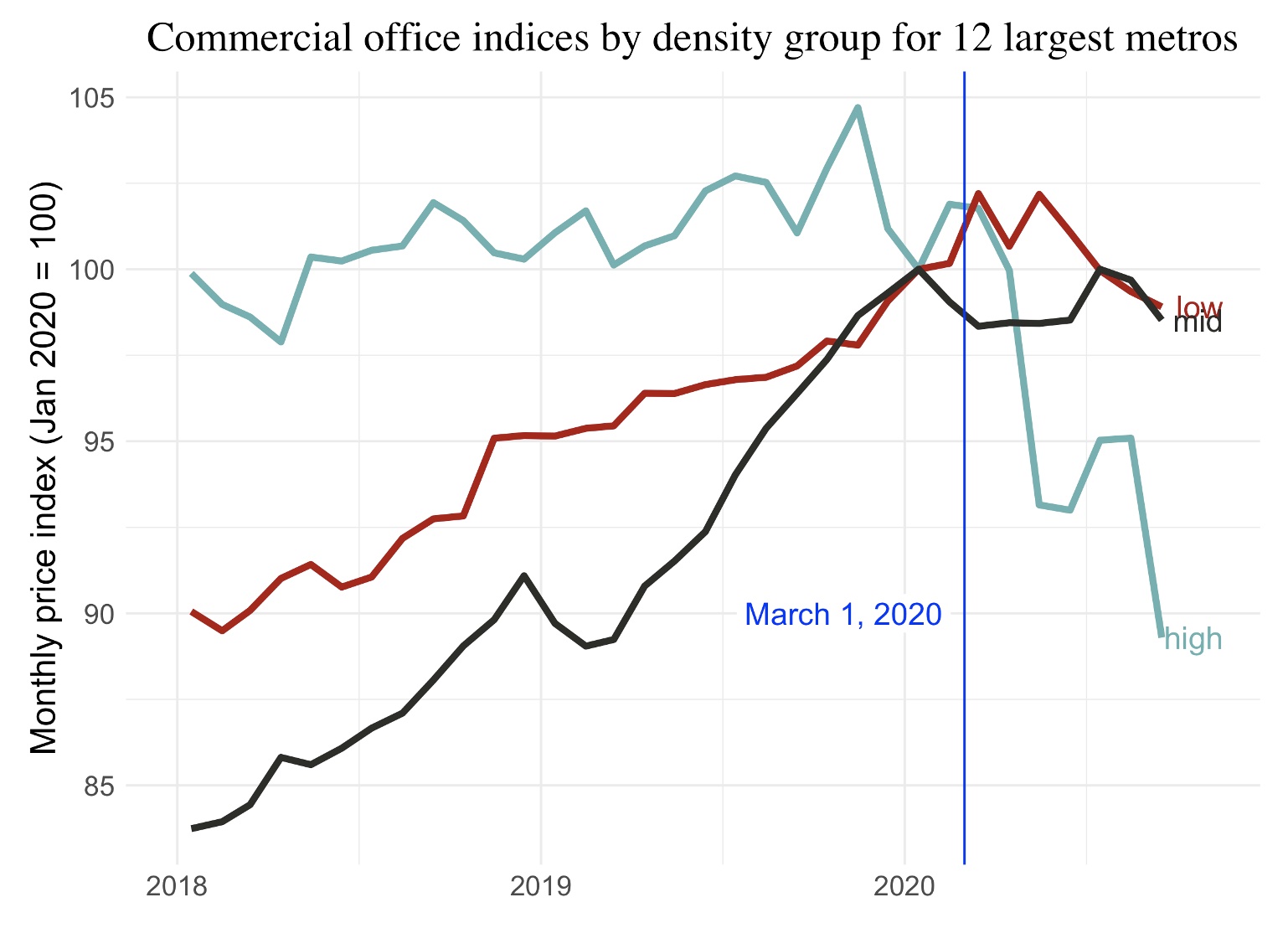
Commercial property transaction data is much sparser than residential property data so we constructed an index ourselves using transaction-level data from Zillow.9 Transactions in CBDs are especially limited, but a similar pattern of divergence between high density tracts and lower density tracts can be seen after the pandemic shock. Overall, we estimate the pandemic led to a 10% drop in commercial office building prices in the densest decile of zip codes relative to other zip codes.

Figure 6 Commercial office buildings have fallen in value in dense areas relative to less dense areas
5b6c5 bloom28janfig6 The doughnut effect of COVID 19 on cities | VOX, CEPR Policy Portal   voxeu.org

What policymakers can start thinking about

Though people will still go to work in America’s biggest cities, there will certainly be shifts in urban structure. State and local governments must ease the transition. Though people will commute to work on less days per week, more people will flock to areas further from city centres, which increases the need for spread out public transportation networks. Furthermore, property and sales taxes in city centres will take a hit (Althoff et al. 2020), which may require city governments to make tough choices on services unless states step in to provide support.

Cities will also benefit from more balanced real estate prices across different regions. A best-case scenario is a more affordable city centre with more enjoyable work environments rather than pricy living spaces that are dominated by the rich.?

References

Althoff, L, F Eckert, S Ganapati and C Walsh (2020), “The City Paradox: Skilled Services and Remote Work”, CESifo Working Paper No. 8734

Barrero, J M, N Bloom, and S J Davis (2020), “Why Working From Home Will Stick.” University of Chicago, Becker Friedman Institute for Economics Working Paper 2020-174.

Bloom, N (2020), “How working from home works out”, SIEPR Policy Brief.

Dingel, J and B Neiman (2020), “How Many Jobs Can be Done at Home?”, Covid Economics 1: 16-24.

Gindelsky, M, J Moulton, and S A Wentland (2019), “Valuing housing services in the era of big data: A user cost approach leveraging Zillow microdata.” Big Data for 21st Century Economic Statistics. University of Chicago Press.

Liu, S, and Y Su (2020), “The impact of the COVID-19 pandemic on the demand for density: Evidence from the US housing market”, available at SSRN 3661052.

Endnotes

1 E.g. https://www.npr.org/transcripts/921769579?t=1611751522022

2 https://www.nytimes.com/interactive/2020/05/15/upshot/who-left-new-york-coronavirus.html

3 The hardest hit area in New York was downtown Manhattan, a classic example of a neighbourhood vulnerable to COVID-19. Manhattan has a high-share of residents who can work from home, high population density, expensive rents and prices, and normally benefits from many in-person amenities to attract residents.

4 Our sample of the 12 largest metro areas in the US by population consists of New York, Los Angeles, San Francisco, Chicago, Washington DC, Atlanta, Philadelphia, Boston, Miami, Houston, Phoenix, and Dallas. And our zip code density buckets are high = top 10%, mid = 50-90th percentile, low = 0-50th percentile.

5 https://archive.curbed.com/2020/7/13/21319909/coronavirus-urban-exodus-cities-moving-suburbs

6 https://fortune.com/2020/07/17/people-leaving-cities-coronavirus-data-population-millennials-marriage-families-housing-real-estate-suburbs/

7 Dingel and Neiman (2020) calculate the share of occupations that can be done from home weighted by wage for each industry by determining whether an occupation’s tasks can be done from home or not. Our methodology assumes that this metric is relatively stable across US geographies.

https://www.frbatlanta.org/blogs/macroblog/2020/07/10/covid-wont-kill-demand-for-office-space

9 We build a hedonic model of commercial property prices to construct a monthly price index across zip code density groups for our sample of MSAs. Our methodology is similar to that of Gindelsky et al. (2019) and aims to control for changes in the composition of properties sold. Data provided by Zillow through the Zillow Transaction and Assessment Dataset (ZTRAX). More information on accessing the data can be found at http://www.zillow.com/ztrax. The results and opinions are those of the author(s) and do not reflect the position of Zillow Group.

Article source: https://voxeu.org/article/doughnut-effect-covid-19-cities

Posted in SF Bay Area News | Tagged | Leave a comment

California Black, Latina real estate couple lowballed $250,000 in home appraisal – KGO

OAKLAND, Calif. (KGO) — The Curtis family reached out to ABC7 News after seeing the now-viral story of a Marin City couple lowballed in what they believe was a racially biased appraisal. The Curtis family knew something wasn’t right when they also received a low appraisal because both the husband and wife work in real estate.

Ronald who is Black and Dominique who is Puerto Rican believe they received the same treatment and decided to sit down with ABC7′s Race and Culture Reporter Julian Glover to tell their story.

“We were in the process of doing a refinance. The appraiser came out and we were shocked when we saw the value of our home was $254,000 less than the appraisal we got months earlier,” said Ronald Curtis.

The family’s lender, Rocket Mortgage, owned by Quicken Loans, ordered the appraisal through an independent appraisal management company (AMC) in December 2020.

The home was valued at $900,000, but just months earlier in April the home appraised for $1,154,000 in an appraisal also ordered by the lender: a quarter-million-dollar difference.

Meanwhile, housing prices went up and interest rates fell.

But the Curtis family was uniquely positioned to do their own investigation, surveying comparable homes to realize something wasn’t right.

“I’ve been a realtor for over 10 years and currently I’m a licensed real estate broker,” said Mr. Curtis.

“I’ve been training to become an appraiser for about two and a half years now. I’m due to take my test fairly soon,” said Ms. Curtis.

After doing some research Ronald knew there was a greater issue at play.

VIDEO: Black California couple lowballed by $500K in home appraisal, believe race was a factor

“Somebody doesn’t have to say that the reason why they did it is because we were Black or Puerto Rican, or people of color. But absolutely, that’s the reason why,” said Curtis.

The Curtis family immediately pulled reports of the comparable homes the appraiser used in their report from the marketing listing service (MLS) they have access to as licensed real estate professionals.

The family showed ABC7′s Julian Glover pictures of the current status of the homes, blighted with boarded-up windows, a caved-in garage, and bricks lining a roof to hold shingles in place.

“He was just deliberately looking for a property that fits his price so he could lower our value,” said Curtis.

Those same photos were also attached to the extensive, nearly 60-page complaint the family filed with the California Board of Real Estate.

The investigation is ongoing.

Meanwhile, interest rates have increased meaning the family missed out on a chance to save thousands of dollars a year on their mortgage by refinancing.

ABC7 reached out to Quicken Loans and received the following statement:

Quicken Loans truly regrets the frustration that Mr. Curtis and his family have experienced with their home loan. Under federal law, lenders are required to work with independent appraisal management companies who then assign the work to state-licensed professionals to conduct home appraisals as part of the mortgage process. The law’s intent is to determine the home’s value without any input or bias from the lender – or anyone else – participating in the transaction.

We have reached out to Mr. Curtis to gain his permission to order a new appraisal from a second licensed appraiser, at our expense as an accommodation to our client, to obtain an additional opinion of value. Quicken Loans values equity and fair lending and we stand prepared to assist Mr. Curtis in securing financing for his home if the second appraisal is sufficient to support the loan amount.

However, the Curtis family provided a voicemail showing a Quicken Loans representative only offered a second appraisal the day after ABC7 News reached out to the company for comment.

Out of frustration with the company, the Curtis family declined the second appraisal offered Monday, and in a follow-up statement, Quicken Loans informed ABC7 News the company now considers the case closed.

Given the current monthly mortgage rate, the Curtis Family informed ABC7 News they have signed a lease to rent a home and will likely sell their current property.

“We know the implications of what this means. It doesn’t mean that it affects us for a month or two and then it goes away. This is stuff that affects us for generations,” said Curtis.

Discrimination in the housing market is systemic and detrimental to marginalized people with consequences suffered across generations.

A 2018 report by the Brookings Institution on the “devaluation of assets in Black neighborhoods” found in most metro areas in the country, homes in majority-Black neighborhoods were valued for significantly less than homes in neighborhoods with virtually no Black residents.

The study found the differences in homes and neighborhood quality don’t explain the devaluation of homes in black neighborhoods.

The study showed homes in the Bay Area’s Black neighborhoods are valued at 27% less than homes of similar quality in white neighborhoods: a difference of $164,000 on average, among the worse differences in the nation.

Looking at the national picture, homes in Black neighborhoods with similar amenities are worth 23% less, $48,000 per home on average.

“We shouldn’t have to scrub Blackness from our homes to get a fair shake in society,” said Andre M. Perry, Senior Fellow at the Brookings Institution.

Perry wrote the Brookings Institution study on the devaluation of Black homes and wrote the book “Know your Price: Valuing Black Lives and Property in America’s Black Cities.”

As the Austin’s story went viral, several Twitter users tagged ABC7′s Julian Glover in Perry’s work.

“Whether it’s appraisals, whether it’s real estate agent behavior, lending practices, all of these things in housing markets impact price, and it’s clear that something is going on today that throttles the price of Black homes,” said Perry.

“That’s about $156 billion in lost equity across the country. It would have paid for more than 8 million college degrees, based on the average amount of a public four-year institution. It would have replaced the pipes in Flint, Michigan, 3000 times over-It’s a big number,” he said.

Those loses often go unseen and unreported.

That’s why non-profit advocacy groups like the Fair Housing Advocates of Northern California (FHANC) encourage families to file formal complaints.

The FHANC represents victims of housing discrimination.

In California someone discriminated against on the basis of race, religion, gender, sexual orientation, disability, or age – among other protected classes – can file a complaint.

The executive director Caroline Peattie said she was stunned when she heard of the Austin’s story.

“Folks can file an administrative discrimination complaint with the Department of Housing and Urban Development (HUD) and the California Department of Fair Employment and Housing,” said Peattie.

If you would like to file a complaint, click here.

She also pointed out families or individuals facing housing discrimination have one year to file a complaint and two years to file a lawsuit in California.

There are remedies in both situations involving rentals and real estate purchases.

Peattie said most often action leads to settlements or reprimands on behalf of the negligent institution.

The process, however, can drag on taking months or even years for resolution.

Peattie said victims have better odds if they are represented.

“Racism needs to be addressed and remediated in ways that will be remembered,” she said.

The Austin’s are now considering filing a formal complaint.

Tate Austin is glad sharing her family’s story has encouraged others to come forward.

“With people standing up and starting to fight back for social justice, I feel like the world is primed to have this conversation,” said Tenisha Tate Austin.

“People are talking and they are standing up and letting people know that this is not just a one off thing. This is a systemic issue that needs to be changed,” said Austin.

Article source: https://abc7news.com/black-homeowner-problems-sf-bay-area-housing-discrimination-minority-homeownership-anti-black-policy/10362859/

Posted in SF Bay Area News | Tagged | Leave a comment

Coronavirus: Bay Area apartments may have rent deals for years

After years of soaring Bay Area rents, the economic slowdown and remote work mandates could bring deep cuts to higher-end apartment prices for years to come.

Rents may fall in the Bay Area for at least one or two more years, according to analysts from the real estate data firm Yardi Matrix.  A return to pre-pandemic prices in multi-family buildings — typically newer high rises or sprawling suburban apartment communities — could be five years or more away, analysts say.

The South Bay market, including San Jose, is expected to decline for another year, while Oakland and San Francisco rents could fall for two more years.

Already, San Jose property managers are offering the most rent discounts in the U.S. to attract tenants. Doug Ressler of Yardi Matrix said the widespread San Jose discounts, typically weeks or months of free rent, show soft demand for the high-end market.

Bay Area rents have plummeted throughout the coronavirus pandemic, dropping as much as 30 percent in cities with a high concentration of tech companies, according to listing and property management site Zumper. The spread of remote work for tech workers has driven many younger employees to cheaper, bigger apartments, sometimes outside California or back home.

Since January 2020, the median two-bedroom rent in San Jose has fallen 10 percent to $2,660, dropped 17 percent in Oakland to $2,530, and cratered 23 percent in San Francisco to $3,500, according to Zumper.

Rents for two-bedroom apartments in Peninsula cities have also seen dramatic declines: Santa Clara and Cupertino both dropped 12 percent to $2,730, Mountain View fell 28 percent to $3,050, and Menlo Park sank 26 percent to $3,000.

Apartments in the more affordable East Bay cities of Livermore, Concord and Dublin have seen mostly stable rents throughout from last year, according to Zumper.

Rents in several cities stabilized from December to January after a steady, pandemic-induced decline. But housing experts say the flat rents might be a blip caused by the typically high demand for moving in early January.

“The headline is, ‘Watch this space,’” said Zumper CEO Anth Georgiades. “It’s too early to make a call.”

The coronavirus vaccine and expected return to more normal office schedules should give a clearer picture by August, Georgiades said. Still, when it comes to how remote work rules will affect housing in the future, he said, “there’s a lot of head-scratching.”

Managers of multi-family buildings are offering weeks or months of free rent to attract tenants as demand drops. Zumper is seeing listings with between two weeks and three months of rent concessions.

In San Jose, roughly 4 in 10 high-end apartments offered free rents in December, by far the highest percentage in the country, with an average discount of $3,500, according to Yardi Matrix. About 1 in 5 San Francisco high-rises advertised discounts, with an average savings of $3,600.

Yardi Matrix analysts found other big concessions in New York City and throughout cities in Texas, including Austin, San Antonio, Dallas and Houston. Analysts noted the discounts were most prevalent during the summer.

Ressler said rents could rebound some in the East Bay as tenants seek to trade up to more space or amenities.

Bay Area and Sacramento apartment prices, among the highest in the nation, have dropped nearly 9 percent from last January, according to Yardi Matrix. Nationally, rents have dropped less than 1 percent during the same period.

But Bay Area prices for older units with fewer amenities have not declined substantially during the pandemic. Tenant advocates say service workers and other blue-collar employees continue to struggle to pay their bills. Many low-income residents spend more than half their pre-pandemic income on housing and are unable to keep up with lost wages. The state estimates California tenants owe at least $400 million in back rent.


Article source: https://www.mercurynews.com/2021/02/05/coronavirus-bay-area-apartments-may-have-rent-deals-for-years

Posted in SF Bay Area News | Tagged | Leave a comment

Real estate photographer robbed of camera equipment while driving in San Francisco

Video shows brazen thieves in San Francisco robbery

The video was captured by a Tesla Model 3′s built-in camera system. The owner, Alex M., shared the video with KTVU.

A Bay Area real estate photographer had around $7,000 in camera equipment stolen from his vehicle while he was driving Friday evening in San Francisco.

The brazen incident was all captured on video, thanks to a San Francisco man named Alex, who asked we don’t use his last name, who was behind the wheel of a Tesla Model 3 that recorded it all.

The victim, Ben, and his wife had just finished working at a property in San Francisco and were headed onto the Bay Bridge around 4:30 p.m. to capture the sunset behind the city from Treasure Island.

That’s when a black Honda pulled alongside Ben and his wife. In seconds, an unidentified man smashes the back window of his vehicle, quickly grabbing a dark colored bag before jumping back into a Honda and getting away.

Inside the dark colored bag was a camera, drone, camera lens, video gear, camera flash and some other accessories. In total, Ben says the equipment is valued at about $7,000.

Knowing that his car had captured the robbery on video, Alex pulled over and exchanged contact information with the victims.

The driver of the Model 3 took to Twitter to share news of the robbery.

Alex also shared the video on Twitter, which has since gone viral.

Ben thinks he and has wife were targeted and were followed by the thieves. He filed a police report with the San Francisco police, who confirm a drone and camera equipment were stolen.

San Francisco police say they’ll soon be assigning an investigator to the case.

In the mean time, a GoFundMe has been established to help Ben and his wife pay for the items that were stolen.

Article source: https://www.ktvu.com/news/real-estate-photographer-robbed-of-camera-equipment-while-driving-in-san-francisco

Posted in SF Bay Area News | Tagged | Leave a comment

Day Around the Bay: Bay Area Rents Continue to Nosedive; Harris Sells SoMa Condo

The promised mid-February update has been issued, but the Burning Man Project cannot say whether the 2021 event can happen in person, and the new announcement timeline is “no later than the end of May.”

Article source: https://sfist.com/2021/02/19/day-around-the-bay-bay-area-rents-continue-to-nosedive-harris-sells-soma-condo/

Posted in SF Bay Area News | Tagged | Leave a comment