

Twitter Causes Rent Surge in Mid-Market Neighborhood

Marc Perrier/Bloomberg
Twitter’s relocation next month to Mid-Market, an area better known until now for drug deals, graffiti and vagrants, has sent rents up as much as 60 percent in a business district that didn’t exist a year ago.
Twitter’s relocation next month to Mid-Market, an area better known until now for drug deals, graffiti and vagrants, has sent rents up as much as 60 percent in a business district that didn’t exist a year ago. Photographer: Marc Perrier/Bloomberg
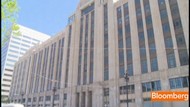
May 11 (Bloomberg) — Douglas Shorenstein, chief executive officer of Shorenstein Properties LP, and Terry Kwik, partner at RMW Architects, talk about Shorenstein’s $300 million investment in Market Square, located in the Mid-Market area of the city.
Twitter Inc. will relocate to Market Square next month, a move that has sent rents up as much as 60 percent in a business district that didn’t exist a year ago. (Source: Bloomberg)
The Future Offices of Twitter Inc.
Marc Perrier/Bloomberg
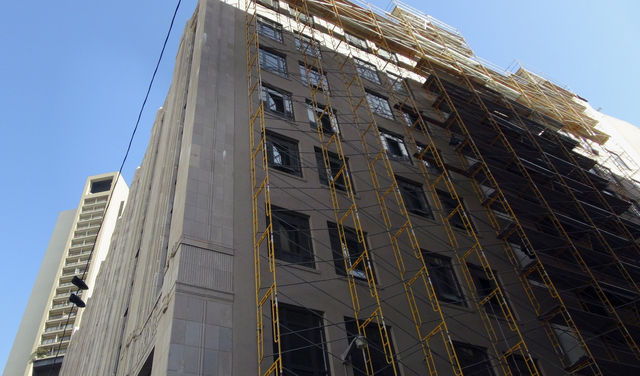
Scaffolding hangs on the future offices of Twitter Inc. in the Mid-Market neighborhood of San Francisco on May 9, 2012.
Scaffolding hangs on the future offices of Twitter Inc. in the Mid-Market neighborhood of San Francisco on May 9, 2012. Photographer: Marc Perrier/Bloomberg

The Future Offices of Twitter Inc.

ZUM via Bloomberg
An artist rendering depicts the building where Twitter Inc. will relocate next month.
An artist rendering depicts the building where Twitter Inc. will relocate next month. Source: ZUM via Bloomberg
Frank Fudem, a San Francisco broker
for office tenants, realized that rents in the city were about
to spike as Twitter Inc. agreed to move to a gritty neighborhood
and leasing by technology companies started to accelerate.
“Twitter was and is the whole phenomenon,” said Fudem, a
partner at real estate services firm Cassidy Turley. “I tell
clients to make their deal as soon as they can.”
Twitter’s relocation next month to Mid-Market, an area
better known until now for drug deals, graffiti and vagrants,
has sent rents up as much as 60 percent in a business district
that didn’t exist a year ago. That type of growth is making San
Francisco the best U.S. office market as demand from Internet
and social-media companies surges.
The city’s five-year investment outlook, based on rent-
growth forecasts, beats West Los Angeles, Boston and midtown
Manhattan, its closest competitors, according to Green Street
Advisors Inc. Office occupancy in the first quarter surpassed
the pre-recession peak in 2007, at almost 75 million square feet
(7 million square meters), data from Cassidy Turley show. Annual
effective rents in the metropolitan area rose 6.8 percent, the
biggest gain in the U.S., Reis Inc. reported last month.
“It’s an outright boom,” said Kenneth Rosen, chairman of
the University of California’s Fisher Center for Real Estate and
Urban Economics in Berkeley. The economist, who advises U.S.
banks and real estate investment trusts on market trends, said
hiring at social-media and other Internet companies accelerated
office-rent gains he thought would occur in 2013.
Below Peak
Pensions, REITs and foreign funds seeking to buy U.S.
commercial property can expect values to keep rising because
rental rates are still well below the previous peak, said Joe Rodriguez, managing director at Invesco Real Estate, which
oversees $48.9 billion of property investments. The Dallas-based
company since August has purchased two office-retail buildings
in the Union Square shopping district, for $51 million and $30
million, according to Real Capital Analytics Inc.
“It’s worth noting that during the dot-com boom, office
rents approached $70 a square foot on average,” Rodriguez wrote
in an e-mail, referring to San Francisco’s late 1990s run-up,
which collapsed in 2000. “Tech and creative company demand is
healthy, and there is a robust venture capital and IPO market
for companies that happen to reside in the Bay Area.”
Rents Up 24%
San Francisco office rents rose 24 percent to an average
$46.66 a square foot in the first quarter from a year earlier,
and are up 39 percent from the market bottom in 2010, according
to Jones Lang LaSalle Inc., which tracks rates within city
limits. In the South of Market district, a popular location for
tech companies and Twitter’s current home, the vacancy rate
shrank by more than half in the first quarter to 3.8 percent,
the lowest since 2000, the brokerage said.
Yelp Inc. (YELP), the website that allows people to comment on
businesses and services, said yesterday it will relocate its
headquarters to a historic South of Market tower that’s being
renovated. The annual rent on an eight-year lease for 98,144
square feet begins Oct. 1, 2013, at $54 a square foot and
concludes at $66 a square foot, the company said in a filing
with the U.S. Securities and Exchange Commission.
Boston Properties Inc. (BXP), the biggest U.S. office REIT, and
closely held Tishman Speyer Properties LP, owner of New York’s
Rockefeller Center, describe San Francisco as their top-
performing market. Rents rose 15 percent last year at Boston
Properties’ Embarcadero Center complex and recent lease deals
were completed at rates of more than $70 a square foot, Douglas Linde, president of the Boston-based company, said on a May 2
earnings conference call.
Limits to Gains
Tishman Speyer, based in New York, will start work on two
Class A offices in San Francisco and expects annual rent gains
in the “high single digits” when leasing begins in 2014, Co-
Chief Executive Officer Rob Speyer said in an interview.
The market may not be as robust as it seems, said David
Churton, Twitter’s broker at Jones Lang LaSalle. Most tenant
leases, at 7,000 to 10,000 square feet, are smaller than high-
profile deals, and technology allows companies to produce more
with fewer people and less space, Churton said at a March real
estate conference. Macroeconomic disruption in China or Europe
might have a negative effect on local growth, he said.
“What if tech falters?” Churton said. “We’re not at peak
conditions, but we need to be cautious.”
‘Early Innings’
The boom hasn’t been limited to offices, said Steven Brown,
senior portfolio manager at Kansas City, Missouri-based American
Century Investments. REITs that own apartments in the San
Francisco area will see rents advance as much as 13 percent this
year, while revenue per available room at hotel REITs will rise
15 percent. Both will double the U.S. average, Brown said.
“It’s the strongest region in the country, and we’re still
in the early innings,” Brown said in an interview.
One of the biggest areas for growth is Mid-Market, a
forlorn stretch of the city’s main corridor where Twitter, the
global messaging service with 140 million active users, is
scheduled to move on June 1. The company’s presence will
transform the area into a “legitimate submarket,” said Fudem,
the Cassidy Turley broker.
The district resisted efforts by public officials, arts
groups and property developers to improve it over the years,
said Cathy Simon, an architect who didn’t mind the area’s
grittiness while working there from 2000 to 2009.
‘Unsavory Place’
“You had to step over people or somebody’s vomit in the
morning,” Simon, a principal at Perkins + Will and designer of
the Ferry Building offices and food market, said of her Mid-
Market years. “It was an unsavory place, not part of sanitized
San Francisco.”
Twitter chose an empty furniture mart as its new
headquarters after negotiating a six-year payroll tax exclusion
supported by San Francisco Mayor Edwin M. Lee as a way to keep
growing firms in the city and build up Mid-Market. The benefit
applies to any company that relocates to the district, roughly
defined as Market Street between Sixth and Tenth streets, said
Christine Falvey, the mayor’s spokeswoman.
Twitter had to consider all options as it experienced
“staggering” growth, including moving out of the city, said
Ron Conway, founder of San Francisco-based venture firm SV
Angel, an investor in the company.
The search overlapped with locally based Shorenstein
Properties LP’s acquisition in March 2011 of the old mart for
$120 million. As recently as 2007, barbed wire was strung on
parts of the property, which includes a 1930s main building and
1970s annex spanning Market Street from Ninth to Tenth streets,
to thwart graffiti vandals.
Ripple Effect
The purchase was made before Twitter agreed in May to be a
tenant, said CEO Douglas Shorenstein. His firm will spend a
total of $300 million on Market Square, as the 1.1 million-
square-foot property is now called. An expanded lobby with 17-
foot ceilings, six high-speed elevators, a retail area spanning
the width of the building, a courtyard, loggia and basketball
court are among the improvements, Shorenstein said during a tour
of the site.
The combination of a well-regarded developer, whose
investors include Yale University’s endowment, and the marquee
tech company produced a “ripple effect,” Lee said in an
interview. It revived a 749-unit apartment project, now under
construction across Tenth Street, and led to two purchases in
late 2011 of nearby office buildings that together have 1.4
million square feet, he said.
“That was significant and reverberated across the real
estate community,” Lee said.
Market Square Leases
Twitter’s six-year lease at Market Square gives the company
three floors with 215,000 square feet at an average annual
rental rate of $30 a square foot. In February, call center
company Callsocket.com committed to 29,000 square feet in the
building at $42 a square foot. Onekingslane.com, a home-decor
sales website, followed in March, renting 52,000 square feet at
$44 a square foot.
Yammer.com, a social network for businesses, last month
signed the most recent lease, taking 79,000 square feet at $48 a
square foot, or 60 percent more than Twitter.
Rates in a nearby office property purchased in the wake of
Twitter’s announced move will range from the high $30s to the
low $50s a square foot, said Stuart Shiff, CEO of DivcoWest
Inc., which bought the building in a joint venture with TMG Inc.
The closely held San Francisco firms paid $44 million in October
for the 385,000-square-foot property, according to New York-
based Real Capital. It is scheduled to open in the first quarter
of 2013, Shiff said.
‘Head and Shoulders’
For landlords, the city’s market should outperform for at
least the next four years, according to Green Street Advisors.
San Francisco office properties are forecast to gain 7.9 percent
in annual revenue per square foot through 2016, “head and
shoulders” ahead of 6.6 percent for West Los Angeles, 6.3
percent for Boston and 5.7 percent for midtown Manhattan, said
Jed Reagan, an analyst at the Newport Beach, California-based
real estate research company.
“The concentration of tech in San Francisco is driving it
as a whole,” Reagan said in an interview. “From our
perspective, it’s the hottest market in the country.”
To contact the reporter on this story:
Dan Levy in San Francisco at
dlevy13@bloomberg.net
To contact the editor responsible for this story:
Kara Wetzel at
kwetzel@bloomberg.net
Please enable JavaScript to view the comments powered by Disqus.
Article source: http://www.bloomberg.com/news/2012-05-11/twitter-rent-surge-makes-san-francisco-best-office-market.html