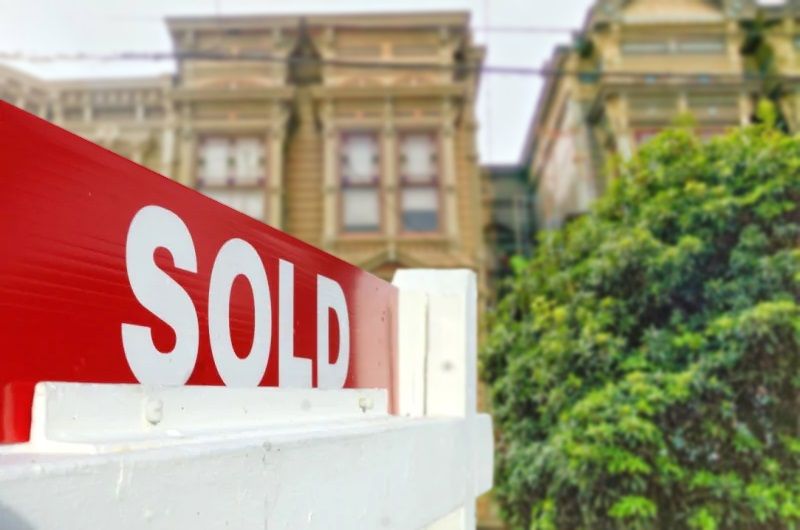
The East Bay, with its diverse neighborhoods, vibrant communities, and eclectic activities, is often seen as a more realistic place to buy a home in relation to San Francisco. Though, with space becoming more scarce, local and foreign developers buying up property, and the highest year-over-year change in annual median house sale price, spiking to $200,000, that fact seems to be changing.
The coastal area came to prominence in the middle of the nineteenth century as the part of the Bay Area most accessible by land from the east. The shoreline is an urban corridor with several cities exceeding 1 million residents which includes Oakland, Hayward, Fremont, Richmond, and Berkeley. The Greater Oakland-Berkeley East Bay region has experienced a 21% increase in median house sale price from 2020 to 2021. For a point of reference, Sonoma County and San Francisco only saw a 9% increase, according to Compass’ Bay Area Market Report.
Looking at the combined markets of Oakland, Piedmont, Alameda, Berkeley, Albany, Kensington, El Cerrito, and Richmond, the average house dollar per square foot has increased more than $100 from $653 in Q1 2021 to $764 in Q2 2021. It seems it’s no coincidence that after the “exodus” of people fleeing the Bay Area that people wanting to return are finding values at all-time highs. When the pandemic hit, the price per square foot ranged from $550 – $600 which allowed big investors, knowing the pandemic was not a matter of if but when, took advantage of the sale in front of them.
Compass / Bay Area Market Report
In the June 2021 update of Compass’ Bay Area Market Reports, the largest portion of homes for sale in the Oakland-Berkeley Inner East Bay Region is in the range of $500,000 – $749,000. For people looking to buy East Bay real estate under $1 million, that should be good news. The total dollar volume was approximately $4.1 billion spread across 3,820 properties – a mean average of just over $1 million. Some more ranges: 11% of home sales were under $500,000; 19% of home sales were under $750,000 – $999,999; 11%-13% of home sales were between $1,000,000 – $2,000,000 and the rest 6% and under between $2,000,000 and $3,000,000. That’s a big difference when eager home buyers are looking at housing and apartments for sale in San Francisco.
Of course, there are a number of reasons for the vast divide of housing prices between East Bay and San Francisco. From tech workers having to commute over the Bay Bridge to Silicon Valley or others using Bart, to the overall differences, too many to note here, between cities, buyers can see the disparities. In that case, buyers should consider the saying, just because it costs more doesn’t mean it’s necessarily better, or something like that. If new homeowners are eager to buy in the East Bay but are hesitant, they should really consider the neighborhood, the schools in the area if they have kids, and what their overall commute will look like. There are hundreds of other factors besides price.
Here are a few homes we found on Zillow below one million for which potential home buyers may like to make an offer.
Robin L. Dustan / Sotheby’s
Located in prime Rockridge just a block to College Avenue, 368 Hudson was originally built in 1912 and has been in the same family since 1956.
Daniel Winkler / Winkler Real Estate Group
849 Milton is an excellent chance for a savvy investor to purchase a property and legalize a perfectly situated partially finished first floor to create two units.
Carrie Mcalister / The Grubb Co.
Enchanting cottage nestled in N. Berkeley Hills with beautiful exposed brick wall and vaulted wood ceilings.
“The city’s business tax base, which is our second largest revenue source next to property tax, is based in part on where people are working from,” said San Francisco City Controller Ben Rosenfield.
For many employees in tech and other high-paying but still largely remote industries, that is not San Francisco.
For example, “We don’t tax all of Google’s revenues by the San Francisco tax rate,” said San Francisco Chief Economist Ted Egan. Instead a share of that money generated in San Francisco is what gets skimmed into city coffers. Despite city voters ratifying Prop F’s shift to taxing businesses on their gross receipts instead of payroll, determining how much of that revenue should go to the city is still largely based on who is working where.
Companies pay a variety of taxes to the city, including on their gross receipts. In fiscal year 2020-2021that money accounted for more than $800 million in city revenue, or about 13.3% of the city’s general fund. Mayor London Breed signed a $13.25 billion budget for the upcoming fiscal year in July, along with $12.75 billion for the following year.
The money goes into the general fund and isn’t allocated to a specific service, although impending city layoffs last year that were narrowly avoided gave a sense of how funding gaps can impact municipal services.
According to Rosenfield’s office, the 100 largest companies in the city measured by their 2020 San Francisco gross receipts reported a 14% decline compared to 2019 gross receipts. That equated to a drop of $7.9 billion reported on their tax filings and included a 13% drop in reported gross receipts in the city among information (tech) and financial services businesses.
The controller’s office said that drop is likely due to telecommuting and they expect much of the same once 2021 wraps up, with remote work becoming more entrenched along with the virus’ hold on society.
That could also pose a problem since the Prop. F envisions business taxes on both of those industries that increase between 2020 and 2024. In 2024, under the measure, the city’s information industry is expected to pay $43 million more compared with 2020, while the financial services sector will see its tax bill increase by $25 million over the same period.
With many offices still closed, it’s not clear if all of that expected tax money will materialize in the city treasury. It’s also not clear exactly how many people are working remotely for San Francisco companies. About half of all jobs in San Francisco can be done remotely, according to a study by the Bay Area Council.
While some of that revenue is likely to ebb, the city is also reaping less money from other industries hit hardest by the pandemic. Retail, service businesses, manufacturing, arts, entertainment and recreation, accommodations and food services will see tax cuts in 2021 and 2022 as a pandemic relief measure before their rates increase in 2023.
In terms of what business revenue the city will see, “2022, 2023, that’s where it becomes more of a guessing game,” said Rosenfield, the city controller, adding that part of the answer will depend on major employers’ long-term working arrangements.
Egan said the city is likely to see budget problems in the future, particularly as federal stopgap funding wanes in the coming years.
“The city’s five year financial plan envisions ongoing budget problems as the federal income supports go away,” he said. That included the loss of the emergency federal CARES Act money and other federal funding that is expected to amount to hundreds of millions of dollars.
A report from Rosenfield’s office from earlier this year said whether the city’s expected budget would hold up is something of a question mark and, “Is closely tied to the recovery of sectors most affected by the pandemic: tourism, office industries, and small businesses.”
Whether telecommuting, out-migration, and conventions and international travel pick back up or stay depressed “will be critically important to the city’s tax base,” the report said.
While some conferences and events have returned to the city, hotels are still largely vacant and far below the common pre-pandemic occupancy rate of 80%. That causes the city to miss out on significant hotel tax revenue as well.
The Controller’s Office said in fiscal year 2020-21, total hotel tax revenue was $42.2 million, down 85% from the year before and down close to 90% from the previous high mark in fiscal year 2018-2019.
There are other unknowns as well.
United States Postal Service data has shown that many people who left San Francisco during the pandemic relocated elsewhere in the Bay Area. But, if they want to return to the office, there won’t be as much space to come back to as companies have offloaded expensive rents for large spaces to save money and build in remote work for good.
Yelp said earlier this month it will cut its office space by about a third and isn’t planning on workers returning until next year. Salesforce and Twitter have already said they won’t require most of their workers to be in any one location ever again. And Facebook initially eyed a broader return to its offices but pulled back in recent months in favor of allowing employees to request permanent remote work as the delta variant spread.
Even some startups are no longer requiring employees to monitor the in-office kombucha taps, and while tech job postings in San Francisco have recovered to pre-pandemic levels by some measures, the number of jobs that allow remote work is growing, according to data Egan presented to city supervisors in September
There are some mitigating factors that could save the city from spilling too much red ink.
“The tech industry as a whole had a huge 2020,” Egan said, noting that while the city may see less revenue because of remote working, “The size of the pie grew.”
Egan said while many tech companies have pared down leases, high vacancy rates of commercial real estate in the city could drive prices down and allow other businesses and their employees to move in, bolstering the tax base.
In July the city’s vacancy rates for offices rose to 20%, the highest level in almost 20 years despite an increase in leasing activity.
“Some of what we lost from the work from home group we’ll get back from the new set of companies that are moving in,” Egan said.
Rosenfield, the controller, said it won’t be clear until early next year how much revenue the city lost out on in 2021 because of remote working.
“Big picture, the city’s economy is made up of two key pillars,” he said. “One is the office industry in the city which is heavily concentrated in tech … the other is the hospitality industry.”
With the pandemic’s convulsions still rippling through both, he said the only question left is how large its impact will ultimately be.
In the report his office produced in June, Rosenfield’s office said the city’s budget assumes the ongoing economic recovery will drive annual tax revenue growth by about $250 million in fiscal year 2021-22 and roughly $500 million in fiscal year 2022-23.
But those projections assume large-scale remote work will fade rapidly in the coming two fiscal years, a possibility that seems increasingly unlikely with each passing day.
Chase DiFeliciantonio is a San Francisco Chronicle staff writer. Email: chase.difeliciantonio@sfchronicle.com Twitter: @ChaseDiFelice
“The city’s business tax base, which is our second largest revenue source next to property tax, is based in part on where people are working from,” said San Francisco City Controller Ben Rosenfield.
For many employees in tech and other high-paying but still largely remote industries, that is not San Francisco.
For example, “We don’t tax all of Google’s revenues by the San Francisco tax rate,” said San Francisco Chief Economist Ted Egan. Instead a share of that money generated in San Francisco is what gets skimmed into city coffers. Despite city voters ratifying Prop F’s shift to taxing businesses on their gross receipts instead of payroll, determining how much of that revenue should go to the city is still largely based on who is working where.
Companies pay a variety of taxes to the city, including on their gross receipts. In fiscal year 2020-2021that money accounted for more than $800 million in city revenue, or about 13.3% of the city’s general fund. Mayor London Breed signed a $13.25 billion budget for the upcoming fiscal year in July, along with $12.75 billion for the following year.
The money goes into the general fund and isn’t allocated to a specific service, although impending city layoffs last year that were narrowly avoided gave a sense of how funding gaps can impact municipal services.
According to Rosenfield’s office, the 100 largest companies in the city measured by their 2020 San Francisco gross receipts reported a 14% decline compared to 2019 gross receipts. That equated to a drop of $7.9 billion reported on their tax filings and included a 13% drop in reported gross receipts in the city among information (tech) and financial services businesses.
The controller’s office said that drop is likely due to telecommuting and they expect much of the same once 2021 wraps up, with remote work becoming more entrenched along with the virus’ hold on society.
That could also pose a problem since the Prop. F envisions business taxes on both of those industries that increase between 2020 and 2024. In 2024, under the measure, the city’s information industry is expected to pay $43 million more compared with 2020, while the financial services sector will see its tax bill increase by $25 million over the same period.
With many offices still closed, it’s not clear if all of that expected tax money will materialize in the city treasury. It’s also not clear exactly how many people are working remotely for San Francisco companies. About half of all jobs in San Francisco can be done remotely, according to a study by the Bay Area Council.
While some of that revenue is likely to ebb, the city is also reaping less money from other industries hit hardest by the pandemic. Retail, service businesses, manufacturing, arts, entertainment and recreation, accommodations and food services will see tax cuts in 2021 and 2022 as a pandemic relief measure before their rates increase in 2023.
“2022, 2023, that’s where it becomes more of a guessing game,” in terms of what business revenues the city will see, said Rosenfield, the city controller, adding that part of the answer will depend on major employers’ long-term working arrangements.
Egan said the city is likely to see budget problems in the future, particularly as federal stopgap funding wanes in the coming years.
“The city’s five year financial plan envisions ongoing budget problems as the federal income supports go away,” he said. That included the loss of the emergency federal CARES Act money and other federal funding that is expected to amount to hundreds of millions of dollars.
A report from Rosenfield’s office from earlier this year said whether the city’s expected budget would hold up is something of a question mark and, “Is closely tied to the recovery of sectors most affected by the pandemic: tourism, office industries, and small businesses.”
Whether telecommuting, out-migration, and conventions and international travel pick back up or stay depressed “will be critically important to the city’s tax base,” the report said.
While some conferences and events have returned to the city, hotels are still largely vacant and far below the common pre-pandemic occupancy rate of 80%. That causes the city to miss out on significant hotel tax revenue as well.
The Controller’s Office said in fiscal year 2020-21, total hotel tax revenue was $42.2 million, down 85% from the year before and down close to 90% from the previous high mark in fiscal year 2018-2019.
There are other unknowns as well.
United States Postal Service data has shown that many people who left San Francisco during the pandemic relocated elsewhere in the Bay Area. But, if they want to return to the office, there won’t be as much space to come back to as companies have offloaded expensive rents for large spaces to save money and build in remote work for good.
Yelp said earlier this month it will cut its office space by about a third and isn’t planning on workers returning until next year. Salesforce and Twitter have already said they won’t require most of their workers to be in any one location ever again. And Facebook initially eyed a broader return to its offices but pulled back in recent months in favor of allowing employees to request permanent remote work as the delta variant spread.
Even some startups are no longer requiring employees to monitor the in-office kombucha taps, and while tech job postings in San Francisco have recovered to pre-pandemic levels by some measures, the number of jobs that allow remote work is growing, according to data Egan presented to city supervisors in September
There are some mitigating factors that could save the city from spilling too much red ink.
“The tech industry as a whole had a huge 2020,” Egan said, noting that while the city may see less revenue because of remote working, “The size of the pie grew.”
Egan said while many tech companies have pared down leases, high vacancy rates of commercial real estate in the city could drive prices down and allow other businesses and their employees to move in, bolstering the tax base.
In July the city’s vacancy rates for offices rose to 20%, the highest level in almost 20 years despite an increase in leasing activity.
“Some of what we lost from the work from home group we’ll get back from the new set of companies that are moving in,” Egan said.
Rosenfield, the controller, said it won’t be clear until early next year how much revenue the city lost out on in 2021 because of remote working.
“Big picture, the city’s economy is made up of two key pillars,” he said. “One is the office industry in the city which is heavily concentrated in tech … the other is the hospitality industry.”
With the pandemic’s convulsions still rippling through both, he said the only question left is how large its impact will ultimately be.
In the report his office produced in June, Rosenfield’s office said the city’s budget assumes the ongoing economic recovery will drive annual tax revenue growth by about $250 million in fiscal year 2021-22 and roughly $500 million in fiscal year 2022-23.
But those projections assume large-scale remote work will fade rapidly in the coming two fiscal years, a possibility that seems increasingly unlikely with each passing day.
Chase DiFeliciantonio is a San Francisco Chronicle staff writer. Email: chase.difeliciantonio@sfchronicle.com Twitter: @ChaseDiFelice
Some landlords and real estate brokers believe it won’t lead to many evictions, because property owners are desperate to keep their spaces filled and want to renegotiate leases.
“I don’t know anyone evicting tenants. We’re not evicting anyone,” John Callan, president of San Mateo Land Exchange, owner of a downtown San Francisco building at 201 Kearny St., said. “If somebody’s been impacted by COVID we work with them.”
But tenants and small business advocates fear that since many struggling businesses haven’t been able to resolve lease and rent disputes, evictions are inevitable.
Julie Gilgoff, staff attorney at Lawyers’ Committee for Civil Rights of the San Francisco Bay Area, has worked with over 100 small businesses and said only a few have successfully renegotiated.
San Francisco retail tenants collectively owe an estimated $285.7 to $564.7 million in unpaid rent between April 2020 and August 2021, according to a city study released last week. Office tenants owe only an estimated $11.1 million to $22.8 million in unpaid rent for that time.
Westlake Coffee Shop in Daly City was able to renegotiate its lease and avoid eviction.
Santiago Mejia/The Chronicle
“By and large we have found landlords either wanting the full rental amount or not willing to forgive even the months where tenants had to close because of government mandate,” said Gilgoff, whose group works with San Francisco’s Office of Economic and Workforce Development to connect with business owners. “We believe landlords have the upper hand over tenants at this time.”
Retail broker David Blatteis disagreed and said all but one of the landlords of the 37 San Francisco buildings that he manages have reduced rents by as much as 50%, helping small businesses like Brownies Ace Hardware on Polk Street and Goorin Bros. Hat in North Beach to survive. Even clothing giant Gap got a rent reduction to keep its Chestnut Street store open as it closed all three of its other locations in the city, he said.
“None of my landlords are planning on evictions,” Blatteis said. “They want to work with tenants.”
The rent abatements are typically up to a few months at a time, after which they’ll be re-evaluated to see if the economy has improved.
Leases typically mandate that tenants continue paying rents unless a “force majeure” occurs. Whether the pandemic qualifies is, in many cases, under dispute and dependent on what the specific language is in a particular lease.
Some disputes involving major retailers have also gone to court. Gap’s Old Navy division was sued last summer by landlord Ponte Gadea California LLC for $1.6 million in alleged unpaid rent at 821 Market St. in San Francisco. The case is ongoing.
Gap and Simon Property Group, the country’s biggest mall owner, settled a lawsuit over an alleged $107 million in unpaid rent last December. Nordstrom, HM and Saks were all sued last year over alleged missed rent payments in downtown San Francisco.
Cases where tenants were able to renegotiate leases also involved many challenges, underscoring the difficulties especially for low-income and minority-owned businesses.
Sara Segovia, owner of Westlake Coffee Shop in Daly City, had to close for two weeks in March 2020 and then rely only on takeout and delivery. Sales plunged more than 85%, with monthly revenue around $5,000 during the worst of the shutdown, compared with $35,000 in 2019. The pandemic closure of Century Theatres, which is in the same building, badly hurt business. The cafe’s seven employees are now down to five.
Segovia, who speaks Spanish but not English, wasn’t aware of what government aid was available until the end of 2020.
“That happened with many Latino-owned businesses, especially women, I realized,” said Gabriela Sapp, a financial adviser at the San Francisco Small Business Development Center, which helps small businesses including Westlake Cafe. “They were so focused on trying to run the business that they didn’t really hear any information about COVID-19 funding or anything.”
Sapp tried to help Segovia renegotiate her lease, but calls to building manager CBRE, the giant real estate brokerage, weren’t returned. It wasn’t until a smaller company took over management that Segovia was able to make progress and reached an agreement to reduce rent to an affordable rate based on the cafe’s business revenue. Sales have partially recovered but are still around 30% lower than in 2019.
CBRE declined to comment, and the landlord DB Real Estate Pacific Plaza Partners didn’t immediately respond to a request for comment.
Segovia supports extending the moratorium until at least the end of the year.
“Not everyone is able to communicate with their landlord. Families are struggling to pay rent,” Segovia said in Spanish, as translated by Sapp.
Callan, the owner of 201 Kearny St., agrees that it’s been a brutal year for tenants.
One restaurant in his building spent a year and a half before the pandemic obtaining permits to switch from a sushi restaurant to a new eatery called Chicken Little Rotisserie. It reopened in the first week of March 2020 and is now empty. It’s not clear if it will ever reopen, Callan said.
But landlords have also suffered with their own unavoidable expenses and haven’t received the same level of government support as tenants, he said.
“At times I think the city is at war with the property owners,” Callan said of San Francisco. “I don’t think they realize landlords have large bills, property tax bills, insurance bills, utility bills, water bills.”
Three of 201 Kearny’s nine commercial spaces are vacant, and Callan has reduced rents to help those businesses that need it. Some tenants, like a medical company, are doing fine, while a catering company is struggling.
“Our philosophy is everyone should pay their fair rent,” he said.
Although the state order is expiring, local governments continue to work on regulations and assistance.
Los Angeles County officials voted on Tuesday to extend its commercial eviction moratorium through the end of January. San Francisco officials have not done so, but the Board of Supervisors passed an ordinance by Supervisor Ahsha Safaí to establish a rent relief fund for small business.
Businesses with fewer than 50 employees have between 12 and 24 months to repay rent. Mayor London Breed signed an amendment on Monday that gives some businesses with 50 to 99 employees up to six months to repay rent. The city has allocated more than $63 million in relief to support over 3,000 small businesses during the pandemic.
“As the state’s commercial eviction moratorium ends, we want to ensure that our businesses and property owners have the resources and support and assistance they need,” said Kate Sofis, director of the city’s Office of Economic and Workforce Development, in a statement.
Marisela Castillo makes coffee at Westlake Coffee Shop in Daly City.
Santiago Mejia/The Chronicle
Even when tenants and landlords have positive relationships, survival can be fraught.
Osbelia Castaneda, owner of Osbelia’s Hair Salon in the Excelsior, said the shop was closed between March 2020 and January 2021, aside from a brief window before the winter surge.
In the darkest days, she felt hopeless and had to rely on family, friends and aid to pay for food and rent. It was hard taking care of her son, who has schizophrenia. Unable to color anyone’s hair in person, all she could do was send hair products by mail.
“I felt like I might give up and leave the country,” Castaneda said in Spanish, as translated by Sapp, who also assisted her. Castaneda is originally from Mexico.
It took around five months to renegotiate her lease, and her $3,500 per month rent was retroactively reduced to $600 for the months she was closed. Her landlord didn’t immediately respond to a request for comment.
Castaneda supports extending the moratorium for another year, because businesses like hers are just starting to recover.
She had three employees and three contractors, all who were laid off or left the company. She’s been able to rehire two new employees and two contractors, but sales are still only about 30% of 2019 levels, or about $5,000 a month. That’s barely more than her rent, which is back to its 2019 level.
Roland Li is a San Francisco Chronicle staff writer. Email: roland.li@sfchronicle.com Twitter: @rolandlisf