California Housing Market Pukes: As Sales Collapse (San Diego County -41%), Prices Begin to Swoon

San Francisco Silicon Valley lead. Southern California is catching up. In Los Angeles County, prices fell in July from June for the first since Adam and Eve.

By Wolf Richter for WOLF STREET.

It’s peak home-buying season in California, but sky-high home prices, holy-moly mortgage rates, the collapse of cryptos, the vanishing DeFi, and the implosion of tech startups, SPACs, and IPOs, all of which are crucial to the wealth, or perceived wealth, of many Californians, pulled the rug out from under California’s splendid housing markets.

Sales volume of single-family houses (SFH) in California plunged by 14% in July from June, seasonally adjusted, and by 31% from a year ago, the 13th month in a row of year-over-year declines, according to the California Association of Realtors.

Sales volume of condos plunged by 18% in July from June, and by 36% from a year ago.

Prices eventually follow volume: The median price of single-family houses dropped 3.5% in July from June, down for the second month in a row, slashing the year-over-year gain to just 2.8%. The median price of condos dropped 2.3%, down for the third month in a row, whittling down the year-over-year gain to 7.5%.

San Francisco and Silicon Valley lead with the declines.

Sales volume of houses and condos in the entire San Francisco Bay Area has collapsed by 37% from a year ago.

Price has started to follow volume. Year-over-year, the median price of houses across the Bay Area was down for the first time since lockdown May 2020.

Year-over-year, it was down in three of the five big counties that cover San Francisco, Silicon Valley, and part of the East Bay, led by San Francisco, where the median price was down 8.2% year-over-year. We’ll get to the charts in a moment.

Southern California is behind but catching up.

Sales volume of houses plunged by 20% from June, and by 37% from a year ago. In San Diego, sales volume collapsed by 21% in July from June and by 41% year-over-year. In Orange County, sales volume collapsed by 39% year-over-year, in Los Angeles County by 32%.

Price eventually follows volume, even in Southern California. In the counties of San Diego and Orange, the median price dropped for the third month in a row.

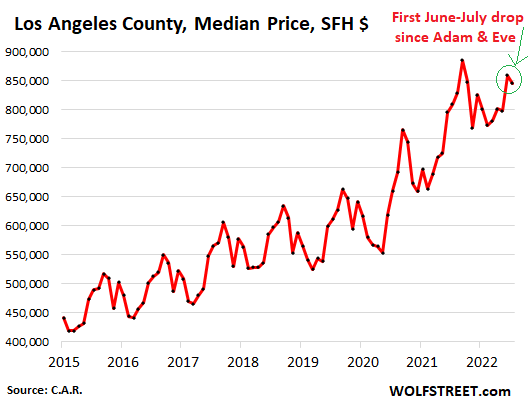
In Los Angeles County, the median price had peaked in September 2021 and has been on a wild ride since, up and down. But in July it fell, which was a bummer because it always rises from June to July; it even rose in 2009 from June to July, when all heck had broken loose, which puts this drop in a special light.

Supply and median time on the market jump.

In all of California, supply of houses and condos for sale rose to 3.2 months, up from 1.9 months a year ago, and the highest level since May 2020.

The median time on the market jumped to 14 days in July, up from 11 days in June, and up from 8 days a year ago.

In the Bay Area, supply jumped to 2.5 months in July, up from 2.0 months in June, and up from 1.5 months in July last year.

The median time on the market jumped to 15 days in July, up from 12 days in June, and up from 10 days a year ago.

In Southern California, supply jumped to 3.3 months, up from 2.5 months in June, and up from 1.9 months in July last year.

The median time on the market jumped to 13 days in July, up from 10 days in June, and up from 8 days a year ago.

Median Prices of SFH the Biggest Counties.

Median prices are very volatile, and we need to look at them with a good dose of circumspection, and trends need to be confirmed over time. But when the median price is down so far that the huge year-over-year gains in prior periods get whittled down to just small gains or even year-over-year declines, then the data points are starting to acquire heft as trends. And that’s what we’re now starting to see.

The Bay Area leads in price declines.

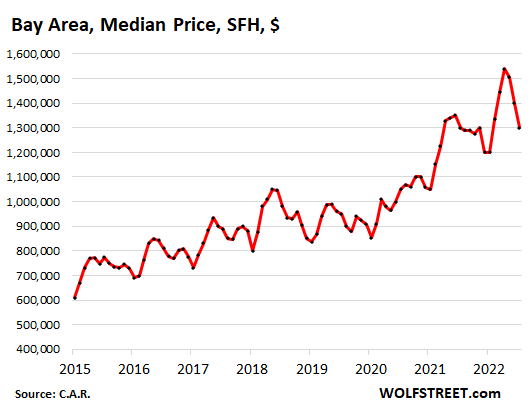
In the overall San Francisco Bay Area, the median price of single-family houses dropped for the third month in a row in July, is down 15.5% from the peak, and down 0.1% from a year ago, down year-over-year for the first time since lockdown May:
02f99 US california housing CAR 2022 08 19 Bay Area California Housing Market Pukes: As Sales Collapse (San Diego County  41%), Prices Begin to Swoon

In San Francisco, house prices fell for the third month in a row, are down 17% from the peak and are down 8% year-over-year. These are very large and sudden declines, especially in June and July, and it rolled the median price back to where it first was in February 2018:

02f99 US california housing CAR 2022 08 19 San Francisco  California Housing Market Pukes: As Sales Collapse (San Diego County  41%), Prices Begin to Swoon

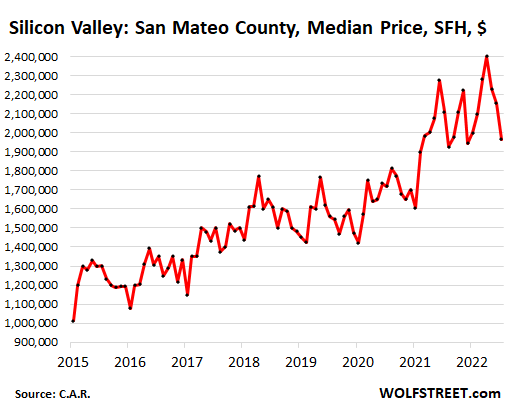
In San Mateo County, the northern part of Silicon Valley, the median price also fell for the third month in a row, -18% from the peak and -7% year-over-year. These are large and sudden drops that took the median price back to where it had first been in March 2021:
02f99 US california housing CAR 2022 08 19 San Mateo California Housing Market Pukes: As Sales Collapse (San Diego County  41%), Prices Begin to Swoon

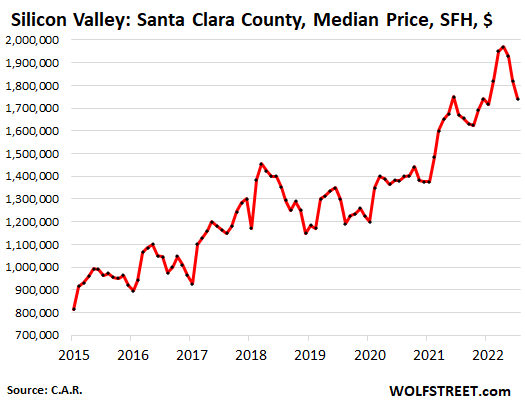
In Santa Clara County, which includes the southern part of Silicon Valley, the median price also fell for the third month in a row, -12% from the peak, but still +4% year-over-year, compared to the 20% gains last year:
02f99 US california housing CAR 2022 08 19 Santa Clara California Housing Market Pukes: As Sales Collapse (San Diego County  41%), Prices Begin to Swoon

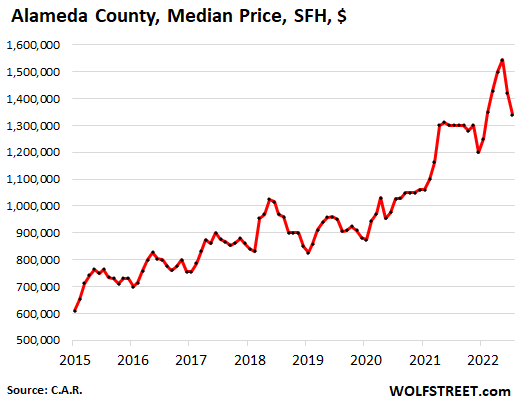
In Alameda County, in the East Bay, house prices fell for the second month in a row, -13% from the peak, but still +3% year-over-year:
75c0a US california housing CAR 2022 08 19 Alameda California Housing Market Pukes: As Sales Collapse (San Diego County  41%), Prices Begin to Swoon

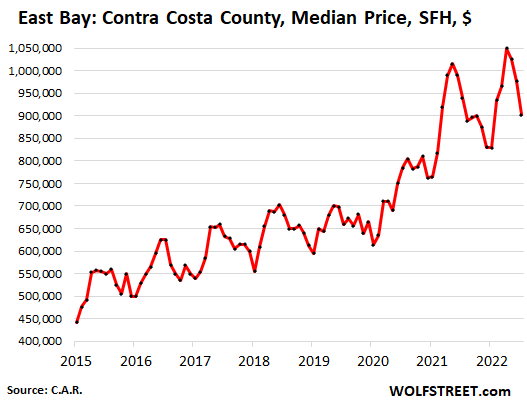
In Contra Costa County, in the East Bay, house prices fell for the third month in a row, -14% from the peak, -4% year-over-year:
75c0a US california housing CAR 2022 08 19 Contra Costa California Housing Market Pukes: As Sales Collapse (San Diego County  41%), Prices Begin to Swoon

Southern California trying to catch up with the Bay Area.

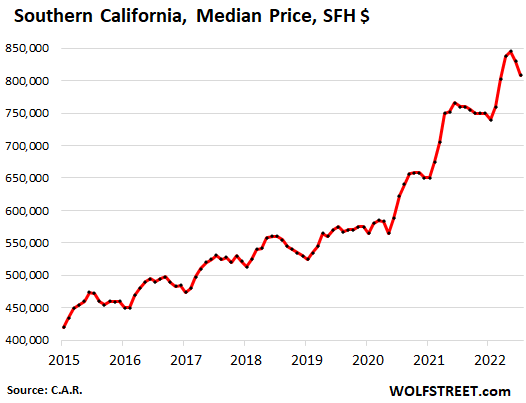
In Southern California overall, house prices fell for the second month in a row, -4% from the peak, but still +6% year-over-year.
75c0a US california housing CAR 2022 08 19 Southern California California Housing Market Pukes: As Sales Collapse (San Diego County  41%), Prices Begin to Swoon

In San Diego County, the median house price fell for the third month in a row, -5% from the peak, which whittled the year-over-year gain from the 30%-range last year to +8% in July:

94a2d US california housing CAR 2022 08 19 San Diego California Housing Market Pukes: As Sales Collapse (San Diego County  41%), Prices Begin to Swoon

In Los Angeles County, the median house price has gone wild since the peak in September last year, -4.5% from that peak.  Year-over-year, +4.5%.

But wait… special nugget: Seasonally, in LA County, the median price always rises from June to July, and this year’s drop in July from June was the first drop in many, many years. During the Housing Bust in 2008, the median price was essentially flat. And even in July 2009, as all heck had broken loose, the median price rose from June, which puts this year’s 1.6% drop in July from June into a very special light.
94a2d US california housing CAR 2022 08 19 Los Angeles  California Housing Market Pukes: As Sales Collapse (San Diego County  41%), Prices Begin to Swoon

In Orange County, the median house price fell for the third month in a row, -7% from the peak, which whittled the year-over-year gain from the 27%-range early this year to 13% in July:

94a2d US california housing CAR 2022 08 19 orange California Housing Market Pukes: As Sales Collapse (San Diego County  41%), Prices Begin to Swoon

Enjoy reading WOLF STREET and want to support it? Using ad blockers – I totally get why – but want to support the site? You can donate. I appreciate it immensely. Click on the beer and iced-tea mug to find out how:

94a2d BeerMug2 California Housing Market Pukes: As Sales Collapse (San Diego County  41%), Prices Begin to Swoon

Would you like to be notified via email when WOLF STREET publishes a new article? Sign up here.

d49ef placeholder2 California Housing Market Pukes: As Sales Collapse (San Diego County  41%), Prices Begin to Swoon


Article source: https://wolfstreet.com/2022/08/19/california-housing-market-pukes-as-sales-collapse-san-diego-county-42-prices-begin-to-swoon/

Posted in SF Bay Area News | Tagged | Leave a comment

Another real estate tech giant lays off workers in face of housing slump

“While we remain bullish on the long-term potential of what is a $200 billion addressable market, we must always take prudent steps to drive improved efficiency, including now,” Doctorow said in the email.

Though a spokesperson for Realtor.com declined to share how many employees were let go, Doctorow’s email indicated that the layoffs impacted both regular and contracted employees across most of the company’s locations and functions. Laid-off employees are being offered a “generous severance,” including a continuation of their health care benefits and comprehensive career counseling. 

Realtor.com is headquartered in Santa Clara. About 200 of the company’s approximately 2,500 employees live in the Bay Area, according to LinkedIn. 

Housing markets across the country have slowed as mortgage rates rise, and the Bay Area has seen some of the biggest impacts of this trend. According to Redfin data, San Francisco and Oakland are the only metro areas in the country to have seen a year-over-year decline in the median home sale price, with prices falling 1.5% in Oakland and 2.8% in San Francisco since 2020. 

Realtor.com isn’t the only large real estate company to lay off employees due to the market slowdown — Compass and Redfin both laid off hundreds of employees in June. 

Article source: https://www.sfgate.com/realestate/article/realtorcom-layoffs-amid-housing-slowdown-17439156.php

Posted in SF Bay Area News | Tagged | Leave a comment

Another housing battle has erupted over 1,000 homes in Wine Country. Here’s why residents aren’t likely to win

Now, state and county officials want to build 1,000 units of housing, office and retail space, and a boutique hotel on nearly 200 acres of the 945-acre site, much of which is open space.

But the plan, like many large developments around the Bay Area, is facing community opposition from nearby residents who say they want it significantly scaled down. Residents in Glen Ellen cite worries about congestion during wildfire evacuations, disruption to wildlife in the area and emissions from vehicles, and dozens voiced those concerns at a planning commission hearing on Thursday.

Throughout the Bay Area and indeed California, neighbors successfully block large proposals, but with this project, there’s a catch. If the county can’t approve a plan for the state-owned property by the end of the year, the state will take over and work with a developer — which it expects to choose by Nov. 23 —to build anyway.

The fight of over the project is just the latest example of California officials getting tough in the face of a dire housing shortage. Gov. Gavin Newsom’s Housing Accountability Unit has sent more than 100 “accountability letters” warning cities to comply with housing law and helping to push through project approvals delayed by local governments. It is also challenging cities to be realistic in how they will meet their housing goals.

The Sonoma Developmental Center, located in the unincorporated Eldridge, was one of several state-run institutions for the severely disabled — and for decades also Sonoma County’s largest employer, with 1,900 on staff at its height serving 3,700 residents. The state has been phasing out the facilities, and the Sonoma center closed in 2018 after several patient abuse scandals.

The state is looking to reuse the 180-acre built-out campus part of the area, preserving the rest as open space. Under California law, because the state owns the land, any proposed development on the site must prioritize housing, especially affordable housing, preserve open space and be economically feasible.

In 2019, the state partnered with the county to prepare the two documents on the table now: an environmental impact report and a specific plan, which would guide the kind of project allowed. The guidelines are meant to fulfill the state’s goals while reflecting community input.

After years of community engagement, the county put forward 1,000 housing units in a mix of single-family homes and multifamily buildings with just over a quarter of those as affordable units. Half of the remaining market-rate units would be saved for what they call “missing middle housing” for people who make between 120% and 160% of the area’s median income — too much to qualify for an affordable unit, but not enough to buy a home, which has a typical value of $1 million in Sonoma County, according to Zillow.

The project would also create 940 permanent jobs.

All open space would be protected as dictated by state law.

The plan notes that, if the state were to take over due to inaction from the county, it could result in anywhere from 750 new housing units to 1,250 — and potentially even more.

Still, many are worried about the scale of the county’s plan, explained John McCaull, the land acquisition director at Sonoma Land Trust, which aims to protect open land in the county.

“We are absolutely supportive of the housing component. It’s part of the law,” he said. “But can we right-size this for the wildlife corridor and for the surrounding rural area?”

One of the group’s main points of contention is that the plan calls for another road connecting Arnold Drive and Highway 12, two major roadways surrounding the area, to facilitate wildfire evacuations. That road is particularly important given that part of the property burned during the 2017 Wine Country fires, and it took hours for people to evacuate from the surrounding areas at that time.

The Sonoma Land Trust argues that the road and the proposal’s density would interrupt the wildlife corridor, thus disrupting the entire ecosystem, but the trust has not specified how many units it thinks would be appropriate.

“As everybody, I think, knows, roads and wildlife corridors do not mix,” said Eamon O’Byrne, the group’s executive director

The county’s specific plan does not say exactly where that route would go, but it does say how that road will affect the open space warrants “further study.”

Bradley Dunn, a county policy manager, noted that the county worked with the Sonoma Valley Fire District and the Department of Emergency Management to develop evacuation scenarios used in the plan.

“The new road between Highway 12 and Arnold Drive that can be used for evacuations, a fire station staffed by Sonoma Valley Fire, and the refurbished water system will all help people evacuate or fight wildfire,” he said.

A group of residents called Eldridge for All is similarly concerned with wildfire risk as well as vehicle emissions and is pushing to limit the development to 450 units and preserve all, rather than some, of the historic buildings.

In online materials, the group says the area “is at risk of being urbanized due to county plans to create a new town with a large ’70s style sprawl subdivision, high-end hotel and a new road on rural and agricultural lands.”

But the environmental impact report found that the 450-unit alternative would not be financially feasible unless it prioritized only market-rate housing.

Opponents have taken issue with the environmental impact report, calling it inadequate. Because the proposed plan has policies like preserving the historic character of the site and improving public transit in the area, the environmental impact report concludes that the measures already in the plan are enough to offset its impacts.

For its part, the county is accepting comments on the documents until Sept. 26 and has to finalize its plan and impact report by Oct. 17.

After that, the documents go to the county’s board of supervisors, which needs to certify it in early November.

If all goes according to plan, the developer chosen would buy the site from the state and propose a project that fits the guidelines in the specific plan, kicking off more approvals and then decades of building.

But at Thursday’s commission meeting, this schedule was a sticking point for many speakers, as well as some commissioners.

“The schedule is completely inadequate and inefficient to have a good plan,” Commissioner Gregg Carr said, suggesting the county take several more months to adjust the plan with public input.

Commissioner Jacquelynne Ocana pushed her colleagues to move forward with the set timeline to avoid the state takeover.

“If we don’t provide the specific plan by Dec. 31, we would essentially lose our opportunity to guide this project entirely,” she said. “I’m not sure I’m willing to take that risk.”

Danielle Echeverria is a San Francisco Chronicle staff writer. Email: danielle.echeverria@sfchronicle.com Twitter: @DanielleEchev

Article source: https://www.sfchronicle.com/bayarea/article/Another-housing-battle-has-erupted-over-1-000-17443955.php

Posted in SF Bay Area News | Tagged | Leave a comment

Real estate startup Belong flees Bay Area for Miami

While it’s not an uncommon phenomenon — in recent years, Miami Mayor Francis Suarez has made an aggressive push to court tech and crypto firms — the rhetoric behind the move is new. Belong CEO and co-founder Ale Resnik said in a statement that the city “represents a glimpse at a possible future of the USA.”

“One that’s multicultural, more pragmatic, and less ideological,” Resnik said in the statement. “This is an ecosystem where consumer tech can blossom.”

Suarez himself celebrated the news, calling it proof of “the Miami Movement,” his push to bring more tech companies into Miami, at work. 

What, specifically, Resnik means by “less ideological” remains unclear. Florida at large has historically been considered a battleground state, though it has leaned more Republican in recent years. Miami skews more liberal than the rest of the state, voting for the Democratic presidential candidate in the last three elections, but is not as unequivocally Democrat-leaning as the Bay Area. 

The move comes as Miami and other cities in South Florida experience a steep rise in housing costs, making it among the most expensive cities to live in the country relative to residents’ mean income. 

Belong, according to press material, is a “home management platform” for small landlords that promises to build a path for home ownership. Earlier this year, it snagged $80 million in funding, led by venture capital giant Andreessen Horowitz. The company offers services in the Bay Area, Miami, Seattle and Southern California.

The news was first reported by the South Florida Business Journal.

Article source: https://www.sfgate.com/local/article/belong-startup-moves-to-miami-17428162.php

Posted in SF Bay Area News | Tagged | Leave a comment

These cities’ housing markets are less affordable than SF’s

With a median home price of $1,388,000, San Francisco is ranked as the seventh least-affordable housing market in the nation. The city’s median household income of $126,117, which is notably higher than in most places the index lists, could contribute to why it’s ranked lower than you’d expect. The average SF family would need to use 66.56% of its yearly income to afford a home.

Miami was ranked as the least-affordable housing market with a median home price of $610,000 and a median household income of $44,581. With a 5.5% interest rate on a 30-year fixed-rate mortgage, the average Miami family would need to spend 87.39% of its annual income to afford a home. Los Angeles is slightly more affordable, with a median home price just shy of $1 million at $975,000 and a median household income of $69,695. The average LA family would need to spend 85.34% of its income to afford a home. 

New York City was predictably unaffordable, coming in as the third least-affordable city. With a median household income of $68,129 and a median home price of $925,000, an average family would need to spend 82.47% of its yearly income to afford a home. 

Newark, New Jersey’s largest metropolis, is ranked fourth in the index, followed by Hialeah, Florida, which borders Miami. 

Sixth on the index is my hometown of Long Beach, which doesn’t surprise me, considering most of the people I grew up with can’t afford to live there anymore. The median home price in the LBC is $799,000 and the median household income is $70,677, meaning the average family there needs 69.77% of its yearly income to afford a home. 

After San Francisco at No. 7, the eighth, ninth and 10th spots on the index are all in Southern California — San Diego, Anaheim and Santa Ana, respectively. Oakland ranks right after them at No. 11, with a median home price of $798,000 and a median household income of $82,649.

Article source: https://www.sfgate.com/realestate/article/housing-less-affordable-than-SF-17428910.php

Posted in SF Bay Area News | Tagged | Leave a comment