The bay window most San Franciscans think of — the one exhibited on a classic Victorian like the Painted Ladies, for example — is a specific type of two shorter windows and one longer window that come together at angles to form a “bay.” Tim Kelley, a consultant and historic preservation advocate in San Francisco, said they began appearing in the city in the late 1880s.
They continued in popularity through the Victorian era, when so much of the architecture was lauded for its function. “You get more light when you incorporate a bay window, and Victorians took advantage of that,” Bonnie Spindler, a real estate agent and “the Victorian Specialist” of San Francisco, said. “At the time they were built, [residents] were relying on gas lighting, and the interiors were painted dark to cover up soot from the gas lights and soot from coal burning.”
She said this particularly helped in foggy San Francisco.
The way that the windows jutted out beyond the building also allowed for extra space. “While bay windows have aesthetic (shape) and functional (natural light and views) characteristics that contribute to their iconic status in San Francisco architecture past and present, there is an economic motivation for bay windows that is often overlooked,” said Steven Doctors, an assistant professor of architecture at the University of San Francisco. “… Bay windows efficiently increase the square footage of a building, often by projecting beyond the property line into the air space above the public sidewalk. This ‘free’ space within the public realm increases the square footage of the building, thereby increasing its economic value or rental income to the private property owner.”
Row of seven Victorian houses in central San Francisco known as Painted Ladies.
LimeWave – inspiration to exploration/Getty Images
San Francisco is also known for its preservation of older homes, and a lot of what’s preserved has been old Edwardian and Victorian houses, where bay windows are common, Spindler said.
There’s also an obvious reason bay windows are mistakenly synonymous with the Bay Area — it’s in the name. “We’re the Bay Area and they are bay windows,” Spindler said. “There are lots of other bays, but we’re probably the most famous bay.”
Today, bay windows are more common in San Francisco than Victorian houses, and they come in all types of styles and sizes. They can be found on art deco, marina-style and even some Tudor revival houses, though many may utilize more of a bow window, which includes four or more windows to create more of a rounded arc. Either way, the homes still accomplish their original intention — more light and more square footage.
Rob Thomson, president of the Victorian Alliance, said bay windows in San Francisco can also be used as a handy shortcut in determining a home’s age. “No bay (flat front) or an angled bay typically means it’s 1870s or earlier. A box bay is associated with the 1880s, and a rounded bay means it’s 1890s or later,” he said. “The system isn’t perfect, and there are exceptions, but it’s a useful tool and a great way to sound smart to your friends.”
Bay windows are not only quintessential Bay Area, they’re so beloved they even increase a home’s value, Spindler said. She said they’re right up there with fireplaces on people’s most loved features list when they’re looking to purchase real estate. But, the windows have something incredibly unique that almost no other feature has. “It’s really bay windows that catch your attention from the outside of the building and catch your attention from the inside of the building,” she said. “There are very few features that travel from inside to out.”
Editor’s note: This story was updated to include additional information about bay windows and home ages.
Bay Area home buyers have begun to settle back into neighborhoods closer to their offices, driving up prices in Alameda and Santa Clara counties.
The median sale price for a single-family home in the Bay Area reached $1.13 million in September, a slight decline from this summer’s record highs. Homebuyers’ craving for suburban space continued, but cooled in the outer suburbs of Contra Costa and Marin counties, according to CoreLogic data.
Economists and agents expect a robust market heading into the holiday season, with low interest rates and millennial techies looking to buy.
The relatively short supply of homes for sale means buyers are acting fast. “What does come up, we bid on it,” said Fremont agent Sunil Sethi, “and we’re never alone.”
The median price for an existing single-family home in the Bay Area jumped 16% from last September, according to CoreLogic. The year-over-year gain reflects a pandemic-slowed market in 2020, which has rebounded to record levels since early this year.
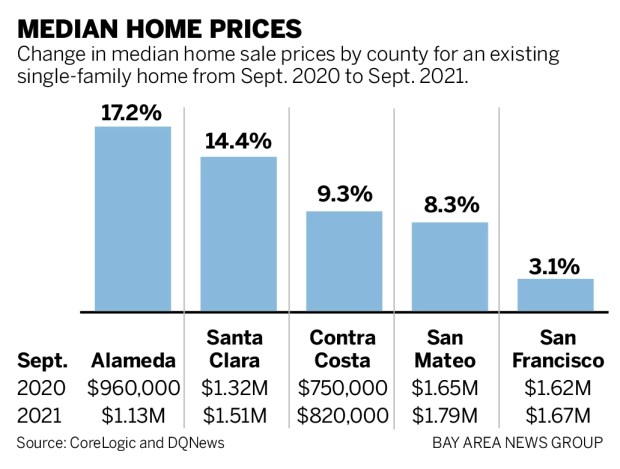
Home prices rose in all nine Bay Area counties. But the biggest gains were in Alameda, where prices leaped 17.2% from the previous year to $1.13 million and Santa Clara, up 14% to $1.51 million.
Contra Costa County prices grew 9.3% to $820,000, San Mateo increased 8.3% to a region-high $1.79 million, and San Francisco rose 3.1% to $1.67 million.
Overall sales, including new units and condos, ticked up 6% from the previous September, suggesting buyers and sellers have eased their concerns about visiting and showing homes during the pandemic.
The Bay Area market has seen fewer highs and lows during the pandemic than other parts of the country, said CoreLogic economist Selma Hepp.
“We were really expecting, at this point, for sales to be lower,” Hepp said. “Demand is still there.” Sales did decline sharply in Marin and Napa counties, while closings grew by double-digit percentages in Santa Clara County and San Francisco — suggesting homebuyers are returning to urban and suburban homes near job centers.
In the East Bay, buyers saw more choices on the market in El Cerrito and Pinole. But agents planted fewer for sale signs in Clayton, Martinez and Walnut Creek. Home inventory also dropped in Fremont and Newark from the previous year, according to Bay East Association of Realtors. The median price in Berkeley in September reached $1.6 million, and nearly touched $1.5 million in Fremont, according to local data.
California Association of Realtors chief economist Jordan Levine told East Bay brokers that economic conditions are expected to improve with more people moving back to full-time work and continued low interest rates headed into 2022. After months of record lows, interest rates have climbed over 3% for a standard, fixed 30-year mortgage.
“For sellers, the market’s still pretty hot,” Levin said.
Santa Clara agent Alan Wang is seeing some buyer fatigue and a slight slowdown in the frenetic pace of spring and summer. But Wang still sees move-in-ready homes in Silicon Valley getting multiple offers and selling quickly.
After losing three or four bidding wars, some home shoppers have decided to wait until next year. “If you underestimate the market,” Wang said, “you’re going to get a reality check very quickly.”
Still, tech professionals continue to snap up homes in the Valley, he said. One of Wang’s clients fell hard for a fully renovated four-bedroom home in Belmont with stunning views of the hills. At least six buyers put in offers, driving the $3 million list price up to nearly $3.5 million. His clients won — but only after pushing to the edge of their budget.
“We knew the house was beautiful,” he said, “and we knew it was going to be a battle.”
East Bay homes have been selling more quickly, with buyers willing to take pre-emptive offers or simply accepting a smaller number of strong offers, Sethi said. East Bay data shows high-end homes priced in excess of $3 million are selling at seven times the volume they sold in 2020.
Lamorinda agent Paddy Kehoe said the market has begun to level off a little. But shoppers still are willing to pay a premium for good locations, he said.
“Buyers are not afraid to bid up 15, 20, 25%,” Kehoe said. “There’s almost a sense of desperation.”
The biggest decline in the nine-county region was in Marin County, where the median sold price fell 10.9% to $1,560,000 from July to August, according to the Realtors group. In San Mateo County, prices fell 8.8% to a median $1,925,000, and in Contra Costa the decline was 5.4% with a median price of $889,500.
The median was relatively flat in San Francisco at $1,850,000, down just $2,500 from July. Sonoma was the only Bay Area county seeing an increase, with the median sold price rising 1.1% to $770,000 in August.
The price drops accompanied a small rise in supply: Available homes in the San Francisco metropolitan area listed on real estate website Zillow rose from 8,630 in July to 8,795 in August. The share of listings with a price cut grew as well — meaning that buyers had more choices and an improved chance of seeing a drop in asking price. However, compared to the same month in 2020, inventory was down 4.1%.
Zillow defines the San Francisco metro area as Alameda, Contra Costa, San Francisco, San Mateo and Marin counties.
For-sale home inventory, August 2021.
Zillow Economic Research
According to the Realtors group, the unsold inventory index — indicating the number of months it would take to sell the supply of homes on the market at the current rate — was flat for most Bay Area counties in August.
Statewide, the median sold price set its fifth record in six months, reaching $827,940, up 2.1% from July and 17.1% from August last year, the Realtors group said.
Zillow uses a different metric called typical home value, which it calculates as an average of the middle third of the market, minus the top and bottom 5%. In August, the typical home value in the San Francisco metro area was $1,331,868, up 1.5% from July and 17.9% over last year, according to Zillow.
Nationwide, while home values grew in all 50 of the country’s largest markets last month, a deceleration is widespread, according to Zillow — 43 of the 50 major metros saw appreciation slow down. San Francisco was among the cities with the largest drop-off, along with Buffalo, San Diego and Austin.
The “lift of the gas pedal” in terms of home values “is indicative of balance returning to the market” Nicole Bachaud, economic data analyst at Zillow, said in a press release. But the factors that “pushed the market to extremes” this year are still present, she said.
Zillow Observed Rent Index, August 2021.
Zillow Economic Research
Nationwide, home sales have been rising monthly since March, and monthly rent growth had been accelerating since January before slowing down slightly last month.
Typical rent in the San Francisco metro area in August — around $3,092 a month — was up from $3,072 in July and up 3.9% from $2,977 in August 2020, according to Zillow.
Danielle Echeverria is a San Francisco Chronicle staff writer. Email: danielle.echeverria@sfchronicle.com Twitter: @DanielleEchev
Change is a part of life, and while change can be scary, it cannot be avoided by any one of us. Those espousing NIMBYism need to remember the lesson they were taught in kindergarten: to share what we have and to care for others.
We should all be embarrassed that in one of the wealthiest nations in the world, we have people living on the streets even though we have the means and the ability to provide them all with decent and affordable housing. What is missing is the will.
Myo Kyaw Myint, San Jose
Bigger not always better
Proposals by San Francisco and other California cities to permit three-to-eight unit complexes in existing single-family areas should be viewed with caution. There are several potential problems I have encountered as a planning and housing consultant.
These type of units have often been packaged as real estate investments for small-scale investors often located throughout the country, many of whom are interested primarily in maximizing tax advantages, rental income and minimizing maintenance expenditures.
With neither local or on-site management, these units often fall into disrepair and become a blight on the neighborhoods.
Either condominium ownership or a management contract with locally based property management should be required. In California at present, the only management requirements are for an on-site manager for larger projects.
The other issue is potential for increases in land value leading to demolition of older, affordable housing.
Tom Cooke, Oakland
Let’s assess the need
I’m a moderate who would welcome an unbiased assessment of the housing issues confronting the Bay Area, without rhetoric, name calling and buzzwords. Facts only, please. A clear definition of affordable housing and how many Bay Area residents need it would be a good place to start.
For example, a new development of multimillion-dollar townhomes in Sunnyvale boasts that 12% of the units are affordably priced at 120% of the average area median income, which is $180,000 a year for a family of four. Huh?
Before welcoming newcomers with more luxury housing, let’s focus on the people who already live here and their needs.
Carlene Nakagawa, Sunnyvale
Build more, build often
Increasing the availability of the full range of housing by building more should help with affordability. Newer housing can be made more resource efficient by saving on water and energy. Even building more expensive housing increases supply and frees up cheaper housing.
People are commuting for hours from communities built on flat, formerly agricultural land because they want a bigger house. I think more housing projects should be approved to increase supplies.
“Knowing you’re moving to a neighborhood to have a family, you’re like, ‘Whoa, what does this mean?’” Thadaney-Israni recalled. “You’re told, ‘Well, it’s not enforceable.’”
Homeowners all across the country have found themselves in a version of Thadaney-Israni’s predicament in the decades since discriminatory covenants were outlawed by the 1968 Fair Housing Act. But in the past year, after the murder of George Floyd and the ensuing racial reckoning, California policymakers and communities like Ladera have taken bigger steps to challenge the thousands of racist housing bans still estimated to be on the books.
In early November, after a year-and-a-half-long volunteer campaign, residents submitted a formal amendment to San Mateo County to replace the old racial restrictions on the titles to all 534 lots with a statement avowing, “The Ladera Community supports diversity, equity, and inclusion.” More homeowners could soon follow suit after California lawmakers approved AB1466, a bill requiring real estate industry officials to notify buyers of any discriminatory covenants, making the county modification process easier and dedicating funding to identify remaining covenants in the state.
As Thadaney-Israni and her neighbors discovered, the current process to unwind the remnants of redlining can be expensive, confusing and time-consuming. And in affluent communities like Ladera, a former working-class co-op community where the median home now sells for around $3 million, digging into the past can also unearth new questions about today’s forms of segregation.
Utopia undone
The 260 acres of oak trees, wildlife and sweeping bay views that make up Ladera were first home to the Ohlone, then Spanish ranchers and Bay Area horse breeders. By 1944, when a group of professors from nearby Stanford University and area nurses, carpenters and schoolteachers were scouting locations for a co-op amid a World War II housing shortage, the land seemed perfect for the nascent Peninsula Housing Association’s 400-family experiment in ecologically and socially harmonious homes starting at $10,000.
The problem: Their plans for racial integration didn’t fly with construction loan funders and the Federal Housing Administration, historian Richard Rothstein wrote in his 2017 book “The Color of Law.” This was in the era of redlining, when banks and government insurers commonly blocked non-white land ownership in desirable areas, instead forcing Black, Asian, Latino and other minority residents into neighborhoods color-coded red on lending maps to denote high financial risk.
The co-op first attempted to skirt the issue with a 1948 quota assuring that the proportion of African Americans in the association would not exceed California’s overall ratio of Black residents. When that didn’t work and the project was still stalled by 1950, the crumbling co-op sold the land to a developer with the total ban on non-white occupancy.
In the process, the small number of non-white families in the co-op were forced to sell their lots — a fact that still haunts present-day residents like Thadaney-Israni.
“There were four families who had land, who would have been our neighbors,” she said.
Finding those families, and supporting an emerging grassroots campaign to amend the old covenants, became two of Thadaney-Israni’s top priorities last year when she launched a neighborhood diversity, equity and inclusion group following Floyd’s murder.
The idea of rewriting the racist language in local deeds wasn’t totally unprecedented. Ladera resident Bob Felderman set out to “clean up (his) own house” in the summer of 2019 after his teenage son read the chapter on the community in “The Color of Law.”
“He said ‘Is that us?’” Felderman recalled. “And I said, ‘Yeah, our house has this stuff on it.’”
Altering the covenant on his own home turned out to be complicated, even for a Google researcher like Felderman. Among the steps he took: ordering and paying for a certified copy of the covenant, physically striking out and rewriting the racist language, filling out a notarized Restrictive Covenant Modification form and refiling the documents to the county.
After the byzantine individual process, he was supportive but skeptical when a local architect named Leslie Wambach raised the idea last summer of amending all 500-plus deeds in the community. There was general support from the governing Ladera Community Association, she said, but it was up to volunteers to move forward.
Leslie Wambach at her home in Ladera.
Stephen Lam/The Chronicle
Last fall, Wambach and fellow volunteers started consulting with attorneys, raising money from neighbors and cataloging every homeowner in the community — many of whom own their property in convoluted trust arrangements. They would need notarized signatures from two-thirds of named property owners, she learned, or about 700 people.
One motivation was the stark lingering divide that historic policies have fostered. Ladera is 86% white and 90% college-educated, and has a median income of more than $250,000, census estimates show. Compare that to East Palo Alto, one of the few areas on the Peninsula where non-white people were able to buy homes before the civil rights movement, which is located 8 miles away and is about 88% non-white, 20% college-educated and home to a median income around $67,000.
Ultimately, it was a Ladera community survey that revealed strong support for amending the covenants — including non-white neighbors’ comments about the sting they felt reading the documents — that pushed the project forward.
“I’m offended by this as a white person, but I’m not living this trauma day in and day out,” said Wambach. “It suddenly made me way more convinced that we had to do something.”
Leslie Wambach, who led a community campaign to amend racist housing covenants, holds a copy of the amendment at her Ladera home.
Stephen Lam/The Chronicle
Signed and delivered
Growing up in East Palo Alto, Salvador Alvizar-Ibanez rarely had a reason to cross the freeways separating his hometown and the enclaves like Ladera that dot the foothills of the Santa Cruz Mountains above Interstate 280. That is, until Wambach offered the 32-year-old notary a job presiding over all the signatures she needed to collect this past summer.
All Alvizar-Ibanez knew about Ladera was that a local church had once given him a scholarship. He really got on board with the campaign once he, too, read about the region’s history of housing covenants and the segregation they entrenched.
“I was just in shock,” Alvizar-Ibanez said. “Like ‘Wow, this is happening in my own backyard.’”
By August, the group had a plan. They would launch the signature drive on the so-called “CCR campaign” — short for “covenants, conditions and restrictions” in a deed — at Ladera’s first-ever Pride parade in August. Volunteers set up two tables: one to attract residents, verify ownership and request donations, then a second where Alvizar-Ibanez would notarize each property owner’s signature.
They repeated the process every Saturday for 2½ months, plus weeknights when neighbors hosted tables in their driveways. Reminders were blasted out on an email listserv and paper flyers. Residents showed up with kids, dogs and, in one case, a bright red parrot in a backpack.
It was on a Saturday in early October, outside the community pool and tennis court, that the group hit the required two-thirds signature mark. By the time the county officially recorded the amendment last week, the campaign had cost more than $14,000, Wambach said, and owners of 391 out of Ladera’s 534 properties had signed. Wambach has been advised that title companies should begin updating the language in the coming months.
“Hopefully this ignites other communities to do it,” Alvizar-Ibanez said. “I’m glad to be part of that movement.”
Monique Patel teaches neighbor kids about Diyas, traditional clay lamps in India, during a Diwali celebration at Ladera Recreation District.
Brontë Wittpenn/The Chronicle
What next?
As the residents of Ladera racked up signatures, state Assembly Member Kevin McCarty (D-Sacramento) spent the fall in the state Capitol trying to streamline the covenant modification process for other homeowners.
McCarty, who is biracial, said his family discovered an old discriminatory covenant when they bought their house in Sacramento years ago. Back then, he didn’t know how to address the old language superseded by today’s state and federal anti-discrimination laws. But this fall, fellow lawmakers passed his bill to force real estate industry officials and California counties to improve the process to address lingering racial covenants.
Starting next summer, McCarty’s AB1466 will require Realtors, title companies and escrow companies to notify buyers of any racial covenants, as well as their right to modify them. The bill also directs all California counties to move toward a standard modification form, and creates a new fund to identify and map remaining covenants statewide.
“In a perfect world, we would have just removed them all across California,” McCarty said. “But we don’t know where they are.”
For Thadaney-Israni, amending Ladera’s covenant and making good on the idea that “words matter” is just the beginning. She’s now searching for the families originally forced out by the covenant while planning new community celebrations for holidays like the Indian festival of Diwali — one everyday way to combat any lingering notion that “we all just fell off the Mayflower,” she said.
Lauren Hepler is a San Francisco Chronicle staff writer. Email: lauren.hepler@sfchronicle.com Twitter: @LAHepler

 “We were really expecting, at this point, for sales to be lower,” Hepp said. “Demand is still there.” Sales did decline sharply in Marin and Napa counties, while closings grew by double-digit percentages in Santa Clara County and San Francisco — suggesting homebuyers are returning to urban and suburban homes near job centers.