(KRON) — Home sales may be down, but prices across the Bay Area are staying consistent, according to the RE/MAX National Housing Report.
Home sales are currently down 29% compared to the same time last year. Bay Area home prices have also dropped and are down 4.2% year-over-year. Tim Yee, the president and broker for RE/MAX Gold Bay Area says, “As schools open and life returns to ‘normal,’ it seems that the previously overheated real estate market is also returning to a state of normalcy.”
According to RE/MAX, the average Bay Area home sells in 31 days, and that is 10 days longer than sellers saw last year. The number of houses that are available for sale in the Bay Area is up 17.2% compared to last year.
KRON On is streaming now
Yee says that though sale transactions are down, “prices seem to be holding steady.” RE/MAX found that the current median home sale price across the Bay Area is $1,075,000.
Yee is optimistic about the market’s current state, “the bottom line is that there are still sellers who have to sell and plenty of buyers waiting on the sidelines. Pricing correctly will be the key for the duration of 2022.”
A team of Chronicle reporters recently published a project
investigating property ownership across the region, including a deep-dive
into 12 of the Bay’s most influential residential property holders. But our list didn’t just rely on the owner name listed on the property record. Instead, we grouped properties by their registered mailing address, because we learned that many large owners own properties across lots of separate LLCs and affiliates
but tend to register many of those companies at the same corporate addresses.
But looking at unique owner names can still provide a useful window into property ownership, even though it may not show the full scope of what some businesses own. The table below shows the 50 owner names with the most properties tied to them in the Bay Area. The list relies on some work the Chronicle did to join the data across nine counties, but doesn’t rely on the analysis and research we used to group connected companies.
The largest single owners of property in the Bay are government agencies: “State of California” is the single-biggest owner, with 1,776 properties, followed by the Santa Clara Valley Water District, abbreviated in the assessor data as “S C V W D,” followed by the County of Sonoma. Two other owners that are clearly shorthand for the state government — “California State Of” (1,211 properties) and “California State” (374) — mean the state actually owns at least 3,361 assessor-defined properties.
Home developers and builders, plus a few owner’s associations and several large corporate landlords, round out the overall top-50 list. There’s the Shell Owners Association (1,226 properties) and the Sea Ranch Association (385), both homeowners associations; then there’s Ardenwood Developer’s Association, Community Fund LLC and Invitation Homes. There’s also a nature conservation group — the Coastside Land Trust, “dedicated to the preservation, protection and enhancement” of Half Moon Bay.
We also created a list of just the 100 largest non-government owners, by filtering out keywords associated with public entities. These non-government owners include the investor-owned utility PGE; Chevron Inc.; Google, Inc.; the Archdiocese of San Francisco; the Teachers Insurance Annuity Association of America, or TIAA; and dozens of companies tied to home developers and commercial and residential landlords.
Both of these owner lists come with caveats. Many corporate owners of real estate often hide their true size by creating separate companies to hold various properties. So while, for example, “Winterland S.F. Partners” is on this list as having 303 properties, it’s actually a subsidiary of UDR, Inc., which our analysis found owns at least 560 assessor-defined properties.
Even if an owner isn’t trying to hide how much they own, some of the owner names are spelled or worded slightly differently — a company might list itself as “EQR WATSON GENERAL PARTNERSHIP” on some properties, and with a slight typo, reading “EQR WATSON GENERAL PARTMERSHIP,” on others. Another example — Google owns a lot of properties through two primary entities, Google Inc. and Google LLC, that show up differently in this data.
Additionally, these top lists look at assessor-defined properties, which are unique “parcels” monitored and tracked by each assessor’s office. But a single parcel can be anything from a whole apartment building to one condo unit to a single-family home, so our counts may not accurately reflect the exact number of buildings an owner has.
Susie Neilson (she/her) is a San Francisco Chronicle staff writer. Emma Stiefel is a San Francisco Chronicle newsroom developer. Email: susan.neilson@sfchronicle.com
The spike in mortgage rates that began in April ended a period of historically low rates that helped fuel competition and home prices in the region to astronomical levels. Mortgage rate hikes have chipped away a significant chunk in buyers’ spending power in a region where home prices are still growing, although much more slowly.
For example, a buyer who puts down 20% to purchase a home for $1.7 million — San Francisco’s median sale price in August — would be paying about $10,500 in monthly payments under 30-year fixed-rate mortgage set at 6.29%, according to a Redfin calculator.
That same home purchase would have cost $7,800 at the start of the year when the average mortgage rate was half of what it is now. It reflects a 34% increase.
“Buyers are just kind of sitting on the sidelines waiting to see what’s going on,” said mortgage broker Jim Wilson, president of the Walnut Creek-based Preferred Mortgage, Inc.
Mortgage applications over the past three months have dropped 90%, said Wilson, who predicted a drop in home prices in the next six months. And while it’s become more common to see sellers in the Bay Area drop their asking prices, those reductions often aren’t enough to balance the impact of surging mortgage rates.
“Sellers are going to have to be willing to drop their prices until they find someone who’s going to be able to afford it,” Wilson said.
Average mortgage rates went up by one percentage point since mid-August. Rates climbed down between late June and the beginning of August, resulting in a modest month-to-month bump in home sales and prices, according to the California Association of Realtors.
Home sales in the Bay Area have dropped 29% from last year, a trend that’s likely to continue through the rest of the year as rates keep climbing, according to the state Realtors’ association.
The contrast in demand is striking compared to last year’s frenzied market, a period defined by bidding wars and a 20% year-over-year growth in home prices. Now, homes listings are generally yielding fewer bids and staying on the market longer.
In Contra Costa County, for example, the median number of days home listings stay on the market more than doubled to 18 days compared to eight days in August 2021.
The rise in interest rates is hitting the region’s high-earning buyers, as well. According to a Redfin report, no place in the country saw a bigger drop in luxury home sales than the Bay Area.
Year-over-year luxury home sales, which Redfin defined as homes “estimated to be in the top 5% based on market value,” dropped significantly in Oakland (-64%), San Jose (-60%) and San Francisco (-50%).
“High-end-house hunters are getting sticker shock when they see the impact of rising mortgage rates on paper,” Redfin economist Daryl Fairweather said in the report. “For a luxury buyer, a higher interest rate can equate to a monthly housing bill that’s thousands of dollars more expensive. … Luxury goods are often the first thing to get cut when uncertain times force people to reexamine their finances.”
Ricardo Cano is a San Francisco Chronicle staff writer. Email: ricardo.cano@sfchronicle.com Twitter: @ByRicardoCano
When you’re trying to build housing in San Francisco, the city is a jungle. Its overgrown regulation, astronomical costs and myriad reasons to say ‘no’ have killed many a development project.
Despite all of that, some projects somehow still get built.
The average San Francisco building cost clocks in at an astronomical $440 per square foot, the highest in the world, according to data research group CBRE.
Labor costs are also sky-high. A multitude of fees—some citywide, others neighborhood-specific — erode the profitability of housing projects, dollar by dollar.
The city’s affordable housing rules require developers to either pay a massive fee or make 20% to 33% of units below market-rate in any development larger than 10 units—though political or community groups often push for more. And the Board of Supervisors can still deny a project, even if it meets all the other requirements.
The Standard analyzed SF Planning’s housing pipeline data from Q1 2022, and had a look at the largest developments that made it through the crazy system.
The top five are located in SoMA or nearby. But other, smaller projects stretch across much of the city.
The data paints a stark picture of the city’s struggle to increase its housing stock and create affordable units. When all the projects listed in the Q1 data are complete, they will add just 4,150 new units to the city—2,098 of them will be affordable.
Dan Sider, chief of staff at SF Planning, admits that the state has set high goals for San Francisco. But he says the numbers are far from bleak.
“Any unit of housing helps and the good news is that we have a lot of units coming online,” he said. “Some are market rate, some are affordable. We need all of them.”
Here are the largest projects coming down the pipeline.
Hayes Point
30 Van Ness Avenue, Civic Center
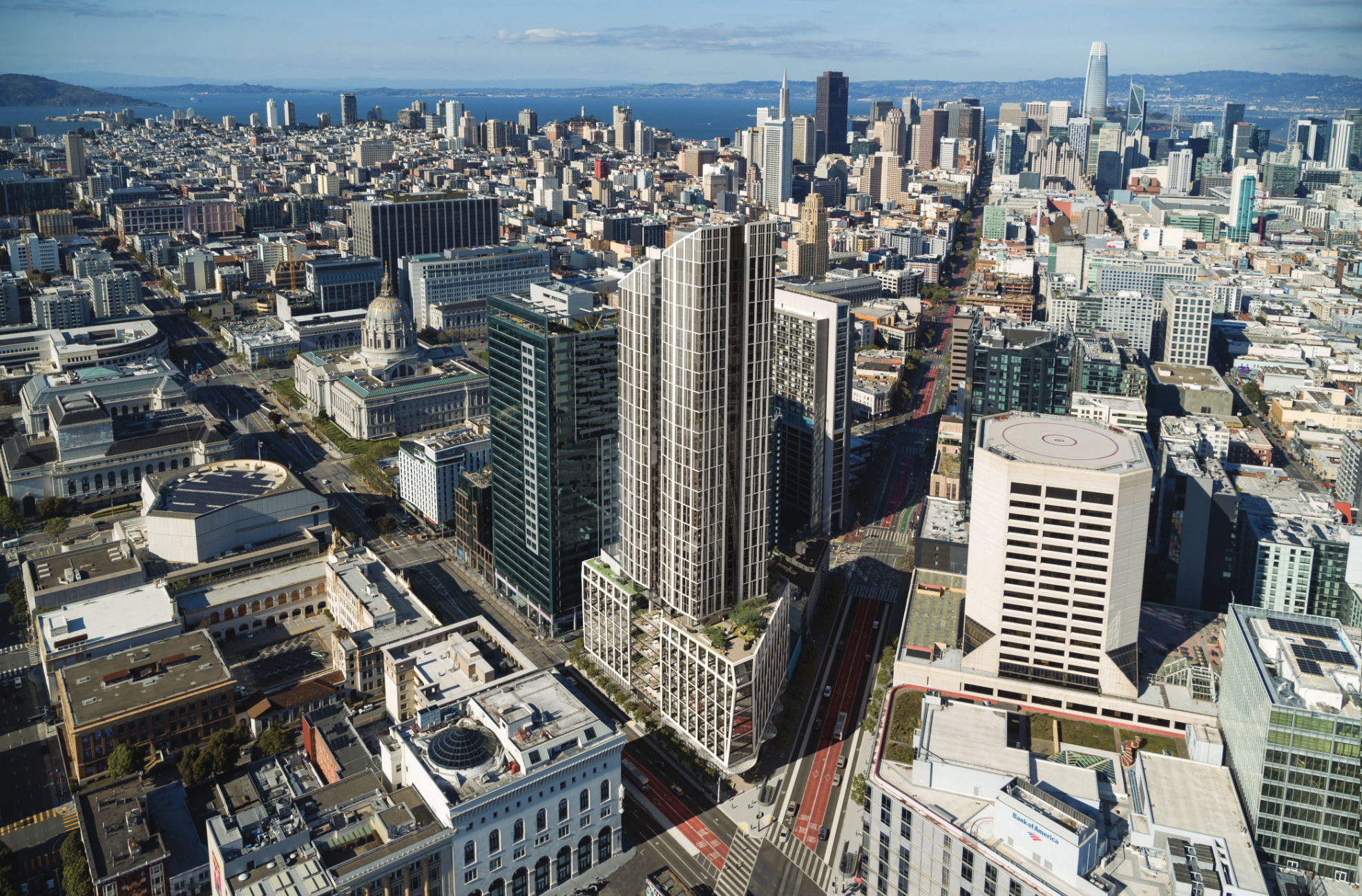
A rendering of the exterior of a new development at 30 Van Ness (center) in San Francisco. Courtesy Solomon Cordwell Buenz
Hailed by Mayor London Breed as the kind of project San Francisco needs to “unclog the housing pipeline,” the development at 30 Van Ness Avenue—christened Hayes Point—is an usual one.
At a time when the city is struggling to attract renters to its commercial office buildings, this new development just north of Market Street plans to place 333 condos on top of a five-story, 29,000 square foot office building.
It was possible to construct such a building because Australian developer Lendlease is able to handle the financing, construction, and development all on its own, a company manager told the San Francisco Chronicle earlier this month.
The firm officially broke ground on the project, which Lendlease values at over $1 billion, in September. It is scheduled for completion in 2025.
Notably, 25% of the units in Hayes Point—or 83 condos—will be priced below market rate, more than was required at the time. Lendlease was able to purchase and develop the property in part because it agreed to so many affordable units.
An exterior of the UC Hastings Student Housing at 198 McAllister St in San Francisco, Calif., on September 26, 2022. The building’s approval involved an elaborate and complex permitting process. | Justin Katigbak for The Standard
Technically, the largest housing development project in San Francisco’s pipeline as of Q1 2022 isn’t “traditional” apartments available to the broader public; it’s part of UC Hastings College of Law’s “Academic Village.”
Developed by Greystar, the residential complex in San Francisco’s rough-and-tumble Tenderloin neighborhood will add 656 new units of housing to the city — but only for graduate students from Hastings, UCSF, and other Bay Area universities. Most of the apartments will be small efficiency units and studios. According to the university, the new 14-story building, called Academe at 198, will also feature classrooms, offices, mock courtrooms, and a 400-person auditorium on its first three floors and ground-floor retail space.
Academe at 198 should be completed in July 2023. Another phase of the project, which envisions renovating the historic building at 100 McAllister Street next door, will be finished in 2025 or later.
Why is the largest ongoing housing development in San Francisco specifically for students? Part of the reason may be that Academe at 198 had an inherent advantage over construction projects: Hastings is affiliated with the University of California system, it is not under the purview of SF Planning.
David Seward, the university’s chief financial officer, disagrees that this is an advantage. He says UC Hastings works “very collaboratively” with SF Planning and takes its input, but “there’s no approval authority there.”
He says Academe at 198 aims to solve affordable housing issues for graduate students, a group underserved by much student housing, and to become a “community activator” for the underserved Tenderloin, putting students on the sidewalks and money into local businesses.
“Urban campuses—it’s really all about the energy and the vibe and the collaborations that will result” when students from different disciplines live together, Seward said.
1064 Mission Street
1064 Mission St., SoMA
Construction is underway for a new residential development project on 1064 Mission Street in in San Francisco, Calif., on September 23, 2022. The building approvals involved an elaborate and complex permitting process. | Justin Katigbak for The Standard
Unlike many of the other developments currently under construction, 1064 Mission St. is not the work of a major for-profit developer. Rather, it is a joint project of Mercy Housing, a national affordable housing nonprofit, and Episcopal Community Services of San Francisco.
Construction began in March 2020 and is nearing completion. The complex is set to begin receiving residents on October 3, 2022.
The two buildings that make up the complex will offer 256 affordable studio apartments for formerly homeless adults and seniors, adding to the city’s growing portfolio of permanent supportive housing. They will also have case managers and support service managers on staff. Additionally, an urgent care clinic and a satellite clinic of St. Anthony’s Medical Center, a federally qualified health center, will be located in the complex.
Prospective residents will be referred to the facility through the city Department of Homelessness and Supportive Housing’s Adult Coordinated Entry system.
The complex is being constructed on land provided by the federal government exclusively to house the homeless.
It is being built using a modular construction technique, which means that the individual apartments are assembled off-site and later “clicked into place,” according to Beth Stokes, executive director of Episcopal Community Services.
See Also
The new complex “accomplishes a commitment to continuing to create new units of supportive housing to house a growing population of folks that are chronically homeless with pretty significant disabling conditions,” she said.
Ventana Residences
99 Ocean Avenue, Mission Terrace/Excelsior
A rendering of a new residential building at 99 Ocean Avenue. Courtesy RG-Architecture
This new high-density residential complex in the Mission Terrace area will add 193 units to San Francisco’s housing stock, 48of which will be affordable.
It will be located half a mile from the Balboa Park BART station, giving residents access to the rapid transit system, multiple Muni lines, and numerous bus routes.
The complex will also include the Wu Yee Children’s Services, a preschool that will serve up to 75 children, on site. Developer Presidio Bay Ventures says this will be a first for a housing development project in San Francisco, where most developers simply pay into the San Francisco Childcare Impact Fee Fund.
One of the goals of the project is to accommodate young families, who might otherwise struggle to find housing that can accommodate their need for more space, Kabir Seth, chief operations officer of Presidio Bay Ventures said. These families might otherwise have to leave the city.
Getting the project approved was difficult, Seth said, explaining that his company acquired the site at the end of 2016, but couldn’t get it “shovel ready” until 2020.
In 2019, a coalition of community groups publicly opposed the project, demanding that 100% of the apartments be affordable. The Planning Commission eventually advanced the project, the San Francisco Examiner reported.
Seth told The Standard that he believes community input results in better outcomes. But materials, labor, taxes and affordability requirements already make multi-family development very difficult. When even going above the affordability minimums—as Presidio did by making 25% of the units affordable—is not enough, that can derail important construction projects.
“Our project still got appealed,” he said, “and we still had to present it and overcome the appeal at the Board of Appeals, following what was already a very lengthy entitlement and environmental review process.”
‘Brady Block’ residential building
1621 Market St, SoMA
A rendering the view of Brady Park from Brady Street at the new residential building at 1621 Market Street in San Francisco. Courtesy Kennelly Architecture and Planning
The building at 1621 Market St. was long the home of the UA Local 38 plumbers and pipefitter’s union. But in 2017, the union teamed up with Strada Investment Group to construct a six-building housing project, according to the San Francisco Business Times.
That project, which is located between Market and Brady streets and sometimes called the “Brady Block,” will create a total of 595 residential units. Of those, 103 will be affordable and 96 will be supportive housing for formerly homeless individuals, according to SF Planning.
The project currently coming down the pipeline is a nine-story residential building that will include 185 units. According to the Q1 2022 data, none of them will be affordable, suggesting that the below-market apartments may be in other Brady Block structures. The development is currently under construction.
The union hall originally at 1621 Market St. has been demolished and included in another building in the new development.
Strada has been contacted for comment.
Here’s a map of some of the larger developments coming down the pipeline:
A month ago, the SP CoreLogic Case-Shiller Home Price Index, which lags housing market reality on the ground by 4-6 months, started picking up the first month-to-month price declines, all of them in the West: the metros of Seattle, San Francisco, San Diego, Los Angeles, Denver, and Portland.
Those price declines have now sharply steepened, according to today’s Case-Shiller Home Price Index, and price declines are now spreading across the US, including Boston, Phoenix, Dallas, and Washington DC. And what a huge shocker, even in San Diego, the #1 Most Splendid Housing Bubble in America, prices dropped by 2.5%, the metro’s largest month-to-month drop since Housing Bust 1.
Today’s release of the Case-Shiller Index was for “July,” which consists of the three-month average of closed home sales that were entered into public records in May, June, and July. Due to the delay between when a deal is made to sell a house and when the “closed sale” is entered into public records, the time span today for “July” roughly covers deals made in April through June. During that time, the average 30-year fixed mortgage rate was in the 5% to 6% range.
The Most Splendid Housing Bubbles where prices fell.
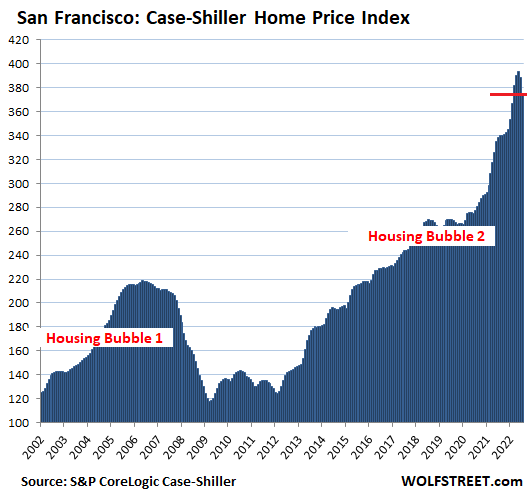
In the San Francisco Bay Area, house prices plunged by 3.5% in “July” (three month moving average of May, June, and July) from June, the steepest month-to-month drop since February 2012, at the bottom of Housing Bust 1, after having dropped 1.3% in June.
These two drops came after the ridiculous spike over the past two years, and brought the year-over-year gain down to 10.8%, from 16% in the prior month and from over 24% earlier this year. A couple more drops like this, and the index will catch up with the median price and be negative year-over-year.
For the Case Shiller Index, the metro consists of the five-counties covering San Francisco, part of Silicon Valley, part of the East Bay, and part of the North Bay.
In the Seattle metro, house prices plunged by 3.1% in “July” from June, the biggest month-to-month plunge since January 2009, during the depth of Housing Bust 1. This followed the 1.9% drop in the prior month. Both drops combined wiped out the prior four months of gains, thereby going down on the other side of a totally ridiculous spike. This slashed the year-over-year gain down to 8.4%, from 27% earlier this year.
In the San Diego metro, house prices fell by 2.5% in “July,” the biggest month-to-month drop since January 2012, and the second month-to-month decline in a row, after a most splendidly ridiculous spike. The index is now below the March level. This slashed the year-over-year gain to 16.6%.
The index value of 414 for San Diego means that home prices shot up by 314% since January 2000, when the index was set at 100 (over the same period, the Consumer Price Index rose by 75%). The index for San Diego has now dropped to the same level as Los Angeles (414), and both share the honor of being the #1 Most Splendid Housing Bubble in America.
In the Los Angeles metro, house prices fell by 1.6% in July from June, the sharpest decline since March 2012, and the second month in a row of declines. This whittled the year-over-year price gain down to +15.7%.
In the Denver metro, house prices dropped 1.4% in July from June, the second month in a row of declines, whittling down the year-over-year gain to 15.6%:
In the Portland metro, house prices dropped 1.1% in July from June, the second month in a row of declines, after a ridiculous spike. This whittled down the year-over-year gain to 11.7%:
The Case-Shiller Index uses the “sales pairs” method, comparing sales in the current month to when the same houses sold previously. The price changes within each sales pair are integrated into the index for the metro, and adjustments are made for home improvements (methodology). By tracking the change in dollars it took to buy the same house over time, the index is a measure of house price inflation.
In the Washington D.C. metro, house prices dipped 0.7% for the month, after having been flat in the prior month. This whittled down the year-over-year gain to +9.4%:
In the Dallas metro, prices dipped 0.4% for the month, the first decline since 2019. And while this seems like a small dip, it was the largest decline since October 2012. This whittled from the year-over-year gain to 24.7% from the 30%+ range earlier this year.
In the Boston metro, house prices dipped 0.3% for the month, which whittled down the year-over-year gain to 13.3%:
In the Phoenix metro, house prices edged down 0.1% for the month, so roughly flat, after the huge spikes earlier this year and last year. This whittled down the year-over-year gain to +22.4% from +32% earlier this year:
The Most Splendid Housing Bubbles where price gains “decelerated” or stalled.
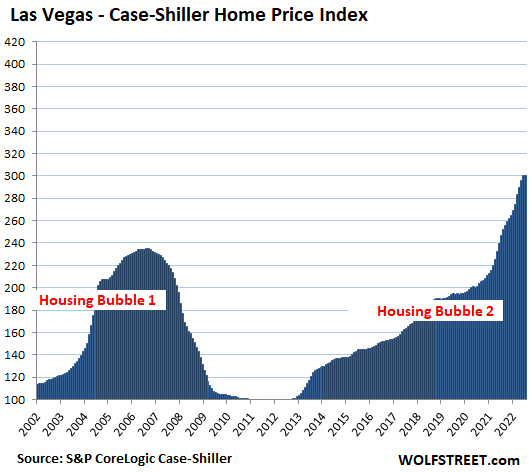
Las Vegas metro: prices stalled and were unchanged for the month, compared to jumps in the 3% range earlier this year. This whittled down the year-over-year gain to +21.8%, from the 28% range earlier this year:
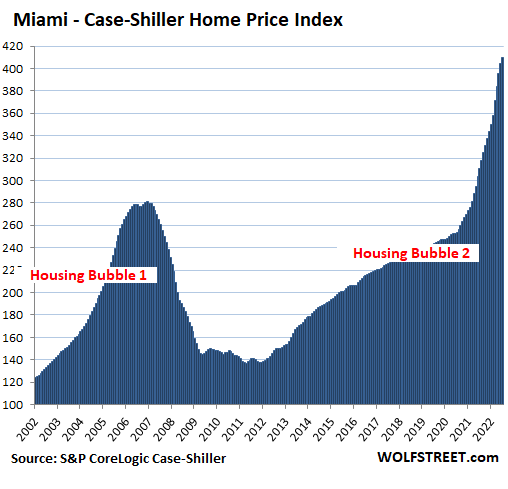
Miami metro: +1.3% for the month, “decelerating” from month-to-month gains in the 3.5% range in prior months. This whittled down the year-over-year gains to a still ridiculous 31.7%, from +33% in June and +34% in May.
Tampa metro: +0.6% for the month, decelerating from 3%+ gains earlier this year. This whittled down the year-over-year spike to 31.8% from 36% in the prior month, still solidly in ridiculous territory.
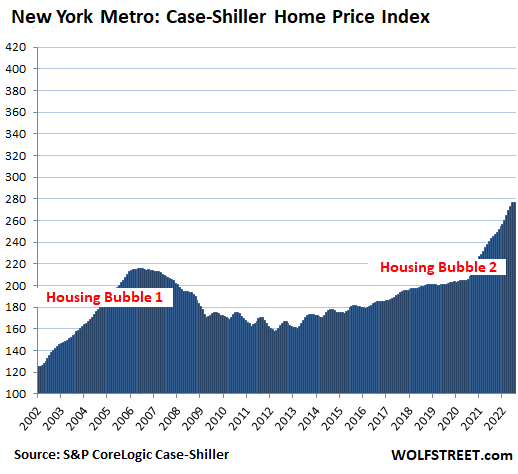
In the New York metro: +0.2% for the month, decelerating from the +1.5% range in the prior months, which whittled down the year-over-year gain to +13.7%:
Based on the Case-Shiller Index value of 276, the New York metro has experienced 176% house price inflation since January 2000. The remaining cities in the 20-City Case-Shiller Index (Chicago, Charlotte, Minneapolis, Atlanta, Detroit, and Cleveland) have had less house price inflation and don’t qualify for this illustrious list. Among them, there were monthly declines in Detroit (-0.1%) and Minneapolis (-0.2%).
Enjoy reading WOLF STREET and want to support it? Using ad blockers – I totally get why – but want to support the site? You can donate. I appreciate it immensely. Click on the beer and iced-tea mug to find out how:
Would you like to be notified via email when WOLF STREET publishes a new article? Sign up here.