$39M Alamo estate offers over 21000 square feet of over the top luxury

  • e29e2 a $39M Alamo estate offers over 21000 square feet of over the top luxury


Caption

Close


Welcome to “Fieldhaven,” where, at 7 Country Oak Lane, over 21,000 square feet sprawls over an almost 21-acre lot in Alamo. Its listing language declares it to be “The San Francisco Bay Area’s most exceptional estate.” Certainly, it’s one of our more ostentatious.

Built in 2010, the estate includes a main home, guest house (all totaling 10 beds, 17.5 baths) and numerous luxury features both inside and out. Such features include:

  • Inside: hardwood, stone, formal dining room, library, office, wet bar, theater, custom “indoor forest” shower, wine cellar, finished basement
  • Outside: dog run, fenced yards, garden, covered patio, pool and hot tub. The listing reassures Alamo buyers that horses “are possible” and we think that’s true. Aside from over 20 acres of land, there’s a 12-car garage in the style of a barn. Why not 10 cars and two horses then?

Priced at $39,000,000, this behemoth is part of the Bryan Ranch community, so it includes a $267 HOA — spare change for anyone who can afford Fieldhaven.

Anna Marie Erwert writes from both the renter and new buyer perspective, having (finally) achieved both statuses. She focuses on national real estate trends, specializing in the San Francisco Bay Area and Pacific Northwest. Follow Anna on Twitter: @AnnaMarieErwert

Article source: http://blog.sfgate.com/ontheblock/2016/07/04/39m-alamo-estate-offers-over-21000-square-feet-of-over-the-top-luxury/

Posted in SF Bay Area News | Tagged | Leave a comment

Oil baron’s Claremont mansion brings history to Berkeley real estate

  • 301c7 a Oil barons Claremont mansion brings history to Berkeley real estate


Caption

Close


This 8,639-square-foot mansion has starred in many historic roles over the last century, and still very much looks the part.  Built in 1910 for Paul O. Tietzen, an oil baron and banker, this house was one of the first two structures built inside the Claremont Court neighborhood. It was designed by John Galen Howard, who employed Julia Morgan early in her career. Howard is well known in Berkeley, particularly for designing many structures on the UC Berkeley campus including the Greek Theater, Memorial Stadium, Doe Library, Sather Gate and Sather Tower (the Campanile).

Listing agent Allen Hibbard tells On the Block that Tietzen and his wife chose Berkeley, which at that time was mostly farmland, because Mrs. Tietzen “did not want to live close to the oil derricks in Southern California.” Across from 2840 Claremont Blvd. is Clement’s Episcopal Church, built circa 1909, and is the other (together with this mansion) of the first two structures in Claremont Court.

Claremont homes make a splash on the local real estate market. A 1901 traditional at 24 Plaza Dr. — a quarter the size of this mansion — listed and sold in less than a month early this June for a final price of $2,625,000 (an over-bid of $641,880).

Only three owners in over a century

This Claremont manse presents a time capsule — its preservation due, in part, to the fact that it has changed hands only three times before its current debut on the market. Mr. Tietzen sold to the Ballards: “According to a descendant, Mr. Ballard invented a lubricant that did not break down in salt water just prior to World War II, which was very interesting to the U.S. Navy,” says Hibbard.

In 1968, the Ballards sold to David and Sylvia Tower, who ran the Berkeley Psychotherapy Clinic for many years. And thus ends the ownership records for this property.

Updating vs. preserving

The house sits on almost a half-acre of prime, coveted Berkeley land. There are five bedrooms and three bathrooms on the second level; two bedrooms, a kitchen and a bath in the attic; the original club room, with a bath and still another kitchen in the basement; and a studio unit over the garage, with additional bath and kitchen.

For the most part, the house remains as it was built. The main family kitchen was updated sometime after 1968 by Mrs. Tower; otherwise, it could easily still suit the oil baron and his wife.

New owners, hopefully, will also appreciate the architectural merits of this grand old home, though, fairly, may wish to make a few additional updates. So readers:  If you had the $5,450,000 listing price, what would you change (if anything) in this historic home?

Anna Marie Erwert writes from both the renter and new buyer perspective, having (finally) achieved both statuses. She focuses on national real estate trends, specializing in the San Francisco Bay Area and Pacific Northwest. Follow Anna on Twitter: @AnnaMarieErwert

Article source: http://blog.sfgate.com/ontheblock/2016/07/01/oil-barons-claremont-mansion-brings-history-to-berkeley-real-estate/

Posted in SF Bay Area News | Tagged | Leave a comment

Cleveland Working to Be Champs in Real Estate, Too

The Cleveland Cavaliers beat the Golden State Warriors in the National Basketball Association  Championship. Now it looks like the city by Lake Erie is working hard to beat the San Francisco bay area in the real estate game, too.
 
“When you look at the fundamentals in Cleveland versus the Bay area, they are actually stronger in Cleveland in the sense that the absorption of units has been stronger relative to the new supply,” said Jean-Michel Wasterlain, co-CEO of Capfundr.
 
Wasterlain added that Bay Area real estate is not poised for a fall, it’s just that they have “maxed out their growth.” 
 
Wasterlain was once the CEO of ORIX Capital Markets, the U.S. real estate and structured finance business of a large Japanese finance company, and chief investment officer of NorthStar Realty Finance  ( NRF) , a real estate investment trust with a $20 billion portfolio of diversified real estate investments.
 
Capfundr offers investors exposure to real estate funds, thereby eliminating the need to go through brokers or pay their fees. Capfundr selects private real estate funds with strong management teams and proven track records and opens them up to the public online. It also manages some of its own funds, in areas where it has expertise.
 
Wasterlain said cities such as Pittsburgh, Providence, Nashville and even Detroit are seeing a surge in property investment, primarily because they had not seen a windfall of investment previously — unlike larger coastal cities.
 
He said publicly traded REITs are highly correlated to the stock market, so investors seeking true diversification into real estate are better off in a private fund. That said, Wasterlain did acknowledge that private real estate funds do not have the same liquidity as listed REITs.
 
“Our funds are really meant for investors with a medium-term to long-term view of five to seven years and are willing to lock up their money for that period of time,” said Wasterlain, adding that he is projecting the yield on his latest multi-family fund to be 7%.

Article source: https://www.thestreet.com/story/13624493/1/cleveland-working-to-be-champs-in-real-estate-too.html

Posted in SF Bay Area News | Tagged | Leave a comment

Skyrocketing Rents Challenge San Francisco Bay Area Nonprofits

3440b For Rent 771x578 Skyrocketing Rents Challenge San Francisco Bay Area Nonprofits

0124TL / Pistols Drawn

June 24, 2016; San Jose Mercury News

Soaring real estate prices and rents in the San Francisco Bay Area, fed by the success of the region’s high-tech industry, continue to take their toll on the region’s nonprofits, as NPQ has reported in the past (two more recent examples may be found here and here).

The San Jose Mercury News tells the tale by focusing on the East Bay Alliance for a Sustainable Economy (EBASE) which was hit with a 30 percent rent increase last year after the building in which it rented office space was sold.

“The affordability crisis and displacement that had affected so many of the low-wage workers that EBASE works with is now affecting the nonprofit itself,” said the Mercury News.

Because of the big rent hike, EBASE moved to a small, temporary headquarters in Oakland’s Chinatown as it searches for permanent office space. But it won’t be easy, as rents across the Bay Area remain high. This group’s dilemma is becoming more and more common for nonprofits in the region. Many of them are being pushed out of their long-time homes as commercial properties change hands in the Bay Area’s red-hot real estate market.

The paper reports that rent increases of 30 percent or more are not unusual, compounded by a lack of affordable options. The nonprofits in the area are finding it challenging to serve the people struggling with the same high costs of housing.

Since most nonprofits rent, they are typically at the mercy of the real estate market. The tech-fueled boom in is exacerbating the problem. In the past, many Bay Area nonprofits found affordable space in underserved neighborhoods where weak demand kept rents reasonable.

“But with a business sector that has exploded in recent years, commercial real estate—much like housing—has become more expensive across almost every neighborhood in every Bay Area city,” one anti-poverty executive told the paper.

A recent survey of nearly 500 nonprofits operating in 846 locations across Alameda, Contra Costa, Marin, San Francisco, San Mateo, and Santa Clara counties found that over 80 percent worry about the expensive real estate market and their long-term finances. Most expect to move within the next five years to find more affordable housing.

The Northern California Community Loan Fund said it is seeing affordability increasingly becoming a challenge in the East and South Bay. This funder operates San Francisco’s Nonprofit Displacement Mitigation Program, a public-private partnership that provides technical and financial assistance to nonprofits facing displacement and rent hikes.

Local nonprofits, developers, and cities are considering the establishment of nonprofit “hubs” like the David Brower Center in Berkeley, host to a variety of resident environmental nonprofits that are able to save money and pool resources. Another approach comes from the Community Arts Stabilization Trust, a holding company that buys properties and rents them to nonprofits for up to 10 years to give the nonprofit tenants time to raise the money to purchase the buildings from the Trust at an affordable price.

Bay Area nonprofits also face increasing pay scales for employees who likewise face the high cost of living in the area. This confronts many of them with the prospect of having to close up shop or cut back, which has a significant impact on the communities they serve. It’s a classic example of a region becoming a victim of its success.—Larry Kaplan

Article source: https://nonprofitquarterly.org/2016/06/27/skyrocketing-rents-challenge-san-francisco-bay-area-nonprofits/

Posted in SF Bay Area News | Tagged | Leave a comment

Brexit Effect On US Real Estate: Why Millennials May Be Priced Out Of Some Markets

Pricey New York real estate might get even more costly whether or not Britons vote to shuck their membership in the European Union, and millennials might see either more competition from foreign investors pricing them out of the market, or will benefit from falling interest rates — cheaper mortgages — engendered by a faltering global economy.

With the Brexit vote looming Thursday, high-net-worth real estate investors — both individual and institutional — are eyeing New York and other gateway U.S. cities as safe havens, spooked by uncertainty that has crept into the London market in the last year, not only as a result of the contentious Brexit campaign but also because of recent policy changes involving visa approvals and real estate taxes.

New York real estate attorney Edward Mermelstein said big-money foreign investors have been shifting to the U.S. market for the past year, and the turmoil generated by the Brexit campaign has escalated the trend.

“There is a fairly strong consensus the British economy is going to be negatively affected by Brexit,” Mermelstein said. “Paired with what has been happening recently in the investment atmosphere, it’s only going to put additional pressure on Britain as a place to invest.”

Lawrence Yun, chief economist at the National Association of Realtors, estimated that foreigners invested $80 billion in U.S. real estate last year. Overall, U.S. real estate is worth approximately $22 trillion, about 2 or 3 percent of it controlled by foreign investors.

Continue Reading Below

Last year, 16 percent of that investment came from China, followed by Canada at 14 percent and Mexico at 9 percent. Eight percent of investment came from India, followed by Britain at 4 percent, France and Germany at 3 percent, and Venezuela at 2 percent.
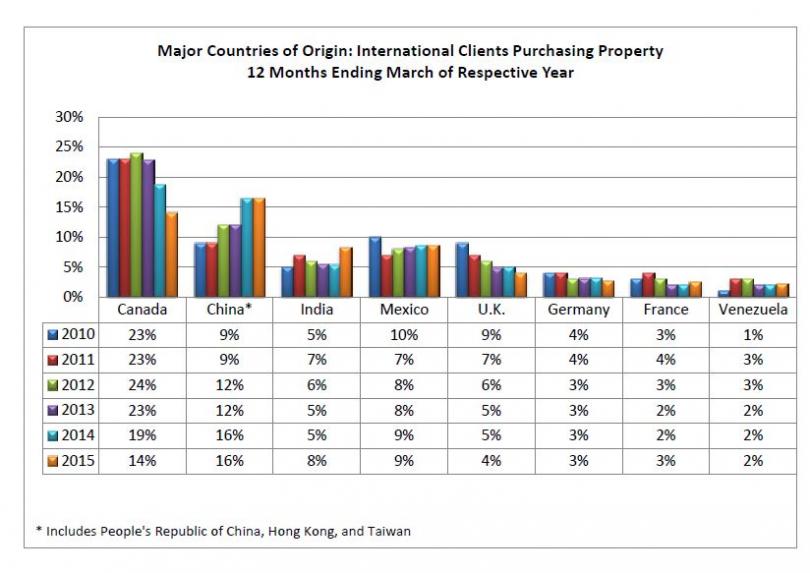
 Brexit Effect On US Real Estate: Why Millennials May Be Priced Out Of Some Markets Foreigners invested $102 billion in U.S. real estate from April 2014 to March 2015, buying homes that averaged $500,000 each. Photo: National Association of Realtors

From April 2014 through March 2015, the Realtors estimate, foreign buyers bought 209,000 houses, valued at $104 billion and representing 8 percent of the sales volume, with Florida, California, Texas and Arizona accounting for half the purchases. The average price of those houses was $500,000, compared to the average U.S. home price of $256,000.

New York real estate attorney Edward Mermelstein said big-money foreign investors have been shifting to the U.S. market for the last year, and the turmoil generated by the Brexit campaign has escalated the trend.

“There is a fairly strong consensus the British economy is going to be negatively affected by Brexit,” Mermelstein said. “Paired with what has been happening recently in the investment atmosphere, it’s only going to put additional pressure on Britain as a place to invest.”

Should Britons vote to go it alone, the British economy is expected to slow, pressuring the pound sterling and bonds.

“The implication of Brexit taking place is that it is looking good for the U.S. market,” Mermelstein said.

Yun said the prospect of Britain turning toward isolationism has raised “questions of confidence,” encouraging investors to seek opportunities elsewhere. “The U.S. will be considered competition or a safe haven,” Yun said, adding that a Brexit implies a reduction in international trade and a negative impact on economic expansion for both Britain and the EU, which will trickle down to other countries.

“That could lead to interest rates falling. The mortgage rate here in the U.S. could begin to decline because of lower GDP [gross domestic product] expansion. That always benefits the housing market,” Yun said.

Yun said in addition to New York, cities like Washington, Miami, Los Angeles and San Francisco are most likely to benefit, also possibly the Tampa Bay area in Florida, Chicago and Dallas. Smaller metro areas are unlikely to see much impact unless foreign investors see the bigger markets as overbought, Yun said.

Mermelstein said major European cities, including Paris and Rome, also are likely to benefit and attributes the shift out of London to the British trying to revive the concept of home ownership. British officials are trying to open the market to local purchasers by restricting visa applications and altering real estate tax laws to enable Britons to purchase homes at younger ages.

0a7f8 mermelstein Brexit Effect On US Real Estate: Why Millennials May Be Priced Out Of Some Markets Edward Mermelstein, a New York real estate attorney, says, “The implication of Brexit taking place is that it is looking good for the U.S. market.” Photo: Rheem, Bell Mermelstein

“Britons value ownership of personal property differently. In many cases they don’t get married until they are able to afford a home,” Mermelstein said. “This has caused the birth rate in Britain in plummet. Families are starting much later. Home ownership has become out of reach for many people.”

Yun said an influx of foreign capital to the U.S. real estate market could make it more difficult for young adults in the targeted cities to purchase property as well.

“First-time buyers are struggling to get into the market as it is. If more foreigners, typically cash purchasers, get into the market, they will face stiff competition to get their properties,” Yun said. “Typically younger purchasers need a mortgage. If they have to compete with foreign buyers with all cash, that hinders first-time buyers from getting their home.”

Mermelstein said, however, the influx of foreign capital probably would have little impact on first-time buyers, likely because they would be looking at the lower end of the market. He sees most investment coming from individuals willing to buy $15 million properties.

“Ten to 15 people will shift the needle significantly,” he said. “An investor I was advising was making London home base. He shifted his business and home to the U.S. His home purchase alone was $40 million. That’s not including the business interests. Individuals are making those kinds of commitments to the U.S. as opposed to Britain. You don’t need too many of them to move the needle.”

Another side benefit to a Brexit would be the creation of an atmosphere of stability in U.S. credit markets, Mermelstein said.

“The commercial real estate market also will continue to attract foreign investment — in secondary markets, not just New York, San Francisco and Chicago,” he said.

0a7f8 new york city skyline Brexit Effect On US Real Estate: Why Millennials May Be Priced Out Of Some Markets New York City skyline as seen from Top of the Rock. Photo: Katie Haugland/Flickr

Article source: http://www.ibtimes.com/brexit-effect-us-real-estate-why-millennials-may-be-priced-out-some-markets-2383618


Posted in SF Bay Area News | Tagged | Leave a comment