Bay Area home price median beats all-time peak

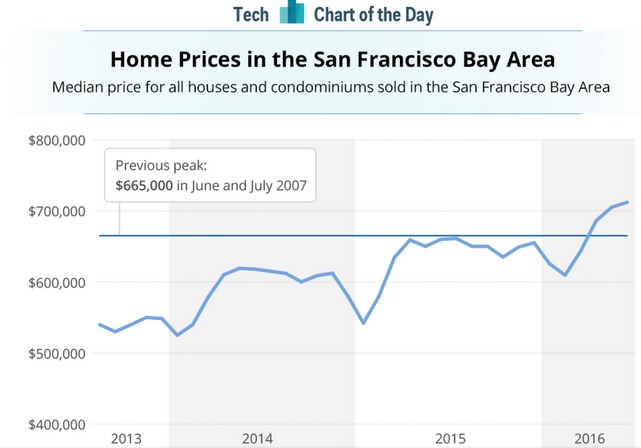
Even as speculation bubbles and ferments about when or if present pricing peaks will begin to take a dive, word has just come down from the statistics aggregating site Statista and Business Insider that median home prices across the Bay Area have broken the records set by previous all-time highs in 2007.

We know what you’re thinking—we’ve peaked just now? Not last year? Or the year before? In San Francisco and other molten hot markets like San Mateo County, we left old all-time high records behind years ago as prices exited the stratosphere.

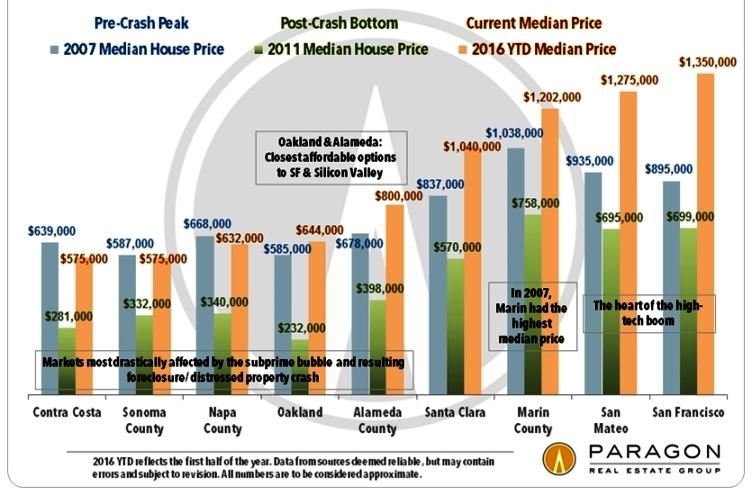
But as the real estate company Paragon reminded us this week, some parts of the Bay Area never fully recovered from the 2008 bust.

58008 Bay Area Median SFD by County 2007 2011 Present Bay Area home price median beats all time peak

Napa County, Sonoma County, and Contra Costa County in particular have received only a middling boost from the feeding frenzy of demand the past five years, partly because the juiced up reputation of South Bay counties has robbed them of some of their past prestige.

(The 2014 Napa earthquake probably accounts for a good portion of that region’s lingering malaise as well.)

And of course, those counties have a lot of real estate, particularly Contra Costa, home to well over a million people. So while the rest of us have been charting like mad, the overall average of the nine counties together has behaved a bit more conservatively.

As you can see from the Statista chart, we’ve flirted with the previous high regional median of $665,000 since late 2014, maintaining a daredevil-like degree of tension for months. Statista pulled the data compiled here from reports by analytics agency CoreLogic.

bfe6b statista Bay Area home price median beats all time peak

The fact that only now are we in uncharted territory is perhaps startling. Against all intuition and evident definitions of reason, everything that’s happened in the last five years has technically been within established parameters.

(For the Bay Area overall, at least. The significance of more tightly defined craziness in San Francisco, Oakland, San Jose, Palo Alto etc, still stands.)

So that’s how it is. $665,001 is the new normal. For now, at least.

Article source: http://sf.curbed.com/2016/8/3/12370472/bay-area-home-price-all-time-peak

Posted in SF Bay Area News | Tagged | Leave a comment

It’s a seller’s real-estate market, but who’s selling?

Even though the U.S. has seen more than three years of a booming seller’s market for housing, there are plenty of Americans who are reluctant to sell their homes for a very simple reason: Where are they going to live?

The supply of U.S. homes for sale, known as inventory, has dropped to some of the lowest levels since before the Great Recession. In June, the National Association of Realtors said that inventory dropped nearly 1% from May to about 2.14 million homes, a supply of about 4.6 months, compared with a typical supply of 6 months in a healthy market. (That means that it would take just 4.6 months at the current sales rate to deplete the entire inventory of homes for sale in the U.S.)

Not only does the low housing inventory mean a bidding war for buyers, but sellers who may want to move to a smaller home and stay in the same market are quite often stuck — because of the rise in prices for smaller homes that are being fought over by both first-time buyers and downsizing empty-nesters.

“A key part of the inventory problem is that in expensive markets it’s difficult for existing homeowners to find another home afterwards if they do sell,” said Ralph McLaughlin, an economist with San Francisco-based Trulia.com, a real-estate research firm. “It’s a double-edged sword.”

b682d MW ET038 home i 20160803081902 NS Its a sellers real estate market, but whos selling?

Nationally, the number of starter homes (median price of $154,156) in the first quarter of 2016 in the U.S. has dropped by more than 43% since the same period in 2012, and the price buyers will have to pay for those homes has risen 5.6% since 2012, Trulia said in a May report. So-called “trade-up” homes, with a median list price of $267,845, have fallen by 41% since 2012, Trulia said.

Also see: Need to buy a house fast after selling yours? Don’t panic, here’s what to do

Overall, inventory numbers are down nearly 6% from a year ago, the NAR said in an Aug. 2 blog posting. The tight inventory numbers are also helping push up housing prices, with U.S. median homes prices rising to $247,700 in June, up 4.8% from a year ago, the NAR said.

“I am seeing people that literally will never be able to move,” said Joe Winpisinger, a Re/Max Realtor in Cape Coral, Fla. “The homes they are downsizing to have gone up exponentially more than the homes they have to sell,” he said.

Not surprisingly, some of the lowest inventory is in the San Francisco Bay Area, where single-family homes are scarce and multiple bidding for homes on the market is the norm. For example, the South Bay city of San Jose has just a 1.6 month supply of homes, meaning that given the buying frenzy in Silicon Valley, the city would exhaust its inventory of homes on the market in just over 45 days with every home sold, says Trulia’s McLaughlin. Oakland and San Francisco have similarly thin stocks, with 1.7 months worth, according to Trulia’s analysis of the largest 100 real-estate markets in the U.S.

A normal supply of homes is typically six months, says McLaughlin. And it isn’t just the red-hot market of the Bay area with low inventory. Seattle has just a 1.8 month supply, less than 60 days. Other hot markets include Columbus, Ohio, and Washington, D.C., which has just a 2.5 month supply of homes.

John Lazenby, a Realtor with Colony Realty Group in Orlando, Fla., said in vacation spots near attractions like the Disney World resort,

DIS, +1.09%

inventory is particularly short because of investors and vacation home buyers who’d rather have a home instead of a hotel when they visit. Orlando’s supply of homes under $200,000 in June would last just 1.6 months, according to the Orlando Regional Realtor Association.

“I am seeing people that literally will never be able to move. The homes they are downsizing to have gone up exponentially more than the homes they have to sell.”


Joe Winpisinger, a Re/Max Realtor

“There’s a general reluctance among existing, non-relocating owners to sell despite such healthy increases in value, because of the known difficulty in securing a replacement home in Orlando,” Lazenby said.

Lazenby also said that some ”empty-nesters” are reluctant to sell because they’d rather stay where they are to be able to have their children and grandchildren visit, and have somewhere to stay if they need long-term care. “They’re saying they want the larger house for when the kids come, or when I need them to come,” he said.

To that end, many aging parents are taking advantage of their equity and near-record low interest rates to invest in their homes, adding elevators, stair chairs, adjustable countertops and other elements that allow older residents to age in place, said Andrew Carle, a professor who focuses on aging issues at George Mason University’s College of Health and Human Services in Fairfax, Va.

“What we’ve seen is that when they do sell, they are up-sizing, not downsizing,” Carle said. Indeed, Americans will spend a record $350 billion on home improvements in 2016, according to the American Institute of Architects.

Carle also noted that many elderly homeowners also fear what might happen if they do sell and there’s another real estate crash. “There’s some nervousness about making a move,” he said. “They’re thinking ‘we’ve got a roof over our head’ so why sell’” and risk losing money.

When it comes to alleviating the inventory shortage, Winpisinger is actually encouraging his clients to sell, but build a new home instead of buying an existing one and pocket the savings. A new 2,000-square-foot home could be built for as little as $177,000 , according to HomeAdvisor.com well below the aforementioned median sales price of a existing home of $247,700, and has the advantage of being a brand new home. “Existing homes are way overpriced compared to what you can build new for,” said Winpisinger.

Article source: http://www.marketwatch.com/story/its-a-sellers-real-estate-market-but-whos-selling-2016-08-03

Posted in SF Bay Area News | Tagged | Leave a comment

SF’s landmark tower for rich and famous is sinking and tilting

  • 9ddac 920x920 SFs landmark tower for rich and famous is sinking and tilting

Caption

Close


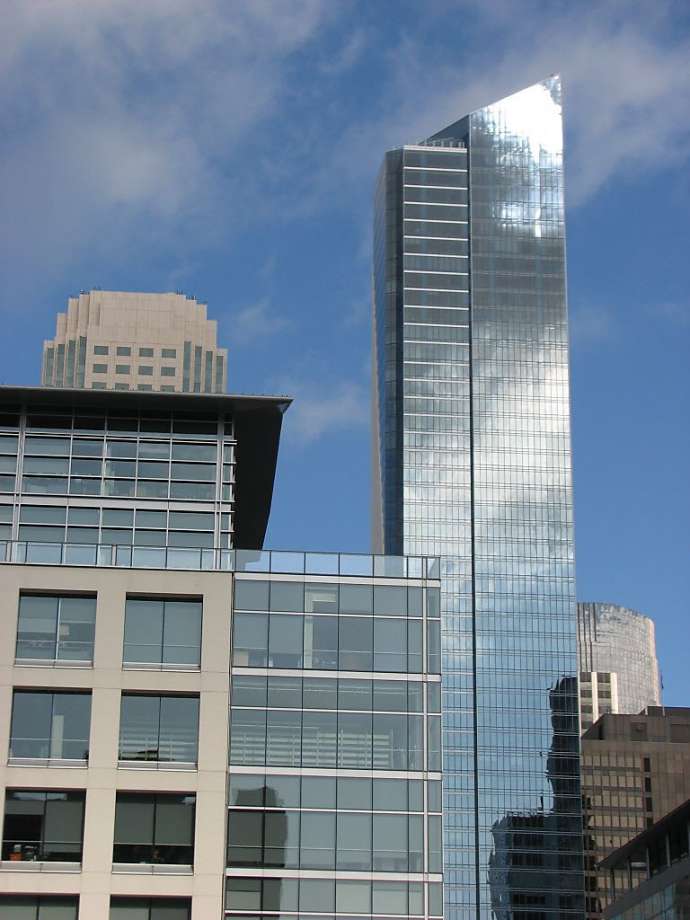
The Millennium Tower, a leading symbol of San Francisco’s new high-rise and high-end living, is sinking — setting the stage for what could be one of the most contentious and costly real estate legal battles the city has ever seen.

Rated by Worth magazine as one of the top 10 residential buildings in the world, the Millennium at 301 Mission St. is home to such A-listers as Joe Montana and Hunter Pence. Until his recent death, it’s where venture capitalist Tom Perkins owned a penthouse. Condos sell for anywhere from $1.6 million to north of $10 million.

However, since its completion in 2008, the 58-story building has sunk 16 inches, according to an independent consultant hired to monitor the problem. It has also tilted 2 inches to the northwest.


“That’s significant … and of concern,” said Professor Greg Deierlein, director of the John A. Blume Earthquake Engineering Center at Stanford University, who has been called in to evaluate the designs of a couple of San Francisco’s newer downtown high-rises.

Deierlein noted that the 88-story Petronas Twin Towers in Malaysia — which were the world’s tallest buildings when they opened in 1998 — have sunk less than 3 inches. Their tilt, or “differential settlement,” is less than half an inch.

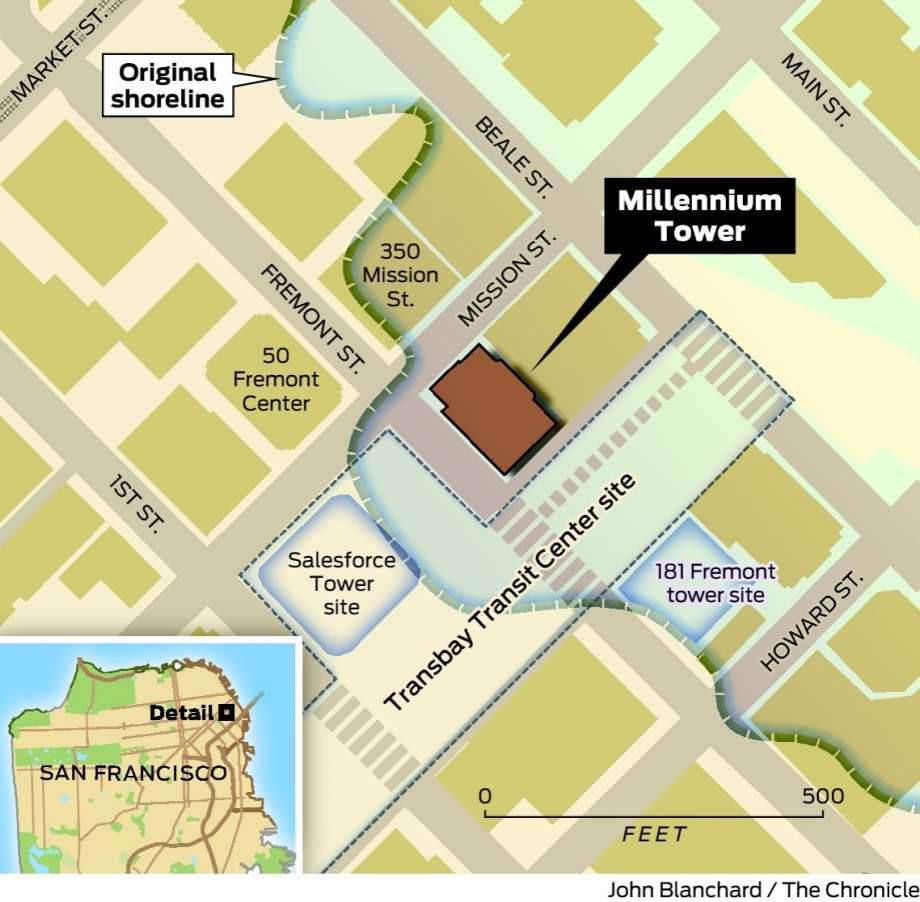
This isn’t just an issue for the Millennium’s owners and wealthy inhabitants: It could be a headache for taxpayers as well. There are potentially big public dollars at stake, with the owners alleging that the massive hole dug next door for the new Transbay Transit Center is to blame for the building’s issues.
b0a1b 920x1240 SFs landmark tower for rich and famous is sinking and tilting

The problem first came to light in 2010 when the Transbay Joint Powers Authority, the public agency constructing the transit center, hired the consulting firm Arup to gauge how the excavation could affect the tower.

According to the consultant’s initial report, by the time excavation began — two years after the $350 million Millennium was completed — the tower had already settled 10 inches. That was 4 inches more than its builders had predicted for the life of the high-rise.

Since then, “the building has continued to settle vertically, now 16 inches,” representatives of the Transbay Joint Powers Authority said in a statement in response to questions from The Chronicle.

At the same time, geotechnical reports show that since 2009, the settling has been uneven — resulting in the 2-inch tilt.

And while Stanford’s Deierlein doesn’t consider the sink or tilt a safety issue, he did say, “I would be concerned for my investment.” That’s because a shifting building can cause walls to crack, elevators to malfunction and all manner of other annoyances.

P.J. Johnston, spokesman for tower builder Millennium Partners and its principal owner, Sean Jeffries, said a nine-month, independent structural safety review in 2014 “determined the settlement has not significantly affected the seismic performance of the building, and does not represent a safety risk.”

An attorney for the Millennium homeowners association’s board, John Gill, recently sent a confidential letter to some of the more than 400 residents saying the board was “actively engaged in negotiations with Millennium Partners to resolve building settlement issues.” The letter also said the association was “sensitive to the concerns of everyone about any issue which could impact the value of their units.”


In a statement Friday, homeowner representatives said they had “retained a number of engineering consultants to investigate the causes and long-term impact of these settlement conditions” and were evaluating their legal options. They cited any number of parties that could be held “legally accountable” — including the developer, the high-rise’s designers, the contractors and the Transbay Joint Powers Authority, which is run by San Francisco, AC Transit, Caltrans and the agency that operates Caltrain.

For his part, Millennium spokesman Johnston wasted no time blaming the transit center authority. He insisted that the tower’s settling had been within normal range until excavation began on the bus and rail center next door.

“They built a half-mile tunnel 60 feet underground and next to our building, and they were supposed to (protect the Millennium) — and they didn’t,” Johnston said.

The authority also signed an agreement with the Millennium developer in 2008 “to repair, at its own cost and expense … any damage to the development substantially caused by TJPA’s construction activities,” according a copy of the agreement on file at San Francisco City Hall.

Records show the Transbay Joint Powers Authority pumped more than $58 million into an underground buttressing system to shore up the Millennium before beginning excavation in 2010. That’s one of the many reasons for the new transit center’s spiraling costs, which are now at $2.4 billion and counting.

In its statement, the transit center authority said it “bears no responsibility for the tilt and excessive settlement.”

Unlike some downtown high-rises, the Millennium isn’t steel-framed. Instead, the developer chose a concrete design more common to residential buildings. It relies on huge columns, shear walls and beams, and it’s much heavier than steel. What’s more, the building is located on unstable mud-fill, just off the bay’s original shoreline.

The Millennium’s engineers anchored the building over a thick concrete slab with piles driven roughly 80 feet into dense sand. “To cut costs, Millennium did not drill piles to bedrock,” or 200 feet down, the transit center authority said in its statement. Had it done so, the agency said, “the tower would not be tilting today.”

Johnston countered that “virtually all other buildings in that part of the city have their foundations at the same subterranean level,” citing skyscrapers that include the St. Regis and Intercontinental hotels.

He added that the Millennium’s design was state of the art for residential buildings and that concrete can be preferable to steel for several reasons, including sound insulation.

“In any case, this was not a cost-saving decision, but the preferred design,” Johnston said.

While there have been reports of cracks appearing in the Millennium’s underground garage, there’s no word of residents complaining about damage to their condos. Instead, the shifting and sinking of the concrete platform beneath the building has necessitated what Johnston called “minor repairs to sidewalks and connections at the ground level.”

Experts tell us it’s uncertain exactly what, if anything, can be done to fix the problem or straighten the tower. There has been talk of pumping cement underneath the base and drilling new piles — complicated and expensive undertakings.

An assessment, no doubt, that offers little comfort to those living in the building.

San Francisco Chronicle columnists Phillip Matier and Andrew Ross appear Sundays, Mondays and Wednesdays. Matier can be seen on the KPIX TV morning and evening news. He can also be heard on KCBS radio Monday through Friday at 7:50 a.m. and 5:50 p.m. Got a tip? Call (415) 777-8815, or email matierandross@sfchronicle.com. Twitter: @matierandross

Article source: http://www.sfgate.com/bayarea/article/SF-s-landmark-tower-for-rich-and-famous-is-8920197.php

Posted in SF Bay Area News | Tagged | Leave a comment

San Francisco in a week: July 25-29

Need news in a flash? Here’s what’s happening in your community

The normalization of the Bay Area market isn’t limited to San Francisco and Silicon Valley. The Marin County and East Bay real estate markets aren’t climbing as fast in price, while sellers face a more lenient buying process, according to Pacific Union’s second quarter report.

The majority of the best places for investment in California were either located in the southern or Bay Area parts of the state, according to SmartAsset’s second annual list of the top counties for real estate investment. Santa Clara, Alameda, Placer and Contra Costa counties were all on the top 10 list.

Click To Tweet

Home values in the 94702 ZIP code (Berkeley) are expected keep increasing through next 12 months, according to data from Weiss Analytics.

Got a lead on some news happening in your community? Send information to local@inman.com. 

Article source: http://www.inman.com/2016/08/01/san-francisco-in-a-week-july-25-29/

Posted in SF Bay Area News | Tagged | Leave a comment

Zero down on $2M house no problem in Silicon Valley – Tribune


Zero down on $2M house no problem in Silicon Valley

Updated 14 hours ago

It turns out that even the well-off need help in a housing market as crazy as the one in the San Francisco Bay area, and lenders are elbowing each other in a rush to provide it.

They’re courting Silicon Valley workers with tailored loans, guaranteed 24-hour approval and financial-planning services. Social Finance Inc. has deals with Google and other top technology companies that allow it to market to new hires. First Republic Bank — which gave Facebook Inc. billionaire Mark Zuckerberg a 1.05 percent interest-rate mortgage — has opened branches in Facebook and Twitter Inc. headquarters. San Francisco Federal Credit Union will finance 100 percent of houses costing up to $2 million.

Michael Tannenbaum, senior vice president of SoFi’s mortgage group, calls it “white-glove service.” Lenders often give special treatment to the wealthy, of course, but the tech industry has created a particularly ripe crop of clients who are rich or on their way. It’s a smart bet to cater to a sector that’s created thousands of millionaires and dozens of billionaires, says Glenn Kelman, chief executive officer of the brokerage Redfin. The downside is that the most expensive U.S. housing region is becoming “a no-fly zone for anyone outside technology,” especially with so many people shut out altogether by tight credit standards imposed after the 2008 real-estate crash.

What’s going on “might be good for the borrower and good for the lender,” he says, “but it’s not necessarily good for San Francisco.”

‘Substantial’ incomes

The city’s median home value is $1.13 million, up almost 67 percent since 2011, and the numbers are higher in some nearby towns — $6.36 million in Atherton, according to Zillow Group Inc., and $4.12 million in Hillsborough.

Nick Merz knows how tough it can be. He’s a 41-year-old product designer at Apple Inc. whose wife also works there, and says they couldn’t figure out whether they could afford to own a place anywhere near the company’s offices in Cupertino, where the median value is $1.8 million.

One reason: Almost half of their compensation packages are in Apple shares. So their lender, Opes Advisors, assigned the couple a financial adviser who used a software program to factor in debts and future income, including the stock, and the costs of education over the years for two young children.

‘Scary market’

The result? No problem. They could buy in the range they were looking without jeopardizing their finances. “In a weird housing market, in a place where a lot of assets are not liquid, it helps to have their kind of modeling,” Merz says. “They’re catering to people scared by this scary real estate market.”

For many, it’s not home values that keep them in rentals but alarming down payments, which can be more than the cost of the average U.S. house: $187,000. That’s where San Francisco Federal Credit Union comes in. It started offering zero-down loans in December to people who work in San Francisco or San Mateo County. The credit union has more than $100 million pre- approved for 30-year adjustable-rate mortgages in what’s called the Proud Ownership Purchase Program for You.

As the tech boom starts to show signs of cracks, there’s some concern that high loan-to-value mortgages are dangerous. Silicon Valley venture-capital funding fell 20 percent in the second quarter from a year earlier, according to a report by PricewaterhouseCoopers and the National Venture Capital Association. New companies are staying private longer, leaving fewer options for shareholders to cash out.

The median San Francisco condo price rose less than 1 percent in the second quarter after an 18 percent increase a year earlier, data from Paragon Real Estate Group show. Inventories of condos listed at $2 million or more jumped 44 percent — but the number sold fell 30 percent.

“Lenders get so caught up trying to stay competitive and finding a market edge, they basically allow greed to overcome common sense,” says Terry Wakefield, a mortgage consultant who co-founded one of the first online direct lenders in 1998. “Easy money does fuel and accelerate the inevitable bubble.”

And the notion of 100 percent financing makes some in the industry nervous. “Given what we went through in 2008, zero-down financing is suicidal for our country,” says Chuck Green, CEO of Bay Area Captial Funding Inc., a mortgage brokerage that offers loans from about 40 different companies. “We have to learn from our mistakes.”

‘Clients for life’

For its part, San Francisco Federal Credit Union sees the gamble as manageable. Four in 10 applicants are rejected and those that have gotten loans have an average FICO score of 747 and average household income of $219,000, says Rebecca Reynolds Lytle, chief lending officer. “We are vetting our borrowers to make sure they can afford it and have reserves.” But in the end “it’s a loan — it’s not going to be risk free.”

At Social Finance, the strategy is about getting in on the ground floor, which it aims to do through its marketing partnerships with 22 companies and a promise of an answer on a loan application within a day to help speed up the home-buying process. SoFi also woos clients with loan officers who fight to help them win bidding wars against cash buyers.

Wells Fargo Co.,the largest retail jumbo mortgage lender in the U.S., has been focusing on borrowers in tech-heavy markets including San Francisco, Boulder, Colo., and Austin, Texas, says Brad Blackwell, the bank’s portfolio business manager. Customers can qualify based on compensation tied to restricted stock as long as they show that has been a stable source of income.

Lenders are “targeting a segment that is the highest potential segment in the country,” says Patrick Carlisle, chief market analyst at Paragon. “They want these people to be clients for life.”

Article source: http://triblive.com/business/headlines/10861883-74/percent-san-says

Posted in SF Bay Area News | Tagged | Leave a comment