California’s hottest real estate ZIP codes are in the High Desert. Here’s what it’s like to live there

In California, the ZIP codes with the fastest average growth in typical home values during the pandemic were in the south state’s High Desert — by an overwhelming margin. That’s according to a Chronicle analysis of data from real estate listings company Zillow.

In the No. 1 spot in the region — which is not formally defined but runs from northern Los Angeles County through the Mojave Desert basin to the east, including parts of San Bernardino, Kern and Inyo counties — was the community of Landers, where home values soared 84% over the past two years. Joshua Tree, which saw home values grow 69% during the pandemic, was in second place, followed by Twentynine Palms at 63%.

Bob Armstrong, a broker associate at Green Real Estate Group who has lived in the High Desert area for 42 years, said the growth is almost “overwhelming.”

While homeowners have benefited from the boom, both locals and transplants acknowledge the rapid transition is already sparking concerns seen in other high-growth areas like Tahoe, especially around future housing affordability — and raising questions about what happens next for the region.

Who is buying in the High Desert?

In 2016, Britt Nelson and Kyle Johnson set out from San Francisco for their first, fateful trip together to Joshua Tree.

Despite the chilly January weather — to their surprise, it had snowed at the national park in the Southern California desert a week before — the couple soaked in the rugged, beautiful landscape.

 Californias hottest real estate ZIP codes are in the High Desert. Heres what its like to live there

The living room of a Yucca Valley rental home owned by Britt Nelson and Kyle Johnson, who purchased and fixed up the home in 2017. The couple now owns three properties in southern California’s High Desert.

Courtesy of Britt Nelson

Nelson, 40, and Johnson, 35, were both working for tech companies at the time, and they soon found themselves considering an investment property. For Nelson, the idea of having a place closer to her Southern California relatives was appealing, and she wanted to sell her San Francisco place with a pricey mortgage.

She and Johnson consulted with an acquaintance who’d owned a home in Yucca Valley, about 27 miles north of Palm Springs, and they soon put in an offer sight unseen on a fixer-upper there. The couple renovated the property and turned it into an Airbnb rental. Now, they live full time in the desert and are in the process of purchasing their third High Desert home.

Lynee LaVoie, a real estate agent with Cherie Miller Associates in Yucca Valley, said the majority of her clients are people like Nelson and Johnson: buyers looking for a vacation property, many coming from Los Angeles, Orange County and the Bay Area to take advantage of the lower home prices and sprawling desert environment.

A good portion of them are Millennials looking for midcentury homes with “character.” They fix them up, stay there now and then, and rent them out the rest of the time, using that money to pay for the mortgage and as passive income, she said.

Though interest in the area appears to have accelerated in the past two years, it predates the pandemic, stemming from the rising popularity of Joshua Tree National Park. In 2015, attendance exceeded 2 million for the first time. After a dip in 2020 due to pandemic closures, attendance surged again last year, surpassing 3 million.

Some parts of the High Desert come with a heavy dose of quirkiness that makes them stand out from other more established California destinations. Landers, for instance, is a magnet for UFO aficionados, featuring the Integratron dome built by ufologist George Van Tassel.

LaVoie said the area near Joshua Tree still doesn’t have enough services, including lodgings and restaurants, to support so many tourists. So besides camping and a handful of hotels, rental homes are the main option for visitors.

 Californias hottest real estate ZIP codes are in the High Desert. Heres what its like to live there

A home in the Southern California community of Landers owned by former Bay Area residents Shelby and Darren Lemson, who regularly rent out the property and stay in a trailer when guests arrive.

Courtesy of Shelby Lemson/

A 2019 birthday trip to the desert inspired Shelby Lemson, 48, then a Bay Area resident, to consider the slower pace of life. She and her husband, Darren, 55, started looking at High Desert homes soon after and closed on a three-bedroom, two-bathroom property with a guest house on 2.5 acres in Landers in January 2020.

Soon after, Darren got sick and subsequently learned he had COVID-19. The disease wreaked havoc on his lungs, and he had to stop working.

Darren’s doctor recommended they move to Landers, so they rented out their Brentwood and Bethel Island houses and started a new life in the desert.

“It’s just a different way of life, it’s simpler, it’s a slower pace,” Shelby said. “It makes you be a little bit more aware of what matters in life. … Everybody just comes as they are.”

Affordable no more?

For many people coming from big cities, home prices in the High Desert are especially attractive. A fixer-upper on 3 acres can go for $200,000 to $400,000, which is a steal compared to homes in Los Angeles County, where the median home price was $795,000 last November.

According to the U.S. Census Bureau, the ZIP codes including Landers, Joshua Tree and Twentynine Palms have a dramatically lower median household income than the overall figure for California — ranging from $32,000 to $43,000, versus the California median of about $75,000. Anywhere from 25% to 32% of residents live below the poverty line in these three ZIP codes, compared to 11.5% across California.

LaVoie, a High Desert native, said the growth in home values is having a negative impact on residents who live there year-round.

“There are local people who can’t afford to buy a house here now,” she said. “For people coming from cities, the market is extremely affordable. But for people who live in our area, $400,000 to $500,000 … is not conducive to their income.”

Armstrong said he believes locals are split on the issue, with some donning “Go back to L.A.” stickers on their cars.

“Our community is going through change, and not minor change, it’s a significant change,” he said. “There are locals being priced out of the market, and I think locals are unhappy that there’s more traffic.”

He said while the growth has increased, the need for workers tied to the vacation rental business, it hasn’t necessarily created new jobs, but rather different types of jobs. And no major employers have come out to the area to give a needed boost to the economy.

“I hope we can be respectful of the desert and keep its uniqueness,” Shelby Lemson said. “I’d hate to see new developers come in and build huge neighborhoods.”

Alexander Aquino-Kaljakin, 37, moved from Los Angeles to Yucca Valley a year ago with his wife and two children. They wanted to buy a home in the Los Angeles area, but it was out of their price range.

 Californias hottest real estate ZIP codes are in the High Desert. Heres what its like to live there

The home of Alexander Aquino-Kaljakin and Che Hurley, who moved with their kids to Yucca Valley in Southern California’s High Desert from Los Angeles a year ago.

Courtesy of Alexander Aquino-Kaljakin/

“We were struggling to find a place that we loved in an area that we wanted to live in,” he said.

His wife presented the idea of buying in the High Desert, and they reached out to LaVoie. Aquino-Kaljakin said they quickly saw their money could go much further in the High Desert.

They found a two-bedroom midcentury modern home in a suburban community, with “nice views of open land” and Joshua trees on the property. The list price was $259,000, and the final sale was $275,000.

Aquino-Kaljakin said since moving the family has made a strong network of friends, and they love the “small-town charm” and access to nature.

Posted in SF Bay Area News | Tagged | Leave a comment

There’s one ‘affordable’ home for every 3,500 middle-class homebuyers in this Bay Area city

The San Francisco Bay Area is among the most affected in terms of inventory, Nadia Evangelou, the director of forecasting and senior economist at NAR, said in a statement.


“Higher incomes together with lower mortgage rates helped make homes more affordable in these areas,” she said. “But even though some buyers can afford a greater share of homes, fewer options exist as a result of the record-low inventory.”

But while those with higher incomes may be able to afford more options, Bay Area residents in the middle class are among the worst-off in the nation.

In San Jose, there is one affordable home for every 3,528 households making between $75,000 to $100,000. (According to the Pew Research Center, a family of four earning this range is considered middle-class in the San Jose area.) 

The number is still staggering, even for those in the higher range of what Pew deems middle-class — $100,000 to $125,000. 

“For households in the income range of $100,000 to $125,000,” Evangelou said, “there is one affordable listing for every 1,210 households.”

And even as income swells, the lack of housing options has made homebuying still increasingly unattainable.

In San Francisco, households making that amount have “one affordable listing for every 310 households,” she added. (That rate was one for every 230 households in 2019.)

The NAR report also acknowledges that this issue is exacerbated for Black and Hispanic households in San Francisco, which were 46% and 59%, respectively, as likely to be able to afford to buy compared to white households.

All this is to say: Home ownership is getting harder for the middle class — doubly so for Black and Hispanic buyers.

“… The homeownership rate has been around 50% for all households in the expensive metro markets, such as Los Angeles and San Francisco,” said NAR’s chief economist Lawrence Yun in a statement. “and therefore it’s becoming nearly impossible to afford a home, especially for Black households.”


Article source: https://www.sfgate.com/realestate/article/one-affordable-home-3500-buyers-San-Jose-16845692.php

Posted in SF Bay Area News | Tagged | Leave a comment

Bay Area home prices soared at record clip in 2021

The Bay Area real estate market finished 2021 with sales and home values climbing at their fastest rates since the pre-pandemic frenzy of 2018, back when the typical home price was still under $1 million and a few suburban bargains remained.

Median home prices in the nine-county region rose 17% in December to $1.1 million, continuing the year’s white-hot market driven by few houses for sale and a flood of new buyers willing to join bidding wars.

“The market’s carried over from last year,” said Santa Clara agent Alan Wang. “It’s very competitive.”

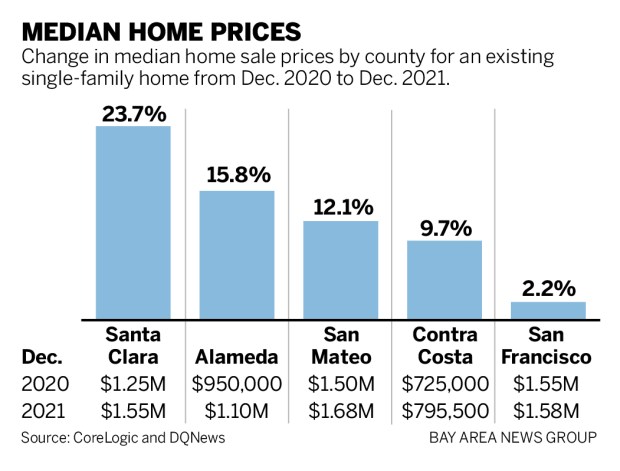
The median sale price for an existing single-family home in the Bay Area rose from $939,000 last December to $1.1 million in December 2021, according to CoreLogic and DQNews data. The rising prices were led by Santa Clara County, up nearly 24% to $1.55 million, followed by Alameda County, up almost 16% to $1.1 million, and San Mateo County, up 12% to $1.68 million. San Mateo remains the region’s priciest county.

Contra Costa County home prices jumped almost 10%, to $795,000, from the previous December, and San Francisco edged up 2% to $1.58 million. Six of the nine Bay Area counties saw increases greater than 10%, according to sale data.

Record low numbers of homes for sale are driving bidding wars and putting sellers in command of the market. Potential speed bumps — the prospect of higher interest rates, the COVID-19 omicron surge and holiday distractions — didn’t slow down buyers.

Even as the pandemic heads into a third year, “people are largely better off” financially, said CoreLogic senior economist Selma Hepp. The $1 million list price might well become the new normal in attractive destinations like the Bay Area and parts of Los Angeles, she said.

While the Bay Area is one of the most expensive markets in the country, Hepp said a strong economy and high incomes support the prices. “The Bay Area is not considered an over-valued market,” she said.

The suburbs remain more attractive than core cities, with home values in San Francisco increasing just 2% from the previous year, while Santa Clara County values grew more than 20%.

Millennial homebuyers have become a greater portion of market in recent years, as young families looking to settle into their first home found low interest rates and remote work careers that demanded more space. “Everywhere you look, they had reasons to buy,” she said.

The number of homes sold even ticked up slightly from the previous December. Condo sales have also started to rebound, up nearly 8% to a median price of $749,000, according to CoreLogic.

ba5d2 SJM L HOMES 0205 90 01 Bay Area home prices soared at record clip in 2021Bay Area agents report furious demand, with buyers searching in affordable neighborhoods that would have been less desirable pre-pandemic.

Matt Rubenstein, a Walnut Creek agent, compared the market to musical chairs, where buyers rush through open houses and elbow their way into a deal. “There’s low inventory, but there’s still enough demand,” he said.

Rubenstein has had clients visit more than 20 homes who are still unable to win a bidding war. East Bay homes now regularly sell above listing prices — something unusual in many communities pre-pandemic.

He has often helped buyers make pre-emptive offers to try to get ahead of the competition.

Some tech buyers took a step away from house-hunting, as recent stock market gyrations have cut into the personal wealth of professional couples.

Menlo Park agent Billy McNair has seen some clients pause their searches after the January drop in tech stocks. The majority of his clients, he said, use equity grants and programs to fund purchases.

“I saw some buyers who were apprehensive,” he said but added that the hesitation only lasted a few days.

Silicon Valley properties are selling at premiums, bid up by an influx of first-time buyers and families continuing to look for more space, Wang said. Even bids $500,000 over a list price have fallen short.

Tech families, suffering fewer financial consequences from the pandemic, are driving demand. “They have a dream,” Wang said, “and they want to achieve that dream.”


Article source: https://www.mercurynews.com/2022/02/09/bay-area-home-prices-soared-at-record-clip-in-2021

Posted in SF Bay Area News | Tagged | Leave a comment

Bay Area calls on homeowners to help house homeless residents

As the Bay Area continues to struggle under the weight of its homelessness crisis, officials and nonprofits are asking local residents to do more than hand out meals or donate spare change. They’re asking them to open up their homes.

Nearly 30,000 people are unhoused in the five-county Bay Area and there isn’t nearly enough room in the region’s existing affordable housing developments. To fill the gaps, service providers increasingly are recruiting private landlords to take in homeless tenants. Some property owners are renting out entire units in exchange for agreements that the government or a nonprofit will cover the rent. Others are offering up spare bedrooms in their homes – sometimes in exchange for a small stipend, and sometimes as a purely charitable act.

But it’s hard to find owners willing to take a chance on someone down on their luck. At least one program recently ended because of a lack of landlord interest.

“This is something that someone can do when they just feel that despair of ‘oh my gosh, I just can’t stand seeing these poor people on the streets near my home,’” said Christi Carpenter, executive director of East Bay nonprofit Safe Time, which places unhoused college students and families in spare bedrooms for between one and six months. Since 2017, the group has made more than 60 placements.

Richmond Mayor Tom Butt recently partnered with the Rotary Club to match unhoused people with local landlords. The small program will be funded entirely by private donations and landlords will get one year’s rent in advance. The number of people Butt can house depends on donations and volunteer interest, but he already has two more landlords lined up.

“There are a lot of people out there who want to do something meaningful to try to alleviate the homelessness problem,” Butt said.

Butt made his first placement last month – a family of six, including four children, who were living in an RV encampment off Castro Street.

For a while, the COVID-19 pandemic made it easier to recruit landlords, said Kara Carnahan, vice president of programs at housing nonprofit Abode Services, which runs matching programs throughout the Bay Area.

“When we started this program, it was much easier because landlords needed us. There were such high vacancies,” she said of an Alameda County program that started during COVID. “The things that we can offer to landlords is we’ll pay our rent. You will get guaranteed rent from us.”

As virus restrictions have loosened, landlords have more options and are more hesitant to take on homeless tenants who may have poor credit and/or a criminal record, Carnahan said.

But the need remains huge. Abode has been matching homeless clients with landlords for years, but the nonprofit dramatically ramped up its efforts in Alameda County to house the hundreds of homeless people who were given temporary pandemic shelter in hotels through Project Roomkey and needed housing as those hotels closed.

Abode more than doubled its number of Alameda County landlords during the pandemic, and has housed about 600 former Roomkey participants in private homes or apartments, Carnahan said. Landlords charge market-rate prices, tenants pay 30% of their incomes toward rent and utilities, and Abode uses state and federal funding to make up the difference.

In the other Bay Area counties Abode serves – Santa Clara, San Francisco, San Mateo, Santa Cruz and Napa – the nonprofit has brought on nearly 500 landlords during the pandemic. Most are in Santa Clara County.

Jessica Valdez, 35, was living in her car with two of her children after serving time in Santa Rita Jail for stealing a car. About a year ago, Abode found her a two-bedroom apartment in Hayward. Now, instead of sleeping in a cramped car and relying on libraries for internet service, her sons have their own room and online access.

“It’s the best thing for them,” Valdez said. “They have their own little space.”

1a69a SJM L LANDLORDS 02XX 9 Bay Area calls on homeowners to help house homeless residents
HAYWARD, CA – FEBRUARY 02: Jessica Valdez kisses her dog Blue at her apartment in Hayward, Calif., on Wednesday, Feb. 2, 2022. Abode Services helped her find housing and paid her rent for a year until she could afford to pay it on her own. (Jane Tyska/Bay Area News Group) 

Abode helped her pay her rent for the first year. Last month, Valdez – who now is working two jobs – made her first payment on her own.

In Santa Clara County, the Bill Wilson Center ran a program matching young, homeless, LGBTQ adults with people who had a spare room. But the program struggled to recruit hosts and closed in June, after housing 21 people, said Pilar Furlong, chief community resources officer.

Recruiting landlords also is a challenge for the Homecoming Project, which houses formerly incarcerated people – a group that’s often stigmatized. Using donations, the nonprofit pays hosts in Alameda and Contra Costa counties $30 a day to house someone in a spare bedroom for six months. Each former inmate is matched with a case manager to help them find a job and save money for a permanent home. Sex offenders aren’t eligible.

“When we first started talking about this project people thought we were crazy. You’re going to put somebody from prison into somebody’s house?” said Aishatu Yusuf, vice president of innovation programs at Impact Justice, which runs the project.

But the nonprofit has housed nearly 70 people so far, none of whom have gone back to jail or prison.

Zach Stein and his wife volunteered with Safe Time in 2020, opening their spare bedroom in Albany to a struggling young woman for three months. “In some ways, it was really weird,” having a stranger there, Stein said. But the experience seemed to make a big difference in the woman’s life.

Stein and his wife recently had a baby, and hope to continue hosting once they get settled as parents. They were able to buy their house because they inherited money, and they want to share that good luck with those less fortunate.

“Being in a position to do that, especially in a place like the Bay Area,” Stein said, “it felt really important to us to find ways to open that up.”

ca758 SJM L LANDLORDS 02XX 3 Bay Area calls on homeowners to help house homeless residents
HAYWARD, CA – FEBRUARY 02: Jessica Valdez is reflected as she straightens a mirror at her apartment in Hayward, Calif., on Wednesday, Feb. 2, 2022. Abode Services helped her find housing and paid her rent for a year until she could afford to pay it on her own. (Jane Tyska/Bay Area News Group) 

How to help

These groups are looking for property owners who have a rental unit or extra bedroom and are interested in housing someone who is homeless or at risk of becoming homeless.

Abode is seeking landlords with apartments throughout the Bay Area. Landlords will be paid rent by the tenant and by Abode. Call 1-800-811-0393, email landlords@abodeservices.org or visit abodeservices.org/landlords.

The Homecoming Project is looking for people in Alameda and Contra Costa counties with a spare bedroom. Participants would host a formerly incarcerated person for six months and receive a $30 a day stipend. Visit impactjustice.org/impact/homecoming-project.

Richmond Mayor Tom Butt is looking for landlords in West Contra Costa County with a studio, one-bedroom or two-bedroom apartment. One year’s rent would be paid in advance. Email tom.butt@intres.com.

Safe Time needs hosts with spare bedrooms to take in college students for between one and six months in Alameda and Contra Costa counties. Hosts are not paid. Visit safetimehost.org.


Article source: https://www.mercurynews.com/2022/02/07/how-bay-area-homeowners-can-help-house-homeless-residents

Posted in SF Bay Area News | Tagged | Leave a comment

Amazon is using San Francisco’s zoning policy to plot a huge expansion in the city. Some locals aren’t happy

At 888 Tennessee St., at the foot of a slow street and across from Esprit Park, Amazon has established an UltraFastFresh logistics center. A half-mile southeast at 435 23rd St., just to the south of the Potrero Power Station, a large sign outside a 75,000-square-foot warehouse says “welcome Amazonians.” And farther to the south, at 749 Toland St., Amazon has a 112,000-square-foot delivery hub.

But Amazon’s biggest and most controversial incursion into San Francisco is a proposed 725,000-square-foot delivery hub at 900 Seventh St., a 6-acre rectangular parcel in Showplace Square that Amazon bought for $200 million. For decades that site was home to garbage trucks, a fleet of 300 that each morning would rumble out onto the streets of Showplace Square at an hour the streets were still dark and most city residents still in bed.

Now the trash trucks are gone — the garbage company Recology relocated them to Brisbane — but a proposal from the new property owner is causing consternation from neighbors who say that a heavy industrial use no longer fits in a creative neighborhood that has evolved into a mix of housing, design and artist spaces, light “advanced” manufacturing and an expanding California College of the Arts campus.

 Amazon is using San Franciscos zoning policy to plot a huge expansion in the city. Some locals arent happy

Amazon plans to expand into San Francisco by turning this location at 900 7th St., and others, into facilities for the company.

Samantha Laurey/The Chronicle

David Meckel, senior adviser to the president at CCA, said three daily shifts of 400 workers would generate 2,800 car trips, in addition to the 70 Amazon trucks that will be coming and going from the facility. The traffic could create a pedestrian nightmare for CCA’s 1,600 students as well as for residents at 888 Seventh St, a 224-unit that overlooks the future Amazon site.

“To me it’s not about Amazon, it’s about the intensity of the use,” said Meckel. “I’d have the same concerns if it were FedEx or UPS. For me it’s about urban design.”

On Tuesday, the controversy prompted San Francisco Supervisor Shamann Walton, who represents the neighborhood where the logistics center will be located, to introduce legislation that would seek to place an 18-month moratorium on all new parcel delivery services in the city, including Amazon’s proposed Seventh Street development. The legislation will go before the Land Use and Transportation Committee in the coming months, followed by a vote at the full Board of Supervisors.

The move, backed by the Teamsters and the United Food and Commercial Workers union , is the latest battle in the war between organized labor and Amazon, which has planned or already opened more than two dozen distribution centers throughout the Bay Area, according to Jim Araby, strategic campaign director with United Food and Commercial Workers.

“The city needs the tools necessary to evaluate the impact of this project,” said Araby.

Will Roscoe, who lives at 888 Seventh St., said the pollution and traffic would worsen air quality in a neighborhood in which freeways and Caltrain already generate high levels of particulate matter. About a dozen years ago, Roscoe, who works for a nonprofit, was evicted from a building in the Western Addition. He said he feels like the Amazon project will once again force him to move.

“Hundreds of people now have come in to make this their neighborhood and this just really turns the clock back to a massive usage that is antithetical to a livable neighborhood for people with children, seniors,” he said. “It’s contrary to that.”

But while a busy distribution center may feel out of sync with Showplace Square’s current vibe, it is in fact just what city zoning calls for. And Recology decided to sell the site only after neighbors had rejected its 2018 plan to build about 1,000 units of housing there.

At a pre-application meeting at the site on June 27, 2019, a packed room of Dogpatch and Potrero Hill residents lambasted the idea of building housing on the site. One called it “a land grab and giveaway to developers.” Another resident said San Francisco suffered from a “PDR crisis” — PDR stands for production, distribution and repair — and that the property should remain zoned for industrial uses. One attendee called it “a bad project,” while another argued that “housing is not needed in the neighborhood.”

If the vocal opposition was intended to give Recology cold feet, it worked. Recology first cut the number of proposed units in half. Then, facing an uphill approval process that was likely to drag on three or four years, not including delays from environmental lawsuits common in San Francisco, the rubbish company gave up and sold the 6-acre site to Amazon in 2020.

“We received an offer and determined it was in Recology’s interest to accept it,” Eric Potashner, then the vice president and senior director of strategic affairs at Recology, said at the time.

While the housing plan would have required a series of zoning changes and conditional use authorizations, Amazon’s proposed 57-foot-high warehouse is consistent with the Eastern Neighborhoods land use plan adopted in December of 2008 after a decade of debate. The site is part of a block of parcels roughly bounded by Seventh Street, Division Street, Potrero Avenue and 16th Street that were zoned for industrial uses.

Ken Rich, who was project manager at the Planning Department for the Eastern Neighborhoods rezoning, said the city tried to strike a balance between protecting industrial jobs and creating room for new housing. The plan has generated thousands of new housing units in Dogpatch and Potrero Hill. It also has prompted property owners at sites such as 1 DeHaro, 100 Hooper and 150 Hooper to build PDR spaces for advanced manufacturing.

The Eastern Neighborhoods plan’s goal of protecting light industrial jobs on a swath of land that would have otherwise been gobbled up by tech offices and housing developers has done what it was intended to do, according to Anne Taupier, director of development at the Mayor’s Office of Economic and Workforce Development.

“A clear set of rules to play by were established and it really hasn’t changed since then,” said Taupier. “We think it has worked and is continuing to work.”

The opposition to Amazon’s Seventh Street plan is motivated not just by land-use issues but by the company’s track record of crushing unionization efforts and its reputation for grueling work conditions, according to J.R. Eppler, a board member with the Potrero Boosters neighborhood association.

Eppler said that neighbors around 888 Tennessee St. have had success over the past year working with Amazon on issues like traffic, parking and security.

Friends of Jackson Park is in talks with Amazon about the company possibly contributing funding to badly needed improvements. But the labor issues are harder to negotiate, he said.

In a recent San Francisco Standard article, two supervisors, Aaron Peskin and Walton, suggested that the city had been overly receptive to Amazon’s project and less than up-front with residents and other stakeholders.

Taupier said Amazon is at the very beginning of its approval process and there would be ample time for residents and elected officials to shape the project.

“We are going to have conversations with Amazon about supporting our local small businesses, including our brick-and-mortar retail businesses,” said Taupier. “We will make sure they understand that San Francisco has expectations that if you are going to do business here, you are going to be part of the community.”

In the meantime the empty rectangular lot feels like an island in a neighborhood that has moved on. To the north is the condo building at 888 Seventh St., which houses many senior Chinese immigrants. To the south on Hooper Street are headquarters for Adobe and a new SFMade building that houses a roster of manufacturing businesses including robotics groups, a distillery and fabricators of items including drapes, bags and hydrogen tanks for the automobile and industrial markets.

Scott Mason, a San Francisco commercial real estate broker who specializes in industrial properties, said Amazon is among a select group of well-funded users who qualify for PDR sites but have far deeper pockets than the typical family-run auto body or plumbing supply company. He said mom and pop PDR companies needed to make a city like San Francisco function cannot compete in a market dominated by Amazon.

“Your everyday smaller company in San Francisco is having a tough time,” he said. “The venture-backed tech-driven company can pay more per square foot because they are not working off a regular balance sheet.”

Stephen Maduli-Williams, Amazon’s manager of economic development policy, said construction at the old Recology site would not start for 18 to 24 months. He said there would be retail at the site and Amazon would work with local residents and businesses to determine what sort of goods might be sold. He said the company is looking into how Amazon could support Jackson Park.

“We intend to use this time to listen to and engage all of our neighbors and stakeholders, with the goal of reaching a shared vision not only for the project, but to also create long-lasting partnerships” he said.

For Dogpatch and Potrero residents, there is an increasing sense that Amazon “has the neighborhoods surrounded,” said Eppler. Roscoe said he is concerned that some neighborhood groups will successfully squeeze Amazon to fund various needs, leaving residents to live with the trucks with the blue smiles coming and going.

“Nobody speaks for our building,” said Roscoe. “We don’t want it. Nobody I’ve talked to is like, ‘Oh yes, good idea.’ The others in the coalition are going for community benefits — but what community benefits could they give us? Free gas masks? Lifetime cancer screenings? The benefit we need is to not be subjected to traffic and pollution.”

Doug Bloch, political director at Teamsters Joint Council 7, said Supervisor Walton’s push to delay planning on the project represents an escalation in the “trench warfare” the unions have been engaged in against Amazon over the past few years as the company has sought to build warehouses in and close to urban areas like Contra Costa County, Morgan Hill, Santa Rosa, Hayward, Gilroy and San Jose.

“The battle has come to San Francisco — this is the big one,” he said. “This is San Francisco saying we need to pause and evaluate this project and what it means for our communities and our workers.”

J.K. Dineen is a San Francisco Chronicle staff writer. Email: jdineen@sfchronicle.com Twitter: @sfjkdineen

Article source: https://www.sfchronicle.com/sf/article/Amazon-is-exploiting-San-Francisco-s-zoning-16918848.php

Posted in SF Bay Area News | Tagged | Leave a comment