Warned of a Crash, Start-Ups in Silicon Valley Narrow Their Focus

To save articles or get newsletters, alerts or recommendations – all free.

Don’t have an account yet?

Subscribed through iTunes and need an NYTimes.com account?
Learn more »

Need to connect your Home Delivery subscription to NYTimes.com?
Link your subscription »

Article source: http://www.nytimes.com/2016/08/29/technology/warned-of-a-crash-start-ups-narrowed-their-focus.html

Posted in SF Bay Area News | Tagged | Leave a comment

Bay Area’s Hot Housing Market Relocates To Oakland

Their search wasn’t in Silicon Valley or San Francisco. It was just across the bay in Oakland, which has supplanted its pricier and better-known neighbors to become the region’s most heated real estate market.

“Something we had to wrap our head around really quickly was the fact that we were automatically going to bid at least 30% over asking,” said Smith, a 50-year-old strategy consultant who moved from San Francisco in search of more space for her family’s three kids. “It’s the new normal.”

d89e8 IREokld082616 Bay Areas Hot Housing Market Relocates To OaklandOakland’s housing market is still soaring, even as growth cools in San Francisco, where million-dollar median home prices have left buyers searching for more-affordable alternatives. The East Bay city had California’s highest annual appreciation of home values and the biggest rent growth of the 50 largest U.S. cities as of June, according to data compiled by Zillow.

Despite persistently high crime rates and political turmoil, Oakland is attracting residents for its relative affordability, vibrant cultural scene, diverse population and urban environment within commuting distance to San Francisco. Companies such as Uber Technologies are moving in — helping to fuel a 43% jump in office rents in two years — while big investors including Blackstone Group (BX) and Boston Properties (BXP) are putting money into residential projects in the city.

“Oakland is the hottest residential real estate market in the Bay Area,” said Kenneth Rosen, chairman of the Fisher Center for Real Estate and Urban Economics at the University of California, Berkeley. “It’s still expensive, but it’s more affordable” than San Francisco.

Biggest Gains

Oakland home values soared 16% in June from a year earlier to a median $616,300, the biggest gain of California’s major cities, according to Zillow. The median monthly rent jumped 15%, the most in the U.S., to $2,846 in the same period. That was almost triple the 5.5% growth in San Francisco, and more than five times the nationwide increase.

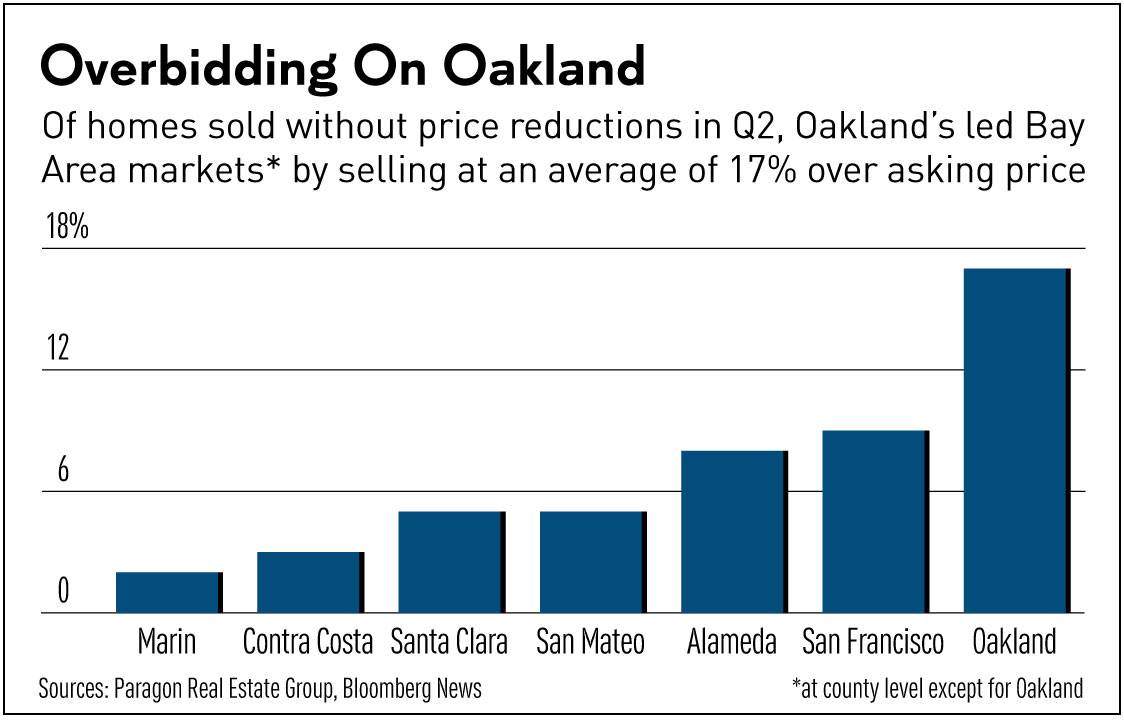
Houses are selling fast — and far above list prices. The average home in Oakland sold for 17% more than asking in the second quarter, according to data from Paragon Real Estate Group measuring properties that didn’t go through a price reduction first. That compared with 9% for San Francisco and 5% in Silicon Valley’s Santa Clara and San Mateo counties. Oakland homes were on the market an average of 20 days, fewer than the 34 days in San Francisco.

“Most markets would be pleased if they averaged asking price, or 1% or 2% over asking price,” said Patrick Carlisle, chief market analyst at Paragon. “To see things averaging 9% to 17% over asking price is virtually unheard of. It’s the highest I’ve ever seen.”

The median home price in Oakland has soared 178% since 2011, almost double the gain in San Francisco, Paragon data show.

Police Scandal

Oakland is still struggling with a reputation for social and political unrest. Its police department is operating without a chief after three departed, one after another, in the span of about a week in June amid a sex scandal involving officers and a teenage prostitute. It’s also an epicenter of social protests, including those connected to the Black Lives Matter and Occupy Wall Street movements.

The troubles aren’t deterring newcomers, city officials say.

“It’s not slowing growth in the way that it used to five or 10 years ago,” said Marisa Raya, an economic analyst in Oakland’s office of economic and workforce development. “But we are certainly seeing a lot of political activism around the superfast rent growth.”

Oakland voters will consider ballot measures in November to strengthen rent control and issue bonds for affordable housing.

Blackstone Rarity

Blackstone has teamed with CityView, a property company started by former U.S. Housing and Urban Development Secretary Henry Cisneros, to build a 423-unit apartment complex in Oakland. The $175 million project at 3093 Broadway, due to be finished in 2018, is the first development in the city for the world’s largest alternative-asset manager.

Jon Gray, Blackstone’s billionaire head of real estate, said he thinks Oakland may become the next Brooklyn — a comparison that has frequently been evoked in recent years as the city comes into its own as a hot spot after previously being overshadowed by its glitzier neighbor.

“We very rarely do ground-up development, so this project reflects our strong confidence in the transformation under way in Oakland,” Gray said in an e-mail.

Boston Properties, the largest publicly traded U.S. office owner, signed a letter of intent to invest in a 25-story residential development in Oakland’s Temescal neighborhood, Chief Executive Officer Owen Thomas said on a July 27 earnings conference call.

“Given the high cost of multifamily product in the San Francisco market, we believe we can deliver high-quality units that are approximately at a 20% discount to San Francisco rents in a location that is a 16-minute transit ride from the Embarcadero BART Station in downtown San Francisco,” he said on the call. Arista Joyner, a spokeswoman for the company, declined to comment further.

Job Growth

Oakland’s job growth also is showing signs of outpacing its neighbor, with listings up 16% since April, compared with a 1% decline in San Francisco, according to LinkUp, a job-search engine based in Minneapolis. Among the companies setting up shop is San Francisco-based Uber, which last year bought the old Sears (SHLD) building in Oakland’s urban core and is renovating it, with plans to open in late 2017.

The city is home to consumer-products maker Clorox (CLX); Kaiser Permanente, a nonprofit health insurer and hospital chain; and internet-radio service Pandora Media (P).

The rate for top-quality office space in the city has grown 43% in the second quarter compared with two years earlier, while San Francisco’s rent is up 20% in that time, according to data from real estate brokerage CBRE Group (CBG).

The influx of companies is helping to prop up housing prices. Even as the technology industry slows, there are still “many, many buyers” in Oakland, said Carla Buffington, a real estate broker at Pacific Union in the city.

“We’re seeing a majority of properties selling with multiple offers,” Buffington said. “Almost weekly, I am shocked by the price that a certain property will get.”

RELATED:

America’s Hottest Housing Markets Are Mainly Out West

Skyrocketing Rents Are Sputtering — But Mostly In High End Markets

San Francisco’s Commercial-Property Frenzy Showing Signs Of Slowing

Article source: http://www.investors.com/news/real-estate/bay-areas-hot-housing-market-relocates-to-oakland/

Posted in SF Bay Area News | Tagged | Leave a comment

20 Hottest US Real Estate Markets in August

The month of August is typically a good one for home sellers and buyers, and this August has been no exception. In fact, sales are better than they’ve been in 10 years, properties are moving more quickly, and, the best news for sellers, prices have reached record highs.

According to preliminary estimates from Realtor.com’s chief economist, Jonathan Smoke, the median price for a home in August actually fell by $1,000 from July’s median to $250,000, but that’s up 8% year over year and a record high for the month. A little good news for buyers and very good news for sellers.

On top of that, homes for sale remained on the market a median of 68 days, one day less than a year ago, but three days slower than June. That month-over-month drop is normal because inventory reaches a peak in July and the increased supply of houses leads to fewer sales. New listings totaled an estimated 500,000 in July, not enough to keep up with demand and lower than the inventory level in July 2015.

Jonathan Smoke noted:

Realtor.com’s traffic growth has been particularly strong in August, even surpassing record highs set in July, making this an extended summer with unprecedented interest in buying.

With the school year starting now in most of the country, we’re seeing some drop-off in immediate buying interest. The current conditions provide more opportunity for any frustrated buyers still in the market to face less competition as we close out the summer.

Realtor.com has identified August’s 20 hottest U.S. home markets, those medium-to-large cities where homes sell fastest because buyers are eager to buy. Of the top 20, 11 are in California and three are located in the San Francisco Bay area, not including Santa Cruz or Sacramento. Here’s the full list:

  1. Vallejo, California
  2. Dallas, Texas
  3. Denver, Colorado
  4. San Francisco, California
  5. Stockton, California
  6. San Diego, California
  7. Columbus, Ohio
  8. Waco, Texas
  9. Detroit, Michigan
  10. Sacramento, California
  11. Fort Wayne, Indiana
  12. Yuba City, California
  13. Modesto, California
  14. San Jose, California
  15. Fresno, California
  16. Colorado Springs, Colorado
  17. Santa Cruz, California
  18. Kennewick, Washington
  19. Santa Rosa, California
  20. Nashville, Tennessee


c8bb6 247logo clear 20 Hottest US Real Estate Markets in AugustTop Stories Delivered Daily

Article source: http://247wallst.com/housing/2016/08/27/20-hottest-us-real-estate-markets-in-august/

Posted in SF Bay Area News | Tagged | Leave a comment

A Home Seller’s Guide to Pocket Listings

How do you want to market your home when it comes time to sell? It’s probably not a question you’re ready to answer, even if you’re planning to sell soon.

A
good real estate agent
will have a marketing plan for your property. But as the seller, you’re going to be the one most affected by how it’s marketed, and not every tactic works for every home.

While most sellers choose the traditional route of marketing their home on the local multiple listing service, pocket listings – or private listings – are becoming a bigger part of the conversation. Here’s what you need to know about the option of a pocket listing, and how to determine if it will better serve the sale of your home.


[See:
10 Tips to Sell Your Home Fast
.]

What Is a Pocket Listing?

A pocket listing is a property for sale that is not marketed on the MLS, which is a system local
real estate agents
use to market their listings, contact other agents and begin negotiations toward a transaction.

The property may be advertised elsewhere – including on the listing agent’s website or other real estate listing sites – but because it is not on the MLS, the listing is considered private.

Since they are not marketed to other agents through the MLS, pocket listings are often advertised to a network of potential buyers or agents that the listing agent or firm knows may be interested.

Pocket listings can serve as a great private option for selling your home, as it limits the pool of buyers to those potentially willing to
pay a premium
for the ability to bid on the home before it reaches a broader market.

If a buyer without an agent places a bid, the listing agent can potentially close the deal as dual agency, where the agent technically represents both parties in the deal. While this means a little more money for the agent and a little less money paid by the seller, it also leaves room for an unethical agent to take advantage of either party by not ensuring the best deal possible for them.

But when not being used for nefarious purposes, pocket listings can be a great way for agents and sellers to achieve a fair deal with less interruption in the seller’s life, which is a point worth making, says Alex Ianos, CEO of Pocket Deed, a real estate listing site for properties not listed in the MLS.

“As a broker, personally, I feel that should be our responsibility to at least present that option [of listing privately],” Ianos says.


[See:
10 Unorthodox Ways Your Real Estate Agent May Market Your Home
.]

Why Would You Want to Sell Your Home With a Pocket Listing?

Certain circumstances make listing a property privately an attractive option, to both avoid the gaze of the public eye and to protect the property from the stigma a home can develop if it remains on the MLS even slightly longer than market average. Here are four reasons a pocket listing may be a good idea for you.


You want to maintain privacy.


Marketing your home for sale and allowing strangers to tour your residence can be a difficult hurdle for some homeowners.

“It might be security purposes, it might be business purposes,” says Walt Danley, president of Walt Danley Realty, Christie’s International Real Estate in Paradise Valley, Arizona.

You may be a public figure who doesn’t want your (literal) dirty laundry in the open, or you may have a tenant on your property you haven’t told about the sale. With a private listing, you reduce the chance of inquiring strangers driving by and causing problems.


You live elsewhere for part of the year.


It can be difficult to keep your home
show-ready
when it’s shuttered for part of the year.

Danley says many properties he lists privately are owned by people who aren’t in town during the hot summer months, which makes it a good time to list the home privately while the owners – and often the most likely buyers – are away.


You want to test out the market.


If you’re not sure what buyers would be
willing to pay
for your home, a brief stint as a pocket listing could help to test out a higher price.

“Maybe reserve a week to say, ‘Let’s try it as a pocket listing, see if we can find a buyer directly.’ … If that doesn’t work out, then we can take it public,” Ianos says. Then if your agent does put the listing on the MLS, your home can begin at a lower price without having to endure a public price drop, which can wreak havoc on future offers.


You’re still preparing your home for the market.


If your home
needs some updates
and maintenance before it hits the market, it can take several months before you can hold an
open house.

Your agent could list the property privately while you complete the updates “in the hopes that someone would come along and pay the seller’s price. And the seller wouldn’t have to go through the time and energy and money of making it perfect for the market launch,” says Thomas Henthorne, a real estate agent at Decker Bullock Sotheby’s International Realty in the San Francisco Bay Area.


[See:
8 Types of Roads That Can Have a Big Impact on Home Sales
.]

When Is Standard Marketing a Better Option?

Most homes will benefit from reaching the widest range of buyers possible – about 90 percent of the time, according to Danley. “We want to do what’s in the best interest of the clients. And most times – the overwhelming majority of times – that is to expose the property to the broadest audience and the largest pool of buyers possible, and that is through the MLS,” he says.

There are also good reasons

not

to market your home as a pocket listing. If any of the following are true, stick to a standard marketing strategy.


It’s a hot seller’s market.


If homes are selling fast and for more than their asking price, you might as well take advantage of what could easily become a bidding war for your home.


You’ll always ask “what if?”


Be honest with yourself – if you’re the type of person who will wonder what you could have gotten had your home been marketed publicly, there’s no point in listing your property privately. “You have to have a price in mind that you’re happy with getting with a limited-exposure strategy,” Henthorne says.


Your agent is pushing a pocket listing when you’re unsure.


You should only have your home marketed as a pocket listing if it’s best for you. If your agent
tries to push the option
on you, he or she likely don’t have your best interests in mind.

Article source: http://realestate.usnews.com/real-estate/articles/a-home-sellers-guide-to-pocket-listings/

Posted in SF Bay Area News | Tagged | Leave a comment

Can the SF Bay Area Solve Its Affordable Housing Crisis?

August 24, 2016

c3dba sf bay area affordable housing crisis feature Can the SF Bay Area Solve Its Affordable Housing Crisis?

f055b icon facebook Can the SF Bay Area Solve Its Affordable Housing Crisis?

f055b icon twitter Can the SF Bay Area Solve Its Affordable Housing Crisis?

f055b icon linkedin Can the SF Bay Area Solve Its Affordable Housing Crisis?

Sky-high rents and a competitive real estate market have created a housing crisis of epic proportions in California and especially in the San Francisco Bay Area. The National Low Income Housing Coalition’s annual report, Out of Reach, ranks California as the third most expensive rental market in the country. The five most expensive rental counties are in the San Francisco Bay Area: Marin, San Francisco, Alameda, Contra Costa, and San Mateo.

Personal finance experts say it’s ideal to pay no more than 30 percent of income on housing. But regardless of income level, 48 percent of homeowners and 57 percent of renters are cost-burdened in California. Service workers, teachers, and even those with moderate-income positions often see more than half of their paychecks going to housing expenses.

“Lower-income households are paying 50–60 percent of their income on housing in California,” said Lena Robinson, regional manager of Community Development at the SF Fed, speaking at Innovative Approaches to Solving the Housing Crisis, a recent forum at the Federal Reserve Bank of San Francisco.

When you consider what that means in terms of financial stability and money for other necessities, the housing affordability problem becomes a larger economic issue.

“Average income in the top 20 percent of Bay Area households is $263,000 greater than the bottom 20 percent,” explained Supervisor Jane Kim, who represents District 6 on San Francisco’s Board of Supervisors.

The Tenderloin, Civic Center, South Beach, and South of Market (SOMA) are all within District 6, which is absorbing 80 percent of San Francisco’s development. Most of that development is new construction of large high-rise buildings consisting primarily of unsubsidized market-rate units for rent or purchase.

“San Francisco is building at 158 percent of market-rate housing need compared to 20 percent of need for low-income. We need to build more low and middle-income housing to solve the housing crisis,” said Kim.

High Demand, Short Supply

Affordability is only part of the Bay Area’s housing problem. Inadequate supply is the real underlying issue.

Housing production remains far below the estimated housing units needed to meet demand, especially in strong employment markets according to a report from the Legislative Analyst’s Office. Supervisor Kim says San Francisco’s data reflects those findings.

“In 2015, the Bay Area added 64,000 new jobs, most of them in Silicon Valley. But less than 5,000 new homes were constructed,” she said.

Solutions Start with City Leadership

In San Francisco, the average developer, when building a new unit, builds for a household of four that makes $270,000 per year. But without subsidy, there is no financial motivation to build below-market units that are affordable to households earning below the area median income. To address this problem, the city of San Francisco passed a $350 million affordable housing bond to achieve a dedicated source of subsidy for affordable housing construction and preservation.

Kim advocates for city leaders to be more involved in creating affordable housing as well. For example, by negotiating for a higher percentage of units to be built as affordable and mid-income above typical inclusionary zoning requirements. But many areas are challenged in knowing how well those requirements are being met. That’s one reason the San Francisco Board of Supervisors passed Ordinance No. 53-15 in April 2015. It calls for the city’s planning department to monitor the number of units being built at market rate and as affordable housing to gather better data.

Being more thoughtful and intentional about how city-owned land is utilized is another strategy that Kim discussed.

“If the city has site control, that’s a tremendous benefit. It gives us flexibility in building affordable housing by taking out the cost of the land,” she said. “Now we look at the entire portfolio of city land and land that’s underutilized. If there’s 100 percent usage, such as the MUNI bus yard, we could look at building housing on top of that existing usage.”

Local Economies at Risk

Matt Regan, senior vice president of policy at the Bay Area Council, explained that it’s in the best interest of local economies to create more affordable and middle-income housing now if they want to keep businesses in the Bay Area.

“Companies cannot grow here and cannot expand here. Jamba Juice is moving out of Emeryville to Texas. Western Digital is going to Oregon. We’re losing middle-income jobs because of the housing crisis. Companies can’t afford to pay middle-income employees enough to afford to live here,” he cautioned.

Beyond economic development opportunities, the SF Fed’s Community Development department finds that housing affordability and availability impact a host of issues, including the environment and the physical and mental well-being of the population.

Speaking after the forum, Robinson said, “The toll of long commutes, reduced disposable income, and a compromised quality of life are externalities of the housing crisis that we can no longer ignore.”

You may also want to read:

  • Pathways to Economic Opportunity
  • Link Social Mission with Private Enterprise to Develop Better Affordable Homes
  • The Color of Wealth in Los Angeles
  • Stemming the Tide of Displacement: The Highlight Reel

Article source: http://www.frbsf.org/our-district/about/sf-fed-blog/can-san-francisco-bay-area-solve-affordable-housing-crisis/

Posted in SF Bay Area News | Tagged | Leave a comment